Monday, May 30, 2011

Lessons learned from cboxers

Just by looking through the cbox history, one can learn a lot of lessons from the actions (or sometimes the non-action) of people. I'll just list them out objectively,  not to ridicule but rather to reinforce the lessons in me again. I must have done it many times in the past, but hopefully not ever again.


1. Buyer's remorse (or seller's remorse)


This is when the queue that you had put in place had been hit, but instead of having feelings of joy and jubilation, you are feeling unhappy because you now really own the shares at the price. This is actually quite similar to seller's remorse, where you sold at a certain price but again instead of feeling happy, you actually regret selling at the price. These are just basic emotions of greed and fear at work. For buyer's remorse, it's the fear that after you key in a (hopefully) cheap price, the price will tank further. For seller's remorse, it's the greed that makes you want to earn more after seeing the stock rise up higher than the price you just sold.


Do I have this kind of remorse? Of course I do. It's hard to eradicate it, so it's better to think of ways to manage it. First of all, you really have to want the shares you want at that price. Only after the intent is clear will I queue for it. I don't queue for 'fun' because if the queue is really hit, it's not very funny. As for seller's remorse, I think setting a specific target price and sticking to it (and really, be content with it) is the key. Of course, selling slowly in batches is also a good way to alleviate that emotion if you have more lots - sometime like averaging up your selling price.


These days, after I sell it, I no longer look at it until perhaps a few weeks later. This is more as a post action review on how I can perfect my exit technique rather than to see if I had lost out on any potential future gains.


2. NATO (no action talk only)


I think to make money in the market, it's better to do more action rather than talking about it. Talking (to the right people) will help you understand certain aspects of your intention but beyond that, when it comes to pulling the trigger, you're all on your own. If you do not exercise your own judgement, it's really hard to pull the trigger. When the market is up, you'll be hesitant to buy because you think you can get a cheaper price. When the market is down, you'll be hesitant to buy because you're afraid it'll go down lower. So pray tell, when is the best time to buy? Perhaps talking about it will dissuade you from really doing something about it.


It might be easier if you have conviction behind your buying/selling thesis. There's a reason why people do fundamental analysis and technical analysis - the reason is to discover the value of the underlying stock. 'Discover' is used with deliberation, because I really think that's the way it is. You go around exploring, finding out a range in which the current valuation of the stock is, and you go and make your decision based on that conviction. For those without proper understanding of FA or TA, or those without strong conviction, I think the chances of NATO-ing is pretty high.


3. Too emotional over noise


I hate being manipulated like a ragdoll toy by market physics. It's something that I felt intensely when I was gambling with HSI warrants in the earlier part of my stock market journey and later on during the index futures phase. As I reflected on these emotional roller coasters, I realised that the only thing that make me emotional over such price fluctuations actually stems from money management, rather the lack of it.


If I've 50k and I put 40k into a counter, making it 80% of my entire portfolio, how can I not be emotional? If I earn 60k in a year and I put 40k into a single counter, how can I not be emotional? On the other hand, if I've 100k and I put 10k into a counter, making it 10% of my entire portfolio, would I be bothered if the price tanked? If I earn 150k in a year and I put 10k into a single counter, would I similarly be bothered by market fluctuations?


Feel free to change the percentages to suit your individual requirements - it's the idea that matters.


4. No exit strategy


Most books that I read about stock market focuses solely on how to buy correctly. Seldom do I find one that talks about exiting. I believe that even if you want to keep a stock for long periods of time, there is still a need to get in and out at opportune times to get the best out of the investment. It's best to look at different scenarios before you buy in so that you have a impartial view of the situation. Just by asking yourself questions starting with 'what if', you can clarify your thought process. It's important to have a clear strategy, be it based on specific target price or a particular value thesis, because it allows you to act when the time comes and not freeze like a animal looking straight at the headlights of an incoming car. Think about the cut loss levels (if you have one) and the % returns that you are after before buying it. If you think it can reach the % returns that you are after, then go for it. No point hoping and waiting for a miracle in a stock that just cannot move so much in the timeframe of investing.


5. Improper money management


I think this can be a post by itself because there are just so many points to talk about. I'll just talk about a few pertinent points.


a. Limit your counter to a certain percentage of your portfolio, even if you think the counter is 'guaranteed' to make money. In the face of unknown probabilities, invest in preparedness.


b. Limit the amount that you can buy in a single transaction according to portfolio size. This means that if you have only 100k of investible cash, you don't whack 50k in one single transaction. This ties in with part (a).


c. Bro8888's advice always ring true - buy and sell slowly


d. If you have a losing streak, stop yourself from buying anymore. Give yourself a time to reflect and gather your thoughts and think about why you are losing money. When starting up again, reduce the amount invested again, only increasing it after you've proven your worth by making a winning trade.

Thursday, May 26, 2011

More artwork ...

Here's a few more sketches coming from my Wacom tablet. I am really beginning to get a feel of how to work around this gadget. Unlike sketching on paper, where you can see exactly where you draw, this tablet works more like a mouse. You move the stylus one the tablet but your eyes are fixed on the cursor on the screen. It takes some practice to get the hand eye coordination perfect, but once it's settled, it's like sketching on paper.


The above sketch is me trying to recreate the innocence of childhood sketches. I used to doodle a lot on crayons and coloured pencils when I was a kid.


This one is a helm from a Greek Corinthian era. I was just trying to test out the effects of recreating the hair like plum on the helm.


This is Brie-boy. It was from the book from my favourite director, Tim Burton, called the melancholy life of oyster boy. The accompanying poem goes like this


Brie Boy had a dream he only had twice,
that his full, round head was only a slice.


The other children never let Brie Boy play....
but at least he went well with a nice Chardonnay

Tuesday, May 24, 2011

Life in Singapore

Have you heard about the financial bombs in life? These are the obstacles, the road bumps, along your road to accumulate wealth. It seems unavoidable especially if you want to follow the typical model family in Singapore. Of course you can also choose to lead the estranged and socially divorced life of Diogenes, but his is an extreme life. Let's talk more about these financial bombs.


Firstly there is the extravagant wedding. For Chinese couple, it would entail the customary wedding banquet in some posh hotels that would set you back by a few tens of thousands. For me, I kept it to a respectably 30k by keeping the banquet tables smaller and removing a lot of unnecessary (in my opinion, of course) frills that are just icing on the cake that we can do without. We got back in terms of the ang bao money given by generous guest and relatives, so it was really kept at a pretty low cost. It was a good thing too because on hindsight, the extra cash that we can save is really dumped into the next financial bomb....


...Housing. The second financial bomb that comes along will be one of the biggest purchase anyone in Singapore would have the misfortune or fortune (depending on how you see it) of experiencing. I got a resale HDB in a matured estate and a 5 room one too. Things are all well and kept within plans but the funny thing is that when the plans collides with reality, all your well laid plans might just fly away in the face of reality. I know the ideal home for me when I see it, the perfect location, the ideal setting to set up my family and a good location to set up my work at home plans...the only problem was that the property is a 5 roomer but the 'planned' property is a 4 roomer. Some had said that it was lunacy buying at such a high price with such a high COV to boot, but I think it was a period of rare sanity amidst my usual well organised but ultimately sterilized 'insanity' that is so characteristic of my life. Whatever you call it, it is a done deal now so I'll have to make the best out of it. After settling the downpayment and the necessary fees, the next financial bomb comes ticking in.


Renovation. I was searching around for renovation ideas and went to the recently held fare at Expo to take a look at the packages and quotations offered by the various interior designer firms. I think from the mind draining and sleep inducing talk by the various companies, it would seem that the renovation costs alone for my property might go up to around 50k. There are some serious questions to ask myself and my wife: Will we really enjoy the marbled living room floor instead of the cheaper homogeneous tiles? Are we paying good value for the parquet instead of focusing on, again, cheaper alternatives? Is a feature wall necessary in the living room? What is the focus on the living room - is it a place where different minds meet together in jovial conversation or where different eyes meet in the lively pixels of the latest LED tv?  Many more questions bombarded us as we go from company to company, seeking that elusive interior designer to help us discover what we really wanted in our hearts when we have not a clue to what we wanted. I think with furniture thrown in, it might really escalate the entire cost to the range of 60k plus. Oh well... so be it then.


If you've still survived all these three financial bombs, there'll be a fourth one - kids. Since I've not been hit by it, I'll not talk about it now. But seriously, it makes me think what I really wanted in life. It seems like either we have a pretty high standard of living or simply that we are not earning enough money. Money seems to drain out from our coffers like a fully running tap ever since we got married last year. Mind you, the proverbial tap is not dripping water, it's gushing water and for years to come too! I guess I'm just at the wrong place at the wrong time, but such talk do not make me feel better nor does it improve my situation, hence it's ultimately demoralizing and pointless. Let's just bear with it and shoulder on.

Friday, May 20, 2011

Black Swan Theory revisited

I hear a lot of talk about Black Swans in my cbox these days. It's getting to be pretty cliche because of the constant usage. Just what is a Black Swan? Black Swan theory (capitalized to avoid the reference to actual swans that are black) is a phenomenon, popularized by one of my favourite author, Nassim Nicolas Taleb. Black Swan theory is characterized by 4 things - it's an event that is highly improbable and incalculable probability, highly consequential and finally the event can be rationalized by hindsight after the event.


There's a lot of interesting things about Black Swan theory that I've already talked about when I read the books a few years ago. I thought it's a great idea for readers to read it for themselves. Nassim Nicholas Taleb wrote two books on his pet topic, "Fooled by Randomness" and "The Black Swan". I think that the first book is a better read than the second one, though the second one is laced with more substance. It's the easy readability of his first book that endeared me to his astute observations about the world we lived in.


Here's a few links that I wrote in my past entries:


The black swan

 Fooled?

 Living life in an uncertain world


 There are a few things that I'd always remembered after reading his books. A good book will make always leave some indelible marks after reading, such that you can never see life again in the same light. Here's a few thoughts that still stick to my mind:


Incalculable, improbable, consequential & retrospective


1. Do not confuse absence of evidence for the evidence of absence.


It's hard not to mix up a rare and low probability event by a non-event. Not seeing a swan that is black (absence of evidence) does not mean that there are no black swans (evidence of absence). Well, it could be that there are really no black swans in the entire universe or simply that you haven't come across it yet. Likewise, a 100 yr old man who had never died before (absence of evidence) cannot proudly boast that since he had not lived a day where he had died in the past 100 yrs, he's going to live for another 100 yrs (evidence of absence). Here, a single occurrence of a rare event will render all theories that came before it totally flabbergasted, thus the management of rare events plays a highly important role in everyday life.


In essence, we have to be open minded and embrace possibilities instead of being trapped in the framework of the past.


2. It is impossible to tell in advance whether an event has yet to happen or it can never happen.


This is linked to the first point because it's hard not to get mixed up between a zero probability event and a event that has low probability. As the local posters by the police had mentioned, low crime doesn't mean no crime. If we have a pack of 500 cards, and after drawing 499 cards, we are still drawing to get a queen of hearts, do we say that there isn't a queen of hearts or simply that it has a low probability of occurrence? It's just impossible to tell in advance whether an event has yet to happen or it can never happen.


Again, this calls for one to be open minded and really requires one to have the ability to accept possibilities, even strange ones that nobody had thought about. As Albert Einstein put it so succinctly, a genius is a person who dreams of snow while living in a desert. 


3. Black Swan events have positive AND negative connotations


A lot of people attributed a negative connotation to Black Swan events. It can be the financial crisis (bad), it can be a spate of natural disasters in Japan (bad) or it can be a sudden diagnosis of cancer (bad). However, if you go by the definition, highly consequential events can either be good or bad. If you feed a chicken all the way when it's just a little chick, the chicken will learn to trust you. It may learn that you are its provider of food and you will take care of it. However, when the chicken is of age, you slaughter it for food. To the chicken, it's a negative Black Swan event.


(This brings to mind another interesting aspect. A Black Swan event is a relative term. If you're the person who reared the chicken for food, there is no doubt in your mind that once the chicken reaches a certain age, you'll slaughter it for food. However, in the eyes of the chicken, nothing is further from the truth. The many years that the chicken has lived peacefully without you slaughtering it cannot be misconstrued as the evidence of absence of slaughter.)


Similarly, I can give other examples of a person striking it rich with a ticket lottery. Or a chance encounter with someone who loves your singing so much that he's willing to sign you up as a singer.


To prepare for Black Swan events, we must be prepared for both the good ones, as well as the bad ones. The key is to limit exposure to the bad ones while maximizing exposure to the good ones. We should all work hard to expose ourselves to opportunities, even those that looks like opportunities (again, I cannot seem to emphasize this enough - be open minded!). You'll never know if your next break may come from helping an innocent bystander to pick up the book that he dropped on the floor, or to strike up a conversation with the person sitting next to you on the lonely road to the office during peak hour (interestingly, a crowded MRT can be a very lonely journey).


To prove my point, I wish to highlight the fact that many of the world's greatest discoveries or inventions are made when the person involved is not actively searching for it. Penicillin, the wonder antibiotic, was discovered by a very open minded researcher in a very fortunate accident. America was discovered when a trip was made to look for India (trivial: hence Native Americans are called Indians). A way to measure the density of irregular objects was likewise made when a certain someone is relaxing in a bathtub, possibly after trying to solve a problem deliberately.


So there, that's something to digest and think about.


*This article is contributed to IM$avvy financial portal, which is managed by Central Provident Fund Board and supported by MoneySense. This site has a noble aim of promoting financial literacy to the general population.

Wednesday, May 18, 2011

STI

For self reference:


I see a few things - a downtrend restricting the upward movement stretching back in Nov 2010, heads and shoulders (though with no volume confirmation), strong support at 3120 level and the significant recent low near 3078 (which is also near the ema 200d).


Sell in May and go away?

Sunday, May 15, 2011

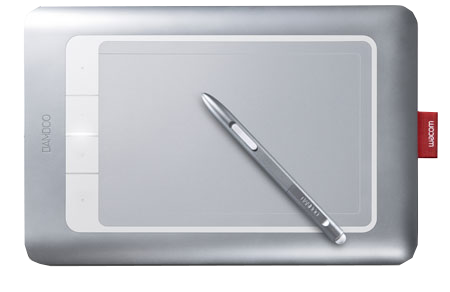
Wacom Bamboo Fun pen and touch tablet

I got a new tech toy recently - it's the Wacom Bamboo fun pen and touch tablet. It's primary function is to serve as an pen and touch input, not unlike a touch screen phone. I've been delaying the purchase for a few months, trying to decipher within myself if this is an impulsive buy or something that I really wanted to have. The cost of this is not exactly cheap (retailing at 329 SGD), and with that cost, I could have gotten one of those wifi enabled tablets or even an ipod touch. But I guess I really wanted this.


The trigger for the purchase came ironically because of ipad2. I was playing around with an app, called zen touch and was immediately impressed by it. I was having so much fun that my wife had to pull me away from the apple store. If I really got an ipad2 there and then, it would have been because I wanted to explore more on the zen touch app. So this lead to that, and I found a pre-owned Bamboo tablet selling for 250 SGD and I grabbed the opportunity. I guess I never looked back since.


I cropped away the edges...okay, I admit, it was a bullshit job. I'm quite inept at photoshoping or gimping. Yet.


It was such a pleasure drawing and painting and sketching and experimenting. There are a few things about drawing digitally that is so vastly different from drawing physically:


1. There is no lack of paints or paper or the right kind of equipment. With a proper software (included in the package), you can form amazing rendition of any sort of painting. You are only restricted by your imagination and skills, not by lack of equipment or constrained by cost. I think in the past, where I'm too pai seh to ask my parents for yet another box of coloured pencils, had doomed me to sketch with just a single 2B pencil. As a result, I'm much more inclined to do monochromatic sketches rather than using the full spectrum of colours that are available.


2. I can undo multiple times digitally, but I can't do that physically. Undo is such a godsend! I can experiment with different techniques without risk of spoiling the overall picture. When drawing physically, there's always the risk of erasing more than I can handle. It's even worse when painting, because the botch-up might not be always recoverable and it'll definitely leave a mark. Not with the magic 'undo' button.


3. The ability to draw on layers is a concept that is pretty new to me. On paper, everything from the form sketches to the colours to the shades of colours are done on a single layer. Digitally, you can break out a project into multiple layers overlaid on each other, so that you can do edition on one layers independently without affecting the others. It makes a other 2D project three dimensional, so to speak.


I'm like a child magically teleported inside a candy store - suddenly I've so many tools to play with and I don't know what to start with. As a result of this endless permutation of tools to play with, I'm addicted to doing some art project daily. Sometimes I just have to wean myself off the screen and take a break, because staring at the screen for extended periods always tire my eyes (another good reason why for serious readers, you should get a kindle instead of the more popular ipad - it's that different).


Here's some of the projects I've done. I've conveniently removed the more amateurish attempts when I first tried playing with the bamboo. I censored the clumsier attempts all for your viewing pleasure of course, not for my ego, haha :)


Wholly inspired by SMOL's latest post, of course


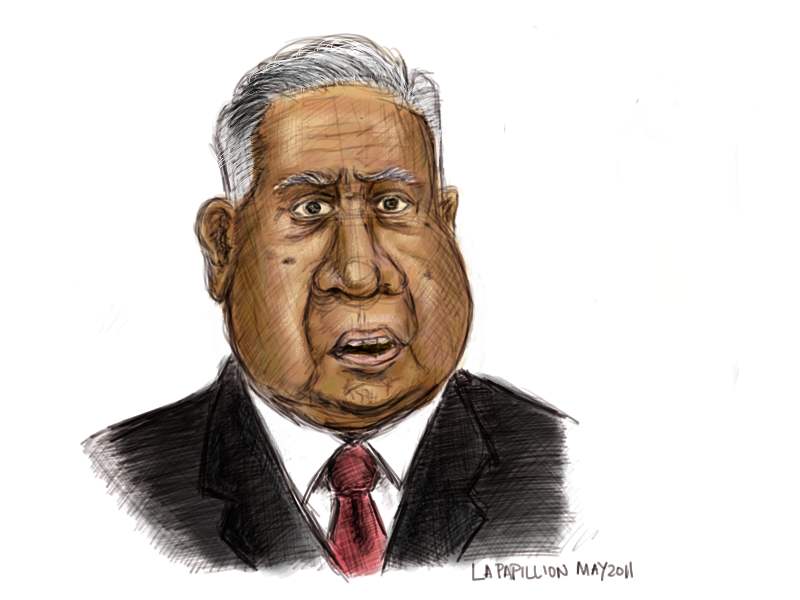
If you don't know who this this, don't ask


This is still work-in-progress...been 3 days already. One of my longest project on Bamboo


-----------------------------------

I've finally completed this after 3 days. The hard work is well worth it because I know the tool so much better than just a few days ago. I'm ready for more challenging projects :)


There is a story behind the picture. It'll set the mood and the feelings for this project:


Urthadar of Clan Hunting Wolf stands alone, in the wretched rain. The storm clouds darken much of the sky, as if foretelling his dire circumstances now. He alone will guard this only bridge to his homeland, if none others would volunteer. No, they have a much more important task at hand - to warn the others of the coming of the impending Plague that comes from the north. The ominous sound of a horn is heard, and is rapidly followed by many others, forming a cacophony that heralds the coming of the cursed orcs. Calling upon Tempus, his god of war, he gripped the handle of his battleaxe with renewed determination and roared defiantly.

Tuesday, May 10, 2011

Know your limits, then break them

You know that I've always been saying that saving can be achieved by two means - either through an increase in income or by decreasing one's expenses. But till recently, I've never put a thought to which method is gives the least resistance. In other words, I didn't take into account the mind's resistance to new changes. I think based on your personality, you might find it easier to increase your income, but another person might find it much easier to just reduce expenses. Ultimately, the success of each method depends on how well suited you are to the method and how far you have to stretch out of your comfort zone.


This epiphany came as I analyzed the weight loss equation. There are two ways to lose weight - either to increase your energy through exercising more or by eating less calorific food. I know myself, I'm not a very sporty person so asking me to go out to exercise more is definitely harder than to simply eat less. I know another person who is better suited for losing weight through exercise because food is simply too tempting to avoid. I guess thr method you choose really have to suit your lifestyle to make the journey easier, because you do not have to step too far out of your comfort zone. Isn't this the same as the financial analysis versus technical analysis divide too? Some are better suited for the swashbuckling trading way rather than the more studious and research based investing. It's hard for someone with a personality for trading to switch to investing and vice versa. It's not that it can't be done, it's just that it might not be the easiest path.


Back to savings, I think it's easier for me to save more by reducing expenses. Some people might find it hard but for me, I think it just comes naturally. In fact, to spend more money requires quite an effort from me and that always amazes my wife. I find it quite a curse to be so tightly bound to my money habits (I'm trying to change it and my friends told me I'm much better now). That being said, the easier method might not be the better method in terms of accomplishing your goals. The pursuit of comfort might hinder the pursuit of goals because you tend to do things that doesn't stretch your comfort zone too much, never mind whether it achieves your end point or not. So, since I'm better at reducing expenses, I should not just concentrate on reducing expenses because that's easily done. I should explore options to increase my income because that is truly the limiting factor in the savings equation; You are limited by what you cannot do well, not by what you can do well.


For that somebody who finds it easier to lose weight by exercising more, she can try eating lesser as well as continuing her normal exercise routine. For those who are naturally suited to financial analysis as a way to view the stock market, he can take up a bit of charting. For those who are good in charting, she can pick up fundamental analysis to push her skills to another level. And finally, for those who are good at increasing income to save money, he can try reducing his expenses.


In summary, what do I advocate? Know your strengths and choose the method that suits your personality. Once you start on whatever goals you desired, maybe you should look at the limiting factor that stunts your journey, take a dab at that, try it out. If things don't work out, no problem because the risk of failure is low since you've already have something working. If it works out well, then your limit is expanded. And that is always a good thing, yes?


*This article is contributed to IM$avvy financial portal, which is managed by Central Provident Fund Board and supported by MoneySense. This site has a noble aim of promoting financial literacy to the general population.

Saturday, May 07, 2011

The past and simpler world

"How many people long for that past, 'simpler, and better world', I wonder, without ever recognizing the truth that perhaps it was they who were simpler and better, and not the world around them?"

~ Drizzt Do-Urden


How true that simple statement is. People, me included, often thought of the good old times, reminiscing how good the older and simpler times are compared to the more unpleasant present. How well it'll be if all the flats are cheaper and bigger, how well it'll be if the cost of food is cheaper compared to my salary and how carefree students are in school compared to the present. While no doubt that there are truth in such statements, perhaps it is also clouded by the nostalgic sentiments of the past, so that you only see the past with bias recollection of the more pleasant times, while blatantly ignoring the more unpleasant times.


Perhaps Drizzt Do-Urden is right, the world changes no doubt, but it is the person who changed even more. If I am somehow, magically transported to my distant past, would I have found the world a better and simpler place to live in? Maybe not, because I no longer look at the past with the eyes of someone browsing through a new book for the very first time, soaking in the smell of the new-ness of the book and absorbing all the sights of a tourist arriving in a beautiful town for the very first time. Memories are to be re-lived in the mind, not to be visited physically, otherwise the magic of the sweet nostalgia would be broken by harsh reality.


Let's relive some memories mentally then. People of my generation would have experienced these little pockets of memories as lively as my own recollection:


1. In primary school, we are have to chew on some tablets that gives a red colouration to our teeth so that the plaque are highlighted in order for us to brush it off.


2. After recess in primary school, the whole class can be seen squatting besides the drain in the school compound, gurgling water from a cup and brushing their teeth.


3. Buses are paid in coins, with a conductor stamping the ticket. Then the paying system becomes transit link card where you have to press your own fare. Finally it becomes ez link card where the fare are automatically calculated for you.


4. In primary school, I witness the explosion of plastic usage in everyday life. Tuppleware parties are held. The wood and metal tables and chairs are slowly replaced by plastic ones. Metal containers used to hold food are replaced by plastic containers. Metal water bottles are changed to plastic ones.


5. There's no such thing as calling someone you're meeting at 1pm that you're late, using a handphone. Handphone only became popular towards my army days and perhaps into my university period. Before that, if you make an appointment, you bloody hell make sure you're there on time. If not, there's no way to contact the person en route since neither of us carries handphone...


6. ...unless that person carries a pager. In which case, you have to call his pager, leave a voice message, and hope that he received the page and CALL his voice mail to retrieve the message. Really, it's just easy to be punctual.


7. I remembered dialling up to connect to internet...it was a frustrating exercise when a call comes in, then all your internet connection gets cut off. Not that there's anything much to do on the internet anyway.


8. Before google, alta vista was my favorite search engine. Lycos, yahoo are a close second. But once google appears, everything else is changed. Search engine can never be the same again.


9. I saw the advent of coloured television. When I was little, I remembered watching television in black and white. Then it became coloured, now it became 3D.


10. I saw the building of the MRT lines. I remembered fondly in primary school that a worker was waving at us (or rather, because we're waving at him) from the half constructed mrt lines. I remembered my first ride on the east-west line and how scared I was by the roar of the train when it's underground.


11. When I was in secondary school, punggol/sengkang was a swamp. I have great memories of canoeing and camping there. I remembered serangoon shopping centre was a hangout for ah-bengs and gangsters too.


12. In the past, buses are not air-conditioned. There are little windows that you have to shut it when it's raining. On the top of the buses, there's also a air vent that you have to close it physically when it's raining. Have you seen the sight of rain splattering inside a bus? A journey inside such a bus is warm but sleep inducing. I can even say that I can sweat comfortably and be lulled into a nice nap.


Is there more of such memories that you can think of? What was it like for life in the 50s, 60s, 70s, 80s that you remembered fondly? Do share it in the comment box below. I would love to have a oral history of how life was like in the past, compared to now :)

Tuesday, May 03, 2011

Outgrow your problems

Everyone knows that to save more money, you need to reduce your expenditure. However, not many talked about saving money by earning more money. The equation is this: Savings = Earnings - Expenditure. From here, we know that to increase savings, you can either decrease your expenditure or increase your earnings. Nobody is going to stop you if you do both too.


If you've read T.Harv's book titled "Secret of the Millionaire mind", you'll read about growing bigger than your problems. He mentioned that "Rich men grows bigger than their problems. Poor men tries to solve their problems". Now, of course that is a general sweeping statement, but if you would just stop and think through it, it is actually quite a good paradigm shift in thinking about personal finance. No longer do we have to cut on our wants in order to reduce expenditure, but we can have both our wants and save more at the same time. But how do we do so?


Simply increase your earnings!


If you are so much bigger than your problems, then you can not only solve them, you actually outgrow them.


That is easier said than done, or simply impossible to some. Impossible is something that people try to reason to themselves in order for the status quo to remain the same. If you're always feeling comfortable and secure, then you are not growing. Most jobs do not require you to work over the weekends, so that's your best shot at monetising your private time. If you enjoy teaching, you can take some students for tuition. If you enjoy swimming, you can teach children how to swim. There's bound to be certain things that you enjoy doing over the weekends but can earn you an extra bit over and above your main salary. Most of the mid-career switch to being self-employed actually begins like this. A stressed up lawyer might do some baking over the weekends, but is so good at his craft that people will pay for them, so he quits his job and starts a bakery shop, thus earning way above his lawyer's pay but working in something that he likes very much. Not everyone will have this fairy tale ending, but if you don't try, you'll definitely not have it!


To grow bigger than your problems is to increase your earnings to such an extent that the problems shrink to something insignificant. I remembered fondly of the times that me and my classmates would pool money to buy MacDonalds in our JC days. In those times, having a decent meal for an outing is a trip to the golden arches. Even coming up with the few dollars needed to share a meal at MacDonalds is a strain on my financial resources, because the only 'earnings' that I have is the pocket money that is given to me by my parents. After I started working and my salary increases many fold, the few dollars seem insignificant now. That is the magic of growing bigger than your problems - the problems that plagued you in the past suddenly doesn't seem so daunting anymore because you've outgrown it. I'm sure there are people who can buy Mercedes without batting their eyes at all because their income is so high that the price of a Mercedes is just a Happy Meal to them. Price is a relative thing.


Here's a suggestion on how to both increase your savings and to satisfy the wants. This method works for me, so it might also work for you. If you want to get something that cost $500, try to earn $1000 above what you normally earn. The reason for this is that I try to keep my savings ratio above 50% of what I take home per month, so if I earn $1000, I have the 'right' to spend $500 without affecting my savings ratio. If you can earn that $1000, that you will get rewarded for getting that unnecessary but ultimately fulfilling want. In the event that you can't earn that extra $1000, you carry on as long as necessary, until the desire to get that want is just diminished (it's just too much work) or you've worked extra hard over the next few months to earn it (so you are rewarded).


You can tweak the percentage as you deem fit, but the basic underlying concept still applies. You always spend less than what you earn. If you want something that is not a need, you earn your right to buy it by earning more than the cost of that want. In this way, you can save more and get your craving satisfied. Don't always talk about fulfilling your needs and suppressing your wants. Needs sustain you but it's the wants that colours your life. You don't merely want to survive life right? You want to live life with as rich an experience as you could ever have.


*This article is contributed to IM$avvy financial portal, which is managed by Central Provident Fund Board and supported by MoneySense. This site has a noble aim of promoting financial literacy to the general population.

Thursday, April 28, 2011

NOL / Cache / Indoagri charts

Personal reference only.

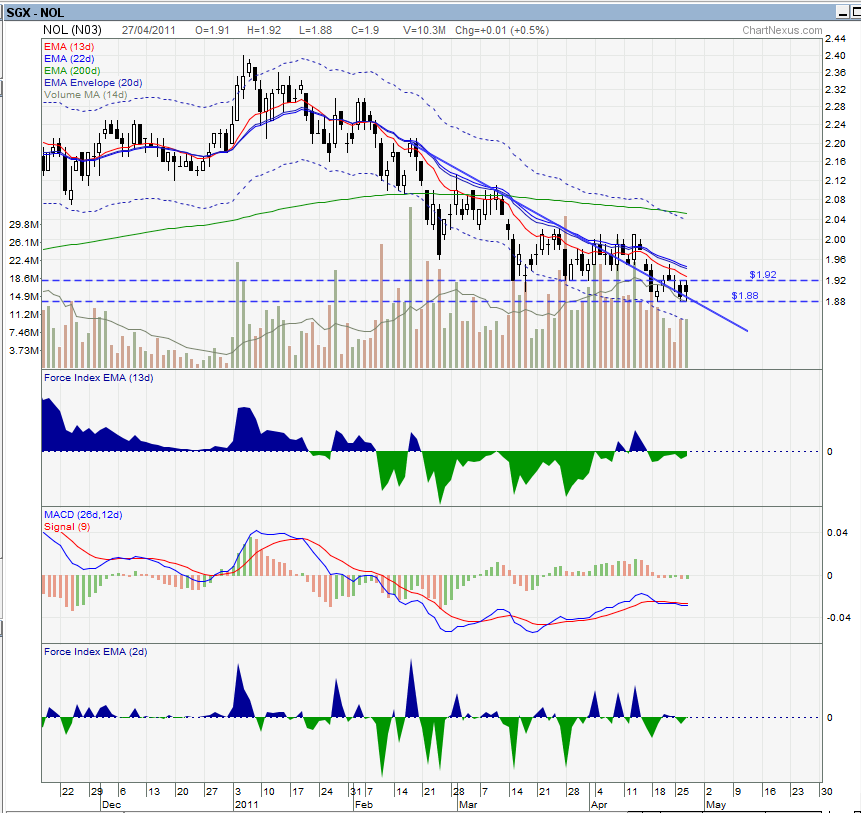
NOL:


I think I mentioned in the cbox not too long ago about the possibility of seeing a triple bullish divergence. We're seeing it now. I still don't like the persistent downtrend line that the price seems so reluctant to break. I think 1.88 seems like a good entry point, exit at 1.96 thereabouts? Undecided whether to trade this or not.


Cache


I got in at 0.915, which I think is an excellent entry point. I see a bullish wedge formation with the neckline at 0.955/0.960. Not sure if the higher than average volume seen on Wed means anything. Will have to see if there's a followup on Thurs. With so many trenches dug in at 0.96, it might take a great effort to go pass that resistance. If it does, 0.98 and eventually 1.00 would be the way to go. I really like this one, both weekly and daily.


Indoagri


This looks good too. Entry 2.12 with tp of 2.22-2.25. This certainly looks better than NOL. Should I? Hmm...

Tuesday, April 26, 2011

Addicted to burgers :D

** "BIAS" is a special feature in my blog where I get to say whatever I want with scant regards for your feelings. I'm not politically correct in this feature, so go ahead, judge me."


Quite recently, I've been addicted to this new burger by Burger King. Actually I'm not sure if this is a new burger or not, but there's this promotion that had been going on for some time. Basically, you order a standard meal that comes with a burger, medium fries and a drink, but you get two pieces of black pepper basil drumlets for free! This costs only $6.95, and I'm sure it'll fill you up because there's really a lot of things to eat.


Anyway, I digress. The burger that I was so addicted was the BK Doubles Crispy Onion burger. The sauce is a tangy BBQ-like sauce that is put in between two the beef patty and with a crispy onion. Just the thought of it makes my mouth water, haha :) A picture will replace a thousand words:


I think the picture above is for the single crispy onion burger. But I'm quite sure that I'm addicted to the doubles crispy onion one, haha! It was truly the best burger I've even eaten, and I was back at it again and again. That's this time that I got so hooked by it I was eating it thrice a week! But I have to take care of my health, so I scaled down on it already :)


There's now a promotion for Burger King again. This time round, you can get a free sundae with every burger purchased, whether it's a meal or not. I've never tried sundae before but from what I've gathered, it seems that it would be a good choice. But there's just so many things to eat, haha, so likely I'll have to share the meal with my wife. You can click the link here to get the coupon to enjoy the special giveaway. From what I've heard, it's good enough to save it in your handphone, so you don't really have to physically print it out.

Saturday, April 23, 2011

My political inclination

Vault dweller showed me a very interesting test on my political inclination. Since the hottest topic these days is about election, and I've no idea which side I'm on, I took a test that he linked to me. You can try the test here and do write it in the comments so that we can compare notes :) The test is quite long, around 6 pages worth of short questions in which you have to answer 4 choices : strong disagree, disagree, agree and strongly agree. After that, they will show you an analysis of your political inclination together with snapshots of the results that  famous politicians will show with this test.


Here's my result:

This is the typical quadrant:


These are the famous politicans:


And this is my result:


Looks like my political inclination belong to the libertarian leftist :) I'm more alike politically to Gandhi and Dalai Lama and most unlike George Bush and Margaret Thatcher, haha! You should really try out the test :)

Thursday, April 21, 2011

Leveraging for passive income

Recently a person named newbie shared some of his insights into leveraging for passive income. It's not a new concept to me, but he did kindly shared some of the details on how he did it. Many thanks and appreciation for his generous sharing in my infamous cbox. Before I proceed, do take note that I've never done it before and this is at best an interpretation of what I had gathered from his sharing. It may not be exactly what he had in mind because some of the information might be lost in translation, but I believe the gist of it is captured here. Any mistakes posted is solely my own and please do read the disclaimer at the bottom of the site if you decide to act on this information.


The idea can be summarized in a line: Borrowing at a cheap interest rate and using the money to buy a stable financial instrument that is paying a higher interest rate, thereby earning the difference between the two.


As in all decisions regarding financial investment, the devil lies in the details. Several questions comes to mind. I don't profess to have the answers to all but this is what I've gathered from our conversations.


1. How cheap is the borrowing? Where to get such cheap money?


He mentioned that cheap financing is available from margin facilities in certain brokerage. From my understanding, if you're a private banking client, you can have access to cheap financing too. These will lend you different currencies at different rates, say USD at 2% pa or SGD at 1.5% pa (the figures are for illustration purpose only). Of course, not everyone is a private banking client (you need to satisfy a minimum asset requirement), but you and me can get cheap financing too. Newbie offered a suggestion of the possibility of getting a lower than 2% pa balance transfer for 6 months, thereafter it's a matter of rotating between different banks after every 6 months to enjoy the preferential borrowing rates.


The thing is, after you had reached a certain amount of assets, you start to have more options available to you that is not available before.


2. What is stable financial instrument? How much higher interest rate can you get from it?


Stability here means that the price do not move much. It is risk defined in the academic sense, and the lower the price volatility, the more stable the instrument is said to be. At the same time, there is a second criteria to fulfill. The instrument must also have high yield. What fits into this then? There are broadly three asset classes - stocks, bonds and preferred shares. Not all stocks satisfy this criteria of stability. But some examples like singpost and perhaps SPH might fit this well. Bonds are preferable because of the call back function upon maturity, so the price movement in between listing and the callable date is immaterial, which thus places the focus solely on the yield. Preferred share (or perps) is an equally good option because of the possibility of getting back the capital upon maturity, and thus removing totally the price volatility factor from the equation to consider.


I think high yielding perps by banks (ranging from 6-8%) are good for such purposes. Newbie did mention something important too - he do not wish to dabble in forex risk, hence the currency he borrowed and the financial instrument must be in the same currency denomination. For example, if you borrow SGD at 1.5% pa, you will buy a bond denominated in SGD at say 6% pa, and not another instrument denominated in USD at 6% pa. This eliminates forex risk and reduces the number of factors to consider.


3. What about the payment of interest and the principal borrowed?


For this type of leveraging, the securities that is bought with the borrowed money is pledged as the collateral, hence there is no need for downpayment or even monthly payment of interest/principal, IF you so wish. I think you'll have to work out the sums yourself if you choose to roll over the interest payments and see if it's worthwhile to even begin doing such things. Of course, you can always make principal payments month to month, using the net interest generated, and eventually get the collateral pledged as free. That is not unlike the pillow strategy used by bro8888 but with a twist - that is the use of leverage.


There is also the very real risk of a margin call, which happens when the value of the collateral goes below a certain percentage of the borrowed amount. If that happens, there will be a margin call to top up cash to lower down the ratio to the acceptable level. The way to mitigate this is to cut loss at a determined level, or simply to use the net interest generated to redeem the principal from time to time, hence raising the limit before a margin call comes in. Besides the risk of the value of the collateral dropping, there is also the matter of increment in interest for the money borrowed. However, this is not going to come overnight so there will be time to react. For example, if you borrowed USD at 2% pa to buy a bond at 6% pa, it might take a few years before the interest of the borrowed amount of 2% will reach 6%, thereby reducing the net interest earned.


Newbie reminded me that at the end of each day, each collateral is marked to market price, so there's a real need to be meticulous in the record keeping to ensure that there will not be a margin call at all. Not for the tardy person.


4. What are the risks involved? Too good to be true it seems...


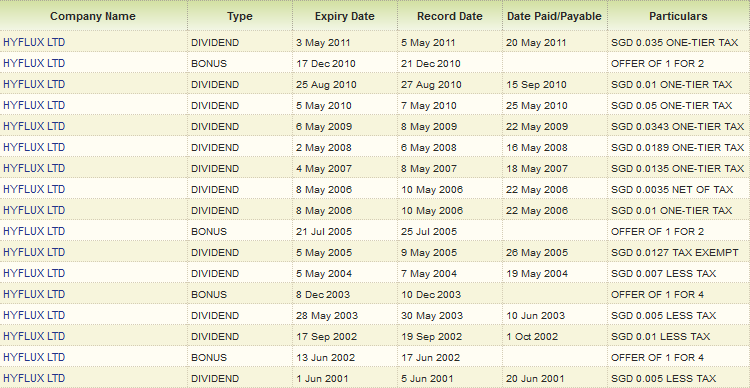
First there is the risk of interest rate increasing. That will cause the interest that you can borrow to increase, hence reducing the net interest that you get. Secondly, there is the risk of the securities dipping in value, thus causing a margin call or a forced sale of the securities in order to maintain the margin ratio. Thirdly, there is the risk of the underlying company of the securities (for example, the underlying company of the much talked about Hyflux preference shares is Hyflux) going belly-up, rendering the securities un-tradable for unspecified period of time.


I think the third risk is the hardest to mitigate, because from history, even the most stable company can cave in. Even if you buy the most stable banking institutions, the one that is 'too big to fail', black swans event can happen most unexpectedly despite the most scrutinizing study of its financial statements.


That being said, will I get involved in this kind of leveraging? I might, but certainly not now. I'll keep my options open and concentrate on getting my main income going up, because my risk for my main income is the lowest, since I know exactly what I'm getting into. I think if you know what you're doing when leveraging, it can be a powerful weapon to advance your financial goals. Just be aware of the risks and mitigate them as well as you can. Thanks again for newbie for this eye-opener way of getting passive income.

Tuesday, April 19, 2011

Spendthrift youth?

I came to know of a story regarding a female private university student who had spent 11k of her parent's money from the start of the semester to now. The semester should be about 4 months, starting from the beginning of the year. It's really incredible because at 11k for 4 months, it's about $2,750 per month of expenses. And she hasn't even started earning her keep yet! This is not the first time I've heard of spendthrift students, but this must be one of the highest maintenance kid that I've heard of.


According to a friend of hers, I came to know that it's because she had taken taxi to and fro everyday. Since she had lived a fair distance from the university, she had to spend around $60 per day on cabs on average. This means that in a span of 4 months, she'll have chalked up 7.2k worth of transportation fees alone. With this amount, it'll be better getting a car rather than taking public transport. I guess the rest of the 3.8k must have been spent on other stuff. It's really amazing to me that a young lady can really spend so much money in 1 month. 2.7k per month can be the typical salary of a worker in Singapore.


This is not the end. There's another story of a student from an elite school in Singapore overhearing that his friend is asking for 3k pocket money from his parents so that he won't have to keep pestering from them again and again. To ask for 3k per month for a student is really something, especially compared to my own pocket money. My pocket money in secondary school per month (estimated, because it had been a really long time) is around $80, rising to around $120 in junior college and finally $200 in university. That sum of money includes everything that I need to buy for that month, like transportation, food/drinks, books, misc fees for school etc. It is all inclusive. It had been roughly 10 to 15 years since I had left school, so had the pocket money rose up by almost 100 times? Had the price of food and entertainment and books rose up by 100 times too? I doubt so.


Perhaps this is the kind of parenthood that a double income household can give to their kids. Instead of giving time to their kids, they had to work and perhaps money is used as a compensation to their kids for that lost time spent together. This is so wrong.


It doesn't really matter if the parents can afford to give these extravagant sum of money to their kids. This is really about sending the wrong signal to their children about money. I wonder how many of these kids will be able to sustain the lifestyle that they must be enjoying right now during their schooling years. Once a high maintenance lifestyle is established, it's going to be very hard to live a more frugal kind of living. What if they can't earn that kind of money to sustain this kind of standard of living? It's just a ticking time bomb for these impressionable youths.


If this is the kind of behaviour that the youths are doing even before they start work, I want no part in this. I hope that they do not wake up one day in a rude shock that they are deeply in debts for their excessive wants. In the end, I also hope that their parents would not be the ultimate ones to suffer because of the actions of their kids. Seems like we're living in a very different world now, so may this be a wake up call for all parents!


*This article is contributed to IM$avvy financial portal, which is managed by Central Provident Fund Board and supported by MoneySense. This site has a noble aim of promoting financial literacy to the general population.

Saturday, April 16, 2011

Hyflux preference shares Part 3

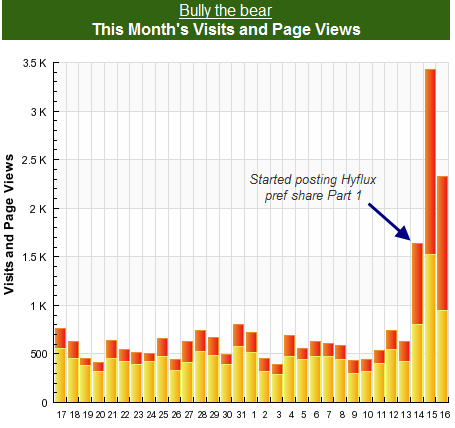
It seems like hyflux preference shares issue is getting a lot of attention lately. Besides splashing nearly a whole page on the local newspaper, it is also widely commented in internet forums and blogs. To see how immense the interest in the hyflux preference share is, one only have to look at the explosive increase in viewership after I've posted the two articles on my opinion regarding this fund raising exercise.


This is not the only indicator of the immense interest in the preference shares. Here's a few more:


1. The owner of finance.sg had his site banned by adsense (the appeal is still pending), likely because of the huge spike in traffic after AK and me posted our opinions on the preference shares.


2. The placement for the preference shares is so hot that the bookrunner, DBS, had received orders almost seven times the planned number of shares (i.e. S$200 million offer size). As a result, the offer is prematurely closed since the maximum number of allotment for placement cannot exceed $200 million.


3.  Since the placement is oversubscribed by 7 times, the allotment for the placement is roughly 14% (1/7 = 14.28%). This is in line with what I've read in the forum for those who had been allocated their placement shares. It range from 10% to 15% roughly, based on a small sample of people who had mentioned their allotment percentages.


I was quite shocked by the strong demand for the preference shares, frankly. It goes to show that there are a lot of money floating around waiting to be deployed. Is that another indication that the bull run will carry on? But one thing for sure, the offer for the retail tranche of the preference shares would be pretty hot. Perhaps you can only get the minimum of 1 lot unless you really put in a lot of capital. Most likely it will be more oversubscribed than the placement shares, because those who did not get enough from the placement would likely try their luck in balloting for the retail tranche. Of course, you have to add in a huge number of those who would stag this preference share to get a quick buck.


If it's oversubscribed by 7 times, you probably need to put in 70k to get 10k (100 shares) of the preference shares. If it's oversubscribed by 10 times, you probably need 100k to get 10k worth of it. You can do the math yourself. But know that there is only 2 million shares to go around for everyone, so maybe some might not get any at all. Judging by the huge response of the placement, it seems like many would likely try their hands on the balloting to sell on the first day.


It'll definitely be interesting to see how the opening of the Hyflux preference shares be like on 26th April. Would hyflux bring big bucks for the holders? haha :)

Friday, April 15, 2011

Hyflux preference shares Part 2

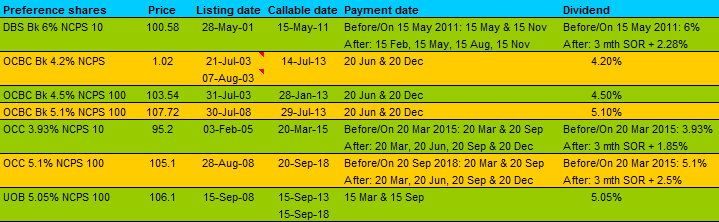
Here's part 2 of the Hyflux preference shares commentary. In part 1, I've talked about the technical details of the offer, so now we can concentrate on whether it is a good buy, which is the ultimate question.  Let's take a look at the preference shares offered by the banks here:


Most of them are ranged between 4 to 6% pa. Hyflux is issuing theirs at 6% and subsequently stepped up to 8% pa if they did not redeem by April 2018. But the company issuing these preference shares are banks, which are ranked above normal companies in my opinion, so naturally Hyflux will have to offer a higher yield to account for their more risky circumstances. Banks are financial institutions that are integral to a country and they must not be allowed to fail, especially in Singapore's case, lest the public's confidence in the financial system be wavered. Can the same be said for Hyflux? No matter how good the terms of the preference shares are, if the underlying company that issued it sinks, all the high yield offered are moot. I can't tell what I'm going to eat for lunch later, so I don't have the predictive powers to determine if Hyflux is still going to be around in a few years time to give me my dividend.


I would have thought that people who preferred preference shares are those who do not want to worry so much about the ups and downs of the market, since if they had bought it at par value, the shares would also be redeemed back at par value too, so the fluctuations of the price in between does not matter to them. In the meantime, they just have to collect the dividends and live their own life. Would they care to look closely at how the underlying company is doing from time to time? I would think not, because such investors should want a fuss free kind of passive income. Would hyflux offer such a safe, fuss-free haven, being the underlying company issuing the preference shares? I do not know, but I would bet my money on the banks anytime if I truly want a fuss-free kind of investment instrument. Besides, I do have a preference share by HSBC bought below par value, at a rate of 6.4% pa (but denominated in USD). I do not even care about what the price of the shares, which is exactly what I like about preference shares. If any preference shares that I bought do not give me this kind of feeling, I would avoid.


The dividend yield for Hyflux is around 2.5-3% pa. Do you wonder why it is low? Hyflux is a growth company, hence the need for cash necessarily reduces the amount given as dividend. They must obviously think that they can give you a better returns for the cash than you could. The good thing about putting your money into the ordinary shares of Hyflux is that you can participate in the upside of the company's growth. If the earnings of the company grew, the price will also rise (eventually). The bad thing is that if all these scenario didn't come to fruition, you'll end up with a possible loss. On the other hand, buying the preference shares limit the upside in terms of price appreciation. Preference shares do not move too much upwards, though it can certainly plunge downwards. Just take a look at the preference shares of the various banks during the financial crisis. The downside for preference shares is limited though, unless the underlying company fails catastrophically, because the lower the share price, the higher the yield will be. There will come a point in time where the yield is so attractive that buyers will step in to stop the downslide. If you buy at par value and hold it until redemption, there will be no capital loss at all.


My point 4 in this post on preference shares still sums up my decision on this one. I would look at it only when the price goes below the par value. I think you can still make money out of this (in fact, I think it might be a good stag). Given that you can even use up to 35% of your investible savings in CPF (the balance in CPF ordinary account plus the net amount withdrawn for education and investment) to apply for this and get a yield higher than what the CPF rates can give you, it might be worthwhile to invest some money into it.


So there, the odds are laid out in front of you. Go ahead and decide what to do with your money.


*This article is contributed to IM$avvy financial portal, which is managed by Central Provident Fund Board and supported by MoneySense. This site has a noble aim of promoting financial literacy to the general population.

Thursday, April 14, 2011

Hyflux preference shares Part 1

Hyflux recently announced plans to offer a 6% cumulative, non-convertible, non-voting, perpetual preference shares to raise funds. The purpose of this fund raising exercise is not known (or I've not read closely enough in the prospectus here). Regardless, let's see if this is worth looking into. First of all, let's take a look at the terms of the offer.


Preference shares is a type of hybrid between bond and equity (in fact, closer to bond than equity). The holder of this instrument will be entitled to dividend at 6% pa, payable semi-annually on 25th April and 25th October every year. Since this preference share is also perpetual, which means that unlike a bond, there is no maturity period for which the issuer will redeem back the bond. However, there is an option for the issuer to redeem back the preference shares on or after 25th April 2018. Take note that this is a right solely to be considered by Hyflux, not an obligation. If they chose not to redeem it back on or after 2018, then they will step up the dividend rate from 6% pa to 8% pa. If they chose to redeem it back, they will buy it back from you at par value. I will explain what's par value shortly.


Interestingly, this is one of the few cumulative preference shares I've seen. The bulk of the ones I've seen are non-cumulative. Cumulative means that in the event that dividend is not given for 25th April and/or 25th October, the payments are accumulated and paid on the next payment date. In other words, the payment are cumulative. However, dividends are not guaranteed. From what I understand from preference shares of banks, if dividends are given to ordinary share holders, preference shares must also be given theirs. This makes it almost as good as guaranteeing the dividend if the track record of dividend given by the company is anything to go by.


What's par value? In this case, it is the issue price of the preference share at S$100 per share. This preference share will be listed and traded on the main board of SGX from 26th April 2011 onwards. Since you bought it at $100 per share and it is traded thereafter, the price of the share will go up and down according to factors like interest rates, macro-societal factors and just basically, market sentiments. This means that the price can go above $100 or below $100. But on 25th April 2018, should Hyflux choose to redeem back the preference share (again, it's a right, not an obligation to do so), they will buy it back from you at $100 per share, regardless of what the share price of the preference share is at that point in time.


Those who had bought the share at $100 and held it till Hyflux redeemed it back in 2018 will realise no capital gain at all, since it is redeemed back at par value (which is $100) too. However, they get to keep the 6% pa for the period they are holding the share till 2018. For those who bought at a price of more than $100 after listing, they will make a capital loss (hopefully the dividends collected will more than cover up that loss). Finally, those who had bought at a price below the par value of $100, they will make both a capital gain as well as all the dividend collected till redemption. Should Hyflux chose not to redeem back in 2018, they will step up the dividend rate to 8% pa, instead of the usual 6% pa. You can treat this as their 'punishment' for not buying back the shares from you.


The offer for the preference share is up to S$200 million in total value (i.e. 2 million shares are offered) to the public, with an option to upsize the offer to $400 million if there is unsatisfied demand under the reserve and/or placement offer. You can expect it to be quite illiquid and characterised by huge gaps between buy and sell bids after listing, judging from the daily quotes of preference shares offered by other companies. After listing, the shares are traded in board lots of 10 shares, so buying or selling 1 lot of preference shares will be around the range of $1000 in value. As a sidenote, there is no voting rights attached to the preference shares, so holders are not entitled to attend or vote at AGM.


If you choose to buy it,you have to act fast. The public offer will open at 9 am on 14th April 2011 and close at 12 noon on 20th April 2011. The process is through ATM like all other IPOs, so you will have to pay a small fee of a few dollars for the application. Other than that, there is no brokerage charge if you apply through ATM. For the balloting through ATM, you need to put in a minimum of 100 preference shares (i.e. S$10,000 in total at $100 per share) and subsequent integral multiples of 10. In other words, the minimum you can apply for is 100 shares, followed by 110 shares, 120 and so on. You cannot apply 101 shares or 102 shares.


For those who like a surer bet, you can try calling your DBS Vicks online broker (since the sole book runner is DBS) to ask for a placement, but will be subjected to brokerage charges at a percentage of the total value. The difference between balloting using ATM and placement through your broker is that in the former, you do not pay any brokerage fees and thus are not guaranteed to get the shares, while the latter you'll have to pay a fee and will be guaranteed an amount given to you by the broker.


I'll discuss about the ultimate question - whether it is a good buy or not - in the next post. This is getting very lengthy as it is now. In the meantime, you can read about other posts I've blogged in the past regarding preference shares:


Preference shares part 1

Preference shares part 2

Preference shares part 3

Preference shares part 4


*This article is contributed to IM$avvy financial portal, which is managed by Central Provident Fund Board and supported by MoneySense. This site has a noble aim of promoting financial literacy to the general population.

Monday, April 11, 2011

The difficulties of investing

The most difficult part of investing is the fact that repeating the same thing in different times will end up with different results. That is both frustrating and difficulty to correct. Imagine you are trying to learn how to ride a bicycle. You do an action and immediately you can see the results, hence the learning cycle is reduced. You practically learn how to cycle by trial and error alone. But in investing, the duration that transpired between the action and the results could be a few years apart. If you invest in this company, it's only after a period of time, ranging from a few months to a few years, before you can see the fruits of the action that you sowed. This makes correcting for error in methodology extremely difficult and makes the learning curve steep and treacherous. Do you really want to invest in a company and realizing that it is a dud after a few years, thinking throughout the entire holding period that you need time for the fruits to mature?


The learning curve to ride a bicycle is shorter because of the immediate feedback


This reminds me of an example. Some of the schools that my students are studying in do not have the habit of giving back the test results back to the students. In doing so, the students are deprived of a chance to learn from their mistakes. In other words, they can be doing a thousand tests and still not learn what is right or wrong since they have no feedback mechanism that can enlighten them otherwise. Likewise, investing now and knowing the results after a prolonged period of time can make the learning curve in investing necessarily steep and long. In investing, it helps to be a good student of history, because while circumstances vary, the human emotions that interplay between buyer and seller stays constant. All the panicky market crashes and euphoric bubbles are there for all of us to see, but not all will look at it to learn.


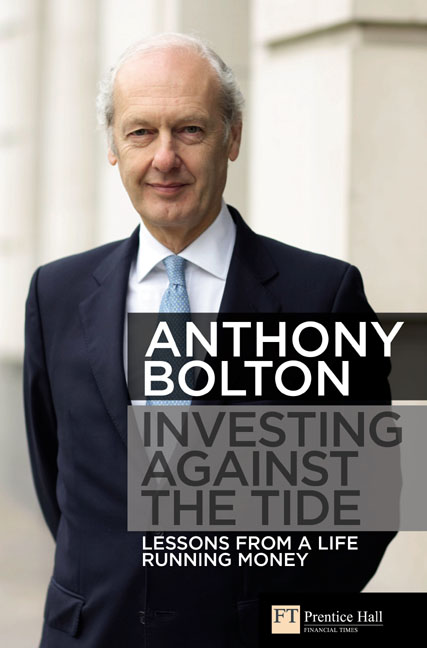
Throughout the whole market cycle, there are times when its profitable to trade, time to invest and a time to gun for yield. I think the key question is when to do which method, in order to get the best out of the current market conditions. In this aspect, I think Anthony Bolton's approach of doing different things at different times is very enlightening. I find his approach well balanced and not siding with either extremes of doing only trading or only investing. You can read more about him in his book "Investing against the tide". That being said, to really learn this, it'll take several market cycles of bull and bear before one can confidently say that one can do it well. To do this well, you have to learn different methods of playing the market and to know the right time to do each method. Difficult?


I quite like this book - it gives a very balanced view of investing vs trading


I offer an alternative that may prove tempting instead of learning how to juggle so many things in one market cycle. You can be a specialist, focusing all your attention to one single trick. You read up, you research, you practice all the time for that one single trick. If the conditions are not right, you wait as patiently as a fisherman with your calm facade suppressing the eagerness to hook a fish. Once the right conditions appear, you strike out using all the training that you've been prepared for. The hardest part of this alternative is to sit on the sideline waiting to do your single powerful trick and waiting patiently in the meantime. It is not easy doing nothing and believing that it will help you get more out of the market.


Then know this, it is even harder doing nothing when people all around you are shouting for action and making profits from the market, while you are doing nothing and believing that the right conditions for your trick is not here yet. Who ever says investing is easy?


*This article is contributed to IM$avvy financial portal, which is managed by Central Provident Fund Board and supported by MoneySense. This site has a noble aim of promoting financial literacy to the general population.

Friday, April 08, 2011

I'm a big girl now, mummy

I came across this wonderful poem while reading this book by Virginia Ironside, titled "The Virginia Monologues", which I'll share in this post. I picked the book up in the library yesterday when my class got cancelled in the evening. I love moments like this - a sudden god-send gift to relax. Since it's too late to arrange a dinner with my wife, I just went to the library to see if any books can find me (I realised that we never find books. Books find their readers). The book just screams out to me when I was ambling through the shelves without any particular aim in mind. This book is about growing old and why it's great to grow old. When is the last time you've seen a book like this, extolling the virtues of getting old?


The old age theme seems to catch up on me recently. Just over the last weekend, I was at Suntec city when they had a convention suitably named "Active aging". In that convention, you see all sorts of interesting stuff, from will writings, general insurance, cooking classes, HDB's studio apartment with a twist for greying population, line dancing, games (including kinec) and many more. There's even a section where you can try on this very fun thing called kangaroo jumps. Imagine a roller blade with the wheels, mounted onto two crescent shaped arcs, forming a spring of some sort. You just wear it and start jumping! I saw a lot of seniors wearing it and start bouncing around. Since I was there for some time (I tried it and wifey even bought a pair), I've never seen one who failed to balance. Coupled with the huge 25% discount, I think the product flew off the shelves.


You wear, you jump - the aptly named "Kangaroo Jumps"

Have you ever felt this way too? Suddenly, it seems that everywhere you turn, things or events of similar theme just happens to you. For me this time, it seems to be the elderly theme. I went to the convention without intending to do so, and I borrowed a book on aging without planning to do so.


Here's the poems I am talking about. It's from the book and I find it very meaningful. Enjoy.


I'm a big girl now, mummy,
I can walk, holding on to a chair.
and I can feed myself with a spoon
and I can say 'Moo'.


I'm a big girl now, mummy,
I can go to school
and I can cross the road all by myself.


I'm a big girl now, mummy,
And I can come back home at whatever time I like,
You're bloody lucky I come home at all!


I'm a big girl now, mummy,
I sit on committees
and boss other people around
and lay down the rules about what you give my
children to eat if I let them
stay with you.


I'm a big girl now, mummy,
And I can face death calmly.


And then we will meet again.
Mummy.

Thursday, April 07, 2011

The posts that never made it

The title is a little misleading. In this blog post, I will put in some posts that I canned away before it is even published. The reasons will be stated besides each canned blog posts too, so that you can agree or disagree with them, haha! As mentioned in previous postings, it's hard to keep up with new posts every now and then, so the only approach I found viable is to have ideas jotted down, as they come along. So, when I'm walking along the streets and an idea hit me, I'll whip out my handphone and type in the rough idea of what I'm going to blog in a notepad application found in my handphone. This way, I'll keep track of the new ideas and if I can flesh it out, I'll blog about it.


Anyway, here goes:


1. The 5 most expensive things I've bought


I almost immediately brushed off this blog post after I've keyed into my handphone. It doesn't excite me nor do I want to dig out my records to see what I've got and the costs of each of them. The initial idea of this post is to veer towards the direction of having a lifestyle that do not require high maintenance or surrounded by branded goods. I think the comments that follows will be quite interesting to see though.


Killed ideas


2. Relative tragedy


This is right after the Japan earthquake/tsunami in March 2011. I've wanted to blog about how our personal troubles can be diminished (or enlarged) by comparing how others fare. I had this inspiration because as I was travelling, I've heard people complaining about all sorts of things. It could be that the bus is late, their school work is mounting up, tests are coming and so on. In light of the disaster happening in Japan, somehow I feel that their personal tragedies seem minute. I wanted to talk about this comical contrasts but decided against it. I do not have enough worthy examples and do not want to gloat over others' problems like that, hence I canned this post.


3. How do you know you've been converted as a soldier after ICT


This post is inspired by a chatting session with my bunk mates during my very recent in camp training (aka reservist). I've been away for around one month, so it's enough to convert the civilian in me to a soldier. Some of the things I've brainstormed include using IC to scan for food in restaurants, wearing a cap when under the sun, the ability to sleep anyway, the ability to sit anyway and so on. It'll be a light hearted post but the lameness of it deterred me. Not everyone is as enthusiastic about ICT as me, haha!