Showing posts with label IM$avvy. Show all posts

Thursday, August 04, 2011

Home mortgage insurance

Not a lot of people talk about home mortgage insurance, so maybe I should start the ball rolling. This kind of protection is good if you have a mortgage for a property and you want to insure against the risk that you will strike the big three - critical illness (CI), death, total permanent disability (TPD) - while you are still paying the mortgage loan for the property. If it strikes you, then you don't have to pay for the proportion of the mortgage loan that you are covered by the home mortgage insurance. For example, if you opt to cover 50% of the total mortgage loan only under the insurance plan, then when you are struck by the big three, your part of the payment of the mortgage loan will be paid for by the insurance company. If you opt to cover 100% of the total mortgage loan, then the property will be paid fully. Another thing about home mortgage insurance plan is that it is a decreasing term plan. Decreasing means that the amount covered will decrease yearly, which is good because you paid up the mortgage every month so the amount of loan outstanding will also decrease. This should cause the premiums to be cheaper than say a level term. Term plan means that it will stop coverage by a certain age, usually 65 yrs or until the duration of the loan.


Since I bought a resale flat by HDB, they offered me their own brand of home mortgage insurance called the home protection scheme (HPS) offered by CPF. I ran into some problems during the health checkup phase (they sent me a letter saying that because my sum assured was too large, I'll have to go for health checkup) so I wasn't covered by the HPS eventually, though they told me I can re-apply again after 6 months with a report on my health status. That was when I began to check on private home mortgage insurance plans offered by insurance companies.


I found out some interesting observations by making some comparison between the quotations offered and the standard HPS plan. To make it transparent, I was comparing Prudential's PruMortgage against HPS for a 30 yr loan period, 100% coverage of mortgage loan. Here's what I found out:


1. I found out that HPS is more expensive than that by PruMortage. The premium for HPS is 27.1% more expensive compared to prudential. The absolute amount we're talking about is a few hundred dollars (<$200) per year.


2. To make a fairer comparison, I multiplied the premium of both plans by the number of years that you have to pay the premium i.e HPS is 27 yrs and prudential is 30 yrs. I found out that the total premiums paid for HPS is still more expensive than that offered by prudential. It's more expensive than prudential by 14.4%. The absolute amount works out to be 4 digit figure (in my case, it's less than 3k). I just realised that for prudential, there is no need to pay the premiums for the last three years of coverage. This is similar (but not the same) as HPS, which states that the last 10% of the yrs of coverage, you do not have to pay premiums. This means that for shorter mortgage duration (<30 yrs), the total amount of premiums paid for prudential should be lower than that of HPS. For 30 yrs loan period, there is no need to pay premiums for the last 3 yrs of coverage for both HPS and prudential.


I liberally took this from another blog : I hate to plan - http://www.ihatetoplan.com/


3. Actually, the difference in premiums isn't that much after considering the total premiums paid for both plans (for mine, it's less than 5k difference). But is the coverage similar too? A resolute no. For prudential, you can get a crisis waiver that is somewhat like a CI rider on top of the basic plans. The premiums are waived if the conditions for CI are met. This means that all the big 3 strikes are covered. What about the HPS? They only cover TPD and death. 


4. When the conditions for claims are met, the HPS do not give cash at all. It is paid directly to HDB and you will not touch the claim amount at all. For prudential's plan, you are paid in cash if the conditions for claim are met. This means that the options becomes more varied because you can treat the prudential plan like a normal term plan that insures against your health and death risk, besides insuring against the risk that you're unable to pay for the mortgage loan. I might choose to carry on this plan even after I've finished my mortgage and treat this as a normal term plan. Have to find out if this is possible.


5. The premiums for HPS is paid through CPF, so there is no cash outlay at all. However, the premiums for prudential's plan is paid through cash. I've no CPF contribution at all, so it doesn't really matter to me which payment mode is better. But I do suppose that this could be an important consideration, especially to those who have tight cash flow. If you can pay through CPF, that is one less thing to pay out of your pocket. I believe this could be the ultimate deal breaker to choose between HPS and other private home mortgage insurance plans.


Now, who would have thought that CPF's HPS would be more expensive than private home mortgage insurance plans? I certainly didn't think so. Do take note that I'm not a financial advisor nor do I pretend to be so. Without insulting my readers who are all discerning adults, I wish to lay down my disclaimer. The whole of this article are based on my possibly wrong interpretation of facts and analysis, so if you are interested, do find out more from someone certified and qualified.


*This article is contributed to IM$avvy financial portal, which is managed by Central Provident Fund Board and supported by MoneySense. This site has a noble aim of promoting financial literacy to the general population.

Saturday, July 16, 2011

Difficulty of arriving on time

Recently, I had a class which I arrived earlier than the scheduled time. I was early by 10 mins but the parent questioned me on why I was so early. In the end, the parent told me a whole lot of story about how the child had to rush back from school and had to run back and that it was so worrying and all that. After all that, she reminded me to try my very best to be on time.


Maybe that parent had been too used to driving, because if she had taken public transport (like I do), the frequency that the bus arrives is hardly something that can be controlled by me. If I didn't come before time, I'll most likely arrive later than scheduled. Long ago, I had been late 15 mins before (to the same parent), but she called me and asked me where I was and that the child was waiting for me. Seriously, some people are just hard to please. I think it's easier to be late and easier to be early but it had to take a lot of luck to arrive just on time. A lot of factors had to be just right in order to arrive at the appointed time.


I think the same thing goes for people in the market who wants to get the peak or the trough of a market movement. Aiming for the bottom-est price just before it reverses is a fool's game. You can aim for the region but if you really get the lowest price, it's more a matter of luck than skill. As you narrow down the time frame, the price movement gets more and more random. Likewise, it's a fool's game to aim for the peak before selling. You can sell a little earlier or a little later but to hit the highest price before reversal, you need lady fortune on your side. This doesn't mean that TA fails - it just shows the limitation of what timing the market realistically can be.


Psychologically, I think it's better to sell earlier and buy earlier, since we cannot sell at the peak and buy at the trough consistently. Selling earlier means that you'll always see the price go up higher after you had sold the stock. Selling later means that you'll see the price go downhill after hitting a maximum. Chances are that after you've seen how high the stock had risen, you've already anchored that particular price in your mind. You'll be less reluctant to sell and you'll end up hoping that the price will still rise up to that particular level. I don't like that and I had several experiences of me ending up turning a profitable positions into a neutral or losing position. Likewise, buying earlier means that you'll see the price go down lower after your purchase, but I feel that this beats seeing the price goes up higher after hitting the lowest price, anchoring that particular price in your mind and missing the whole boat altogether while waiting for the price to come down to that level again.


*This article is contributed to IM$avvy financial portal, which is managed by Central Provident Fund Board and supported by MoneySense. This site has a noble aim of promoting financial literacy to the general population.

Monday, June 27, 2011

Financial freedom tag-team

It's important to choose a spouse carefully, it seems. According to the book that I'm reading, "The Millionaire Next Door", it mentioned that for a large proportion of the millionaires that they had interviewed, their spouse are more frugal than them. The constant complain about their spouse is that they can't get them to spend money!


The book mentioned about having quality offense and quality defense when playing this game of financial freedom. One of the couple, usually the male, would play good offense. They would go out and earn a lot of income. It's mentioned that most of these millionaires interviewed have higher household income than average too - so that's the offensive side. The spouse, usually the wife, would stay at home and play quality defense. They are the ones who would manage the household, making sure that as a whole family, they not only stay within budget but way below their income. That's the kind of tag team playing that I found it interesting.


It's hard to say who is more frugal - me or my wife. For the little things (those that cost less than $50), I'm the more frugal ones. I always have to remind my wife not to overspend on such things. However, for big ticket items, my wife is the more frugal one. She would have to remind me that even though I have the means to afford, we should still be careful on how we spend it. For the recent resale flat purchase, I have to convince and reassure her that the 40k cov is worth the money. Same thing goes for the renovation. I guess my wife and I are not spendthrifts and each of us are more frugal than the other depending on the amount spent! That makes us a compatible tag team partners because we defend each other weak points, haha!


Nacho Libre - I absolutely love the movie!


On the flip side, it's very hard to be financially free if your spouse do not support the idea. The journey towards it involves making sacrifices now so as to enjoy greater rewards in the future. Not everyone wants to reach the end point, that I understand. If one of the couple wants to climb a mountain, the other has to belay the ropes and egg each other on, supporting and encouraging each other along the way. If there is only one person actively climbing the mountain, the other would drag along and act as a complaining dead-weight behind you as you climb. It's still possible to make it to the top, of course, but it makes the journey unbearably difficult.


Thus for those of you who so desire to reach the top of the mountain, choose your other half wisely. Pick the characteristics of the person that you think would aid you, for I believe that a marriage is like a partnership - it should benefit both parties, and not just to one only (or worse - none). Choose a tag team partner that you can synergise with - if you play quality offense, pick someone who play quality defense for instance. You can't pick both who play good offense (because you might spend all that you earn), nor both who play good defense (because playing defensively all the time might take too slow to reach the end). When all the beautiful face and great body fades away with age, what is it that still endears you to your spouse?


*This article is contributed to IM$avvy financial portal, which is managed by Central Provident Fund Board and supported by MoneySense. This site has a noble aim of promoting financial literacy to the general population.

Wednesday, June 22, 2011

Market warning bells

Market bells are ringing softly....can you hear it? When will the bells ring louder? You don't need to know how to read charts or value companies to know that the market is overheated. It can be as easy as paying more attention to the surroundings and people around you. These warning signs might not tell you the exact date in which the market will crash, but a rough estimate is better than none, so that you can make preparation in case it happens. Here's a few points that I can think of:


1. When newbies that comes to the market and start to make a lot of money without knowing anything at all, that will be one sure danger sign. In the market, newbies are supposed to lose money. If they earn anything, it's more by luck and only a handful of these newbies will survive because of their skills. Thus, when you see a lot of newbies who don't know how they made money, it's a sure sign that the market is overheating. If even the newbies are in the market, who else is going to buy the shares from you?


2. When the uncles and aunties you meet on the streets are talking about buying this stock and that stock, you'll hear the market bells ring louder. During the peak market, you can see actors and actresses busy buying stocks. People are talking about stocks in the lifts. Taxi drivers are also talking about them when you took the cab. Thus, when people who ordinarily have no interest in the market start to talk about the market, be careful.


3. When the analyst start making more calls to buy, it'll be another sign. The reports will be glowing with optimism and ever increasing target price (the target price are met so they have to upgrade again and again). Another thing I noticed is that they would shift the valuation benchmark to PE based, instead of asset based ratios like PB.


4. When the newspaper start to talk positively about the market and stories about people who made a lot of money from the market, it'll be one of the last warning signs. Newspaper are usually reactive, and they would not make a bold statement about the market unless the trend had been going on for a long time. This last ditch attempt to lure more sailors to the sirens would propel the market to ever greater heights, eventually capitulating and start the bear cycle.


5. When speculative counters (think ass-shares and warrants) chalk up the top volume, be careful. Usually the newbies that enter the market have little capital, so the only way they can participate in the market is to punt on penny stocks. Most of the blue chips have done its part to bring the index to new heights, so the last to run are usually the pennies. Many stocks that are rubbish will have extreme optimism attached to it, because of the belief that a greater fool will buy it from you. Be careful that you are not the last fool holding the hot potato, if you choose to play this game.


Can you think of other signs of market overheating?


*This article is contributed to IM$avvy financial portal, which is managed by Central Provident Fund Board and supported by MoneySense. This site has a noble aim of promoting financial literacy to the general population.

Saturday, June 18, 2011

How good are you at accumulating wealth?

I'm currently reading a book titled "The millionaire next door". From the few chapters that I gathered, the book is about the characteristics of wealthy people. As I read it, I am keenly aware that while wealthy people have certain characteristics that make them wealthy, it's not true that by following such characteristics, I'll be wealthy too. This logical flaw is similar to this: It is found that all cancer patients drink water, so drinking water will cause cancer. Basically, it's a mistake on causation and correlation. Correlation does not imply causation. I think it's important to have this principle in mind so that when I'm reading this book, I won't be unduly swayed by these characteristics and start to follow them, thinking that it'll lead me to wealth.


There is, however, one thing that I found quite interesting as I was reading the book. It's a heading about how to determine if you're wealthy. As described in the book, you can determine this by this rule of thumb:


Multiply your age by your realised pretax annual household income from all sources except inheritance. Divide by ten. This, less any inherited wealth, is what your net worth should be.


Let's say a 30 yr old person earning 50k a year and having an investment return of 10k a year, will have a calculated net worth of 180k. If that person has a networth of less than 180k, he is a UAW (under accumulator of wealth). If he has a networth of 180k, he is a AAW (average accumulator of wealth). If he has a networth of twice the calculated amount, that is 360k, he is a PAW (prodigious accumulator of wealth).


I found this idea rather interesting. Based on the rule of thumb, I'm considered a AAW because my networth is around that value calculated. For computation of networth, I included all my cash, cash equivalent and investments (marked to market), cpf and the cash value of whole life insurance. I did not include my house since I treat the asset value of the house at cost and that will be balanced by the liability of the loan in my balance sheet. I guess the reason why I'm not a PAW is because my investments are not returning a fantastic return to me. That is something that I would have to do about in the future.


You'll realised that you cannot just pluck the numbers and key into the formula straight away. You'll need to find out how much you earn per year (that is usually easy for salaried workers). You'll also need to know your assets and liabilities and calculate your actual net worth so that you can have something to compare with. I think by doing this little rule of thumb exercise, you can get to know more about your own financial status.


So go on, try it and tell me if you're a PAW, AAW or UAW.


*This article is contributed to IM$avvy financial portal, which is managed by Central Provident Fund Board and supported by MoneySense. This site has a noble aim of promoting financial literacy to the general population.

Wednesday, June 15, 2011

Are you surviving or living?

In thinking about our wants and needs, conventional literature always advise us to concentrate on our needs and forgo our wants. Resources are limited, hence we should ration the things that our resources can exchange wisely in case it runs out. We should budget what little we have and try to scrimp and save to make sure it last long and good. Excess and frivolous frills should be trimmed, reduced and eliminated. Get the smallest house that you can afford, do not overspend and buy a huge house. Get the cheapest furniture and get the barest renovation so that the money can be saved up for investment.


That is a way to survive, but is this the way to live?


I understand totally that all of us have different standards of living. I'm not advocating that we should model our standards of living after others, but we should really figure out what we want to achieve in our financial goals. If accumulation is the end by itself, then that goal can never be accomplished. There's simply too much to accumulate and accumulation as an end will never end.


There must be a balance between the two extremes - spending too much and saving too much. I know which side I'm on and which side I should be working towards. Finding that sweet spot that balances the two extremes will be a unique journey for one to discover. What is the right way to live? There isn't a right answer nor a wrong one, though there is a sustainable or an unsustainable way of living. In the face of such open ended possibilities that is inherent in life, what then should we do?


Walk the middle path, for the answer lies somewhere in between the extremes.


*This article is contributed to IM$avvy financial portal, which is managed by Central Provident Fund Board and supported by MoneySense. This site has a noble aim of promoting financial literacy to the general population.

Friday, June 03, 2011

Old MacGrath and his bucketful of milk

Old MacGrath owned a farm in a countryside where he kept a few cows for dairy milk. In one particular milking session, the cows gave him a huge bounty of milk. Usually, Old MacGrath will have two full buckets of milk on average, so can you imagine his wrinkled but beaming face when after milking all his cows, he realised that he had not two, not three and six buckets of milk!


Old MacGrath was full of joy, and on the way back to the farm, he was already thinking of what to do with the milk. Oh, how his mouth salivate when he thought of the many milk products that can be made from the six full buckets to feed himself and his family! He can make cheese, butter and all sorts of delicious products from the milk. After making so many products, he couldn't possibly finish all of them by himself, so he can even sell it to the market or barter it for some other goods. How fortune smiles upon him! 


But on the other hand, he could also sell the extra milk to the market so that he can have some extra money immediately for him to buy some seeds for the summer planting season that is to come in a few weeks time. With the new seeds, he can plant more crops too! Oh decision decision decision...what should Old MacGrath do with his six buckets of milk? It was such a heaven-sent gift, but for hellish reasons, he couldn't make up his mind on which options he could best utilize this 'windfall'.


So, being unsure of himself, he called for a quick meeting among his family to discuss the matter. His wife told him to sell it to the market for some quick cash so that he can buy more seeds for the summer crops. His eldest son told him it's wiser to keep the milk and turn it into dairy products for their own consumption. His daughter told him that he should use 3 buckets of milk for their own consumption and sell 3 buckets of milk to the market. After a whole day of discussion, Old MacGrath was still unsure of what to do with his milk because everyone makes perfect sense.


Tired of all the heated discussion, Old MacGrath thought that he should take some of the milk to quench his thirst. Taking a ladle, he scooped up a cupful of milk from one of the buckets and took a deep sip, wishing the refreshing taste of milk to sooth his throat. He spitted it out immediately! It was so sour! Looking closely under the dimming light, he realised that almost the whole day had passed since he last milked the cows and the buckets of milk had turned bad!


Oh horrid horrid fate, he cried out loud, totally inconsolably by his family who crowded beside him. His indecision had caused nature to take the decision off his own hands! On hindsight, any decision made on his part seems better than the one that nature had forced upon him unwillingly. Oh horrid horrid fate....


----------------------------------

Special thanks to SMOL for teaching me the value of story telling. Stories are wonderful wonderful way to impart values and at the same time, because of their ambiguity, it is also timeless and borderless. Reading the same story at different times of your life will elucidate different aspects of your life. Reading the same story by different people will teach different things to them too. Like the Rorschach ink blot test, the variance in interpretation varies across time and space. That is also the reason why I like reading children's story books. 


Good children's books are meant for children to read, but for adults to understand.


---------------------------------------


*This article is contributed to IM$avvy financial portal, which is managed by Central Provident Fund Board and supported by MoneySense. This site has a noble aim of promoting financial literacy to the general population.
Tuesday, May 10, 2011

Know your limits, then break them

You know that I've always been saying that saving can be achieved by two means - either through an increase in income or by decreasing one's expenses. But till recently, I've never put a thought to which method is gives the least resistance. In other words, I didn't take into account the mind's resistance to new changes. I think based on your personality, you might find it easier to increase your income, but another person might find it much easier to just reduce expenses. Ultimately, the success of each method depends on how well suited you are to the method and how far you have to stretch out of your comfort zone.


This epiphany came as I analyzed the weight loss equation. There are two ways to lose weight - either to increase your energy through exercising more or by eating less calorific food. I know myself, I'm not a very sporty person so asking me to go out to exercise more is definitely harder than to simply eat less. I know another person who is better suited for losing weight through exercise because food is simply too tempting to avoid. I guess thr method you choose really have to suit your lifestyle to make the journey easier, because you do not have to step too far out of your comfort zone. Isn't this the same as the financial analysis versus technical analysis divide too? Some are better suited for the swashbuckling trading way rather than the more studious and research based investing. It's hard for someone with a personality for trading to switch to investing and vice versa. It's not that it can't be done, it's just that it might not be the easiest path.


Back to savings, I think it's easier for me to save more by reducing expenses. Some people might find it hard but for me, I think it just comes naturally. In fact, to spend more money requires quite an effort from me and that always amazes my wife. I find it quite a curse to be so tightly bound to my money habits (I'm trying to change it and my friends told me I'm much better now). That being said, the easier method might not be the better method in terms of accomplishing your goals. The pursuit of comfort might hinder the pursuit of goals because you tend to do things that doesn't stretch your comfort zone too much, never mind whether it achieves your end point or not. So, since I'm better at reducing expenses, I should not just concentrate on reducing expenses because that's easily done. I should explore options to increase my income because that is truly the limiting factor in the savings equation; You are limited by what you cannot do well, not by what you can do well.


For that somebody who finds it easier to lose weight by exercising more, she can try eating lesser as well as continuing her normal exercise routine. For those who are naturally suited to financial analysis as a way to view the stock market, he can take up a bit of charting. For those who are good in charting, she can pick up fundamental analysis to push her skills to another level. And finally, for those who are good at increasing income to save money, he can try reducing his expenses.


In summary, what do I advocate? Know your strengths and choose the method that suits your personality. Once you start on whatever goals you desired, maybe you should look at the limiting factor that stunts your journey, take a dab at that, try it out. If things don't work out, no problem because the risk of failure is low since you've already have something working. If it works out well, then your limit is expanded. And that is always a good thing, yes?


*This article is contributed to IM$avvy financial portal, which is managed by Central Provident Fund Board and supported by MoneySense. This site has a noble aim of promoting financial literacy to the general population.
Tuesday, May 03, 2011

Outgrow your problems

Everyone knows that to save more money, you need to reduce your expenditure. However, not many talked about saving money by earning more money. The equation is this: Savings = Earnings - Expenditure. From here, we know that to increase savings, you can either decrease your expenditure or increase your earnings. Nobody is going to stop you if you do both too.


If you've read T.Harv's book titled "Secret of the Millionaire mind", you'll read about growing bigger than your problems. He mentioned that "Rich men grows bigger than their problems. Poor men tries to solve their problems". Now, of course that is a general sweeping statement, but if you would just stop and think through it, it is actually quite a good paradigm shift in thinking about personal finance. No longer do we have to cut on our wants in order to reduce expenditure, but we can have both our wants and save more at the same time. But how do we do so?


Simply increase your earnings!


If you are so much bigger than your problems, then you can not only solve them, you actually outgrow them.


That is easier said than done, or simply impossible to some. Impossible is something that people try to reason to themselves in order for the status quo to remain the same. If you're always feeling comfortable and secure, then you are not growing. Most jobs do not require you to work over the weekends, so that's your best shot at monetising your private time. If you enjoy teaching, you can take some students for tuition. If you enjoy swimming, you can teach children how to swim. There's bound to be certain things that you enjoy doing over the weekends but can earn you an extra bit over and above your main salary. Most of the mid-career switch to being self-employed actually begins like this. A stressed up lawyer might do some baking over the weekends, but is so good at his craft that people will pay for them, so he quits his job and starts a bakery shop, thus earning way above his lawyer's pay but working in something that he likes very much. Not everyone will have this fairy tale ending, but if you don't try, you'll definitely not have it!


To grow bigger than your problems is to increase your earnings to such an extent that the problems shrink to something insignificant. I remembered fondly of the times that me and my classmates would pool money to buy MacDonalds in our JC days. In those times, having a decent meal for an outing is a trip to the golden arches. Even coming up with the few dollars needed to share a meal at MacDonalds is a strain on my financial resources, because the only 'earnings' that I have is the pocket money that is given to me by my parents. After I started working and my salary increases many fold, the few dollars seem insignificant now. That is the magic of growing bigger than your problems - the problems that plagued you in the past suddenly doesn't seem so daunting anymore because you've outgrown it. I'm sure there are people who can buy Mercedes without batting their eyes at all because their income is so high that the price of a Mercedes is just a Happy Meal to them. Price is a relative thing.


Here's a suggestion on how to both increase your savings and to satisfy the wants. This method works for me, so it might also work for you. If you want to get something that cost $500, try to earn $1000 above what you normally earn. The reason for this is that I try to keep my savings ratio above 50% of what I take home per month, so if I earn $1000, I have the 'right' to spend $500 without affecting my savings ratio. If you can earn that $1000, that you will get rewarded for getting that unnecessary but ultimately fulfilling want. In the event that you can't earn that extra $1000, you carry on as long as necessary, until the desire to get that want is just diminished (it's just too much work) or you've worked extra hard over the next few months to earn it (so you are rewarded).


You can tweak the percentage as you deem fit, but the basic underlying concept still applies. You always spend less than what you earn. If you want something that is not a need, you earn your right to buy it by earning more than the cost of that want. In this way, you can save more and get your craving satisfied. Don't always talk about fulfilling your needs and suppressing your wants. Needs sustain you but it's the wants that colours your life. You don't merely want to survive life right? You want to live life with as rich an experience as you could ever have.


*This article is contributed to IM$avvy financial portal, which is managed by Central Provident Fund Board and supported by MoneySense. This site has a noble aim of promoting financial literacy to the general population.

Tuesday, April 19, 2011

Spendthrift youth?

I came to know of a story regarding a female private university student who had spent 11k of her parent's money from the start of the semester to now. The semester should be about 4 months, starting from the beginning of the year. It's really incredible because at 11k for 4 months, it's about $2,750 per month of expenses. And she hasn't even started earning her keep yet! This is not the first time I've heard of spendthrift students, but this must be one of the highest maintenance kid that I've heard of.


According to a friend of hers, I came to know that it's because she had taken taxi to and fro everyday. Since she had lived a fair distance from the university, she had to spend around $60 per day on cabs on average. This means that in a span of 4 months, she'll have chalked up 7.2k worth of transportation fees alone. With this amount, it'll be better getting a car rather than taking public transport. I guess the rest of the 3.8k must have been spent on other stuff. It's really amazing to me that a young lady can really spend so much money in 1 month. 2.7k per month can be the typical salary of a worker in Singapore.


This is not the end. There's another story of a student from an elite school in Singapore overhearing that his friend is asking for 3k pocket money from his parents so that he won't have to keep pestering from them again and again. To ask for 3k per month for a student is really something, especially compared to my own pocket money. My pocket money in secondary school per month (estimated, because it had been a really long time) is around $80, rising to around $120 in junior college and finally $200 in university. That sum of money includes everything that I need to buy for that month, like transportation, food/drinks, books, misc fees for school etc. It is all inclusive. It had been roughly 10 to 15 years since I had left school, so had the pocket money rose up by almost 100 times? Had the price of food and entertainment and books rose up by 100 times too? I doubt so.


Perhaps this is the kind of parenthood that a double income household can give to their kids. Instead of giving time to their kids, they had to work and perhaps money is used as a compensation to their kids for that lost time spent together. This is so wrong.


It doesn't really matter if the parents can afford to give these extravagant sum of money to their kids. This is really about sending the wrong signal to their children about money. I wonder how many of these kids will be able to sustain the lifestyle that they must be enjoying right now during their schooling years. Once a high maintenance lifestyle is established, it's going to be very hard to live a more frugal kind of living. What if they can't earn that kind of money to sustain this kind of standard of living? It's just a ticking time bomb for these impressionable youths.


If this is the kind of behaviour that the youths are doing even before they start work, I want no part in this. I hope that they do not wake up one day in a rude shock that they are deeply in debts for their excessive wants. In the end, I also hope that their parents would not be the ultimate ones to suffer because of the actions of their kids. Seems like we're living in a very different world now, so may this be a wake up call for all parents!


*This article is contributed to IM$avvy financial portal, which is managed by Central Provident Fund Board and supported by MoneySense. This site has a noble aim of promoting financial literacy to the general population.
Friday, April 15, 2011

Hyflux preference shares Part 2

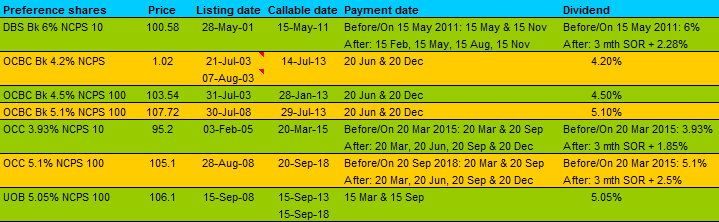
Here's part 2 of the Hyflux preference shares commentary. In part 1, I've talked about the technical details of the offer, so now we can concentrate on whether it is a good buy, which is the ultimate question.  Let's take a look at the preference shares offered by the banks here:


Most of them are ranged between 4 to 6% pa. Hyflux is issuing theirs at 6% and subsequently stepped up to 8% pa if they did not redeem by April 2018. But the company issuing these preference shares are banks, which are ranked above normal companies in my opinion, so naturally Hyflux will have to offer a higher yield to account for their more risky circumstances. Banks are financial institutions that are integral to a country and they must not be allowed to fail, especially in Singapore's case, lest the public's confidence in the financial system be wavered. Can the same be said for Hyflux? No matter how good the terms of the preference shares are, if the underlying company that issued it sinks, all the high yield offered are moot. I can't tell what I'm going to eat for lunch later, so I don't have the predictive powers to determine if Hyflux is still going to be around in a few years time to give me my dividend.


I would have thought that people who preferred preference shares are those who do not want to worry so much about the ups and downs of the market, since if they had bought it at par value, the shares would also be redeemed back at par value too, so the fluctuations of the price in between does not matter to them. In the meantime, they just have to collect the dividends and live their own life. Would they care to look closely at how the underlying company is doing from time to time? I would think not, because such investors should want a fuss free kind of passive income. Would hyflux offer such a safe, fuss-free haven, being the underlying company issuing the preference shares? I do not know, but I would bet my money on the banks anytime if I truly want a fuss-free kind of investment instrument. Besides, I do have a preference share by HSBC bought below par value, at a rate of 6.4% pa (but denominated in USD). I do not even care about what the price of the shares, which is exactly what I like about preference shares. If any preference shares that I bought do not give me this kind of feeling, I would avoid.


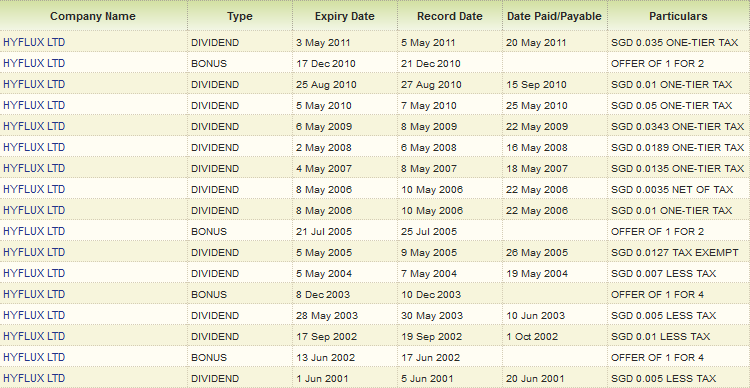
The dividend yield for Hyflux is around 2.5-3% pa. Do you wonder why it is low? Hyflux is a growth company, hence the need for cash necessarily reduces the amount given as dividend. They must obviously think that they can give you a better returns for the cash than you could. The good thing about putting your money into the ordinary shares of Hyflux is that you can participate in the upside of the company's growth. If the earnings of the company grew, the price will also rise (eventually). The bad thing is that if all these scenario didn't come to fruition, you'll end up with a possible loss. On the other hand, buying the preference shares limit the upside in terms of price appreciation. Preference shares do not move too much upwards, though it can certainly plunge downwards. Just take a look at the preference shares of the various banks during the financial crisis. The downside for preference shares is limited though, unless the underlying company fails catastrophically, because the lower the share price, the higher the yield will be. There will come a point in time where the yield is so attractive that buyers will step in to stop the downslide. If you buy at par value and hold it until redemption, there will be no capital loss at all.


My point 4 in this post on preference shares still sums up my decision on this one. I would look at it only when the price goes below the par value. I think you can still make money out of this (in fact, I think it might be a good stag). Given that you can even use up to 35% of your investible savings in CPF (the balance in CPF ordinary account plus the net amount withdrawn for education and investment) to apply for this and get a yield higher than what the CPF rates can give you, it might be worthwhile to invest some money into it.


So there, the odds are laid out in front of you. Go ahead and decide what to do with your money.


*This article is contributed to IM$avvy financial portal, which is managed by Central Provident Fund Board and supported by MoneySense. This site has a noble aim of promoting financial literacy to the general population.

Thursday, April 14, 2011

Hyflux preference shares Part 1

Hyflux recently announced plans to offer a 6% cumulative, non-convertible, non-voting, perpetual preference shares to raise funds. The purpose of this fund raising exercise is not known (or I've not read closely enough in the prospectus here). Regardless, let's see if this is worth looking into. First of all, let's take a look at the terms of the offer.


Preference shares is a type of hybrid between bond and equity (in fact, closer to bond than equity). The holder of this instrument will be entitled to dividend at 6% pa, payable semi-annually on 25th April and 25th October every year. Since this preference share is also perpetual, which means that unlike a bond, there is no maturity period for which the issuer will redeem back the bond. However, there is an option for the issuer to redeem back the preference shares on or after 25th April 2018. Take note that this is a right solely to be considered by Hyflux, not an obligation. If they chose not to redeem it back on or after 2018, then they will step up the dividend rate from 6% pa to 8% pa. If they chose to redeem it back, they will buy it back from you at par value. I will explain what's par value shortly.


Interestingly, this is one of the few cumulative preference shares I've seen. The bulk of the ones I've seen are non-cumulative. Cumulative means that in the event that dividend is not given for 25th April and/or 25th October, the payments are accumulated and paid on the next payment date. In other words, the payment are cumulative. However, dividends are not guaranteed. From what I understand from preference shares of banks, if dividends are given to ordinary share holders, preference shares must also be given theirs. This makes it almost as good as guaranteeing the dividend if the track record of dividend given by the company is anything to go by.


What's par value? In this case, it is the issue price of the preference share at S$100 per share. This preference share will be listed and traded on the main board of SGX from 26th April 2011 onwards. Since you bought it at $100 per share and it is traded thereafter, the price of the share will go up and down according to factors like interest rates, macro-societal factors and just basically, market sentiments. This means that the price can go above $100 or below $100. But on 25th April 2018, should Hyflux choose to redeem back the preference share (again, it's a right, not an obligation to do so), they will buy it back from you at $100 per share, regardless of what the share price of the preference share is at that point in time.


Those who had bought the share at $100 and held it till Hyflux redeemed it back in 2018 will realise no capital gain at all, since it is redeemed back at par value (which is $100) too. However, they get to keep the 6% pa for the period they are holding the share till 2018. For those who bought at a price of more than $100 after listing, they will make a capital loss (hopefully the dividends collected will more than cover up that loss). Finally, those who had bought at a price below the par value of $100, they will make both a capital gain as well as all the dividend collected till redemption. Should Hyflux chose not to redeem back in 2018, they will step up the dividend rate to 8% pa, instead of the usual 6% pa. You can treat this as their 'punishment' for not buying back the shares from you.


The offer for the preference share is up to S$200 million in total value (i.e. 2 million shares are offered) to the public, with an option to upsize the offer to $400 million if there is unsatisfied demand under the reserve and/or placement offer. You can expect it to be quite illiquid and characterised by huge gaps between buy and sell bids after listing, judging from the daily quotes of preference shares offered by other companies. After listing, the shares are traded in board lots of 10 shares, so buying or selling 1 lot of preference shares will be around the range of $1000 in value. As a sidenote, there is no voting rights attached to the preference shares, so holders are not entitled to attend or vote at AGM.


If you choose to buy it,you have to act fast. The public offer will open at 9 am on 14th April 2011 and close at 12 noon on 20th April 2011. The process is through ATM like all other IPOs, so you will have to pay a small fee of a few dollars for the application. Other than that, there is no brokerage charge if you apply through ATM. For the balloting through ATM, you need to put in a minimum of 100 preference shares (i.e. S$10,000 in total at $100 per share) and subsequent integral multiples of 10. In other words, the minimum you can apply for is 100 shares, followed by 110 shares, 120 and so on. You cannot apply 101 shares or 102 shares.


For those who like a surer bet, you can try calling your DBS Vicks online broker (since the sole book runner is DBS) to ask for a placement, but will be subjected to brokerage charges at a percentage of the total value. The difference between balloting using ATM and placement through your broker is that in the former, you do not pay any brokerage fees and thus are not guaranteed to get the shares, while the latter you'll have to pay a fee and will be guaranteed an amount given to you by the broker.


I'll discuss about the ultimate question - whether it is a good buy or not - in the next post. This is getting very lengthy as it is now. In the meantime, you can read about other posts I've blogged in the past regarding preference shares:


Preference shares part 1

Preference shares part 2

Preference shares part 3

Preference shares part 4


*This article is contributed to IM$avvy financial portal, which is managed by Central Provident Fund Board and supported by MoneySense. This site has a noble aim of promoting financial literacy to the general population.

Monday, April 11, 2011

The difficulties of investing

The most difficult part of investing is the fact that repeating the same thing in different times will end up with different results. That is both frustrating and difficulty to correct. Imagine you are trying to learn how to ride a bicycle. You do an action and immediately you can see the results, hence the learning cycle is reduced. You practically learn how to cycle by trial and error alone. But in investing, the duration that transpired between the action and the results could be a few years apart. If you invest in this company, it's only after a period of time, ranging from a few months to a few years, before you can see the fruits of the action that you sowed. This makes correcting for error in methodology extremely difficult and makes the learning curve steep and treacherous. Do you really want to invest in a company and realizing that it is a dud after a few years, thinking throughout the entire holding period that you need time for the fruits to mature?


The learning curve to ride a bicycle is shorter because of the immediate feedback


This reminds me of an example. Some of the schools that my students are studying in do not have the habit of giving back the test results back to the students. In doing so, the students are deprived of a chance to learn from their mistakes. In other words, they can be doing a thousand tests and still not learn what is right or wrong since they have no feedback mechanism that can enlighten them otherwise. Likewise, investing now and knowing the results after a prolonged period of time can make the learning curve in investing necessarily steep and long. In investing, it helps to be a good student of history, because while circumstances vary, the human emotions that interplay between buyer and seller stays constant. All the panicky market crashes and euphoric bubbles are there for all of us to see, but not all will look at it to learn.


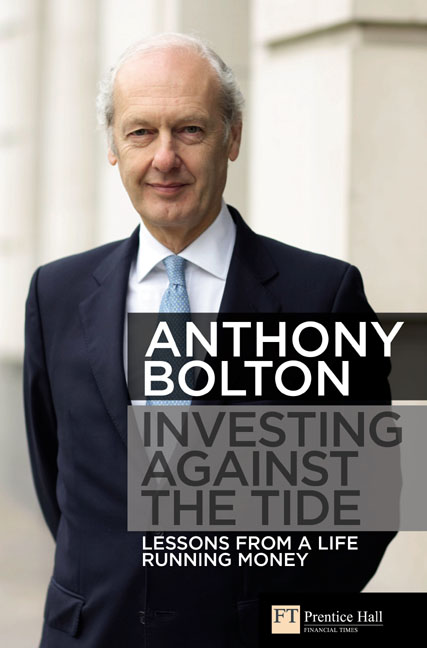
Throughout the whole market cycle, there are times when its profitable to trade, time to invest and a time to gun for yield. I think the key question is when to do which method, in order to get the best out of the current market conditions. In this aspect, I think Anthony Bolton's approach of doing different things at different times is very enlightening. I find his approach well balanced and not siding with either extremes of doing only trading or only investing. You can read more about him in his book "Investing against the tide". That being said, to really learn this, it'll take several market cycles of bull and bear before one can confidently say that one can do it well. To do this well, you have to learn different methods of playing the market and to know the right time to do each method. Difficult?


I quite like this book - it gives a very balanced view of investing vs trading


I offer an alternative that may prove tempting instead of learning how to juggle so many things in one market cycle. You can be a specialist, focusing all your attention to one single trick. You read up, you research, you practice all the time for that one single trick. If the conditions are not right, you wait as patiently as a fisherman with your calm facade suppressing the eagerness to hook a fish. Once the right conditions appear, you strike out using all the training that you've been prepared for. The hardest part of this alternative is to sit on the sideline waiting to do your single powerful trick and waiting patiently in the meantime. It is not easy doing nothing and believing that it will help you get more out of the market.


Then know this, it is even harder doing nothing when people all around you are shouting for action and making profits from the market, while you are doing nothing and believing that the right conditions for your trick is not here yet. Who ever says investing is easy?


*This article is contributed to IM$avvy financial portal, which is managed by Central Provident Fund Board and supported by MoneySense. This site has a noble aim of promoting financial literacy to the general population.

Friday, April 01, 2011

A giant living in a small world

In this horrid times, I feel like a giant roaming around in Singapore. When I go to a typical food court to have my meals, I just cannot be filled by one portion size anymore. More frequently, I'll have to order double portions or eat a light snack immediately after my main meal to ward off those growling hunger pangs. Even the drinks that I ordered seem to conspire against me, because the cups are so filled with ice that I can probably finish the entire drink in one single gulp.


When I'm at home, I'm likewise reminded of my gigantic size too. The rooms seem so much smaller than the ones I had lived in my parent's home. I remembered that we can put a round dining table right in the kitchen of my 4 room flat, and still have plenty of room to put a bar counter. There's also space for a few people to help out in the kitchen. I must had grown so much bigger now, because the kitchen these days can barely hold a proper dining table. From what I estimated, I can probably squeeze in two stools and a tiny table if I wish to sacrifice the walking space leading to the kitchen.  Dwarfish properties seem to be accompanied by gigantic prices these fell times.


Big body, small seats... familiar situation?


I'm sure some of these things are just part of the effects of inflation. While the price of the goods sold might remain the same, the quantity will have to be reduced so that the profit margin can remain as before. What can be worse is the situation I encountered when I ate a certain famous curry puff. The price of the curry puffs had not only gone up, the amount of filling inside the puffs had been reduced too, so the effects of inflation cuts you twice as much. You've to buy more at a dearer price because getting one doesn't fill you as much as before. No wonder I feel like a giant these days!


Big appetite, small portion....familiar?


However, part of my giant-ness is also due to the fact that progressively more things are packed into a smaller packaging. Capitalism? Efficiency? Consider the sardine-packed crowd in the MRT train. I feel like a giant squeezing into a tin can, hurling me at great speed to dump me to my destination. What about the buses? The seats are having lesser leg room until it is decided that perhaps they'll do with less seats and more standing room instead. Clothes? Thankfully I'm not a lady, but it seems that more women have to fit into progressively smaller sizes. Perhaps there's no more L size sold in departmental shops anymore, except during sales where all the odd sizes make their rare appearance. Men are also wearing tighter bottoms, literally named 'skinny jeans', as a fashion statement (I remembered fondly the times where baggy clothes are in...I really believe that if you stay with the same style, eventually fashion will catch up with you once again). Hand phones are getting smaller, music playing devices are getting smaller, laptops are getting smaller, your office cubicle is getting smaller, cars are getting smaller....


Is it any wonder that your money is getting smaller too?


*This article is contributed to IM$avvy financial portal, which is managed by Central Provident Fund Board and supported by MoneySense. This site has a noble aim of promoting financial literacy to the general population.

Friday, March 25, 2011

The 4 priorities

I believe that when we start working and start having a decent income stream, we shouldn't start investing straight away with that money. I think that certain foundation needs to be built first before we should think about growing our wealth. These following points, in my opinion, are listed in order of priority. I'll start with the first point with the greatest priority, followed by the last with the least priority:


1. Savings


This is the start of everything. Unless your family provides you with a huge sum of money to begin with, you'll have to work your way up. The savings is needed to build up a cash coffer for the many milestone events (like marriage, housing etc) that will likely occur in the near future. For those salaried worker, I think it's easy to set aside a portion of your monthly salary into another account, and then spend the remaining. This 'pay-yourself-first' strategy is reputed to be the best strategy rather than to spend and save whatever is remaining. For self employed tutors like me, I normally set aside cash as and when they come. My cash flow is not predictable, hence I work on a yearly savings target which is further broken down in monthly target. I'll continue transferring money (as it comes along) to a separate account until it hits that monthly savings target.


This brings about the next question: how much to save? I guess the answer to save as much as you can do it without feeling shortchanged in life. I think minimally, if you're earning 3k and above, you should be able to save at least 20% of your take home. If you can't hit 20%, you either have to find more ways to reduce your expenditure or to find more ways to earn more. As a guideline, I keep a savings percentage of around 60-80% of my cash intake.


2. Insurance


Insurance is to protect your savings. I'm not going to dive into the thorny whole life vs term fight here, but the first and most minimum protection should be a hospitalisation and surgery plan. Some might recommend using the cheap medisave plan and not a private shield plan. I leave it to interested parties to find out the advantages and disadvantages of each.  Personally, I have a private shield plan covering me to the the best ward available, complete with rider to cover the co-insurance / deductible portion. I think a disability income plan is the next important one to have, followed by the standard bread and butter life coverage with critical illness component. The permutations for the same coverage is infinite, so there's a lot of room for customisation according to everyone's needs and wishes.


I believe that it's good advice to think a few years ahead before you commit to any long term plan. I've heard stories of people committing to a very expensive plan but because it takes such a hefty toll on one's cashflow, the plan is surrendered often with a loss. I think if in doubt, do not buy first. Just seek professional advice.


I think unless you're super interested in the industry, insurance coverage is something that you want to have
without having too many headaches. Sort this out as soon as possible so that you can have a peace of mind.


3. Set aside money for emergencies


Life is often unpredictable and most of these events that popped up usually requires money. I think the standard recommendation is to have 6 months of your average monthly expenditure (including the cash component of housing loans) in the form of cash or cash equivalent (meaning the cash is put into assets that can be easily converted back into cash) ready for such emergencies. I think that the 6 months guideline is based on the premise that if you lose your job, you might need to look for 6 months before you can find one and starting earning the money to pay the bills. By having a buffer, you can sleep a little more soundly at night. Actually, I would put in 6 months of salary to have an even greater buffer, but that's just me.


This money is not to be used for investment purposes that is hard to liquefy when in need. I think the ideal place to put such a sum is in savings account, fixed deposit or money market funds (MMF). Personally, I had mine split into my investment of stocks and another portion in savings account and MMF. I don't mean that as an advice for everyone. I guess my job is slightly different because I am not in the mercy of just a single employer so my emergency coffer can be a little less liquid than the typical salaried worker.


4. Investment


I think everyone must be able to invest in some way or another. It's really very very hard to reach financial freedom by just working for someone because that is basically exchanging your time with money. To reach financial freedom by just savings alone isn't going to be easy and I think probably you'll run out of time. There willcome a time when you are older and less energetic and can no longer fetch such a good price for your time. This is where your passive income comes in. Ideally, the passive income should grow to such an extend that it can rival your active income. But where does the capital from your passive income comes from? Active work of course.


Everyone must dabble in some investing instruments, be it bonds, stocks or property. This is akin to taking a quick ride on a car along one's financial freedom route. If not, the slow march along the road would probably be too slow and you'll run out of time before you can reach your destination.


I think in investing, the capital idea is not to lose your capital. You may make less returns but as long as you don't lose catastrophically, you'll be alright as time would weave its compounding magic for you. This doesn't mean that because you have a lot of time on your side, you can take more risk. I think it's good advice that as long as you don't lose money, making any returns is a bonus. Remember, this is the extra boost that will propel you faster towards your destination. The main workhorse for that journey is still your active income, which will provide you with the first tranche of capital needed to grow more capital.


*This article is contributed to IM$avvy financial portal, which is managed by Central Provident Fund Board and supported by MoneySense. This site has a noble aim of promoting financial literacy to the general population.