Showing posts with label STI. Show all posts

Tuesday, August 22, 2017

The 4 Seasons (part 2)

I wrote a article about the different seasons using the MACD (moving average convergence divergence) indicator here. In it, I talked about how the four seasons can be characterised objectively by looking at the slope and the positivity/negativity of the histogram. Let's see if we can replicate that into another indicator - the moving average.

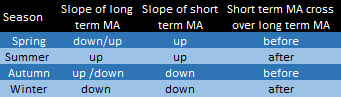
There are a few kinds of moving average, and usually I'm using exponential moving average (EMA) because they are more sensitive to the latest price movement. Moving average should be drawn in a pair, one shorter and one longer term with the longer one being twice that of the shorter one. That means if you use 10 days MA, you should include 20 days MA as the longer term line. It doesn't really matter which days you're using, it could be 50/100, or 100/200, but for the purpose of this article, I'm using my 13/26 days EMA. 13 days EMA is my short term line and 26 days EMA is my longer term line, unless otherwise stated.

Here's the matrix:

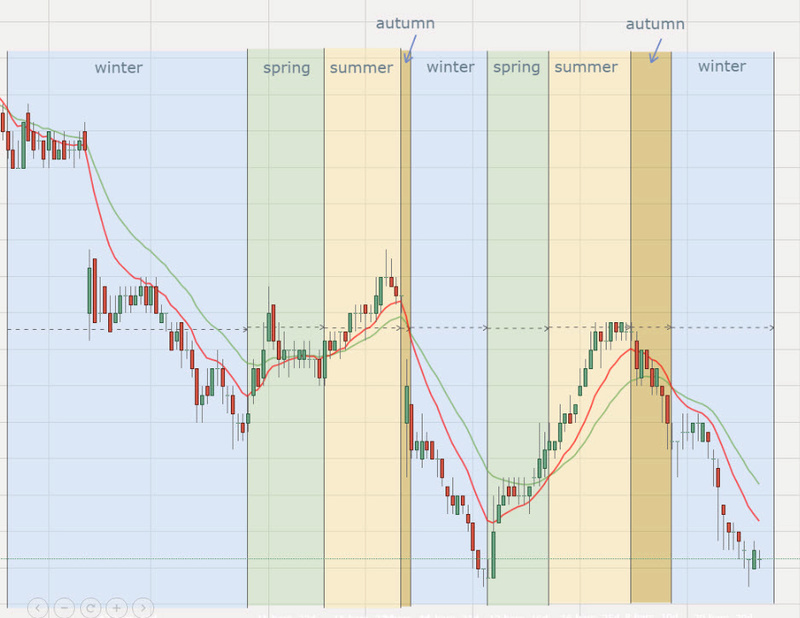
I'll illustrate with an example: Singpost
(The red line is the short term line - 11d EMA and the green line is the long term line - 22d EMA)


Different stocks are like different countries in different hemispheres. Some are freezing in deep winter while others are sweating in hot summer. Some have longer summer and shorter winters, while others have longer winters and shorter summers.

Let's have a look at the different index:

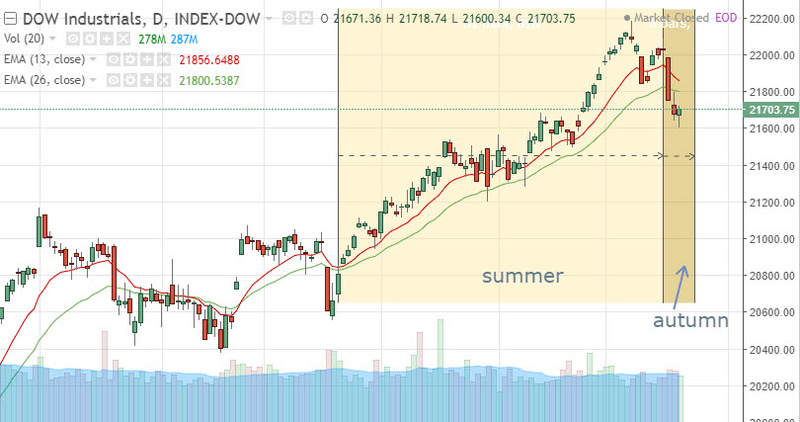
DJI : after a prolonged summer, it's autumn now

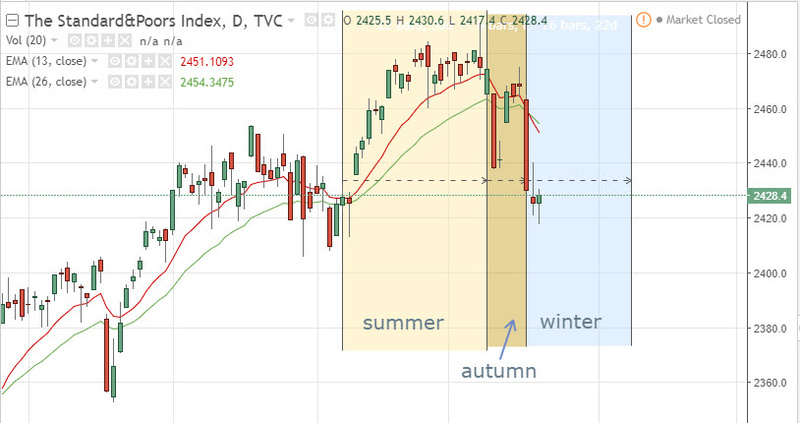
S&P: autumn had given way to winter. The first snow just fell a few days ago.

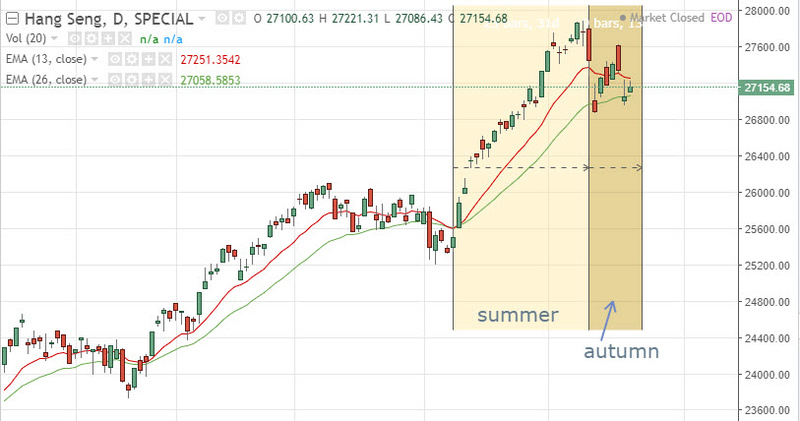
HSI: It's still bright and sunny, but to the observant ones, some of the leaves on the trees are turning brown and starting to fall


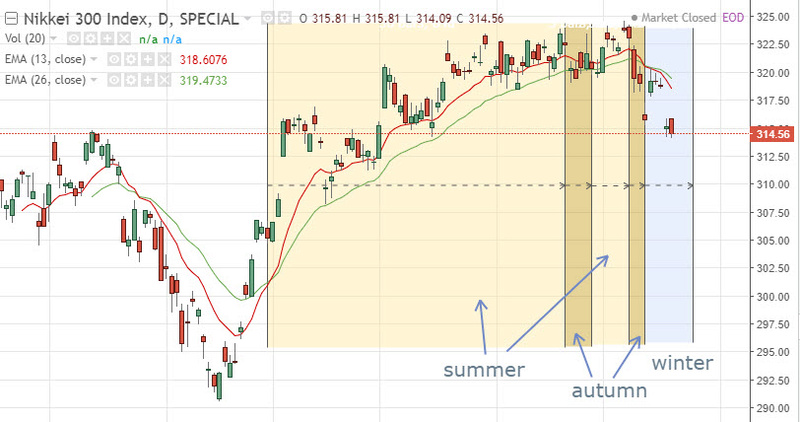
Nikkei: strange weather phenomenon. Very long summer, a fake autumn, another shorter summer and a brief autumn, bringing us to winter now

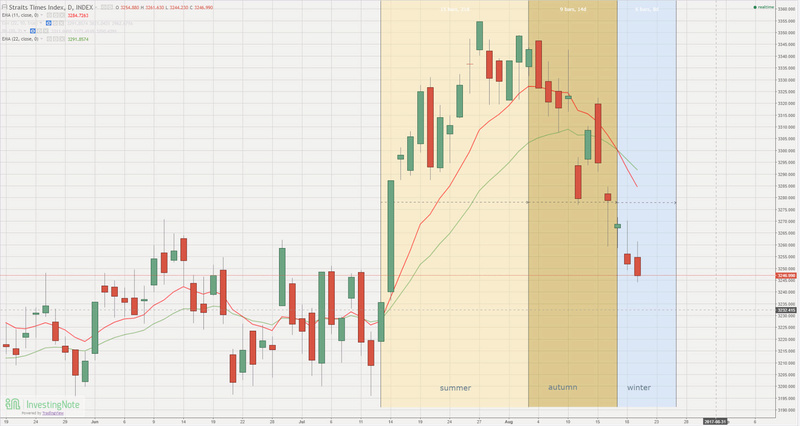
STI: winter is coming (or had already come).


This is neither a rally to buy or to sell, it's simply weather reporting. I'm not even forecasting. Doesn't matter whether it's summer or winter, we just make sure we fatten ourselves during summer to prepare for winter, and do the necessary prep work to plant the seeds just when the last snow falls to prepare for the bright sunlight during summer.

Friday, December 06, 2013

Thoughts about STI part 3

After looking at Drizzt's blog regarding the yearly percentage returns from Dow Jones here, I wanted to have a look to see how our very own STI would look like if the same information is sliced up and presented.


Source:

The raw data of ^STI is taken directly from Yahoo! Finance site here. The adjusted closing price is used and according to the same site, it refers to the closing price for each day adjusted for splits and dividends.


Calculation of yearly returns:

I take the adjusted closing price of the last market day of each year, divided by that of the first market day of each year, then subtracted by 1 and multiplied by 100%. Each calculation is rounded to 0 decimal places. Dividends are also not included in the returns, so are the costs of ownership and brokerage.

For example,

Adjusted closing price for 2012 (31st Dec) is 3167.08
Adjusted closing price for 2012 (3rd Jan) is 2688.36

[(3167.08 / 2688.36) - 1]*100% = 18% (0 decimal places)

Since 2013 is not yet over, I use the latest adjusted closing price for 5th Dec 2013 to estimate the yearly returns. Unless something drastically happens, I think it should be a fairly good estimate.


Results:

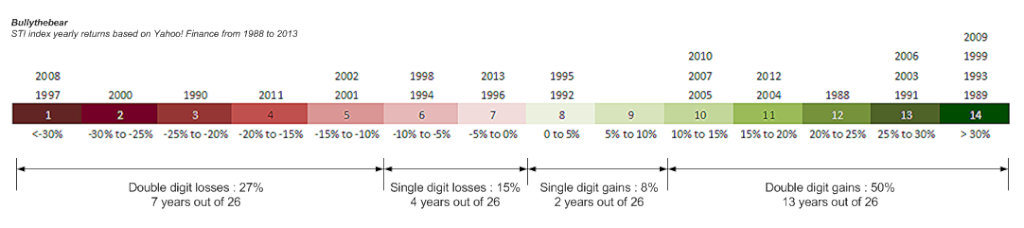
Here, this is how it looks like for our STI:


Yearly returns of STI from 1988 - 2013. Click to see a bigger version.


Observation:

1. It's interesting to note that there's a general bias towards gains throughout the (short) history of STI. 15 out of the 26 years recorded (58%) are gains, while the rest of the 11 years (42%) are losses.


2. 1 out of every 2 years (50%), there'll be a double digit gains. If you look back at Drizzt's blog, it's about the same for DJ (49%). On the other hand, 27% of the time, there'll be a double digit losses for STI, compared to 22% chance of double digit losses for DJ. As mentioned in point 1, there's an inherent bias in the index towards gains.


3. For STI, 15% of the time, there's more than 30% gains. To give an illustration as to what a feel of 30% is, consider for a moment that for a base of 3000, a 30% gains will be 900 points added, so that's quite a massive increment yearly. On the other hand, about 8% of the time there'll be a more than 30% losses. To compare with DJ, it's 6% of the years having more than 30% gains, and 5% of the years having more than 30% losses.


4. The median returns is 6.6% and the average returns is 8.8% (it has, however a standard deviation of 29.1% - which means it's as volatile as a boat out in the sea on a typhoon).


5. For those years that posted a yearly gain, the median gain is 24.6% while the average gain is 27.8% (with standard deviation of 21.3%). For those years that posted a yearly loss, the median loss is 14.4% while the average loss is 17.9% (with standard deviation of 12.4%). It's funny to see that the losses are more consistent that than the gains.


Thoughts:

Does it mean that we should scramble and go get STI index straight away? Well, yes and no. Do take note that while the results here suggests that it's more likely to have gains in STI every year, implying that you'll gain more likely than you lose if you hold STI, the results are based on a yearly returns. This means that you'll have to buy at the start of the year and sell at the end to mimic this result, assuming that the past is any indication of the future. If you hold STI over a period longer than 1 year, your returns will vary significantly from the results shown here.


Let's pretend that you have $100 in year 0. After you lose 30% of it in year 1 and lose 30% of it in year 2, you still lose 9%. In other words, timing and the holding period matters a lot. I blogged about this years ago here and here that if your average holding period is 14 years, then you're safe from having negative returns (there's some assumptions in this conclusion too). Any shorter period of holding may result in a negative returns or it may not. It depends on your entrance price and exit price. In other words- timing.


I guess the take away is that if you want to do dumb-idiot-proof averaging (I'm not against it, btw. In fact, I'm quite for it if you don't want to care a hoot yet want to have a reasonable returns for your money), then you better choose a stock that is inherently bias towards safety. And what safer stock is there then index because of all the gains-bias and survivor-ship bias? Since the underlying is already there, you just need to worry about the cost. Find the lowest cost of holding index and you can just carry on your life with other more interesting stuff compared to finance and investing.

Tuesday, October 07, 2008

The floor's slippery - it's covered with thick, red liquid

Chicken Little starts screaming "It's the end of the world!"


With STI falling 5.61% to reach 2,168 and DJ now hovering below 9800, dropping 5.12%, it's hard not to see otherwise. I didn't expect DJ to drop below 10k, which is an important psychological level for investors. Here's my views on STI:


Support level 2100, 1800 then 1600?

Tuesday, September 30, 2008

Death of equities?

This is the shock I got when I opened up yahoo! finance this morning, like all morning.


I've not seen such a precipitous drop in DJ or SP500 before! STI's fall yesterday seems like child's play when compared to the big brothers over at US. I think STI might fall 6% too, so it will be around 2200. Too bad I've got work, otherwise watch the historic moment unfold.

When I came back home, I was rather shocked to learn that STI did not break 2200. In fact, it's slightly neutral at -0.1%.


What a world of difference a few hours make! Market is hard to predict indeed. STI is surprisingly strong. After going down to 2240, STI rebounded and never looked back. HSI also went from -1k to +135 intraday. Invisible hands at work here?

A little market trivia: The title of this article, "Death of equities", was published by Business Week. Then, DJ was around 800. But by the early 90s, DJ had risen over to over 3k. The rise was started around 3 months after the article was published :)

Wednesday, August 27, 2008

Falling wedge formation

Doing this for a friend who asked me what is the meaning of falling wedge formation.


It's true...there is a falling wedge formation, awaiting confirmation. If it breaks green line (esp with heavy volume), then bullish confirmation is confirmed. This means there is more upside. I think this is quite likely. It's possible to reach up to 3010. If it breaks red line, then bullish signal becomes very very bearish sign. I think it's unlikely, but if it happens, then we might see 2400 level.

Tuesday, August 19, 2008

Thoughts about STI part 2

Was nudged by millionairemind to do a little investigation into the total returns of STI should year 2008 fall by 20%. Since I have not been checking STI absolute value (I did check the daily relative % drop/rise though), I was quite surprised that since the start of the year, we've dropped a cool 20%.

I did post a table with the values of all the CAGR for different years from investing in STI, in this post. I think this time, I better list down my assumptions for calculating the values:


1. Most importantly, the data is taken from Yahoo! finance website. The price is adjusted closing price.

2. The CAGR (compound annual growth rate) is calculated like this:

To find the CAGR from period A to period B:

CAGR = (price at 31-dec of period B / price at 1st-jan of period A)^(1/(B-A)) - 1

If market is not opened on 31st Dec or 1st Jan, the price of the market days closest to the dates will be taken instead.

3. The AVERAGE CAGR is calculated by taking a simple average of all the CAGR of the same period i.e. sum of all CAGR of the same period divided by the number of CAGR taken.

Below is the table calculated for the returns on STI for different periods, assuming that 2008 closed on 31st Dec at 2769, a 20% drop from 1st Jan 2008:


For comparison, here is my earlier table posted, without taking into account 2008:


Here's what can be observed:

1. Average CAGR dropped across most periods. 'Most' is the keyword. Average CAGR for 5-yr, 7-yr, 10-yr actually increased. I don't ascribe any significance to this fact, because of the way I computed the CAGR. I took 1st Jan and 31st Dec as the price for each period of calculation, so I'm very sure that if I changed the starting and ending period to take the price (say, using 1st June to 1st-June next year), the whole data will change.

2. Adding data for 2008 still doesn't change the fact that after investing for 14-yrs, there is not a single year of negative CAGR. This means that based on historical data, if one invests in any year in the past, for 14 years starting from 1st Jan and selling on 31st Dec of the 14th year, you will not make any losses. But the returns are a pathetic 3.1% per annum (on average) for a period of 14 yrs.

Again, this would most definitely change should I change the dates where I calculate my CAGR for different periods.

3. This much I can conclude: Investment period and Average CAGR seem to follow a U-shaped curve. There is a period of declining average CAGR from 1-st year till around the 10-14th year, beyond which, the average CAGR increases with period of years invested. However, the shorter the period of investments, the more volatile the the returns are. Conversely, the longer the period of investments, the less volatile the returns will be.

4. Here's a very interesting observation when I break down the percentage of getting positive CAGR for different investment periods.

------Years----total number of samples----number of +CAGR-----% of +CAGR
-------1 yr-----------------21---------------------12---------------------57%
-------3 yr-----------------19---------------------14---------------------74%
-------5 yr-----------------17----------------------12---------------------71%
-------7 yr-----------------15----------------------10---------------------67%
------10 yr----------------12-----------------------9----------------------75%
------12 yr----------------10-----------------------9----------------------90%
------13 yr-----------------9-----------------------8-----------------------89%
---14 yrs onwards---------------------------------------------------------100%

It's quite obvious that the longer the period of investments, the lesser the number of years in which one gets negative returns, no matter which year they started the investment. As mentioned, on the 14th year onwards, all the sample data gave positive CAGR.

But all these mean nothing if the percentage of losses in sample data is greater than percentage of gains in sample data. What I mean is that even though, based on past data, there are greater chances of getting +ve returns no matter what investment periods I choose, I can still lose money if the % of losses in losing years are greater than the % of gains in winning years.

Let's see this table:

------Years----Average gains of +ve years^----Average losses of -ve years#
-------1 yr-----------------28.1%---------------------16.2%
-------3 yr-----------------12.3%---------------------10.3%
-------5 yr-----------------9.8%-----------------------5.2%
-------7 yr-----------------7.6%-----------------------3.8%
------10 yr-----------------4.4%-----------------------1.7%
------12 yr-----------------3.2%-----------------------0.3%
------13 yr-----------------3.3%-----------------------0.8%
------14 yr-----------------3.1%
------15 yr-----------------3.6%
------16 yr-----------------4.6%
------17 yr-----------------5.0%
------18 yr-----------------5.5%
------19 yr-----------------5.6%
------20 yr-----------------6.3%

^ average gains of +ve years means the simple average of all the gains made for that particular years of investment
# average gains of -ve years means the simple average of all the losses made for that particular years of investment
* There are no average losses data for 14th year of investment periods and beyond, because there are no -ve years.

I am quite surprised by the results. Not only are there higher probability of getting positive years, the average gains for every data for different investment years yield the same results - the average gains of positive years is much more than losses incurred in negative years. But of course, average doesn't mean anything. On average, each family in country X has 2.2 children doesn't really mean they really have 2.2 children. The same logic applies here.

Monday, May 05, 2008

Thoughts about STI

While trying to find out more about the compounded returns of investing in STI ETF today, I managed to crunch some numbers for the adjusted close of STI since inception on 28th Dec, 1987 till now. The data that I used comes from Yahoo! finance. Below is the chart (linear y-axis) of STI from inception till last close, on 2nd May 2008.


We can see from the STI chart that there are notable periods of time that it dropped sharply. In 1990, 1998, 2003 and 2007, we can see a visual drop in STI. But I think a more appropriate chart to use is a logarithmic y-axis, so that we can better appreciate the change in % of STI.

It's interesting to take note that while the 1990s and 1998 crashes are very severe, the 2007 subprime crisis which is acting out now is a mere blip on the chart. In fact, the subprime crisis is nothing compared to 1998 where the market crashed below inception level. That must be the dot com crisis that plagued US and possibly spilled over to Singapore shores. (I made a mistake, it's not the dot-com, it's the asian financial crisis of 1997-1998)

It's actually very encouraging to see such charts because it gives hopes to investors that while all seems lost, time itself will right the wrong and correct the excesses, hence there is no need to worry about the current crisis if one's holding power is there. But some may argue that STI ultimately is a collection of a number of big caps ranked in market capitalization, so while STI may rise, retail investors investing in smaller pennies might suffer much more than suggested otherwise. There is also the added complication of survivorship bias where those who didn't survive are taken out of STI, hence STI isn't such a good beacon of hope. Well, that's true.

I further compiled a table that shows the compounded annual growth rate for STI taken at different periods of time : 1 yr, 3 yr, 5, 7, 10 to 20 yrs, just to see what sort of returns one might get from holding STI.


One will surely notice that the further one holds, the lesser the chances of having negative returns. The break even year is actually 14-yrs holding period - which means to say a person holding STI for 14 yrs will not have a single year of losses. But of course this comes at a price; holding longer period will ensure less returns but it's safer than say, holding over 1 year period.

Holding STI over a period of 20 years will reward the patient investor with a very safe and compounded returns of around 7%, beating long term SG bonds hands down (SG bonds give only around 4% long term). With the CPF rate pegged to long term SG bond rate, I wonder why investors would not consider a passive and low cost fund like ETF, it's certainly not exciting but it beats most investment out there without the holder needing anything but patience.

Not exactly my kind of returns though :P