Showing posts with label Bonds. Show all posts

Friday, September 21, 2018

The returns of OCBC 5.1% preference shares

I bought the OCBC preference shares, OCC 5.1% NCPS, a while ago for my parent's retirement funds. I didn't even know that OCBC had redeemed back the perp on their first call date until I saw the capital returned to my bank account. Another one bites the dust... So how had it performed? Let's take a look at the details:


1st tranche:

Buy date: 3rd-Feb-2014
A) Buy price: $106.10
B) Quantity: 100 shares
C) Comms paid for buying: $37.19
D) Dividend collected: $2551.40
E) Total profits: 100*B + D - 100*A - C = $1904.21
F) Recall date: 20th Sept 2018
G) Total duration: 4.63 yrs
H) Total % profit: E/(100*A + C)*100 = 17.88%
I) % returns/yr = H/G = 3.86% per annum

2nd tranche:

Buy date: 14-Jan-2015
A) Buy price: $106
B) Quantity: 100 shares
C) Comms paid for buying: $36.30
D) Dividend collected: $2041.39
E) Total profits: 100*B + D - 100*A - C = $1405.09
F) Recall date: 20th Sept 2018
G) Total duration: 3.68 yrs
H) Total % profit: E/(100*A + C)*100 = 13.21%
I) % returns/yr = H/G = 3.58% per annum


I think the returns per annum is pretty decent, especially at those times where the Singapore savings bond is not even available yet. Those are the times when the interest rate is super low. In fact, so low that I am compelled to help my parents because their default action is to put into fixed deposit.

I'm glad I didn't screw it up for them.

Wednesday, June 06, 2018

Astrea IV private equity Class A-1 bond

Astrea IV is a wholly owned subsidiary of Azalea Asset Management Pte. Ltd, which is indirectly wholly owned by Temasek Holdings. They are issuing bonds from their private equity funds, so this marks the first time we have a retail bond linked to companies that are not publicly listed and thus not accessible to the general non-accredited retail investors like you and me. Wholly shit.


BOND DETAILS

Name: Class A-1 Bonds 10NC5

Interest: 4.35% pa, semi annual payment. If not redeemed after 5 yrs on Jun 2023, will step up to 5.35% pa

Maturity: 10 yrs, on 14th Jun 2028 with scheduled call date on 14th Jun 2023. "Scheduled" is not "optional". If there is sufficient cash set aside for the class A bond to be redeemed, it must be redeemed. It's not an option. 

Application for IPO: Min $2k, with integral multiples of $1k thereafter

Period of application for IPO: 6th Jun 2018 9am to 12 Jun 2018 12 pm

Rating: Expected to be rated Asf by Fitch and A(sf) by S&P

Extra features: There is a bonus redemption premium of an amount not exceeding 0.5% of the principal amount. This means that if the par value if $1.000, the bond might be redeemed at less than or equal to $1.005, if conditions are met. The condition is that the sponsor receives 50% of its total equity (US $313 million) on or before 14th Jun 2023.

You can read more details from the full prospectus here. Product highlight can be found here.


Kyith has a more in depth and detailed write up on this same bond, so if you're into the nitty gritty details, you can check it out here. Kenichi kindly shared this video by Azalea regarding the bonds. Have a look below:


PERSONAL TAKE

1) Firstly, this is not Hyflux. This is a rated A bond by the rating agency. While I don't give a shit what they say about the bond, ultimately a rated A bond is still better than an unrated bond because the financials support it.

2) Putting money into a bond is lending money to others, who are likely going to take the borrowed funds and invest at a higher returns while giving you a lower interest. If you're not comfortable lending them at 4.35% while they earn an astronomical returns of 15 to 30% and pocketing all the difference, then don't lend. The risk profile of investing in private equity fund directly and lending money to private equity fund in the form of bonds are totally different. While it's true that private equity investors have higher upside, they have a greater downside as well.

3) After IPO, the bonds is going to be transacted in the open market at SGX on 18th Jun 9am. If you're not going to hold until they redeem back, you can sell it off at the market price. The market price is just what the name suggests - it can be higher or lower than the capital you put in, and you still have to include commissions. If you hold until maturity at the 5 yr or 10 yr mark, then you'll get back all your principal, and perhaps plus a little more because of the bonus redemption premium.

4) The interest rate is going up now, so in the event of a huge rise in interest over the next 5 yrs or so, the market price of the bond might go lower. If you can't hold for the entire duration of the bond until they redeem it, you might have to suffer a capital loss. But if you hold till redemption, it'll be redeemed at the principal value, minimally. In other words, it's capital guaranteed upon maturity.

5) Since the interest rate is going up, there might be more enticing bond than this in the future. I wouldn't put my whole warchest into here. A suitable allocation here should be fine. I'll be applying for this. Initially I wanted to put in some new funds from my parent's retirement fund into here, but I think I'm having second thoughts.

Tuesday, November 15, 2016

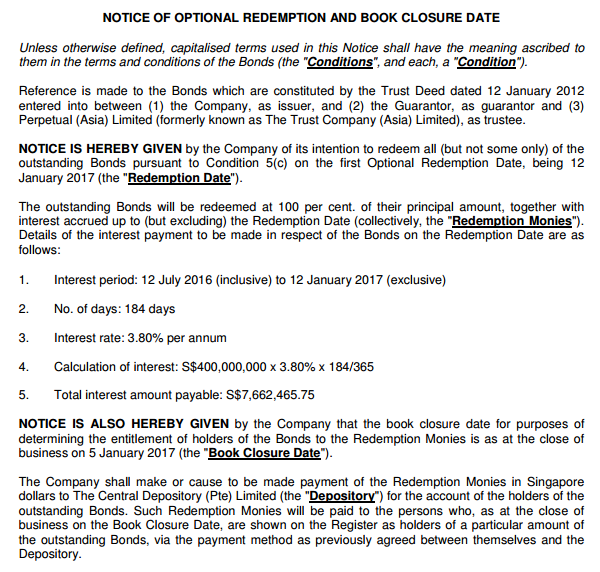
Capitamalls asia bonds optional redemption

Another bond bites the dust.

Don't worry, this is not from the troubled oil and gas sector. It's the optional redemption of Capitamalls asia bonds, CapMallA3.8%b220112 announced from sgx here. I blogged about the bonds here and here.

The full maturity of the bond is actually on 12-Jan-2022 but there is an option for early redemption on 12-Jan-2017 and every year thereafter. Since there is a step up option for the bond  if it is not redeemed on 12-Jan-2017 to 4.5% instead of 3.8%, I guess there's every reason for them to redeem it back in full. The 3 months SIBOR now is 0.87%, about doubled since Jan 2015. I guess I was wrong to think they wouldn't redeem it. There's still another bond out there with 3.08% by Capital Mall Trust (not the same, but yeah) with no step up option and with maturity date in 2020.


How would this affect me?

It wouldn't affect my portfolio because I don't have any more of this bond. But it'll affect my parent's retirement portfolio, to the tune of $26k. Guess what, I'm going to take the redeemed amount and return it back to them. The last time OCBC pref shares redeemed back, I took the money and reinvested back into FCL bonds, but I'm not going to do so now. It would seem that in the very near future, it might be better to put the money in the safety and guarantee of a fixed deposit in the banks, rather than to take that extra bit of interest and risk the price volatility of the bond. Especially if I'm the one guaranteeing their capital.

Nope, going to return them the money. No more reinvestment of the money into bonds for them.

Wednesday, May 18, 2016

Hyflux 6% perpetual securities

This morning, I was quite excited to receive news of another retail bond. This time it's from Hyflux. The last they did that was in 2011 and I made a 4 part series on preference shares here. Back then, they are issuing 6% cumulative, non-convertible, non-voting and perpetual preference shares. This time, this issue seems more like perpetual shares than bonds. The difference is not significant though, given that it's a perp, so there is no maturity date even though there is a optional but not obligated redeemable date.


Terms of the security 

The terms of the perps is spelled out very clearly in the announcement here:


1. Public offer of up to 230 million (can go up to 250 million), out of total size of 300 million (can go up to 500 million) if oversubscribed


2. Opens on 18th May, close on 25th May noon


3. Min amount is $2k, thereafter in multiples of $1k.


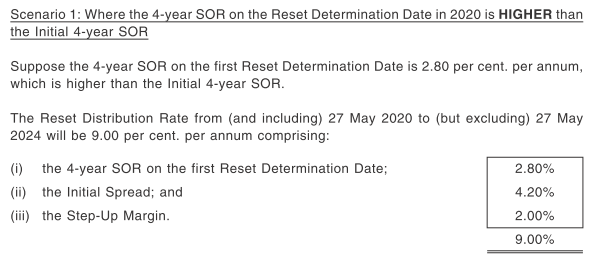
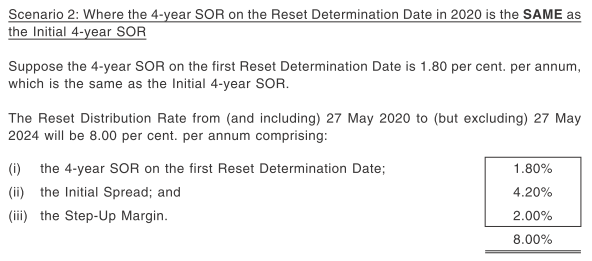
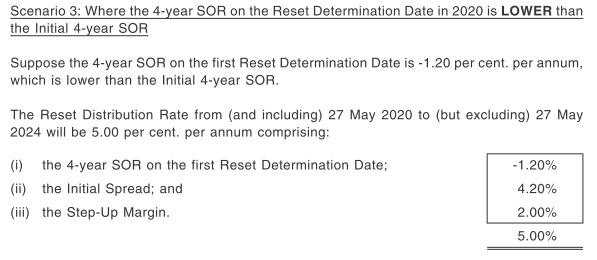
4. This is the interesting feature about the issue. They are giving 6% pa, paid semi-annually (on 27th May and 27th Nov every yr) for first 4 yrs until and excluding 27th May 2020. From 27th May 2020 (inclusive), it'll not be 6% pa anymore, but will be at reset distribution rate.

Reset distribution rate = 4 yr SOR on the reset date + 4.2% pa, + step up margin of 2% pa

They gave excellent illustration for 3 different scenario after 2020 to 2024, shown below:


5. From 2024 onwards, the distribution will be reset again using the formula shown in point 3, but with a new 4 year SOR rate at the reset date in 2024.


6. Is there guarantee of payment if you're a holder of the security? The prospectus states that "each security confers a right to receive distribution on its outstanding principal amount from the issue date at the applicable distribution rate". The word 'right' doesn't sound right. It offers them a possibility to defer distribution under certain conditions and is no way guaranteed. Reading further from the prospectus, it mentioned that the issuer may elect not to pay a distribution (or to pay a part of) by giving ample notice. They may not elect to defer any distribution if 6 month before the scheduled distribution payment date, one or both of the following occurred:

a. A dividend is paid to its junior obligations. I take junior obligations as the ordinary shares of Hyflux. I may be wrong.

b. If the junior obligation is redeemed, reduced, cancelled or bought back.

This means that if they give out dividends in their junior obligations (I take it as the ordinary shares of Hyflux, which I may be wrong), and/or they did not redeem, cancel or bought back all the junior obligations in a period of 6 months before the distribution payment date, they cannot defer distribution to this security.

Don't ever think they are obligated to pay holders of this security. You have a right to receive but they are not obligated to do so under the stated conditions. But it's not as bad.

They have a feature in this issue that is quite similar to any cumulative pref shares or bond. If they did not pay out any distribution in full or in part, that portion that is not paid out will be placed under arrears of distribution. They will have to pay out the arrears, plus any distribution, by the time they redeem back the securities, or by the next distribution payment date, or before they wind up, whichever comes earlier. If not, they cannot declare or pay dividends to its junior obligations or to redeem, back buy, cancel, reduce it.

I think in simple layman's language, it just means that they must pay out the dividends on the distribution date, unless they are also not giving dividends to hyflux ordinary shares/bond/pref shares holders. That is your sort of guarantee that they will pay out what they should pay out.


7. First redeemable date is on 27th May 2020, which is about 4 years from now, at the par value. They have to redeem all the outstanding amount or none at all. Thereafter, on each distribution payment date, meaning 27th May or 27th Nov after May 2020, they have an option to redeem back too. As mentioned earlier, this is a perp, so there is no fixed maturity date.


Financial strength of Hyflux

Alright, so far that's just the details of the perp. It's quite a complex issue, if you ask me. My initial excitement becomes a lot more muted once I took a look at Hyflux results.


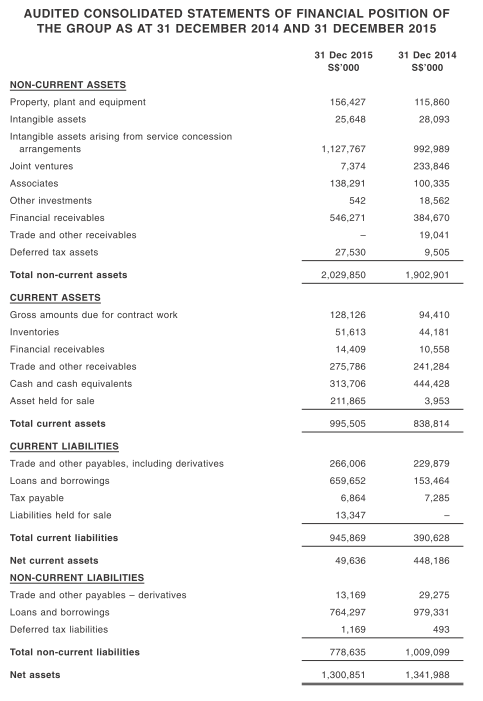
Debts debts debts. Just mountains of them. I think they are rolling about in their notes and preference shares debts, issuing new ones to redeem older issues. Even this current issue is to redeem back the older issued notes. Specifically, 91.66% of the proceeds is to be used for the repayment of the $100 million 3.5% notes done in July 2008 and updated on Jan 2016, and another $175 million 4.8% outstanding perps (this is not the retail 6% one).

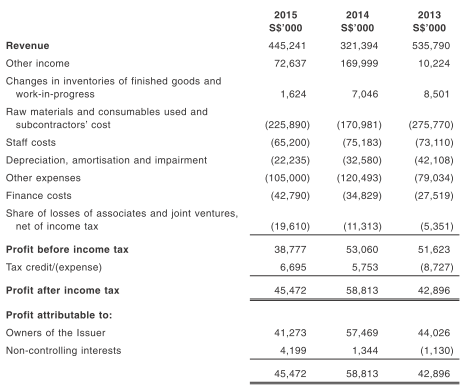
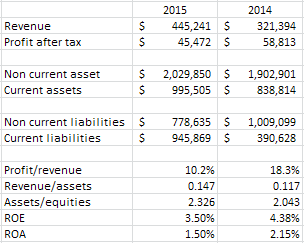
I'm too lazy to dig out past 10 yrs of financial statements, so using the last 2 yrs should suffice:


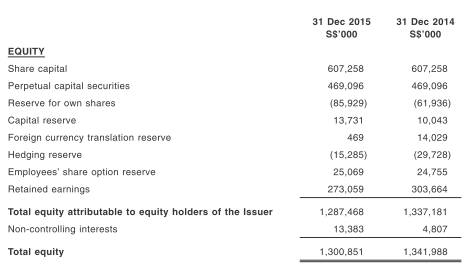
With a ROE of 3.5% in 2015, this isn't a company that I would have invested. But the pref or bonds issued might be a different story. Are they highly leveraged? Below is the ROE for Oxley. They also recently issued a new bond less than a year after their had their first retail one.


Looking at their financial leverage (Assets/equities), Oxley is the more leveraged one, but they are different industry of course. There really isn't a direct comparison for Hyflux. The question is, can they survive for 4 years or more and continue giving dividends to their ordinary shares as well as their bond/perps holders? I'm not confident. Revenue is contract and order based, so a bit lumpy. Even with their leverage, their ROE is not fantastic too. Their free cash flow isn't exactly very stable, and most years are just negative. I suppose they will have to continue borrowing from Peter to pay Paul.


Existing Hyflux 6% CPS


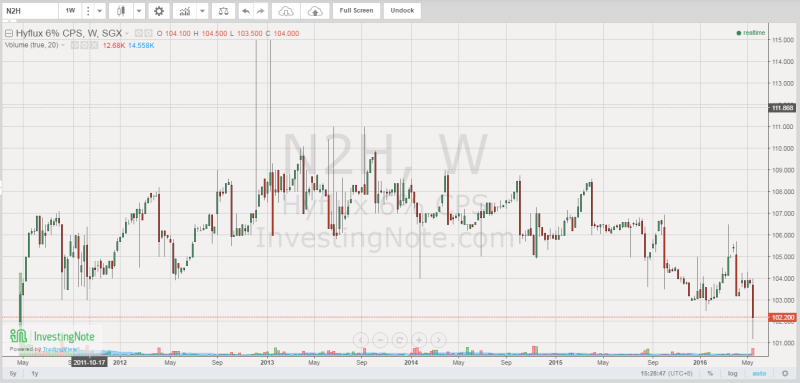
Throughout their listing, the hyflux 6% retail preference shares had never once dipped below its par value of $100. May 2011 to the present time isn't exactly kind to the stock market, so having maintained its share price above par is a great comfort to its holders. It acts as a good place to store their cash - it's a good cash equivalent that pays 6% pa, if you want to see it that way.

Their terms is 6% pa, payable semi annually on 25th April and 25th Oct every year, with first redemption on 25th April 2018. Thereafter, they will step up the rate from 6% to 8% if they don't redeem back.

Based on current price of 102.2, the yield to maturity until first redemption date is about 5.8%. Maybe by then, Hyflux will issue another preference shares, either institutional or retail, to roll over the debt. Considering that their pref shares at this kind of environment is still 6%, I think it'll be cheaper than to pay a higher stepped up rate of 8%. Maybe that's why the price of the pref shares is dropping steadily to par value. We're about 2 yrs shy of that first (optional) redemption date.

Note that the price shot up 3% on the first day, and thereafter within 2 months, shot up to about 7%. Not too shabby for a pref shares with 6% yield.


Conclusion

In summary, weak company but strong pref shares and dividend paying record. But that's all in the past, will it continue in the future? I think so and the gameplan, like Oxley and Perennial, is to continue issuing such bonds in the future. This should be quite a hot issue, I suspect. Actually, anything that is higher than fixed deposit rate is hot in Singapore these days, lol


Good for a stag. I'll expect it to be very hot.

Wednesday, April 20, 2016

New perennial 4.55% 4 yrs bond - Goodbye or good buy?

Looks like yet another bond offering in the local retail bond market. It's always the same few players offering bonds, and this time it's by Perennial Real Estate Holding (PREH). They just offered a 3 yrs 4.65% bond in Oct 2015 that I blogged about it here and now they are back at it again.


This time round, it's a 4 yrs 4.55% bond. Let's see how it compares with the currently traded 3yr4.65% bond.

Last close price of 3yr4.65% bond: $1.012
Par value of bond : $1.000
Capital loss from buying above par: $0.012

Total no of coupon payments left: 5
Payout for each coupon payment: $0.02325
Total returns upon maturity: 0.02325x5 - 0.012 = $0.10425
Total % returns: 10.301%

Maturity date of bond: 23rd Oct 2018
Today's date: 20th Apr 2016
Total holding period: 916 days or 2.51 yrs
Average returns: 4.10% pa
Yield to maturity: 4.22% pa


Here's the chart of how it performed since listing.


Screenshot from Investingnote

The gap down around mid April 2016 is due to the XD for its first coupon payment to be paid out at the end of April this year. It didn't go below its par value at all since listing, even during the severe drop around the start of the this year for STI. The newly listed Aspial 5.3% bond didn't share the same fate - it's now currently traded below par. Even the older Aspial 5.25% bond is trading below par too.


Good bye or good buy? I wouldn't buy it. 4 yrs seem to be a little long given the potential increase in interest rate in the near future. In 4 yrs time, it's bound to be a certainty, just a matter of how much it'll increase, so for those who are buying, be prepared to hold till maturity. Your capital might not be preserved if you need to cash it out for stocks purchase, for example.


I guess you have to ask yourself whether there are better alternatives out there - like those stocks with bond like qualities haha

Wednesday, March 23, 2016

Aspial 5.30% bond (AGAIN) - Good buy or Goodbye?

Aspial is issuing out new bonds again. The last time that did it was back around Aug 2015, giving 5.25% pa with maturity period of 5 yrs, which I've blogged about it here. This time round, they are upping the stake, giving 5.30% pa with a maturity period of 4 yrs.


The expected issue date is 1st April 2016, and since this is a retail bond, you can bid for the allotment of the bonds through ATM as well. DBS is the sole lead manager and bookrunner, which is the same as last year.


I don't think much had changed in the fundamentals of Aspial over the course of less than 1 year. If anything, it should get worse or at best neutral. So fundamentally, Aspial is just about the same company as it was last year. It's a company that I won't invest in, to put it bluntly. But what about the bond? Will you lend money to them? Will they survive for 4 yrs for them to pay out the coupons of the bonds? Nobody knows.


Let's see how their bond 5 yrs, 5.25% bond performed last year. It went to a high of 1.020 to the most recent 0.984 after their most recent coupon payment this year around Feb. The price had went up to today's transacted price of 0.996. There are a total of 10 coupon payments each with $0.02625 (5.25% / 2), of which one is paid out, leaving 9 left. What's the total returns of that bond if you buy at today's transacted price of 0.996?


Total no of payments left: 9
Payout per payment: $0.02625
Total coupon payout: $0.23625 (9 x 0.02625)
Capital gain from buying below par: $0.004 (1-0.996)
Total gain excluding comms: $0.24025 (0.23625 + 0.004)

Total % returns: 24.12% (0.24025/0.996)
No of days till maturity in 28 Aug 2020: 1619 days or 4.436 years
Ave % returns pa : 5.438% (24.12/4.436)


5.438% if you buy their issued bond last year, as opposed to this new bond 5.3% and they roughly matured in the same year as well, just a difference over a few months. Of course you need to include the brokerage commission to buy the traded bonds at SGX, compared to just paying $2 to bid for the bond over at ATM, so it's going to be lower than 5.438% after brokerage. Since the traded 5.25% bond is giving a better return than this upcoming 5.3% one, I think it's not such a good deal. But as mentioned, you have to include brokerage. It might not work out to be of much difference I suspect.


The advantage of bond can be seen easily with the chart below:


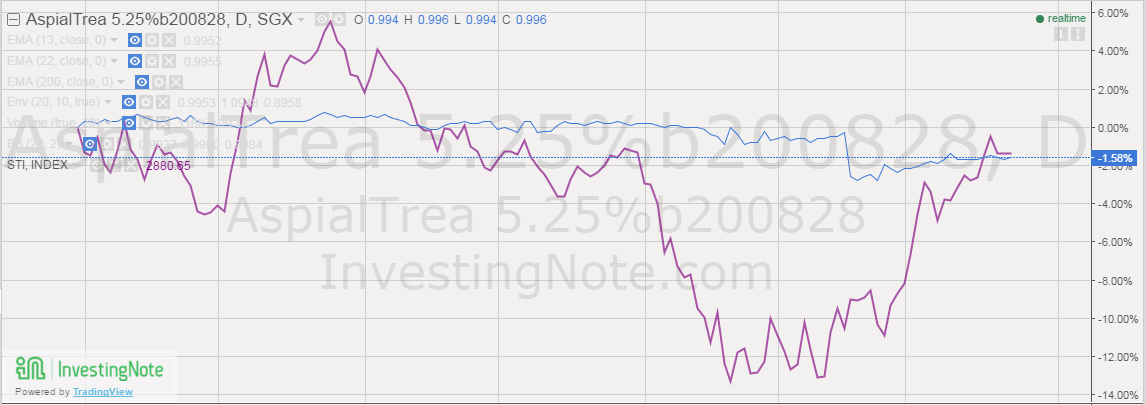
Blue line is the Aspial 5.25% bond while the purple line represent the index STI.


The chart is generated using Investingnote. It's free and I can't recommend it enough. It's even better than the (also free) Chartnexus with real time and also more historical price data to choose from. Anyway, you can see that the price of the bond stays relatively the same despite the ups and downs of the market. This means you can 'switch' out of the bonds, as some sort of high yielding cash equivalent, when the market is not doing too well. Rebalance, so to speak.


Still, last August when they issued the bonds, STI was around 3300. Now is about 2880. Back then 5.25% pa might be hard to find everywhere, but I think even with the present market conditions, there are plenty of choices to get 5.30%. Starhub (6%)? STeng (5%)? SPH (4.9%)? I haven't even included reits and business trust.


I won't go for it. I'm gunning for blue chips with reit like yield, haha!

Monday, November 02, 2015

Real investor (in pref shares), real returns!

Real investors, real returns!


I had the honour of handling my parent's retirement portfolio, otherwise known as LP bond fund 1, 2 and 3, starting from around 2013 to the most recent early 2015. In it, I bought several lots of preference shares by OCBC. It's the perp that I blogged about earlier here, paying a coupon yield of 4.2% pa and they are going to be redeemed soon in 2nd December 2015.


One good thing about investing in bonds is that you know the returns and the price before you plonk in your money. In the case of preference shares or perps, it's a little trickier because you don't know when they are going to redeem it back. In other words, unlike bonds with a stated and clear maturity date, perps technically only have an optional first callable date. It happens that for this OCBC pref shares, the first callable date is on 14th July 2013, and thereafter on every dividend payment date, they can choose to redeem it back at a par value of $1.00 per share.


With that, I can calculate exactly how much returns I extracted from the preference shares while holding it. So here's the result:


A few key points:

1. The earliest first batch, invested since 27 Dec 2013 gets the most returns. I got in at a price above par of 1.025, and averaged out over the entire holding period, it gives me an average of 2.80% per year. Very similar to the singapore savings bond, except that the instrument is not out yet in 2013. Back then, it was pretty hard to find a decent retail bond!


2. The second batch, about 1 month later, gets 2.73% pa on average over the holding period. Still okay. I got in at a slightly higher price of 1.029 though. That probably accounted for all the difference in the final total returns.


3. The third batch is the one that I just broke even excluding commissions, and slightly negative after comms. Who would have thought that the issuer will redeem back the preference shares less than 1 yr after I got in? It would minimally need 1.5 yrs before I can make a positive return, and I bet that it wouldn't redeem back within that time. And I lost that bet. The good thing is that it's only a small part of my parent's portfolio, consisting between 17% to 27% in each tranche of the portfolio (I've LP bond 1, 2 and 3). In absolute amount, the loss is $20.30, thankfully. I think the relevant lesson learnt here is that if you want to have a portfolio of preference shares or bonds, it's wise not to put the entire sum into the one with the highest yield, even after accounting for the safety of the issuer company. The reason is that even the safest company may fail. History shows a lot of such blue chips quality company turning blue black. The other reason is that if they redeem it back, then you might have to reinvest again at a point at a point where it's not conducive to do so. That might eat into your returns as well.


So, when they redeemed back the preference shares, I can only hope they will reissue another preference shares. A good quality preference shares by a bank is something that would be suitable for my parents, since their holding period is really just forever.


Now I've to crack my brains to think of where to put in the capital to generate cashflow again. Or maybe I can return back to my parents, haha


Wednesday, October 28, 2015

Another pref shares bites the dust..

Just received word that the OCBC Bk 4.2% NCPS preference share is going to be fully redeemed. That is very bad news. As it is now, there's not a lot of preference shares by the banks listed in at SGX, and yet one by one those good ones are redeemed. There used to be UOB's preference shares too, but that is gone by the wind too. Now, there's just the preference shares by CityDev, Hyflux, another OCBC 5.1%, DBS 4.7%, Fibrechem and lastly United engineers.


OCBC is going to pay the last preferential dividend of $1.00 x 4.2% x 183/365 = $0.02106 per share and redeem back the preference shares at $1 par value. The trading price now is 1.020/1.025, so it's about right. If ever the price drops below 1.020, you should just buy it because you get net returns after getting paid your last dividends and losing out due to the capital loss from buying above par (excluding commission).


The redemption date is on 2nd Dec 2015 and the counter will go XD after 27 Nov, and will cease trading on 30th Nov and will be delisted on 22nd Dec 2015. Proceeds from the redemption of the preference shares at par value will be paid on 21st Dec 2015.


Personally I don't have any of this, but my parent's portfolio which I managed had a substantial chunk of this. Need to find a place to park their money after I get the proceeds from the redemption. So many low yield but high quality retail bonds out there, so I'm not afraid, haha

Tuesday, October 27, 2015

Oxley 5% bond - Good buy or Goodbye?

I realised that my bond articles are quite widely read. It was quite shocking to see that all my highest read post are bonds - Aspial, Perennial, Frasers, hyflux pref shares (kind of a bond) etc - all of them are up there in the highest number of pageviews throughout the entire history of nearly 10 yrs,  So let me say this in the clearest way possible. You don't just read what others write about bonds and then you decide whether you want to follow. Even if I decide to buy a certain bond, it doesn't mean that it's suitable for you. Even if it's suitable for you, it doesn't mean that you bought the right amount according to your portfolio allocation. Even if you bought the right amount to diversify in your allocation, it doesn't mean you have the holding power. So many unknowns. I'm writing for myself and for my own situation, so please do your own due diligence. At best, this is just a platform for discussing the virtues (or sins) of any particular investment and at worse, I'm just a idiot not knowing what I'm talking about. You should assume and learn towards the latter. I hold no more special knowledge than any of you.


Okay, that should be clear enough.


Oxley, mentioned that they are going to issue bonds of 5% pa for a duration of 4 yrs. The details are as follows:

Issuer and guarantor: Oxley MTN Pte. Ltd is the issuer and Oxley Holding Limited is the Guarantor.
Issue price and board lot: $1 par value, board lot size of 1000
Maturity date: 5th Nov 2019 (4 yrs from now)
Payment: Twice a year, 5th May and 5th Nov every year, from 5th May 2016 onwards until 5th Nov 2019
Credit rating: Unrated
Amount of bonds issued: $125 mil in total with $100 mil for public retail tranche and $25 for institutional investors. Option to increase up to $300 mil in total.

Application: Opens from 27th Oct 2015 9am to 3rd Nov 2015 12 noon. Min $2k and incremental of $1k thereafter

Expected timetable of key events:


The surety of a bond depends on the solvency of the underlying company, so let's take a look at Oxley.

Here's a few pointers:


1. This company has many many bonds, issued at various year and matured at different years ranging from 2015 to 2018. They have a total of $725 million fixed rates notes (i.e. bonds), all listed in the table below:


If you look at bond number 3 and 4 which expiring in 23rd Sept and 6th Nov 2015 respectively, the total amount is $135 + $90 = $225 million. Both are at a rate of 4.75% maturing for 2 yrs. Based on the overwhelming response from the most recent Aspial and Perennial bonds, it seems they are likely to increase the size of the offering. Perhaps the bond is to replace these 2 that are expiring at the end of this year.

Considering that they had been issuing bonds every year since 2013, I think they are also going to issue bonds next year, possibly at a higher rate than 5%, though not necessarily to retail investors. I think they are using a series of bonds/notes to fund their business.


2. The total liabilities to total asset had been dropping steadily since 2011. They are listed in 2010. The TL/TA ratio is shown below.

2012 - 0.90
2013 - 0.89
2014 - 0.86
2015 - 0.85


3. Having debts is okay if they can pay off the debts with their earnings. (The) Boring Investor posted an excellent article that inspired me to pick up my dusty copy of Security analysis again to review the fixed income investing section. Will do that during the holiday season to sharpen my skills. Till then, I'm referring to his clear and concise method of calculating earnings coverage ratio. Any error in calculating it is solely due to my sucky skills at reading financial statements.

Here goes the earnings coverage:

2012 - 8.21
2013 - 15.46
2014 - 12.17
2015 - 3.98

The aim is to be more than 3 times, and Oxley passed in all the years since listing. I would wish for a longer period of listing to see how they performed during the crisis years, but that's the data I have.


4. ROE


I'm not so concerned about ROE, more about the Asset/Equity ratio. You can see that this is really a business that is funded by debts. Dupont analysis of ROE shows us what drives the business forward. Assets/Equity is also known as a kind of financial leverage. As we can see from the total liabilities to assets in point 3, it is dropping, but it's still freaking high.


Conclusion: This is probably more risky (to the bookmakers) than Perennial, based on the yield and duration of the bond. Oxley offers 5% pa for 4 yrs, while Perennial is 4.75% pa for 3 yrs. Perennial don't have a long history to see their results, while Oxley has a history mired in debts and bonds. What's the chances of Oxley defaulting? I don't know, but I think they should be able to repay off their bond debts since it's not floating, so nothing really to do with interest rates. The only problem is whether their business can still do well if we're expecting higher interest rate environment, with the cost of borrowing money to buy property going to be higher, which invariably affects their bottom line.

Man, this is a hard one for me to decide. I'm sitting on the fence for the decision - I really don't know.

Monday, October 26, 2015

Sneak preview: Oxley 5% bond, 4 yrs maturity

The local retail bonds scene is bursting with action this year with so many choices for people to invest in. I think it must have something to do with the ssb savings bond or the impending rate hike. Suddenly everyone is rushing to build up their cash reserves before something happened. There's Frasers 7 years @ 3.65% in May this year, Aspial 5 years @ 5.25% around August, and Perennial 3 yrs @ 4.65% which haven't even finish completing their ipo bond exercise.


And now we have a new kid on the block, and that's Oxley holdings.


There's scant details of the bond, where news of it is just fresh out of the oven here. $100 million will be issued to the general public and $25 million will be for institutional investors, with DBS as the book runner for the bond. I'll blog more about it when details of the bond comes out. As it is, Oxley holdings holds several residential/industrial/commercial properties in Singapore (about 80% of which are freehold) and some in London, Cambodia and China.


Didn't look through the annual report much, but at the very least they are making money in 2013 and 2014. And they had been giving dividends since 2011 without fail - so that's always a good sign. Will have to do a more thorough check up later when they have more details of the bond.


This looks good for me because it fulfills the requirement of being at least 5% in order for my 1k per month passive income (again based on 240k capital) to work. It's good to have an instrument that you don't have to care about prices for the next 4 yrs. A small holding in this shouldn't go wrong.

Update as of 27th-Oct-2015: The new post on Oxley bond is here.

Tuesday, October 13, 2015

Perennial Real Estate 4.65% bond - Good buy or Goodbye?

Perennial Real Estate Holdings is launching their first retail bond. It's a 3 year bond paying 4.65% pa, payable semi-annually and with a min amount of $2k. Is it good buy or good bye?


Beautiful name, this perennial word. Perennial means lasting or existing for a long or apparently infinite time; enduring or continually recurring. Unfortunately, the word perennial for this company refers to the hope that it'll last forever and not a fact of its actual existence. How so?


I went to SGX website to take a look at the issuing company's financial statements, and realised that there's only 2 yrs worth of it. It's essentially one year if you exclude FY2014, because the figures between the FY2014 and FY2015 doesn't make sense. From their circulars, I read that last year in 2014, they went through sooo many corporate changes that I was not even sure I'm reading it correctly. Perennial Real Estate Holdings originally came from St. James Holdings Limited, and they are going to dispose all their existing business to Citybar Holding Pte Ltd, consolidate their shares to the tune of every 50 to 1, offer of Perennial China Retail Trust by exchanging their shares (don't ask me the details), transfer their catalist listing to main board and many other proposals, and thereafter change their name to the present Perennial Real Estate Holdings Limited.

Yeah, this St. James powerstation

It is this Perennial Real estate holdings that is issuing the 3 yr bond of 4.65% pa. So this company is one of the many shape shifter company that changed name and business until nobody really knows who they came from and where. As such, they really only have 1 year of financial statements to look at. Nothing really to see, so this is going to be short.


A few key points:

1. Their total assets consists mainly of China (70%) and Singapore (27%). Their Singapore assets consists of CHIJMES, TripleOne Sommerset, Capitol Singapore, House of Tan Yeck Nee, AXA Tower, Chinatown point and 112 Katong. I don't know how well their business is in China, but I don't really like their properties in Singapore. They are really no where near the quality of Capitaland and Frasers.

2. How well a bond does depends on how well the issuer company do, especially over the duration of the bond. I have no idea how they are doing, given the short history of their 'new' company and hence have no idea how well the bond will be doing. I don't even know how well their management is going to be like.

3. Sponsors come from Mr Kuok (CEO of Wilmar), Mr Ron Sim (CEO of OSIM), Wilmar International Ltd and Mr Pua (CEO of this group). Not exactly comforting or reassuring to me.


That's it.


The good thing about this bond is that it has a short duration, hence it won't be so affected by the impending interest rate hike. Anyway, if the company lasts that long and you hold the bond for the full duration, it'll be capital guaranteed. The recent Aspial, 5.25% pa, 5 yr bond is trading at $1.017 now, up from $1.000 par value and I'm quite sure this will be something like that too. Frankly, looking for a high yield bond coupled with the inherent risk that comes with it by sacrificing safety seems silly to me. Don't forget, there's always the 'risk-free' SSB with possibly 3% pa (it's now 2.78% pa on average) if you hold for 10 yrs. So is it a good buy or good bye for me?


It's a good bye for me. Thanks but no thanks.


Thursday, August 20, 2015

Aspial 5.25% bond - Good buy or Goodbye?

Aspial, the group that is better known for the brands under the group: Lee Hwa jewellery, Gold heart, Citigems, as well as the pawnshop that litters all over neighborhoods in Singapore like a blue plague - Maxicash. They are offering a retail bond, one of the rare ones in Singapore, at an interest rate of 5.25% per year.


The question on my mind is whether this is a good buy.


Bonds being bonds, are capital guaranteed upon maturity. But the guarantee of a bond is only as good as the solvency of the company issuing the bond. And we really just need it to last 5 yrs until the maturity of the bond in order for the bond investors to get their capital back.


I have such a hard time looking for annual reports at their main website that I have to resort to SGX's site for their financial information. There's even a missing file in their link for the annual report, tsk tsk. Usually I like to take my info first hand from annual reports, so this is quite an exception. Still, I must commend SGX's revamped site. It's quite useful to learn about a company in a very short time.


Here's the chart showing their debts and various ratios relating to debt:


Good or bad?


Their debts are just mounting year after year. But increase in debts is okay if their debts are just a small portion of their assets. Just how much of their total assets consists of debts (both long and short term)? In FY2011, it was 72%. Then progressively in FY2012, it went up to 76%, then FY2013 was 74% and finally FY2014 was 77.5%. So that's about 3/4 of their total assets. Okay, that's still alright, because perhaps that's how their business model is based on. Different industry have different debt levels to run smoothly and I'm certainly not an expert in deciding what the right level of debt is for their business to run. Debt can be a good thing in the right hands.


But can they pay their debts from the income and cashflow generated from their business?


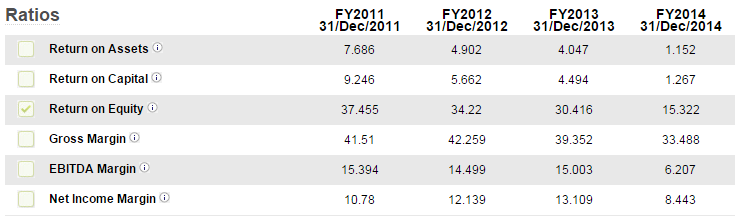
Total revenue is kind of stable, but their net income isn't coming in as well. All their earnings ratio, returns ratio are dropping, as shown below:


Okay, drop in net income is still okay as long as their cash that it brings in is enough to pay upkeep the cash burn. So, do they generate enough cash in their business?


Cash flow from operation is just negative. It seems like most of the cash flow comes from financing, and that part of the cash flow contributes enough to have the net change in cash as positive. Verdict? Debts is their way of financing their business, which isn't generating enough cash flow from their business operations and they have to progressively borrow more to upkeep their cash burn.


This is not a good company to buy, if you ask me. The bonds, however, might be a different matter altogether.


Can they survive for 5 yrs? Likely, as long as they can continue to borrow money. Or if the banks are reluctant to offer them more cashline, they can resort to another one of these retail bonds, likely at higher interest rate in the near future when their cash runs dry. They probably won't die within 5 yrs, and might even enjoy a revival of sorts in their pawnshop business if the economy downturn comes in the near future.


I wouldn't let my parents get any of these though, because there's always a risk of default in bond in this unrated debt that they are offering. It's on a whole different level from the FCL bond that is offered to retail earlier this year at 3.65 %. Since the min bid is $2k, I might get in for a small amount, maybe 2k to 3k, which is only a tiny percentage of my portfolio.


Nothing more, and definitely, no show hand in this bond. Application had started already, and will end on noon Aug 26th, with DBS as the sole bookrunner. Trading of bonds will start on 31st Aug and investors will be paid semi annually on Feb 28th and Aug 28th every year, until 2020. News just came in that Aspial had re-allocated $25 million in bonds offered to the public to its placement to institutions. So now, the public tranche is $25 million, down from $50 million.

Wednesday, July 22, 2015

How best to utilize the Singapore Savings Bond?

With the recent announcements of the Singapore Savings Bond (SSB) coming up in Sept, which is just 2 months away, there's a lot more thinking on my part regarding how best to utilise this new instrument to preserve and grow our wealth.


The advantages of this savings bond is widely reported in the newspaper. It's that you can cash in and liquidate the bond any time without price risk. For bonds, there is a maturity date and if you hold the bonds till maturity date, there is a guarantee on the capital invested. The price in between the purchase date (if you buy on par) and the maturity date can fluctuate widely, and possibly go down because of the near certainty of a interest rate increase in the short term, but you can sleep well on it. Because if you hold the bonds till maturity, you'll get back the par value of the bond. However, if you cash in early before the maturity date of the bond, you stand to lose (or gain) depending on the price that the bond is trading at that point in time. Well, the SSB don't have this advantage at all.


The other advantage is that the interest rate will pro-rate according to how long you hold. If you hold it for 1 yr, the interest rate of the investment sum will approach the 1 yr bond interest rate. If you hold it for 10 yrs, then you will get the interest rate equal to that of a 10 yr bond interest. Add to the fact that you don't have price risk when you cash out early, this serves as a quick and dirty way to hold your excess cash.


The last good thing about this is that it's guaranteed by the Singapore government. Ultimately, a bond is an IOU from the debtor to the lender, where the lender lends a sum of money to the debtor, with the debtor promising to pay the sum borrowed plus another interest to compensate the lender for lending. Hence, a bond is as guaranteed as the solvency of the debtor. If the debtor crash and burn, so too will your piece of IOU. In this case, the debtor for the SSB is the Singapore government. As good as gold, as they say.


Do bear in mind that you need about 1 month's time to liquidate the bonds. So, it's probably not good to leave ALL your extra cash inside. What happens if you have an emergency where you need a sum of money NOW? Got to think about that.


So how am I going to utilise this new instrument?


1. I'll first put in about 3-6 months worth of emergency cash in it as a first tranche. Since I'm paying my mortgage using cash, and I'm filling up my CPF with cash as an emergency hoard for paying my mortgage, and the CPF pays higher rates than the SSB, I'll likely put in an amount equivalent to 3 to 6 months of expenses WITHOUT including mortgage. I'll rather put my mortgage money in the CPF, thank you very much. Some people are funny, they are actually asking whether they can buy using CPF...


2. Next will be my war chest. Currently they are sitting in my POEMS money market fund, getting about 0.5% pa. If I put it in SSB for 1 yr, I'll get around 0.9% pa. For 2 yrs, it'll be about 1.2% pa and so on until 10 yrs, which is about 2.4% pa (and expected to rise too). Maybe I'll put in 2/3 of war chest inside here and will keep the rest as cash. The exact proportion I haven't worked it out yet..we'll see how it goes.


I'll put in my 3-6 months emergency cash in first, get to know how the system works, and see how to do it regarding my war chest. I'll be a great additional weapon to use, but I still wish we have more retail bonds lol

Thursday, May 21, 2015

Frasers Centrepoint Limited bonds allocation table (part 4)

Bonds allocation for FCL is out. The allocation table is shown below for future reference:


A few observations:

1. Everyone will get something because the balloting ratio is 1:1

2. A lot applied between 41 to 50 lots, including yours truly.

3. The allotment favours those who bid 25 lots and below. If you bid anything less than or equal to 25 lots, you get exactly what you want. Does it mean that it's not as hot, as say CMT bonds?

Friday, May 15, 2015

Fraser Centrepoint Limited 3.65% pa bond (part 3)

Someone asked me what the returns are like when FCL do an early redemption. The bond is widely published as having a maturity period of 7 yrs, but we have to be mindful of the possibility of early redemption. I wrote more about the details here.


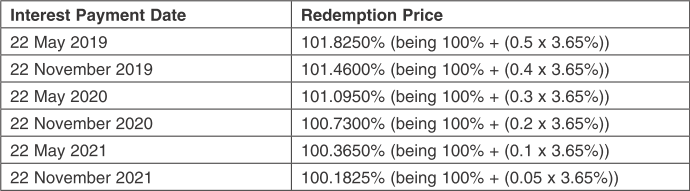
They have an interesting way of paying back the investor if they do an early redemption. The earliest optional redemption is on the 4th year, which is 22nd May 2019. They will redeem back at a price higher than the par value of $1. I've not seen such feature before in the bonds that I've studied. I think it's only fair to compensate the investors by giving them a higher par value for the interest payments that will be forfeited if FCL decided to redeem back the bonds early.


I did out a table to show the returns if they decided to do early redemption of the bonds. There are two factors here at work. Firstly, if instead of redeeming the bonds on the 7th year, they choose to redeem back on the 5th year, you will lose out on 2 years worth of interest payment. Secondly, because they choose to redeem back at a price higher than par, you will get a capital gain if you've bought the bond at a par value of $1. Which of the two factors will dominate?


I did out a table below to see the different returns on an annual basis.


You'll notice that it's actually quite a good deal if they choose to redeem back the bonds early. The missed interest payments is much lesser than the effect of boosting the redemption price of the bonds, netting you a return of 4.106% pa. Obviously as the date of redemption approaches the 7th year, the returns get lesser and lesser until it reaches 3.65% pa on the 7th year.


Is the chances of them redeeming early high? I'll say it's not. Interest rates should go up in 7 yrs time. Unless they do not need the money for working capital or have found a cheaper source of financing, I think they will want to drag out the debt to its full term of 7 years. Anyway, for a good bond, you'll want them to continue paying you forever!


What's the implication of this? I think even though the possibility of them redeeming the bonds is low, it still serves as a value point where the price of the bond will hover around. On May, 4th year of the bond, the price of the bond should be lower than 1.01825 and on Nov, it should be less than 1.014600. It doesn't make sense that the market price of the bond is higher than the possible redemption price at that point in time. But 4 years is a long time...who knows what will happen then? I'll still suggest that whoever wants this bond must be willing to wait out for the full term of 7 years, if not, you shouldn't be in this.


The last post I'll do for this FCL bond series is probably on the results of the balloting.

Here's the rest of the post:

1. FCL bond (part 1)
2. FCL bond (part 2)

Thursday, May 14, 2015

Fraser Centrepoint Limited 3.65% pa bond (part 2)

This is the second part of the Frasers Centrepoint Limited 3.65% pa bond. The first part is here. I managed to get a copy of the prospectus and read it. Hence, for ease of reading, I summarised the main points of the bonds again here, with some additional information:

-------------------------------------------------------------
Duration: 7 years until 22nd May 2022. 
Option for early redemption: Earliest date for optional redemption is 22nd May 2019 and on each interest payment date thereafter
Interest payment dates: 22nd May and 22nd November. First payment on 22nd Nov 2015.
Coupon yield: 3.65% pa

Open for subscription: 13th May 2015, 9 am
Closing: 20th May 2015, 12 noon
Minimum amt for retail: $2000, with integral multiples of $1000 thereafter

Retail (public tranche): $150 million
Institutional tranche: $50 million (closed!)
--------------------------------------------------------------


I decided to do a FAQ of questions that I had gathered from interacting with others on facebook and the comments from my previous post. The information is laid bare here. It's up to you to decide if this is a good deal or not and I won't answer questions regarding whether it's suitable for you.


1. Can we use CPF to apply?

No

2. Can we use funds from Supplementary retirement scheme (SRS) to buy?

There are two stages in this. Firstly, there is an initial offer of the bonds, which is what they are doing now. Consider this the same as the IPO of stocks. After this initial offer, the bonds will be listed on SGX, where you get to buy at whatever market price the bond is offered.

You cannot use SRS funds to buy this bond at the initial offer stage. However, you can use funds from SRS to purchase the bonds from the market after it is listed on SGX.

3. How long do you have to hold it?

7 years, if you want 0% chance of losing your initial capital. There is a slight complication in the redemption date, so please read point number 4 below. You can sell it anytime like stocks on SGX since the bond will be listed there, and you’ll be subjected to the market price of the bonds then. Hence, you might suffer a loss if you sell below $1 or book a profit if you sell above $1. Brokerage fees and comms apply too.

4. Can the issuer redeem the bonds earlier than the maturity period of 7 years?

Yes. In the prospectus, page 47, it is stated that the issuer can choose to redeem back the entire tranche but not in part, of the bonds starting from 22nd May 2019 (inclusive), on 22nd May and 22nd Nov each year. They will have to give 1 month to 2 months of notice to the holders if they choose to do so. Furthermore, should the issuer choose to redeem early, they will not redeem back at par value of $1.

The table, also taken from page 47 of the prospectus, state the redemption price of the bond in % of the par value of the bond at different possible redemption date starting from 22nd May 2019.


For example, if they choose to redeem on 22nd May 2020, which is earlier by 2 yrs from the maturity period of 7 years, they will have to redeem back the bond at 101.0950% of the par value of $1, which is $1.01095.

5. When are the interest payment dates?

The bonds pay out interest twice a year, on 22nd May and 22nd Nov each year, from 22nd Nov 2015 (first payment) to 22nd May 2022 (last interest payment). 22nd May 2022 is also the maturity date of the bond

6. What’s the par value?

The par value of this bond is $1. When it’s listed, it will come in board lots of 1000 ‘shares’. Par value is what the price of the bond is when it is first issued out, and also the price that the issuer will redeem back from you, regardless of market price, at the end of 7 yrs on 22nd May 2022. There is a slight complication, so please read point number 4.

7. What are the returns like?

If you bought the bond at par value of $1, and hold it for 7 yrs, you will be guaranteed your capital. On top of that, you will have interest paid to you at 3.65% per year, paid out twice a year.

If you bought the bond on the secondary market after it had been listed, the returns will then depend on the market price of the bond. If you buy it above par of $1, you will be guaranteed a loss upon maturity of the bond, because the issuer will redeem back the bond at $1, regardless of how much you bought it. On the other hand, if you buy it below the par value of $1, you will be guaranteed a profit at the maturity of the bond. 3.65% pa yield is only for a par value of $1, so if you buy above or below par, the yield will decrease or increase proportionally. For bonds, it’s better to calculate the yield to maturity if you buy it at any market price other than the par value, and at any other times other than the initial offer of the bond.

8.  How does the bond work? Can you explain how the process is like for us to be paid?

If you’ve experience in buying shares, this analogy should clarify your fears. If a company wants to be listed on SGX, they will do an IPO for investors to get in. So investors will buy at the IPO price through ATM or internet banking. If it is oversubscribed, the issuer will do balloting, so you might not get everything that you bid for. They will have an allotment table to tell you how many lots of this IPO you get based on how much you want to subscribe.

After this IPO is over, the company becomes listed on SGX and you can buy/sell it, subject to market price. The shares certificates are kept in the CDP account, which can be linked to your bank account. If the company gives dividends, they will check if your name is under the registrar by checking up the CDP account. If it is, then you’ll be entitled to the dividends. Once the dividend is paid, it’ll be transferred to your bank account tied to your CDP account.

If you sell the shares, the share certificates will be transferred electronically to the buyer after a few days. The money you get from selling it will be transferred to your bank account tied to your CDP account again.

That’s for shares.

For bonds, they will also do an IPO. The ‘IPO’ price of the bond is called the par value. Investors participate in the bond IPO by going to ATM or internet banking to subscribe for it. Again, if the bonds are oversubscribed, the issuer will do balloting so you might not get all that you subscribed for. The allotment will be based on a table just like the IPO of shares. I will highly suggest applying odd and not even number of lots if you want more.

After the IPO of the bonds is over, the bond will get listed on SGX and you can buy/sell subject to market price. The bonds are in board lots of 1000 ‘shares’, so the minimum you need to buy is $1000 (exclude brokerage and comms). The bond certificate is also placed in your CDP account and when interest is paid (twice yearly), they will check if your name is under the registrar by checking your CDP account. If you have the bond certificate in your CDP account, the ‘dividends’ of the bond will be paid to the bank account tied to your CDP account.

Should the issuer redeem back the bonds, the money that you get is again transferred to the bank account tied to your CDP account.

9.  Is it really guaranteed?

The guarantee of a bond is only as sure as the solvency of the underlying issuer. You will have to do your own judgement whether Fraser Centrepoint Limited will still be around in 7 years. If you think they have problems surviving till 2022, then it's better not to buy the bond.


Update: I did a post on the returns that you can if they choose to redeem it early on the 4th year. I'm just expanding a little more detail regarding the possibility of early redemption. Please read it here.

Wednesday, May 13, 2015

Frasers Centrepoint Limited 3.65% pa, 7 yrs bonds

I was alerted to a facebook feed regarding this year's first retail bond launch. This is more exciting that the savings bonds thingy to me.

Frasers Centrepoint Limited (FCL) is offering a bond, open to both retail and institutional investors. The terms of the bonds are as follows:


Duration: 7 years
Coupon yield: 3.65%
Open for subscription: 13th May 2015, 9am
Closing: 20th May 2015, 12 noon
Minimum amt for retail: $2000, with integral multiples of $1000 thereafter

Retail (public tranche): $150 million
Institutional tranche: $50 million

This is likely the first bond I've seen in which the retail tranche is bigger than the institutional tranche. This will create a lot of good will for FCL. The usual way to apply is like applying for IPO, which is through participating banks like DBS, POSB, OCBC and UOB ATMs. Take note that you need to put in a min of 2k, with subsequent addition of 1k thereafter.

I suspect this will be taken up like hot cakes. I will personally bid a big part into this, if not for myself, it's also that I can 'sell' some to my parent's retirement portfolio that I'm managing for them. This is quite likely going to be traded in the open market like other bonds. There's a lot more details that I wish I can elaborate, but these details are found in the prospectus that is lodged in Opera MAS site. It's down now and I can't access it. I'll do another post on it soon.


Update: Here's the second part of the FCL bonds. There are very important information that I added after reading through the prospectus, including the optional redemption. Please do read it.

Tuesday, January 13, 2015

How to beat OCBC 360's return

To the above blog title, I should add, 'in a relatively safe manner'. Risk and returns are directly related, so if you want to beat OCBC 360's 3.05% pa returns, you can always invest in the stock market with the potential risk of having capital losses. Here, I'm going to try beating the 3.05% returns, as well as equal it in terms of the risk of losing your capital. Possible? Read on.


We all know what's so great about OCBC 360 account.  If you hit certain milestone conditions, you get stepped up interest ranging from 0.05% to 1.05%, 2.05% and finally a max of 3.05%. There's some disadvantages to this though:

1. For those who can't change their salary code, you will have to forsake the 1% interest for crediting your salary every month

2. For those who can't pay more than $400 on credit card, you will forsake another 1% interest. I'm sure everyone can hit the $400, but it's how much trouble you want to do to change your status quo.

3. This is up to a max of $50k only.


So, what do I propose?


There's a listed retail bond traded over at sgx with the counter name CapMallA3.8%b220112. Details of the bond are as follows:


1. Coupon issuance dates: Twice a year, Jan and July
2. Underlying: Capitalmall asia
3. Maturity date:  First optional redemption 12-Jan-2017 and every year thereafter till 12-Jan-2022 (7 year from now),
4. Face yield: 3.8% every year (1.9% every half year) before 12-Jan-17, thereafter 4.50%
5. Number of payout till maturity: 13
6. Price traded now: $1.028 vs par value of $1.000
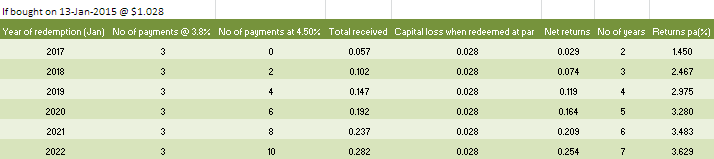
7. Based on the year of redemption, the non-compounded returns are indicated in the table:


(Thanks to SRSI for the gentle reminder of the possibility of early redemption! I forgot about it!)

So to beat the OCBC 360 rate, we have to bet that the bond is not redeemed at least till 2020, which is 5 years from now. If that happens, we get a annualised non-compounded return of 3.28% if we bought it at today's price of $1.028. If the bond is not redeemed earlier, they will have to mature on Jan 2022, which is 7 year from now. That will get you an annualised return of 3.63% pa.

A few risks needs to be highlighted now:

1. What's the chance of them redeeming the bond?

Capitalmalls asia had the bond set up in Jan 2012. For lack of a better gauge for borrowing costs for companies from banks, I used 3 mths SIBOR to see the risk premium of them borrowing money from investors at 3.8% (which is the face value of the bond). The 3 mths SIBOR back then was 0.39%. So to entice investors to invest, they are giving a premium of 3.41% (3.8-0.39) pa.

There is a step up component of this particular bond. If they did not redeem on 12-Jan-2017 and every year thereafter (until 2022), they will have to pay a higher interest of 4.50% instead of 3.80%, which is an increase of 0.7%. Assuming everything else stays the same, if Capitalmalls asia still has a risk premium of 3.41%, the 3mths SIBOR have to be 1.09% (4.5-3.41) by 2017.

If 3-mth SIBOR is higher than 1.09% by 2017, then the borrowing cost for Capitaland from banks will also rise, making them less likely to redeem back the bond since they have a low cost of borrowing through the bonds. The last time 3 mth SIBOR is 1% or more is back in 2009 before the financial crisis. The current rate now is 0.46% and is very likely to hit 1% in 1 or 2 years time, with the US Fed Reserve set to raise the rates by Q2 or Q3 2015.

I take it that therefore it's unlikely for them to redeem back the bond in 2017. But it's a very simplistic way to see this, I realised. Capitalmalls asia might, for example, not require the debts at all and choose to redeem it.


2. The quality and safety of the bond is as good as the underlying

Capitalsmall Asia is under the big umbrella of Capitaland. To me, a bond by Capitaland family is as good as gold, and as safe as fixed deposit, maybe just a little riskier. The returns stated are non-compounded. To raise it further, you can invest the money received for a higher returns. And technically, I should use XIRR since the cashflow are pretty consistent and even, but I didn't. You can try it out if you wish.


Oh, the caveat...you must hold on to the bond until the underlying redeems it at par value. If you do that, you can forget about looking at the market price of the traded bond. If you wish to sell it earlier before it is redeemed, then you have to take what the market gives you. From what I observed so far over 1 yr, the price is pretty stable, whatever the market is doing. Even if the market price drops below your buy price, it's not a concern IF you are holding the bond till maturity.


There you go.

Tuesday, December 30, 2014

LP minibonds 20k

I was setting up the stage for LP mini bond for my parents' friend for 20k, so naturally I've to do some homework. I started by looking up the yields for the different bonds and preference shares listed at SGX.


Do take note that the yields I calculate is based on my own way stated here. It basically included all the coupon/dividends payment until the first date of maturity, subtracted from the guaranteed capital loss from buying the bonds/pref shares above par.


Retail bonds

1. Genting SP5.125% Perp - 7.8 yrs to maturity (YTM) - 4.47% pa
2. Olam6.75%b180129 US$ - 3.1 YTM - 5.70% pa (USD)
3. LTA n4.17%160510 10k - 1.4 YTM - 1.59% pa
4. CapmallA3.8%b220112 - 7.0 YTM - 3.09% pa
5. SIA 2.15%b150930 - 0.8 YTM - 2.19%pa

Pref shares

1. OCC5.1% NCPS 100 - 3.7 YTM - 3.76% pa
2, CityDev NCCPS - perp
3. DBS Bk 4.7% NCPS 100 - 5.9 YTM - 3.67% pa
4. Hyflux 6% CPS 10 - 3.3 YTM - 4.98% pa
5. OCBC Bk4.2% NCPS - perp
6. OCC 3.93% NCPS 10 - 0.2% YTM - 8.97% pa


I noticed a few things:

1. The price of most pref shares either dropped or stayed the same. The drop is understandable, because the numbers of payments before maturity decreases, hence the price will have to drop so that the yield remained good enough to entice people to buy. But I noticed that the price drops lesser decrease in future payments, meaning that the yield actually drops a little.

In other words, I'll have a better deal buying earlier than later, despite the drop in market price of these bonds/pref shares.


2. OCC 3.93% is selling at par value right now. It'll mature on 20th Mar 2015 (optional), so there's still one more payment left. They pay twice every year, on Mar and Sept so one more payment means 1.965% returns with zero capital loss (since you're buying on par). Only commissions. Since 20th Mar is an optional redemption date, they can choose not to redeem, and therefore pay a 1.85% + 3mSOR quarterly starting on 20th Mar, Jun, Sep and Dec. The 3m SOR is about 0.42% now, expected to rise further, so minimally after 20th Mar (if they choose not to redeem), you can expect to get at least 2.27% pa, split into 4 times a year.

To sum up, it's 1.965% this year. If they redeem, they redeem at par, so net net just lose commission for buying. If they didn't redeem back, at least 2.27% pa every quarter from 20th Mar. But it might be some time before they will redeem back, so the market price might keep dropping, which is still fine as long as you don't sell it. Your capital is just locked up.


Good deal? I leave it to you.


In the end, I decided on 2 holdings for the 20k portfolio. Too little to diversify.

1. Capmalla3.8% b220112 (47.0 % of portfolio)
2. DBS Bk 4.7% NCPS 100 (52.9 % of portfolio)

The earliest maturity date is 5.9 yrs, and the guaranteed capital loss because of buying above par will be $900. My plan for this minibond is as usual, pay 2% pa and build up the cash reserves for that guaranteed loss. Thereafter, pay a higher % pa but always reserve some cash in case the person wants to redeem back and the market price is lower than par. This is no longer a capital guaranteed bond, but I'll still treat it as such. The only difference is that now, I didn't say it's capital guaranteed, haha


A big difference it'll make ;)

Wednesday, February 19, 2014

Capital Mall Trust (CMT) bonds balloting results are out!

The balloting results are out for the Capital Mall Trust (CMT) bonds. The announcement is made here.


Some comments:

1. The balloting ratio of 1:1 means that everyone who applies will get some. Might not be all but at least you won't go empty handed.

2. They are quite kind to small investors. Everyone who subscribed 2 to 10 lots will get 100% allocation. This means that if you apply for 8 lots, you'll get 8 lots of the bonds.

3. As usual, those who applied for more will get lesser as a percentage allocated to them. I think it's only fair.

4. On hindsight, next time we should all apply odd number of lots so that you can push to the next banding.


I applied for 25 lots. Since it falls within the range of 21 to 30, I'll get 15 lots. The rest of the fees should be refunded back to me starting from today. By 20th Feb 2014, you should be able to log in to your CDP account and check that the bonds are there. The bonds should commence trading on SGX this coming Fri on the 21st Feb 2014 under "CapMallTrb3.08%210220" with board lot size of 1000 shares, with stock code of "TY6Z".


I can look forward to the first semi-annual payment on 20th Aug this year.