Showing posts with label Personal finance. Show all posts

Tuesday, February 09, 2021

The 3 ways to Financial Freedom (Trilogy part 3)

 Fully expecting 

another knock on the head,

I shut my eyes, 

and slowly opened them in dread.

The old man seems older, 

he took a deep breath,  

gave me an unnerving stare, 

to try to freeze me to death.

"I'm going to show you the last way

to be financially free,

if this doesn't suit you, 

pack your things and leave."


"If you decide to choose 

the powerful Wizard's way, 

you will need to study 

until your hair starts to grey.

You will learn to read, to research, 

using old charts and tomes

in order to investigate anomalies

as astutely as Sherlock Holmes.

You will learn to manage money, 

and possess a mastery of your mind,

and cultivate an investing method 

that will be polished till steel fine."


"There are three Circles of power 

that an aspiring wizard must learn,

the First Circle is of Method - 

"How", "What", "When" he must yearn.

When honed to near perfection, 

it gives the Wizard an edge

to slice, to dice, and to push 

his opponents right off the ledge.

The Second Circle is of Money - 

essentially it is portfolio defence.

To manage risk or diversify, 

to ensure you don't lose your sense."


"The Third Circle is of Mind - 

the most important of the Circles.

With this last mastery, 

you can clear all investing hurdles.

A good Wizard is cool, 

especially when the heat is on.

The mastery of his emotions

makes him inert like Argon.

He's greedy in the face of fear, 

afraid when the rest are blissful.

A Wizard thinks and acts alone, 

yet somehow finds it cheerful."


"All Wizards are drawn to a field,

and have an area of speciality,

could be stocks, forex or crypto, 

bonds, metals, and property.

Actually, in the entire universe 

there are two branches of wizardry.

The first branch is the Chartist - 

a master of charts and all its trickery.

The second branch is the Investor - 

like Buffett, Dalio and all they represent

Matters not which branch in the end, 

if your annual returns exceed ten per cent.


"A Wizard is ultimately

a master of compounding,

conjuring returns 

in a rate that is astounding.

Twelve per cent returns 

with half a million dough,

in six years will turn to a million, 

and that's still considered slow.

By the harnessing and control

of his immense investing power, 

a Wizard wins the rat's race 

by this innate superpower."


And with this our story

has come to an end. 

So which of the three paths 

will you choose, my friend?

In truth, you don't even need

to pick just one path. 

Mastering two out of three, 

you'll definitely hit home-run.

So there you are, these secrets, 

I'm sure you will need'em

in your long arduous journey

of achieving financial freedom.


The 3 ways to Financial Freedom (Trilogy part 2)

But how can I choose which path

until I know much more?

Oh please, enlightened one -

do teach me, my mentor! 

The sage looked up at me 

and this is what he said,

"Those who choose the Second path

this road he will tread,

He lives the life of a Shaman 

who is an excellent rainmaker. 

A Shaman always finds a way, 

that clever money-maker" 


"A Shaman can invite a parrot

to grant the gift of the gab,

to charm his way around you

to make you pay for his tab.

By making an origami fold, 

he turns it into a spider 

that can spin the most intricate web 

for his network to grow wider.

By tapping on his special bond

with animals of Mother Nature,

a Shaman uses his druidic power

to call a bonded creature."


"After the summoning smoke settles, 

out comes a poisonous adder,

that can aid its bonded master

in the climbing of career ladder,

or a brightly feathered toucan

who just loves eating pecan,

that specialises in business ventures

to create a source of income. 

The way of the Shaman 

is to bring in so much dough,

that he doesn't have to try

to keep his expenses low."


"By boosting his total income,

and earning more than his peers,

he can save more in a year, 

what others must do in years.

Shamans can have two options:

First to climb the career ladder

by invoking the special talent

of his summoned death adder.

Second to call a toucan 

to build a business empire,

that rains a constant income 

to lift his networth higher."


"Savings is what remains of income

after subtracting what you've spent.

While the philosophy of the Monk

is to live on just one cent,

the way of the Shaman 

is to earn all that he can, 

because being a hermit or a caveman 

is never his game plan.

As long as he doesn't do silly things,

and keeps his spending in check,

the Shaman will win the rat's race 

by the power of his paycheck."


"So young one, what do you think?

Do the Shaman's path call on you?"

I can feel his attention all on me.

Let me think first....... mmm....hmm....ewe

I don't think I'm a Shaman,

never had a gilded tongue.

So many animals tagging along, 

Gosh, I don't want to step on dung.

Honestly, I don't mean to complain,

but being a shaman sounds so meh,

perhaps you can aid me once more

and show me the Wizard's way?


Sunday, February 07, 2021

The 3 ways to Financial Freedom (Trilogy part 1)

I heard of a sage 

who lives up the highland,

located in an old and hidden,

largely forgotten island.

I trekked all the way 

right up to his doorsteps,

to ask the wise man 

the secrets of his success,

and what ways there are 

to be financially free

so that when I'm working, 

I don't scream like a banshee.


After ten minutes 

(it could have been twenty),

he broke into a smile

that meant aplenty.

"Three ways there are

 to be free financially. 

The First is a Monk - 

the disciple of frugality. 

The Second is a Shaman - 

master rainmaker. 

The Third, a Wizard - 

investing kingmaker"


I'm not sure what's a monk 

(I mean... I do know).

Will I have to live

in a temple in Guangzhou?

Can I have a wife? 

Can I still eat at Tex-Mex?

Oh...no no no no no, 

does it mean I've to give up sex?

Before I could voice-out 

more concerns about being a monk,

there's a knock on my head, 

like I'm being hit by a trunk.


The wise sage continued, 

albeit a little angry,

"You can still have a wife, 

continue your hanky panky.

You need the eyes of a hawk, 

to track your own expenses,

and the immense strength of a bear

to slash spendings that dull your senses.

Eventually, you'll find felicity 

by basking in simplicity,

purging the toxicity

of living in complexity."


"The way of the Monk

is to keep his expenses low,

and not to compare income 

with people like John Doe.

By choosing instead to spend 

on things that truly matter,

he deftly side-steps to avoid

becoming a source of flatter.

Striving to keep his ego 

firmly on the ground,

he wins the rat's race

by simply sitting around."


"If you don't have the quiet temperament

of the frugal and disciplined Monk,

you like to party, to dance 

and imbibe like a wasted drunk,

then this kind of simple life

is really not meant for you, 

hence we shall take our leave 

and bid this path adieu.

The way of the Shaman

and the Wizard lies ahead.

Now of the two pathways,

which one will you tread?"


Wednesday, May 20, 2020

Singlife accout or CIMB fastsaver

I recently signed up with the Singlife account. You can read about it from other blogger's reviews or from the actual site itself, but to me, it's essentially a savings account. Since I also have CIMB fast saver, I want to explore the decision tree to decide when to put extra funds into CIMB fastsaver or into Singlife account. In my analysis, I'm really going to ignore all the extras, like retrenchment benefits, insurance parts etc of the Singlife account. 

Here's the facts:

Singlife account:
First 10k - 2.5% pa
Next 90k - 1.0% pa
Thereafter - 0% pa

CIMB fast saver:
First 50k - 1.0% pa
Next 25k - 1.5% pa
Next 25k - 1.8% pa
Thereafter - 0.6% pa

Here's the calculations of the interest earned and interest % pa for both:

Singlife account:


CIMB fast saver:


I just did up the interest for the various banding. Straight away we can see that the interest we can get for CIMB is much more for greater amounts of principal put inside, but for smaller amount of principal, Singlife will be more worth it. There must be a point where if I put x amount in Singlife account and the same x amount in CIMB fastsave, the two interest will be the same. And I know x must be somewhere between 75k to 100k.

So, let x be an amount between 75k to 100k,

Amt of interest from Singlife acct: 10,000*0.025 + (x-10,000)*0.01 = 150 + 0.01x 

Amt of interest from CIMB fastsaver: 50,000*0.01 + 25,000*0.015 + (x-75,000)*0.018 = 0.018x - 475

Equating them:

150 + 0.01x = 0.018x - 475

So, x = $78,125

And thus my decision is clear:

To get the highest interest for the same amount of dollars:
I should put it in Singlife account if I have lesser than $78,125
I should put it in CIMB fast saver if I have more than $78,125

If I have exactly $78,125, then I should put it in Singlife account because of the little bit of insurance that I didn't take into account. Both have deposit insurance of up to $75k, so there should be some safety features built into this. 

Okay, now my decision flow is clearer.


Update: 

How silly of me. In the pursuit of deciding either THIS or THAT is better, I forgot that the better solution is a blend of BOTH. Non-duality! Thanks to 15 hww and WGM for pointing this out to me. In light of that, the best solution is put money in both accounts, as shown:

First 10k - put in Singlife account for 2.5% pa - total interest: $250
Thereafter - put in CIMB fastsaver, preferably not more than 100k inside

Done! 


Monday, February 10, 2020

Am I prepared?

Back in 2003/2004, there is the SARS outbreak. Back then, I just started work and didn't think too much of the possibility of getting infected. That's stupid and reckless of me, but now I have too much to lose. I can see people are avoiding shopping malls and restaurants are mostly empty even during the weekend peak dinner crowd. You can practically walk into a restaurant and see that there are more staff than customers during peak hours. It's that bad.

In this post, I'll like to focus on the things I'm doing to protect myself. My chief concerns are:

1) My family's health
2) My work income
3) My financial status


1) Family's health

The current Wuhan corona virus is still largely unknown, but it seems from official statistics that it is highly infectious but with low mortality rate. Thank goodness for that. I'll rather take my chances with this than another strain with low infectious rates and extremely high mortality rate. Ultimately, mask or not, it just depends on our immunity system to survive.

As 2020 started, I did 3 things that helps a lot regarding health. Firstly, me and my wife had been going to the gym almost everyday. 30 mins of intense cardio really does help a lot, I feel. That should do for the exercise part of keeping healthy. Secondly, every gym day, we had almost carb free salad for lunch. That's the diet part of keeping healthy. Thirdly, I started doing cold showers. I read from Tools of Titans by Tim Ferriss (Wim Hof/Tony Robbins section) that having cold showers can boost the immunity system and willpower, among other things. Been doing it for 3 weeks, not bad, will continue doing so.

Other than that, I didn't join the groceries store run, nor the mask buying queues to avoid crowds. I did go out to shopping malls now because it's largely empty. My mum prepares some herbal concoction for us to drink, and hopefully all these measures will help. Not necessarily in preventing us from getting infected, but to recover swiftly once infected.


2) My work income

I'm a private tutor. Students come over to my place for lessons, so I'm potentially exposed to a higher chance of infection that most people I guess. I accept that. From the start of the pandemic in China, I've already anticipated that parents will stop and cancel lessons. Just last week, I had two cancellations. I think primary school tutors will be hit more severely than me, not to mention those running group lessons. I think we just need one cluster to form in schools and that's it. Back in SARS period, primary school was stopped for about 3 weeks, secondary schools about 2 weeks and JC about 1 week. Why? JC students can die is it? It's about the immunity system - those who are elderly and very young have weaker immunity system, making them more susceptible to infections.

What happens if the situation gets worse and tuition stops? I have a plan B. I got a webcam from a good friend, got my wacom drawing tablet/digital pen and an online whiteboard with video conferencing/chat capabilities ready. I've also asked for permission from students and parents in case the situation warrants it. And so now we wait.


3) My financial status

What if I've no active income for a stretch of say 1 year? Can I take the hit?
Yes - my CPF has enough to last me 1 yr of mortgage payment, which is my biggest expense and greatest worry. I'll transfer more warchest to emergency cash too, so I can tide over more than 1 yr if needed.

What if I've no active income for 1 yr and I'm hospitalised? Can I take the hit?
Yes - hospitalisation plans are still in place and I've enough funds to cover any deductibles/co-insurance. Same for all my family members. Insurance plans also cover ICU should that need arises. If there are worse scenario I've not imagined, there's also a reserve battalion of Singapore savings bond, equivalent to 6 months of monthly expenses, waiting for me.

I took account of all my liquid cash, minus 1 year of monthly expenses, and the remaining is my war chest. It's still good enough to fire substantially, so that's good. My plan, as always, is to survive first, then thrive. And I'm determined to thrive.

Wednesday, January 01, 2020

DBS multiplier account NERFED

It's the first day of the 3rd decade of the 3rd millennium and I received some news that DBS is going to nerf their multiplier account. I first heard it from Kyith (here) and the new changes, which will take effect from 1st Feb 2020 is listed here.

The major changes are that instead of dividends being under the "Investment" category, it is now grouped under a new "Income" category, which combines both the salary credit component together with all dividends received. This sucks because now, most people will have one less category to fight for the highest interest of 3.8%. I really don't want to get into some long term commitment, like buying a regular savings plan or DCA into sti etf, for something that is short term and fickle like the terms and conditions for the DBS multiplier account. I guess I'll have to contend with less interest.

The other major change is that the higher interest for the salary credit + transactions in 1 category is now applied up to a new cap of 25k only, down from the current 50k. It's not clear what they meant by this.

I take the liberty to include two scenario. But first, this is what is like currently (click if it's too small to zoom in):


This is what I think it'll be like after the changes to the cap from 50k to 25k:

Scenario 1

This is what I think it could be if they are kinder:

Scenario 2
Scenario 1 will introduce 2 tiers, first tier of 25k, next tier of 25k, then final tier of 50k. For this scenario, if you hit 3 categories including the new income category, and you also hit the max transactions per month of 30k and above, you'll get a blended interest of 2.79% pa ([2.08*25 + 3.50*25]/50 = 2.79) for the first 50k.

Initially it's 3.50% for first 50k, so that's a drop of $145/mth to $116/mth after 1st Feb. Say bye bye to the next 50k unless you buy their insurance and investment, which I am very repulsed to do so.

I don't think they are going to be kind so screw scenario 2. Ironically, in my mind, I just wanted to do scenario 2, until I actually do out the jpg to realise that it's too nice to have scenario 1 where there is a first 25k tier, next 25k tier, and final 50k and above tier.

Maybe just bloody buy their stocks and get a dividend of more than 5% pa lol

Monday, December 02, 2019

Networth update 2019

2019 is coming to an end, so my usual tradition is to round the year up with an update of my networth numbers and also reflect on the figures to see how the direction is aligned with what I want in my life. In general, I think 2019 is a great year for me. Stock market is generally up and I was working a lot more this year than the last, which should contribute more to my income. But I also have more expenses because my child is going to child care center. How would that affect my networth? Let's have a look.

The last I wrote on my net-worth was back in 10th Dec 2018, here. I'm going to do the same below.

There are so many ways to calculate networth, but I've always done mine this way. It's essentially assets minus liabilities but how you define assets and liabilities makes all the difference. Like in the past, I excluded the asset part of my stay-in property, but included the liabilities portion. Besides the stay-in property, my liabilities also included the car that I bought in 2018, which I'm still paying off. As usual, I'm also not going to include the value of my car in the assets part, but will include the liabilities part.

The assets part include:

1. Cash in my wallet
2. All the money in my various bank accounts
3. Cash holdings under mattress and milo tins at home
4. Money in my paypal account
5. All the money in the 3 accounts in my CPF
6. Money market fund account
7. Marked to market investment portfolios
8. Surrender cash value of whole life insurance plans

Again, I do not include the value of my 5 room flat that I'm currently staying in, and also the value of the family car that I own.

The liabilities part include:

1. Credit card bills
2. My portion of the HDB mortgage loan (total remaining loan amount divided by 2)
3. My portion of the car loan I took this year (total remaining loan amount divided by 2)

Here goes:

2014: Assets: $226k, Liabilities: $220k, Networth: $6k
2015: Assets: $295k, Liabilities: $207k, Networth: $87k
2016: Assets: $351k, Liabilities: $188k, Networth: $163k
2017: Assets: $449k, Liabilities: $182k, Networth: $267k
2018: Assets: $483k, Liabilities: $191k, Networth: $291k
2019: Assets: $560k, Liabilities: $167k, Networth: $393k


Plenty of things to be grateful for this year. The networth figure increases by 102k from both an increase in asset of 77k and also a decrease in liabilities by 24k. The bullish stock market props up my assets substantially, since it is marked to market. Also, my active income contributed to me saving more than 60k this year. Slightly less contribution coming from dividends as I take money out from the stock market but that is kind of offset by higher interest bearing accounts. All in all, the asset part is a great improvement. Liabilities dropped more than usual because I started doing partial repayments of my mortgage this year to reduce the risk of interest rate rising in the near future. I've taken steps to reduce the interest rate fluctuations by locking the interest rate for 5 yrs by repricing my loan, so that is currently still in the works. I've also reduced the duration of my loan to pay more per month. Mortgage is still the major liability that I have, so it's always going to weigh heavily in my mind until I can clear the bulk of it. Takes time.

Going forward in 2020, I expect that the stock market might not do too well. Already more than 10 years of bull run, so maybe we can expect a severe downturn in the likes of the dot com era or the sub prime. Who knows such things? I also don't think my active income will be as huat as this year, since an economic crisis usually follows a stock market crash. I'm not going to say I'll tighten my wallet and live frugally from this year on. No. I will aspire to maintain my lifestyle as much as I can without compromising at all. The hallmark of great financial planning is that things should remain as normal as possible in spite of the stormy weathers. All my defense mechanism are in place, and I remain confident that I can weather the storm and survive, then hopefully thrive in the aftermath.

Same for my networth. In spite of the uncertainties, I will strive to increase my networth. So far so good, as it had been steadily increasing since 2014. Let's keep it rising for another decade or so.

This post is just the boring financial part of how the year 2019 goes for me. I'll do a separate post on reflecting on why 2019 is such a great year for me in terms of various themes, like family, health, relationships etc.


Thursday, May 30, 2019

Half year audit 2019

It's nearly May and that means nearly half the year is gone. Is the time spent carelessly away in frivolous and meaningless activities, or invested to form deep-seated memories or experiences to be archived, savoured and re-visited again in the warm glow of memory? Let's try to make an account of the time spent in the last 6 months.


Family:

This year, we started sending our kid to a nearby childcare centre to expose him to different experiences. That means I have to wake up early to prep him for school. And in exchange, we'll have at least half the day free to catch a breath or catch a movie if we really want to. I choose to spend the time exercising before I start work in the afternoon. More about that later. We usually fetch him back home around early afternoon before I start work. I think this regularity is good for him, even though he might cry and fuss on days he didn't feel like going to school. My wife is also having more lessons as she begins her career as a tutor, so we have lots of experiences to share, including complaining about bad students haha

My son has some problems eating the food at the child care centre, preferring to eat at home. If he is more settled there, I can give a higher rating in this area. Maybe in the next half of the year, we will do better?

Rating: 3/5

Health:

Bought my Fitbit charge 3 after Chinese new year, and had been spending the morning time exercising. Could be a 3km run, run-and-walk, walk, interval, hill training or just walking leisurely at East Coast Park with my wife for an hour or so. It was very good, and I wished that I've done it sooner. Never feel fitter in my life, and it shows when I brought my son out for walks. That's all I wanted, to be able to keep up with him without feeling wasted. In a way, he is my motivation for good health.

Recently, all of us got the dreaded HFMD (hand, foot, mouth disease). Started from my kid (but of course), spread to my wife, and finally to me. I think my wife is the one who got the brunt of the disease, with painful sores and ulcers that made her unable to speak for close to a week. Mine is much milder, thankfully, so I can take on the bulk of the caretaking. Naturally, lessons had to be cancelled, and my son stopped going to the centre for 2 weeks, which is fine because the centre had to be closed because of the outbreak anyway. Had to go back and fro the clinics to check on the condition, get certified and he is fit for school again and so on. I am very glad that the whole episode is over.

After that, I had to restart my exercising regime again because I felt my stamina being drained. It's okay. Like the stock market, we have to be on the uptrend with occasional corrections along the way, in order to move up even higher!

Rating: 4/5

Brain food:

As of now, I've read as many books as I had in the past year 2018. Where did I find the time to read? I cut my gaming sessions to zero and starting reading on my phone using Google Play books. Whenever I wanted to open up my social media app to check on the latest insignificant notification, I'll open my Google Play books instead and start reading. Just these two changes open up a whole lot of time for me to nourish my mind with books. It also helps that I discovered a new genre of books to read: Chinese science fiction (translated to English, thank you very much).

Rating: 5/5

Finances:

This year has the making of a good financial year. As of now, I've saved $29k out of my default target of $50k. Should be able to surpass the goal comfortably since the second half of the year is where I have less annual financial commitments. As long as I have good health, I can do the necessary work to bring in the income. The recent bout of illness is a sore reminder of the importance of health.

Always wanted to boost up my insurance coverage after having a kid. Boosted my life coverage by 300k, CI by 250k and early CI by 100k. Also 'forced' my wife to boost up hers too to take into account our newly minted status as parents. Feels much safer after this.

As my mortgage interest rises, I also did a partial capital repayment of $14k from my CPF-OA account. I might pare it down further to reduce my debts, but have to weigh against the opportunity cost. I'll keep it flexible and gauge it year by year on whether I should pay down my debts.

Rating: 5/5

Personal:

I did a Marie-Kondo audit on my wardrobe. Kept all my threadless t-shirts away and bought some exercise t-shirts for about $10 each. Helps that there are only 2 colours - grey and black. That hugely simplifies the choice that I have to make each day regarding what to wear. My wardrobe is just cleaned out like that. I also bought sports shoes from Decathlon. Not so long ago, I would have baulked at the purchase. Now, it's affordable, replaceable and good enough for me. It's so comfortable and added to the fact that I'm immersing myself to concentrate on health and exercising, I started wearing it everywhere I go. I like the simplification of my life and the direction that I'm going.

Rating: 5/5

Monday, December 10, 2018

Networth update in 2018

2018 is a rather slack year for me. I don't think I work as hard as I do in previous years in terms of work, so the time that is otherwise spent working is channeled to my family, especially my growing child. This year is also a bad year for those who invested in equities. It seems like if you put money under your pillow, you'll end up being better. Will it affect my net-worth? Let's see.

The last I wrote on my net-worth was back in 1st Dec 2017, here. I'm going to do the same below.

There are so many ways to calculate networth, but I've always done mine this way. It's essentially assets minus liabilities but how you define assets and liabilities makes all the difference. Like in the past, I excluded the asset part of my stay-in property, but included the liabilities portion. This year I incurred new debts too, in the form of a car loan of 3 yrs. I'm also not going to include the value of my car in the assets part, but will include the liabilities part.

The assets part include:

1. Cash in my wallet
2. All the money in my various bank accounts
3. Cash holdings under mattress and milo tins at home
4. Money in my paypal account
5. All the money in the 3 accounts in my CPF
6. Money market fund account
7. Marked to market investment portfolios
8. Surrender cash value of whole life insurance plans

Again, I do not include the value of my 5 room flat that I'm currently staying in, and also the value of the family car that I own.

The liabilities part include:

1. Credit card bills
2. My portion of the HDB mortgage loan (total remaining loan amount divided by 2)
3. My portion of the car loan I took this year (total remaining loan amount divided by 2)

Here goes:

2014: Assets: $226k, Liabilities: $220k, Networth: $6k
2015: Assets: $295k, Liabilities: $207k, Networth: $87k
2016: Assets: $351k, Liabilities: $188k, Networth: $163k
2017: Assets: $449k, Liabilities: $182k, Networth: $267k
2018: Assets: $483k, Liabilities: $191k, Networth: $291k


There's a few things I should be glad and grateful for in 2018. Firstly, despite the downturn in the stock market, my networth is still up. Of course it didn't go up as much, like the crazy almost 100k increase from 2016 to 2017, but the fact that it is still positive is good enough for me. This year is also when I paid a hefty down payment for my new car, so that is also why the asset didn't go up as much. Secondly, overall I saved about 55k this year and that surprises me. These days, I no longer consciously check how much I saved. Just perhaps a brief look every half a year or so to make sure I'm generally on the right track. Not all the savings are in cash too, because I transferred a part of it into my CPF to fulfill my self-employed contribution, and also to shore up my OA for my reserves. My work income dropped a bit, but my dividends pushed it up, so net net I'm not that far off. That is exactly what the dividends are for, and I'm thankful for stabilizing my income.

Market can go up and down, but my net worth must go up all the time. That's the philosophy that I adhere to. If not, there's nothing to show for at the end of a year of hard work.

Financially, there's more things to look forward for year 2019. It looks like my work income is going to have a boost as I have a very robust order book for the coming year. If all things go according to plan, I should be running when Jan 2019 comes, instead of strolling. There's also more expenses to come, because I'm sending my child to a child-care center next year.

Till December 2019 then!

Wednesday, July 18, 2018

Analyzing an Aphorism

Have you seen this quote before?


On my social media feeds, I've been fed this quote a couple of times this week. The first time I read it, it seems pretty logical. In fact that's the thing I told my wife too when she goes on some bulk purchase to save a couple of dollars. The second time I've seen it, I had a nagging feeling that something isn't quite right. So I went to think and analyse deeper into this statement.

Firstly, what is savings? Savings is what's left of your income after spending. Mathematically, the formula is:

Savings = Income - Expenses

Let's just put a number to these items in order to illustrate the situation better. Let's assume the following:

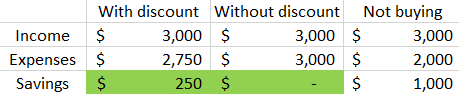
A) Income = $3000
B) Expenses = $2000
C) Savings = $3000 - $2000 = $1000

The above illustrates the base situation where we did not make the purchases. In our base scenario, our savings is $1000.

Let's analyse 3 possible cases:

1) Discretionary purchases (things you can do without)

For frivolous and discretionary purchases, we usually compare against the case of not buying it vs buying it. Why? Because we can well do without it. If you spend $750, your expenses increases by $2750, so your savings becomes $3000 - $2750 = $250. Between not buying and having a savings of $1000, vs buying and having a savings of $250, you save lesser by $750.


2) Non-discretionary purchases (things you can't do without)

For non discretionary purchases, we usually compare against the case of buying the item at non-discounted price vs buying at discounted price. If u buy at a non-discounted price of $1000, your expenses increases to $3000. Hence your savings becomes $3000 - $3000 = 0. If you buy at a discounted price of $750, your savings becomes $250. Since it's an item that you have to buy anyway, you save $250 if you buy at this discounted price. Notice that we do not compare against the case of not buying it and having a savings of $1000, because it is a purchase that we must make.


3) Investments (things you buy that increases your income)

For purchases that increases your income, the spending of $750 may result in a rise in future income. If your future income increases by more than the amount spent, you save more even after the purchase. If future income increases less than the amount spent, then net net there will be less savings. So, it depends on the investment returns to see if we save more or we save less or we don't save at all.


It's not so simple now, isn't it? As with all aphorism, the simple statement works as a good soundbite - catchy, memorable and impressive. But it simplifies the truth of the matter too much. There's a lot of details that need to be mentioned.


We can put this analysis to the test by analysing the purchase of a car. If a car is a discretionary purchase, the fall in COE has nothing to do with you. Having the cost of the car dropping from 100k to 80k still means that you have to spend 80k. However, if a car is a decision you are going to make anyway, a drop in the cost of the car is great for you. Now you can make the car purchase at a cheaper price, resulting in a net savings of 20k. Finally, if your car can make you earn more income because it extends your range and reach and allows you to save time and energy, it doesn't mean you should commit to the purchase immediately. The next step is to see if the potential increase in income is worth more than the purchase. Frankly, it need not even be just the increase in income, because we could be looking at other intangible stuff that we cannot put a money value to it. If after weighing all the good against the total cost of the car, and you think it's worth it, then we can go on and make the purchase.


Next time when someone says buying something is not a good purchase, you'll have to ask yourself first : out of the 3 scenarios, which one fits your situation the best?

Saturday, June 02, 2018

Voluntary contributions by self employed

Not too long ago, I received a letter from IRAS that I have to pay for my mandatory contribution to my medisave account as a self employed. It comes up to be $6393. I was mulling through the options that I have, so I might as well share it here since I know there is a dearth of write up just for self employed by self employed.

My situation:

1) I've done voluntary contribution to my CPF for ages, and the reason is to reduce my income tax and also to build a buffer in my OA so that if I have a bad year of income, I can rely on my OA to make payments to my mortgage, which is my biggest expense. And since I've switched to a loan with a floating interest rate, there will be a time when I need to prepay the loan when the interest rate shoots up sky high.

So far, I've saved up about 14 months of full mortgage payment in my OA account. Usually the mortgage payment is split 50-50 with my wife, so this 14 months is full payment for both of us. This means that if both of us are in a tough situation where we don't have income, I can use my OA to pay for the entire mortgage for another 14 months. I'm using a floating interest rate now, and I'm using the figures for the monthly mortgage payment with the assumption that the interest rate increases by another 40%. Should be safe enough but I can do more. Maybe 24 months?

2) Based on my age band, every dollar contributed to CPF will contribute to the accounts in the following ratio:

     OA :     SA   :  MA
0.5677 : 0.1891 : 0.2432

Since I need to do mandatory contribution of $6393, if I were to do voluntary contribution to 3 accounts, I will need to contribute $26,287 (6393/0.2432). That is way way too much for me. I don't want to put in so much into the CPF, tax relief or no.

Of course there is another way out for me. I can also do a voluntary contribution direct to MA alone. So since I need to do mandatory contribution of $6393 to MA, I just need to pay $6393 to MA.

In summary, it's a contribution of $6393 direct to MA or a contribution of $26,287 to the 3 CPF accounts. Both have tax relief, if you satisfy certain conditions.

3) It's a bit more complicated than that, because of the conditions for tax relief. I wrote about the conditions and the various types of contribution here.

I didn't do any voluntary contribution direct to MA in tax year 2017. According to the rules, if I didn't do VC to MA alone in last year, and I want to do VC to MA alone for this year, I won't be eligible for tax relief for this particular contribution. I've checked and confirmed with an officer from IRAS and got affirmation that my thinking is correct.

I did, however, done voluntary contribution to the 3 accounts in tax year 2017, hence if I do the same thing in tax year 2018 (that is, this year), I will be eligible for tax relief.

This means that in tax year 2018, I won't get tax relief for doing VC to MA. There will still be tax relief for VC to all 3 accounts.

3) Hence I came up with 3 plans. Basically it's a combination of both VC to MA direct (without tax relief) and VC to 3 accounts (with tax relief).

Plan A:
Contribute a total of 12k, of which 4.6k is directly into MA, and 7.4k into the 3 accounts.

Based on 7.4k contribution to the 3 accounts, I'll have 1.8k in my MA (7.4/0.2432). Add this 1.8k to the 4.6k contribution direct to MA, I'll have a total of 6.4k into the MA, which satisfies the mandatory requirement for me.

Plan B:
Contribute a total of 14k, of which 4k is directly into MA, and 10k into the 3 accounts.

Based on 10k contribution to the 3 accounts, I'll have 2.4k in my MA (10/0.2432). Add this 2.4k to the 4k contribution direct to MA, I'll have a total of 6.4k into the MA, which satisfies the mandatory requirement for me.

Plan C:
Contribute a total of 16k, of which 3.3k is directly into MA, and 12.8k into the 3 accounts.

Based on 12.8k contribution to the 3 accounts, I'll have 3.1k in my MA (12.8/0.2432). Add this 3.1k to the 3.3k contribution direct to MA, I'll have a total of 6.4k into the MA, which satisfies the mandatory requirement for me.

It's all summarised in this table below. The tax relief is only for the VC to 3 accounts because I didn't do any VC to MA in tax year 2017 (stupid me).


4) This morning I saw the post by Kyith about 2018 July's Singapore savings bond here. The 9 yr rate already exceeds OA's interest rate of 2.5%. 10 yr rate average interest is at 2.63%...wow. This instrument beats OA's interest rate, yet allows you to withdraw relatively short term (1 month max) compared to the CPF. What more do you want?

So, instead of having the CPF contribution, maybe we can do a plan D:

Contribute a total of 6.4k directly into MA. Then put in whatever amount (likely in the range of 8 to 10k) in the Singapore savings bond to get a return similar, if not better, than the CPF-OA account. There is no tax relief for this plan, but I can treat that as a 'cost' for more flexibility in the usage of my funds without the hard lock in under CPF.


I still have half a year to decide and think through the options, and I bet I'll be coming back to this post around Dec to decide by then.

Wednesday, April 25, 2018

Did you give away your equity freely?

I wanted to share this idea regarding child caring. The default way these days is for both parents to work while hiring a foreign domestic worker (or two) to take care of the kids. That is the most economic and financially savvy way. Hiring a domestic worker is much cheaper than going to infant care or child care, and have more utility. That is also the reason (I suspect) why my mum-in-law insists on wanting us to hire one. I vehemently refuse.

I seek to explain why here. But let us go to a separate domain of raising capital for companies first. I'll show you why knowing that stray bit of information is important in understanding my decision in not hiring a domestic helper.


HOW TO RAISE CAPITAL 

There are two ways in which a company can raise capital. Either give up some ownership by selling equities or retain ownership by borrowing money using debt. Most companies do a mix between these two extremes because there are some advantages and disadvantages for doing so.

If a company raises capital by selling equities, they lose ownership in the process. Future profits might be more but the original owners will get a lesser cut out of it. On the other hand, they don't have to pay anything now (let's exclude the fees to raise the equities now to simplify matters). The 'payment' is taken from the potential future profits of the company, which may or may not materialise. The company essentially raises cash in the present by paying from their future. Examples of raising capital by issuing equities are issuing new shares, rights and ipo.

If a company raises capital by borrowing money, they lose money right now in the form of interest paid on the borrowed sum. On the other hand, they retain full ownership and they don't have to pay any potential future profits to their debtors as the interest is fixed at the time of borrowing. The company is essentially raising cash in the present by paying right now. Examples of raising capital by issuing debts are loans from banks and bonds.

I want to highlight that neither methods are superior in itself. It's all based on circumstances. However, there seems to be a bias against borrowing money. Well, don't be. Borrowing money is perfectly fine, especially if you didn't over leverage and have the means to pay off. Businesses borrowing money to earn a greater profit by taking on projects that they can't otherwise undertake, is perfectly normal.


HOW TO RAISE HELP FOR CHILDCARE 

There are two ways to do this. You can ask someone to do it or you can do it yourself. When I mean someone, I mean anyone other than the parents. It can be a foreign domestic helper, a nanny, your mum in law or any of those commercial child care services.

If you raise help by asking someone else, you are like a company issuing equity. You are giving up ownership of your child to them. That someone else have a claim on the future relational profits that came from taking care of your child. Some parents are afraid that their hired helper (or mum in law) is getting too close to their child, to the extent that they prefer to be with the helper rather than the parents. This is a good example of a future claim on relational profits. The disadvantage is that you can't control formation of habits and values because transmission of such things are formed through daily contact, and you had already given up ownership on this.

If you raise help by doing it yourself, you are like the company borrowing money by issuing debts. You have full ownership of your child, and what values and habits you want to inculcate. Any future relational profits will be yours to gain. The drawback is the time spent and the potential income lost from doing it yourself. That is the interest you have to pay for 'borrowing', but you retain full ownership of any relational profits (or losses) yourself.

Most parents do a mix between these two extremes. Some activities they choose to do it themselves, while others they choose to seek help. The actual percentage varies according to circumstances, just like how the companies will choose their own debt/equity ratio. I've seen extreme cases too, where a household hires a foreign domestic helper while both parent works. Maybe a grandma stays in to watch over things. This is nearly 100% equities already. Another extreme case is where father works, mum quits her job to be full time housewife. She takes care of home matters all by herself. That's like a 100% debts scenario, based on my definition.


CONVERTIBLE BONDS?

This way of looking at child caring in household leads to interesting situations if we take the model of raising capital by companies to the extreme. Let's take a look at just one funny case.

Companies sometimes issue convertible bonds, so it's a mix between debt and equity. It's initially a bond paying fixed interest until a certain call date where the holders of the debt can convert it to equities, thus having a partial ownership of the company's future profit. If we extend the concept of convertible bonds to raising help in child care, then it's like a household hires a nanny to take care of the child, then after a period of time, marries the nanny into the family and thus the bond becomes an equity! Sacrilegious!

I'm sure readers can think of even more ridiculous application, so do share at the comments below.


I've seen a family with a household of 3 maids. One to cook, two to take care of household chores because the home is damn damn big. He is one of the bigshots of a media company living in the heart of Orchard road. Of course, this suaku Singaporean that is me is stunned like vegetable. Still yet to see a house filled with a harem of manga inspired 'maids'. That will be a sight to remember, haha


MY HOUSEHOLD

I work at home, so do my wife. Sometimes we have to go out for work, but that's just a few hours. My mum comes over to help out during the day, but leaves at night, so we take over the night duty. It's my wife who mainly handles the night part while I'm the backup because I have more work than her so I can't rest during the day time while she can (when my mum takes over). Selected activities are done by my mum while the rest are taken up by both of us. So, I'll say for my household, we're like 40% equities, 60% debts. Remember? Equities mean giving up ownership by asking for help, while debts mean retaining ownership by doing it yourself. So, I'm about 60% hands on and 40% outsourced.

My brother does quite the opposite from me. He hires help and outsourced the work to my mum who stays for about 6 years at his place. Both wife and himself are working full time, so it's a 100% equities for his household. I can see that the child is more attached to the helper and my mum, and there are periods of tension between my brother's wife and my mum because of this relational profits issue. They should have known better I suppose, because by issuing equities, they are giving away future relational profits to the very people who took care of the child. It's unavoidable - we like people more if they spend time more with us. Being a parent is not a right, it's something you have to spend time to grow into. Learning from this experience is also why I am a bit more cautious in giving away equity so freely.

Not wanting to hire help is a personal choice and personal preference. To be honest, I've seen families work well too with both parents working and the kids are taken care of by foreign domestic workers. But take note, usually the success cases I've seen are where the helpers are staying with the family for prolonged periods of time. 5 to 10 yrs? The helpers are not the come and go type. And there must be a family member at home together with the helper, so it's usually the grandma from either side of the parents. There is also a critical period too, usually before the kid enter primary school. Hence the first 6 years is the most important part of the kid where a lot of things are set right or failing which, it'll be hard to reverse.

Dad working + mum working + helper - family member at home = High chances of failure. Not going to take the chances after seeing what I see.


FINANCIAL SENSE NOT EQUALS COMMON SENSE

You are losing common sense if everything fulfills financial sense. These days, everything seems to be poisoned by financials. If it doesn't make sense economically, it's a bad decision. You weigh the decision of whether to have a child by looking at money. You weight the decision of buying a car by looking at money. You weigh the value of a university degree by looking at money. It's not wrong to make a decision by analyzing it financially; it's wrong if you make a decision only by analyzing it financially.


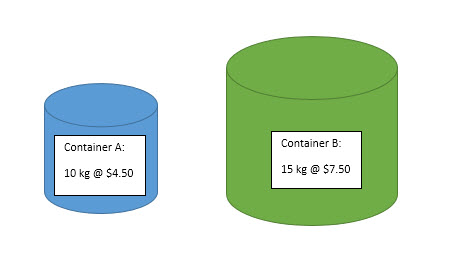
Look at a typical school based question. Container A has 10 kg of say milo powder selling at $4.50 each. Container B has 15 kg of the same milo powder selling at $7.50 each. The typical question is, which of the two containers should a fictitious person, say Mary, buy?

The unit price for container A is $0.45/kg, and that for container B is $0.50/kg. If you did not choose container A because it is cheaper per kg basis, I'm quite sure you'll be marked wrong. A more clever question is this: given that container A has a lower unit price, why should Mary buy container B instead?

a) Mary needed between 10 to 15 kg but not more than 18 kg, so 2 containers of A will be too much but one container of B is just enough

b) Mary needed the size of container B to store things

c) Container A has an expiry date that is nearer than container B

d) Mary likes the green colour of container B. She hates blue.

Must everything be in dollars and cents? That's just one perspective, isn't it?

Financially, it's better for both parents to work to earn the income, hire a foreign domestic helper with the earned income, take care of the kids and settle everything. In reality, it doesn't work as nicely as it should be. I've seen a lot of cases where the parents did not build a strong foundation with the kid, and when the kid starts to have behavioral issues (especially when they started school and mix around with others) and the parents start realising something is wrong. One of them, usually the mum, quits her job to oversee things, but it might be too late. If the parent did not reach a certain level of trust in the relationship, he or she can't start issuing advice. The kid just won't be able to accept. This is especially so for boys, because I think they are genetically programmed to rebel against his parents in order to forge his own sense of identity.

Parents, don't just be an ATM to your kid, please.

Tuesday, April 24, 2018

FIRE

Wanted to share my thoughts on what is meant by FIRE. I've a disclaimer here - I've not read a single piece of literature on this subject matter and I'm simply deconstructing the word based on what I've read about the components and piecing it up together. So, if I'm wrong, don't get so hot and start flaming me and set me on fire for anyhow firing an article on fire.


FIRE does not mean financially indebted, retired early. It stands for financially independent, retire early. Let's break up into the two parts : financially independent and retire early.


FINANCIALLY INDEPENDENT

Financially independent really just mean that you have an option not to work for money ever again. To be financially independent, we can go through 2 extreme models. Usually people take a path somewhere in between these 2 extremes. The 2 extremes are the networth method and the cash flow method.

The networth method is to have enough liquid assets after accounting for all debts, such that it can last you until you leave this place permanently. Let's say you know your annual expenses  and you project that you have 40 years from now till you expire. After taking into account inflation and money to pay off all your debts, you saved up 50 times your annual expenses. I think you are financially independent already. Most people can't do it this way, because the mathematics is just brutal. To pass the criteria, you either have to be an extremely high saver, be extremely low maintenance, have an extremely reduced life expiration date after retirement (either by delaying retirement age or die early), or all of the above.

It's not easy to do, but it's the most Conservative way because there's no reliance on any investment returns. Just hope that there won't be hyper inflation for extended periods of time and that the currency you saved in is still legal tender. But those are risk everyone will have to par take, not just you.

The other method to be financially independent is to go through the cash flow method. This means that whenever the income you generated passively, equals or exceeds your expenses, you are financially independent. There's a lot of negative connotation to the word 'passive', so let's elaborate on that. Passive does not mean lying on the beach, drinking cocktails while waiting for bags of money to drop at your lap. Passive means that you don't have to be actively present at the source where your money is made. Passive does not mean that there is no active involvement in the generation of income. It just means that you don't have to be there in order for the money to be made. With that out of the way, will the cashflow method be easier to achieve?

I think definitely much easier than the networth method. If I spend 3k a month, or 36k annually, and assuming I've a constant investment returns of 5% pa, I will just need 720k to fulfill the definition of being financially free, cashflow wise. On the other hand, if I'm doing the networth way, assuming I retire at age 60 and expire at age 90 (a good 30 yrs of life), I will need a comparatively larger amount of 1.08 million. And I haven't even included inflation.

But the relatively simpler status of being financially independent by the cash flow method has a drawback. It is very dependent on external  market factors, like the returns of your investments for example. I suspect people might hop between being financially independent and not financially independent in stretches of say 5 to 10 years. This method is obviously less conservative, unless u choose a very low investment returns, maybe to the tune of 2 to 3% pa, but correspondingly, the amount to cross the hurdle becomes larger. Interestingly, if you choose an increasingly lower investment returns, the cashflow method approaches the networth method. An investment return of 0% pa means that your passive income generated is simply the money you hide under the bed that u are withdrawing every month for your expenses. Not any different from the networth method.


RETIRE EARLY

To retire early, we must first know what is meant by early. Earlier than what? I think it's compared to the retirement age. Locally, that's like 65 years (maybe that is slowly being pushed later to 67 now, if it had not been done already). This means that as long as you are retired before age 65, you are considered early compared to others.

But is retire early the same as retired early? 'Retired' suggest the status is being forced onto you, while 'retire' suggest you actually force it on others. If you retire early, you force your boss to look for another replacement. If you are retired early, your boss forces you to look for another job. Crudely put, it's a matter of whether you got fucked or you fuck someone. Seldom do we see a situation where both the boss and the employee are on the same wavelength at the same time, with regards to the topic of early retirement

What are we retiring from? Not from life, hopefully, though it could be another morbid interpretation. Retire early from work most likely. Why retire early from work? Many reasons, and I list some below, non-exhaustively :

1) poor health, either personal or of closed ones
2) freedom to pursue other life goals
3) sucky work environment
4) for family

Because modern work entails being stuck in a work environment for maybe 70 to 80% of your waking hours, retirement from work means a lot of time is liberated to do other hopefully more interesting and worthy things. Unless, your work is interesting and worthy and pays reasonably well, so you don't mind spending close to 80% of your waking hours being stuck in a work environment. In fact, you might not even notice your environment, or the time spent, because you are constantly in a state of flow - that nice spot where challenge, skill and creativity all come together in a mass orgy that you can't help but stare continuously, oblivious to anything else.


PUTTING IT ALL TOGETHER - FIRE 

To reach FIRE is quite different from just FI. It's like you have 250 for your PSLE and feeling quite good about yourself, until you realised that everyone gets around 265. To retire early and also to be financially independent is like the top of the food chain, the king predator. You have to be so good at personal finances, managing your investment returns and also likely having a good career paying top dollar while living like Diogenes. Simply put, it's not for everyone, and you don't have to jump on this bandwagon because everyone else wanted to do it.

To see how hard it is to achieve this, let's just use a simple example. Say u stop school at age 25, and wanted to retire early and be financially free at age 40. I'm a soothsayer so I know you will expire at age 85, so that's a good 45 years of life after retirement that had to be funded by 15 yrs of work life. You also have to feed yourself during the 15 yrs of working life, so during that precious 15 yrs of income generating period, you have to earn enough to feed yourself for 60 years. In other words, every 1 yr of work you'll have to save for 4 yrs of non-work. That's a 80% saving rate for the 15 yrs of work that you do. How many can save at 80% rate for 15 years?

I can, if I'm single, lives with my family, eat simply, and life simply. Harder to do with a family, esp in Singapore. Not impossible, just very hard to do. That's why I say it's the elite of elites that can truly reach FIRE.

Even though FIRE might be hard to achieve, but we can always strive to reach FI. Interestingly, in the past when FIRE is not known yet, it's just FF (financial freedom) or FI (financial independence) here and there. So I must conclude that the retire early part is a pretty new addition to the personal finance jargon. Who knows maybe in another 5 or 10 yrs, we will be seeing people wanting to get FIRED. What's FIRED? Financially Independent Retire Early Debtfree.

But wait...isn't the purpose of being financially independent to actually pursue what you want to do? And what happened to the independence part? How come after achieving FI or FIRE or FIRED, we are still following the conventions set up others? Isn't it jumping from one corporate rat race to another financially free rat race? I admit these are different races altogether but you are still a rat if you're racing with each other to an arbitrary end game, not set by yourself. When your choices and happiness are dictated by others, you are not free at all. At best, you are less chained but still chained nevertheless.


WHAT ABOUT ME?

You'll notice that I never said I wanted to retire early, so that's never a goal of mine. I'm happily and purposefully driven in my job and will be happy to continue working as long as others would have me. But I do intend to reach financial independence years down the road. Maybe when I'm 55? It's also never a hard target, more like a personal milestone or achievement if I can do it. If I can't do it, so be it.

That's why I hate it when people start to do competitive financial goals. Oh, I saved 100k when I'm 25. Nah, that's nothing, I saved 200k when I'm 20. I'm better, I saved 300k when I'm just 5. If you find yourself doing that, you have to reflect whether this is what you want. Is it any different from running the corporate rat race that you're so dying to escape from? I realised I'm part of this game somehow, so I stopped putting up a single post on my savings every year. If I ever do, it's more for my personal accounting (so that I know how much I accumulated each other). We save what we can, so you don't have to know what's mine. If I cause you to feel red or green, please accept my sincere apologies. I was young and insensitive, and I do not know the repercussions of my actions.

I know I have good financial habits. I save every month and I don't have devastating bad financial habits. I spend my money purposefully most of the time and I don't deprive myself from getting the quality of life that I want throughout this journey.

If I can live life without worrying much about money because I am secure and knowledgeable about it, I think I have already achieved what I set out to do - financial freedom.

Sunday, March 04, 2018

Indifferent to the difference between needs and wants

Today I was chatting with some members in the Bigscribe facebook group regarding fixed and variable income. It's just the usual banter that happens daily, so it provides an environment where you get saturated with how to build wealth and generally live a good life. Like diffusion and osmosis, you have no choice but to be the average of the 5 people you hang out with.


But that's not the point of this post. I was reflecting on my journey regarding the separation of needs and wants. You know the usual rules when it comes down to controlling expenses, that gurus will first ask you to list down your needs and your wants. By strictly managing between your needs and wants, you can reduce your expenses. I've nothing against this, and I've also done this before, but no longer do that anymore.

So why is that so?

In this particular aspect, my journey is as follows:

1) Know nothing between wants and needs. Just spend as long as I have cash or credit.
2) Know the difference between wants and needs. Just spend on the needs and cut back on the wants.
3) Question the difference between wants and needs. Start to spend more on the wants to enhance quality of life.
4) Know nothing between wants and needs. Just spend as long as I have cash or credit.


Life is often like a game of snake and ladders. We travelled so far to go back to square one.


It seems that I have travelled around the world and went back to square one. But this isn't the case! On the surface, it seems that I no longer care about the needs and wants, but the mindset is totally different. I don't care much about spending now because I already know that even if I were to go mad with shopaholic disease, I couldn't possibly bust my bank account. Hence the difference between stage (1) and stage (4) is a deep understanding of myself and my limits. Everything is internally controlled and there is no need for an artificial demarcation of spending into needs and wants.


There are many other examples where I have gone full circle and went back to square one, well, superficially. But the journey is not just what happens on the surface, it is a journey travelled internally as well.


And what is essential is invisible to the eye.

Friday, December 01, 2017

Networth update in 2017

Another year is almost coming to a close. This year is yet another fantastic year for me. Every year seems to be fantastic to me, so either I'm delusional or I'm really happy with my life. I'm going for the latter haha! The last time I did my networth update is around the same time last year, back in 2nd Dec 2016 here. To clarify, this is my networth, not the networth of my household.

There are so many ways to calculate networth, but I've always done mine this way. It's essentially assets minus liabilities but how you define assets and liabilities makes all the difference. Unlike most people, I excluded the value of my property but included the debt associated with it. Took me a few years to reach from a negative value to 0. The assets part include:

1. Cash in my wallet
2. All the money in my various bank accounts
3. Cash holdings under mattress and milo tins at home
4. Money in my paypal account
5. All the money in the 3 accounts in my CPF
6. Money market fund account
7. Marked to market investment portfolios
8. Surrender cash value of whole life insurance plans

I do not include the value of my 5 room flat that I'm currently staying in, and also the value of the family car that I own.

The liabilities part include:

1. Credit card bills
2. My portion of the HDB mortgage loan (total remaining loan amount divided by 2)

A good friend, Azrael, finally legitimize the way I calculated my networth. He introduced the term Net Current Asset Value (NCAV), first coined by Benjamin Graham to valuate a company. NCAV basically means taking the current assets minus all total liabilities. Since property value of my residential property is not under current assets (I could be wrong, I'm no accountant), hence what I did to valuate my networth is similar to the conceptual definition of NCAV. I stand to be corrected of course. But seriously, it also doesn't matter. I'm still going to do it my way haha

2014: Assets: $226k, Liabilities: $220k, Networth: $6k
2015: Assets: $295k, Liabilities: $207k, Networth: $87k
2016: Assets: $351k, Liabilities: $188k, Networth: $163k
2017: Assets: $449k, Liabilities: $182k, Networth: $267k


At first glance, there seems to be a huge increase in networth. Nearly a 100k increase year to year since 2016. Liabilities did not drop that much, only dropping by 6k from 2016. Assets went up a lot, nearly 100k to 449k in 2017.

The assets increased by a lot, and I think it's mainly due to my dividends and the bullish stock market. This year, because of my kid, I definitely worked much lesser compared to previous years. My total income fell as I free up my weekend time slots to make more time to take care of my kid. Hence, initially I thought my savings will drop as a result. Surprisingly, it came in pretty strong at 72k. This amount must have been saved by the combination of more dividends, parental leave and child care leave added together. So even though I worked less actively, these streams of income played their role to cushion my fall in active income. In the future, I would expect my asset value to generate more and more cashflow for me, as I progressively spend more and more time towards my family instead of wealth building. Inevitable.

Liabilities is mainly from the amount that I owed for my HDB mortgage. I switched from HDB loan of 2.6% to a commercial loan. It's somewhere in transition yet, so I have not paid my mortgage since November. Traditionally, I would also do a lump sum partial capital repayment for my loan, but because it's in between lenders now, I would do it only in 2018 when things are settled down. That would explain why my liabilities only dropped 6k from 2016.

Networth went up nearly 100k, and I think it's mainly due to asset value increasing. This means it's mainly the bullishness of the stock market that causes my asset value to go up. I'm about 40% cash. That will be my option if and when the market allows me to buy. Not in a hurry to use it all, so let it rot.

My networth is finally way over my liabilities. This means that if I choose to, I can liquidate everything and pay off my liabilities. I wouldn't do that of course, but I can choose to do that now. I look forward to the day that my networth is twice of my liabilities, then my whole family will be relieved of one great debt.

Tuesday, August 01, 2017

The 6 Errors in Month-end Accounting

Every first of each month, I'll do my month end accounting for the previous month. This means that I will do a bank reconciliation to make sure that all the accounts are properly tallied and accounted for. Today, when I was doing the same thing I had been doing for years, I realised I had a surplus of $1k. That is, my actual cash that I counted had about $1k more than the amount that is reflected digitally. This is usually a happy problem for some, but for me, any amount more than $50 is a huge major red flag. That means there's some major discrepancy somewhere.


Usually the problem lies with the income part. I must have forgotten to record some cash that I received. In the midst of trying to find out where the error occurred, I discovered yet another major error. I had 3 records of my income, and all three had to tally each month, if not it's another major red flag. Somehow, I had not received cash, but I had in my records that I had received it, and after some investigation and confirmation from the affected parent, I found out the error. It was rectified immediately and all records are tallied now.


This is all thanks to YNAB. If not for that software to do double entry accounting, I probably wouldn't have discovered the error. That brings me to the gist of this post. What are the possible errors that might happen when doing my month end accounting?


1) Error of omission

This is exactly what happened to me. I received cash, but I had omitted the transaction records in my books, so my actual cash holding is more than what my records say I should have. This is quite common. Oftentimes, it'll be some purchase of food or drinks that I had forgotten to record down, but if the difference is only a few dollars, I usually ignore that. It's not a major flag unless it's more than $50.

2) Error of commission

This is when you record things in the wrong account. For example, I draw out money bank A, but I recorded it as bank B. I've encountered this before too, and it's fairly easy to spot. Both accounts will be wrong by equal amount, so a little investigation will shed the light on where the problem area is.

3) Error of original entry

This is when you are supposed to record $11.60 but recorded $16.10 instead. If it's not a big amount, it's actually okay. But if it's a big amount, it's going to be hard to check the records. Especially when there are so many records on food transactions for me. Without the original receipt to counter check, I'll say it's quite impossible to find out, especially if it's cash transactions. Thankfully for bigger items that cost more, I usually use credit card, so there's already a paper trail.

4) Compensating error

This is when you received $500, but you keyed in as $300. At the same time, you also spent $400 from the same account but keyed in wrongly as $300. The positive error and the negative error cancelled each other out. This means that while the balance sheet is balanced, it's wrongly balanced. So far I've not had such errors. Or maybe I haven't discovered it yet...gasp.

5) Error of principle

This is fairly common because of auto-correct in hand phone. Sometimes when I spent $10 in my wallet, it'll deduct $10 from my bank account instead of wallet account. That's an error in principle. Usually a month end bank reconciliation will discover such errors.

6) Error of complete reversal

This is when you are supposed to take out $10 from account A and put into account B, but you keyed in that you take out $10 from account B and put into account A. This is not an issue, because the smart YNAB software will prompt you when such things happen. At least the obvious ones.


Sunday, January 29, 2017

Marginal utility of Time vs Money

I'm always fascinated by my earlier 'miserly' behaviour, like how I used rusty shavers to save some money or how I worked like crazy to save my first 50k until I get so burnt out. I framed it as a growth mindset, where I grew bigger than my problems, hence it's not that my problems became smaller and therefore manageable, but rather I grew bigger, so the problems no longer affect me that much.

This three articles I blogged about has the same underlying theme:

1. Frugality isn't just about saving money
2. Being frugal with your time
3. Of Dragons and Men

Recently, while reading Tools of Titans by Tim Ferriss (I could not recommend that book enough), I came across another interesting framework to use. It's the idea of the marginal utility of an extra minute vs an extra dollar.

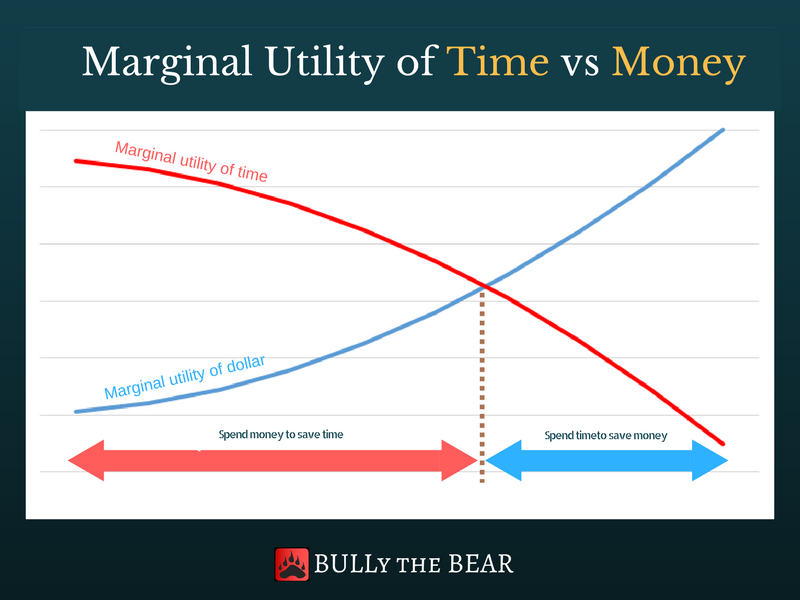
The idea is simple: Imagine you want to go to another place, and you can go by either taking a cab or walking there. Taking a cab is definitely faster but more expensive, so you spend money to save time. On the other hand, walking is slower but cheaper, so it allows you to spend time to save money. By comparing the marginal utility of time vs dollar, you can make a rational decision. If the utility of one extra dollar is more than the utility of one extra minute, save the dollar and spend the time i.e. walk there. If the utility of one extra minute is more than the utility of one extra dollar, save the time and spend the dollar i.e take a cab there.


Here's a few more illustrations:

1. In the past I used to go all the way to Pennisular Plaza to get sports shoes. The reason is that because there are a lot of similar shops there, so the greater competition combined with the great variety makes it a cheaper place to shop. However, the savings is probably not much, perhaps only 10-20% only. So to save that few dollars, I would spend the time to go over there, because I have more time than money, so the utility of that extra dollar is more important to me than the utility of that extra minute, hence I spend my time to save the dollar.

2. Until about 5 years ago, I used to go to my student's place for lessons. These days, I would charge a lesser amount if students come over to my place for lessons instead, because I don't have to spend the extra time travelling. Even though I can earn more if I go over, I normally don't do that anymore. The reason is that the utility of an extra minute is now much more than the utility of an extra dollar, hence I would rather spend money to save time by letting students come over to my place instead of the other way.


But please do not treat this as a mathematical model. At best, it's a philosophical concept. If you want, you can valuate your hourly rate, but I think it will be hard to valuate your time. So agar agar (estimate) will do and there's no need for complex computation to derive whether your marginal utility of time is more or less than that of your money.

Why?

Because the marginal utility of your time is more valuable than the marginal utility of doing the computation LOL

Saturday, December 17, 2016

Somebody staring at me

I wore a new t-shirt out today and noticed a few people, especially the guys, looking at me. I know because I saw their eyes trying to read what my t-shirt says. I took a selfie of myself and here's how I look:


Yeah, I know my face is something that comes out of a horror film. But really, I think it's my t-shirt that these people are looking at. I think my t-shirt is a good conversation starter. I'm wearing it for work and hoping one day my students, out of curiosity, would ask me what Financial Independence means. I'll be all prepared and ready to deliver my heart wrenching, inspirational speech about financial freedom with the soundtrack of Braveheart in the backdrop.


Here's how my fantasy reply goes:

1. I'll ask what they think financial independence is all about.

2. I'll ask them for some reasons why people work.

3. I'll ask if they had ever done anything that they will gladly do for free because it's exactly how they would spend their leisure time on

4. I'll ask if they would want to be able to do things like that for the rest of their lives

5. I'll ask how they would feel if I can show them a way where they no longer have to work for a living, and have all the freedom and time to pursue what they want to do (cue for Braveheart music)

6. I'll sell them a series of video links at $99.99 each and be freaking rich

6. That's what Financial Independence is all about.

7. Students leave my place, all teary but inspired. Each step they take take sparkles with the fire of passion. Each breath they take fills their lungs with air and purpose. Each heartbeat sends positive energy and optimism that vibrates throughout their body. Sounds coming out of their mouth are like angels singing. Light entering their eyes are rainbows brightening their vision.


Nah, most likely my students will mouth out an invisible huh, and proceed to play with their handphone on their way out, with me screaming at their backs to remember to do their work for the next lesson. Or they wouldn't even ask because their curiosity about the world had been deadened by the burden of the school. I bet they wouldn't even ask where I got my t-shirt from.

It's okay, perhaps my readers will ask. Or perhaps one day when my students are ready, this blog will be here for them.