Showing posts with label Banks. Show all posts

Friday, September 21, 2018

The returns of OCBC 5.1% preference shares

I bought the OCBC preference shares, OCC 5.1% NCPS, a while ago for my parent's retirement funds. I didn't even know that OCBC had redeemed back the perp on their first call date until I saw the capital returned to my bank account. Another one bites the dust... So how had it performed? Let's take a look at the details:


1st tranche:

Buy date: 3rd-Feb-2014
A) Buy price: $106.10
B) Quantity: 100 shares
C) Comms paid for buying: $37.19
D) Dividend collected: $2551.40
E) Total profits: 100*B + D - 100*A - C = $1904.21
F) Recall date: 20th Sept 2018
G) Total duration: 4.63 yrs
H) Total % profit: E/(100*A + C)*100 = 17.88%
I) % returns/yr = H/G = 3.86% per annum

2nd tranche:

Buy date: 14-Jan-2015
A) Buy price: $106
B) Quantity: 100 shares
C) Comms paid for buying: $36.30
D) Dividend collected: $2041.39
E) Total profits: 100*B + D - 100*A - C = $1405.09
F) Recall date: 20th Sept 2018
G) Total duration: 3.68 yrs
H) Total % profit: E/(100*A + C)*100 = 13.21%
I) % returns/yr = H/G = 3.58% per annum


I think the returns per annum is pretty decent, especially at those times where the Singapore savings bond is not even available yet. Those are the times when the interest rate is super low. In fact, so low that I am compelled to help my parents because their default action is to put into fixed deposit.

I'm glad I didn't screw it up for them.

Tuesday, April 24, 2018

FIRE

Wanted to share my thoughts on what is meant by FIRE. I've a disclaimer here - I've not read a single piece of literature on this subject matter and I'm simply deconstructing the word based on what I've read about the components and piecing it up together. So, if I'm wrong, don't get so hot and start flaming me and set me on fire for anyhow firing an article on fire.


FIRE does not mean financially indebted, retired early. It stands for financially independent, retire early. Let's break up into the two parts : financially independent and retire early.


FINANCIALLY INDEPENDENT

Financially independent really just mean that you have an option not to work for money ever again. To be financially independent, we can go through 2 extreme models. Usually people take a path somewhere in between these 2 extremes. The 2 extremes are the networth method and the cash flow method.

The networth method is to have enough liquid assets after accounting for all debts, such that it can last you until you leave this place permanently. Let's say you know your annual expenses  and you project that you have 40 years from now till you expire. After taking into account inflation and money to pay off all your debts, you saved up 50 times your annual expenses. I think you are financially independent already. Most people can't do it this way, because the mathematics is just brutal. To pass the criteria, you either have to be an extremely high saver, be extremely low maintenance, have an extremely reduced life expiration date after retirement (either by delaying retirement age or die early), or all of the above.

It's not easy to do, but it's the most Conservative way because there's no reliance on any investment returns. Just hope that there won't be hyper inflation for extended periods of time and that the currency you saved in is still legal tender. But those are risk everyone will have to par take, not just you.

The other method to be financially independent is to go through the cash flow method. This means that whenever the income you generated passively, equals or exceeds your expenses, you are financially independent. There's a lot of negative connotation to the word 'passive', so let's elaborate on that. Passive does not mean lying on the beach, drinking cocktails while waiting for bags of money to drop at your lap. Passive means that you don't have to be actively present at the source where your money is made. Passive does not mean that there is no active involvement in the generation of income. It just means that you don't have to be there in order for the money to be made. With that out of the way, will the cashflow method be easier to achieve?

I think definitely much easier than the networth method. If I spend 3k a month, or 36k annually, and assuming I've a constant investment returns of 5% pa, I will just need 720k to fulfill the definition of being financially free, cashflow wise. On the other hand, if I'm doing the networth way, assuming I retire at age 60 and expire at age 90 (a good 30 yrs of life), I will need a comparatively larger amount of 1.08 million. And I haven't even included inflation.

But the relatively simpler status of being financially independent by the cash flow method has a drawback. It is very dependent on external  market factors, like the returns of your investments for example. I suspect people might hop between being financially independent and not financially independent in stretches of say 5 to 10 years. This method is obviously less conservative, unless u choose a very low investment returns, maybe to the tune of 2 to 3% pa, but correspondingly, the amount to cross the hurdle becomes larger. Interestingly, if you choose an increasingly lower investment returns, the cashflow method approaches the networth method. An investment return of 0% pa means that your passive income generated is simply the money you hide under the bed that u are withdrawing every month for your expenses. Not any different from the networth method.


RETIRE EARLY

To retire early, we must first know what is meant by early. Earlier than what? I think it's compared to the retirement age. Locally, that's like 65 years (maybe that is slowly being pushed later to 67 now, if it had not been done already). This means that as long as you are retired before age 65, you are considered early compared to others.

But is retire early the same as retired early? 'Retired' suggest the status is being forced onto you, while 'retire' suggest you actually force it on others. If you retire early, you force your boss to look for another replacement. If you are retired early, your boss forces you to look for another job. Crudely put, it's a matter of whether you got fucked or you fuck someone. Seldom do we see a situation where both the boss and the employee are on the same wavelength at the same time, with regards to the topic of early retirement

What are we retiring from? Not from life, hopefully, though it could be another morbid interpretation. Retire early from work most likely. Why retire early from work? Many reasons, and I list some below, non-exhaustively :

1) poor health, either personal or of closed ones
2) freedom to pursue other life goals
3) sucky work environment
4) for family

Because modern work entails being stuck in a work environment for maybe 70 to 80% of your waking hours, retirement from work means a lot of time is liberated to do other hopefully more interesting and worthy things. Unless, your work is interesting and worthy and pays reasonably well, so you don't mind spending close to 80% of your waking hours being stuck in a work environment. In fact, you might not even notice your environment, or the time spent, because you are constantly in a state of flow - that nice spot where challenge, skill and creativity all come together in a mass orgy that you can't help but stare continuously, oblivious to anything else.


PUTTING IT ALL TOGETHER - FIRE 

To reach FIRE is quite different from just FI. It's like you have 250 for your PSLE and feeling quite good about yourself, until you realised that everyone gets around 265. To retire early and also to be financially independent is like the top of the food chain, the king predator. You have to be so good at personal finances, managing your investment returns and also likely having a good career paying top dollar while living like Diogenes. Simply put, it's not for everyone, and you don't have to jump on this bandwagon because everyone else wanted to do it.

To see how hard it is to achieve this, let's just use a simple example. Say u stop school at age 25, and wanted to retire early and be financially free at age 40. I'm a soothsayer so I know you will expire at age 85, so that's a good 45 years of life after retirement that had to be funded by 15 yrs of work life. You also have to feed yourself during the 15 yrs of working life, so during that precious 15 yrs of income generating period, you have to earn enough to feed yourself for 60 years. In other words, every 1 yr of work you'll have to save for 4 yrs of non-work. That's a 80% saving rate for the 15 yrs of work that you do. How many can save at 80% rate for 15 years?

I can, if I'm single, lives with my family, eat simply, and life simply. Harder to do with a family, esp in Singapore. Not impossible, just very hard to do. That's why I say it's the elite of elites that can truly reach FIRE.

Even though FIRE might be hard to achieve, but we can always strive to reach FI. Interestingly, in the past when FIRE is not known yet, it's just FF (financial freedom) or FI (financial independence) here and there. So I must conclude that the retire early part is a pretty new addition to the personal finance jargon. Who knows maybe in another 5 or 10 yrs, we will be seeing people wanting to get FIRED. What's FIRED? Financially Independent Retire Early Debtfree.

But wait...isn't the purpose of being financially independent to actually pursue what you want to do? And what happened to the independence part? How come after achieving FI or FIRE or FIRED, we are still following the conventions set up others? Isn't it jumping from one corporate rat race to another financially free rat race? I admit these are different races altogether but you are still a rat if you're racing with each other to an arbitrary end game, not set by yourself. When your choices and happiness are dictated by others, you are not free at all. At best, you are less chained but still chained nevertheless.


WHAT ABOUT ME?

You'll notice that I never said I wanted to retire early, so that's never a goal of mine. I'm happily and purposefully driven in my job and will be happy to continue working as long as others would have me. But I do intend to reach financial independence years down the road. Maybe when I'm 55? It's also never a hard target, more like a personal milestone or achievement if I can do it. If I can't do it, so be it.

That's why I hate it when people start to do competitive financial goals. Oh, I saved 100k when I'm 25. Nah, that's nothing, I saved 200k when I'm 20. I'm better, I saved 300k when I'm just 5. If you find yourself doing that, you have to reflect whether this is what you want. Is it any different from running the corporate rat race that you're so dying to escape from? I realised I'm part of this game somehow, so I stopped putting up a single post on my savings every year. If I ever do, it's more for my personal accounting (so that I know how much I accumulated each other). We save what we can, so you don't have to know what's mine. If I cause you to feel red or green, please accept my sincere apologies. I was young and insensitive, and I do not know the repercussions of my actions.

I know I have good financial habits. I save every month and I don't have devastating bad financial habits. I spend my money purposefully most of the time and I don't deprive myself from getting the quality of life that I want throughout this journey.

If I can live life without worrying much about money because I am secure and knowledgeable about it, I think I have already achieved what I set out to do - financial freedom.

Sunday, January 29, 2017

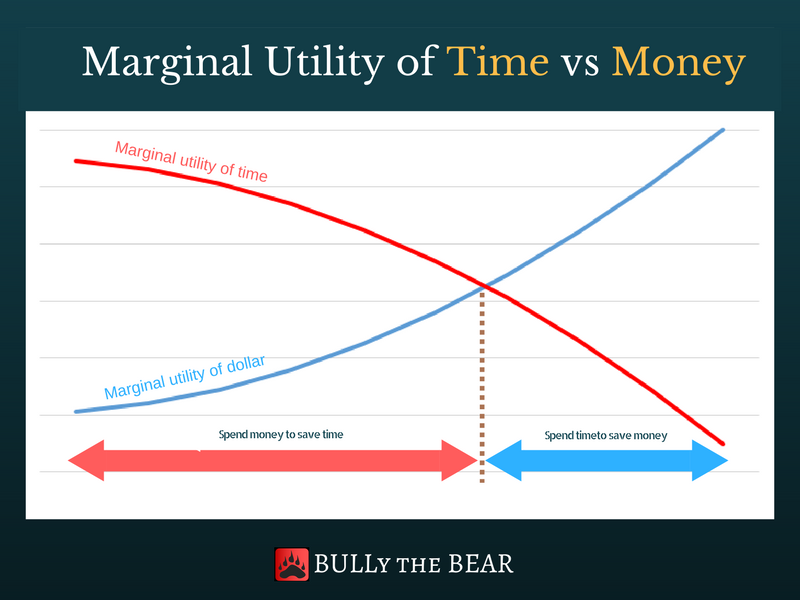
Marginal utility of Time vs Money

I'm always fascinated by my earlier 'miserly' behaviour, like how I used rusty shavers to save some money or how I worked like crazy to save my first 50k until I get so burnt out. I framed it as a growth mindset, where I grew bigger than my problems, hence it's not that my problems became smaller and therefore manageable, but rather I grew bigger, so the problems no longer affect me that much.

This three articles I blogged about has the same underlying theme:

1. Frugality isn't just about saving money
2. Being frugal with your time
3. Of Dragons and Men

Recently, while reading Tools of Titans by Tim Ferriss (I could not recommend that book enough), I came across another interesting framework to use. It's the idea of the marginal utility of an extra minute vs an extra dollar.

The idea is simple: Imagine you want to go to another place, and you can go by either taking a cab or walking there. Taking a cab is definitely faster but more expensive, so you spend money to save time. On the other hand, walking is slower but cheaper, so it allows you to spend time to save money. By comparing the marginal utility of time vs dollar, you can make a rational decision. If the utility of one extra dollar is more than the utility of one extra minute, save the dollar and spend the time i.e. walk there. If the utility of one extra minute is more than the utility of one extra dollar, save the time and spend the dollar i.e take a cab there.


Here's a few more illustrations:

1. In the past I used to go all the way to Pennisular Plaza to get sports shoes. The reason is that because there are a lot of similar shops there, so the greater competition combined with the great variety makes it a cheaper place to shop. However, the savings is probably not much, perhaps only 10-20% only. So to save that few dollars, I would spend the time to go over there, because I have more time than money, so the utility of that extra dollar is more important to me than the utility of that extra minute, hence I spend my time to save the dollar.

2. Until about 5 years ago, I used to go to my student's place for lessons. These days, I would charge a lesser amount if students come over to my place for lessons instead, because I don't have to spend the extra time travelling. Even though I can earn more if I go over, I normally don't do that anymore. The reason is that the utility of an extra minute is now much more than the utility of an extra dollar, hence I would rather spend money to save time by letting students come over to my place instead of the other way.


But please do not treat this as a mathematical model. At best, it's a philosophical concept. If you want, you can valuate your hourly rate, but I think it will be hard to valuate your time. So agar agar (estimate) will do and there's no need for complex computation to derive whether your marginal utility of time is more or less than that of your money.

Why?

Because the marginal utility of your time is more valuable than the marginal utility of doing the computation LOL

Wednesday, December 23, 2015

A little a day goes a long way; A lot goes a longer way

Savings more or earning more is the way forward? Some say it's savings more, some say it's earning more and some say both are important. To me, I think the sequence is more important.


 I think if you're having a fixed pay where your income is fixed, then there's nothing else you can do to increase it. If you want to save more, then you have to cut your spending. The savings equation is very simple; Savings = Income - Expenses. Cutting expenses is the least disruptive way towards saving more. Here's where the needs and wants are segregated, and you want to reduce frivolous expenses down to a minimum. But there's only so much you can cut once you've tried. Without going down the cheapskate route, being frugal still means having to eat food and having a shelter above your head when you sleep at night. There's also so much you can cut without sacrificing long term health too.


This is the point where you have to think about increasing your earnings. This is much more disruptive than cutting costs, because it will involve changing your entire assumptions about your earning power. At some point in time, you have to rack your brains to think what other streams of income can you get while still maintaining your expenses. This is hard, and there's a lot more reasons (or excuses) you can give not to do this and continue cutting your expenses to save more.


So, for salaried workers, save more by cutting expenses first, then go and try earning more.


For salesman and self employed, where there's no such thing as a fixed salary, you'll find that people tend to favour earning more as a way to save more. Once you think of yourself as a company, you'll want to increase your net profits by increasing revenue and not just reducing cost. Which is fine, until you realise that people who earn a lot more tend to spend a lot more too. If that's the case, then the next step is to learn how to stop your cost from rising proportionally to your earnings. If you earn much more than the rise of your expenses, net net you'll still save more.


So, I think for those without fixed pay, try to earn more and then try to reduce your expenses in order to save more.


What about me? I started saving more by cutting costs. Then when I realised that I've nothing more to cut because it is so painful for me to live such a miserable life like that, I started to change my assumptions to earn more. Ironically, that is also painful. I've to work a lot more hours and a lot more odd hours. Hence the first 50k that I saved is so much tougher than the last 50k that I saved. It's like that - if you want to create a new habit, you have to constantly remind yourself and basically live and immerse yourself in that environment. That's why you have to ask yourself why you even want to save this amount in the first place.


Motivation will make your journey more understandable. Desperation will make it possible. A little goes a long way, but for me, a lot goes a longer way. A lot of what? Effort!!


Friday, October 17, 2014

Prepare yourself mentally for bear market

For those of you who had not seen a real mother bear striking down at the market, here's a sneak preview from the past. Unfortunately, I've lost some of the pics when the server I've uploaded them crashed and died. The pictures I saved is meant to serve as a reminder for me when the next bear comes...which might be now.

This one is taken from 2009 Sept 10.


Just look at the Nasdaq and SP500, you'll see why we haven't reached 'there' yet.


This one is for STI. A drop of 5.61% in one day is no joke.


Lastly, this is for the rest of the exchange. As you can see, it's not called the global financial crisis for fun.


Can you stomach this kind of draw-downs in your portfolio value? Surviving is one thing. You must also thrive in this environment. That's how the cash-rich gets richer in every financial crisis. START saving up your warchest now!

Tuesday, November 23, 2010

Rights exercise for ICBC bank

ICBC, a china bank listed in HK (1398.hk), is going to have a rights issue. The reason for the rights issue is to meet the new basel III requirement for banks. ICBC is already well capitalised, so they do not require much of a capital injection. Hence, the rights of the H shares (that is, HK listed one) is on the basis of 0.45 shares at HK$3.49 for every 10 existing H shares held before XR.


The announcement is made here.


Having rights for HK listed companies is a little different from those in Singapore. I had experienced it before for my HSBC counter. Basically the shares are held in a custodian account held by whichever broker you had bought the H shares from. Hence, they will do the necessary paper work for you (don't be happy, you have to pay them for such things known as company action). They will send you a letter to ask you to tick your choice and you'll have to send it back, together with the payment for the rights.


I've no intention of subscribing to the rights at all, hence I've already disposed of ICBC long before this announcement. Last close was at 6.04. Based on this price, the price after the rights should go down to 5.93. ( {6.04*10 + 0.45*3.49}/10.45 ) It had been dropping after China announced more controls to raise the capital adequacy ratio of the state bank (which ICBC proudly belongs to) and hinting of more controls over its fight on inflation and the bubbling property market.


It'll be interesting to see how it reacts after the rights issue, by mid December this year.

Monday, November 15, 2010

Preference shares Part IV

Ok, here's my analysis on the 7 preference shares listed in SGX. Let's run through some definitions before I show you the results. I made the following assumptions/clarifications:


1. The preference shares is assumed to be called off at the first callable date at the par value. This means that with the exception of OCBC Bk 4.2% NCPS which has a par value of $1, the rest has a par value of $100. The respective banks that issued the preference shares will buy it back from the holder at the par value, regardless of whatever price that the preference shares is trading at.


2. I assumed that you had bought the shares last Friday on 12 Nov 2010. That is just an arbitrary date because I just took the last closing price. Based on that date, some of the preference shares still have some payment to be made this year, particularly those that had payment on 20 Dec. Depending on the callable date, there could be 1 installment of payment before it gets called off. I put down under the column "no. of payments till maturity".


3. Returns till maturity is the sum of the total number of payments made till the first callable date plus any capital gain (or loss) resulting from the difference in the price and the par value. So if a preference share is bought at 100.58 and the par value is 100, you will book in a capital loss of $0.58 per share. So the returns till maturity (in my definition) is the capital loss + whatever payments made from the time you bought to the first callable date.


4. Yield pa is the annualised yield calculated by the formula:

Yield pa = (returns till maturity)/(price of share)   x  360/(days till maturity)  x 100%

I think this is what they call the yield to call.


So here's the tabulated results shown below:


My thoughts:


1. Three factors affect the annualised yield till maturity - the callable date, the price that you bought in (above par or below par value) and the nominal yield. I think of all that factors, the price that you bought in is the most important. Why? Price that you bought controls the actual yield that you get from the preference shares, and can allow you to book a capital gain when it matures. That being said, OCBC 3.93% NCPS 10 is the only preference shares out of the 7 listed in SGX that is currently below par value. That boost the yield to 4.13% (3.93*100/95.2) instead of the nominal 3.93%. We haven't even talk about the potential capital gain should they choose to call it back.


2. All these looks very nice on paper. However, if the assumption that the preference shares are not called back, then things would not be so nice anymore. That is because 3 of the 7 preference shares have this dividend policy that if it is not called back, the dividend will be pegged to some percentage of 3 month SOR. Who knows what the 3 month SOR will be like when it is near the callable date? What I do know is that if the SOR is low, the banks shouldn't recall it back since they can get to use the debts at a cheaper cost. If the SOR is high, then the banks should want to recall it back and you don't get the upside from the new dividend policy. Tails they win, heads you lose.


3. To remove all the anxieties and messiness of the overall picture, it might be better to just concentrate on those preference shares without 'funny' dividend policy. You know exactly what the dividend you'll get before and after callable date. I think people who are into preference shares do not want to be troubled by such things. That's the whole point isn't it?


4. The best time to buy a preference shares is when they are below par. Like during the time when we're at the deepest of the financial crisis and all of these preference shares are at a discount to the par value (so are all the rest of the market).

Sunday, November 14, 2010

Preference shares Part III

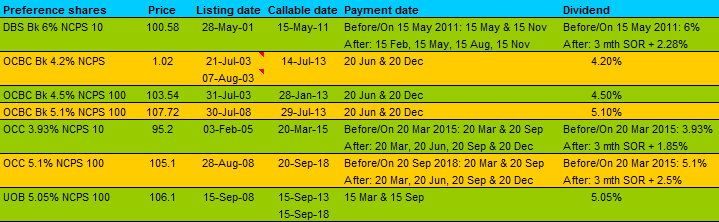
I've always wanted to compile a list of all the preference shares offered by banks since 2008, but never really got the time and inclination to do it. That is until some anonymous reader of my blog prompted me by asking me some questions about the preference shares. I did some quick research to answer the questions and realised that there just isn't any place where I can compile all the data in a single post. I think I should do that for personal reference.


I started collecting information about the 7 preference shares that are already listed in SGX. Soon, there'll be one more addition to the family by DBS. I shall skip all the technical details about what actually is a preference share, since I've mentioned at length in other posts. For quick reference, here's the two posts I made on preference shares:

Preference shares part I 

Preference shares part II

Here's a compiled list of all the 7 preference shares below. Please do pay attention to the remarks below the table, as they contained important information relating to the preference shares.


Remarks:

1. All the preference shares listed above have par value of $100, with the exception of OCBC Bk 4.2% NCPS which has a par value of $1.00.

2. For OCBC Bk 4.2% NCPS, there are two listing date. For the first tranche listed on 21-Jul-2003, it is issued at a price of $0.995. For the second tranche listed on 7-Aug-03, the issue price is $1.0027. All the other preference shares are issued at a price of $100.

3. I typed out information related to the DBS preference shares here, OCBC here and UOB here. Please double check the information yourself. It's late at night and I'm sleepy.


I think what's important here is to pay close attention to the callable date and the dividend payment policy. Especially the dividend policy. The callable date is important because it determines when the party might end. For example, DBS 6% NCPS 10, the callable date is on 15-May-2011. This means that on that date or thereafter on every dividend payment date, the bank might recall back the preference shares by paying the holder the par value of the preference shares, which is $100. If you bought it at $100.58 last Friday and they recall it on 15-May-2011, you get payment on 15 May 2011 only (too late for the 15 Nov 2010 payment because it had gone XD, thanks to WR for pointing out my mistake), hence you'll get less than the $6 per share. At the same time, you'll have to incur a capital loss because the bank will give you $100 for each share you bought. Since you bought it at $100.58, you'll stand to lose $0.58 per share


That's not all. After the callable date, if the bank did not recall the preference shares back, the dividend policy will also change. Instead of giving 6% pa on the par value (i.e.$100), they will give you 3 month Swap Offer Rate (SOR) + 2.28%. The 3 month SOR as of last Friday (12th Nov 2010) is 0.268%. The highest since 2008 is around 2% and the lowest, well, is right now.


Let's say I'm the bank. If by 15 May 2011, the 3 month SOR hovers around the same level, say 0.3%, then instead of giving each preference share owner 6% pa, I'll be giving them 2.58% pa (0.3 + 2.28 = 2.58). That is much lower than the 4.7% preference share that DBS is going to launch soon. Will I recall them back? Probably not, unless I need the money (I didn't bother to find out exactly how many 6% pref shares are issued, compared against the 4.7% one) because I can secure the debt (selling preference shares is sort of a debt) at a cheaper cost and use it to generate profits. Let's see how it turns out by May 2011.


Some of these had two callable dates, and I didn't list out those callable dates that had passed. I just want to say that the banks do not have to recall at the callable date. It's just a possibility to consider. I'll do some more analysis on each preference shares because I think it's quite interesting to see their total returns, assuming they will be recalled back at the earliest possible callable date.

Wednesday, September 15, 2010

Preference shares Part II

I've written this article on preference shares a long time ago, suitably titled as Preference Shares Part I. I thought I should finish that article now, haha, after so long!


To have a quick recap, let's go through some of the terms. Nothing much had changed since the last definition, but today I'm not in the mood for fancy words, so let's just use plain Jane terms. There are a few terms in preference shares that need to be understood.


Non-cumulative : This means that if they did not give out a payment in the stated date, they will not accumulate that payment to pay more in the next payment date. In other words, the payment is not guaranteed, unlike a bond. However, all of the preference shares I saw state that if the ordinary shares are given a payment, they are also obliged to pay for the preference shares. Cumulative means that if the payment is somehow not given for this particular payment date, it will be accrued and paid on the next payment date. Non-cumulative is important because I just read from my older post that only non-cumulative ones are placed in Tier 1 capital for banks. Not sure if that's still in effect now, given the new basel III regulatory rules.


Non-convertible : This means that the preference shares cannot be converted into ordinary shares. Convertible of course means that it can be changed to ordinary shares.


Par value: Each preference share is issued at par value. Let's say the par value of this particular one is 100 upon issue. The preference share is traded in the open market, so it will be subjected to price volatility, meaning that it can go above or below the par value. During the crisis, most if not all the preference shares are traded way below the par value, but I think now most are trading above it. It's important to understand that if the issuer is to call back the preference shares, they will buy from you back at the par value. Hence, it's a good idea to buy yours at below par, so as secure a capital gains on top of any dividend payment. Unlike a bond where there is a maturity date (where the issuer will buy back the bond at par value), there isn't one for preference shares. There will, however, be a callable date, after which it may be liable for call back at par value.


This is not to say that buying above par value is a bad thing. If the preference shares pay you 5% pa and you buy above par value by 2%, it's still a good deal if it is called back after 1 yr because you'll still get 3% (5-2=3) returns. Of course, if you buy below par value, then there will be a margin of safety, so to speak. Price volatility is not a problem as long as you hold it till the issuer calls back the shares. In the worst case, if the issuer goes belly up, then too bad, you get almost nothing.


In the event of liquidation, where the assets of the company that issued the preference shares are to be sold, the creditors will get the first tranche of money. Creditors will be those that buy bonds. However, preference shares are ranked above ordinary shares.  Hence preference shares are junior to bonds but senior to ordinary shares in the event of liquidation. Let's hope nothing of that sort happens in the first place, so place your bets on companies that are safe. No point getting a preference shares of 15% pa on a very risky company. I believe when one is buying preference shares, you want to have the liquidity of share market to buy in or sell out yet at the same time have a sort of nonchalance to price movement. Getting preference shares is the surest thing to getting a almost guaranteed dividend income without worrying about price movement.


I had bought this non-cumulative, non-convertible 6.20% preference shares from hsbc, with par value of 25 USD. Callable date 16th Dec 2010 and anytime after that date. Dividend comes in quarterly tranches per year, on the 15th of March, June, Sept and Dec. I'll work out some calculations here for my own reference in the future.


Price bought: 24.1 USD
Yield : 6.2/24.1 x 25 : 6.43% pa
Price discount to par value : 1-24.1/25 = 3.6%


If they recall back on 16th Dec 2010, I'll get at least one quarter of the yearly dividends, or 1.61% (6.43/4). Since they will have to buy back from me at par, I'll get 5.2% (3.6+1.61) returns before commission and forex. If they recall one year later, I'll be looking at 3.6% + n (6.43)% returns, where n is the number of full years I'm holding. Sounds like a good deal to me.

Monday, December 22, 2008

DBS rights issue

DBS halt trading early this morning and rumors are flying about as to what is the actual reasons for the trading halt. I thought that DBS will be settling the troubled bonds issue today, as the relevant authorities mentioned that an answer would be made at the end of this month. But that was not the reason for the trading halt. The real reason caught me a little by surprise.

DBS announced that it is going to raise capital to the tune of SGD 4 bil by issuing rights shares to existing shareholders. Rights exercise is basically an attempt to raise capital from exisiting shareholders by granting them an entitlement to buy additional shares at a discounted price. There are a few things that are important in a rights issue, and I take this chance to share with you what I know about it.


These are the few things you need to know:

1. Rights ratio

DBS are offering rights shares at a one-for-two ratio, which means that for every two pre-rights shares that you have before ex-rights (XR), you will be entitlted to apply for one more rights issue at the rights issue price of $5.42, a discount to the last close of $9.37 today. This means that for every 2 lots of DBS shares you own before XR, you'll need to pay $5,420 to get your entitlement of 1 lot of DBS rights shares.


2. Nil paid rights

The rights shares will commence trading as 'nil-paid' rights on 6th Jan 2009. As the name 'nil-paid' suggests, it means that you haven't paid for the rights yet. The rights will trade in the open market with its own quotation and symbol. Basically this system caters for 3 types of people:


a. Those who are already shareholders at XR and do not want to pay for the rights. The thing goes like this, whether you want it or not, you'll be given the nil paid rights. If you want to subscribe to it, you can do so by accepting it and paying for it before 20th Jan 2009 (last date for acceptance). You can even subscribe to excess rights beyond what is entitled to you too, but it might not be successful. For those who do not want the nil-paid rights (i.e. do not want to accept the rights shares and pay for it), you can sell it in the open market. The last date of trading for the nil paid rights is 14th Jan, 2009. Which brings us to the next category...


b. For those shareholders who want to make sure they can get excess rights shares without bidding for it (and thus subjecting to chance), they can also buy the nil paid rights direct from the open market. Of course, if you subscribe to excess rights and bid for a chance to get it, you'll only pay $5.42 for each right. But if you buy from the open market, you have to pay the market price of the right PLUS a fixed $5.42. Might not be so cheap.

c. Those who are not DBS shareholders at XR but want to buy the nil paid rights at open market. Basically these arbitrageurs will look for opportunities to buy the rights cheaply, waiting for the nil-paid rights to become ordinary shares on 2nd Feb 2009, then profit (or lose) the difference.

However, do not be mistaken that the nil paid rights will be trading at the rights issue price of $5.42. If we take the post-rights price of DBS to be $8.37 (as mentioned in the announcement), then the nil paid rights should be trading at around $2.95 range (8.37 - 5.42 = 2.95). DO NOT assume that it's cheap - it might not be!

For example, if we buy the nil paid rights off the market at $2.90 per share (this varies according to market forces), then pay another $5.42 per share (this is fixed) to convert it to ordinary shares, our cost of each new share of DBS will be $8.32. There's no brokerage involved so that is truly our cost. If after the new shares commence trading on 2nd Feb 2009 at a price of $8.37, we basically earn $0.05 per share (8.37 - 8.32 = 0.05) excluding brokerage involved in selling. To succeed in this arbritrage opportunity, we have to guesstimate the price of DBS on 2nd Feb, then minus off 5.42. Any price lower than that is a good bargain, pre brokerage charge.


3. The theoretical post-rights price of DBS on 2nd Feb 2009

If you've been in the market for long, you'll realise that 'by right', the price can be this and that, but 'by left', all is not right. Oh well, in theory, because DBS is offering 1 new shares for every 2 existing shares, they are going to dilute their earnings and dividends by a factor of 2/3, which is quite substantial for those who are shareholders but chose not to subscribe for the rights. This means that if the earnings is say $3 per share pre-rights, the new earnings will be $2 per share post-rights. Dividends yield too, if their dividend yield per annum is say 6%, the new dividend yield will be 4%. Ouch.

Anyway, here's how to calculate the new share price of DBS when the rights shares commence trading on 2nd Feb. Today, DBS closed at $9.37, so let's use this price. The formula is:

New share price of DBS = (2 x 9.37 + 5.42) / 3

If we take DBS's closing price to be 9.85, then using the calculation, we end up with the post rights share price of DBS at 8.37 per share. However, do take note that the actual price will be swayed by more than just mathematical calculations, hence it might not be what is calculated. Be aware of the risk of arbitraging!


There's a whole lot more details that I missed out, so for those who wished to find out more, do visit my newbie's FAQ. Alternatively, you can visit the same version in this blog over here.

Now I worry about HSBC's possible capital injection through rights too. Will I be able to subscribe to it because I'm a foreign investor?

Monday, November 10, 2008

Bank Bubble Burst

This is a chart that shows the market cap before and after the sub prime crisis about a year ago. I think in a snapshot, we can see plainly who's the survivor and who's not.

Sunday, October 12, 2008

OCBC's valuation range

I learnt a little more about the person who wanted a stake in Ocbc. She wanted to pass it on to her future generations, so the time horizon can be stretched further than the 3-5 yrs that she had told me initially. As such, preference shares might not be the best option anymore. I'm looking more into OCBC because that's what she wanted.

This is based on the data I posted on my earlier post.


Based on historical data, the dividends per share (excluding extraordinary and special dividends) had been increasing steadily for the past 5 years. Since I still do not know how to valuate banks well, I might as well treat OCBC as a dividend yielding company. I'm not looking for extraordinary growth here, just hope to see enough income to beat inflation (~3-5% pa returns in the form of dividends) is good enough.

Assuming that we have a pretty bad year in 2008, and OCBC has a EPS of 50 cts (do note that 1H08, OCBC's diluted EPS is already 53.3 cts). Assuming a dividend payout ratio of 35% (management mentioned payout of at least 45% of core net profit though), we can expect the DPS to be 18 cts. In order to have a dividend yield of 3% to 5%, we ought to buy OCBC at a price range of $3.6 to $6, with the lower price limit corresponding to a dividend yield of 5%. At this starting dividend, even if the EPS (and the corresponding dividend per share) do not increase, it's still very good.

If we look at the price to NAV (without valuation surplus), it ranges between a low P/NAV of 1.15 to 1.57. Based on 1H08, the NAV (without valuation surplus) is $4.60, so multiplying by these multiples, we get a price range of between $5.29 to 7.22.

Lastly, on a technical perspective, here's the chart for OCBC since 2003.


Support levels can be found at 5.70 (Jul 2005 low). This seems to me to be a pretty strong level. The next lower level will be at $5, back to early 2003 level.

Summary:

1. $3.6 - $6 for a dividend yield of 3% to 5% (look at the assumptions made)
2. $5.3 - $7.2, based on P/NAV (without valuation surplus)
3. $5.70, if not $5, based on 5 yr chart

Saturday, October 04, 2008

Preference shares Part 1

After chatting with a few guys over at the cbox, I realized that a better instrument for the person who wanted to buy OCBC (see my post on “Brief overview of Local banks") will be the preference shares that is also offered by the three banks.

Preference shares goes by the funny stock name with many letters in it. Here’s the list of all the listed preference shares by the three local banks.


1. UOB 5.05% NCPS 100
2. DBS Bk 6% NCPS 10
3. OCBC Bk 4.2% NCPS 100
4. OCBC Bk 4.5% NCPS 100
5. OCBC Bk 5.1% NCPS 100
6. OCBC Cap 5.1% NCPS 100
7. OCBC Cap 3.93% Pref 10


In the process of finding out what those letters mean, I did some research and I emerged a little more knowledgeable on these preference shares.


1. NCPS – refers to non-convertible and/or non-cumulative preference shares.

There are quite a lot of things to illuminate here. First of all, what is a preference share? Preference share is not the same as ordinary shares, the latter being the ordinary shares that are traded on SGX. Preference shares do not carry voting rights, unlike ordinary shares. However, preference shares are ranked higher than ordinary shares. With that, I mean that in the event of liquidation of the parent company, preferred shareholders will be paid out assets before the common shareholders (those who hold ordinary shares) but after debt holders (those who hold bonds issued by the company).

Beside this, preference shares might have an option to convert them to ordinary shares at a prescribed price. This is called the ‘convertible’ option. However, for the preference shares issued by the banks, they are non-convertible and non-cumulative, hence the moniker NC.

So what’s non-cumulative?

Before explaining that, it’s important for you to know that the dividends paid out are not guaranteed. By this, I mean that the dividends payments, which are given out semi-annually, might be skipped. However, if the dividends on the preference shares are not paid up, they are not allowed to declare dividends on the ordinary shares too. Non-cumulative means that any dividends payments missed are not accumulated and paid at a future date. For contrast, cumulative preference shares mean that if the dividend is not paid, it will accumulate to be paid for future payment. Since the banks are shoring up their Tier 1 capital by issuing preference shares, they will have to be non-cumulative so as to be included in it.


2. Difference between preference shares and bonds

You might have realized that preference shares are quite similar to bonds. Some key differences exist though:


a. Bonds have a fixed maturity date, while NCPS do not have. On maturity date, the issue company of the bond will buy back the bonds at par value, which is the price that the bond is first sold off. This means that if one buys direct from the issuer and holds till maturity, there is neither capital appreciation nor losses. The dividends, or in this case called the coupon, are received by the bond holder until maturity.

For NCPS, the maturity is till perpetuity. Well, on theory anyway. Different NCPS have different terms where the issuers have the right but not the obligation to redeem the preference shares at a certain date/dates according to the terms stated out in the prospectus. For example, OCBC 5.1% NCPS 100 have the right but not the obligation to redeem the preference shares, in whole and not in part, on 20th Sept 2018 and on each dividend date after 20th Sept 2018 at a par value of SGD 100.


b. The other major difference is that bond holders will receive guaranteed coupons, whereas the dividends coming from non-cumulative preference shares are not guaranteed. As mentioned previously, as long as the ordinary shareholders are paid a dividend, the preference shares will also have to pay it. Based on track records, it’s quite a safe bet that the banks will carry on paying dividends, since they’ve been paying for the past 10 years at least.


In summary, I’ve discussed about a little about the letters that made up the stock quote for the preference shares. For example, for DBS Bk 6% NCPS 10, it means that the shares are issued by DBS bank, with a dividend yield of 6% at par value (usually $100). It is non-cumulative, non-convertible and has a lot size of 10 shares. You should be able to tell, at least from this post, what is meant by a non-cumulative and non-convertible share and the difference between a bond and a preference share.

I’ll work on the differences in yields and terms for the different preference shares in my next posting.

Sunday, September 28, 2008

Brief overview of local banks

Is it time to buy local banks now? Someone wanted to invest a substantial amount of money into OCBC, so I thought I would do a little research to see whether it makes sense. I do not really know how to valuate banks and will not attempt to do so here. Rather, I'll just dig into the past number and let the reader do the rest of the legwork, if they are interested.

My source for these information comes from Shares Investment book (340 issue) and the respective banks' website.

Here is the brief overview of their segmented business data. It shows the revenue incurred from various segments as a percentage of the FY07's revenue.


We can see that OCBC derived a substantial portion of their revenue from dividend and rental. I suppose that rental means they have, under their holdings, certain properties. DBS has more percentage in terms of interest income and fees/commission. UOB is quite similar to DBS in that aspect, though I'm curious to know what constitutes the 'others'.

Below shows the ratios that I've done for the three local banks from FY03 to FY07. Do pay attention to the * portion below each table, as I noted the assumptions I made when calculating the figures.


Based on annualised 1H08 earnings for the three banks, at current closing of OCBC @ 7.160, DBS @ 16.920 and UOB @ 16.800, the forward PE for FY08 (estimated) and Price/Book are:

Banks-----------PE------------P/B
OCBC ----------10.7-----------1.6
DBS ------------10.2-----------1.3
UOB ----------- 11.2-----------1.6

I've browsed through the Singapore Country Book prepared by Deutsche Bank around May 2008. They mentioned that OCBC and DBS are well positioned to benefit from double digit loan growth and a rising net interest margin environment. The report seems quite bullish about the loan growth, saying that it is expected to be the second strongest year after Asian crisis. I've nothing much to comment about this, since I'm not in the know. They did cite factors such as strongth growth in business lending (particularly building and construction, property area) and in housing loans (particularly the mass to mid-market private residential, and HDB) as catalyst to push up the loans growth in the local banks.

This is for future reference:

OCBC


DBS


UOB


So which provides the most value? Price is often illusory, because the cheapest in price need not be the cheapest in value. Need to do more research.