Wednesday, March 23, 2016

Aspial 5.30% bond (AGAIN) - Good buy or Goodbye?

Aspial is issuing out new bonds again. The last time that did it was back around Aug 2015, giving 5.25% pa with maturity period of 5 yrs, which I've blogged about it here. This time round, they are upping the stake, giving 5.30% pa with a maturity period of 4 yrs.


The expected issue date is 1st April 2016, and since this is a retail bond, you can bid for the allotment of the bonds through ATM as well. DBS is the sole lead manager and bookrunner, which is the same as last year.


I don't think much had changed in the fundamentals of Aspial over the course of less than 1 year. If anything, it should get worse or at best neutral. So fundamentally, Aspial is just about the same company as it was last year. It's a company that I won't invest in, to put it bluntly. But what about the bond? Will you lend money to them? Will they survive for 4 yrs for them to pay out the coupons of the bonds? Nobody knows.


Let's see how their bond 5 yrs, 5.25% bond performed last year. It went to a high of 1.020 to the most recent 0.984 after their most recent coupon payment this year around Feb. The price had went up to today's transacted price of 0.996. There are a total of 10 coupon payments each with $0.02625 (5.25% / 2), of which one is paid out, leaving 9 left. What's the total returns of that bond if you buy at today's transacted price of 0.996?


Total no of payments left: 9
Payout per payment: $0.02625
Total coupon payout: $0.23625 (9 x 0.02625)
Capital gain from buying below par: $0.004 (1-0.996)
Total gain excluding comms: $0.24025 (0.23625 + 0.004)

Total % returns: 24.12% (0.24025/0.996)
No of days till maturity in 28 Aug 2020: 1619 days or 4.436 years
Ave % returns pa : 5.438% (24.12/4.436)


5.438% if you buy their issued bond last year, as opposed to this new bond 5.3% and they roughly matured in the same year as well, just a difference over a few months. Of course you need to include the brokerage commission to buy the traded bonds at SGX, compared to just paying $2 to bid for the bond over at ATM, so it's going to be lower than 5.438% after brokerage. Since the traded 5.25% bond is giving a better return than this upcoming 5.3% one, I think it's not such a good deal. But as mentioned, you have to include brokerage. It might not work out to be of much difference I suspect.


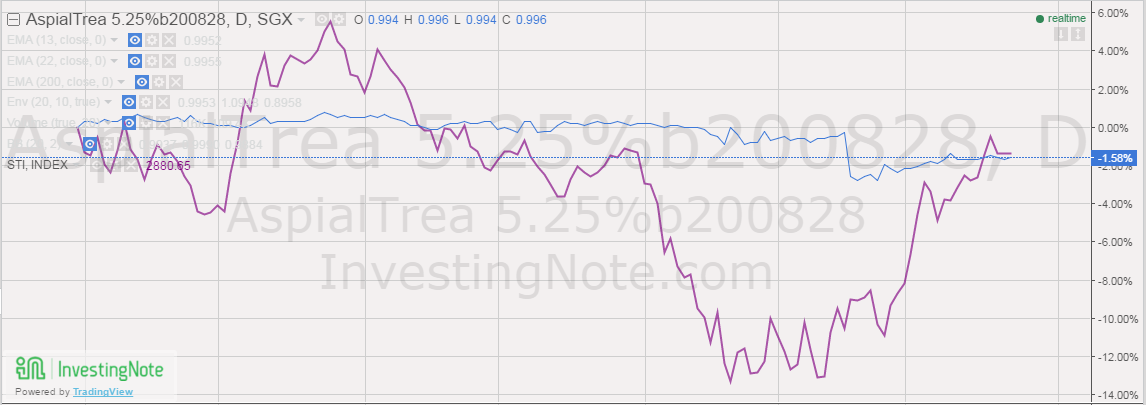
The advantage of bond can be seen easily with the chart below:


Blue line is the Aspial 5.25% bond while the purple line represent the index STI.


The chart is generated using Investingnote. It's free and I can't recommend it enough. It's even better than the (also free) Chartnexus with real time and also more historical price data to choose from. Anyway, you can see that the price of the bond stays relatively the same despite the ups and downs of the market. This means you can 'switch' out of the bonds, as some sort of high yielding cash equivalent, when the market is not doing too well. Rebalance, so to speak.


Still, last August when they issued the bonds, STI was around 3300. Now is about 2880. Back then 5.25% pa might be hard to find everywhere, but I think even with the present market conditions, there are plenty of choices to get 5.30%. Starhub (6%)? STeng (5%)? SPH (4.9%)? I haven't even included reits and business trust.


I won't go for it. I'm gunning for blue chips with reit like yield, haha!

Friday, March 11, 2016

I closed off my Saizen arbritrage

I entered Saizen a few months ago, which I blogged about here. I just sold off today, so let's see if this arbitrage works out well.


Entry price: $1.09
Ordinary dividends declared: $0.0283
Extraordinary dividends declared: $1.056
Exit price: $0.077
Profits per share: (1.056 + 0.0283 + 0.077) - 1.09 =  $0.0713


After accounting for commission for both buy and sell, the profit percentage becomes 5.9% all in. That's not too bad for a few months of work, haha!


Whatever is left will be the escrow account, which is about $0.0895. The current price now is 0.080, so I'm leaving $0.0095 max on the table, which is about 80 dollars. I said max because they will still have some months to go in which the parties involved might claim from. I'll happy with leaving that money for others and taking mine right now.


I think more importantly, this is a very good learning experience. It's an element of luck that I got in at 1.09, which I queued immediately after the announcement of the take over. It's an element of bravery (some say a fool's courage) to hold on to your beliefs in the calculations and take action based on that. It's an element of contentment to know how much is enough and take money off the table now instead of waiting for better things to come. I have conviction and it's an intelligent bet.


But it's like that lah, I made profit, so I can talk cock and say I beat the rest of the market to invest based on what I think is right...I'm a contrarian...I'm an investor... If I didn't make profits, then I'll be blamed for chasing after a stock (which I did, considering I bought after the run up to the announcement). I'll be blamed for not having a margin of safety in my purchase, or gambling in the stock market. The signs are all there but it's the herd that pushes me to buy etc etc.


Stock market rationality...pfft

Tuesday, March 08, 2016

Investment that gives you 3k per month?

This is a rare stock tip from bullythebears. I don't normally give tips, because it's too much responsibilities to bear, but this such a sure win that I can't help but share. This company gives about $1k to $10k per month as dividends. Sometimes more, sometimes less, but it had a track record of giving increasing amounts every year. Can't believe it? Well, it's your job!


Let's take the average salary of $3k per month. If you want to have a dividend giving that amount per month, or an equivalent of $36k per year, you'll need a capital of $720k invested @ 5% pa! Do you have 720k? I certainly don't have that yet, but I can still have that dividend credited to my bank account every month, as long as I show up for work.


So for all the people out there keen on investment, you should try investing in yourself and in your work and see if you can squeeze more out of it. Income from work, though active, is going to have a lot more effect in your financial health than investing ever could be. The reason is because we have a smaller base capital when we're younger and so work provides that stable, consistent income that if we're diligent and disciplined enough to save up, will form a solid foundation in which we can deploy later.


The problem comes when we try to put the cart before the horse - focusing to earn a passive income stream when we should be focusing on earning a good active income stream. To be an investor is to be efficient in capital deployment. Investing our time and energy on building a passive income stream when our human asset is the strongest seems to be out of sync. It's like choosing to eat canned tomatoes when there are fresh seasonal tomatoes plucked directly from the vine. Hey, got fresh tomatoes, eat it first lah! When it's ripe and you can't store it anymore, then you go and can it and make it last a little longer so that you can eat it in the future.


Do the right thing at the right time!


Monday, March 07, 2016

I'm a different person now

On Sunday I bought a new printer. It had automated duplex function (able to print 2 sides of the page without manually flipping the paper around), a scan function with OCR capabilities and able to copy and fax. The last time I bought a printer with somewhat similar capabilities was in 2011. The printer then cost me $299 and I remembered it's the costliest printer I had ever bought. I had to think twice and thrice, did days of research before I went down to IT fair to beat the crowd and get it.


This time round, I had about 15 mins of research a few days ago when my printer started showing symptoms of breaking down. The printer had difficulties feeding paper and I had to stand around for about 5 minutes during my work to feed it again and again. It's a frustrating exercise all in all. Today, I just went down to sim lim square and got it straight for $270. There's a lot more functions that I can only dream of in my last printer and it even cost lower than my previous one. Fantastic buy!


A few things comes to mind:


1. Firstly, I did not spend a lot of time researching and comparing the specifications of the printer. I just needed a quick fix to my problem - which is I'm spending a lot of time trying to force feed paper into my 5 yr old printer. I was surprised at the speed in which I arrived at my decision into which model I'll be buying. I thought this is a step in the right direction because I'm not sweating the small stuff. Things that cost $300 to me 5 yrs ago is a big decision involving spreadsheets of specifications in order to compare, plus going to different places to ask for quotes to get the cheapest price and so on. Now, it's just a split second decision.

Success is to be continually challenged by bigger and bigger failures. I think I'm growing bigger than my problem, and that itself is a cause for celebration.


2. Cost aside, I think I'm really trying to use money to save time. There comes a time in your life where you are willing to spend more in order to save time, because your time cost more than the amount saved. By going straight to the store, I can skip the long queues and crowd at this coming weekend's IT fair. By deciding quickly to replace my aging printer, I can spend more time doing my work properly and less time troubleshooting the printer. By deciding on a printer based on certain key stats instead of comparing the whole entire spectrum of printers, I can spend less time and live more! I am probably also given the IT fair's pricing according to the salesman, which is about $30 discount plus some $50 shopping vouchers. But I'll have to check and confirm if it's true.

Increasingly my time is getting more and more expensive.


3. The new printer had so many new features, like wireless capabilities and automated duplex, plus longer warranty duration and it actually cost lesser than my previous one. Unbelievable! I certainly don't want to be in such a job sector where I have to do more and more things but earning the same amount of pay, or even lesser! It's such a sucky situation to be in.

Makes me think about the kind of sector we're working in. We definitely need to work less and earn more, not work more and earn lesser as time goes by.


For those interested to know which printer I bought, I got this:

MFC L2700 DW from Brother

Sunday, February 28, 2016

Portfolios of the Poor

I am reading this book, titled "Portfolios of the Poor" by Collins et al. It's an interesting book because it studies the poor, defined broadly as those living with 2 USD per month or below, in a few continents like South Africa and India. We are talking about people who have irregular income, living in slum cities, plagued with various health issues and still have a family to support. They are living with less than $2 US per month on average, meaning that there are months they earn a little more and months where there is no income at all. The most interesting part about is that the book talks not about the census statistics but drills deep into the assets and liabilities (i.e. balance sheet) and cash flow of the poor, hence the title of the book.


I'm about 50% through, but there is already some interesting findings about it that I think can apply to my life already:


1. Remittance to your family, is it counted as an asset or an expense?

First of all, the book makes an important distinction between remittance of various nationalities. If you're remitting part of your income back to some distant relatives that is not going to help your immediate situation, that remittance is counted (in the book) as expenses. If you're remitting back to your own family back in the hometown, that is counted as an asset. I thought that is an important revelation for me, as I would have counted all remittance as an expense.

Going back to my own situation, I gave a portion of my income to my parents. It's not a small sum, and it is easily the 3rd or 4th biggest expenses after mortgage, food and insurance. I've counted it as an expense all the time, until the revelation hits me. To be honest, sometimes my parents would buy me some food stuff and help me to get some stuff done when I couldn't be at home. In other words, you can treat this 'expenses' to parents as an asset that you can utilize when you need to.

Now to qualify it further, I think it's important to distinguish between parents who can help you and those who can't. I'm not trying to be mercenary, but it's an important difference to make when you are considering to call upon the help of your parents. If you're never going to ask help from your parents because they are not competent enough or your relationship with them is just not that strong, but you're still giving them an allowance to fulfill your duty as their child, then please treat this as an expense.


2. Most of them take microloans with huge interest. Isn't that financially unsound?

Whatever I'm talking about in point 1 is an informal asset. If you talk to an accountant, they are going to tell you that since you're paying money with no immediate benefit, it's an expense. But the poor studied in the book really utilized such informal assets very frequently. They will have to because their income is unstable and comes in only at certain months of the year, but they have to eat every day. Hence cashflow to them is very important.

To tide through months where they have negligible income, they take microloans with huge interest (easily 30% per month). It seems a lot, but these are actually simple interest loans with flexible period of payment even though it's stated clearly the duration of the loan period. Their system is flexible and sometimes the lender (all of them are not licensed but do it out of obligation or just trying to help their fellow villagers) will forgive the interest or principle if they deemed the borrower had paid enough.

I'm not saying we should all go and take out microloans with huge interest, but I think I'm starting to understand their perspective a little more, instead of just saying they are not financially wise to do so. If you have family to feed daily but your income drips in every other month, you do what you can to settle the most immediate concerns now.

I start to see the role of such microlenders to provide cash flow for the poor. I do not expect Singapore's microlenders to forgive the debts and to have simple interest with flexible payment period, but to sweep all of them as devils trying to profit from the desperation of the poor seems a little harsh. They do serve a niche area where the bigger institutions like banks are reluctant to do because of the higher risks involved. It's precisely because of the unstable income that they need to borrow money to provide a stable cashflow but it's also the same reason why the banks refuse to lend them. If you remove the microlenders or put harsh penalties to drive out them out of business, then who is going to step in to provide the still needed service? Loan sharks?


3. The things we take for granted.

When I read that a lot of them deposit money in banks every month for a year, so that they can take out slightly less than the total amount put in, I was stunned. The system we're used to here is that we get paid for depositing money, but they are paying for the right to deposit money. What's the issue here?

Firstly, there's a lot of places worse than putting in bank. If you place it under your mattress, you risk having it stolen or burgled. If you hide it in your home, you risk having your home burnt down in a slum fire or washed away by floods or demolished by the government trying to control the spread of the slum cities. This sort of stability is something we take for granted.

They also have multiple savings clubs where their schemes are so ingenious that I might take a whole article to spell it all out. One of the more simple ones is where each month they give $10 to a person, and by the end of the year, they can take out $120. This is way more convenient than walking 2 hours to the nearest bank, but you run the risk of the money getting robbed/stolen/embezzled. Might be safer with the banks with a small cost, isn't it?


Secondly, the drudgery of life makes it easy and tempting to focus on the immediate and forsake the longer term future. Without the discipline instilled in putting a sum every month in the bank, the poor people will have a hard time saving up for major milestone event like wedding, funeral, buying of seeds for harvest etc etc. In other words, they are paying a small sum for the discipline that is forced down onto them, to make sure they save up so that they have a lump sum payment at the end of the maturity period. This really opens up my eyes. We're complaining about the low interest rates here for saving deposits...wait till we have to pay to deposit money (aka negative interest rates).


I think this is one of the most interesting books I've read this year regarding finances. It really opens up my eyes on how the poor people studied in the book manage their financial life. If you ask me, they are astute cash flow managers, being able to move cash in and out multiple times of their networth. This means networth is not really their concern over there, cash flow is. Isn't that the same for us? This book is much more significant to me as I'm also a self employed with variable income. Whatever they do to alleviate the stress of not being able to bring in money during their off peak months, I can also follow.


Another 50% more to go to complete the book.

Wednesday, February 24, 2016

Beware of the rug under your feet

I saw a newspaper article on Straits Times regarding JC students shunning geography as a A lvl subject here. These are the articles that represent one of my grave concerns with my career as a tutor. Major changes like these can make or break my livelihood, and it's very important for me to stay up to date.


Imagine if I'm a pure geography tutor who specialises in this one and only subject. Geography tutors are fairly rare, unlike the more ubiquitous maths/science tutors, so I suppose they can charge a premium in their rates. But structural changes that affects the cohort of people taking A'lvl Geography will affect them in massive ways. No matter how good you are, you're going to have to face headwinds in the declining number of students you can teach, so the pie gets smaller for everyone teaching Geography. And how much can you raise your rates to offset the drop in the number of students? I'll be a little stressed if I'm a Geography tutor.


The issue is that such major changes might happen every 5 or 10 years, and I don't know whether it'll hit one of the core subjects that I'm teaching. Perhaps there will be a shift in the focus away from the sciences towards the arts? Who knows? Long ago when I just began, I remembered seeing a lot of chinese tutors and tuition centres closing down because there is a fundamental shift in the way Chinese is included in the raw score for entry to JC. And students in Singapore are pretty pragmatic - they have to be since society focuses so much on education and having that degree.


I don't want to be caught in this situation.


Here's what I'll do:


1. I'll teach several subjects at several levels. If the stars are not aligned properly, I'll switch to other levels and/or other subjects. That will ensure the longevity of my career as a tutor. I think I still need a job that pays the bills for the next 15 to 20 yrs, so I have to do the necessary hardwork to juggle all these subjects at all these levels. The call is for tutors to specialise in just one subject i.e. to be a subject specialist. I'll resist that, thank you very much. It's boring and it's not good for the long term and it's not robust enough for my comfort.


2. Focus building up on passive income. There'll come a time when there might not be work even if I want to. Ageism in tutors is a mixed bag - some say matured tutors are better, some say younger tutors can click better with the students. I don't want to find out the hard way, so it's good to have multiple streams of income. My way is the stocks/bonds way, not the property way. To do that, it's back to the fundamentals with savings, then investing. This will take greater and greater focus in the next 10 years as I seek to replace my active income with the income streaming from my financial assets.


3. Pay off the debts as soon as I can. This is reduce my overhead to the barest possible and will greatly relieve the stress of not being able to earn as much as before due to policy and structural changes in my macro work environment.


Better don't stay so comfortable. The rug under your feet may be pulled by external forces that you may not be able to control.

Monday, February 22, 2016

I paid off my car loan!

Last month, I just finished my paying off the loan for my pre-owned car. Before the cap for borrowing had been set by law, I've already put in 50% down payment for it, so the amount of money that I borrowed is relatively low. Still, it's a great relief to have paid off something and have no debts.


Now, if only that car loan that I've just paid off is my housing loan, haha! Since I'm relatively happy and relieved that I've paid off my car loan, I can only imagine what happens if my housing loan is also paid off. I think it'll be like throwing huge burden off my shoulders. I guess that will be another 12 to 13 yrs away, provided I keep up with my yearly partial capital repayment plan.


I guess people are either comfortable with debts or they are not. I'm prefer not to have a huge overhead, since my income is variable and having a high fixed cost of living makes planning that bit more difficult. My wife's income is also variable, and not fixed, hence having some semblance of stability will be good for us.


Another thing that struck me is how fast 4 yrs had just flew by. 4 yrs is the duration of the loan, and that is the length of time I had my car for. Since the payment is on GIRO, it's amazing how month after month adds up to 48 months. 4 yrs of my life, and with a snap of my fingers, it's gone. I think my situation is much much better than 4 yrs ago, because back then I had just about bought my home and settled my renovation, so I'm relatively broke. I could pay off the car straight up, but I thought I should be a little conservative and borrow a sum so that my cash flow is a little less tight. The cost of having a less tight cash flow amounts to a cost of 1.2k over a period of 4 yrs, so I thought it's pretty reasonable.


I don't think I'll borrow for my next car. It'll be straight up cash from here.

Thursday, February 18, 2016

We walk together but alone

On Wed, I met up with 2 financial bloggers. Though it's not the first time we met, the online conversation spilled over to face to face interaction and before long, we chatted for nearly 5 hours just like that. This is shorter than the 6 hours I spent a few months ago here. My wife would probably lament that 3 grown men can chat longer than 3 aunties lol! There's usually a lot more sharing of personal experiences during such face to face interactions, because some things just can't be said online. It might be rude, might be crude, or might be politically incorrect, so face to face meeting is still good for such topics. 


I think as financial bloggers, we're really an odd bunch of people. We don't really fit into mainstream and what's interesting is that we're probably okay and comfortable sitting in an outlier position. I guess most of us are lone rangers - and we have to be in order to take some bitter pills and bash through the jungle to carve out our own paths that nobody really understand and might even vehemently opposes to. Like squirreling a huge portion of our salary aside. Like putting money into the stock market when others are running away from it. Or even simple things like bringing your own meals to work to save our health and wealth. Others might feel we're shortchanging ourselves but we know better.


I think people either get it or they don't. It's not that financial bloggers are all about money. Actually no, we're all about recapturing back our life and our values and not being interested in what non stakeholders demand of us. It's like the donkey, the man and the boy story. Some people might want the man to sit on the donkey, some might want the boy to sit on the donkey and some might want the both man and boy to carry the donkey. Please all and you will please none. For that to happen, we have to experiment and try out what we really want for ourselves. 


I'm very proud to know these 2 financial bloggers who had the courage to do what they need to do and ignore the naysayers. I know it's not easy and the journey is made tougher by blogging about some of the personal stuff online, exposing a part of your core to public scrutiny. Though we will always have to travel through our own journey alone, let us travel together for this small part of the road together.


And that's what this blog is for. Not to boast about what I've done, not to get passive income from ads, and not to teach you how to be this and do that. If readers get inspired to follow, that's a bonus. I'm really blogging to see who are the kindred spirits. You're either get it or you don't. If you are, we can walk together but alone, at least for a while.

Thursday, February 11, 2016

My Saizen arbitrage

Just received a circular for Saizen unit holders, telling us a lot of finalized details about the upcoming disposal of their entire portfolio to Trangle TMK. Of note here is the special distribution of $1.056 per unit to unit holders. I bought and sold a few rounds already, but after they made the announcement near Nov in 2015, I bought it again at $1.0938 (inclusive of comms), hoping to arbitrage on this, which I blogged about it here. Let's see how it goes.


About 30.3 million SGD is to be paid out as special distribution, representing $1.056 per unit. From here, I worked out the number of outstanding units to be 287,026,515. Another 25.7 million SGD ($0.0895 per unit), amounting to 5% of the purchase price is to be kept in an escrow account for up to 4 months after the completion of this entire exercise and liable to be claimed. The cost includes 3.4 million SGD ($0.0118 per unit) for expenses related to post completion maintenance of the company, plus another $1.2 million ($0.0042 per unit) for the manager.


Not to forget the normal (as opposed to special) distribution in Mar 2016, amounting to about $0.0310 per unit (from Jul 2015 to Dec 2015), which is based on last year's DPU.


The summary is as follows:

Special distribution: $1.056
Normal distribution: $0.031
Escrow account: $0.0895
-----------------------------------
Sub total: $1.1765

Post completion expenses: $0.0118
Cost paid to manager: $0.0042
-----------------------------------
Sub total: $0.016
-----------------------------------
Total: $1.1605

Buy price inclusive of comms: $1.0938
Percentage profit: 6.1%


That represents the max amount provided that none of the escrow account set aside is withdrawn to paid for anything PLUS the distribution in March matches last year's distribution at $0.031. If say, we take 50% of the amount set aside in the escrow account, my returns will be 2.3% in less than a year. Not impressive, but okay lah.


The actual amount remains to be seen, and I might have to wait till Aug 2016 to see it all completed.

------------------------------

After throwing this post to the universe, I was reminded that there's another distribution not counted in. It's the period from Jan 2016 to the completion date, which is stated as "on or before 31st March 2016". The income collected during this period is technically not TMK but the unit holder, hence there should be another final distribution amounting to about half of the 1st half DPU, which stands at roughly $0.014. This is a significant amount, pushing the max returns to nearly 7.4%.

So good ah? Did I miscalculate? How come the price of Saizen still lingers around 1.09, which is my buy price? Haha

Tuesday, February 02, 2016

Addictions

This post first appeared in Kungfu Cats Academy.

I watched this TED talk recently by Johann Hari regarding Addiction. It's a good talk show, and it talks about how everything we knew about addiction is out-dated and wrong. In essence, addiction had been shown to be cured by introducing more social bonds to the addicts. If the addicts have something to look forward to, where they feel they are needed and wanted, then they will not depend on substances like alcohol, gaming, gambling or drugs etc to fulfill that need for connections.


This might be important information when I meet computer games addicted teenagers in my line of work.


Usually gaming addiction is a more serious problem afflicting boys. Girls have their own set of nightmares to deal with, but it's seldom with gaming. At least I've not seen it before, even with my 12 yrs in this business with more students being females than males. The worst case I've seen that I can't handle is a boy who lives around Serangoon area. He lives in a well to do district in private estate and also studied in a very good school near his district. Everything seems to be fine for him except that he can't stop gaming day and night, somethings without much sleep. He will go to lessons with me feeling all grumpy and sleepy, and sometimes I've to wait a good 30 mins or so to wait for him to come down. I was pretty newbie back then, so I couldn't handle this case and had to give up. I always wondered what happened to him.


While I'm pretty sure restricting access to tablets and smartphones to young kids is going to work, especially for young boys, I think there's also another way that we had to work on. Most of these kids have highly successful parents - all high flyers in their respective fields. And unfortunately all very busy with their careers to really take care of the little nitty gritty details in their family life. Most of the time the maid (and occasionally, maids) will have to take care of the kids. The situation is kind of ridiculous - it's like telling the policeman to catch criminals but they can't touch the criminals. They can only yell and scold and hope the criminals will slow down and head for the nearest jail themselves. Paper tigers won't stand a chance; kids these days know the power relationship very very well.


The other way that we had to work on, based on the TED talk mentioned above, is to work on connecting them to something outside of themselves. Usually this connection is fulfilled by parents or grandparents, then followed by friends. But these days with the social connection kind of being fulfilled online by gaming or social media, it's all going downhill. Maybe reality is so bad and stressful that people are finding connections online. Fighting demons with a powerful wizard in greater rifts level 70 easily with a press of a few mouse clicks can be quite empowering. Probably much better than facing an empty connections in an empty house in real life, or the prospect of being an un-liked kid in school.


I'm a gamer too, and I played games throughout exams period since primary school. But there's always something out there in the real work that I felt obliged to go back to, either out of responsibility or duty. Maybe that is what parents need to work on. And from experience, they will really have to start young, probably in primary school level. After that, it's going to be harder and harder to change.


I've seen plenty of cases where the parents, suddenly aware of the dropping results of their kids in secondary school, started to punish the kids by withdrawing their laptop or handphones. It works initially because of the cold turkey treatment, but eventually that emptiness still needs to be filled by something tangible. If not, the kid will go back to the gaming. Do you think your locked passwords can stop them? These kids are digital natives, and probably know a few tricks that you don't even know. Besides, they can also go LAN shop or some friend's home for 'group study'. With games being online and so mobile, you don't even need your own computer to play.


I'm a bit long winded here because this is something close to heart. The key takeaways mixed with some suggestions:

1. While making sure your kid are not having unrestricted access to any gaming devices, do make sure you set a good habit also. Taking the mobile devices away from your kid but using them yourself to play games is kind of pointless. The irony of which can be easily noticed by your kid.

2. While removing mobile gaming device from your addicted kids, do make sure you have something else to replace that connection. Gaming as an addiction is just a symptom. The real cause is the need for connections. How about spending more time with them?

3. I believe dads can play a greater role in parenting. 99% of the parents I liased with are with the mothers. 99% of the time the mum are the ones who bring the kids to my place for lessons, regardless of whether the mums are working or not. It's something to reflect on when I become a parent as well. This is probably the best reasons to be financially free.


Thursday, January 28, 2016

Normality is over-rated

This article here really tugs at my heart.


I found myself always trying to unlearn the things that I've learnt in school, or from others, so that I can take in new information and assimilate them into my consciousness. The new illiterate are not those who cannot read, but those who cannot unlearn what they had learnt and thus adapt to ever changing circumstances.


When I started my job as a tutor, I wasn't taking a normal job. A normal job is a 9 to 5, wearing long sleeves and a tie, with a suitcase and going towards the city area. You get paid every month, with occasional bonus plus benefits. I always say this: my job as a tutor is so 'abnormal' that even my parents didn't recognise that I'm working until quite recently, especially when I was still living with them. I get calls to find a proper job all the time while I was still living with them. The pressure to conform is very very real.


There are plenty of other normal things that normal people normally do, like retiring at 60 or even eating 3 meals a day. During medieval times, people only eat 2 meals a day, or once if they are poorer! A lot of such norms are really social constructs, which is obvious and common sensical when we're trapped in our current society. There are societies out there who treat their children as mini adults, letting them have all the sex they want (interestingly, they contrasted our society and theirs - ours have all our hunger satisfied but there's no warmth in our relationship. Theirs have no warmth in their bellies) and no mothering over dangerous things like knives or fire. In fact, most kids there have scars to remind them about the danger. If you know about such societies, it does make you question over what is considered normal. If you like more of this, go read "The world until yesterday" by Jared Diamond.


And thus the point of travelling is to experience new cultures. If you want to travel with the cultural baggage that you had, then you just did an out of body kind of travelling. Your body flies across great spans of oceans to arrive at the destination, but your mind is still as closed as a clam back in your self imposed confinement. Maybe reading more will help, rather than travelling more.


Now, I'm not saying everyone should go out and break out of the norm. Going against the norm simply because you want to be contrarian is as sheepish as going together with the herd. It's like Kepcorp dropping like flies and because you want to be a contrarian, and be greedy when others are fearful, you just buy it. Seeing the world in dual choices is silly. If people are not buying A, you don't have to buy A - you can buy B, C, D or E. The important part here is not to be reactionary. You see people do this, you react by following them or not following them without much consideration.


I think we need to examine the norms that we are following unconsciously, and examine them critically to see if their values align with ours. Only then will yours decisions be truly yours and not the product of some reactionary decision you've made by looking at what others did or did not do.

Wednesday, January 27, 2016

Hacking the routine in my life

If you found me posting lesser and lesser, it's not because I'm discouraged by the bear attack recently. In fact, I'm busy buying away and watching my defense line to see if they need supports. Rather, I'm occupied with hacking my life's routine.


On a whim, I decided to start waking up early one day. It started on a particularly slow Monday, where I felt that I was so unproductive that it pisses me off. Then I wanted to wake up on Tues at 7am and go jog - which is something I've not done for a very long time. The last recorded run I ever had was back in mid 2014, and that is unbecoming of me. I clearly know the health benefits of exercising aerobically 3 times a week, but I just didn't have the discipline to do it. And heck, I've been procrastinating for way too long, always coming up with excuses like having too much work etc etc. Work is never going to get lesser, and I'm never going to be more healthy or younger, so it's just now or nothing. What's the point of being focused on earning some much when I don't have the health to support it? Pointless, I say.


So I did wake up at around 7am for the next couple of days and I did went for a jog. Yesterday was the third time in a very long while, and I can now run continuously for about 13 mins over a distance of 1.8 km. Slow, but well, I had to take baby steps to kickstart the whole thing.


I realised that good habits stack on top of one another. One of the hardest excuse to not jog is that I have no time, so I wake up at 7am to run - excuse eliminated. Then I can't wake up early enough, so I have to sleep early at around 11 to 12 instead of 1 to 2am - excuse eliminated. Then I can't relax at night after work, so I shifted my entire schedule to fit in a running schedule, like having a light dinner really really early (like 530 or 6) to give time to digest to allow an early night sleep - excuse eliminated. My point is that as I try to improve myself, several things all change in tandem to one another. It's like I felt my life improving not just by 1 point or 2 points, it's like 30 to 50 points in one shot, because of this cascade of good habits that support each other.


In summary, to have a healthy lifestyle, here's the following I changed over the span of a year:

1. Meditation every night - helps in my sleep and relieving of stress
2. Fruits for lunch every alternate weekday - keeps me more energetic and less bloated
3. Jogging twice every week - helps my cardiovascular fitness
4. Pullup/pushup every day - helps my upper body and back muscles, also the mental strength to go on when I thought I can't go on anymore.
5. Waking up early and hence going to bed early


Everything works in tandem with each other. I shudder to think what happens if this situation is reversed, as in when one bad habit supports a lot of other bad habits and we have a vicious cycle downwards. How we do one thing is how we do everything.


Oh, one advice to people hacking their life - roll with the punches. Your system must have allowance for slack days where you totally don't feel like doing anything of the wonderful life-changing things you've set as your goals. You just want to vegetate in front of your tv eating potato chips. Go and do it. Allow for small failures but get back in the next time. Don't aim for perfection, aim for consistency and sustainability.

Monday, January 18, 2016

Plan for 2016

After utilizing a portion of my warchest, it's time to wait for the kill for the remaining portion of my warchest. It's not easy to look at your portfolio and see it decimated week after week, but I think I took a depression and several years thereafter to get the lesson that the market is trying to teach me when I paid my tuition fees involuntarily. These are lessons that have to be taken eventually. Life has a habit of throwing you obstacles when you think that everything is going smoothly. Learning to take things in stride, especially when you can do nothing about it, is an essential skill.


Let's focus on the things we can do. I'm more worried about my job if the bear market becomes protracted. If we go by the rule of thumb of the market leading the actual economy by 6 months, then we might see a bad situation for SG51. Will my jobs be affected? Since that is my main source of income, that is also my main source of worry.


Here's my worry:

1. Harder to get new students
2. Bad debts for existing students
3. Reduction in fees chargeable


1. Harder to get new students

I think given the often toted resilient nature of the education industry, it might be a while before I can feel this effect. In the past few recessions, I did notice a slowdown in the intake towards the ending phase of the recession, not the start. I guess when people reduce their expenses, their child's educational needs are still considered needs and not wants. It still requires constant effort to keep on marketing and looking for new students year in year out, so I'll continue doing that. I think I'm better trained than most to do this, because every year I have to find new students anyway as my graduating students leave. I should be able to replicate whatever I've done in the past 12 years to do this.


2. Bad debts for existing students

I only have bad debts for the first 2 years of my career. After I implemented some measures to reduce my risk, this had come down to zero. Still, with a possible recession coming, then I will have to step up my measures. For new students, perhaps I will have to start my practice of giving less credit and asking for payments from monthly to bi-weekly. Also I'll collect fees in advance whenever possible, so as to reduce my risk of non-payments. I should be able to handle this aspect from past bad experiences.


3. Reduction in fees chargeable

I suspect that if the demand drops, I might have to reduce the fees somewhat to raise the demand level. That should be the last resort. The better way is to group students together, so that each student pays substantially lesser amount but I get to earn a higher fees per hour. Win-win for everyone. I remembered that a student had to ask for a reduction in fees because the father got retrenched in the last round of recession. I can't remembered whether I took a reduction (knowing myself, I think I did), but now with my own classes conducted at home, I can do a few tricks to protect myself. Grouping is one way. For students whom I am going over for lessons, asking them to come over for a fee reduction is also a great alternative. What I get in lesser fees can be translated to more time and less effort needed to get over there.


Having said all these, I also need to increase the range of services that I 'sell'. I have to upgrade my skillsets to increase the range of modules/subjects that I can teach. This is why I'm very glad to be able to teach new modules/subjects this year. I'm currently handling one IB student with very weird option topics. Usually the option topics will be statistics, which every A'lvl student are taking anyway. But this particular student is taking discrete mathematics, which I've never studied formerly before. Reading up intensely now (and neglecting my 52 books challenge for the time being) so as to prepare myself for possibly wider and more comprehensive range of modules to teach. This is on top of 2 university modules that I could be teaching to 2 students. One is one statistics, matrix algebra and differential equations and the other is math for econs and statistics again. Which means more reading and studying.


What am I doing all these for? To secure my income! I realise that for now, and likely for the next 15 yrs, it's going to have far more reaching consequences that my investments could ever do.


The underlying conditions for all these will be shattered if I do not have the health to support it. We think that health is always a given, until it is lost. If you've ever had a bad case of flu, whatever big plans you have for your career will have to take a backseat while you just really want to lie in bed and sleep. As such, the focus will never ever be off on health. This year, I'm trying to eat cleanly and also continuing my spiritual practice of meditation. Every alternate days on weekdays is going to be fruits for lunch. Halved my portion of rice too. Everyday except Sunday is a rest day for my body, while everyday I have to do some pullups or pushups. I'm trying to kickstart a jogging habit too and I hope to do so by end of this month.


Let's go.

Thursday, January 14, 2016

The Greasy Panda crash of 2016

As I type out this post, STI is down another 47 points to 2650. Everyday you'll see the oil and gas sector, as well as the banks going down and down and down. For every bear, there's always a name attached to it. In my little group, we call this the greasy panda - greasy because it's oil related and panda because the last straw that broke the camel's back seems to start from China.


For those who had the cash to capitalise on this, it's a dream come true. Such events, should we survive, will propel us a few years forward. The key word is that we need to survive through it. I think now we shall see whether you can take the risk that people talk about in the stock market. If you're a Kepcorp investor, seeing your holdings drop 5% everyday is not funny at all. In order not to panic sell and capitulate, I think it's important to sit tightly in your 3 legged chair.


There's a lot of bargains out there. Singtel and Starhub are around the same price now, battling each other to see who can go down more. Since they are at the same price, which would you buy? All the banks are priced below their book value now, which means they are really at a very good valuation. The problem is whether the book value (Asset minus liabilities) can be trusted upon. The banks hold debts for oil and gas companies, as well as their bonds, so if one topples will it drag the rest down with it? Reits are priced at ridiculously high yields now, but between a blue chips at near reit yield vs a reit at super high yield, which would you rather buy? And then there's the oily stocks like semb corp industries, semb corp marine and kep corp. Do you catch a falling knife and hope for mean reversion to kick in? Or is this time different?


These and many other questions are not easy to answer because nothing is clear. If you wait until it's very clear, you'll likely miss out the initial reversal. But if you don't wait until things are clear, you might risk entering too soon. Again, more questions and no answers. More doubts and not enough cash.


What would I do?

1. Proportion each investment with a fixed %. If things go sour, it won't drag your entire portfolio down with it. Do not average down blindly.

2. Stop staring at the watchlist if it affects you. Life goes on with or without the stock market. If you didn't do point (1) properly, you'll get unduly worried, then perhaps you should reduce your holdings. Sell down your holdings to sleeping point. Don't lose sleep over such things.

3. Work hard and save up more. If stock market is a precursor for the economy at large, it doesn't bode well for sg economy in the next 6 months to a year. If your income stability, one of the legs of your 3 legged chair, is threatened, then things will get even harder for you. So save up for both your emergency funds and also your warchest. Survive first, then we can talk about prospering. Be robust first, then we talk about anti-fragility.

4. Buy something in the stock market. We're at this stage where the odds are that in 5 yrs times, we will wonder why we didn't put in more money in the market.


For the uninitiated, welcome to your first bear.

Monday, January 11, 2016

Don't get bullied by the bear

I was in Bangkok when the market went crashing through several levels of support to end up where it is right now. Even though I didn't spend a lot in my trip there, my 'online purchase' is of several magnitudes more than my wife's physical shopping. I had queued for several blue chips and the order got fulfilled one by one. We know this is a bear territory because for many counters, we're in unchartered territory. If you are using the free Chartnexus, you'll know what I mean. The prices are way lower than the last 3 yrs, possibly 5. If you zoom out, you'll see most stocks are right at the bottom of the chart. Suddenly we're back in 2011 to 2013.


I'm a lot less bothered than the last bear. I think whether you will panic in a bear market boils down to three main pillars:

1. Income security
2. Portfolio allocation
3. War chest level

Like a three legged chair, if any one or more of these legs are chopped off, the whole chair will topple.


1. Income security

This is simply how safe your income is. If you're still working, like me, then how secure is your job. If you're not working, then how safe is your passive stream of income coming in. I think we still need to pay various things. Some people have to pay more than others because they have more debts or overhead cost to handle. Regardless, if your income stream is threatened, I think you will be a lot more panicky in a bear market.


For me, my main source of income is from tuition. It's been fairly stable for me once I got the hang of it. I think my income security is pretty good. At the back of my mind, I'm always afraid what funny things MOE can do to threaten my livelihood, so I'm prepared for that by building up my passive income stream from investments. Since I'm not beholden to any one company for my income, I think I should be pretty secure, but I'm certainly preparing for major structural changes should something big happen to disrupt the industry in the next 15 to 20 yrs.


2. Portfolio allocation

In the past bear market, I was heavily concentrated in a few s-chips. I kept averaging down as it drops until I capitulated and sell off at a huge loss. I'll never do that again. This time round, each position is capped by a percentage to entire portfolio size. I think the size of one position in any investment should be proportional to the knowledge you have of that investment, capped to an absolute amount. If you're not so certain, you should have less of your portfolio allocated to it. Vice versa. For newbies, this is a real risk, because if you're not sure of what you're doing, and you keep adding in as the price keeps dropping, you're in for a blow up. I know people who are 50 or 60% into a single counter, but I'm not them and I don't ever think I have the balls to do that.


3. War chest level

Simply put, how much investible cash do you have? A bear market is only good if you have the cash to capitalise on it. Otherwise, you're just window shopping in a sale of the decade. I still have about 30% (down from 40% in Dec 2015) cash that is not allocated yet. Based on my personality, I don't think I will ever be 100% invested. The good thing is that as the new year starts, I should be working more towards my peak and my war chest will be shored up again. There never seem to be a time where it's not good to save up more. In bull times, you save up more to prepare for bear market. In bear market, you save up even more to pump into investments.

Everyday is a good day to save, LOL!


If you're worried about your recent investment souring, fret not. When all these are over and done with, and there's an official name for this bear market we're in, coupled with a whole lot of reasons by experts on why we ended up like this, you'll regret why you didn't put in more money now hahaha!

Monday, December 28, 2015

The chains of Habits

The chains of habit is too light to be felt, until it's too heavy to be broken.


Habits can be both good and bad. Here, let's focus on the good ones. If you want to start a new habit, research says you need at least xx days to form it. 'xx' can be anything from 21 days, or 49 days (7 weeks), to 66 days. I think it doesn't matter how many days, but the point is that you must do it consecutively, or regularly enough, until you can't pass the week (or the day) without doing it. Then you know the chains of habit is too heavy to be broken.


Recently I read an article about meditating for 100 days consecutively, and I wanted to try it myself too. I downloaded an app called Rewire (android). I think there are various such apps out there, so I just picked something that is free and easy on the eyes.


The app works like this: Each day I'm supposed to meditate. It doesn't matter how long I do it as long as I did it. Initially for the first few weeks, I don't dwell on anything other than the fact that I need to do it every day. To make it more regular, I always do it before I go to sleep. From my pushup habits (which I do immediately after I shower), I know that it's important to latch on a new habit to existing habit. You can't avoid not showering, or not sleeping, so these are sure bets. After each time, I'll click on the calendar you see above, and click done. If I do it consecutively, there'll be chains joining one day to the next and the app will tell you the longest chain you've formed.


I think it's cool to gamify the formation of habits this way. So far, I've done 49 out of 49 days consecutively already, without skipping any days. I'm not perfect too, there are some habits that I didn't do as well. Below is my habit for doing some form of exercise everyday for 100 days. For this particular habit, I left Sunday (in blue) as a break. Red means that I failed and didn't do it. It's either because I am too unmotivated to do so, or I'm not feeling too well. Usually both lol!


Back to meditation. From my experience, after about 7 to 8 weeks (2 months), I realised that there are days in which I'll forget to click on the app, but I would still remember to meditate. That's when I know that the habit had formed a strong and heavy chain.


Here's a few key takeaways from my experience in forming new habits:


1. When starting, focus on doing the action. Don't care about the quality or the quantity. If you do it, it's a deed done to strengthen the chain of the habits.


2. You'll need 2 months consecutively for the new habit to sink in, until you can't pass the day without forgetting about it. Even when I skipped certain days, I know I have to do it. It at least didn't slipped my mind.


3. I've not tried it before in kicking a bad habit, but I suspect the mechanism is the same. You just need to override the bad habits with new ones, and do it for 2 months consecutively. Perhaps you'll need more time since psychologically it'll be harder to break, I suspect.


4. Small, regular action reinforce big, macro habits. Don't belittle the little things you do everyday in forming long term habits. It works both ways for good and bad habits too. If you spend $1.80 every day eating a curry puff, it might slowly form a bad habit that will be very hard to break after some time. Don't belittle the small, regular things you do everyday.

Saturday, December 26, 2015

Circle of life

I noticed that with each Christmas that passes me by, it seems that my life gets simpler and simpler. I remember that in my younger days, I would go out to party with friends. Nothing wild, just going to Orchard for the countdown - you know, that sort of thing. Countdown parties seems like the craze for me back then. It's not that Christmas is particularly important for me, maybe it's just an excuse to let loose a while. 'Thon' - that's the word for staying overnight as we countdown to Christmas day itself.


After having a gf, it's about having a proper date. Something like a movie, followed by some restaurants meals, then counting down with her etc. As the relationship progresses where she starts knowing my friends and I know hers, we have parties again, but this time in pairs. It's all about the experience and creating moments together.


So what did I do on this particular Christmas day? Nothing spectacular. I know I don't like crowds and parties, so I didn't want to brave out to Orchard or even Marina area to avoid them. Instead, we went to our quiet neighborhood cafe, had a cup of tea and a slice of cake before going home. No special dinners, just the usual tze char fare at the coffeeshop, ordering the same dishes as usual. Very reflective and quiet.


I think when we have kids, it'll start to become rowdy and the feeling is that we'll be moving towards the days when we're younger again. In order to let your kids experience Christmas like you've not had it before, you might get a real Christmas tree complete with presents at the bottom of the tree. Then everyone can participate to decorate the tree and wrap the presents together. I'm sure there'll be trips to Orchard road and other crowded places to jostle with the rest so that we can feel the proper yuletide atmosphere. The whole experience also includes a complete Christmas dinner with roast chicken, ham and the like. In other words, nothing like what I've experienced yesterday.


And many many years later, when the children are all grown up and leaves the home to set up their own home, maybe it's back to the days now. Quiet, simple yet still a very great Christmas. Quiet and reflective versus Rowdy and experiential. Cycles of ups and downs.


That's the circle of life, I suppose.

Wednesday, December 23, 2015

A little a day goes a long way; A lot goes a longer way

Savings more or earning more is the way forward? Some say it's savings more, some say it's earning more and some say both are important. To me, I think the sequence is more important.


 I think if you're having a fixed pay where your income is fixed, then there's nothing else you can do to increase it. If you want to save more, then you have to cut your spending. The savings equation is very simple; Savings = Income - Expenses. Cutting expenses is the least disruptive way towards saving more. Here's where the needs and wants are segregated, and you want to reduce frivolous expenses down to a minimum. But there's only so much you can cut once you've tried. Without going down the cheapskate route, being frugal still means having to eat food and having a shelter above your head when you sleep at night. There's also so much you can cut without sacrificing long term health too.


This is the point where you have to think about increasing your earnings. This is much more disruptive than cutting costs, because it will involve changing your entire assumptions about your earning power. At some point in time, you have to rack your brains to think what other streams of income can you get while still maintaining your expenses. This is hard, and there's a lot more reasons (or excuses) you can give not to do this and continue cutting your expenses to save more.


So, for salaried workers, save more by cutting expenses first, then go and try earning more.


For salesman and self employed, where there's no such thing as a fixed salary, you'll find that people tend to favour earning more as a way to save more. Once you think of yourself as a company, you'll want to increase your net profits by increasing revenue and not just reducing cost. Which is fine, until you realise that people who earn a lot more tend to spend a lot more too. If that's the case, then the next step is to learn how to stop your cost from rising proportionally to your earnings. If you earn much more than the rise of your expenses, net net you'll still save more.


So, I think for those without fixed pay, try to earn more and then try to reduce your expenses in order to save more.


What about me? I started saving more by cutting costs. Then when I realised that I've nothing more to cut because it is so painful for me to live such a miserable life like that, I started to change my assumptions to earn more. Ironically, that is also painful. I've to work a lot more hours and a lot more odd hours. Hence the first 50k that I saved is so much tougher than the last 50k that I saved. It's like that - if you want to create a new habit, you have to constantly remind yourself and basically live and immerse yourself in that environment. That's why you have to ask yourself why you even want to save this amount in the first place.


Motivation will make your journey more understandable. Desperation will make it possible. A little goes a long way, but for me, a lot goes a longer way. A lot of what? Effort!!


Sunday, December 20, 2015

The year 2015 in terms of books read

Year 2015 is like any other year in terms of my book challenge. I completed my 52 books challenge for 2015 with some more weeks to spare! I find that this year, the quality of the books I read are fantastic. There's a lot more breadth and also a lot more depth. I started reading up books on spiritual growth too, so I think that's a genre that I can always do more in depth. As usual, I'll put up a list of all the 53 books I've read this year, and then later I'll recommend a few which I think are superb reads.


My grandmother asked me to tell you she's sorry - Fredrik Backman
Wouldn't Take Nothing for My Journey Now - Maya Angelou
All God's children need travelling shoes - Maya Angelou
Mom & Me & Mom - Maya Angelou
The Sun My heart - Thich Nhat Hanh
The little book of Safe Money - Jason Zweig
The buddha walks into the office - Lodro Rinzler
What we see when we read - Peter Mendelsund
Way more than Luck: Commencement speeches - various
Inspiration from Buddha - Lim SK/Fu Chunjiang
The terrible and wonderful reasons why I run long distance - Matthew Inman
Linchpin - Seth Godin                             
The little book of market myths - Ken Fisher
Little book of big idea on business - Dr John Lipczynski
The 5th wave - Rick Yancey
The synchronicity key - David Wilcock
A man called Ove - Fredrik Backman
The power of positive thinking - Norman Vincent Peale
Then we came to the End - Joshua Ferris
The Mystery of the Shemitah - Jonathan Cahn
Inedia Non Eating - Joachim M Werdin
Crazy rich asians - Kevin Kwan
Here's looking at Euclid - Alex Bellos
The new new thing - Michael Lewis
Dust - Hugh Howey
My mother's secret - J.L. Witterick
Surely you're joking, Mr. Feynman! - Richard P. Feynman
Kim Jong-Il production - Paul Fischer
The Rosie Effect - Graeme Simsion
Killing sacred cows - Garrett B. Gunderson
Shift (1 to 3) - Hugh Howey
Wool (1 to 5) - Hugh Howey
Mindfulness in plain English - Ven. Henepola Gunaratana
The man who mistook his wife for a hat - Oliver Sacks
To sell is human - Daniel H. Pink
Alex through the looking-glass - Alex Bellos
The Singapore Permanent Portfolio - Alvin Chow
William Shakespeare's Star Wars - Ian Doescher
Out of our minds - Ken Robinson
The next 100 years - George Friedman
All the light we cannot see - Anthony Doerr
Faraday, Maxwell and the Electromagnetic field - Nancy Forbes
Barbarians at the Gate - John Helyar & Bryan Burrough
Son of Hamas - Mosab Hassan Yousef & Ron Brackin
What if - Randall Munroe
Robogenesis - Daniel H. Wilson
Robopocalypse - Daniel H. Wilson
The birth of Korean Cool - Euny Hong
Everything I never told you - Celeste Ng
The education of millionaires - Michael Ellsberg
I am the messenger - Mark Zusak
If you want to write - Brenda Ueland
Hope for the flowers - Trina Paulus


Here's the list of my top 7 books that I recommend for 2015

My grandmother asked me to tell you she's sorry - Fredrik Backman
A man called Ove - Fredrik Backman
My mother's secret - J.L. Witterick
All the light we cannot see - Anthony Doerr
Everything I never told you - Celeste Ng
Alex through the looking-glass - Alex Bellos
The next 100 years - George Friedman


1. Fredrik Backman is my new favourite author. I like his books and they are all translated from his native Swedish. His style focuses on a lot of character building, and at the end of the book, you'll laugh, cry and be touched by them. After reading his books, I realise that everyone became who they are because of the things that had happened to them. Their baggage, so to speak. In the end, we have to be kind to others, because once we know their story, you just cannot help but to do that. Ultimately, being kind to others is also being kind to yourself, because we also have baggage that we carry on our back constantly, like snails. Both the books below are excellent reading, easily the best and most touching novels I've read for the year.


2) J.L. Witterick style in this book is very refreshing. I've seen it employed in different books that I've read, but it's not as effective as it is done here. The story is like watching 4 different persons weaving a single piece of tapestry. Each knit and weave by different person gives you their unique viewpoint of the same tapestry, then as the weave gets bigger and spreads out, the seemingly disparate parts comes together until you see one complete tapestry. Once the threads comes together, you cease to see the 4 different weaving pattern but instead you just see one complete piece of art. It's like that when you read this book. It's also based on a true story, set in the Nazi occupied Poland during world war 2.


3, Some books you just have to read it yourself to feel it. This is yet another book set in occupied France during world war 2. I always feel that history should not be just about the facts. You can't empathize and learn history by just looking at the factual information. An important part of history lies in the stories of the survivors and also those who died. What made them who they are? Why do they do this and that? Would you do the same thing if this happened to you? This is one of the few books that talks about the war from both sides, in the eyes of children. You can't find such viewpoints from movies, and I think it's because it's almost always portrayed as the victor or the victim. This books shows that there is no winner and everyone is poorer but also richer because of the shared experience of the war.


4. How I love this book! First time author Celeste Ng nails it down in her debut writing in this novel. She captures the tension of characters so well and you can't help but flip the pages over and over again just to see what will happen. And I especially like the way in which a character do or says something, which is what everyone can see but you won't know what he or she is thinking about when doing that action. So, the book will tell you what they are thinking about a few pages later. You can immediately compare and contrast the difference between what you see and what they are thinking. Misunderstanding stems from communicating and also from not communicating. I think the author spent several years writing and re-writing this book, and keeps changing it as she went through a full round of pregnancy. This is like the author of The Book Thief, Markus Zusak, who reportedly wrote and rewrote the entire manuscript from scratch until it is the perfect version we cannot forget now.


5. Recommended by a reader from bullythebear, this books took me to a journey involving numbers and their implications in life. This is a page turner for me and I'm sure it'll be if you love mathematics somewhat. You don't have to follow pages and pages of differential equation to like this book, but you do have to love the spirit of mathematics. Alex Bellos goes around the world looking for people who loves numbers too. Very approachable and friendly read. If you're worried about not knowing enough mathematics to enjoy this book, don't worry - it'll be fine.


6. Recommended book again, haha :) Fantastic read - part prophecy, part fiction and part novel. As the title implies, George Friedman tried to speculate what are the major moves happening around the world in the next 100 years. Given that this book is published back in 2009, you can see some of the major currents that he underlined already being played in the world stage today. It also establish the Russian conflict and explains their behavior through Russia's geographical landscape. This book is very interesting if you like to make some sense of the world's major events and love to link economic theories with geography and I enjoyed this thoroughly. Word of advice - don't be so quick to dismiss US and her highly indebted state.


Saturday, December 19, 2015

Digging deeper into ROE

Look at this company's ROE below:

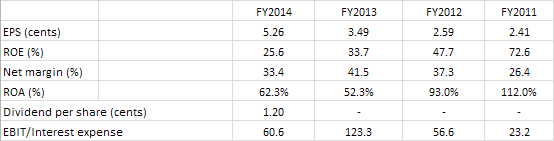
FY 2011  -- ROE 72.6%
FY 2012 --  ROE 47.7%
FY 2013 --  ROE 33.7%
FY 2014 --  ROE 25.6%

The ROE (return over equities) keeps falling from the 70+% range towards the current 25% range, but it's still pretty high. Would you say something is wrong? If so, what went wrong? It's important at this stage to break up the ROE into parts. It's called Dupont analysis, where ROE is split up into three components, net margin, asset turnover and leverage. If you multiply all the three components together, you'll get ROE, as shown below:


Here we can see that the net margin is very very good. Considering that the company IPO in FY2013 (hence anything before is suspect to me), I'll just concentrate on the 2013 and 2014 era. Net profit of 30+% is incredibly high. Take note that the leverage is also dropping from year to year at the same time. This means that the ROE is sustained by the higher asset turnover and also lower leverage. So what if the ROE dropped? It's still okay!


ROE is net profits over equity, so let's check the net profits over the years.


Revenue is rising, and net profit is rising also, but not as fast, which means that the cost of producing the profit also increases. But cost increasing is not such a bad thing. In their case, it's because there's a bigger cost attributed to project and production cost. They set up the cost first and ask for progressive payments, somewhat like construction industry. If there's zero cost, I'm going to have to start worrying for their revenues the next financial year!


It's like free cash flow. If it's reducing, it's not the end of the world. You have to dig out to find what's happening? If the free cash flow reduces because they are investing in stuff that will improve their revenue next year, it's a good thing isn't it? If the free cash flow is stable over the years, it just means that they are sort of in an equilibrium stage. The middle age to golden age of a company, where things are stable, not breaking into new industry or into new markets.


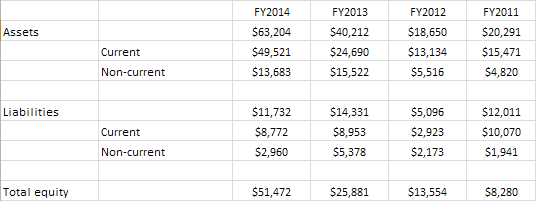
But ROE is part net profit and part equities. Let's see their equities.


You notice that there's a huge rise in the equities in FY2014. How come? The assets increased a lot while the liabilities is reduced too. The equity doubled from FY2013 to FY2014. If the net profits remained the same during the same period, the ROE would have been halved! Since it didn't drop by 50% (from 33.7% to 25.6% in FY2014), the net profit must have risen proportionally higher.


Let's see its NAV (cents).

FY 2011  -- 3.31 cts
FY 2012 --  5.42 cts
FY 2013 --  10.35 cts
FY 2014 --  20.59 cts


Since the equity keeps increasing, of course the NAV also increases. Since the increment is the same as the rise in equity, the no of shares outstanding is not diluted too much. Indeed a check shows that it's the same since IPO (but it's only been a year since IPO, no big deal).


Here's the summary:


At last close, the PER is 5.3, P/B is 1.36 and yield of 4.3%.
Last year, it IPO at PER of 8.8, P/B of 3.0.

I want the readers to focus on the numbers alone without prejudice, hence I blacked out the name of the company below. If you highlight it, you'll see the company, haha! Also do take note that this set of financial results is not the latest. I just want to see the full year results to analyse the ROE - it's never my intention to recommend companies to buy.

The company name is: Starburst