Wednesday, December 07, 2016

Where did all my savings go?

I started tallying the past records of all my savings recently. My aim is to find out where all my hard earned savings go to. Did I 'waste' a lot of my life energy, which is captured in the form of savings, into frivolous stuff? It's a pity that I only started tracking seriously in 2008. I started work around mid 2003, so those 5 years until 2007 are like my lost years


The breakdown over the years

2008: $53k
2009: $50k
2010: $50k
2011: $53k
2012: $29k
2013: $25k
2014: $68k
2015: $64k
2016: $67k ?

I haven't close 2016 yet as there's still some weeks left before the year is up, so that's just an estimated figure. To sum it up, I've accumulated about $460k worth of savings over 9 years, ignoring the lost years from 2003 to 2007 where there's no data available. It averages out to be about $51k savings every year. There are good years and there are bad years, and here is the record that I've made in the most recent 9 years.

I checked back on my past records in order to find out more about the lost years between 2003 and 2007. I should have about $100k to $120k accumulated over about 4.5 years, since I started work in mid 2003. That means I save about $25k per year during that period.


How did I double my savings rate?

On reflection, I think the best thing I did was to buy an freaking expensive whole life plan. I wasn't financially literate back then and I was like a sheep out for slaughter. If I remember, the plan will cost me about $3k every month to service, and that makes me wake up to the fact that I might be scammed. I sucked it up and took it upon myself to find out more about investments, and this lead to that, and eventually I entered the stock market to pay even more tuition fees. It's silly how I resented the fact that I have duped myself to buy such an expensive whole life plan, but years after that incident, it turned out to be one of the most important inflection point in my personal finance. It's the pain of having been scammed that made me push through the hard work to read up all the stuff needed to understand all about finance.

The second thing was that I started tracking my expenses down to the cent. In the past, I had used the old school method of keying expenses in a notebook in my mobile phone, then transfer the data over to my desktop spreadsheet. In 2012/13, I switched to YNAB and never looked back again. An initial experiment to just track my expenses fully for 1 month lead to a start of a habit that lasted for nearly 10 years now. The thing about tracking expenses to this level of detail, is that it leaves no room for mental accounting. It is what it is. I make it a point to reflect upon the data I've collected every end of the year (like what I'm doing right now), and that lead me to believe that there's only so much room to cut expenses, and so I started looking at a lot more ways to squeeze in more work to earn a higher income. This lead to a series of actions to slot in more work and up my game.


Where did all my savings go to?

Adding up all my savings in my 13 years of work, it'll amount to $580k of my life energy. Not a small amount! It was quite a shock to see the figures like that. I'll show you roughly my breakdown below. The disclaimer is that it's really a rough figure, and while I tried my best to trace out what data I can especially during those years without proper record, it's highly possible that I could have missed out a few details. My aim is just to see where my hard earned savings went to.

1. About 41% goes to my portfolio, warchest and emergency cash
2. About 14% goes to cpf
3. Another 18% goes to renovation and furnishing of my flat
4. Home related expenses like downpayment and option takes up 9%
5. 6% is lost away plus bad debts (don't ask me that)
6. Down payment of cars takes about 4% (monthly expenses and installments is under expenses)
7. Another 4% is for partial capital payment for HDB to reduce the loan quantum
8. The last 4% is just a big fat unknown.

I add up all those categories as best as I can, and it more or less tallies with the $580k, so it's fully accounted for. The 4% big fat unknown could be things like headphones, guitars, games, computers, handphones and other stuff that I now classify under 'play fund'. These are the assets that I didn't include in my networth calculation because realistically, nobody will really buy them. It should also include money spent on vacation, also one of those things you use your savings on, but never really reflected in the asset part of networth calculation.

Is that okay? I guess so. I realize I don't have a lot of bad habits financially, so a bulk of my savings is invested in assets. Housing is one big part where I might have gone a little overboard, but it's also a place where I spent a lot of my time in.


What's the difference between expenses and allocating your savings?

Savings = Income - Expenses. We save so that we can use the money in the future, for fulfillment of both short and long term goals. Some people might save up for that nice bag they wanted to get for themselves, others might be saving up for that dream car. You can also save for retirement, so that you have a sum of money to draw down years down the road. Something one off. Expenses are usually more immediate and is chronic, so things like food, bills, even insurance premiums, pocket money for parents, all these are classified under expenses for me. You can even see expenses as spending from your cash flow while allocating your savings is more like spending from your balance sheet. I'm not an accountant, but I think the concept is similar to capitalised cost. I stand to be corrected.

I generally use my savings to advance my goals in life. If I'm a company, savings are like my retained earnings. You distribute some as dividends to reward yourself, but not excessively, so that you can continue to do the same good work you've been doing. Some of it you use it to buy other assets so that it can generate future earnings. If you don't know where your retained earnings go to, then you're not utilizing it the best it should be. I will use my savings to purchase financial assets so that it can continue to generate income for me to prepare for the eventuality where my human assets can no longer generate income for me.

That's my goal and I use my savings to advance it. And that's how I intend to do so until the goal is reached.


Could I have done things differently?

My wife saw me typing this and asked me what I could have done differently. I don't usually think things like that, but I gave a few ways:

1. I would have gotten married as soon as possible and get a flat as soon as I can

The rationale is that housing prices kept going up and it disadvantaged conservative people like me. If I got into a property without ensuring a certain amount of savings first, I could have been debt free by now. My flat could have been cheaper by 100k to 200k if I had bought it a few year earlier. But we also see cases where couples getting married when both are not ready or their mindset is not aligned, so they break up before they even get the keys to their flat. I don't think I would advice anyone to just get married and get a property asap - it's plain irresponsible. My wife added that we might end up in divorce if we married any earlier, because she is not the same person back then and I'm not the same person right now.

2. Start gearing up when I start work in 2003 to reduce/remove that lost years

I took 4.5 yrs to save 100k. Thereafter, it only took me about 2 years on average to reach the same amount. Why? I was putting so much limiting beliefs on myself that I have to break it one by one. That first 100k is the hardest amount I've ever saved because I've to learn how to have that mindset through trial and error. At the end of the research needed to write this post, I am thinking how great it was if I had shortened that journey. Imagine I could have saved another 150k to 200k if I had started tracking my expenses way way earlier! This is hindsight analysis and is just pure fantasy, I know, but one couldn't help but wonder. I alone knew that certain mindset is honed by battle, and even if there is a mentor to guide me on how to gear up my work, I might have a million excuses to avoid taking action. The teacher might be there, but the student is not ready to receive, so that's that.


In summary

I'm not here to preach about savings. I already know that if the reader is not ready, he won't even be here to read this. Or it wouldn't have that eureka moment where all things clicked inside you. I'm really doing it for myself, as a chronicle of what I had done and/or what I should have done. I have my own family with a kid coming soon, and I'm doing pretty decently in a job that I really like, have a roof over my hand, have a lao pok (old and used) car to drive around, and also building up my portfolio to generate dividend income for me. There's a tremendous sense of satisfaction and achievement in seeing the long term plans fall into place through careful planning, hard work and meticulous use of my savings.

I suspect that sense of gratitude and happiness is something I can never achieve by using that savings to buy any material things. This is who I am, and this is what I'm going to be. Working hard to save up, one year at a time.

Sunday, December 04, 2016

Financial competition

Lim, Tan and Lee sat around the marble table of the kopi-thiam. They are classmates that had not met each other for the past 30 years, so naturally they had plenty to share. The conversation flowed along, interrupted only by the periodic crunch of the kaya butter toasts and the sipping of kopi-o in the quaint porcelain cups, until it came to the topic about their children.

Tan started it first when he said that his son is very capable. He is earning $100k per year at age 25 as a banker. Lim said that was nothing to boast about. His daughter is already saving $100k per year at age 22 as a property agent.

Both of them turned their heads towards Lee, fully expecting him to top their stories. Lee looked back at them, and gently put down his cup of kopi-o back to its saucer. The porcelain tinkled like a bell, as if reminding the audience to keep quiet while the curtains are rolled back and the show is about to start.

Lee did not disappoint. He said that his son gave him a million dollars just after reaching 21 yrs old.

Wow, the two of them exclaimed, unable momentarily to process all the sound that they had just heard. Tan, who started all this, naturally asked how Lee's son manage to earn so much money at such a young age?


Lee's faced was sombre.

He said that his son bought an insurance and jumped off the building.

Friday, December 02, 2016

Networth updates in 2016

Usually I'll do a networth update around end of the year, so with few blinks of an eye, we're here again after 1 yr. This year is a fantastic year for me, but I'll talk more about that when I reflect on the year 2016 and how grateful I am for the ups and also the downs. The last time I did my networth was back in 7th Dec, 2015, here.


There are so many ways to calculate networth, but I've always done my this way. It's assets minus liabilities. So, the assets part include:

1. Cash in my wallet
2. All the money in my various bank accounts
3. Cash holdings under mattress and milo tins at home
4. Money in my paypal account
5. All the money in the 3 accounts in my CPF
6. Money market fund account
7. Marked to market investment portfolios
8. Surrender cash value of whole life insurance plans

I do not include the value of my 5 room flat that I'm currently staying in, and also the value of the family car that I own.


Under liabilities:

1. Credit card bills
2. My portion of the HDB mortgage loan (total remaining loan amount divided by 2)

This year I finished the car loan of my previous car and paid up in full for my next car, so I do not have any existing car loans, unlike last year.


So, here are the tabulations:

2014: Assets: $226k, Liabilities: $220k, Networth: $6k
2015: Assets: $295k, Liabilities: $207k, Networth: $87k
2016: Assets: $351k, Liabilities: $188k, Networth: $163k

Compared to 2015, I increased by assets by about 56k. The increase in assets mainly comes from work. A tiny percentage comes from dividends and market returns of my portfolio. This is pretty in line with what I had planned, which is to add a minimum of 50k to my assets every year.

I had also decreased by liabilities by 19k. The bigger drop in liabilities is likely due to my car loan, which I had entirely paid up for. If only this is for my flat!

With that, my networth increased by 76k, which is slightly bigger than expected. This figure doesn't mean much for me, so it's just a number that tells me I'm on the right track. It had been a long while since my networth was nearly 0 in 2014!

The projection for 2017 is that my networth will increase by another 60-70k, so that will bring my networth to be higher than my liabilities. That means my assets will be twice that of my liabilities by next year. Since my liabilities consists mainly of my mortgage loan divided by 2, that means I can choose to cash out everything and pay off my HDB entirely if I chose to. But of course, I won't do that. It's still a thought though, haha


Friday, November 25, 2016

ROE vs PB of regional banks

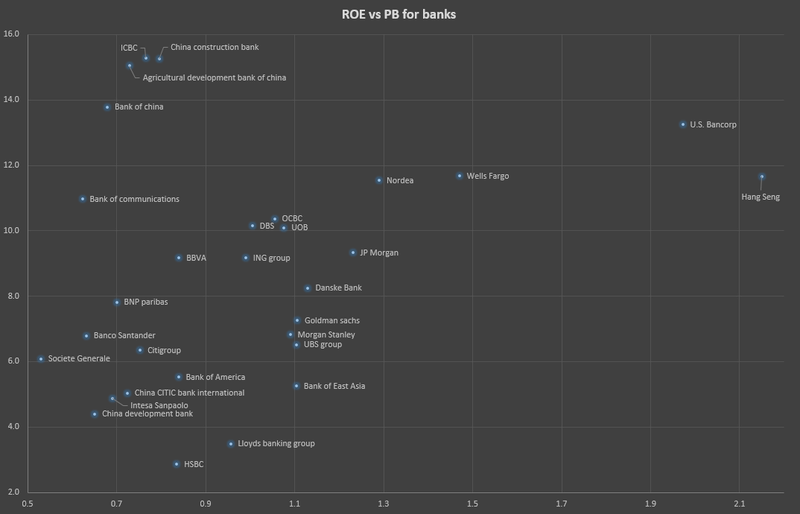
Just out of curiosity, I did a study on the ROE vs PB ratio for the different banks across the region. I fully understand that it's not a good apples to apples comparison because different banks have different regulations and capital requirements, and also different rules to recognise profits, bad debts and so on. But it's still good to see how the banks fare on these two metrics across the board.

All the figures are taken from the bestest platform to happen onto me this year: Investingnote. I don't just use them for the charts, but if you click on the tab 'Fundamentals', you can also get a quick and dirty ratios that are used commonly. They just don't have ROE, so I have to use a quicker and dirtier way to get my ROE by taking two ratios that they do have in the platform, namely Price to Book and Rolling PE. I just took the Rolling PE divided by the Price to book to get a rough ROE. For those companies that I can't find it from Investingnote, I used Yahoo finance to get the figures I want.

Don't trust me, I could have keyed in wrongly though.


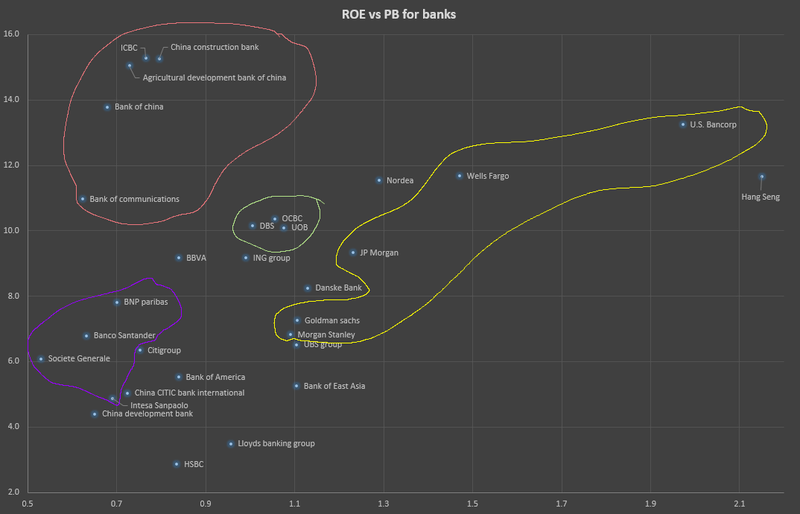
Anyway, here's the scatter plot:


First look is that you can see a few clusters. Let me roughly group them for you:


The pink ones are the HK/China banks listed in HK. They are supposedly the best since they have the highest ROE with the lowest PB. But can their book value be trusted? We need to dig deeper into the figures. The best among them is ICBC and Agricultural development bank of China. ROE of 15+% with a PB of 0.7 to 0.8 is fantastic. Too good to be true? Again, I recommend readers to dig further and not to take these figures at face value.

The green cluster is our Singaporean local banks: OCBC, DBS and UOB. All of them have very similar ROE with OCBC taking the lead. DBS is the only one that is still priced below book (PB < 1) so technically they are still undervalued in terms of that.

The yellow cluster spread over a whole range of PB ratio, and these are the US financial firms. Of these, Wells Fargo and JP Morgan seems to be the best. US Bancorp seems too overvalued, even though they have the highest ROE.

The purple clusters are the banks from the EU side. Generally they are not doing too well, since they occupied the lower left corner of the scatter plot, characterised by low ROE and also low PB. It's interesting when there are investors who only look at PB ratio and determine that a low PB is always a good thing. Take a good look at the troubled banks. Almost all of them have low PB.

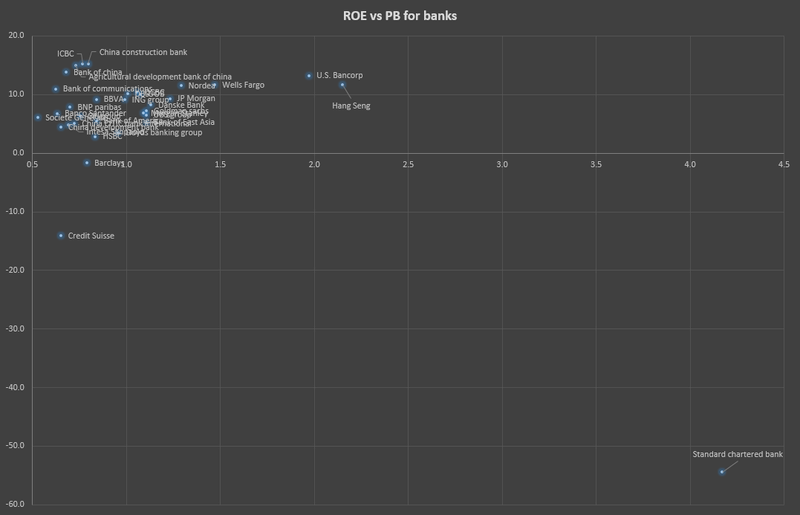
Why almost? You might also be wondering where is standard chartered bank? Here it is:


I excluded those banks with negative ROE (meaning they have negative earnings) so that we can see the scatter plot clearly. Barclays, Credit Suisse and Stanchart is right below the x-axis because they have negative earnings. The high PB ratio of Stanchart is strange. I didn't dig further but accepted the figures as it is. But those who are interested might want to do the dirty work of perusing their statements.

Seriously, I still think our local banks are worth buying, even after this recent run up. At the peak, they can reach a PB of 1.9 to 2.0. We're now around PB of 1.0 for the 3 local banks, so you can do your own calculations. Even at 1.5, there's still a lot of room.

STI 4000? Hahaha!

Tuesday, November 15, 2016

Capitamalls asia bonds optional redemption

Another bond bites the dust.

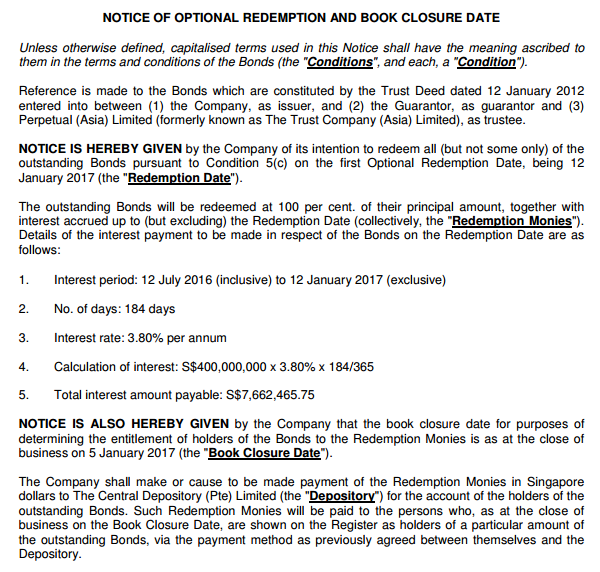
Don't worry, this is not from the troubled oil and gas sector. It's the optional redemption of Capitamalls asia bonds, CapMallA3.8%b220112 announced from sgx here. I blogged about the bonds here and here.

The full maturity of the bond is actually on 12-Jan-2022 but there is an option for early redemption on 12-Jan-2017 and every year thereafter. Since there is a step up option for the bond  if it is not redeemed on 12-Jan-2017 to 4.5% instead of 3.8%, I guess there's every reason for them to redeem it back in full. The 3 months SIBOR now is 0.87%, about doubled since Jan 2015. I guess I was wrong to think they wouldn't redeem it. There's still another bond out there with 3.08% by Capital Mall Trust (not the same, but yeah) with no step up option and with maturity date in 2020.


How would this affect me?

It wouldn't affect my portfolio because I don't have any more of this bond. But it'll affect my parent's retirement portfolio, to the tune of $26k. Guess what, I'm going to take the redeemed amount and return it back to them. The last time OCBC pref shares redeemed back, I took the money and reinvested back into FCL bonds, but I'm not going to do so now. It would seem that in the very near future, it might be better to put the money in the safety and guarantee of a fixed deposit in the banks, rather than to take that extra bit of interest and risk the price volatility of the bond. Especially if I'm the one guaranteeing their capital.

Nope, going to return them the money. No more reinvestment of the money into bonds for them.

Early Retirement Grid

I chanced upon an excellent blog that talks about FIRE (Financial independence Retire early) in 4 pillars. I will take some time to explore the site but I'm liking it already! It's here, called Four Pillar Freedom.

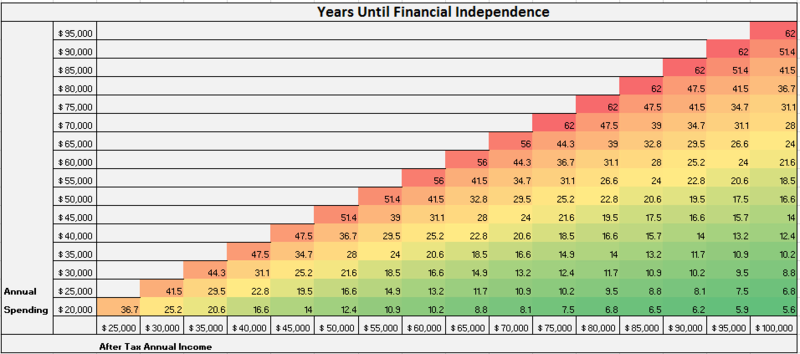
There's a post called early retirement grid with the following picture below

Picture taken from fourpillarfreedom blog post here

Basically it shows you how long you take to reach financial independence given your after tax annual income and annual spending. There's a few assumptions that comes with the table:


1) You're starting from nothing. It's good for those who had just been through the financial bombs of marriage and housing and renovation, because that's essentially what it is. After going through those 3 bombs, I have to start from scratch again and save up.

2) This is using a draw-down method of 4% of the portfolio annually. So you'll end up with almost nothing to pass on to the next generation.

3) It assumes you're investing the savings at 5% pa, and you no longer need to have any capital expenses in the near or distant future.


It might not be possible to hit all the assumptions. In fact, ignore that and let's see this philosophically. Firstly, you should be in the green zone. If you're in the red zone, that's quite dangerous because you're going to take a pretty long time of above 50 yrs to reach financial independence. Meaning you're going to work till you die. If you're in the yellow zone, you're too near the danger zone, and minimally you're going to need at least 25 yrs before reach your retirement. If you're in the green zone, you need less than about 14 yrs to reach your retirement.


Let's be truthful about this. It's good to have that option of being able to retire early upon reaching financial independence. You might not want it but it's still good to have that option. That's because when you're older, the choice might not be yours to take regarding your employment status. Someone will decide whether you can work for them, and when you still have bills to pay, that's going to be highly stressful. So, look up your annual after tax income and look up your annual spending and see what number you're at.


You probably know your after tax income, but you might not know your annual spending, especially if you've not been tracking diligently. It's alright, at least you know that now you have to have some semblance of tracking your spending. If you don't like to track every expenses down to the cents using some technology, that's fine. You can see how much you have from a dedicated spending account at the start of the month, and see how much there is at the end of it. It'll work fine. Either way, you need to know both your annual income and your annual spending.


From there, you know your FI number. The lower the number, the lesser the number of years that you still have to work, and the better it'll be. Did you notice that as you go down the column, your FI numbers drop too? Going to the right will also drop your FI number. Going down the column means you cut $5k off your annual spending, and going to the right means you increase your annual income by 5k. You'll notice for almost all the boxes, going down will decrease your FI number faster than going to the right. So do the easy thing first - cut down your expenses. Once you've cut down what you can, the only way to decrease your FI number is to raise your income level. I've talked about this at length in my blog posts here and here. That's why having a salary increment yet keeping your personal inflation checked in will be such a powerful force multiplier in your journey towards financial independence.


It makes you think twice about spending $5k on a Chanel bag right? That $5k you spent on the bag represents between 1 to 16 years of your life energy working before you can have early retirement! Think about it!

Monday, November 14, 2016

My 50k savings goal back then and now

I was reading back my previous post on my 50k savings challenge here, and trying to see if there's any difference between then and now. I first started back in 2009, and it had been 7 yrs since. How time flies!

Comparing the difference between 2009 and 2016:


1) Shift in focus between 2009 and 2016

I had a plan on how much to save every month back in 2009 and it was further broken down into weekly goals for savings. That created a lot of stress because I have to watch my expenses like a hawk! While I appreciate the shocking jolt that made me rewire my thoughts and actions to align myself to this goal, I think I would not have done the same way again. This year, I just saved what I could after my expenses, and didn't really keep a tab on how things are going. The idea is that I've already streamlined my behavior after so many years, so things are almost on auto pilot mode now. I know if I hit a certain income level, I will have hit a certain savings level at the end of the year. And because of that certainty, my focus is not on cutting expenses, but more on getting that critical mass of students so that I can hit an income level that will guarantee my savings goal. There's only so much to cut in my expenses, but my income can be unlimited. Well, more or less.

Summary: Shifted focus from cutting expenses to increasing income


2) You can get used to shit

I was complaining back then about working 10 hours in a day and having lessons at 7am and ending at 1130pm latest. It was quite entertaining reading about such things because it must have been quite a shock to me back then to work so hard. Back then, I also have my Sunday off, so it wasn't as bad. Compared to 2016, I think the work load in 2009 is considered a breeze! This year I had 14 hours workday, starting at 7am and ending at 11pm with 1 hr break in total for lunch and dinner. 9 hours on a weekday is quite normal and during peak seasons, 12 hours workday is the norm. I was quite stressed up over work back in 2009 and was generally feeling burnt out and unhappy. But this year in 2016, I was just laughing and enjoying my work (mostly), even though I was working a lot harder and longer. Like a hedonistic treadmill but in reverse, you can get used to shit, and when you do, it's no longer shitty.

Summary: I can take shit and enjoy it too. It's just takes a reframing of the shitty situation.


3) Impossibility made possible

Back then, I don't think I can save 50k. It takes a few years of doing it and stressing over it before my mindset is changed. I think it took about 3-4 yrs before my internal dialogue changed from "I think it's crazy" to "I might be able to do it" to "I think I can do it" to "I did it again". I can't stress how important it is to be able to leap from the impossible to the possible, because it gives a shot of confidence in my ability to go through the entire process of goal setting, planning, execution and review. I could never imagine that now, saving 50k is a norm and not a challenge anymore. That's just crazy.

Summary: Plan something crazy and go do it. The growth to achieve that crazy thing you're aiming for will be the catalyst for many other crazy things you could possibly aim for. If you don't challenge yourself and expand your limits, you'll NEVER grow.

Saturday, November 12, 2016

Choose yourself!

I am reading this book by James Altucher titled Choose Yourself. I'm still in the midst of it but am loving the message that the book is trying to convey. In this kind of economy, there's not much loyalty for any particular company. Everyone of us has to treat ourselves as a company and behave like we are one!


Here's some tips on choosing yourself from my own experience:


1. Have a personal brand and personality that people know you for

I think the general impression I get from people is that I'm very well read, disciplined and reliable. Try thinking of any one and rattle off 3 characteristics about that person. It doesn't matter whether it's true or not, but the perception is what matters. If you're perceived to be an asshole, then you will be treated like one. Jobs come and go, but your personal branding and personality stays. When times are bad, your personal branding might be the only thing that can differentiate between you and another stranger in the interviewer's perception. It takes a while to build up a personal brand and reputation, so remember that all it takes is 10s to destroy it. If you don't want to keep up the appearance, then be authentic and real. It'll be easier in the long run!


2. Marketing yourself - everyone must know what you're doing for a living

This is related to point 1. Everyone that I know must know that I'm a tutor, if not I've failed to market myself. It is said that the lobangs come from people outside your inner circle - the acquaintances in your 3rd, 4th, 5th and above degree of separation, so start telling people what you do for a living. If nobody knows what you're doing, then how can they offer help?

I'm not the hard marketing type also, so you likely won't see me dropping name cards in social events. I don't even have a name card lol! There's another side to marketing - you can market yourself all you like, but you better be good in what you are doing. If not, you'll be like the exploding samsung handphones. A good product is meaningless without good marketing while a bad product needs no marketing.


3. Upgrade and invest in yourself

This is not to satisfy some certifications or professional training time. We're talking about real useful skills here. If you choose yourself, then don't let others dictate what is good to learn. Choosing yourself requires responsibility and that involves having a goal in mind and looking for skill sets gap to fill. It can be a formal course like taking a proper training course offline or online, or just reading. Remember we're not upgrading to show others that we have the certification. We're upgrading ourselves because we want to be better, so you don't have to take up official qualifications. Reading is a form of upgrading of skill set too, especially if you read widely. I'm not picky - even reading comics is a form of upgrade. Hey, it takes imagination to jump from frame to frame! But do yourself a favour, don't just read comics. Read a proper book too :)

4. Exercise, meditate and take care of yourself

Resting and taking good care of your mental and spiritual health enables you to walk a further distance than others. Life is a marathon, not a sprint, so make yourself better so that you can provide better quality of service to others. Take care of yourself so that you can take care of others. Treat yourself well because you're a machine that needs occasional oiling and maintenance too!


5. Learn to say no

I'm still learning this. Learning to say no means you value your own time. You don't waste time on nonsense people or events that you do not enjoy. If you value your own time, you can be sure others won't value yours too. Choose yourself and make yourself happy. That way, you can be sure others are happy and don't have to listen to your complains too :)

Tuesday, November 08, 2016

Review of financial goals

I wrote about my offensive and defensive strategies two years ago here, but never really got a chance to review it to see if it's still relevant. Let's do it now.

In that post, I talked about the dilemma of using cash to shave off interest at 2.6% by doing a partial capital repayment, or using it to invest in the market by getting a return of more than 2.6%. It's not an easy solution and I opted to do both to avoid the two extreme end game scenario of being asset rich but cash poor OR paying excessive interest for my housing loan and being in debt for a good 30 yrs. So, I came up with 3 plans:


1. HDB capital repayment plan

This is to top up 12k every year, shared between me and my wife, so that my 30 yrs loan will be shortened by about half. So far, I've been consistently topping up 12k towards the end of every year towards the completion of goal. From last calculation, I would have finished the loan in another 12 years. I talked to my wife about the interesting scenario where my son will be stressing over his PSLE while we will be celebrating and popping champagne for a completed milestone of finishing our HDB loans, LOL! Finishing our home loan will be one of the greatest accomplishment and I look forward to giving HDB my last check to wrap up the whole affair.


2. Build up of capital for 1k/mth dividend plan

This plan is to build up a base of 240k capital, and when invested at >5% pa, will generate 1k/month. In that post, the expected duration is about 2-3 yrs and I think I'm still on track towards that goal. Next year will be the 3rd year and I don't see why I can't fulfill this project on time. Well, at least for the capital build up phase. I intend to slowly deploy even if I have the capital, so there's no rush to get the 1k/month. Realistically, I can channel $20-40k per year to this project, depending on how much I can save, and that depends on how much income I can earn, which is a variable. Every year, my income will drop drastically as the graduating students leave so I will have to work hard to push it up to last year's income as fast as possible in order to save more. I was initially worried about my income for 2017, but I felt a lot more secured when currently I have about 75% of my income confirmed for 2017. I should be able to start 2017 running. This 1k/month dividend income will come in at a very good time as I will have to reduce my work load to prepare for more family time. It couldn't have come at a better time, so I'm glad I started this way ahead.



3. Emergency fund of funds

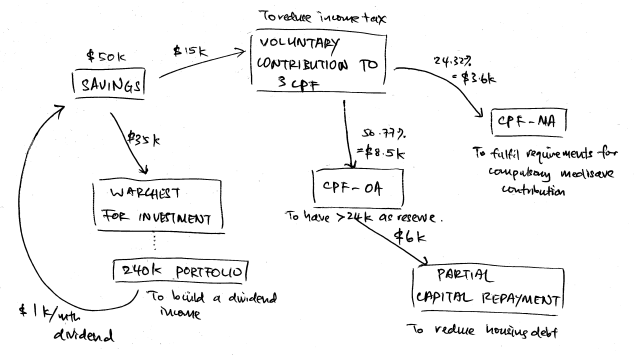
This project is to do voluntary contribution to my 3 cpf accounts in order to build up a full year of mortgage payment, to the tune of 24k. I did a tweak for this project. Instead of topping up 6 to 12k as mentioned in the article, I will top up 10 to 15k as voluntary contribution annually. Firstly, this will reduce the amount of tax I have to pay. Secondly, 56.77% of the contribution amount will be channeled to my OA, so that will be about 5 to 8k every year. I will then do a partial capital repayment of 6k using CPF (instead of cash).


So, the workflow goes like this:


Doing this achieves 5 things in one shot:

1) Reducing personal income taxes because voluntary contribution (VC) will have tax reliefs

2) Topping up MA to pay up for compulsory medisave contribution, as part of the VC (24.33%) will be channeled to MA, so there will be less cash outlay to top up just for the compulsory MA portion

3) Topping up OA to build an emergency fund of funds to have 1 yr of mortgage as reserve, so I know I can last 1 year without income and the mortgage for the house can still be paid for

4) Partial capital repayment to reduce housing debts so that the housing debt will be reduced and it helps to save on the interest for the remaining loan amount

5) More cash available since (1) to (4) comes from the same tranche of money by doing VC, so this enables my investment porfolio to build up faster. Ideally, I should have more money outside CPF than inside, to hedge against the policy risk and constraints of using CPF solely as a retirement tool.


It took me some years to realise this workflow and I should have done it much sooner, but that's the point of this post. If there's some self employed out there who is in a similar situation, you can short cut a few years of trial and error modify/adapt the workflow to suit your circumstances.


To be frank, having a child is not part of the plan when I wrote the post back in 2014. I think it'll be interesting to see how these goals will change when I review it a few years later after having a kid running around the house. I would expect more modifications to come for sure.

Tuesday, November 01, 2016

Buy High Sell Low, not Buy low Sell High

We often hear this nails-scratching-on-blackboard phrase "Buy low Sell high" until our eyes roll and our skin crawling with goosebumps. There's truth in it, except that like all aphorism, it's not as simple as it is. Let's deconstruct that phrase.


Buy low sell high consists of two parts. Firstly, you have to buy at a low and then you have to sell at a high. But unfortunately, the aphorism didn't really say what we're buying at a low. It's implicitly taken to mean buying at a low price and selling at a high price, but I think it's not right. Sometimes buying at $2 might not be better than buying at $2.50, especially when taking into account the risk of dropping even lower. It's better to bottom fish when the mud had settled and the waters become clearer; the chances of fishing a stone that breaks your line is lower. But clarity comes at a higher price, so if we have to follow another aphorism "Do not lose money", then it will make better sense to buy at a higher price rather than hope than the stock will make a V shape recovery by buying at a lower price.


The more correct 'thing' we're buying should be value. Hence it's more correct to say Buy High (in value) and Sell Low (in value), rather than the more risky proposition of Buy Low (in price) and Sell High (in price). Value means different thing to different people. If you're a trader observing a counter moving uptrend, buying at high value means the price touching the lower boundary of the envelope and then selling at the upper boundary of the envelope. If you're an investor, buying at a high value could mean buying when the price went below the intrinsic value of the company and selling when it's above. But do take note that regardless of what type of market participant you are, the price is never the thing we're focusing on. It's always about what the price means with reference to something else.


Since the aphorism consists of two parts, can we also reverse the order? Sell high (in price) and buy low (in price)? Effectively that's what shorting means. You sell off something and then buy back again at a lower price to make your profits. Again, this runs into trouble because basing your decision on price alone is hoping that the high price alone will catalyze the precipitous fall thereafter. No, it should be Sell Low (in value) and Buy High (in value).


By itself, this is quite an un-actionable advice. Without telling people how to determine value, it's impossible to follow this advice, hence it's not actionable. But to tell people how to determine the value, regardless of the 'value' in question here being a trading value or investing value, it will take more than 4 words. Maybe not even 4 books have the breadth and length to begin discussing it fully.


And that's the real reason why I love aphorism. If you know it, you'll appreciate the beauty and simplicity of all the mountains of knowledge condensed into a short sentence with a nice sound bite. If not, you'll understand it after you've made a mistake following it. Either way, you're going to take home something.


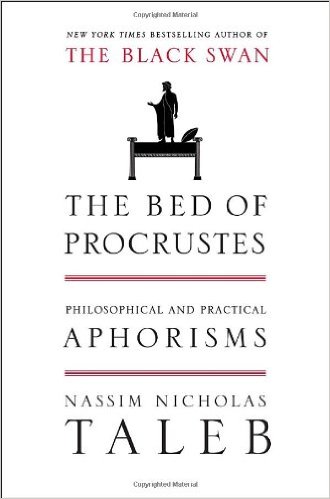
If you're interested in aphorisms, may I recommend a very good one by Nassim Nicholas Taleb titled "The Bed of Procrustes". It's a very easy read, but as with every such aphorism, you'll have tons of things to think about. I think of this book as an aperitif; something to whet your appetite with promises of more things to think about. Also works great if you're a blogger and need materials to write about HAHA

Monday, October 31, 2016

Money beliefs and habits

When students come to me for help, the solution is not as simple as telling them to study. They are obviously not doing well, and the reason for them for not studying can come from a variety of reasons. It could be low self esteem, seeking attention from parents or peers, trying to fit in with his close group of friends and so on. Unless the root cause of the problem is dealt with, any methods of improving the grades is just symptomatic treatment and will seldom work for long, if it works at all. Hence, being a tutor is sort of like a doctor because you see the symptoms of bad results, and you try your best to decipher the symptoms and finding out the root causes.


It's the same for financial advice. If someone is not doing well in his personal finance, it's never as simple as save more and spend less. The symptoms show that the person is not good in his finances, but the root cause springs from his money beliefs. So unless the money beliefs are changed, any symptomatic treatment like budgeting, or separating wants from needs, or just spending less is not going to help much.


That is why Kyith's article here is such a fantastic write up. It's hard enough for people to talk openly about money, and it will be even harder for people to tell you their money beliefs enough for you to know what's wrong. Hence, to change a person's mindset about personal finance is going to be such a up hill journey. I guess the first part is at least to remove the barrier about money being a taboo subject. Once we share our own journey, it might open up the hearts of readers to talk about their own situation and how they handle their money problems, and things will fall into place from there. As a personal finance blogger, I think I have a part to play in this. I will share my journey, and how I navigate the various pitfalls and challenges of life, and hopefully readers will share theirs and we will grow as a community.


If you're interested in such money beliefs, you can try reading Secrets of the millionaire mind by T. Harv Eker. He will scold you and beat you up in his book (and I heard in his seminars too), but the job will get done. You will learn about money beliefs and how it's all linked to our money memory and most importantly, how to delink it and change within yourself. If you're sick, you eat medications to feel better. If you're sick financially, you should start by reading books to change your mindset and hopefully it'll translate to the right actions for the right change.

Wednesday, October 19, 2016

My retirement comes annually

As my work winds down for the seasonal lull, I suddenly have a lot more free time. To the point that I don't know what to do with my time. I'm very used to working 6 to 8 hours of class time on weekdays (not inclusive of preparatory/marking time), so suddenly having only 2 hrs of work or even none takes a little getting used to. Again.


Every year end, I'll face the same situation of getting 'retrenched'. Every year end, I'll get my little experience of having retired and/or having reached financial freedom. It's the same feeling, that I've did what I had done and now I can finally have my life again. It's also invariably mixed in with the fear and worry that my money might run out, and that next year perhaps my earnings might not be better than this year or the last.


But not yet. For the next 2 to 4 weeks, I'll be having my honeymoon period. It's the period where the stress and worry haven't hit me yet and that all I can think of is the free extra time that I will have. I had dim sum lunch with my wife at 2pm and that stretched on with some shopping and tea to about 430 pm. After that, I read and took a nap until 7pm before I went out to have dinner together. At least for the next couple of months, I don't have to worry about rushing. In fact, I can stop looking at the time and let it pass while I enjoy these quiet moments. Try it. It's a different feeling when you have an agenda for the day versus one where you just get to do what you like when you feel like it. It's the same difference between a free and easy holiday versus a scheduled travel agency kind of holiday. It's the honeymoon period, of course.


I've worked pretty hard for this year - in fact, the hardest I've ever worked in my life! I've saved up with more than enough buffer for the winter months and I don't have to worry so much. But I still do. I guess even when I've reached financial freedom and truly have the option not to work, chances are that I'll still work a little. I don't have the climbing down mountain mentality yet, so perhaps this will change as I grow older. We'll see.


Next year is going to be a life changing year. Let's see how I'm going to navigate through this.

Wednesday, October 12, 2016

The danger of holding too much cash

Today I made a mistake. I was queuing for a counter for about 2 weeks at 1.47. But when the stock started showing surges in its bid and sell volume, I started interpreting it as a sign that the counter will move. Against all reasons, I abandoned my queue and bought at the then sell price of 1.50.


It's only 0.03 cts, yes, and I didn't buy a lot (4,000 shares only), but it was still a mistake. The mistake was not sticking to my plan, which was to queue at 1.47 until it expires or it hits. On reflection, I think there's a few reasons why I did that:


1. I did not do my homework scans on Sunday, which I usually do because I was sick. If I had stuck to my routine, I would have realised that maybe today's funny volume movements are not that funny.

2. I had too much cash lying around. Nearly 50% and was climbing until I bought two counters in the last 2 weeks or so. The danger of having too much money lying around is that you tend to fire more eagerly, sometimes seeing what you mind tells you to see.


I want to take the chance to talk about the 2nd point. This is a relatively new problem for me. I never had the opportunity to handle such a record investment portfolio and a bonanza of cash waiting to be deployed, hence this problem might be more and more frequent ahead. We will all reach there one day. It's best to recognise it and stem it as soon as necessary, which is the real reason for this post. It's to remind the future me to wake up and stop doing adjustments when I should be doing nothing.


If we're doing things right, our portfolio will get bigger and bigger in size. Our money management and our psychology when handling money must also change gear from handling small amount to handling big amount. If your portfolio is 20k, you have a different set of worry from handling a portfolio of 200k. With a bigger portfolio, you also can't do the same thing that you did when you're having a smaller set. You can lose a few 20k, painful yes, but not catastrophically so. Nobody can casually say they can lose 200k portfolio, well, unless you are handling 2 million perhaps.


Some of the things I think we should be careful when handling bigger portfolio size is:

1. Diversification - I'm can't do a concentrated portfolio of 8 stocks. I'm not good enough to know if something will trip up in the companies I invested, so it's better for me to spread the risk to more companies. If one fails, it will not rot and bring down the entire ship. This is very important.

2. Finding a place to store that excess cash that is around. I admit I can't invest 100% at all times, so I will always have some cash lying around. I will always have to find some good place to park that cash and when all my current facilities to max the returns for the cash is used up, I'll have to find new ways to do so. I need to set up a system. I think if the cash is not rotting too much, the problem of wanting to invest eagerly may be reduced or eliminated.

3. How to average in your positions. Now with bigger backing, we can enter in 2 or 3 shots. There's a lot of science on how we can enter with 3 rounds. We can double down, enter at fixed time, enter at fixed interval, enter at subsequent support level and so on. This is vastly different when starting small since we only have 1 good shot if we don't want to over allocate our resources into one single company. The same goes for selling too. We don't have to sell all in one shot. We can sell out in 2 or 3 rounds. I need to experiment and come up with a good system to deal with these, so it's less discretionary also.


Anyway, I've a feeling I'll be blogging more and more about other stuff in the future. However, making silly mistakes is one area that I will never blog less about. If I want to be successful, I should have more and more new mistakes, less repeated ones and more reflections following that haha!

Thursday, September 29, 2016

Phillips money market fund (MMF)

It's been a while since I've talked about Phillips money market fund (MMF). A quick search revealed three articles:

1. POEMS money market fund (MMF) (2008)
2. Phillips money market fund (2009)
3. Phillips MMF (2010)

I know, from first look, they are all the same or similar sounding titles. No creativity on my part in choosing a title, haha!


For those who do not know, money market fund is a collection of short term bonds, deposits and savings. They don't give out interest like what stocks or even banks do. It's more like a unit trust where there's a NAV posted every day. If you buy say at 1.002 and after a month the NAV rises up to 1.012, then you have a return of 0.998% ( [1.012-1.002]/1.002 x 100%). The NAV keeps going up as the deposits and savings are capital protection upon maturity and even during the worst financial crisis, the NAV is steadily increasing.


Here's the returns I've tracked in the past:
2007: 2.01% pa
2008: 1.33% pa
2009: 1.04% pa

I didn't really track after that because it keeps dropping down as the interest rate environment is dropping also. But this yr and the last, the returns had been increasing again.

2015 Aug to 2016 Aug: 0.908% pa


If I take the more recent months, the returns will be even higher (but still less than 1% pa). It's time to take a look at this again to put your spare cash or emergency cash in. The process of taking in and putting in money is very fast, about 1 day usually (depending on time) and 2 business days latest.


What's the catch you ask?

It's not guaranteed by the bank deposit insurance, unlike fixed deposit (up to $50k per bank per pax, regardless of accounts in the bank). So, if Phillips MMF is to close down, then the money might not be able to recover. Well, in that case, don't put your whole networth in lah, just put in a suitable amount. You can use this is pay for your equities purchase using POEMS too, and that's what I do. The good thing about this is that it doesn't require you to jump through many hoops like minimum credit card spending etc. It's very good for people like me who don't have a fixed salary so I can't use those ocbc 360 accounts that people are raving about.

Friday, September 16, 2016

It's 3 am I must be lonely

Restitutive, Retributive and Reformative.

These 3 words keep rolling around in my mind as I woke up in the middle of the night to think about this. It must be around 3am, because that's the time my aircon timer is set and I usually wake up due to the difference in temperature. I must have read it somewhere, but I'm not sure why this suddenly cropped up.

Restitution means to restore or repair something to its original state. Retributive effectively means an eye for an eye. Reformative means to correct or adjust for re-integration into society.


Your kid hits another kid in the playground. As a parent, what do you do?

Restitutively, you should pay a small sum of money to the other parent to restore the 'state' of the kid to its original one. Retributively, you should let the other kid hit your kid back. An eye for an eye. Reformatively, you should get your kid to apologise first (no violence no matter who is wronged), find out why they are fighting, and seek to correct the behaviour of using violence to vent out one's frustration or anger and instead seek other avenues to address the wrong.

As you can see, it's hardest to reform and easiest to seek retribution. There's always 3 ways to approach matters, and it's a good reminder to me as well. The right tool for the right situation.

Thursday, September 15, 2016

CPFIS-OA investors shouldn't invest? Really?

There's always a big hoo ha about CPF investors being unable to hit the 2.5% interest rate of ordinary account CPF. The statistics mentioned in this recent news is that over the last 10 years, more than 80% of those who invested their money in CPF would be better off leaving their money in the CPF OA. It's also stated that 45% of the investors made losses in the scheme.

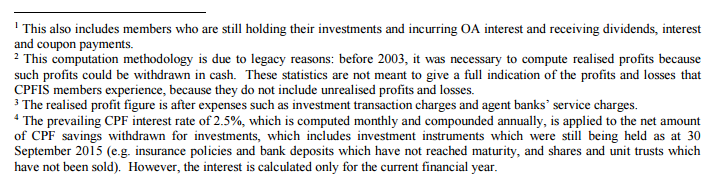
I don't buy this. I dug further and saw this link for actual report of CPFIS-OA investors in the year ending 30th Sept 2015. For easier reference, I screenshot it below:

The first picture shows that really, for the year ending Sept 2015, 38% of CPFIS-OA investors lost money with returns of less than 0%. 46% of members earned a return of 0 to 2.5%, which means a total of 84% of investors might be better off not touching them and earning the 2.5% OA rate. And so it appears that the newspaper article is correct.


 But let's look at the small footer, where all the important details are hidden


In pointer 2, it says that the data do not include unrealised profits and losses. This is not mentioned in the news article!

Imagine I have 3 positions:

1. Company A, bought 30 shares at $1, still holding on at $1.30
2. Company B, bought 40 shares at $1, but cut loss at $0.80
3. Company C, bought 30 shares at $1, sold at profit at $1.20

Out of the 3 positions, only 2 and 3 is realised and position 1 is still 'running'.

Total amount invested = 30*$1 + 40*$1 + 30*$1 = $100
Realized profit/loss = (40*-0.2 + 30*0.2) = -$2 (loss)
Realized profit/loss percentage = (-2)/100 x 100% = -2.0%

Oh no, so I'm one of the members with losses since my realized profits/loss invested is -2%

But if I'm counting my total profits/losses for that duration, I should include BOTH realized and unrealized profits marked to market, so

Total realized + unrealized profits = -2 + 30*0.3 = $7
Total realized/unrealized percentage = $7/100 x 100% = 7.0%

That's a far cry from my realized losses of 2%. Isn't it?

Monday, September 12, 2016

How we react to other's success story

Someone mentioned his success story. You immediately start to think of what are the circumstances that makes him different from you. Maybe he comes from a rich background. Maybe he don't have NS so he starts working earlier by 2 years. Maybe his parents help him pay the downpayment of his property and his car. Maybe he is single so he don't have to pay as much as a married couple with child. I'm sure you have thought of this, and so do I.


The issue about such thinking is that you start to form a hundred and one reason why you cannot emulate the success story. You start thinking that he is different from you and since you don't have the advantages that he had, you cannot have the success that he is having too. I find such thinking highly toxic and even as I'm still struggling to get over such jealous thinking, sometimes it'll start to creep onto you insidiously. 


I think it's part and parcel of being a human. We have our ego and a damaged ego is very hard to swallow. But it's important to turn such discomfort into a strength and motivation to succeed. You already have a role model who had been there and done that, so your learning curve is going to be reduced. If anything, you have a stronger chance of reaching the same success level in a much shorter time. I believe, self delusional or otherwise, that the purpose of sharing success story is more motivational than boasting. We just need to keep an open mind to learn and not close it off and say he is different from me, and I don't have this or that, hence I can't do it. It's important to accept the discomfort arising from the discrepancies and start closing the gap right now.


It seems like my whole life is trying to prove others are wrong:

1. When I'm in JC, there's this teacher who keeps telling me I should drop Further maths. I didn't and I succeeded in getting an A.

2. When I'm in university, my friends and family told me I can't get 1st class. I didn't believe it and I took extra modules to chalk up the score necessary to get it.

3. When I'm working, friends and family told me I can't work as a self employed private tutor. I won't be able to survive. But I did and I continue to do so.

4. When I'm saving 50k a yr after I woke up from my 'financial slumber', there are folks who told me when I get married and start having to pay for my own property, I won't be able to make it. Well, I'm married and I save even more now. 


Iron-teeth. I get highly motivated to reach my goals in order to prove a point. That's who I am. The quality of my motivation changes from being the angry, vengeful, the in-your-face kind of motivation when I'm younger, to a quiet strength where action speaks louder than words when I'm older. Both are pillars of strength when trying to traverse through the obstacles and road blocks in my path, but the second one is one that springs from self confidence. Not angry anymore, just self assured. I think age tends to do that to you. 


You no longer have to prove your 'worth' to anybody.


Friday, September 02, 2016

Principle of Non-equality of Equal magnitude numbers

Hypothesis:

Equal numbers a and b of the same magnitude need not be equal
i.e 1+1 is not necessarily equal to 3-1, even though numerically they are both equal to 2.

Method of proof:

By contradiction

Proof A:

I have 3 million dollars, but I lost 1 million dollars, so I still have 2 million dollars. I might go jump down. If I have 1 million dollar and I made another million, I now have 2 million dollars, instead I jump for joy. The former makes me jump down, the latter makes me jump up, possibly with fist pumping and with occasional shouts of joy. Thus they are clearly different, even though it's the same.

Proof B:

I have 3 bad debts (all of equal amount), and I tried all ways to get rid of 1, so now I have 2 bad debts. I'm overjoyed. If instead I have 1 bad debt, and I incurred another one so that I now have a total of 2 bad debts, I'm overburdened with sadness. The former makes me overjoyed, the latter makes me chained in debts. Thus they are clearly different, even though it's the same.

Proof C:

I have 3 multibaggers in my stock investment. But one of them turned from multibagger to multibeggar and eventually goes to 0. I feel stupid and adopt the 'take profit is never wrong' principle. If instead I have 1 multibagger, and I held another investment until it too became a multibagger, such that in the former and the latter case, I earned the same amount of money, I will feel clever and adopt the 'investment is for the long term' principle. Both are the same result, yet they are different.

Conclusion:

Hence the principle of non-equality of equal magnitude number is verified.

Implication:

1. The journey to the result is as important as the result. If the final result is equal, and the journey to reach the result is the same, then it might be equal in all aspects. But I doubt the journey can be the same. Even if the journey is the same, the person might be different. Even if the person involved is the same, the mental state of the person might be different. Hence, it's safe to conclude that equal results need not be equal to the person carrying out the journey.

2. Aversion of loss is stronger than the greed for gain. If I managed to lose more, I will feel more sadness compared to the happiness I get from gaining more. Conversely, that should mean that if I manage to avoid losing, I should feel more happy than losing the opportunity for gains. This explains why when a counter I'm eyeing doubles in price, I can rationalise it off and say it's just not for me or I'm busy or at that point in time I act on the best of my knowledge. But if I managed to avoid buying a counter that halved in price, I shout HENG AH.

3. Comparing against another person is a very silly thing. You're 30 years old and I'm 30 years old. You have 100k but I only have 30k. So? You might have gone from 200k to 100k while I might have gone from 15k to 30k. Our journey is vastly different. Comparing against your past self might at least reduce the number of variables by one,


Wednesday, August 31, 2016

What's with the rant against whole life plans?

I bought a whole life plan. In fact, 2 of them. One is a traditional whole life, where you pay until forever. The other is a limited payment whole life, where the payment period is condensed to maybe 5, 10 or 15 yrs, so you pay a higher amount but you can stop paying after.


There's so much vitriol against whole life that I thought I should make some statement FOR whole life, just to provide some yin to balance out the yang. The ultimate question is this: Will I buy a whole life plan now? The answer is no, but back then, I didn't know the following:


1. I'm a mighty saver. I can save a lot of my income away without external help. I know some people will spend a lot of their income away, so a whole life plan helps to 'lock up' that excess money away and give it back much much later. It's not ideal of course, but between a rock (not saving) and a hard place (not earning good returns on money), I think there needs to be a compromise. I know the rhetoric of buying term and investing the rest. But I think there is a group of people who will buy term and spend the rest. Whole life will help them a lot in this aspect. Back then, I didn't know which group I am in, but now I know. It's my hedge against my own 'money' character, if you will.

So, buy term invest the rest...but in real life, you might not save the rest. Nor invest it.


2. I can earn a respectable returns myself from investing. The second part about buying term and investing the rest is the investing part. Some people don't want to touch investment instruments at all, except perhaps for insurance and savings deposit. Not even bonds are under their radar. It could be ignorance, or fear or more likely a combination of experiential baggage that causes one to think like that. I'm sure you've heard of ultra conservative people like that. If so, then whole life presents a good investment for them. It might not be good enough for you, but it could be so for them. I don't buy into the idea that if you invest in a low cost fund, things will work out well for you. The stock market returns are never guaranteed. Nobody can guarantee you will earn 1% from the stock market if you put in for the long term. On the other hand, I've never heard of people losing money in whole life insurance, have you? The criticism is that one can earn better than whole life, but perhaps they forgot to mention they could have lost money in the process too.

So, buy term invest the rest will beat whole life returns, but that outcome is not guaranteed. A small guarantee might work better for an non-guaranteed but higher return.


3. I am disciplined. I think that sums up the characteristic of a term plan buyer. If you want to buy term plan, you better be disciplined in your spending and also your investments. If not, it's likely to reap the benefits of a buy-term-invest the rest strategy. It's like hiring a trainer for your gym. Can you do it yourself? Sure, all the information is out there, you just have to read and learn it on your own and execute it. But there will be days when you're not motivated and you just need someone to push you so that you can overcome the barrier. For a fee, of course. Not everyone is interested in financial and insurance matters and will gladly outsource it to others.


What I'm trying to say is that the process of discovering yourself takes time. In the meantime, you still have to work out the best decision based on the available information. Back then, my idea is to use whole life as a base and buy term to top up the coverage. When the term expires at 60 or 70, the whole life will still continue to provide coverage. I will then have to option to convert my whole life to annuity, cash out for retirement needs and/or continue the plan and provide a gift for dependents. Ironically, because of my whole life plan 'mistake' that everyone around me keeps telling me, I went to dig further into investment. I would say the 'mistake' started everything I know about financial stuff.

Interesting isn't it? Nothing is really 'wasted' in nature.

My philosophy now goes towards using term and self insurance. From whole life, to limited payment whole life, to term and to self insurance, I think I'm evolving just like a pokemon. I think life experience and mistakes are the candy needed to evolve yourself into a stronger pokemon with more CP lol!


Monday, August 29, 2016

Gold and Silver investing guide

Bigscribe released a new free ebook again, and this time it's about investing in metals. I'm a lay person and I know nothing about investing in metals, so this guide comes as a godsend to fill up my knowledge base. We always hear people talking about investing in metals as a hedge against hyper inflation (like during extreme conditions in wars), so naturally I'm interested to find out more about it.


This book talks about buying physical metals, specifically the buying of physical investment grade gold and silver, and the other little details like where to store and so on. There are other ways to invest in metals, like Gold ETF, but in shit-hits-the-fan situations, buying in such intangible metals might not be good because you're subjected to counterparty risk. In physical gold or silver, you just take and run. From the guide, I even know that there are 2 other ways to invest in gold, other than ETFs and physical gold. I think it'll be a good guide for lay persons such as me to learn about such things, even if you don't necessary have the huge asset base to diversify into precious metals.


The last part of the guide talks about the different myths for and against buying of Gold and silver. I think this gives the guide a well rounded starting point to find out more about the investing of precious metals. Try and register for it here, it's free and set in the local context, unlike other sources from the internet or books.

Friday, August 26, 2016

Using Investingnote's charting platform

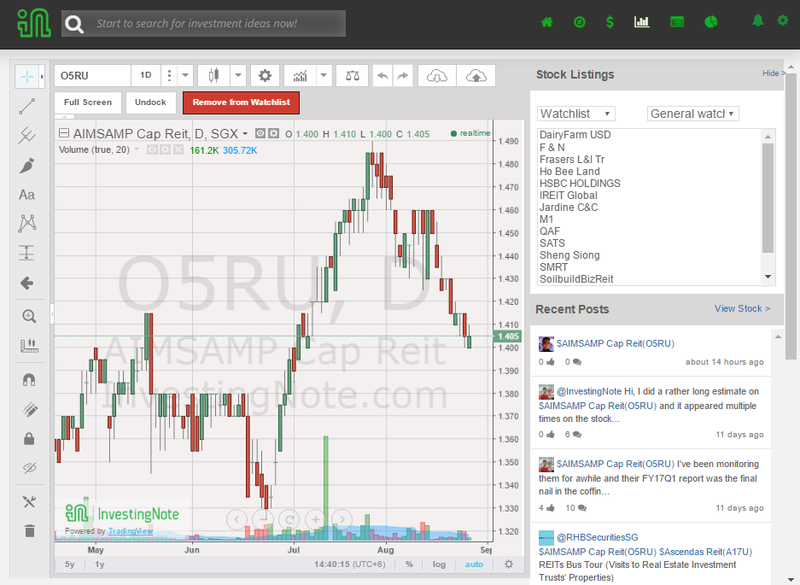
I wanted to help those who are newer to Investingnote, my preferred charting software, hence I'm writing this post. I think the people over at Investingnote are really doing a fine job with a free charting software. It's actually quite powerful and I especially like the real time (okay, it lags by at most 2 minutes) update of the charts. Yahoo finance maybe lags by 10 to 15 mins? I've not seen a charting software that updates realtime too, perhaps except those by brokerage platform. But those are pretty laggy and buggy so I don't like to use them much.

This is not a sponsored post. I just think it's a great tool for people to use it, so I'm sharing it. This is also not a tutorial to show you how to use the charting software, but more of how I use the charting software at Investingnote.

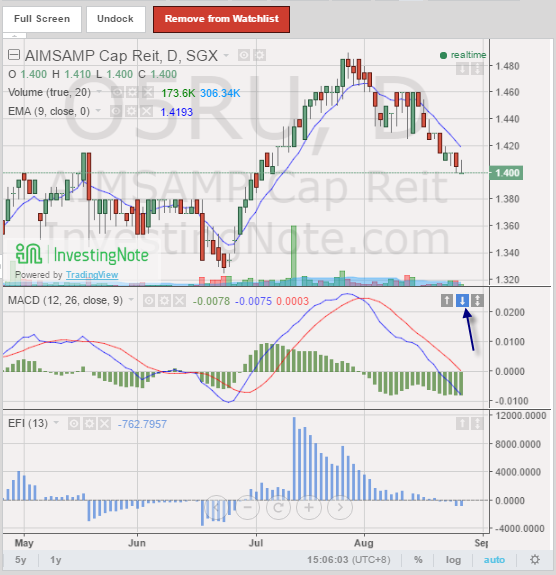
When you logged in and click on the "Charts" option on the upper right corner of the platform, you're going to see something like this screen:


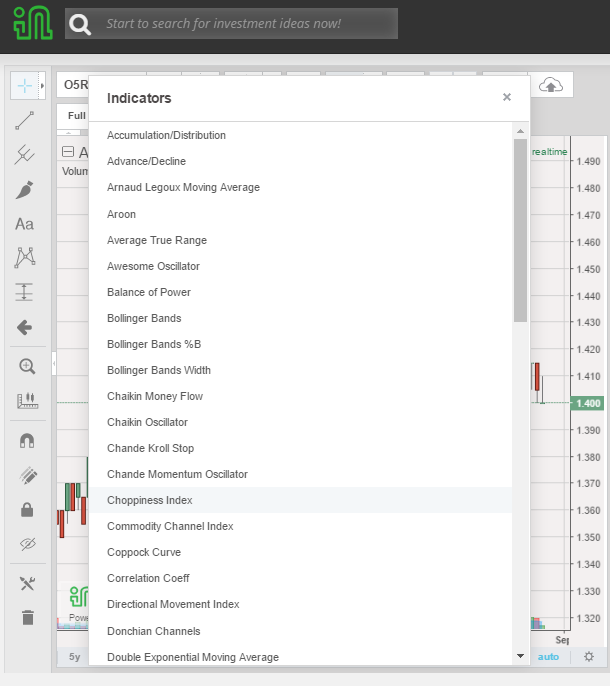
I like to add a few indicators to my chart. I mouse over the symbol with the charts, and you'll see "Indicators" appearing.


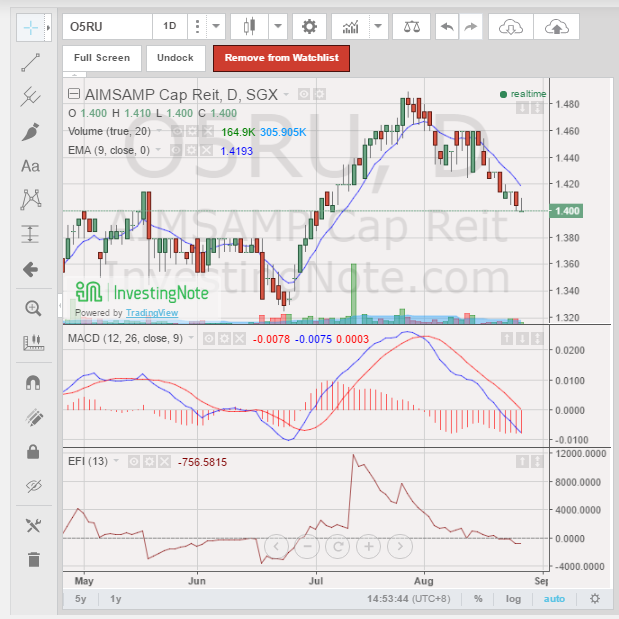
Clicking on it will bring you to the list of indicators available for you to add in. I proceeded to add in MACD, Elders Force index and Moving exponential by clicking on the names. It'll automatically be added to the charts.


Now my charts look like this:


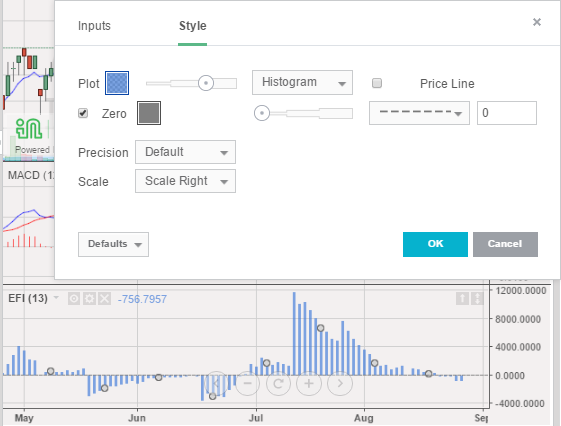
I don't like the Elders Force index (EFI) in a line form. I prefer the histogram format, so I'm going to change it. I mouse my cursor over to the gear symbol just to the right of the word EFI. It's the middle icon. You're going to see the word "Format" appearing. Click on that. You'll see "Inputs" and "Style" menu above.


Play around with the options. I changed the colour of the plot to blue, line to histogram, and thickened the width of the histogram, as shown below:


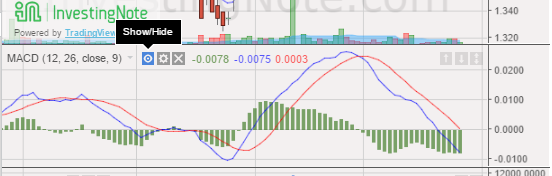
If you're satisfied, you can click OK and it'll be shown on the chart. I did the same format adjustment to MACD too. Let's say you don't want to see the MACD appearing, you can hide it by clicking on the first icon next to the indicator:


You can also shift the order of the indicator up or down. Let's say I want to move my MACD indicator right at the bottom of the chart. I'll press the down button on the top right corner of the indicator box:


Once you've pressed it, the indicator can move up or down according to your liking. You can also draw trendlines, horizontal support, fibo etc by looking at left side of the chart:


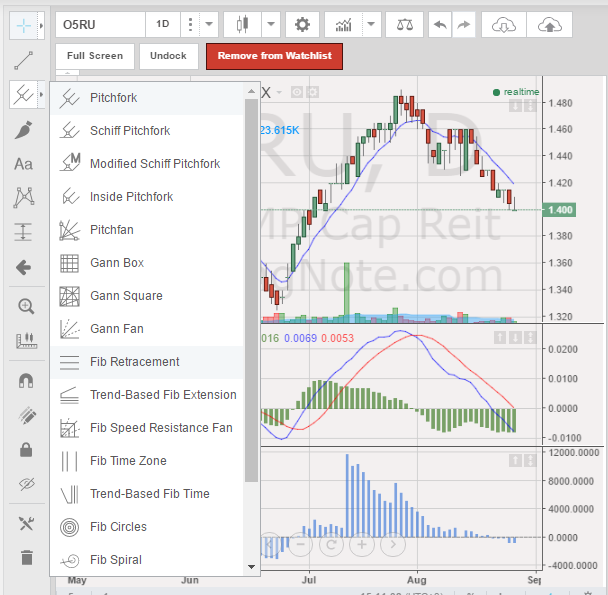
Let's go ahead and choose the fibo retracement lines:


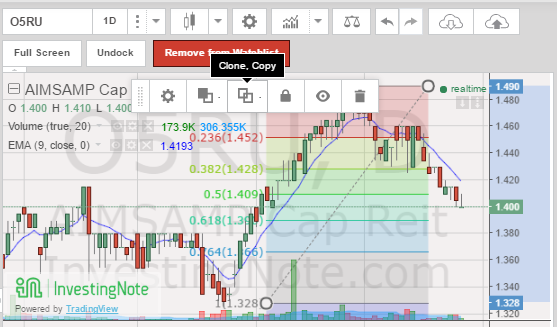
It's the second symbol, click on that small arrow and you'll see a whole host of options available. Let's go ahead and choose Fib retracement and draw it out. You'll see the results below:


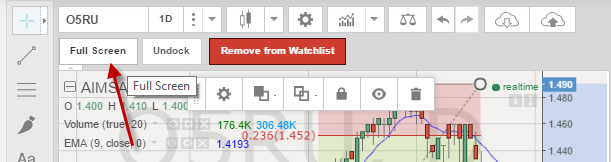
If it's too small and too much things happening on your chart, you can click full screen and blow up the chart to see it clearer:


Okay, here's the important trick. How do you save the nice charts and drawings you've done? There are two ways:

1. Saving individual charts:

Click on the Save chart layout symbol and save everything you're working on for that particular chart. They will ask you to give a chart layout name.


Once you've entered the chart name, you can retrieve it back anytime by pressing the Load chart layout

You can save your work this way.

2. Saving template:

I prefer saving template, so that I can apply this particular set of template (with this set of indicators and format) to different charts. So here's how to do it:

Click on the study template:


You will see the option to "Save study template as". Click on it, give the template a name and you will be able to put this set of layout onto any charts you want easily.


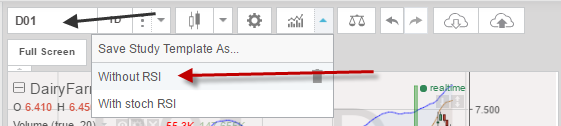
I saved two template (as shown above by the red arrow), the first is "without RSI" and the second is "with stoch RSI".  If I clicked on the template "Without RSI" and click on the box (marked by the black arrow) and type the name of the counter (e.g. SHENG SIONG), I will apply this template onto the chart of Sheng siong.


Of course there are many more functions that I didn't illustrate but I think this is a good starting point to explore the platform yourself.

Friday, August 12, 2016

The difference between preferential offer and rights

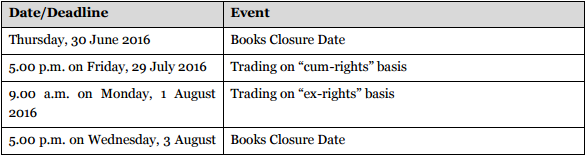
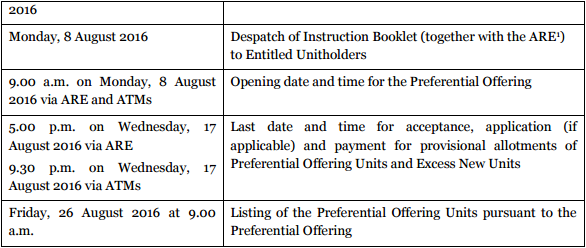
I just received the booklet from Croesus regarding their preferential offer of 10 new units @ 0.797 for every 259 shares owned on ex-offer date of 3rd Aug 2016 that I blogged about here. I initially thought this is like rights exercise, which I'm very familiar with. But on closer inspection, it is not. Let's explore what's the major difference.


I think the most important difference is that rights are usually renounceable. This means that if you do not want to take part in the rights and subscribe to it, you can do so by selling it. If you're a shareholder, you'll be entitled to rights shares. These are called nil paid rights, because you haven't gone down to the ATM to pay the subscription price for it to be converted to ordinary new shares. There's a nil paid rights trading period, about a week or so, where people can buy or sell their nil paid rights. If you do not want to take part in the rights, you can sell the nil paid rights in the market during the nil paid rights trading period, so you're sort of compensated for the eventual dilution in your shareholdings upfront.


So, renonuceable means you can sell/buy and transfer to others, and there'll be a nil paid rights trading period to facilitate this. The nil paid rights counter is usually accompanied by a letter R, so there's no question that this is the rights share you'll be buying or selling.


Preferential offer is non-renounceable. Well, at least the one offered by Croesus is not, so I'm not sure if I can extend it to all other such preferential offerings of other companies. Non-renounceable means you cannot sell/buy and transfer the new units to others. This also means that there will not be a nil paid rights trading period. You either subscribe to your entitlement by going down to the ATM to pay for it (in this case, $0.797 each) or you can walk off. But what you can't do is to sell your nil paid rights away, unlike a proper rights exercise. In other words, you either subscribe or you get diluted because of the injection of new units that you refuse to participate in.


To summarise, in all purpose, a preferential offering is like a rights exercise without the ability to buy/sell your nil paid rights because it's non-renounceable. 

If you really don't want to take part in the preferential offering, I see only a few options available:

1. Sell off the mother shares before the ex-offer date (I did sell off a part as I don't want to be over exposed here). But it's kind of late for Croesus now, since the XO date is over on 3rd Aug.

2. Ignore the entire thing, and let your rights expire without paying the $0.797. This is not a wise thing to do though.

3. Subscribe to the rights by paying $0.797 by 17th Aug 2016 and then sell it on the market when the new units gets listed on 26th Aug 2016. I am even going to apply for excess to see if I can get back cheaper for the holdings that I sold before XO.


I suppose those people who are really forced to put in more capital will be doing number 3. Might expect the Croesus price to drop after 26th August 2016.

Friday, July 29, 2016

The first domino falls

We just heard news of Swiber sudden winding down. DBS is one of the main banks that loans money to Swiber, so their exposure is about 700 million. That's not a lot of loans, relatively speaking. 700 million is about 0.25% of their total outstanding loans in 2015 and it's about 15% of their total 2015 net profit. But they are confident of getting half of it back and after tapping onto their general provision, they are net loss of about 150 million. How much is that? It's about 3.3% of their 2015 net profit.


Is that significant? No, but the trouble is that it might not end there. Most likely, this is just the beginning of the oil and gas sector contagion that will spread eventually to the banks. When Swiber falls, people will be wondering who is the next company to fail. Ezra, ezion, vallianz, swissco and even sembcorp marine are possibly candidates. They might also have inter-related business interest that joins each other like blood brothers and sisters. So if one fails, it might cause a whole domino effect cascading down the entire oil and gas sector in Singapore.


Whoever is lending most aggressively to them will suffer the most. In their heydays, Swiber is a $6 stock and easily one of the most anticipated growth companies here in SGX. Heck, I even traded Swiber before. DBS and OCBC seems to be the more aggressive of the big local 3 banks, UOB being the more conservative one, so it seems. Maybe that's why the share price of the three banks dropped proportionally to the level of loans linked the the troubled oil and gas sector.


I heard news of 98 million shares of Ezra pledged to DBS and another 98 million shares pledged to OCBC as collateral. When the contagion spreads and the share price falls, it will lead to even more selling as nobody wants to be left with a worthless piece of paper as a collateral. We should expect more of such news in the coming months to come.


Is it a good time to scope up bargains in the oil and gas sector? Be greedy when others are fearful and fearful when others are greedy? I think it depends on your skill in navigating the rubbish from the gems. If you understand the sector well and can see which are the companies that can survive and thrive after the crisis blows over, you'll be the biggest winner. But I know I don't know anything about this, hence I will skip it. In the event of a major market sell-down catalyzed by the bankruptcy of the oil and gas companies, I will rather buy those companies that having nothing to do with this sector but nevertheless got their share price marked down severely, than to buy the troubled oil and gas company at a cheap price and hope that they will survive and thrive.


a) Good company, non troubled sector, low price
b) Good company, troubled sector, low price
c) Bad company, troubled sector, low price


Between the a,b and c, I think (a) should be the top most priority. (b) and (c) are the ones that can make you really rich, but do you have the skills to see separate the (c) from the (b)? It's not as if there's only this sector to focus on, so I'll skip it and live with my choices.

Thursday, July 21, 2016

Trying to be SMART on SMRT

Stupidity induced by greed.


That's the only way to describe it. Upon announcement of the offer by Temasek holding for the delisting of SMRT at $1.68, I wanted to arbitrage on any possible price difference between the opening price and the offer price. These are the assumptions I make:

1. There's a dividend of 2.5 cts waiting for me

2. The price that Temasek Holdings offer is too low ball and will be revised upwards


With that, I queued overnight at a limit price of 1.675 and got it this morning at a entry price of 1.665. With that entry price, I will make about 2% after comms and I'm okay with that. It's like a fixed deposit. I was happy for a while until the news kept streaming in that destroyed my underlying assumption.


Firstly, the dividend of 2.5 cts had already been declared and had gone xd on 18th July 2016. So no more dividend and no safety margin for me to fall back on to make this deal work out right.

Secondly, it's not a general offer in the usual delisting lingo but a scheme of agreement. I thought it meant the same but apparently it's not. This 1.68 is the final offer price and if the resolution is not passed, then Temasek holding will not make another offer until 1 year later. And in order for the offer to be passed, at least 50% of the shareholders present in the meeting must vote yes, and they must collectively hold at least 75% of the shares not owned by Temasek holding. And Temasek hold about 54% of the shares.


That means if the offer is passed through, I get $0.015 returns and if I didn't go through, I might potentially lose anything between $0.125 to $0.150. In dollar terms, if it goes through I win $30 (after comms) and if it didn't I lose $500 to $700? The risk reward is so bad that I cut loss at 1.655 and take a loss of about $100 in all.

Stupidity induced by greed.

The good thing in all these is that upon realization of how stupid this deal is, I cut loss immediately and immediately felt much better.

Friday, July 15, 2016

Growing my investment portfolio

There are only two ways in which my portfolio can grow without leverage - the first is to inject it with fresh capital, and the second is to grow it organically from dividends/capital appreciation.

To grow it by injecting fresh capital, it will have to come from savings. And where do savings come from? From work. After subtracting all the necessary deductions, I'm left with 30k to inject into my warchest every year. When my portfolio is small, say about 100k, this addition of 30k per year into my portfolio will increase it by 30%, which is way more than what I think I can grow my portfolio organically. As my portfolio grows bigger in size, there will come a time when the addition of 30k per year will not be significant. 500k portfolio with 30k injection is 6% while a 800k portfolio with 30k injection is just 3.75%.

That's the effect of having a bigger base.


I suppose if I can grow my portfolio at 5% per year, my portfolio has to be more than 600k in order for the addition of 30k fresh capital to be 'insignificant' compared to the portfolio's organic growth. It's a little bit more complicated than that, I know. The fresh capital of 30k that is pumped into the portfolio will generate more dividends, that will result in more savings and thus having more fresh capital to be pumped into it. Let's ignore that fact for now and keep things simple. Whatever extra compounding will offset any losses that will come from time to time in the stock market.

I've a warchest plus portfolio size of 200k right now. To reach 600k with injection of 30k per year, I'll need 14 years to do so. This also means that in the next 14 years or so, it's more important to focus on my job and make sure I can continue to contribute 30k into my portfolio, rather than to depend on my portfolio for organic growth. Eventually, when the size of the portfolio increases to such an extent that the annual 30k increment is no longer significant, then I'll have to be a lot better in my portfolio growth. It's not that I have to choose one or the other, but it's good to know what will contribute to a greater extent to my portfolio growth so that I know what is the most effective way to grow it.

The conclusion is that it's still important to work and earn and save to grow your portfolio. To do that, you need to study to get yourself the required certification to earn a good pay for the greater part of your life, while learning to improve your skills in growing your portfolio that will only kick in towards the later part of your life. Whoever thinks he can skip school and start making big bucks in the stock market when they haven't even stepped into the working world is either delusional or privileged.

I hope it's the latter.

The day SGX stopped trading for 5.5 hrs

On Thurs, 14th July 2016, SGX had to halt trading for all its counters around 1130 am. At first, it's supposed to resume trading at 2pm after lunch, but at 2pm when I was eagerly waiting to see if there's any movement from my brokerage platform, I was disappointed. Nothing moved. Later it was announced that it trading will be resumed at 4pm instead. Yet again, at 4pm, none of the counters moved. The last announcement regarding this screw up was that there won't be any trading for the rest of the day and the market is closed.


I don't think I've seen SGX closed for trading longer than this time round, which lasted about 5.5 hours. It really didn't affected me much, but I can imagine the following groups of people being frustrated with the whole fiasco:


1. Those who naked short in the morning and wanting to close towards market end.

I wonder what will happen to these group of people. Technically it's not their fault to do a naked short since the market is closed so they can't buy back and close their positions even if they wanted to. I wonder how SGX will handle this case.


2. Those who are playing around with Noble rights.

It happened that 14th July is the last day of the nil paid trading rights period, so for those who wanted to sell their nil paid rights without subscribing or wanting to get more nil paid rights, they are prevented from doing so after 1130am. This is resolved when it was announced that the Noble nil paid rights trading period is extended for one more day until Fri. That much was certain and it's easy to solve.

3. Those who are playing around with companies going XD on Fri

That means that Thurs was the last day with the CD status. And since nobody can trade after 1130am, those buyers who wanted to buy to be entitled the upcoming dividends will miss the chance. Or those who want to sell their shares before XD won't be able to do so.

4. Those playing with HSI put/call warrants

HSI market is very much open while STI is closed for the day. This will result in arbitrage situations that may result in gain/loss for people. It's unfair, but I don't think SGX can do anything about it.


I'll be the first to admit that the above 4 groups of people are in the minority. These are generally complex stuff that most people won't even touch at all. If one brokerage firm screws up, we can 'insure' ourselves by having another brokerage platform to trade on. If SGX breaks down, what can we do?

Nothing. Sometimes shit happens and we just have to roll with the punches.

Or, we can really be careful with all the open trading positions we have and limit our exposure. I'm not talking about cut loss or stop losses here. It's just the number of open positions we have. If, for example, Dow jones dropped 10% after we had to stop trading on Thurs, I think the price might open much lower than your stop losses as the price gapped down, which means you will stop your losses lower than what your stop loss limit are. That can be disastrous.

Don't say such things won't happen. I think it'll happen more often when the market is unstable, like in a huge downturn and the volume surged so much that the server can't handle it.

Thursday, July 07, 2016

Who is being speculative?

A value investor, a trader and a gambler goes into a bar. After a drink or two, they started arguing over which of them is speculating in the market.


The value investor says that the other two are not basing their investments on fundamental reasons and treating the buying of their part business ownership like digits, hence the two are speculative.

The traders says that the other two did not consult the technical aspect and the price action of the charts before putting in their money, hence the two are speculative.

The gambler says the other two did not seek insider's news or throng the forums for the hottest rumors, hence they could not possibly know what the BBs are doing without a ear on the ground, hence the two are speculative.

As you can imagine, they couldn't come to a consensus, so they suggested asking the worldly bartender for his opinion on this subject matter.

The bartender says that since all of them would rather spend their time talking about philosophical difference instead of making money like him working on a second job at night, so all of them have no business talking about money, and therefore also investment, and hence all of them are speculative.

Friday, July 01, 2016

Croesus Retail trust preferential offering

Those holding Croesus retail trust needs to fork out money again. This was after their most recent rights back in Oct 2015 which I've blogged about here, here and here. There is now a preferential offering exercise going on, and in all respects, we can treat this as a rights exercise.

Here's the details:


The dilution isn't that much. It's an offer of 10 new shares for every 259 shares held before it goes XR, priced at $0.797 for every new shares. Why 259? I've no idea, must be the doing of their financial wizards. If you own 10,000 shares of Croesus before XR, you'll need to fork out $307.72 to subscribe to the new shares. It's not that much, really.

The price went up to a high of 0.82 today strangely, but perhaps not surprisingly. It wouldn't look too good if the new shares is priced at $0.797 but the share price is trading below that.

I'll be subscribing to it, and applying for excess if available.