Thursday, January 29, 2015

My chin up journey

For the past weeks since the start of the year, you can see 2 persons in the east near to a pull up bar, around 10pm to as late as 11pm. One of them would go near to a bar first, mount it by jumping up and the other would as quickly as possible, grab the ankles and help to assist the person to go up. It'll be 2 sets of 6 assisted chin ups, if they are feeling strong and energetic, or 3 sets of 4 reps if they are not feeling up to it. Always, there'll be rest in between the sets.


Those two persons is me and my wife. For some reason that I'm still trying to figure out, we decided to train to do at least 1 chin up by CNY. Both of us are zero heroes, meaning we can't even do one chin ups. For me, I'm a serial zero hero. At the peak I could do 10+, and that was back in my prime during army days.


During end 2013, I managed to do 3 to 4, so that I could pass the more stringent IPPT before they revamped it all over again. Anyway, I have a lot of experience in going from zero chin ups to 1. The journey from 0 to 1 is immensely harder than from 1 to 2 and from 2 to 3. So a lot of effort had to be done to build up the back muscles and the arms. Esp the back muscles, which is kind of hard to train unless you go to the gym purposefully. For my wife, she never had the experience of doing 1 chin up before, so it's a brand new experience for her.


This is where I want to be


In the past, when I was going from 0 to 1, I was doing all sorts of things except going to the bar to attempt to pull myself up. I would be doing weights, then push ups and dips and those assisted pull up machines found in the gym. The settings of the chin up machine is set so that I can do 10, which means that it's not hard a setting. After training for some time, I would test myself by going to the bar and attempt to do one. A few grunts and a few kicks, I still can't do one. How disappointing, I thought. Didn't I train hard?


If you want to learn how to swim, you can buy the best swimming trunks, the best anti-fog goggles, a nice Speedo swimming cap and even a mp3 player that is water resistance so that you can listen to music while swimming. You can read all about how to do it from books, talk to swimming enthusiasts to ask them to give you some tips and watch youtube videos. But if your feet is not even dipping into the swimming pool, it's not going to help. To learn how to swim, you need to jump into the water. Might not be initially, but eventually you'll need to.


I guess the same lesson applies for my chin ups...if I want to do one chin up, I need to go to the bar and attempt to do it. All other things are peripheral. The most effective way to do it is to attempt to do it. Invariably, you'll encounter problems. Like, I can only do less than half a chin up. Since the back muscles are the ones that do the initial lifting, I concluded that my back muscles are weak. The only way to train is to do more assisted chin ups, until you can do half a chin up (this means that you can lift yourself up to the point where your elbows are about 90 degrees).


And that is where I am right now.


To go further, I need to build up my biceps. That's why I'm doing weights. Out of all books that I read, it's Antifragile by Nassim Nicholas Taleb that I learnt how to build more powerful muscles so that you can lift heavier weights. You just need to take the max weight that you can lift for about 5-6 times, instead of doing multiple times on lighter weights. When I mean 5-6 times, I really mean the last lift you can do is 6. You'll be struggling on the last rep and you possibly can't do anymore after that. The theory is that if you want to lift heavier weights (which is essentially what chin up is about), you need to practice lifter heavier weights. Doing lighter weights multiple times can only make you...lift lighter weights multiple times. So right now for me, it's 8.75 kg for 6 times, 3 sets, with rest in between.


It just takes less than 10 mins to waste my arms totally. On top of this, I'm still doing the die-die-do-12-chins-up-by-any-means exercise with my wife. I tried it yesterday night, and I can barely even do 1/4. It's like that, my muscles are totally wasted. To become stronger, you need to destroy and rebuild. That's how nature works. I just need to supply it with nutrients and water and the rest would take care of itself.
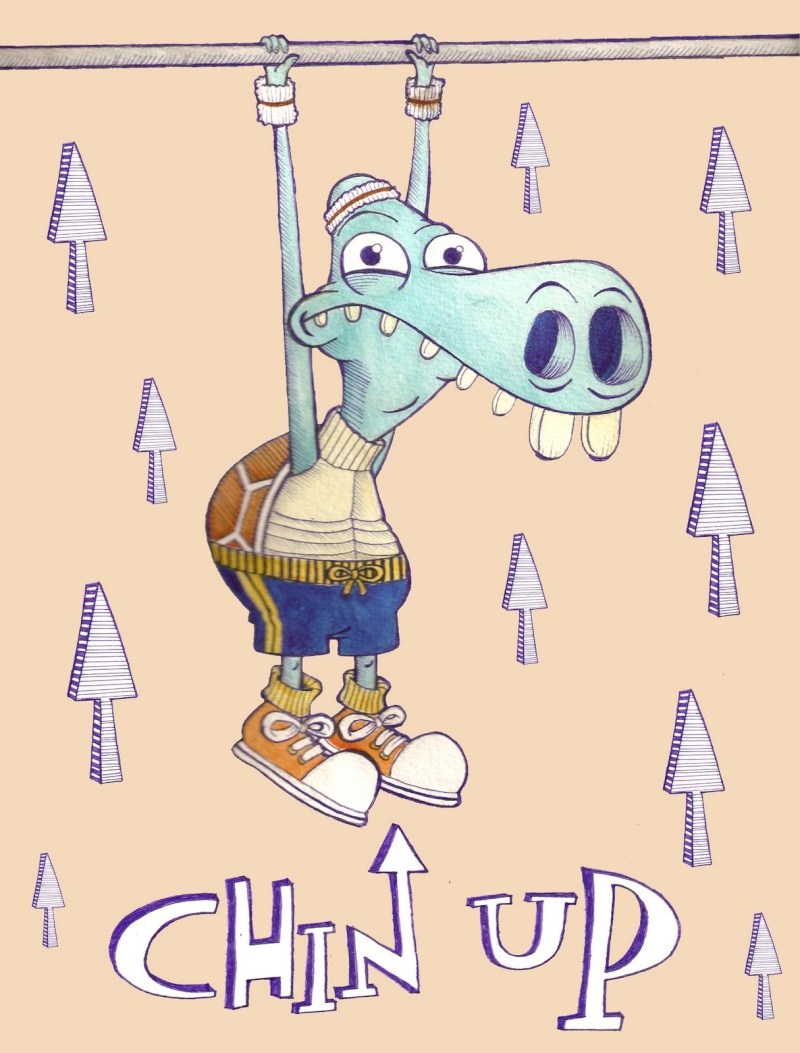

This is where I am now. From Freddy Thorn Illustration

LP the personal trainer? No lah. Knowing me, you know where I'm going to end this post with. Seldom do we see new things, but we consistently find new ways of doing old things. From my chin up journey, you can see a few important points:


1. If you want to do something, go do it. Don't do everything except the things you want to do. I know sometimes we need to psych ourselves to the task. Go do it then, but ultimately remember this, to do chin ups, you need to go to the pull up bar and do chin ups. Any other things are peripheral and at most plays a supporting role. Do the thing that you fear the most.


2. Push your limits to grow. Doing the same thing that you can already do multiple times is a different sort of training if your goal is to do even bigger things. Of course you'll suck at it initially, but that's the only way to push yourself out of your comfort zone.


3. To grow anew, you need to destroy. By going about your old ways yet hoping to see new results is insane and delusional. If you don't remove the old, it's hard to find new space to fit in the new.

Sunday, January 25, 2015

LP's asset portfolio

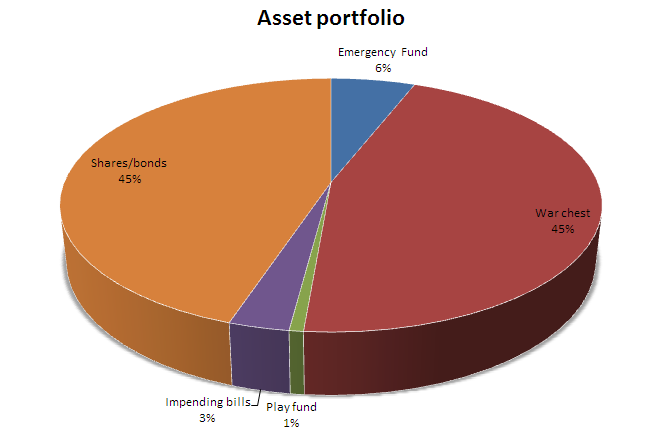
I'm inspired by Derek when he shared his asset portfolio here. Like him, I'm not going to include the asset value of my residential property, nor my CPF or insurance surrender value. No point including property, as it easily overshadow all the other assets, distorting the percentage. Besides, I don't really see my residential property as an asset. Personally I would include the surrender value of my insurance, or decided to keep it as consistently as possible to Derek's definitions.


Shares/bonds

This includes the marked to market value of the shares held since the beginning of Jan 2015. Includes all the SGX shares, US and HK portfolio

War chest

I'm almost 50% cash. Some of this are locked in fixed deposit, and none of my warchest comes from CPF. But my war chest is fluid. Every month, it'll increase by a few k and decrease by a few k when I enter a new position. All my monthly savings are actually going into my warchest. Looking at both Derek and my own's ratio of warchest to invested amount, it's kind of hard for the market to crash LOL

Emergency fund

I only have about 3 months emergency fund. This amount of money is mainly held in my SCB account, which is also jointly held by my wife, though only my part of the money is represented here. This account is used to pay for any joint expenses, like housing mortgage, household repair etc. This account serves as my bill paying account for all joint expenses. I'll always keep a fixed amount inside and we do periodically top up to ensure there's enough to pay 3 months worth of household expenses. I know my segregation of emergency funds and bill paying account is not clear, but this is because I had funds for all sorts of things and not a lot of things will catch me by surprise. Kids, don't follow me!

Impending bills

Just for the purpose of this representation, I pulled out my budget for all my big insurance bills that I have to pay for this year and put it under this category. I pay annually, so this is thes  single most biggest expense that I have to cater for. The rest are easily settled by either the cashflow from my pay or from the emergency fund/bill paying SCB account that I jointly shared with my wife.

Play fund

Play fund is not a physical account but an accounting account. I put aside a fixed budget every month, for frivolous things like gadgets, games, books etc. As long as it's not a necessity and not for work but for leisure, it'll fall into this account. If I have to travel overseas for holidays, it'll fall under this account too.


I don't have a daily expense account. There's a budget for food and restaurant, so these are properly accounted for and there's no need for a physical account to set aside money for it. Most if not all of it is funded by my pay that comes in weekly or bimonthly. In months where it's drier, I might have to tap into my emergency fund, but I seldom do that. So far, I've only done it once or twice in the driest year of my entire career. Actually my wife can also act as my emergency fund. When she's hitting a dry spot, I'll spend more money on food for her. Vice versa, when I'm having drier months, she'll treat me more often.


My blogging fund comes from my play account. But for some things that need to be paid for, I did a cash call from the cbox community in 2013. They kindly raised enough to make it last till 2019! You can read about my own kickstarter campaign here.


There you go!


Saturday, January 24, 2015

POSB did it again!

Not long after the 1.5%, 6 months (cap of 20k) exercise that I blogged about here, they came up with another bigger amount and longer tenure.


This current one is 1.88% pa for 12 months, with a minimum amount of $1k to a max of $1 million. In addition, there's also a $88 ang bao for the first 10,000 customers. The details are all found in their website here. The full terms and conditions is found here.


To qualify, you need:

1. Register by 28th Feb 2015 (inclusive of date) here.
2. Complete the top up by 28th Feb 2015 (min $1k, in multiples of 1k up to a max of 1 mil)
3. Maintain top up amount for 12 months.


As usual, they wanted fresh funds, so just do the necessary FAST credit transfer between banks. The cash gift will be deposited to the account registered by 31st Jan 2016. As for the first 10,000 customers who will receive additional $88, they will get their ang bao in their accounts by 31st March 2015.


I won't be participating in this one. I don't think I'll have enough liquidity to do this. I still have 20k stuck in the previous exercise by POSB until July. Good for those who are holding emergency cash. This is really a good deal and possibly the highest fixed deposit rate offered by any banks here. Awaiting other competitors to top this :)

Thursday, January 22, 2015

My spending threshold

I always believe we should grow bigger than our problems. It's the way to make a big problem smaller, simply because you've grown bigger in size. I've written about these topics at length here:

1. Of dragons and men
2. The relative size of your problems
3. Outgrow your problems
4. Growing bigger than your problems


In the past, I used to fret about $10 meals. I only had very little pocket money and that's all the budget I had which also includes transport, stationeries and other expenses. That happens all the way up to university where I had to plan my meals properly. If I had too many restaurant meals (even those around $10 to $15), I'll have to scrimp and save the rest of the pocket money to last the entire month. So, during that time, my threshold was $10.


As I work and earn my own keep, that gradually increased to about $25. I fondly remembered the times when I was dating, and I had to spend money on movies, restaurants and cafes...It's not so easy for me. The average spending would amount to maybe $30 per outing, more if you have to pay for the other party. That's a lot of money for me, considering I only have $120 to 150 per month (if I remembered correctly) during my university days. So, during that time, my threshold was $30.


You find that at different periods of your life, this threshold where you have to think hard about spending will increase. From fretting about $10 for a meal alone, to $30 for a day's outing, to $60 for a all-boys drinking session, to $150+ for a good smartphone, to $16k downpayment for a car, to $40k COV and on and on. I think after spending thousands for my wedding and renovation, I don't really worry over things below $100 any more. It's like once you've completed Expert level in a game, playing Beginner level is just a walk in the park.


I think in the past, I was very concerned about the absolute price of things because my budget simply doesn't allow that to happen. Gradually, I realised that shopping for things that are value-for-money is more worth while in the long run. That took a longer time than I feel is right. I used to buy cheaper razor blades, cheaper shoes, clothes but they are really of lower quality. It turns out that I have to spend more time and effort buying newer cheaper and lower quality stuff. That changed when I bought my first pair of good Clarke shoes.


Compared to the usual Bata type (less than $30), Clarke shoes are easily $100 to $150 over. I remembered I took a long time debating over it, trying to work out the sums. My threshold back then was still around $100. Eventually I got won over and that changed the perspective that I see things. Things that I want and will use for a long time, I don't mind spending a lot of money on them. Things that I don't want, even if you give it to me for free, I also won't want it. It's simply eliminating wastage.


That eventually spilled over to food as well. In the past, I would gladly spend less on food so that I can conserve my budget. I would never order fruits...a platter of it cost more than what I spend on a proper meal - a meal that consists mainly of carbo but is filling. Drinks? No way, I would never order them since ordering one soft drink can be half the cost of my meal. I'm glad those days are over. The health effects of such actions cannot be belittled. But that was in the past when money was tighter than it was now. I'm glad I lived through it though I hope I'll never go back to those 'dark days' again. And who I am now is shaped by the experience that I had in the past, so no regrets over those. I'll probably do the same thing again if I can go back time.


Back to the topic of growing yourself to make your problems smaller. My stance is this...you can only save so much, and there's only so much cost to cut. Once you've done what you can to cut your expenses without feeling unbalanced, the only way to grow is to increase your earnings. Once you start finding ways to increase your income, you find that you're not just surviving. You're living a proper and balanced life. Maybe even thriving. What's balanced is subjective, but I think if you feel shortchanged by your own circumstances, that's not balanced anymore. I'm not a hermit and I need to spend money, and so I do. I shouldn't have to feel guilty over this.


In the midst of saving up and planning for the future, remember to live a little right now. While it's important to hedge for a long life, it's equally important to hedge against an unexpectedly short life. Financial freedom is a mindset where money is no longer a concern. A situation where you have too much money and you're still concerned with money is as bad as a situation where you have too little money and you're equally concerned over it.


Okay lah, maybe the former is a little better.


Saturday, January 17, 2015

MRT reserved seats

Tan plugged in his earphones, trying hard to ignore the stares of other passengers. He tried to close his eyes, pretending to sleep, so as to shield himself from the knives those eyes are throwing at him. In front of him, a pregnant lady stands close to him. He heard someone muttering, but it's drowned out by the music blasting from the earphones. Tan is, afterall, sitting on the reserved seat of the MRT train. It is Tuesday 8:32 am. To be inside an MRT at this time and day is not exactly an enviable position to be in.

Tan pretended to sleep but he failed miserably. Just before his consciousness quietly slipped away to blissful sleep, his last thoughts lingered on the gambling debt that he's trying to resolve. Tan had to work in a fast food chain after school on weekdays and take up tuition assignment over the weekends. He wondered how long he can do this before his body withers away. But no, such thoughts do his family no good at all.


Siew Hua had always been a gambler. She had promised her fiancé that she would quit when they got married. She did keep to her promise. If her love for gambling is great, the love for her husband is greater. She eventually had two children - a boy first and then a girl - and all was well. Until the sudden death of Siew Hua's husband, that is. Then, everything came crumbling down. When her greatest love was forcefully taken from her, she went back to her second love. Tan is Siew Hua's son.

                                                             *******************
                                                           
Min told her family she's pregnant. She's only 20 and still studying. Thoughts of abortion sprang to her mind but it was her brother's insistence that she chose to keep it eventually. And so everyone in the family accepted the new circumstances, especially her brother.

Min had a checkup with the doctor at KK hospital on Tuesday, so she's taking the MRT with her brother. She's into the 4th month, so it's quite a visible bump. A kind gentleman in his 40s, sitting on the reserved seat gave up the seat to her, which she mouthed out the words "thank you" and smiled. After a few minutes, she saw her brother leaning heavily on the handrails, his head between his bent elbows. His knuckles are all white, as if he's holding the handrails for dear life. Occasionally, his legs will buckle, jolting him out of his sleepiness. Her heart softens.

"Kor kor, come. You sit. You're more tired than me"

Min guided her brother down to the seat and stood next to him. Her brother reluctantly but gratefully sank into the seat. He offered to take Min's haversack and put it gently on his lap, before proceeding to take out his earphones.

"Kor kor, still got time. The appointment is at 9 am. You sleep, I'll wake you up when we're near".

But he was already dozing off.

Friday, January 16, 2015

Start with the man in the mirror

I started ‘playing’ the market with no skills, dabbled in warrants simply because they are cheap and that I have limited amount of cash and patience. I've no idea how warrant works but that doesn't stop me from buying and selling them, often several times in a day to the tune of 15 to 20k per trade to scalp the minute changes. It’s a wonder that I didn't catastrophically burst my bank account. I've heard of people making a lot of sense talking about support and resistance and how the Bollinger squeeze makes a good long or how a RSI and macd-histogram shows that this and that is a good short. I also wanted to be knowledgeable and trade using technical analysis.


So I learn more about the technical side of the market. Charts, with support trend-line and horizontal supports and resistance are drawn.  I learned that the trend is your friend and 61.8% and 38.2% are the golden numbers in the Fibonacci retracement, also found in nature. I need to be careful of divergence when the MACD lines makes a lower low while the price heads up to a higher high. I read Jesse Livermore, Guppy, Martin Pring and all the other greats to learn their trades. But I lost more money. I thought reading these chart wizards makes me good. I understand the theory behind the books I read but I couldn't apply it profitably enough. Then I heard about the people who talks about the market being a weighing machine in the long run and a voting machine in the short run. We’re actually not buying counters but being a part owner in a great business. I also wanted to be knowledgeable and invest like a value investor and analysis a company fundamentally.


So I read up about financial accounting and know the how the cash flow affects the balance sheet and how the accrual accounting makes a profit looks nicer than it actually is. I learnt that we can find out how leveraged a company is by looking at the assets/equity ratio or see how times their current assets can cover their interest payments. I learnt that a PE of 10 means that you've bought 10 years worth of earnings in today’s price. I read that ROE is not a Japanese delicacy that I like to eat but is an important ratio to measure how good a company is at allocating their resources to make a profit. So is the ROA, enterprise value/EBITDA, Price to FCF and many more. Then I was caught in the s-chips like Longcheer and China milk. They have fantastic numbers, amazing value, rich in cash, low in debts and best of all – undervalued based on the whole matrix of ratios applied to them. As the prices of Longcheer dropped, I put in more and more, because if the price of the company is attractive before I bought, it’s going to be even better as the price drop further. I ended up cutting losses. Then I heard someone mentioned that it’s not the individual assets that are important, it’s the portfolio allocation that plays the most important part in your portfolio’s return. I also wanted to be knowledgeable and be a good manager of money.


So I learnt about the efficient market theory and how it’s useless to time the market. Nobody beats the market in the long run, so there’s no point trying to beat the market. Higher risk gives higher returns so if I have different classes of assets at different risk levels and therefore, different returns, it’s possible to find the efficient frontier whereby I have the most diversified asset allocation with the greatest returns for the lowest possible risk. I know about the Greeks, which are really not people from Greece but letters to represent different things. Specifically the beta, which represents how volatile a security is relative to the market in general. Then, there are the delta, vega, theta, gamma and all the fun stuff in options, which are also found in warrants. I didn't know that I dabbled in financial alchemy when I first started! Then I read more about bonds, because it’s a good alternative to the more volatile stocks and are supposedly inversely related to stocks. But bonds are a debt instrument, and when a company issues a bond, they are essentially borrowing money from the investors. Thankfully I know that little bit about accounting in my ‘fundamental analysis phase’. That helped tremendously when I also ventured into preference shares, which have features of both bonds and shares.  Hey, suddenly a lot of things gets tied in from all the loose ends and things seem less muddy now.


I stopped wanting to go for the next hottest quick fix to investments. I stopped wanting to be knowledgeable. I stopped trying for the next cure before I even figured out why the previous method doesn't work. I stopped escaping and finding the next scapegoat to blame for not making a killing in the market. I stopped looking at the stars and the Bradley’s turn dates to decide when the next major top and bottoms are. I stopped looking for the next guru to follow and for them to instruct me what to do.


Instead, I looked deeper in myself and looked hard at the man in the mirror. I have met the enemy, and the enemy is me.

Tuesday, January 13, 2015

How to beat OCBC 360's return

To the above blog title, I should add, 'in a relatively safe manner'. Risk and returns are directly related, so if you want to beat OCBC 360's 3.05% pa returns, you can always invest in the stock market with the potential risk of having capital losses. Here, I'm going to try beating the 3.05% returns, as well as equal it in terms of the risk of losing your capital. Possible? Read on.


We all know what's so great about OCBC 360 account.  If you hit certain milestone conditions, you get stepped up interest ranging from 0.05% to 1.05%, 2.05% and finally a max of 3.05%. There's some disadvantages to this though:

1. For those who can't change their salary code, you will have to forsake the 1% interest for crediting your salary every month

2. For those who can't pay more than $400 on credit card, you will forsake another 1% interest. I'm sure everyone can hit the $400, but it's how much trouble you want to do to change your status quo.

3. This is up to a max of $50k only.


So, what do I propose?


There's a listed retail bond traded over at sgx with the counter name CapMallA3.8%b220112. Details of the bond are as follows:


1. Coupon issuance dates: Twice a year, Jan and July
2. Underlying: Capitalmall asia
3. Maturity date:  First optional redemption 12-Jan-2017 and every year thereafter till 12-Jan-2022 (7 year from now),
4. Face yield: 3.8% every year (1.9% every half year) before 12-Jan-17, thereafter 4.50%
5. Number of payout till maturity: 13
6. Price traded now: $1.028 vs par value of $1.000
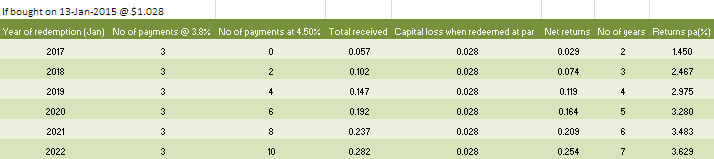
7. Based on the year of redemption, the non-compounded returns are indicated in the table:


(Thanks to SRSI for the gentle reminder of the possibility of early redemption! I forgot about it!)

So to beat the OCBC 360 rate, we have to bet that the bond is not redeemed at least till 2020, which is 5 years from now. If that happens, we get a annualised non-compounded return of 3.28% if we bought it at today's price of $1.028. If the bond is not redeemed earlier, they will have to mature on Jan 2022, which is 7 year from now. That will get you an annualised return of 3.63% pa.

A few risks needs to be highlighted now:

1. What's the chance of them redeeming the bond?

Capitalmalls asia had the bond set up in Jan 2012. For lack of a better gauge for borrowing costs for companies from banks, I used 3 mths SIBOR to see the risk premium of them borrowing money from investors at 3.8% (which is the face value of the bond). The 3 mths SIBOR back then was 0.39%. So to entice investors to invest, they are giving a premium of 3.41% (3.8-0.39) pa.

There is a step up component of this particular bond. If they did not redeem on 12-Jan-2017 and every year thereafter (until 2022), they will have to pay a higher interest of 4.50% instead of 3.80%, which is an increase of 0.7%. Assuming everything else stays the same, if Capitalmalls asia still has a risk premium of 3.41%, the 3mths SIBOR have to be 1.09% (4.5-3.41) by 2017.

If 3-mth SIBOR is higher than 1.09% by 2017, then the borrowing cost for Capitaland from banks will also rise, making them less likely to redeem back the bond since they have a low cost of borrowing through the bonds. The last time 3 mth SIBOR is 1% or more is back in 2009 before the financial crisis. The current rate now is 0.46% and is very likely to hit 1% in 1 or 2 years time, with the US Fed Reserve set to raise the rates by Q2 or Q3 2015.

I take it that therefore it's unlikely for them to redeem back the bond in 2017. But it's a very simplistic way to see this, I realised. Capitalmalls asia might, for example, not require the debts at all and choose to redeem it.


2. The quality and safety of the bond is as good as the underlying

Capitalsmall Asia is under the big umbrella of Capitaland. To me, a bond by Capitaland family is as good as gold, and as safe as fixed deposit, maybe just a little riskier. The returns stated are non-compounded. To raise it further, you can invest the money received for a higher returns. And technically, I should use XIRR since the cashflow are pretty consistent and even, but I didn't. You can try it out if you wish.


Oh, the caveat...you must hold on to the bond until the underlying redeems it at par value. If you do that, you can forget about looking at the market price of the traded bond. If you wish to sell it earlier before it is redeemed, then you have to take what the market gives you. From what I observed so far over 1 yr, the price is pretty stable, whatever the market is doing. Even if the market price drops below your buy price, it's not a concern IF you are holding the bond till maturity.


There you go.

Thursday, January 08, 2015

The story of Old Cody


Near a mountain, far far inland
lived a happy, but a lonely man.
He is not rich; doesn't own a car,
shiny rubies, nor smoke a cigar.
What is his name? If you care to ask.
He’s Old Cody – farming is his task.


Monday six morn, he asked rich Richard,
if he is free, to view his orchard.
Shaking his head, poor Richard replies,
"I am not free, to see the sunrise,
so Old Cody, I bid you goodbye".
Old Cody shrugged, at least he did try.


On Tuesday twelve, he asked proud Peter,
"Come see my vine, where grapes are sweeter!"
Shaking his head, rude Peter exclaimed,
"Oh that won't do, or I'll be ashamed
if I'm seen with, a mere Old Cody!"
Scratching his head, "Why be so snobby?"


On Friday five, silly Sally came
Her petite frame, but with eyes of flame.
"Pretty orchard, with beautiful grapes,
Can I come see?", she stood mouth agape.
Standing there still, shook Old Cody's head
Hands on his hips, this is what he said:


"Oh that won't do, or I'll be ashamed
if I'm seen with, a girl of your name.
I am not free, to see the sunrise,
in the orchard," he cries and he lies.
With that he slams, the giant oak door.
Behind he shouts, "Oh come here no more!"


As he walked off, Old Cody's heart froze
"How I had erred, I've made a new low!
Judging Sally, before I knew her,
is exactly, how I was withered!"
Without more words, he sprang to the door.
There lie Sally, staring at the floor.


"Oh I'm sorry! What a fool I am!
Dismissing you, to hell I be damn!
Holding her hands, they walked to his fields,
to the golden, cheerful daffodils.
Or is it Rose, Jasmine or Aster?
Hmm, don't matter; form's not a factor.

Friday, January 02, 2015

(Some of) My 2014 expenditures

Finally after using YNAB for 1.5 yrs, I have a full set of expenditure data from Jan 2014 to Dec 2014. This is a software that enables me to track my spending to a great degree of accuracy. No faulty mental accounting nor mistakes here, so it's as good as it gets.


These are some of my expenditures:

1. Food/restaurants : $424 per month, or $14 per day ($4 per day for restaurant, $10 per day for foodcourt/hawker/coffee shops)
2. Utilities bill: $50 per month for my share, so it's about $100 household (subsidies included)
3. Clothes/shoes: $30 per month
4. Gifts/ang bao for others: $126 per month
5. Mobile phone: $42 per month
6. Household internet: $45 per month
7. Personal insurance (whole, term, disability, mortgage, h&s rider) :$470 per month
8. Car related expenses (monthly installment, fuel, road tax, maintenance all in): $345 per month


I realised that my own spending is very little by comparison. All the things that I do for entertainment throughout the year (exclude food), which includes shopping for clothes, shoes, movies, books, gadgets, works out to be $53 per month. Maybe it's a bit unfair, because usually my wife buys the stuff I want and I do the same for hers. So I should include gifts/ang bao, totaling about $180/mth. That's more like it.


I also realised that I need to set up a household fund. I spent $430 on house related stuff, like replacing my letterbox lock, aircon maintenance, little repairs here and there. I already budget that in for year 2015. Should have less surprises there for this year. I also set up a car repair fund after I realised that I spent $540 in 2014 for car related repairs and maintenance. I guess after about 2-3 yrs worth of hard data, it'll be harder to surprise me for unexpected expenditures.


The year 2014 is a fantastic work year for me. It's the highest income I've ever earned in 10 years and to put it in context, 2013 was the worst I had in 10 yrs. Maybe it sort of even out. I saved about 63% of my income, which is something I don't expect to repeat year after year. This is partly because of the increased income rather than the decrease of any expenditures. My expenditures are fairly constant, especially after I settled the first two bombs of my life (wedding and housing/renovation).


For self reference, I begin Jan 2015 with a net worth of $229,285 (not inclusive of housing loans and current valuation of house but net of other debts). My half of the portion of housing debt is $217,123, so my net worth is $12,162. It'll be a fantastic year if I can end 2015 with a net worth of $72,000, which is essentially a savings of $60k, or $5k per month.


Let's go.

Tuesday, December 30, 2014

LP minibonds 20k

I was setting up the stage for LP mini bond for my parents' friend for 20k, so naturally I've to do some homework. I started by looking up the yields for the different bonds and preference shares listed at SGX.


Do take note that the yields I calculate is based on my own way stated here. It basically included all the coupon/dividends payment until the first date of maturity, subtracted from the guaranteed capital loss from buying the bonds/pref shares above par.


Retail bonds

1. Genting SP5.125% Perp - 7.8 yrs to maturity (YTM) - 4.47% pa
2. Olam6.75%b180129 US$ - 3.1 YTM - 5.70% pa (USD)
3. LTA n4.17%160510 10k - 1.4 YTM - 1.59% pa
4. CapmallA3.8%b220112 - 7.0 YTM - 3.09% pa
5. SIA 2.15%b150930 - 0.8 YTM - 2.19%pa

Pref shares

1. OCC5.1% NCPS 100 - 3.7 YTM - 3.76% pa
2, CityDev NCCPS - perp
3. DBS Bk 4.7% NCPS 100 - 5.9 YTM - 3.67% pa
4. Hyflux 6% CPS 10 - 3.3 YTM - 4.98% pa
5. OCBC Bk4.2% NCPS - perp
6. OCC 3.93% NCPS 10 - 0.2% YTM - 8.97% pa


I noticed a few things:

1. The price of most pref shares either dropped or stayed the same. The drop is understandable, because the numbers of payments before maturity decreases, hence the price will have to drop so that the yield remained good enough to entice people to buy. But I noticed that the price drops lesser decrease in future payments, meaning that the yield actually drops a little.

In other words, I'll have a better deal buying earlier than later, despite the drop in market price of these bonds/pref shares.


2. OCC 3.93% is selling at par value right now. It'll mature on 20th Mar 2015 (optional), so there's still one more payment left. They pay twice every year, on Mar and Sept so one more payment means 1.965% returns with zero capital loss (since you're buying on par). Only commissions. Since 20th Mar is an optional redemption date, they can choose not to redeem, and therefore pay a 1.85% + 3mSOR quarterly starting on 20th Mar, Jun, Sep and Dec. The 3m SOR is about 0.42% now, expected to rise further, so minimally after 20th Mar (if they choose not to redeem), you can expect to get at least 2.27% pa, split into 4 times a year.

To sum up, it's 1.965% this year. If they redeem, they redeem at par, so net net just lose commission for buying. If they didn't redeem back, at least 2.27% pa every quarter from 20th Mar. But it might be some time before they will redeem back, so the market price might keep dropping, which is still fine as long as you don't sell it. Your capital is just locked up.


Good deal? I leave it to you.


In the end, I decided on 2 holdings for the 20k portfolio. Too little to diversify.

1. Capmalla3.8% b220112 (47.0 % of portfolio)
2. DBS Bk 4.7% NCPS 100 (52.9 % of portfolio)

The earliest maturity date is 5.9 yrs, and the guaranteed capital loss because of buying above par will be $900. My plan for this minibond is as usual, pay 2% pa and build up the cash reserves for that guaranteed loss. Thereafter, pay a higher % pa but always reserve some cash in case the person wants to redeem back and the market price is lower than par. This is no longer a capital guaranteed bond, but I'll still treat it as such. The only difference is that now, I didn't say it's capital guaranteed, haha


A big difference it'll make ;)

Monday, December 29, 2014

Reviewing my resolutions

It's interesting to see other bloggers starting to put out their battle plans for 2015 with their great goals and targets. It's just not me though, not because I don't believe in goals and planning but I think it shouldn't be dictated by the number of revolutions the earth rotates about its axis and around the sun. I think it should be set when one is motivated and the circumstances forces a change in plans :) For me, if you feel all motivated to begin the new year at the end of the current year, go ahead and plan it out. I just feel I'm still in a holiday mood now and I'm not so ready to begin my year, haha :)


I looked back at my past post to see if I did any resolutions (and more importantly, whether I kept to it or not). I realised that while I do set long term targets, I seldom have any new year resolutions. The resolutions, if they are present, is to give myself some leeway to break my long term targets. Blur? Let me explain.


I've some perennial goals and are always present. It's always in my mind. Here's a few:


1. Save 50k per year. While the figure might change pending on circumstances, the goal is still intact, plus minus a few k. For example, my savings target this year is just 30-40k, that's because my outlook for this year isn't that great. Fortunately, I was proved wrong, lol

2. Have a fitness program. This goes on and off, mostly depending on my schedule. At least I worked hard for about a quarter to half a year (before my peak season starts), thereafter my fitness schedule goes to the dumps as work picks up. But at least my diet is the thing that can stay constant. I'm eating better food and less economic rice. While economic rice saves me money, it is very oily, salty and the food is not always the freshest nor the best parts. Tze char seems to be the costlier choice, but better in quality and I can always ask them to use less oil and salt (which they do).

3. Read 52 books a year. Always. No excuses.


These are always going to be my resolutions, so much so that they are the default mode. There's no need to dedicate one day, every year, to write them out again unless one day they proved to be suitably non-challenging anymore. From what I can see, it's not going to be any easier but harder to achieve them. So as long as they challenge me, it'll be there. Here, take a look at some of my 'resolutions' that I've written in the past:


1. Repugnant resolution (2011)

2. Resolutions: To spend more money (2011)

2. New year resolutions redefined (2010)


Firstly, that's not a lot of resolutions written since I started the blog in 2006! Secondly, my resolutions, as mentioned earlier, is all about breaking my perennial goals. Spend more money, work less, enjoy life more, eat more nonsense foods, experience more life, all written in a wishy-washy, messy manner! That's in direct contrast to my clinical and surgical goals - a fixed number by a certain fixed date. Interesting isn't it? Maybe even a bit schizophrenic.


No, I'm not crazy! Okay, maybe just a little.

But that's okay. I'm a complex person and I reserve the rights to be both superbly rational in one minute and a crazily emotional beast the next minute. As long as I'm happy, that's the most important condition.


Wishing everyone a fulfilling, healthy and prosperous 2015 :)


Thursday, December 25, 2014

LP bonds 2014 part 2

Here's part 1. There's an important part that I need to remind myself. Most of the holdings are preference shares and bonds listed in SGX. Here are the holdings:


1. OCBC Bk 4.2% NCPS (perpetual, maybe be redeemed after Jul 2013)
2. OCC 5.1% NCPS 100 (maturity 3.7 yrs)
3. DBS Bk 4.7% NCPS 100 (maturity 5.9 yrs)
4. CapMallA3.8%b220112 (maturity 7.1 yrs)
5. CapMallTrb3.08%210220 (maturity 6 yrs)


Since I bought the bonds/pref shares above par value, there will be a guaranteed capital loss if the issuer wants to redeem back the bonds/shares. That's why I need to keep a part of the cash distributed aside for such an eventuality and not distribute it to my parents 100%. How much do I need to keep for LP bonds?


1. LP bond 50k

Guaranteed capital loss from buying above par: $2,588
Cash from holdings per year: $2,144
Cash distributed to parents per year : $1,000
Cash left: $1,144


Balance sheet wise, I will have enough to pay off the guaranteed capital loss from buying the holdings above par value. I just need about 2.5 yrs and I can accumulate enough to pay off this guarantee capital loss. The only problem here is that the issuer might take it back at different times, especially for the OCBC Bk 4.2% NCPS, which is perpetual and which means they can take back it anytime after Jul 2013. If that's the case, I will have to cough out money and also lose this stream of cash. Double whammy. 


In other words, in the next 2.5 yrs, I need to conserve and pay as minimally to my parents as possible. Once I accumulated enough to pay off that $2,588 from buying above par, I'll be safe. Then I can distribute more out to them. Without caring for the perpetual OCBC Bk 4.2%, the shortest time frame I need to accumulate is 3.7 yrs from now. Any other holdings will mature longer than 3.7 yrs (again, except for the ocbc perps). Furthermore, except the two capmall bonds, not all will mature at the time duration stated above. It's just the date at which the issuer can start redeeming back. 


For a good pref shares or bond, you wish they will keep delaying their redemption. The right time to hold such bonds/pref shares is forever.


2. LP bond 60k

Guaranteed capital loss from buying above par: $2,527
Cash from holdings per year: $2,462.40
Cash distributed to parents per year : $1,200
Cash left: $1,262.40


For this, I will need just 2 yrs to accumulate enough to pay off the capital loss from buying above par, should the issuer redeem back the holdings. The good thing is that once I stashed enough money to make sure I have enough to break even without losing any capital, I can distribute out more. How much more? Both LP bonds will be able to distribute 100% cash received from holdings without worrying about the rise or fall of the market price of the holdings, and by extension, the interest rate environment as long as I hold the bond till maturity. That is the single most important part of this strategy, something that bond fund cannot provide me. 


LP bond 50k will thus pay out 4.29% (2144/50000) and LP bond 60k will pay out 4.10% (2462.4/60000). The first bond pays out slightly more because it is started in Jan while the second one starts off in Feb. That one month means I missed out on one payment cycle for one of the bonds. And the mix of holdings are also a little different. Hey, it's still more than doubled of what is giving out now, at 2% pa. 4%+ per annum will be great.


Either that will happen, or the interest rates rise tremendously within 2 to 3 yrs time so much so that the fixed deposit rate will increase beyond 4+%. If that unlikely scenario takes place, then I will close off both funds, take the loss in capital, distribute back to my parents and ask them to invest in fixed deposit. Lagi better, no longer am I the guarantor! Let others take the hit haha :)

Wednesday, December 24, 2014

LP bonds 2014 results

This is the time to distribute coupons for my LP bonds back to my parents. For those who are scratching their heads, here's the prequel for this post.


There are two tranches for the bond:

1. LP bond 50k

Starting capital: 50k
Invested capital (inclusive of comms): $49,773.02
Cash accumulated from payout of holdings: $2,144
Paper gain (loss) from drop in market price of holdings: ($748.02)
Total portfolio gain (loss): $1,395.98
Total portfolio % changes: 2.79%

Going forward, since it's a capital guaranteed bond (by me, of course), I need to retain a certain amount of cash in case my parents need to liquidate it. I'll pay 70% of the net portfolio gain or 2% of 50k (which is $1000), whichever is higher. That should be the policy going forward.

70% of $1,395.98 is $977.19, which is lower than $1000, so I'll just pay out $1k for this tranche.


2. LP bond 60k

Starting capital: 60k
Invested capital (inclusive of comms): $59,699.66
Cash accumulated from payout of holdings: $2184.94
Paper gain (loss) from drop in market price of holdings: ($498.66)
Total portfolio gain (loss) : $1,686.28
Total portfolio % change: 2.81%

Cash payout so far: $600

For this bond, it's a semi-annual payout. I've already distributed $600 in the middle of this year. Going by the same policy of 70% of net portfolio gain or 2% of 60k ($1.2k), whichever is higher,

70% of $1,686.28 = $1,180.40, which is lesser than $1200, so I'll just pay out $1.2k. However, I've already distributed $600 earlier, so this time, it's only another $600.


It's not easy to run a fund that promises a guaranteed payout of a fixed percentage and yet there's capital guaranteed. The returns are not fantastic, but I must remember what the risk profile of my parents are and what are their goals. They initially just wanted to get into a fixed deposit, which pays about 1.2% or 1.3% at that time but I thought they are not doing their money justice. Hence, I offered to do this for them. Hence my benchmark should be the long term fixed deposit rate. As long as I can do better than the fixed deposit rate, I should run it for them, if not, I might as well cash out, have less trouble and not bounded by my own guarantee!


They are still interested to invest with me (another 100k plus minus!), but too bad, closed shop liao. LP guaranteed bonds is officially over! If they want to invest with me, it'll be LP equity fund LOL! Equity funds means bo bao capital, and if the market tanks, they will bear the loss. I need to highlight that to them haha :) For LP bonds, it's low guaranteed returns and capital guaranteed, maybe for LP equity funds, it'll be medium guaranteed returns but no capital guaranteed...see how lah


Friday, December 19, 2014

To see the world through the eyes of a newbie

The moment you don't need to excel is precisely the moment you start excelling.


I knew that from my past experience as a air rifle shooter. When you take part in competition, you should be in a meditative state of mind. You have to know that you're competing, yet you cannot think you're competing. If you cannot treat the competition like it's just normal, routine practice, you cannot perform well. It's just that when you treat the competition like it's oh-so-important, you start to act and react different. Your heart starts to race when you get a bulls-eye and sink when you miss your shots. These emotional roller coaster creates a cascading avalanche of emotions on subsequent shots, and before you know it, you're a totally different person. Very different when you're doing your usual practice. In usual practice, you're just mindlessly shooting pellets after pellets with no regards to the actual score. You might even be having fun.


I think this can apply to a lot of situation.


1. SMOL had a fantastic year 2014 in his trading performance, and some well-meaning readers suggested increasing his capital size so that the profits will multiply, I'm very glad that he chose not do it. When you're trading with $1000, it's going to be very different trading with $10,000. Until you know how to trade with $2000, then $3000 and progressively increase your trading capital, you're going to act differently and react differently. And that makes all the difference between a 6 bagger or a 6 begger trading performance. I think it's because he don't have to trade for a living, that's why he can trade for a living.


2. There's an examination in university days that I remembered clearly. It's a statistics paper. Not a big deal, it's just mathematics and in my engineering course, there's plenty of those that I have to take up. However, I wanted to do very well for that paper (I'm not sure why). Outside the examination hall, before we all went in to our respective seats, I did something that I never did during all my papers - I started revising. I don't know why I did that, maybe it's because everyone around me all studying (but that never bothered me in the past...) or maybe I really really wanted to do very well for that paper. When I went in and sat down in my seat, I suddenly had a panic attack. Seemingly simple things suddenly became complicated to me and I couldn't do them! I skipped to the next and the next and the next, scribbling out some semblance of an answer but I just couldn't do anything. At that point in time, my mind started painting scenario of me failing the statistics module, having to repeat it again and the next semester I'll have an even heavier workload and I'll fail them all. A small oh-shit moment creates the next bigger oh-shit moment.

That's when I realise I'm panicking. Damn.

They say recognizing we have a problem is the first step towards solving it. I closed the question booklet, and sit back on my chair, took out my water bottle and sipped a mouthful. I just chill-laxed for about half an hour doing nothing except seeing people around me scribbling like crazy. I started humming some music mentally. No point panicking, I thought. What's the big deal? At most just fail loh. When I felt relaxed enough, with a comfortable tune in my mind (it's Madonna's Rain, if you must know), I started attempting my paper. The first question that stumped me suddenly looks do-able. I gave it my best shot, thinking that there's no harm trying. I'm going to fail anyway, so I might as well try. As I did more and more questions, I realised that there's nothing complex about these questions at all! Every question that I did boosted my confidence and I remembered that I thought to myself, I might have a chance after all.

When the results are out, I didn't do that badly. I got an A in spite of my panic attack. But I gave myself an A+ distinction for the great recovery in the middle of the examinations. And I never read my notes ever again before I entered the examination hall. I pay more attention to my mental state from then on. When I don't mind failing, I don't need to fail anymore.


The point here isn't to encourage everyone to accept failure so that you won't fail. It's just that I know that I've performance anxiety. It's part and parcel of having experienced success for a big part of my life. The more you achieve success, the more you have to lose when you experience failure. You're afraid that your excellent track record is broken. You're afraid that others will brand you as a has-been from now on. It's not a particularly strong feeling in me, but I know it's there, hiding deep inside my psyche. It's just whether I'm honest enough to recognise that.


I need to overcome this irritating behaviour, where I stop trying things after I've accomplished what I perceived as my greatest work, my magnum opus. I give a few examples:


1. After doing some digital painting, I never did it again. Deep down, I'm really afraid I couldn't do another one like these again.


But when I started doing this, I've totally ZERO expectations. I didn't expect it to turn out great. And the irony is when it did turn out great, I stopped being great. I simply stopped trying because deep down, I'm afraid I won't be able to produce such great works again.


2. My poem/short stories. Again, I thought this is my magnum opus. I just couldn't bring myself to pen another one. Perhaps it's also the same reason...when I achieved some success, I suddenly become afraid to try like a newbie.


So, I really understand what the first sentence of this blog article means. The moment you don't need to excel is precisely the moment you start excelling. May I change certain words to crystallise the gist of the sentence? The moment you stop trying is precisely the moment you stop excelling.


So try, try and try. Never ever let success stop you from trying. This is a mental limitation that I need to overcome - how to see the world in the eyes of a newbie when you're no longer a newbie. As a full time tutor, this is perhaps one of the greatest ability I can ever master. If you've taught a subject for 10 yrs, you're not going to teach it the same way when you're in year 1. It's just different. You take little things for granted. You take student's confusion with great impatience. After you taught them once, you expect them to know it immediately. But that's not how people learned. You no longer teach as if you're a newbie tutor.


If I ever did that, that'll be the end of me. Stay humble, stay foolish and stay newbie...even when you're not.

Thursday, December 18, 2014

2014 in the eyes of the books I've read

I blogged about my book challenge here. Essentially, it's for me to read 1 book per week, for 52 weeks, summing up to a grand total of 52 books per year. The last time I succeeded in this challenge was way back in 2008 where I managed 55 books that year. Most of the time, it's just 30 odd books, which is about 1 book every 4 days.


I also shared that the main purpose of this challenge is not to squeeze as many books as possible. It's really to ensure that I've a commitment to make to myself to read widely and never give up on books that are unappetizing for the first few chapters. There are many gems that only reveal themselves perhaps half way through the book, so by throwing away books without completing them, it seems I'm not giving them a fair shot at impressing me.


Below are the list of books that I've read in 2014, arranged in chronological order (book 1 is the first book I've read, book 52 is the last) As usual, I'll highlight a few books that I think are really the power-reads for the year 2014.

1) The Alchemist - Paulo Coelho                              
2) How to fail at almost everything and still win big - Scott Adams                            
3) E-Squared: 9 DIY energy experiements that prove your thoughts create reality - Pam Grout
4) Quiet: The power of introverts - Susan Cain  
               
5) Outliers - Malcom Gladwell                  
6) The Wolf of wall street - Jordan Belfort                          
7) How to read a book - Mortimer J. Adler, Charles Van Doren                  
8) The Android's Dream - John Scalzi                    
9) Predictably Irrational - Dan Ariely                      
10) Beyond Outrage - Robert B. Reich                  
11) Redshirts – John Scalzi                          
12) Superpowers - David J. Schwartz                    
13) Luka and the Fire of Life - Salman Rushdie                  
14) An unknown world - Jacob Needleman                        
15) Good Omens - Terry Pratchett & Neil Gailman                          
16) Reaper Man - Terry Pratchett                          
17) An illustrated book of bad arguments - Ali Almossawi                            
18) The world until yesterday - Jared Diamond                
19) The art of thinking clearly - Rolf Dobelli                        
20) The Forgotten Highlander - Alistair Urquhart                              
21) The Victorian Internet - Tom Standage                        
22) David and Goliath - Malcolm Gladwell                          
23) The book thief - Mark Zusak                              
24) The Companions - The Sundering, Book 1                    
25) The Godborn: The Sundering, Book 2                            
26) All Bad things - Stephen Blackmoore                              
27) The Earth Transformed - Mike Stackpole & Nathan Long                      
28) City of screams - James Rollins                          
29) The Blood Gospel - James Rollins & Rebecca Cantrell                              
30) I will teach you to be rich - Ramit Sethi                          
31) The science of getting rich - Wallace D. Wattles                        
32) The total money makeover - Dave Ramsey                
33) The Rosie Project - Graeme C. Simsion                        
34) Damned - Chuck Palaniuk                  
35) Man vs Markets - Paddy Hirsch                        
36) The Richest Woman in America - Janet Wallach                        
37) Gone fishing with Buffett - SeanSeah                            
38) The Big Short - Michael Lewis                            
39) 30 second economics - Donald Marron                        
40) Buddha - Deepak Chopra                    
41) Apocalypse - John Michael Greer                    
42) What your school never taught you about money - Dennis Ng                          
43) The romantic economist - William Nicolson                
44) The secret lives of litterbugs - M.A.C. Farrant                            
45) The Rules of Money - Richard Templar                          
46) Allison Hewitt is trapped - Madeleine Roux                
47) Flash Boys - Michael Lewis                  
48) Secrets of the millionaire investors - Adam Khoo/Conrad Alvin Lim                  
49) Belle - Paula Byrne                
50) Everything is bullshit: Priceonomics authors              
51) Millionaire teacher - Andrew Hallam                              
52) Boomerang - Michael Lewis   


This year I included a few fiction in the list as well. They are just too good to not recommend. Not in any order of importance,


I'm sure everyone heard of Dilbert, but not everyone knows the story of Scott Adams, the creator of that comic strip. What I found good about this book is the idea of creating a system to ensure that you win rather than setting goals. Setting goals means that you're going to fail everyday until you hit the set target, but having a system means that you're always working towards an end game. That's the most important take away for me from this book. It's really an easy read because he's quite a good writer. Funny too :)


I can safely say this book transformed my life! In books like "The secret" or even Antony Robbin's books, you can see them talking about how you can shape your reality by believing in something so much that it becomes reality. Well, this book shows you in 9 steps how to do so. I like it that they start off with small experiments (that you should do!) and gradually get bigger and grander. I was always very amazed when the thought that I wrote out, with all the dateline for it to appear, really does appear, but you have to train your mind to clarify your thoughts so that the right frequency gets sent out. For the first few experiments, I wrote down that I wanted to see a yellow bird, within 24 hours. I'm thinking of a particular yellow bird that flies around my HDB precinct and you can spot them occasionally. In the first 23 hours, there's nothing. But in the last hour, I really saw a yellow bird. Not the real bird, but Birdie from Macdonald's! They are promoting their last toy or something for their happy meal and I saw the yellow bird from the newspaper! I know, it's not the same as what I had in mind, but that hooked me. Progressively, I set higher and harder challenges for the universe to help me, like having xyz students, having xyz income, having xyz savings. All of them exceeded beyond my expectations so much that this year is the best year of my entire 10 yrs of working in my line. I came from a pretty bad position in 2013, so this seriously kickstarted my drive and reset my thinking. I couldn't recommend this book enough and I will read it every now and then to reinforce what I've learnt. If you want to read this, you must try out the activities!


I'm an introvert and will always be. From this book, I learnt a lot about people of my type. Introvert doesn't mean that we're not sociable or shy, it just means that we derive energy from introspection and reflection, unlike being an extrovert where they derive their energy from interacting and mingling with people. This book also highlight how an introvert can use his/her own personality to make a difference to the world where extroverts rule. For one thing, being an introvert makes me a better listener. Perhaps that's why I blog - it's to release my inner voice and have a space to air my thoughts in an otherwise crowded extrovert world.


When I like an author, I'll try to read all his/her series. This will give me a broad range of his works and to better appreciate any relationship between the books. John Scalzi is one of these authors that I constantly go back to for sci-fi reads. I've read a lot of sci-fi books and I'm really really wow-ed by the plot. It's like those Ender's game moments where the world you no longer knew the world around you. It's that mind blowing. Not for everyone - only for sci-fi fans.


This is highly academic and not very readable, and it definitely benefited from my practice of not stopping until I finish a book from cover to cover. The book is actually very enlightening because it shows how traditional society differs from our modern society. Things that you took for granted considered weird just 20-30 yrs ago. For example, in certain parts of the world, kids from traditional society are treated exactly as adults, except they are discounted because of their smaller size. They are allowed to play with knives or practically wander around exposing themselves to all kinds of dangers. Why? They are treated as adults, so they are responsible for their own actions. It's not surprise for the authors to see young kids with burnt marks and scars from their mistakes. Another example is how traditional society handles conflict. If a person makes a mistake, his entire tribe and family and immediate friends are liable to pay for it. We're talking about 30-50 people and above here! They have different ways of resolving conflicts but the ultimate aim is to ensure that they can continue living in harmony. Now, that's something we can all learn from.


6) The Rosie Project - Graeme C. Simsion


I read this book because it's in a book list by Bill Gates. Actually, it's recommended to him by his wife. I really find this book humorous and engaging..it's literally a page turner for me. Good books have this ability to transcend your reality and make you see the world in a different person in a different role. Rosie project did exactly that and lets you see the world in the eyes of a person with Asperger syndrome. Just trust me. Read this book if you have to read one fiction this year, and you won't regret it.


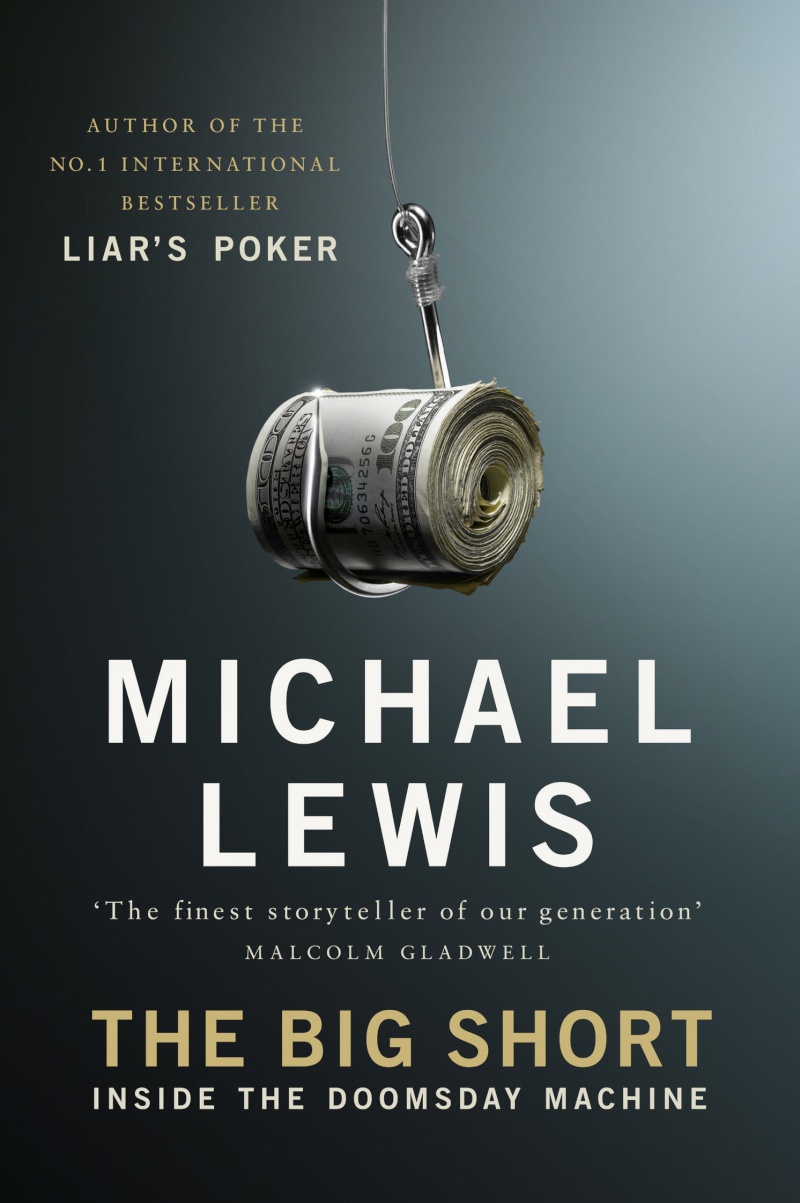
7) The big shot, Flash boys, Boomerang - Michael Lewis


Michael Lewis. Ever since Liar's Poker, I was hooked by his style. He has this ability to explain seemingly complicated things into something easily accessible, and best of all, in a humorous way. The big shot is about the subprime and how it came about. It's a riveting read. I didn't know I can be excited about reading CDO, subprime, mortgage dicing and slicing, but I did. Flash boys is about HFT - or high frequency trading - on how a fraction of a second is so important that people are willing to pay tremendous amount of money to screw other people. Lastly, Boomerang is about the author going to different financial whacked country, like Iceland, Greece and Ireland, to find out about the 'national character' of their people, in order to understand why people do what they do when they have a godzillian amount of money flowing into their pockets. Same crisis, but each country reacted in different ways because of this difference in their national character. I realised I love reading history, specifically the history of financial disasters. If you love it too, you must read Michael Lewis's books. It's really very accessible.


There you go! This year, I've a hard time compiling the list of books that I want to recommend to readers. It's because almost all the books are so good. Special mentions goes to Malcom Gladwell's Outliers and David & Goliath. I also didn't include Janet Wallach's The richest woman in America, which is about Hetty Green, the witch of Wall street. I'm very fascinated with historical figures especially when they have something to do with finance. Sean Seah's Gone fishing with Buffett and Dennis Ng's What you school never taught you about Money are also good reads since it's one of those rare books that deals with local finance. 

Tuesday, December 16, 2014

My offensive and defensive strategies

I wrote about my dilemma regarding whether to pay down my HDB loans or use the excess money for investment. That was back in Nov 2013 and more than a year had since passed. Back then, I really put in an extra 24k to do partial repayment for my HDB loans, and it shaved off 2.5 yrs off my 30 yrs loan.


One year later, I still don't know if I did the right decision. The dilemma is always the same: given a sum of money, is it better to use it pay down the 2.6% mortgage loan or invest in the market to get a yield of more than 2.6%? The decision is complicated by factors such as:

1. Certainty of interest payable on money borrowed vs uncertainty of returns in the market

2. Property insurance bought in the event that either owners hit death or TPD

3. The liquidity of the money invested in the market vs doing a partial capital repayment


In the end I opted for a balanced solution, meaning that I will save a portion for investment and save a portion to make partial capital repayment for my HDB loans. This will avoid the two extreme end game scenario of being asset rich but cash poor (if I use my savings to pay off HDB loans early) and paying excessive interest by dragging the loan period to the maximum (if I invest my savings totally). Both are not ideal outcomes for me, so I would avoid both.


This year, I'm more slanted towards investing my savings in the market. Value is emerging in the stock markets, and so I would keep a larger part of my savings liquid to take opportunities. I made a proposal to my wife to see if she can part with 6k (12k in total) to make partial capital repayments. If we can keep at this rate for every year, we'll be out of debt in 14.2 yrs. This is opposed to not doing any repayments, and letting the loan drag for 24.4 yrs. 6k per person per year seems like a reasonable amount to be able to continue for the long term (at least 10 over years!), and with that we can save about 70k off the total payment for our flat.


I did a comparison by doing several amount of repayment, ranging from 6k all the way to 24k annually. The table shows the results obtained. I tried putting in half yearly too, which means say instead of putting in 24k per year in one shot, I put in 2 injections every half a year of 12k each. Interestingly, not much difference, so I dropped that plan.


24k per year (12k per person per year) is too insane. I can do it for extended period but I'm quite sure my wife would be complaining. If I save 50k per year, 12k would be roughly 25%, so it might be a tad too much. The consensus so far is 12k or 6k per person per year, roughly 10% of my savings of 50k. Like the government, I'll have to adjust this percentage on a yearly basis, seek the shareholder's vote (aka wife's consent) and roll out the plan.


This year, I seem to have a lot of bright ideas to manage my personal finance, like setting up a emergency fund of funds in CPF by doing voluntary contribution and building a base of 240k so that I can generate enough yield to cover my mortgage loan of 1k, It seems like I'm a headless chicken running around in all different directions, don't you think?


But I have my financial freedom plan! On one hand, I'll build up a capital base of 240k. Grow big enough to make my problems smaller. At the same time, I'll reduce my debts by making capital repayments. That's my 'offensive' strategy. My 'defensive' strategy is to lock up enough funds in my CPF OA by doing voluntary contribution, so that I can depend on it in the event that I cannot work for prolonged period of time. A back of the envelope calculation means I've to put 6k per year to make partial repayments (I'll make an effort to do it annually), another 6 to 12k to put into CPF OA (entirely optional, depends on circumstances), so in total about 12k to 18k out of my savings will be channelled into my strategies. And the good thing is that I reserve the rights to change my opinion anytime haha! I'll tweak to my heart's delight every year based on the circumstances. That will give me the leeway to evolve my financial plans together with me.


Here's the summary of the 'budget' needed to run these 'programs':

1. HDB capital repayment plan (intermediate priority)

Short summary: Pay extra $ on top of mortgage payable to reduce interest paid for flat
End point: Be debt free in 14.2 yrs
Amt needed per year: 6k
Expected project duration: 14.2 yrs

2.  Build up of capital for 1k/mth dividend plan (highest priority)

Short summary: Build up a base of 240k (shortfall 100k), invest at >5%
End point: 1k per month dividends based on 5% returns
Amt needed per year to fund: 30k to 50k
Expected project duration: 2-3 yrs

3. Emergency fund of funds (lowest priority)

Short summary: Do voluntary contribution, build up OA acct to contain 1 yr of full monthly mortgage (2k)
End point: Have >24k in OA account
Amt needed per year: 6k to 12k (depending on earnings and tax reliefs obtained)
Expected project duration: 1 to 5 yrs


That's why I need to save money!! 3 programs and I need the budget to run them! Somewhere down the line, the 3 programs will overlap and I will (likely) change my plan again. Paying off my HDB loans will require me to have less money in my emergency fund of funds, then I can use the money to build up my capital of passive income, which will lead me to have more money to pay off my housing loans and have more emergency funds etc etc.


We'll see :) I think my plan for the next 3-5 yrs are crystallising nicely. I'll just need time and effort to carry it through then.


1) Updates of goals on 8th Nov 2016 here


My offensive and defensive strategies

I wrote about my dilemma regarding whether to pay down my HDB loans or use the excess money for investment. That was back in Nov 2013 and more than a year had since passed. Back then, I really put in an extra 24k to do partial repayment for my HDB loans, and it shaved off 2.5 yrs off my 30 yrs loan.


One year later, I still don't know if I did the right decision. The dilemma is always the same: given a sum of money, is it better to use it pay down the 2.6% mortgage loan or invest in the market to get a yield of more than 2.6%? The decision is complicated by factors such as:

1. Certainty of interest payable on money borrowed vs uncertainty of returns in the market

2. Property insurance bought in the event that either owners hit death or TPD

3. The liquidity of the money invested in the market vs doing a partial capital repayment


In the end I opted for a balanced solution, meaning that I will save a portion for investment and save a portion to make partial capital repayment for my HDB loans. This will avoid the two extreme end game scenario of being asset rich but cash poor (if I use my savings to pay off HDB loans early) and paying excessive interest by dragging the loan period to the maximum (if I invest my savings totally). Both are not ideal outcomes for me, so I would avoid both.


This year, I'm more slanted towards investing my savings in the market. Value is emerging in the stock markets, and so I would keep a larger part of my savings liquid to take opportunities. I made a proposal to my wife to see if she can part with 6k (12k in total) to make partial capital repayments. If we can keep at this rate for every year, we'll be out of debt in 14.2 yrs. This is opposed to not doing any repayments, and letting the loan drag for 24.4 yrs. 6k per person per year seems like a reasonable amount to be able to continue for the long term (at least 10 over years!), and with that we can save about 70k off the total payment for our flat.


I did a comparison by doing several amount of repayment, ranging from 6k all the way to 24k annually. The table shows the results obtained. I tried putting in half yearly too, which means say instead of putting in 24k per year in one shot, I put in 2 injections every half a year of 12k each. Interestingly, not much difference, so I dropped that plan.


24k per year (12k per person per year) is too insane. I can do it for extended period but I'm quite sure my wife would be complaining. If I save 50k per year, 12k would be roughly 25%, so it might be a tad too much. The consensus so far is 12k or 6k per person per year, roughly 10% of my savings of 50k. Like the government, I'll have to adjust this percentage on a yearly basis, seek the shareholder's vote (aka wife's consent) and roll out the plan.


This year, I seem to have a lot of bright ideas to manage my personal finance, like setting up a emergency fund of funds in CPF by doing voluntary contribution and building a base of 240k so that I can generate enough yield to cover my mortgage loan of 1k, It seems like I'm a headless chicken running around in all different directions, don't you think?


But I have my financial freedom plan! On one hand, I'll build up a capital base of 240k. Grow big enough to make my problems smaller. At the same time, I'll reduce my debts by making capital repayments. That's my 'offensive' strategy. My 'defensive' strategy is to lock up enough funds in my CPF OA by doing voluntary contribution, so that I can depend on it in the event that I cannot work for prolonged period of time. A back of the envelope calculation means I've to put 6k per year to make partial repayments (I'll make an effort to do it annually), another 6 to 12k to put into CPF OA (entirely optional, depends on circumstances), so in total about 12k to 18k out of my savings will be channelled into my strategies. And the good thing is that I reserve the rights to change my opinion anytime haha! I'll tweak to my heart's delight every year based on the circumstances. That will give me the leeway to evolve my financial plans together with me.


Here's the summary of the 'budget' needed to run these 'programs':

1. HDB capital repayment plan (intermediate priority)

Short summary: Pay extra $ on top of mortgage payable to reduce interest paid for flat
End point: Be debt free in 14.2 yrs
Amt needed per year: 6k
Expected project duration: 14.2 yrs

2.  Build up of capital for 1k/mth dividend plan (highest priority)

Short summary: Build up a base of 240k (shortfall 100k), invest at >5%
End point: 1k per month dividends based on 5% returns
Amt needed per year to fund: 30k to 50k
Expected project duration: 2-3 yrs

3. Emergency fund of funds (lowest priority)

Short summary: Do voluntary contribution, build up OA acct to contain 1 yr of full monthly mortgage (2k)
End point: Have >24k in OA account
Amt needed per year: 6k to 12k (depending on earnings and tax reliefs obtained)
Expected project duration: 1 to 5 yrs


That's why I need to save money!! 3 programs and I need the budget to run them! Somewhere down the line, the 3 programs will overlap and I will (likely) change my plan again. Paying off my HDB loans will require me to have less money in my emergency fund of funds, then I can use the money to build up my capital of passive income, which will lead me to have more money to pay off my housing loans and have more emergency funds etc etc.


We'll see :) I think my plan for the next 3-5 yrs are crystallising nicely. I'll just need time and effort to carry it through then.


1) Updates of goals on 8th Nov 2017 here