Tuesday, February 09, 2021

The 3 ways to Financial Freedom (Trilogy part 3)

 Fully expecting 

another knock on the head,

I shut my eyes, 

and slowly opened them in dread.

The old man seems older, 

he took a deep breath,  

gave me an unnerving stare, 

to try to freeze me to death.

"I'm going to show you the last way

to be financially free,

if this doesn't suit you, 

pack your things and leave."


"If you decide to choose 

the powerful Wizard's way, 

you will need to study 

until your hair starts to grey.

You will learn to read, to research, 

using old charts and tomes

in order to investigate anomalies

as astutely as Sherlock Holmes.

You will learn to manage money, 

and possess a mastery of your mind,

and cultivate an investing method 

that will be polished till steel fine."


"There are three Circles of power 

that an aspiring wizard must learn,

the First Circle is of Method - 

"How", "What", "When" he must yearn.

When honed to near perfection, 

it gives the Wizard an edge

to slice, to dice, and to push 

his opponents right off the ledge.

The Second Circle is of Money - 

essentially it is portfolio defence.

To manage risk or diversify, 

to ensure you don't lose your sense."


"The Third Circle is of Mind - 

the most important of the Circles.

With this last mastery, 

you can clear all investing hurdles.

A good Wizard is cool, 

especially when the heat is on.

The mastery of his emotions

makes him inert like Argon.

He's greedy in the face of fear, 

afraid when the rest are blissful.

A Wizard thinks and acts alone, 

yet somehow finds it cheerful."


"All Wizards are drawn to a field,

and have an area of speciality,

could be stocks, forex or crypto, 

bonds, metals, and property.

Actually, in the entire universe 

there are two branches of wizardry.

The first branch is the Chartist - 

a master of charts and all its trickery.

The second branch is the Investor - 

like Buffett, Dalio and all they represent

Matters not which branch in the end, 

if your annual returns exceed ten per cent.


"A Wizard is ultimately

a master of compounding,

conjuring returns 

in a rate that is astounding.

Twelve per cent returns 

with half a million dough,

in six years will turn to a million, 

and that's still considered slow.

By the harnessing and control

of his immense investing power, 

a Wizard wins the rat's race 

by this innate superpower."


And with this our story

has come to an end. 

So which of the three paths 

will you choose, my friend?

In truth, you don't even need

to pick just one path. 

Mastering two out of three, 

you'll definitely hit home-run.

So there you are, these secrets, 

I'm sure you will need'em

in your long arduous journey

of achieving financial freedom.


The 3 ways to Financial Freedom (Trilogy part 2)

But how can I choose which path

until I know much more?

Oh please, enlightened one -

do teach me, my mentor! 

The sage looked up at me 

and this is what he said,

"Those who choose the Second path

this road he will tread,

He lives the life of a Shaman 

who is an excellent rainmaker. 

A Shaman always finds a way, 

that clever money-maker" 


"A Shaman can invite a parrot

to grant the gift of the gab,

to charm his way around you

to make you pay for his tab.

By making an origami fold, 

he turns it into a spider 

that can spin the most intricate web 

for his network to grow wider.

By tapping on his special bond

with animals of Mother Nature,

a Shaman uses his druidic power

to call a bonded creature."


"After the summoning smoke settles, 

out comes a poisonous adder,

that can aid its bonded master

in the climbing of career ladder,

or a brightly feathered toucan

who just loves eating pecan,

that specialises in business ventures

to create a source of income. 

The way of the Shaman 

is to bring in so much dough,

that he doesn't have to try

to keep his expenses low."


"By boosting his total income,

and earning more than his peers,

he can save more in a year, 

what others must do in years.

Shamans can have two options:

First to climb the career ladder

by invoking the special talent

of his summoned death adder.

Second to call a toucan 

to build a business empire,

that rains a constant income 

to lift his networth higher."


"Savings is what remains of income

after subtracting what you've spent.

While the philosophy of the Monk

is to live on just one cent,

the way of the Shaman 

is to earn all that he can, 

because being a hermit or a caveman 

is never his game plan.

As long as he doesn't do silly things,

and keeps his spending in check,

the Shaman will win the rat's race 

by the power of his paycheck."


"So young one, what do you think?

Do the Shaman's path call on you?"

I can feel his attention all on me.

Let me think first....... mmm....hmm....ewe

I don't think I'm a Shaman,

never had a gilded tongue.

So many animals tagging along, 

Gosh, I don't want to step on dung.

Honestly, I don't mean to complain,

but being a shaman sounds so meh,

perhaps you can aid me once more

and show me the Wizard's way?


Sunday, February 07, 2021

The 3 ways to Financial Freedom (Trilogy part 1)

I heard of a sage 

who lives up the highland,

located in an old and hidden,

largely forgotten island.

I trekked all the way 

right up to his doorsteps,

to ask the wise man 

the secrets of his success,

and what ways there are 

to be financially free

so that when I'm working, 

I don't scream like a banshee.


After ten minutes 

(it could have been twenty),

he broke into a smile

that meant aplenty.

"Three ways there are

 to be free financially. 

The First is a Monk - 

the disciple of frugality. 

The Second is a Shaman - 

master rainmaker. 

The Third, a Wizard - 

investing kingmaker"


I'm not sure what's a monk 

(I mean... I do know).

Will I have to live

in a temple in Guangzhou?

Can I have a wife? 

Can I still eat at Tex-Mex?

Oh...no no no no no, 

does it mean I've to give up sex?

Before I could voice-out 

more concerns about being a monk,

there's a knock on my head, 

like I'm being hit by a trunk.


The wise sage continued, 

albeit a little angry,

"You can still have a wife, 

continue your hanky panky.

You need the eyes of a hawk, 

to track your own expenses,

and the immense strength of a bear

to slash spendings that dull your senses.

Eventually, you'll find felicity 

by basking in simplicity,

purging the toxicity

of living in complexity."


"The way of the Monk

is to keep his expenses low,

and not to compare income 

with people like John Doe.

By choosing instead to spend 

on things that truly matter,

he deftly side-steps to avoid

becoming a source of flatter.

Striving to keep his ego 

firmly on the ground,

he wins the rat's race

by simply sitting around."


"If you don't have the quiet temperament

of the frugal and disciplined Monk,

you like to party, to dance 

and imbibe like a wasted drunk,

then this kind of simple life

is really not meant for you, 

hence we shall take our leave 

and bid this path adieu.

The way of the Shaman

and the Wizard lies ahead.

Now of the two pathways,

which one will you tread?"


Wednesday, February 03, 2021

Book recommendations from year 2020

Year 2020 is the year of the books for me. I read voraciously because I can't go to malls and I'm 'stuck' at home most of the time. But I'm secretly happy because that's exactly what I want to do most of the time - just blanket myself up, put a book on my lap, a pillow behind my back and read myself to sleep.


I read a total of 59 books, way exceeding my target of 52 books a year. I know, I have no life. Since I have the time, I also wrote down short summaries for all the books read. There are some worthy books have a much lengthier summary for my own records and learning purpose. 


In descending order of books read, here's the list:


59) The psychology of money - Morgan Housel

58) The almanack of Naval Ravikant

57) Network Effect - Martha Wells

56) Home: Habitat, Range, Niche, Territory - Martha Wells

55) Exit strategy - Martha Wells

54) Rogue Protocol - Martha Wells

53) Artificial condition - Martha Wells

52) All systems red - Martha Wells

51) Manners begin at breakfast - Marie Chantal

50) Kappa quartet - Daryl Yam

49) X-men: days of future past - Alex Irvine

48) Lee Kuan Yew - Graham Allison/Robert D. Blackwell/Ali Wyne

47) Memoirs of an infantry officer - Siegfried Sassoon

46) Trollhunters - Guillermo Del Toro / Daniel Kraus

45) Too much and never enough - Mary L. Trump

44) Hidden girl - Ken Liu

43) The wandering Earth - Liu Cixin

42) Supernova Era - Liu Cixin

41) The weight of memories - Liu Cixin

40) Of ants and dinosaurs - Liu Cixin

39) Die with Zero - Bill Perkins

38) Beacon 23 - Hugh Howey

37) Hard choices - Sudhir Thomas Vadaketh

36) Ultralearning - Scott Young

35) Opposite of Always - Justin A. Reynolds

34) Hard at work - Gerad Sasges

33) Tripping over the truth - Travis Christofferson

32) Goodbye, Things - Fumio Sasaki

31) Waste tide - Chen Qiufan

30) Currency war - James Rickards 

29) Funny, You Don't Look Autistic - Michael McCreary

28) Things my son needs to know about the world - Fredrik Backman

27) How to forge a frogman - Max West

26) Islands of Genius - Darold A. Treffert

25) The collected stories - R.A Salvatore

24) Tattooist of Auschwitz - Heather Morris

23) Boundless - R.A. Salvatore

22) The new "hidden hand" thread - compiled by Wes Penre

21) How to stop time - Matt Haig

20) Money wisdom - Christopher Tan

19) Maybe you should talk to someone - Lori Gottlieb

18) Maid - Stephanie Land

17) Art of simple living - Shunmyo Masuno

16) Wes Penre papers - 1st level of learning - Wes Penre

15) The man who solved the market - How Jim Simons launched the quant revolution - Gregory Zuckerman

14) Children of the Resistance series - Dugomier/Benoît Ers

13) Invisible planets - Ken Liu

12) Goh Keng Swee: A portrait - Tan Siok Sun

11) Don't fall for it - Ben Carlson

10) Win Bigly - Scott Adams

9) Can't hurt me - David Goggins

8) It's easy to cry - Subhas Anandan

7) The best I could - Subhas Anandan

6) Impractical uses of cake - Yeoh Jo-Ann

5) Loserthink - Scott Adams

4) The new case for Gold - James Rickards

3) Homerooms and Hallpasses - Tom O'Donnell

2) French kids eat everything - Karen Le Billon

1) Fundamentals of piano - Chaun C. Chang


As usual, I'll list down the non-fiction books that I think are great. You decide if you want to follow them up. Most of the books can be borrowed through e-book format from the great NLB accompaniment app Libby (not the NLB's official app).


1. Can't hurt me - David Goggins


This book is about channelling the shit that is happening in your life: all the anger, the injustice and the unfairness, and then funnel them into a motivating force to get better. This helped the author, at least for a while, but later he realised that channelling all the rage isn't going to work anymore. Hence he seeks a sort of contented peace towards the end of the book. The author's extraordinary life in which he overcomes all the obstacles is very inspiring. In the book, you'll see the major events that shaped his life, followed by lessons in which you can do to challenge yourself. Highly inspiring and teaches you how to suffer well. But who exactly is the author? He is the crazy dude who does pullups to break the Guinness record until his skin peels off but continues doing anyway. Or runs ultra-marathons once a week, something like that. 


2. Money wisdom - Christopher Tan


A collection of articles written by the chief of Providend, a fee-only financial advisory firm. I think the book talks about all aspects of personal finance, including insurance and investment. I learnt quite a few things reading it, to the extent that I went ahead to close the gap of long term care in my insurance portfolio by upgrading my Eldershield plan. Makes me want to really go and visit them, pay them a fee and see if I get my financial shits right before it's too late. Highly recommended. 


3. Ultralearning - Scott Young 


I can't stop recommending this enough. If I have to choose the one book to read in Year 2020, this will be the one. This book teaches you how to learn anything. It's the ultimate meta book on learning how to learn. This is one of the worthy books that I mentioned earlier and I made detailed notes in the link here. I expect that I'll be revisiting this book again and again whenever I need some tips and tricks to get through any learning obstacles in the future. 


4. Die with Zero - Bill Perkins


Another worthy book. This book changes my viewpoint on having a poor person's mentality to something more balanced. It's about not leaving excess behind and spending all that you want. I know I know how this sounds like. Doesn't seem fitting for someone on the journey to financial freedom right? But I promise it does make a certain sense. Not suitable for those who are spendthrifts in personality. Very very suitable for hardcore savers looking for another viewpoint towards frugality. Good quality of life, not necessarily materialistically speaking, is what the author is trying to convince us to do. And he convinces me.


5. The psychology of money - Morgan Housel


This book deserves a second or even a third reading. The author is a very good writer and it makes the lessons inside all the easier to assimilate. Each lesson starts off with a story (or two), so it is easier to relate to. Of the many lessons inside, a few stand out to me. The best lesson I've got out of this is that everyone is reasonable. It might not be for you, but it is for them at that point in time, so respect that. The second thing I got out of this is that we don't have to aim for the highest return, just reasonable will do. It'll be easier to sleep at night. Great book.


I read lots of fiction books. For those who don't know my story, I do not read fiction at all for many years. In fact, from after primary school until adulthood because I thought they are just stories. How silly. Non-fiction books teach one about life's reality and fiction books teach one about how to be a human. Both equally important.


For fiction books, I read a lot of books by one of China's sci-fi greats - Liu Cixin. Anything by him is generally good. Of the books written by him, Supernova Era, highly disturbs me. It's a chilling tale about how a supernova from light-years away gave off deadly radiation that killed off all adults on earth. The world is then governed by children. Will that kind of world be a world full of wonders and full of child-like innocence? In short, no. And it's a disturbingly strong no. 


Supernova era by Liu Cixin


Murderbot Diaries by Martha Wells

Then when I was in the library, I chanced across a series of 6 books by Martha Wells named Murderbot Diaries. Oh My Goodness, it was so good. The Murderbot Diaries is written in the perspective of a part organic part inorganic security droid that called itself Murderbot. It hacked itself so that it doesn't have to follow the orders, and yet it cared way too much for the human clients that had hired it. The characterization of this part machine part human being is so good that it makes me want to read on and on and see what it is going to do. This has the potential to be a hit series in Netflix original production and I'm so glad to have chanced upon it. Serendipity. 


2020 is also the year that I started listening seriously to audio books and podcast. At first, it's a little strange, because I find that reading is faster and easier to absorb. But it's all a matter of getting used to this. Eventually it's quite good because I get to listen together with my wife, and possibly lead us to discuss related topics. Shared experiences are good, especially since reading is such a private experience. I expect myself to do more of this in year 2021.


Alright, that's all from me for now. Let me know if you have any good books to recommend me. Also let me know if you had read the books that I've listed here and agree with me that they are fantastic read. Live long and prosper.

Monday, February 01, 2021

Don't be a target board

Recently I've been reading on the works of Michael Bazzell. He is the expert in privacy and does consultations with people who need to disappear from scrutiny. I just finished his book on Extreme Privacy and learn some ways to better prepare myself if the need arises. Why am I reading such books on opsec (operations security)?


You must have heard of the revolt against the establishment by the people. These days, the fight is not out in the streets, like HK, but it happens in the digital space in the stock market. The 'streets' that they fought on are the counters GME (Gamestop), KOSS (Koss) and AMC (AMC Ent Holdg). Though there are no actual groups of people clashing against each other physically, the harm and damage done are very real. I'm not going to repeat the long story you must have heard countless times in social media. Can you feel the sentiment on the ground?


There are lots of angry people out there. Some of the angry people are also desperate and destitute. These attributes are not funny when mixed together. It creates a very volatile situation that will ignite and burst into flames that will spread all over uncontrollably. All it needs is a spark or two. I'm not here to debate who is right or who is right. I just want to make sure no matter what happens, I must survive it all.


Don't be like the aristocrats in France who are still sipping tea and attending balls, totally unaware that people from the Third Estates are already marching to the Bastilles to take up arms. For those who feel what I'm talking about, do the following:


1. Stop flexing. Immediately. Stop posting how much returns you make from your investments in social media. Don't be the spark that causes the fire.

2. Stop posting on social media about where you have been eating your delicious lunch, or where you had been out jogging when others are working. Don't let people with ill intent track your movement.

3. Stop putting pictures of yourself and family members on social media. Don't let people with ill intent know how you look like. Turn off tagging of photos on social media.


I think that's the bare minimum we can do. I'm not talking about more extreme measures like VPN, PO boxes, burner phones etc. Just don't bring unnecessary attention to yourself and your family will be a good enough preventive measure. Stay hidden in plain sight.


Live long and prosper.
Thursday, January 28, 2021

Don't let your Organic Intelligence box me up

Recently WhatsApp had to roll back an initiative to share data with her parent company Facebook. This is after receiving a severe backlash from users, which led them to switch to alternative messaging services like Signal and Telegram. The perception of the data sharing between Whatsapp and Facebook is that if two persons are messaging each other about cars on Whatsapp, both of them will start seeing personalised ads for cars on Facebook. It might not be like this in reality, but that's the perception and hence people are pissed off about the perceived privacy intrusions by these MNC.


I think when communicating with people, we are also collecting personal data. Inside our minds, we have a little secret dossier about the things we know about that person. His likes, dislikes, personality quirks, birthday etc. And from this collection of data, we form an idealised form of what the person is like in our minds. It may not be the real person, but that's the perception of that person in our minds. And perception is often reality. 


So what do we do with the personal dossier formed in our minds? We do more of the things a person likes and do less of the things he doesn't (unless we invert it to achieve other more nefarious objectives). Isn't this similar to personalised ads from Facebook and Google? Their Artificial Intelligence is trying to mimic what our Organic Intelligence is doing unconsciously. In truth, we also collect data on others, often without their explicit consent, with the aim of helping us to achieve some aims. This is called under various terms, like team bonding, dating, networking etc.


I'm okay with the things that are forwarded to me because of my perceived liking. If I like ebooks, and I'm shown more ads or information on ebook devices, or new listings from the authors that I like, that's perfectly fine with me. But what I'm not okay are the things that are missed out because of my perceived dislike or just general disinterest. I might not like it eventually, but I still want to be exposed to it. Maybe after a few more exposure, I'll begin to like it? How many opportunities are missed out because I wasn't forwarded some information that I am perceived to be disinterested in or even hate? I guess we'll never find out because this is censorship straight from the source. Others just stopped sharing.


And here is the thing. While I hope Whatsapp do not share my data with Facebook, I also hope that my friends do not stop sharing things, especially those things that they perceived I do not like. I want the dossier in their minds to list me as curious, open-minded and not afraid to try new things. No matter what my age is. I want my child to tell me his favourite band, his first love and his misadventures. I want my friends to tell me new things that I am never exposed before and that I've never shown an interest in before, because they know I might change. I want them to believe that I can change and adapt, and not box me up.


So, delight me with your surprises.

Monday, January 25, 2021

The power of small changes

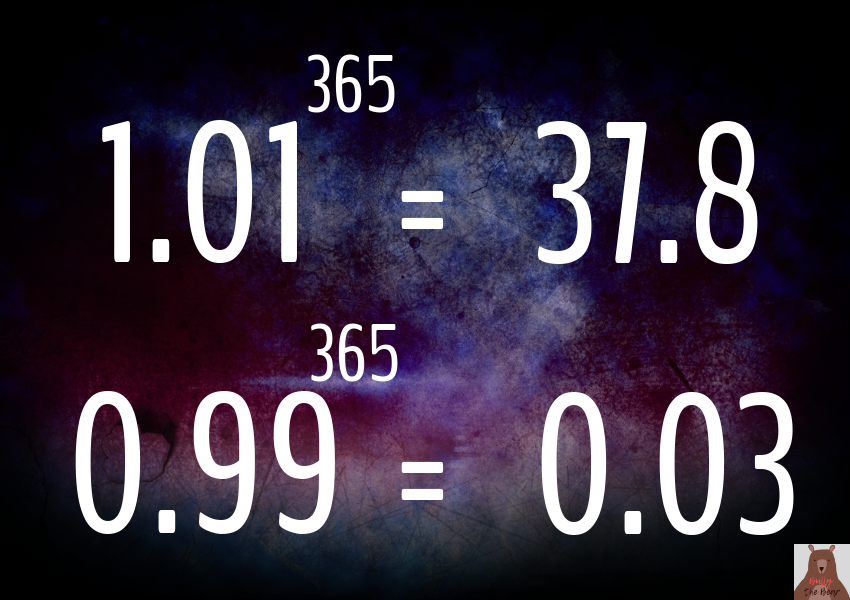
I'm doing a classic SMOL post here (lol!), so interpret however you wish. Here it goes:


Thursday, January 21, 2021

Blogging about blogging

Ever since I resumed blogging this year, I have been quite disciplined in writing. Each article takes about 1 to 2 hrs time to write, edit and essentially just be ready for publishing. This doesn't include time to brainstorm for articles. Hence, you can see it requires a certain discipline to churn out consistently. I'm trying to hit about 2 articles per week, usually published on a Monday and a Thursday to spread them out. 


The writing and editing is the easy part of the job. What's the hardest part? It's to come up with ideas to write on. And for this kind of creative process, you can't just set a goal and say I want to come up with 10 great ideas by this week. It just won't happen this way. It can't be forced like that. Some days you are wet with ideas, and some days you are just dry as a bone. In the past, whenever I felt that I have a brilliant blogging idea, I'll just leap up and type out a draft straight away. But these days, being busier, I have to quickly jot it down digitally before I self-censor or forget about what I wanted to say. 


Self-censorship during blogging is very real. There are so many drafts stored in my blog that failed to publish because halfway during the writing, I decided that it's not worth my readers' time (or my time to write). The article is either too lame or just too painful to flesh it out. These will go straight to the bin. If I keep doing that, it'll be a phenomenon known as writer's block. I read a book that says that to fight this ailment, we just have to keep writing and stop the self-censorship. Oh, and having a routine helps too so that the brain knows that say, after drinking a cup of coffee in the morning, it's time to do some writing. After a series of really lame and bad blog articles, something fresh and unique will (usually) appear. Then we can proceed from there. If I have no bad ideas at all, I think I haven't tried hard enough. There is a saying that an expert fails more times than a newbie had tried. Or a Chinese expert ate more salt than the rice a newbie ate. You get what I mean.


Over the years, I found that the drier periods usually coincide with days when I didn't have time to read. I think reading is a habit that keeps on giving and compounding throughout my life, and in this case, it helps tremendously in blogging as well. Reading is like brain food. If you don't eat food, you don't have energy. If you don't read, you don't have materials to write. As simple as that. My main brain food is reading. I think for others, it could be podcast or youtube or people that you meet up. Whatever floats your boat, man.

There is a certain sense of freedom in not caring about personal branding
and to simply blog without an agenda. It's like financial freedom, but on blogging.

To streamline the work process for blogging, I came up with the following steps:

1) Read daily and consistently to get ideas. The goal of 52 books per week still stands after all these years. In addition to that, I am also getting warmed up to the idea of audiobook summaries and podcast during transit times. Book summaries (I'm using Blinkist) are just summaries of books that are condensed into less than 10 pages. I used this service to get the main ideas of books (especially those themes that I normally wouldn't read) and if I really like it, I'll read the book from cover to cover.

2) As soon as a blogging idea comes up, note it down. I am using Google keep because it allows me to sync between desktop and mobile phone, but it can be any other note-taking app. I prefer digital app because of the syncing, and also because while I don't always have a pen and paper with me, I am very likely to have my mobile phone with me at all times. Since I wanted to write 2 articles per week, I need to have at least 2 ideas added per week to my note-taking app.

3) If I know in advance that I have a block of time (roughly 30 mins), I start to flesh out the ideas noted down in the previous point. This need not have to be free, undisturbed time. I can write while waiting for food or any other such times. Being a parent means free time is a luxury, so sometimes I'll have to multitask and flesh out articles when watching my child watch cartoons, for instance. It's not ideal, I know, but hey, not every minute spend with family is quality time. 2 to 3 such sessions of 30 mins each should be sufficient to flesh out an article. Unless I'm doing a creative post, like writing poems, or short stories, then it might take a very very long time. But it's fine because then, I'll be having lots of fun :)

4) Since I'm writing way ahead of self-publishing deadline, usually a week ahead, I have the time to edit and add some pictures. My picture quality can be improved, I know, but currently, my addition of picture within the article is simply to break up the passage into digestible chunks for easier reading. There are many should-haves regarding pictures - I could have selected more relevant pictures, arranged and edit more attractive ones etc. In fact, I have a grand plan to include my own drawings or illustrations, but it might add an extra hour or two. We shall see how that ambition goes. I've always wanted to do a long term project like drawing something every day and see where that takes me. But I'm afraid it might be too much of a commitment right now. KIV.

5) Publishing. I know some days are better for publishing than other days. Heck, even some timings are better than others. So far, from trial and error, it seems that the best timing is just after lunch. I guess a lot of people just returned from lunch and still getting their gears warmed up before starting work. So they will check their social media platforms to procrastinate a little. I don't know, it's just a wild but reasonable guess. It's not very important also, because these days, this blog is not written with the aim of making ad revenue, or for exposure, or fame. I'm not slamming people who are doing that, and personally, I've done that before too. It's just that at this stage in life, I don't need this anymore. I just want to consolidate my thoughts, gift aways some ideas and maybe, receive ideas in return. The plus point is that I can also freaking write whatever the crap I want to with nary a care about my 'branding', hahaha


That's all folks, enough of this meta-post on blogging about blogging. Live long and prosper.

Monday, January 18, 2021

Big fish small pond OR small fish big pond?

 If you have to choose, would you rather be a small fish in a big pond or a big fish in a small pond? 


I ask this question because my students just had their O'lvl results. After so many years in this line, I tend to get less excited about their results. I fully understand how getting a great result will lead to undesirable consequences in life. I don't know whether to be happy about good results or be sad about bad results anymore. I'll explain more.


This student of mine, let's call him John, got a fantastic result of  L1R5 of 8 points. That is a freaking good showing in the O'lvl. It means almost all the subjects scored an A1 (the highest possible grade), except for 2 subjects which are A2 (the second highest possible grade). Fantastic right? So naturally, John will want to go to the best JC. But I know John since primary school; he's quite a nervous wreck and will often breakdown due to stress. As in, really breakdown, go nuts, need to visit psychiatrist kind of break down. If he goes to an elite JC, I'm worried about whether he will suffer another depression episode because we all know how crazily hard Singapore A'lvl JC course can be. 


So the question again: is it better for John to be a small fish in a big pond and go join a more neighbourly JC and be the top dog there? Or is it better for him to be a big fish in a small pond and go join that elite JC and possibly be crushed by the competition there and suffer any mental breakdown?


I tend to favour the small fish big pond idea, especially since I know John's 'pattern'. The education system is not worth shedding tears and blood, with the real cost of having a mental breakdown. I think the most important thing is to survive the education system with your confidence level intact. You do not want to come out of your schooling year thinking you are not capable of success. I've spoken to some NA/NT students and it's quite sad. After years of being hammered by the system, they have a tendency to think that their lot in life is only this high. They don't want to aim high because 'people like them' can only get this far.


In the past, I've seen a very clever and bubbly girl who got 250+ for PSLE, went to a top integrated programme school and got crushed alive. Does it happen to everyone? Of course not, but as parents, you really have to know the personality of your own children and most importantly, how they handle stress and adversity. Some will crumble and avoid stressful situation, while others will fight even harder. Choose carefully. Being in a top school does not guarantee anything with regards to grades. From what I've seen, most of the elite school assumed that the students have outside help (aka tuition) and so will go at breakneck speed.


For John, I've spoken to the mum about all these issues that worry me. She knows it too, so we'll be keeping tabs on him (if I'm still tutoring him, that is). I don't know which type of fish he'll choose to become, but I sincerely hope it'll be a salmon that swims against the current, jumps repeatedly over white waterfalls, in order to reach their destination. Because that is one fish, big or small, that is a real survivor. 

Thursday, January 14, 2021

Expert versus Newbie

I've been a full-time tutor for 18 years and that's a very very long time. I think if I have a kid early, some of my youngest students can be my children already. Over the course of 18 yrs, I've progressed from a newbie tutor to a more experienced one. I've probably seen the same question in exams over and over again for decades. Therein lies the problem. I find that I'm more impatient over the years, and less willing to try new methods because of past success. I mean, why fix something that works?


It's the problem of the transition from a newbie to an expert.


Being an expert makes doing things a lot easier and faster. After all, an expert has done the same things so many times and had seen so many permutations of the same problem to be able to solve it at an instinctual level. But it comes at the expense of being open-minded and seeing every problem as a nail just because you have a hammer. An example will be those lao jiao investors who had seen the stock price of Creative during the dot com bust and Lehman brothers crumble down before their very eyes, blow by blow. They will think they had seen it all until they realised, just an instant too late, that they had not. It's especially hard to be an expert in an open complex system like the stock market where the outcome is based on many different individuals with different motives and emotions. Are you sure you have seen all the permutations in your years of experience in the stock market? 


On the other hand, being a newbie makes you a little more fearful (okay, granted, there is another type of newbie who is reckless and ignorant, but not readers of this blog I hope) so you tread with caution. You listen and read up more, you stay curious and humble in order to absorb like a sponge. In other words, you sacrifice efficiency in order to learn. I remember devouring libraries of books on investing and trading, but now I hardly ever read one. Or that for every hour of lessons I have with students, I need to spend 2 hours preparing. Now, it's maybe 5 to 10 mins preparatory work per hour of actual lesson?


From ITG.Builder


The issue comes when an expert stops learning. He becomes stagnant and gets left behind by the changing wheels of time. A newbie, however, learns and learns, and eventually, he might become an expert. His destiny is that he too, will stop learning and ceases to be relevant to society. So, how do I break this chain?


I think the most important part is to recognise that you might not be an expert in the first place. In a closed system where the solution is not determined by other players in the system, it is easy to become an expert. A few years in such an environment will enable one to see most of the tricks of the trade. I think being a tutor is mostly a closed system. Year 1 as a tutor might find me sweating because I don't know how to answer a question, but by year 10, shame on me if I still don't know some underlying trends or derive some shortcuts to hack through a difficult topic. I probably would have seen most of what could be set in a topic by now. But in an open system where there are many players, each interacting with one another, it is incredibly hard to be an expert. You might be an expert, for some time, until the system adjusts to a stage where your edge is eroded away. A shining example of that is the stock market. As a trader/investor, you better don't think you're an expert. Always a newbie, always learning, always be that little cautious. The market is not your mother to feed milk to your wide gaping mouth. If you're not careful, it'll steal the milk bottle plus the baby under your nose.


Don't ever fall for the illusion that just because you are an expert in one domain, you are an expert in all domains. Not by a long shot. Most expertise, if any, are extremely localised and specific and thus not transferable. So don't think that because a celebrity actor endorses a hair treatment service, it's a guarantee of its effectiveness. Most likely, she has the expertise in acting, but certainly not in hair treatment. Likewise, having expertise in mathematics (e.g.being a top student) does not guarantee expertise in teaching mathematics. So when I know of parents/tuition agencies wanting a stella academic track record before hiring, I smile silently. They might very well end up with a walking textbook who excels in doing math but sucking big time at teaching it. 


Do something new and be a newbie in some new fields. This will keep you grounded and humble. The feeling of being a newbie is transferable, unlike expertise in domains. I think it's because if you suck at something, the feeling of being a loser hurts you more than the euphoria of feeling powerful as a winner. Hence, being a newbie in a new field might keep you grounded in the domain that you are an expert in. How about surrounding yourself with smarter, wiser people? If you see a diffusion of knowledge as the net movement of information from a person of higher knowledge to a person of lesser knowledge, being in such an environment creates the greatest knowledge gradient between you and the group, so you maximise your learning by being immersed in knowledge, so to speak. I guess this cuts both directions, so don't be the most knowledgeable person in a group. If you are there to stroke your ego, please continue. If not, move on and find a smarter and wiser group of friends.


The best of both worlds is to become an expert in being a newbie - someone who constantly puts himself in an environment to maximise learning, who is humble enough to recognise his own inadequacies in the field, and who is curious enough to keep learning despite...no.. in spite of, past successes. 


So there, that should be my new year's resolution. No...  this is bigger than a new year's resolution. This should be my lifetime goal.

Friday, January 08, 2021

The competitive edge that my parents imparted to me

Having written about how my competitive edge as a parent is in my last post here, I now flipped my perspective around. What skills or values had my own parents imparted to me so that I gain something that will help me in my life?


When I first thought of this question, I wondered how to answer this. I don't really know the answer right away. As I am writing this post, I still don't know how I'll answer, so this exploratory writing will hopefully shed more insights. One of the most important reasons I came back to blogging is that writing allows me to converse with myself, thus clarifying my thoughts. 


My parents are atypical. They don't work in offices and hold no titles, and had been self-employed a large part of their life. My dad stopped working when I'm very young because of health issues and it's my mum who had to put food on the table, so to speak. So she hustled and done many kinds of gigs, all the while taking care of the family. A large part of my character is moulded just by observing and seeing how she handles the adversity of life.


One of the most important things she imparted to me is about money. She didn't sit me down and lecture me about finance 101, so what I learned was by purely by observation and inference. My mum gave me a very little amount of pocket money so I had to be careful with my money and I guess I've always been careful with money since young because of that. She did something right (and I'm going shamelessly copy her when teaching my own kid), which is to give a whole month's worth of pocket money to me. If I didn't keep a watchful eye and did not budget my pocket money carefully, I'll have more days than money near the end of the month. I'm proud of the fact that this had never happened to me before in my many years of experience as a 'money manager'. I think it's because I've been handling my own money pretty young and I've learnt to budget at a young age, albeit unconsciously, that this habit gets stuck throughout my adult life. There are some money lessons that I have to unlearn in the course of adulthood but the foundation of spending less than what I earn is like engraved in me.


My parents work from home and it's not often that they are not around. So I get to see them very often. I used to hate it that my parents are always around at home when I was younger because I don't like that my parents are constantly watching and nagging me in a way that parents always do. But when I'm older, I realised this arrangement is not common at all. Most parents are working in offices and are not around. I guess I learnt two things from here. Firstly, it's okay to work from home. I've no bias against people working from home and had no wish for any bombastic official designation, like directors, executives etc. These empty titles hold no meaning to me. Hence looking back, it seems that I'm primed to be a full-time tutor. The similarity between my parent's stay-at-home self-employment and doing their own hustling is too uncannily similar to mine as a tutor. Secondly, I can take care of my family and work at home at the same time. I don't have to follow the traditional gender role of a father earning money while the mother takes charge of the family. My mum pays the bills AND take care of the family, as such, I have an excellent role model to follow. So I shall and so I did. 


It's not all roses though, so where are the thorns? I made a wishlist of things that I hope my parents could have imparted to me but did not. However, this is not an exercise to find fault and assign blame. I take full responsibility for my own personal development. Still, I could have shaved a few years off my own circuitous road to learn the things I know now. Here's the list:


1) How to grow my money besides working and saving hard. It took me a long time to know such a concept. Things like property investment, stocks investment, or any other kind of investments.

2) The concept of insurance. Again, I took a circuitous, probably expensive route, to learn about this

3) Career advice, including what areas of study and what are the career prospects. There weren't many resources back then (internet was just a fledgeling in those days) and most of the time, I'm like blindly following others, who are probably equally blind too. I am an excellent student, and I probably could have taken a scholarship or two, but I wasn't aware and wasn't pushed. Who knows where that could lead me to?


Again, I stress that this is not a fault-finding exercise. I can totally understand how my parents are occupied with day to day survival issues and wouldn't have the energy or time to worry about future thriving issues. So, being a parent myself now, I will learn and correct from the 'mistakes' my parents made so that the next generation will be even better equipped.


We can see further only because we're standing on the shoulders of giants that came before us.

Tuesday, January 05, 2021

What's your competitive edge as a parent?

 As a parent, I always wondered what I can pass down to my kid in order that they have an advantage later in life. I have a student who works as an occupational therapist. She has a kid (yes, I know I'm super old because even my students are married and have kids of their own!) and I saw from social media that the kid can walk, squat and crawl, plus all the daily activities at a younger age than my own kid. That makes me think that the special skill that she can impart to her kid is somewhat related to her own career.


There are some parents who are rich and I hope what is passed down to their children will be about having a rich mindset and how to start businesses and so on. Not money. I think having too much money passed down to the next generation can be debilitating and demotivating. The right amount of inheritance should be an amount small enough not to make a huge difference to their life decisions, and at a time when they don't need it. I can fantasize just how nice it'll be if my parents are super rich, and my car and property are fully paid by them. But that's just it... a fantasy.  I don't think I'm that rich, neither am I a business owner, so what exactly can I pass down to my own children?


I hope good values and character will be one of them. I will be more proud of him helping others and having a heart, rather than being the top of his cohort (of course, it'll be best if they have both hahaha). And yes, that includes picking snails off the pavement on a rainy day in case someone runs over it. How do I ensure that? I think a lot of lessons, especially those involving values, are taught to children without specific instructions. You don't need to have 1 hour of moral & civic lessons every week to teach values to them, because they will learn based on how you act, rather than what you say. Hence, if I want my children to have good character, I must be exemplary in conduct 24/7. If saying thank you and please and helping others in need is as natural as breathing at home, I'm sure my children will absorb that and see this behaviour as normal.


The next important trait to pass down is how to learn anything independently. I believe strongly in this because I think in my kid's generation, the new illiterates are those who finished their learning in formalised institutions (like schools). To be able to learn anything requires a loop of trying and failing and trying again until success is achieved. Hopefully, my years as a tutor can be an advantage in this aspect. I also intend to show my kid that I'm learning all the time. Either reading, or practising on the piano, or whatever else might interest me in the future. I can't expect my kid to be a life-long learner, yet I'm slacking and watching TV on the couch every day, can I?


The last thing I want to impart to my kid is about health - both physical health and mental health. Health is the underlying foundation upon which all other things are built on but is often taken for granted. At the earliest possible age, I'll introduce meditation to my kid. I know it'll be a great tool to manage mental health and I wished I had been introduced to it sooner. Regarding physical health, my child is a very active person, so I hope I can very easily introduce him to regular exercise. I think starting a life-long habit of exercising will be a superb habit that compounds greatly for my child in the future.


Am I going to send my kid to enrichment camp for robotics and coding? Very unlikely. If I have it my way, I'll rather send him to a meditation camp or a sports camp, rather than a coding workshop. But I reserve the right to change my mind later, hahaha

Sunday, January 03, 2021

Bullythebear is back

I'm back!

After a hiatus of months, I am back, at least for a while. I think I am sufficiently insulated from the rest of the blogosphere now, and a big part of the social media network. I am quite detoxed and thus ready to start a new chapter in my blog. Whether that chapter will lead to me winding up the blog (possibly, but quite unlikely) or entering it again with more fervour, it's hard to tell. I don't even know where the next fork in the road will lead me too, frankly. In a way, that's exciting but never fearful.


One of the main reason why I stopped blogging is that I realised that I no longer needed acknowledgement. Especially from strangers. There was a period that I was posting my returns, savings, books read and so on. On reflection, why did I do that? Hao lian? Trying to one-up others to show that I am more capable? If I'm honest, there is a small part of me that derives pleasure in besting others. I get high while others get low and the whole world is no better off. I am contributing to an economy of envy and jealousy and I don't want any of that anymore. In the past, I can rationalise it by saying I'm motivating others but that's just not going to work for me anymore. SO, going forward, all that ding-dongs are going to be excised from here. I'm still trying to find the right balance for me and how better to do so by doing some exploratory writing.


By all accounts, this is a strange year. Covid-19 wracks the whole world around, creating unique memories that I've never experienced in my life. During the worst of the lockdown, going to shopping malls remind me of the nuclear apocalyptic game Fallout. Mannequins are still posing in their vacant pose exhibiting wares to nobody. Some are covered in plastic sheets, which in turn are covered with a layer of dust. Carparks are nowhere near-maximum capacity and the malls shut down most of the lightings there to presumably save on costs.


From ITG.builder


Despite all the inconvenience that the lockdown brings, this year is very memorable. Easily the top 5 years in my life. Why is that? I think this year is the year that I put my health before all else. I scheduled exercise time before my work. This marks a shift in my thinking because I always put work first. The one big reason is to be able to live healthy enough to see all the milestones achieved by my son - graduation, marriage, his own children. Just thinking of that makes my heart all warm and nice. I don't want to make a living anymore; I want to start living and spending more time with my loved ones. I want to spend time with my son in the years that count, knowing that one day the interaction between us will just be different from now.


The lockdown also means that everyone has to wear a mask and avoid social contact. Hey, this is entirely in my element, and like a fish to water, I swim comfortably in this new normal. There's no issue with me grappling with work and family because of work-from-home law because I've always been doing that. In fact, I'm slightly saddened that online work is changed back to face-to-face work. Still, all good things must come to an end. So do bad things.

That's all for me for now. Live long and prosper.
Sunday, May 24, 2020

What I'm grateful about

The days just zoom past quickly during the lockdown. The hours are long but the days are fast. We're nearing the end of the official lockdown period but it seems that even after the official period, life is pretty much the same. We still can't go out to restaurants to eat, and still can't resume life in general before covid-19. And who knows how long this will last for?

It's good to have the right mindset when dealing with things beyond your control. But before that, we need to know what we can control. I'm still shoring up my reserves in case this last longer than next year, and that means holding more cash as emergency cash. Beyond that, with regards to the stability of future income, or even dividends income, we have to let go. Or rather, let it be

There are a few things that I'm grateful for, despite the circumstances:

1. There's still work that I can do online

I can understand that there are people whose work is affected. Even if they want to do it online, they also can't. My heart goes out to them. I think in these times, you will know if your work is just merely for paying the bills or does it serve other important purposes in life, like social needs and fulfilling some meaning in your life.

Stay at home can be fun too

2. Family and friends are well and healthy

There are no major health issues with important and significant people around me. Boredom perhaps, but it's a matter of perspectives. Beyond bread and butter issues, I think people do need to worry about their mental health. No point being well-fed, sheltered but mad. Maybe being an introvert helps a lot because I find that I'm perhaps more busy and productive than usual, as I do not have to be drained of energy by going out. I'm recharged by the things that drain other more outward-looking people (like my wife) haha! Introverts, the tide has turned!

3. Relationships are better

Let me explain. I see a lot of heartwarming things that I don't see often. Neighbours bringing some groceries to our household when they have extra. We, bringing some cooked food to others to help out. I'll source out jobs offerings to others who had lost their jobs, especially in the tourism/airport sector. Some of the parents of my students lost their jobs, so I also help out by offering lower rates for my tuition services. I mean, I do what I can within my capabilities, to see if I can make someone's life better during these hard times. I'm sure many others are doing the same too. There's something good out of this whole shitty situation, isn't it?

4. The important things distil out

Sometimes life is funny, in the sense that only when shit happens then you will realise what is most important to you. To find out what is most important, you just strip off things one by one and see how it feels like. This lockdown period is the best chance to do an accounting of what's important and what's good to have. 


I like to remember these strange times as being forced to be introspective. Will I worry about income? Sure, of course. But beyond a certain level of preparation, there's nothing much else I can do, and so I'll just concentrate on the things that I can do. 

Stay strong, stay united, Singapore.

Wednesday, May 20, 2020

Singlife accout or CIMB fastsaver

I recently signed up with the Singlife account. You can read about it from other blogger's reviews or from the actual site itself, but to me, it's essentially a savings account. Since I also have CIMB fast saver, I want to explore the decision tree to decide when to put extra funds into CIMB fastsaver or into Singlife account. In my analysis, I'm really going to ignore all the extras, like retrenchment benefits, insurance parts etc of the Singlife account. 

Here's the facts:

Singlife account:
First 10k - 2.5% pa
Next 90k - 1.0% pa
Thereafter - 0% pa

CIMB fast saver:
First 50k - 1.0% pa
Next 25k - 1.5% pa
Next 25k - 1.8% pa
Thereafter - 0.6% pa

Here's the calculations of the interest earned and interest % pa for both:

Singlife account:


CIMB fast saver:


I just did up the interest for the various banding. Straight away we can see that the interest we can get for CIMB is much more for greater amounts of principal put inside, but for smaller amount of principal, Singlife will be more worth it. There must be a point where if I put x amount in Singlife account and the same x amount in CIMB fastsave, the two interest will be the same. And I know x must be somewhere between 75k to 100k.

So, let x be an amount between 75k to 100k,

Amt of interest from Singlife acct: 10,000*0.025 + (x-10,000)*0.01 = 150 + 0.01x 

Amt of interest from CIMB fastsaver: 50,000*0.01 + 25,000*0.015 + (x-75,000)*0.018 = 0.018x - 475

Equating them:

150 + 0.01x = 0.018x - 475

So, x = $78,125

And thus my decision is clear:

To get the highest interest for the same amount of dollars:
I should put it in Singlife account if I have lesser than $78,125
I should put it in CIMB fast saver if I have more than $78,125

If I have exactly $78,125, then I should put it in Singlife account because of the little bit of insurance that I didn't take into account. Both have deposit insurance of up to $75k, so there should be some safety features built into this. 

Okay, now my decision flow is clearer.


Update: 

How silly of me. In the pursuit of deciding either THIS or THAT is better, I forgot that the better solution is a blend of BOTH. Non-duality! Thanks to 15 hww and WGM for pointing this out to me. In light of that, the best solution is put money in both accounts, as shown:

First 10k - put in Singlife account for 2.5% pa - total interest: $250
Thereafter - put in CIMB fastsaver, preferably not more than 100k inside

Done! 


Wednesday, April 15, 2020

Changes in the post-covid Singapore

I wrote this piece in the early days of the virus. Back then, Singapore is still relatively unscathed. But about 1 month later, the infected cases keep shooting up and up. We're not in code red now, but effectively so. The whole of Singapore is under a controlled lockdown, termed euphemistically as a "circuit breaker". If I'm out in the streets, it feels like Chinese New year where all the stores are shuttered and there's not a lot of people walking around. Except we don't have that festive feel in the air. It's quite bad, and I've never experienced anything like this in my life. I thought I've lived through SARS but this is probably much worse than SARS. 

There are quite a few changes in my current lifestyle. First of all, all face to face work is halted for a month (I'm fully expecting it to be extended to 2 months actually) and I have to switch my work online. Most parents and students are fine, so in that sense, I'm lucky enough to still have my work income. My wife is not as lucky. She has quite a few cancellations in her work and being self-employed like me, she will have to bear through it all in stride. We can be down, but never out, so I recommended her to upgrade her skills and do what we can do survive through this period, and hopefully come out even stronger.

The second major change is my exercise routine. Since I can't go to the gym and I don't want to place my family at risk, I've kick-started my home exercise plan. I started to wake up like 6am and do some bodyweight training, like pullups, pushups, squats, situps and some biceps curls. I usually don't wake up so early, but since it's really hard to exercise with a young kid running around at home, I have to do what I have to do. So far it's been great, and I managed to throw in a 10 min meditation sit down too. I haven't really done sit down meditation for a long time, so it's been good. I hope these exercises will not just help to maintain my health but also, more importantly, to keep me sane. As an introvert, I can tank relatively long periods of time at home, but I still have to take care of my mental health. Both physical exercises and meditation should do the trick to ward off the generally negative outlook so ubiquitous nowadays. 

The third major change is my young son is not going to child-care for the time being because of the closure, so I have to spend a lot more time with him to entertain him. As a young kid, he has a lot of excess energy. Recently, I set up a shuttle run course for him so we just run along the hallway of my home, collecting soft toys at each end of the hallway to 'rescue' them from the 'fire'. It's tiring, but he is laughing his head off, so I think it's worth it. The big difference between SARS period back in 2003 is that I don't have as many responsibilities as I have right now. My family is not a potential liability to drag me down. Instead, they are my pillar of support to prop me up. It's all about the framing. 


Every year I try to do something a bit different to increase my productivity or to focus on the neglected areas in my life. Recently, I subscribed to a book summary site to distil the important points for easy digestion. To be honest, I used to look down on such sites because I find it is like cheating, so I'm a bit slow to adopt this. Now I wonder why I didn't sign up earlier. I am still reading books from cover to cover, but with the book summary site, I am getting a lot more pointers to increase my knowledge horizontally (but not so much in-depth or vertically). To make sure I get the best bang for my buck, I wrote down summaries of those summaries, including a short reflection on how those books can apply to my life. I think all these things I made allows more knowledge to be retained. Already, I applied some of the great stuff I've learnt from reading those book summaries, like waking up early (the book I read says 5am, but I think it's more realistic to wake up at 6am for me), non-violent way of communication, starting meditation again...  I look forward to seeing the changes in me by the end of the year.

I might add that I'm going to the gym since the start of the year 2020, but I think that path is kind of derailed for the time being. It's okay, we fall but we pick ourselves up again and continue moving forward.

Investment wise, I froze the accumulation of war chest from dividends and work income. This means that I stop contributing to my war chest from any income source, at least for the time being. The reason is so that I can channel the money towards emergency funds. I already increased the emergency funds from the pre-covid era of 3 months expenses to pre-"code orange" of 1 year, to the planned post-"circuit breaker" emergency funds of 1.5 yrs to 2 yrs expenses. This will be the defensive part of my strategy, to make sure that I survive this no matter what. No point trying to gun for an all-out offence when a blow to my base can cripple me. I will keep adjusting the emergency funds and war chest allocation as the situation evolves. 

At one point in the last month, my war chest was used up nearly 30 to 40%, but I changed the components of the portfolio and sold off some positions, adding in the profits back to the war chest, so now I'm about 95% replenished. My view is that there will be a downturn soon, hence I'm trading off the positions I bought previously as the market went down. If I'm wrong, I'll buy again when the uptrend is established. If I'm right, I'll buy the downturn with my replenished war chest. Either way is good for me. 

Saturday, March 14, 2020

War strategy in a bear market

The recent market meltdown prompted me to re-organise what I classify as emergency cash and war-chest and better fencing of cash and cash equivalents. This comes about as I increased my emergency cash from 3 months of expenses to 12 months. By doing so, I'll fence up more cash that I can't touch for investment, hence the exercise to really look into this.

I have various issues of Singapore savings bonds (SSB), as well as Frasers 3.65% bond and Azalea bond. I decided to classify those under emergency cash. The SSB can be redeemed at par value, and while the two bonds that I held had their prices falling from their highs (Frasers went below par even), I think they are still safe storage of emergency cash. Unlikely for them to do a Hyflux on me, again.

 After accounting for the switch in portfolio counters, I realised I've spent about 15% of my war-chest in a week or two of buying. In this kind of climate, you can buy something and have it fall 10% the following day or so. Crazy times. How does one cope with this? Just be 'delusional', in the sense that you keep thinking the market will return to its formal glory, that this will all pass eventually, that the enterprising human spirit will somehow get you over this and that a few years down the road you'll be wondering why you are even fussing over this minor hump on the road.


I think I've experienced a few crashes in my investing journey so this is not going to be any different. The first few I've 'wasted' it by not being emotionally steady, and/or didn't have enough cash, so I'm determined to make the best out of this. I've some support groups - people who share the same philosophy in money management - so they helped a lot to allay whatever fears in buying up while others are fleeing. Grateful for that. I've seen enough people who made it out of market crashes like this, emerging from the ashes of their portfolio with their net-worth doubled or tripled, to believe in it, so I'll try my best to emulate them.

That said, hope still has to be tempered with ground-level reality and practicality. I must survive all these in order to have a chance to thrive later when all these are over. The top 2 priorities are really health and job security. If that fails, all else fails.

How to spend the remaining war-chest? I think the problem can be split into how much and how long. STI has fallen about 27% from the last peak to the last close, while SP500 is down 20% and HSI about 28% down. Most often, crashes recover after about 30% down. Rarely does it do a 50 to 60% crash and then once in a lifetime, you might see a more than 85% crash. I think based on past history, we should spend the bulk of our war chest preparing for the 30% to 50% crash, rather than the world-changing 85% crash. I think when it comes to that, nobody is really prepared for that. If that comes, there will be more things to worry about survival than about thriving. That should settle the part about how much.

How long then? History shows that it can take 1 to 3 yrs for the bear market to play out from peak to trough. Counting the last peak for STI to be in May 2018, we're about slightly less than 2 yrs right now in Mar 2020. Perhaps it'll end by 2021, in about a year's time. That correlates to what PM Lee said about how long the coronavirus will play out. I wouldn't take it so literally to be exactly 1 year, but that should give a helicopter view of how fast to deploy.

Take care of your health, and prosper.


Monday, February 10, 2020

Am I prepared?

Back in 2003/2004, there is the SARS outbreak. Back then, I just started work and didn't think too much of the possibility of getting infected. That's stupid and reckless of me, but now I have too much to lose. I can see people are avoiding shopping malls and restaurants are mostly empty even during the weekend peak dinner crowd. You can practically walk into a restaurant and see that there are more staff than customers during peak hours. It's that bad.

In this post, I'll like to focus on the things I'm doing to protect myself. My chief concerns are:

1) My family's health
2) My work income
3) My financial status


1) Family's health

The current Wuhan corona virus is still largely unknown, but it seems from official statistics that it is highly infectious but with low mortality rate. Thank goodness for that. I'll rather take my chances with this than another strain with low infectious rates and extremely high mortality rate. Ultimately, mask or not, it just depends on our immunity system to survive.

As 2020 started, I did 3 things that helps a lot regarding health. Firstly, me and my wife had been going to the gym almost everyday. 30 mins of intense cardio really does help a lot, I feel. That should do for the exercise part of keeping healthy. Secondly, every gym day, we had almost carb free salad for lunch. That's the diet part of keeping healthy. Thirdly, I started doing cold showers. I read from Tools of Titans by Tim Ferriss (Wim Hof/Tony Robbins section) that having cold showers can boost the immunity system and willpower, among other things. Been doing it for 3 weeks, not bad, will continue doing so.

Other than that, I didn't join the groceries store run, nor the mask buying queues to avoid crowds. I did go out to shopping malls now because it's largely empty. My mum prepares some herbal concoction for us to drink, and hopefully all these measures will help. Not necessarily in preventing us from getting infected, but to recover swiftly once infected.


2) My work income

I'm a private tutor. Students come over to my place for lessons, so I'm potentially exposed to a higher chance of infection that most people I guess. I accept that. From the start of the pandemic in China, I've already anticipated that parents will stop and cancel lessons. Just last week, I had two cancellations. I think primary school tutors will be hit more severely than me, not to mention those running group lessons. I think we just need one cluster to form in schools and that's it. Back in SARS period, primary school was stopped for about 3 weeks, secondary schools about 2 weeks and JC about 1 week. Why? JC students can die is it? It's about the immunity system - those who are elderly and very young have weaker immunity system, making them more susceptible to infections.

What happens if the situation gets worse and tuition stops? I have a plan B. I got a webcam from a good friend, got my wacom drawing tablet/digital pen and an online whiteboard with video conferencing/chat capabilities ready. I've also asked for permission from students and parents in case the situation warrants it. And so now we wait.


3) My financial status

What if I've no active income for a stretch of say 1 year? Can I take the hit?
Yes - my CPF has enough to last me 1 yr of mortgage payment, which is my biggest expense and greatest worry. I'll transfer more warchest to emergency cash too, so I can tide over more than 1 yr if needed.

What if I've no active income for 1 yr and I'm hospitalised? Can I take the hit?
Yes - hospitalisation plans are still in place and I've enough funds to cover any deductibles/co-insurance. Same for all my family members. Insurance plans also cover ICU should that need arises. If there are worse scenario I've not imagined, there's also a reserve battalion of Singapore savings bond, equivalent to 6 months of monthly expenses, waiting for me.

I took account of all my liquid cash, minus 1 year of monthly expenses, and the remaining is my war chest. It's still good enough to fire substantially, so that's good. My plan, as always, is to survive first, then thrive. And I'm determined to thrive.

Wednesday, January 15, 2020

Bought another insurance policy

Recently I bought another insurance policy - it's called a gym membership. I've been walking/running for nearly a year already, doing it quite consistently for 5 days a week, so I'm quite sure signing up for a gym membership will be a good insurance policy to guard against future health issues.


I signed up with the ActiveSG membership first, and following the instructions, I got a credit of $100. This was an initiative set up in 2014 to encourage Singaporeans to live a healthier lifestyle. I know I'm a bit late in claiming the credits, but better late than never. For off peak gym membership, the free credits will allow me to use the gym for more than a year for free. Anyway, it's not that important since it's one of the cheapest rates in town at $40 per 6 months. Hard to beat at this price range.


Even as my body is aching from all the physical exertions, I think this should be a great start in 2020 to boost up my health sphere even further. I'm not getting any younger, and I need to take responsibility to make sure I stay healthy for my kid. While an actual insurance policy is reactive in nature (it helps only after some health issues had happened), doing more exercise will certainly help in being preemptive (preventing or delaying some health issues from happening). Can't control what might happen in the future, but the least I can do is to build a good base when I am still able to.


Seems like I have a lot of things on my hands. Need to exercise, need to read, need to practice on piano, need to work, need to have family time, haha

Wednesday, January 01, 2020

DBS multiplier account NERFED

It's the first day of the 3rd decade of the 3rd millennium and I received some news that DBS is going to nerf their multiplier account. I first heard it from Kyith (here) and the new changes, which will take effect from 1st Feb 2020 is listed here.

The major changes are that instead of dividends being under the "Investment" category, it is now grouped under a new "Income" category, which combines both the salary credit component together with all dividends received. This sucks because now, most people will have one less category to fight for the highest interest of 3.8%. I really don't want to get into some long term commitment, like buying a regular savings plan or DCA into sti etf, for something that is short term and fickle like the terms and conditions for the DBS multiplier account. I guess I'll have to contend with less interest.

The other major change is that the higher interest for the salary credit + transactions in 1 category is now applied up to a new cap of 25k only, down from the current 50k. It's not clear what they meant by this.

I take the liberty to include two scenario. But first, this is what is like currently (click if it's too small to zoom in):


This is what I think it'll be like after the changes to the cap from 50k to 25k:

Scenario 1

This is what I think it could be if they are kinder:

Scenario 2
Scenario 1 will introduce 2 tiers, first tier of 25k, next tier of 25k, then final tier of 50k. For this scenario, if you hit 3 categories including the new income category, and you also hit the max transactions per month of 30k and above, you'll get a blended interest of 2.79% pa ([2.08*25 + 3.50*25]/50 = 2.79) for the first 50k.

Initially it's 3.50% for first 50k, so that's a drop of $145/mth to $116/mth after 1st Feb. Say bye bye to the next 50k unless you buy their insurance and investment, which I am very repulsed to do so.

I don't think they are going to be kind so screw scenario 2. Ironically, in my mind, I just wanted to do scenario 2, until I actually do out the jpg to realise that it's too nice to have scenario 1 where there is a first 25k tier, next 25k tier, and final 50k and above tier.

Maybe just bloody buy their stocks and get a dividend of more than 5% pa lol