Saturday, November 22, 2014

Low hanging fruits season

POSB is giving another low hanging fruit for us to pick again.


I've blogged about a previous exercise here and here where POSB celebrates National Day with a 1.5% pa bonus if you put in fresh funds for 3 months, up to a cap of 10k. Well, it must have been hugely successful and drawing a lot of new funds for POSB, because they are doing it again with some conditions upsized.


This new exercise that POSB is doing is a little different. It gives 1.5% pa interest for a period of 6 months, up to a cap of 20k. To qualify, you must:


1) Register here by 22nd Dec 2014 (inclusive of that day)

Take note that the sequence is a bit different from the last exercise. In the last one, you have to deposit your funds first THEN register. For the current one, you have to register first, THEN deposit in your fresh funds. So don't screw up!

2) Complete a one time top up by 31st Dec 2014.

Put in fresh funds between $1k to $20k, in multiples of 1k into any existing DBS/POSB bank account by 31st Dec 2014. Do note the definition of 'fresh funds' cannot include those that are transferred intrabank from one DBS/POSB account to another. But the mode of transfer can be through cheque, cashier's order, demand drafts, cash deposit, FAST. For more details, do read the terms and conditions.

3) Maintain top up amount for a period of 6 months.

This is an example quoted in the terms and conditions.

Customer A registers via online through DBS’ website during the Promotion Period and successfully top-up a lump-sum of SGD 20,000 to a CASA by 31 December 2014.

Cash Gift earned by Customer A under the Promotion as follow:
SGD 20,000*1.5%p.a.*181/365 days = SGD 148.77

(Note: 6 months period is from 1 January 2015 to 30 June 2015 = 181 days)

4) Wait to get your 'cash gift', up to a maximum amount of $148.77, which will be transferred to your registered DBS/POSB account between 1st June 2015 to 30th June 2015.


I know it's might not be much, but hey, it's not hard to do this also. I still have 10k locked up until 30th Nov 2014 from the last exercise. I'll see if they are 'smelly' or not by looking at whether they will pay up. By then, I'll still have more than enough time to put in 20k to get this extra interest.


Low hanging fruits? I'll grab it.

Friday, November 21, 2014

The 10 functions of money

What's money good for? From Richard Templar's book, "The Rules of Money", money is good for 10 things. I found the list quite exhaustively, though some points are really be lumped together as a single point. But here it is:

1. Security

I think money provides a huge security for me. I need to have a certain amount in my bank before I can feel safe that I can tide through the month. I also need to save up a certain amount for my future retirement, and also a bit at hand to tide through life's emergency. I guess this is my number 1 priority in wanting to get more. It could be more psychological, I understand.

2. Comfort

Money can't buy everything, but for the things that it can buy, it does it really well. Don't think of just big cars and huge condominiums to stay in, it can also be a comfortable and good medical facilities for your loved ones and a warm bed and food for your children. I realised I don't need too many comfort items, but money does what it's supposed to do - to satisfy those creature needs. Like a really nice bed to sleep in, and a warm and tasty food afterwards, haha

3. Luxuries

I find that this point is the same as point 2, just on a different scale. It can be grouped together as one single point. Fine wines, good meals at top-notch restaurants, a good relaxing holiday overseas, a branded bag etc...these are what money can buy that you may want, but not necessarily need. Still, life is not meant to be survived - it's meant to be lived. So indulge yourself in such things, especially if it creates an experience that you'll remember for a long time.


4. Mobility

The author put first-class trains seats and plane tickets, as well as trips on cruise ships and chauffer driven cars in this point. Hmm, somewhat like point 3 to me as well - good to have but not necessary. For all purpose, I'll treat this as a luxury items. But money does buy you mobility. I've a student whose parents are very very wealthy. She practically flies in and out of Singapore maybe every 2 weeks or so - sometimes as short as a weekend trip, sometimes as long as a month long holiday. It's disruptive to my lessons scheduling, but hey, I can't help but be a little envious when the furthest country I've ever been is Australia on a NS month long war exercise! With enough money, you can book a ship to Antartica (I heard it's about 16k for a month long journey) and even a space flight. Of course, once Richard Branson's company settled the underlying issues with his space shuttles first.

5. Status

Rich people will have different status, that's for sure. You'll get invited to special occasions and exclusive clubs. But these are none of my concerns. However, money does get you special status - I'm just not sure that status will still be there when your money is no longer around. I highly suspect that acquired status will be gone too. This is never my priority in wanting to get more money, but I think some people might see this as quite a motivation.

6. Influence

Money can buy you influence. Influence will get you power. It's a little more subtle than the previous point of money giving you certain status. A lot of powerful rich people get pull enough strings to make even government bend to their request. America history of wall street is full of such people. A few big names comes to mind - Rothschild, Rockefeller, Astor, Vanderbilt and so on.


7. Freedom

This is what most people want to acquire enough money for. Once you have the capital, you get generate enough passive income so that it will exceed or match your expenses, so you won't have to work for money again. Financial freedom - that journey that begins all journey.

8. Leisure

I think this point is tied to the previous point on freedom. With freedom, you will have leisure time, so in effect, your money buys you time instead of paying time to get money in your earlier part of your life. My take is, don't wait till you are financially free before you start enjoying your leisure time. Hedge your life by taking small leisure with your loved ones every now and then, just like you are hedging your future life by saving up in the present.

9. Popularity

Money can buy popularity, but I doubt the kind of acquaintances and friends are the kind that you really wish to associate yourself with. Still, money does its job of making you more popular - you just have to exercise your own judgement to see who will still be around when you have no more money.

10. Philanthropy

Money enables you to give more. It's strange, isn't it? Spending time and effort to get more money, so that you can give to more people. I think money makes you more of who you are. If you're a jerk without money, you're a bigger jerk with money. Likewise, if you're a generous person without money, you'll be even more generous with more money.


Is there any more uses or functions that money can serve as?

Friday, November 14, 2014

The role of parents in an uncertain world

The hardest thing about bringing up a kid is the values that you want him to inculcate. It's never a straightforward equation, where you put in the right input and you get the right output. Different kids respond differently to the same input and produce vastly different outputs.


Take for example a parent who always tries to teach his kid to save up and be frugal. He did it in a way that forces his kid to scrimp and save and the kid grew up having the mindset that money is very important. Here's two diverging paths that might happen; extreme but entirely in the realm of possibilities. The kid either grows up spending crazily to 'make up' for his lost childhood and his whole adult life will be about reclaiming some parts of his life that he didn't experience but other kids did. Or, he will continue to save and scrimp like his parents did, perhaps to gain their approval and therefore their affection. It's hard to tell in advance which paths the kid will take. It's like the Schrodinger's cat phenomenon where both outcomes are possible but it'll be determined only when it's determined.


Extrapolating this idea, a frugal parent might or might not come from extravagant grandparents. But folklore always mention about having a generation of alternating characteristics. For example, you have a grandparent generation who are frugal, then a parent generation who are extravagant (to make up for their frugal upbringing), then a current generation of kids who are frugal again. This, of course, is not fixed in stone, and the unpredictability of the next generation to follow what the previous generation values are, is what I'm talking about here in the first place.


Given this, can we really engineer the kind of values that we want out kids to have? I guess we can only try our best. This is important because trying our best is the only thing we can do. In light of this, it's also important not to blame our parents for whatever ills that this current generation is suffering. More likely than not, when it's time for you to become a parent, who knows, maybe your kids will also blame you for whatever nonsense you've taught them that works for you but utterly failed on them.


A good example will be the "study hard then you'll be settled for life" myth. I use the word myth because it's a socialised fact; everyone knows it and follows it, but nobody really question why or how effective it is. Until now. Parents growing up without much education, and thereupon seeing their peers who are fortunate enough to study and landing well-paying office jobs, are the ones perpetuating this myth. It's the right thing for their generation because having a O'lvl cert back then is as good as having a degree in university. If you had a university degree back then, you must be the top 1% of the most highly educated, and by extension, the most sought after job seeker in that generation. Is it going to work for this generation now? I doubt so.


Going forward, what other values or ideas have you tried teaching your child that works for you by might not work for them? Who can tell? It takes a rather long time for the kid to grow up before you can say for certain what works and what doesn't. By then, it's too late. It's like you bought into a share to hold it for the long term and looking at it after 20 yrs, you realised it's a dud. By then, the period of remediation is long gone and you have a kid who might have blamed you for what you've taught eons ago.


The physical part of parenting is never easy, but it can be easily outsourced. The ideological part of parenting is the tricky part. Firstly, you don't know whether what you taught them is still going to be helpful for them in their future that you no longer belong to. Second, even if you know for sure, whatever you try to inculcate in them might turn out to be quite opposite to what you intended. Thirdly, it's not like you have many chances to go through trial and error. Unless you have a kid now and after 20-30 yrs you have another kid, you pretty much only have 1 chance. Given the circumstances, how can someone ever say that they are ready to be a parent, don't even talk about being a good one?


Still, in the light of all the uncertainty, we have to make a choice:


1. It's important to teach your kids adaptability and resilience. How? I don't know. I just know that it's important to prepare them for the future they are going to inherit, not yours.

2. Don't blame yourself as a parent if things don't go right. Don't blame your parents if things don't go right for you. Nobody knows what is happening and in the thick of the battle where there's a concealing fog of war, you can only do the best you can taking into account all the information available to you at that moment. Point 1 comes in mind - adaptability and be resilience.

3. Beware of unintended consequences. Beware of it, but ultimately what else can you do?

4. Be prepared to fail as a parent. Be prepared to fail as a person growing up in this world. There's no perfection to be attained, only improvements. In spite of all this, love yourself, love your parents.


After this internal dialogue, I end up still being uncertain. I know nothing but I have a feeling being uncertain and knowing that you know nothing is the destination of our journey.

Tuesday, November 11, 2014

Valuation of ST Eng based on order book

ST engineering had been dropping like crazy the last few weeks, and very recently in the last few days, the sell down persisted at a much greater pace. I know that they had a weak quarter, and possibly they will end this financial year with similar revenue but weaker net profits. My class got cancelled, so I had some time to crunch some numbers.

Here's a fancy 5 yr key financial data taken from their site:


A few things to take note:

1. The net profit margin (Net profit/Revenue) hovers around 8% in 2009 to 9% in 2012.

2. The number of shares taken to calculate the earnings per share (EPS) increases from around 30 units to around 31 units.


(What units? EPS is net profit over shares, so if you manipulate the formula you'll get shares = net profit/EPS. And that's what I did. I took the net profit for each year divided by the EPS to get the shares, but I can't be bothered to convert to the proper units. Not that it mattered later on when I use it for calculations.)


The 10 yr order book is provided in the annual report 2013 too. Here it is:


Since the share price of a company should be forward looking, knowing the current order book for the next 10 yrs should determine the current price of the shares now. What I wanted to find out whether I can use the order book to guestimate future revenue booked. Since I know the historical net profit margins, I can guestimate the future net profits. If I divide this by the number of shares unit by the company, I'll have the future EPS. Multiply EPS by the historical PE ratio, I'll have the future price range, and I can decide from there what to do with this garbage-in-garbage-out number so expertly calculated.

Let's go.

First, a little back testing. Since they have the 10 yr order book data for 2003 and 2008, I can use it to see if this is even worth the bandwidth posting. Here it goes:

Assumptions:
1. Share units of 31 (more conservative than 30)
2. Net profit margins of 8% (more conservative than 9%)
3. PE range from 10 to 20 (theoretically it should be 10 yrs, isn't it, since it's a 10 yr order book)

10 yr order book for 2003: $4.6b
Net profit for 2013: $368 mil (4.6*1000*0.08)
EPS for 2013: 11.9 cts/shares (368/31)

Using PE of 10, share price = $1.19
Using PE of 15, share price = $1.78
Using PE of 20, share price = $2.37


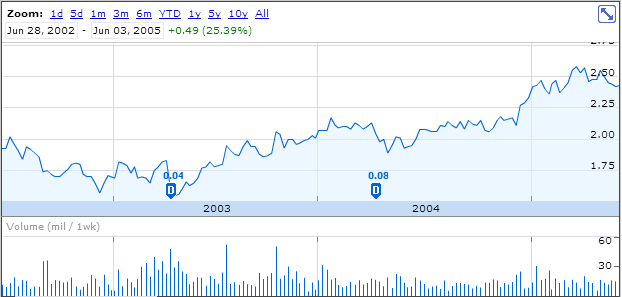
So, based on this order book estimation model, I get around the price range of 1.78 to 2.37. Let's tally it with the historical share price around mid 2002 to mid 2005. You can see that from mid 2002 to end of 2003, the price hovers around a range of 1.6 to about 2. Alright lah.


Let's try for order book for 2008.

10 yr order book for 2008: $10.6b
Net profit for 2018: $848 mil (10.6*1000*0.08)
EPS for 2013: 27.3 cts/shares (848/31)

Using PE of 10, share price = $2.73
Using PE of 15, share price = $4.10
Using PE of 20, share price = $5.47

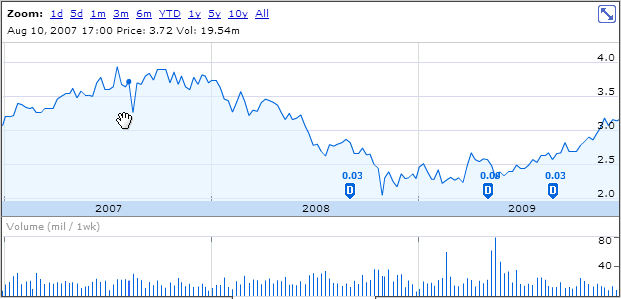
I attach the historical share price from 2007 to 2009 here. Price ranged from about 2 to 4. A little unfair cos it's the global financial crisis, so the PE is depressed by that event. I leave it to you to decide if you can use the order book as a suitable model of valuation based on this 2 samples.


Ah ha, here's what we've been waiting for. Let's try for order book 2013.

10 yr order book for 2013: $13.2b
Net profit for 2023: $1056 mil (13.2*1000*0.08)
EPS for 2023: 34.1 cts/shares (1056/31)

Using PE of 10, share price = $3.41
Using PE of 15, share price = $5.11
Using PE of 20, share price = $6.81


A big caveat here here is that this is of course a simplified model. I'm using net margin of 8% on any revenue booked, but it will change when the composition of the revenue is changed. It could be higher or lower. There's also another consideration - the dividend. Let's say the dividend, which is 15 cts now, will drop to 14 cts in the future. Based on 10 times PE, the yield will be a reasonable 4.1%, with the possibility of the share price 'upgrading' to a PE of 15, possibly booking another 50% capital gain.


My second tranche of averaging down will be a little more pessimistic. Here's a chart that I did quite some time ago before all the plunging of the share price recently.


3.3+ to 3.22 will be where my bullet is aiming. I'll see how it reacts around 3.3+ first before deciding further. And how did I react to the falling share price? Nothing. Unlike the past, I didn't put in more than what I can afford to lose, and this is not an s-chip like longcheer or china milk or ferrochina.


What a journey it had been from then and now lol!

Friday, October 31, 2014

52 books a year challenge

2 more months before the year 2014 is over.


I still have one last major thing to tick off in my goals for this year. This is something pleasurable - reading 52 books per year. I've been doing this for quite a number of years already, so it's nothing new. However, it's always a challenge because I'm operating at a zone just between the impossible and the just possible, which makes this a really good challenge because there's a good chance it may fail unless I change myself. Challenges like these are very satisfying to complete. It has the Goldilock's standard of not-too-hot-not-too-cold optimization.


52 books a year means 1 book per week, regardless of length or thickness. The intention behind the challenge is not for me to read as many books as possible (thought that will be achieved), but to complete as many books that I started as possible. It's very easy to begin a book but after a few pages, you realised that maybe this book isn't as exciting as it looks in the beginning, so you procrastinate and read lesser and lesser before ditching it for another brand new 'exciting' book. If I do that all the time, I'll never finish my 52 books a yr challenge. To prevent myself from not finishing a book when I started it, I set up the challenge. With that target number always in mind, it'll force me to complete books instead of starting them. And thank goodness I did so, because there's a lot of gems that are boring at first but gets better and better as we go along. Imagine how many gems like these will be thrown aside if I didn't adopt this challenge.


I noticed that if I borrowed books from the library, I also tend to finish them faster. I'll plan my schedule such that I'll have time to read them. Books that I had bought, however, are usually left on the shelf. It's silly, but it seems that if there's a time constraint to reading a book, you'll actually finish them faster. I guess it's psychological - it's like you're rushing against time and thus the pressure to complete them. 52 books a year challenge seeks to replicate that time pressure.


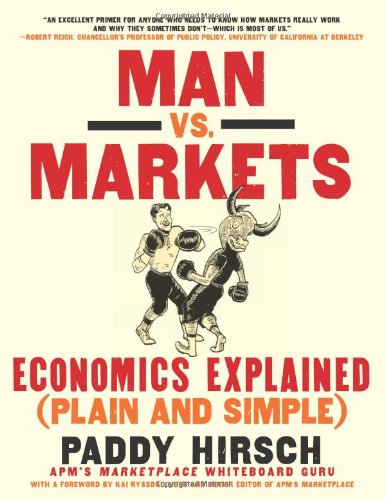
Had a chance encounter with this book at NLB Bishan. Been wanting to read this for 1 yr!

So, how many more books do I need to complete the challenge? I'm currently on book 35 now, which means I have another 17 books to go before 31st December 2014. Let's say I've 20 books to complete in 60 days (2 months). That gives me 3 days to finish reading a book.


Challenge accepted!

Saturday, October 25, 2014

Which one suits you better - earn more or spend less?

We all know there are only two ways to save money. The first is to reduce your expenses. If you spend less, then whatever is left is your savings. The second is to increase your income. If you keep your spending to be the same, what you earned after your spending will be your savings. But which way works better?


I think the key point here is whether your income is scalable. If your income can vary according to the amount of work that you produce, then it's scalable. If that's the case, then you might want to focus on earning more income. My job as a tutor is scalable. A salesman job whose income is tied to the commission earned from the sales made is also scalable. Focusing your energy on an active income stream which is scalable makes sense because there's a lot of benefit besides having a higher income (therefore, higher savings).


1. When you're busy, you can't be shopping. 

I'm not sure about others but when I'm in my peak season, I can't wait to go back home to rest. I understand that some others might go on compensatory shopping to alleviate the stress and pain of working so hard, but to each his own. The months that I spend the least correlates to the months that I earn the most. It's during those months that I've half or a quarter of my work load that I spend more time shopping, watching movies and eating out at restaurants.


2. Working harder might lead you to a higher base salary or a better job

If you work hard enough, you might be noticed by your superiors because of your output. This might lead to a better job prospects/promotion which can lead to higher base salary. Certainty in income is better than variability, so if your hardwork leads you to secure a higher base income, why not? Makes it easier to plan ahead too. If that doesn't work out, perhaps you'll be noticed by headhunters who can direct you to a company that pays you better. If all these doesn't happen, surely there's going to be a better bonus towards the end of the year? Still no? Then maybe you should just switch your company.


3. There's a sense of achievement from career satisfaction or from a job well done

It's not just about savings. A feel-good mentality about your work can lead to a multitude of desirable side effects that makes you happier. Imagine you're the top producer in your company. Beside earning the extra income, you'll also be regarded highly by your peers. Just don't take it that you've arrived and buy yourself an expensive car to go along with that status. A feel good feeling is internal, not necessarily externalized by material goods.


What happens if you income is not scalable? That means that the more hours you put in, not withstanding a possible promotion, you're actually getting less on an hourly basis. I think after some years in your company and looking around at your colleagues who are your seniors, you'll more or less know your chances of promotion. If you still want to stay in your company, then working so hard at work doesn't really benefit you. They know it, you know it too.


If that's the case, working on cutting cost is the option to saving more. Cutting cost forms a good foundation in which you can leverage on. Here's a few good points about the cutting cost path towards increasing your savings:


1. You live on less, so that you don't have to accumulate so much upon retirement

This is perhaps the most important reason. If you reduce your expenses until you can no longer cut without sacrificing minimum comfort, you'll increase your savings on a month to month basis. Even if you have bonus, you'll be able to squirrel that away. But in the future, this habit won't likely go away. This means that upon retirement, you don't have to use up so much per month, hence you also don't have to save up so much now. It's about living on less.


2. You can focus on a simple life

There's joy in simplicity. If you don't have the budget to go out and shop and eat out frequently at restaurants, you'll find a substitute for it. You'll find that there are pleasures that you don't need money to enjoy. A simple cup of kopi with a good book or good companionship won't cost much, but you will won't derive less joy from it. You'll be surprised by how much you need and how much happiness you can get from the simple things in life. I can foresee a healthier lifestyle, with more focus on family and relationship and also nature. What's bad about this, seriously?


3. Less stressful at work

I think once the stress of producing more is relieved from you, you might actually start to enjoy your work once again. No longer do you have to play political games to secure a better position so that you can have a higher pay. You can really say no to a couple of networking sessions. And you know even if you're not needed at work, you can survive with very little and still be sane. That's a very powerful psychological advantage out there.


For me, I focus more on earning more because my income is scalable. I also think that there's only so much cost you can cut, so the better option for me is to increase my income to offset against inflation and also save more. I already know my own spending patterns after a couple of years of detailed tracking, so lifestyle inflation (spending more because of earning more) doesn't work on me. The extra amount of spending that I do to reward myself after a month of hardwork is but a tiny fraction of the amount of money earned, so cash-flow wise, it's a net net gain. I know myself hence I can make an informed decision on where to focus my energy on.


Do you know yourself too? Which method of saving suits you best?


Sunday, October 19, 2014

My service standards in tuition

A student asked me a question that I thought is quite interesting. She had been messaging me through whatsapp, spamming (her words) me with questions throughout the day because of the O'lvls and I had been answering them as and when it comes. She asked if I'll be pissed off because of the spamming of the questions and why I'm so free to answer.


The short answer is that I won't be angry. In fact, I'm actually glad that people asked me a lot of queries. It shows that they care about their work and want to do well. If so, then why should I stop them and inhibit them? I should go all out to support their effort! Do I get pissed of answering at odd hours (some can be as early as 8am and as late as 1130pm)? Nah, I won't be, but I might not wake up so early, oops :)


Actually I'm not that free. But not free doesn't mean cannot take some time out to do some problem solving. I take it as a trivial quiz that pops in my phone every now and then. Oh, what is natural number? What is formed when ammonium nitrate reacts with limewater? How to do this question? How to do that question? Luckily I don't mind solving questions on the go - I actually find it quite fun.


I'm one of the lucky few people whom I know that loves his job. To me, my job is not a job - it's more like a hobby where I meet interesting young people and I will try my best to help them. I get paid for doing this and for solving their problem. To me, it's the interaction and mentoring part of the job that I love, and anything that supports that career goal for me, I'll do it.


My service standard in my website states this:


And I clearly mean to fulfill it. So ask away :)

Friday, October 17, 2014

Prepare yourself mentally for bear market

For those of you who had not seen a real mother bear striking down at the market, here's a sneak preview from the past. Unfortunately, I've lost some of the pics when the server I've uploaded them crashed and died. The pictures I saved is meant to serve as a reminder for me when the next bear comes...which might be now.

This one is taken from 2009 Sept 10.


Just look at the Nasdaq and SP500, you'll see why we haven't reached 'there' yet.


This one is for STI. A drop of 5.61% in one day is no joke.


Lastly, this is for the rest of the exchange. As you can see, it's not called the global financial crisis for fun.


Can you stomach this kind of draw-downs in your portfolio value? Surviving is one thing. You must also thrive in this environment. That's how the cash-rich gets richer in every financial crisis. START saving up your warchest now!

Thursday, October 16, 2014

How do you feel in a jittery stock market?

I noticed a big difference in how I handled the bearish stock market sentiments recently. STI had fallen from a high of around 3300 in early-mid Sept to about 3160 in mid October 2014, roughly about 4%. STI closes on 2nd Jan 2014 (the first trading day of this year) at 3180 and now it's slightly under, wiping all all the gains made so far.


Market is getting more delicious 

How do I feel?


Nothing. Is it calmness or simply bo chup? A bit of both I think. If anything, it's slightly hovering on a excitement, because I can get some company at a bigger discount. I remembered vaguely I was quite agitated when I saw that my portfolio drops a few k per day during the deepest parts of the bear market. I was just trying to see if I should cut loss to preserve my limited capital. From thinking how to survive then, I am now trying to see how I should capitalise and thrive during bearish market. It's a 180 degrees change in mentality.


Just fire slowly. Everyone has limited bullets, so getting it all in isn't going to be good to your psychological well-being. So what should we do?


Shortlist a few companies and do the necessary due diligence. Determine the key levels of support or key levels of acceptable yield to buy in. Look and account for how much capital you have (remember to set aside some liquidity for emergency uses). Apportion your capital into several tranches and buy slowly at these key points, close your eyes, and just wait. It's hard not to do anything, I know. Just imagine you are depositing this amount of money into a fixed deposit and you can only look at it 3 to 5 yrs from now.

Monday, October 13, 2014

Bullythebear's 3 Steps Guide to Stock Market (for newbies!)

There’s a lot of people in this last quarter of the year on how they can start investing in the stock market. I always tell them to read up and I’ll get back to them. If there’s a market truism that you need to remember, it’s this:

"The market is not your mother. It consists of tough men and women who look for ways to take money away from you instead of pouring milk into your mouth." 
Alexander Elder

You must not expect the market to give you money without working hard for it. In most cases, the worst thing that you can do to yourself is to make yourself some money without any knowledge, then proceed to throw your entire savings into it only to lose that initial profit plus a lot more. Without ill intent, I always wish stock market newbies to have small failures initially, if only to learn the lesson that the stock market is not your mother who is that to provide and give.


So how do you go about doing it? You can try Bullythebear’s three step method for newbies listed below. I think reading is extremely important in learning how to invest/trade the stock market. If you can’t sit through a reading because it’s very boring or ‘technical’, then maybe you are not ready to delve deep into the subject matter. You might, to borrow the Marine’s jargon, get up and ring the bell to signify that you give up and call it quits. There’s a season for everything.  Perhaps for you, it’s not now.


1. Learn Accounting

If you want to enter the stock market, you cannot help but read. If you do not have the discipline to read, then you might as well just do a dollar cost averaging and keep buying STI ETF.  Whether you are going fundamental or technical, you always need to read. That’s the source where information is passed from one to another.


Why accounting? Accounting is the language of business. If you can’t differentiate between a balance sheet and cash flow statement, then you owe yourself to learn how to do that. But you’re not trying to be an accountant, so learn the basics but ultimately, your job is not to consolidate accounts or trying to balance your accounts. Your job as an investor is to interpret and analyse the company’s health and prosperity by the 3 statements: balance sheet, income and cash flow statements.


If you can’t sit through reading it, maybe you should ring the bell and call it quits from here.


2.Learn FA and TA

There are two branches in stock market. You can be one or the other, or even both. But you need to learn how they operate. If you’re new, you should read up on both to see which side you lean towards. Unlike Harry Potter, we don’t have a magical hat to tell you which ‘house’ you belong to, so you've to learn both to find out your own inclination.


If I’ve to summarise in one sentence what fundamental analysis (FA) is, it’ll be this: The analysis of financial statements and business in order to derive a valuation of a company’s worth to aid in the decision of buying/selling the shares of a company.


Similarly, if I’ve to summarise in one sentence what technical analysis (TA) is, it’ll be this: The use of market psychology in the form of charts and/or indicators to derive the direction and trend of how the price of a company’s shares will move in order to aid in the decision of buying/selling the shares of a company.


Still blur? Read up on both. If you can’t sit through the reading and find it too tedious or boring, maybe you should ring the bell and call it quits from here.


3.Learn stock market terminology and rules

When I started, I struggled to find information regarding the mechanics of buying and selling in SGX. I remembered I was ridiculed by a broker when I told him I wanted to get like 10 shares, because I didn’t know you need to buy 1 lot (which is 1000 shares but going to be 100 shares next year). Little things like this that everyone knows but nobody says it.


That’s why I compiled a list of newbie's FAQ here, in the hope that it’ll one day help others who also walk the same journey as me. I should have update it but I didn’t find the time (and effort) to do so. But these days, with information so widely available, and even local writers publishing books, it’s hard not to find the information you need. There’s a dearth of local books in the past when I started, which always makes me wonder whether the information stated in the book is applicable in our local context.


Here’s another useful FAQ from SIAS, based on local context that I find it very useful for beginners.


As mentioned earlier in the two points, if you don’t want to read, you’ll be severely disadvantaged. If you find it hard to read ‘technical’ financial jargons, just start somewhere. The journey of a million miles begin with by putting one foot ahead of another. Eventually as you read more and more, you’ll soak in all the jargons and can rattle off terms like a pro. But really, just soak up the information whether you understand it or not. You'll reach a critical mass whether things just connect.


Having more knowledge doesn’t mean you’ll make a killing in the market, but having no knowledge will definitely get you slaughtered.

Here's a few books (that I've read) to get you started:

On accounting
(seriously, any books that teaches you how to read and interpret financial statements will do, but I'll highlight the ones that leaves the best impression on me)

1. Accounting Demystified: A self teaching guide - Loita A. Hart
2. Financial statements: A step by step guide to understanding and creating financial reports - Thomas R. Ittelson
3. Financial statements for non-financial people - Ron Price
4. Warren Buffett and the interpretation of financial statements - Mary Buffett & David Clark

On fundamental analysis (FA)


On technical analysis (TA) 


Sunday, October 05, 2014

Storify your facts

My wife and I like to embellish facts with stories.


There's a very recent example of how we do it. There's a blue dustbin that we had in our void deck, that is used to collect bigger pieces of junk for recycling. One day when returning home, wife exclaimed that the dustbin is no longer there. Instead, on the floor where it used to stand were pieces of rubbish that the dustbin is meant to collect.


She told me about it and I told her that the dustbin had worked there for years and had finally saved enough to retire and lead a financially free life. It's a good thing and we should all be happy for the blue dustbin. That was it then and it wasn't until a few days later, that we saw the same blue dustbin on the porch where people usually drop off or pick up passengers because there's a rain shelter there. What an odd spot to see blue dustbin there! I explained that it's because blue dustbin is waiting for the bus to take him back to home. We waved goodbye to him and wished him a good journey. Wife even told him not to take the wrong bus and have himself sent to Semakau, Singapore's (in)famous rubbish island.


I thought that was the end of blue dustbin and we'll never see him again. The rubbish piled up at the usual 'workplace' for blue dustbin and we lamented that a good 'worker' had left the scene. But a few days later, we saw the same dustbin at the same usual workplace. So what happened?


He had missed the bus, what a poor thing, I said. Spent his money on gambling upon his retirement, said my wife. Got cheated of his money on the way back, I suggested. Either way, good old blue dustbin is back at work at his usual workplace but with double or triple the load. My wife threw in a good moral to the story: Be really certain you can reach financial freedom before you leave, otherwise you come back and work your ass off!


Another one?


There's this story of a snail going to the market to buy some groceries after a particularly rainy day. On the way there while crossing a pavement, it suddenly felt a strong pull upwards. Oh no! It must be suffering from heart attack and died or something. This must be the tunnel vision that one experiences when one is out of body! Instinctively it shrank into its shell and waited for the moment to pass and speak to its creator. It waited quite a while but no godly voice boomed to speak to it. Timidly, it popped out its head and lo and behold, it appeared on the other side of the pavement!


What manner of sorcery is this?! It normally take him 5 minutes to walk across if it sprinted there, but this took no longer than 30 s! Still shaken, it went to do the chores required and went home, feeling both grateful and lucky that it's still alive. Later that evening, the snail's news reported of yet another mysterious 'alien' abduction. Statistics show that it's more likely to be abducted by aliens after a rainy day, so it warned all snails around the vicinity to exercise extreme caution and prudence when crossing the mystical 'Pavement 51'.


Life is just that little bit more magical when you do that, isn't it?

Friday, October 03, 2014

Kungfu Cats Academy is here!

For those of you who are regular readers, you'll know what I do for a living. I'm a full-time tutor and had been one for the last 10 years (and counting!). I recently set up a new website to showcase the things that I do as a tutor, and it's called Kungfu Cats Academy. I'll like to share it with you :)


One of the main reasons why I wanted to set up a separate site for my career is so that I can blog about different things that interest me. I find the bullythebear is not the right platform for thoughts and reflections about the education industry in general, so I really really like the idea of setting up a different site to talk about such things. The themes in Kungfu Cats will be about motivational issues, life in general as a full time tutor and other stuff about the educational scene in Singapore. This will be a different platform from what I share in Bullythebear, which is mainly about finance, notably personal finance.


Erm...you'll never walk alone?

The other reason is obvious blatant advertising. I take in students through word-of-mouth alone and it'll be good for the long run if I can increase the number of people who knows what I do. Hence, the site will act as a focal point of my efforts to make my services more visible. It's also so much easier to tell people to go to a site rather than to type out some of the faq that I also put in the site. One time effort but reaping rewards the rest of the time - I love such asymmetry in effort and rewards relationship.


I had also set up a Facebook page for the same purpose. Those who are interested to receive articles regarding education/tuition/motivation might find it useful. I leave it to you to decide whether to 'like' it or not :) I think the whole purpose of setting up a site like this is to let it grow organically, so I realised from past experiences that having 10,000 likes is not the same as having one person who really likes it. The statistics doesn't matter one bit in how I'm going to do my job. I'm used to talking alone anyway, and that's how bullythebear begins. I still remembered the time where there's only 3 persons in my cbox - me, myself and I.


Why cats, you may ask? There's a lot of things we can learn from them - notably creativity, curiosity and independence. These traits are what an educated person should be.

Tuesday, September 30, 2014

Learn from the Ants!

There's a lot of things that we can learn from the ants. Here's a trick on productivity coming straight from the ants colony itself - it's called Ant Colony Optimization.


How does a scouting ant tell the rest of her colony that there's food here? She will secrete more pheromones - some kind of ant perfume - along the path that she found the food. When her colony mates passes by and picks up the pheromones, they will follow the trail, find the food, giving more pheromones and attract more ant mates and so on. Over time, you find that the chemical trail will get reinforced and becomes stronger and stronger.


So how does Ant Colony Optimization works? It works on exactly that principle - that which is useful will be ranked higher than those that are less useful, subsequently reinforced through repeated trials and eventually, the more useful 'path' will be discovered simply by the usage frequency. I'll give a few examples of how this can work in your everyday life:


1. Sorting files

We tend to sort files alphabetically or chronologically. We don't have to. Take for example one file filled with notes arranged chronologically. Every time we take out something from that file, we place it right in front of the rest, ignoring the order. After several iterations, what we use most often will be placed right in front of the file, making it more optimized for your usage instead of arranging in other common order (like chronological or alphabetical or subject matter) but ultimately useless arrangement.

This is exactly what the Noguchi Filing system works. When I read that, I was mindblown. It wasn't until I read and watched a lot of ants video on Youtube before I realized that it's derived from nature.


2. Sorting apps in your smart phone

Same theory. Arrange your apps according to the usage. Every time you use the app, arrange it in the forefront. Upon subsequent iterations, you'll find that the most useful apps will be right in front and the least useful app are right behind. Go ahead and delete that once it crosses a certain time threshold.


3. Internet bookmarks

If you're like me, you'll have so many 'useful' bookmarks in my internet browser that it's not always possible to find the stuff you need anymore. Yet you can't bare to delete them in the event that you might need it one day.


Here's where ant colony optimisation comes in too. You just sort the bookmark by arranging the one that you use right in front. Over time, the most useful bookmarks will be ranked right at the top while the least useful one will be at the bottom of the least. Again, you can delete those at the bottom with the knowledge that you seldom use it anyway, so there's no need to miss them.


These are just 3 examples that you can use to simplify your life. Besides micro things like these, ant colony optimisation can also be used to decide the best route for transportation networks like where to build a highway, bus routes etc. Basically when there's so many choices leading from point A to point B with multiple variables involved, ant colony optimisation will be useful.


Think about it.

Monday, September 29, 2014

The 3 components of ROE

I've written in the past about the dangers of relying solely on ROE calculations. The danger comes from not knowing the components that makes up ROE. For the uninitiated, it refers to a matrix called Return on Equities.


Not this roe lah!

I think it's important to use Dupont analysis of ROE to break up the components of ROE into 3 main categories:


  1. Financial leverage = Total assets / Equity
  2. Assets turnover = Revenue / Assets
  3. Net margin = Profits after tax (PAT)/ Revenues


If you take the 3 ratios above and multiply them, you'll find that the denominator and numerator of most components will cancel each other, giving you :


ROE = Total assets/Equity x Revenue/Assets x PAT/Revenues = PAT/equity

That is the standard formula for the computation of ROE


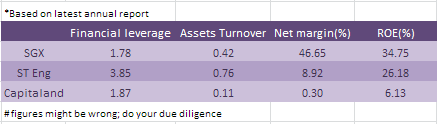
Let's use some concrete examples. I randomly take 3 STI components, SGX, ST Eng and Capitaland. They have nothing to do with each other (in terms of the business they do). The only commonality is that they have easily accessible annual reports so that I don't have to plow through everything to get the numbers required. Lazy, I know :)


So here it goes:


If you look at the ROE component, you'll have realised that ST Engineering's ROE is high because it is more highly geared up. Basically with leverage, you'll have a multiplier effect on your gains or your losses. That's not necessary bad, it's just that if you compare ROE alone, you'll miss that fact.


Again, if you look at the ROE of SGX, you'll find that the main component driving it is actually it's high net margins. That super delicious net margins pushes up the ROE. That is not necessary good or bad, it's just something that might not be noticed if you just focus on ROE alone.


You can dig more about ROE in my previous post here. The real important one is the 2nd link, but it's riddled with broken links of pictures...argh..

1. Dupont analysis of ROE
2. Woe be to those who missed out ROE
(I apologise for the lack of pictures...the server that I had uploaded the pictures went bust...so it's gone)

Thursday, September 25, 2014

Winning the skirmishes but losing the war

We are sometimes so caught up with our lives that we neglect the big picture. We often keep doing the things that are urgent, but forget about the things that are less urgent but nevertheless are important.


Study the matrix above.


Urgent means that it has a time factor to it. It needs to be done as soon as possible in order to meet datelines that are either self-imposed or externally imposed. Important means that it fulfills certain long term goals or mission.


Quadrant 1 are the tasks that are both urgent and important. These are crises situation and are emergencies. Priority should be given to these. But how many crises situation are there in a day? If everything is a crisis, your workflow is not set up yet, so you might need to work on that. An example of such a situation is when your client calls you for an important presentation that may lead to a sale. Everything else needs to be put on hold while you pursue this lead.


Quadrant 2 are the tasks that are not urgent but are important. These are the tasks that are often neglected because of the lack of urgency. A good example is retirement planning. Retirement is a goal that is years away for working adults but if you don't start planning now, it might reach a point of no return. So for such situation, we need to sit down and think about what are the things that are potentially urgent in the future and has great impact on your life. These, we need to do long term planning. You can probably delay for a week or two, but certainly not delay in years.


Quadrant 3 are the tasks that are urgent but not important. At best, these are interruptions to your workflow. It could be your boss asking you for yet another board meeting. It could be your mum asking you to get something for her while you are doing your work.


Quadrant 4 are the tasks that are not important and not urgent. I try to push a lot of task into this category as I grow up. Not a lot of things are as important now as it seems in the past. An example of this is playing games. It serves at best as a time waster event, though we all need such activities to relax and wind down. Just don't make this a priority when there are Q1, Q2 and Q3 things left undone.


The ideal workflow goes like this:


  1. Classify all activities into the four quadrants 
  2. Settle all the Q1 (urgent and important) activities first
  3.  Then try to push those activities from Q3 (urgent but not important) into Q4 (not urgent and not important), as much as possible.
  4. Settle the remaining Q3 activities
  5. Schedule the Q2 stuff daily or weekly into your timetable. They are not urgent but they are still important. So do them on a daily/weekly/monthly/yearly basis. The key point is to plan it into your timetable, otherwise they will not be missed until it's too late.
  6. Do the Q4 activities the last. Or when you need a break from your suddenly productive life.

I'll proceed to give an example of how to use this in a typical student's life.

  • Do all assignments that is due this week first
  • Pass down some 'arrows' that are shot by your group leaders in your co-curricular activities to others. Those that can't be passed down, just settle it as soon as you can
  • Exams are in 2 months time. Have a plan of how your revision schedule will be like. Stick to it every week. Start early, finish leisurely. Start late, finish panicky.
  • Stop watching you-tube videos or korean dramas when you don't even have time to finish the above. Allow yourself only a very limited time to do these per week, and only after you've had a good productive week.

You can be surprised how many people cannot find the time to study for exams until it's too late. Too swamped by everyday living that they miss the big picture. Are you doing that in your financial life too? Too concerned with day to day living and miss planning for longer term goals?

Saturday, September 20, 2014

Will you buy a chair for 1.6k?

I read a very interesting article about the comfort principle this morning. It's about optimising your spending in such a way so that you maximise your comfort level. If not taken to the extreme, this provides a very good guide on spending on things that are of value to you, not merely to catch up with or impress others.


Similar to the author in the article, I also spent A LOT of money on a chair. When I renovated my current home, I knew I will be spending a lot of time at home. I'm constantly having back aches from sitting in ill adjusted chairs and because of the long amount of time spent sitting down, the chair gets hot very easily. It's very frustrating when you know you have to do work but you're suffering from back aches and hot butts. Hence, when I saw this awesome chair with mesh netting (to allow ventilation) with lots of adjustments to fit the chair on you, instead of the other way round, I wanted to get it immediately. But the price tag of 1.6k is what held me back.


This is the exact chair that I bought


That was when my wife came in and reasoned with me. This chair will probably last 6 years, probably longer. My previous chairs lasted about that amount of time too (imagine the aches I've to suffer!!). If I spend 8 hours sitting on it per day, it'll be a good 17,500 hours of usage, which works out to be about $0.10 cents per hour. Considering that this is the 3rd year of usage and it's still running strong, I think it can probably last a lot longer than 6 yrs, bringing down the usage cost per hour. Knowing myself, I will probably not buy another chair if this one can last that long.


And so I bought a super duper chair with a price tag of $1.6k. Sounds like a splurge, but I think it's one of the best buy because it's something I use every single day, bringing me a comfort level that I might not have if I've to get a chair which is way cheaper.


This principle is not a good excuse to buy anything because you only live once. The article mentioned that you must also combine it with knowing what is 'good enough'. Also, what is expensive need not necessary be the best, so don't go judging the quality of items with the price tag.


I think to balance this article, I must also mention that while I can spend so much on a chair, I'm loathe to spend on a watch. A watch is functional to me and it must have 3 things - lights, stopwatch, digital time. I can't wear metal watches (It'll be too heavy for me) and the weather is too hot for leather straps (it'll stink when sweat soaks in). That totally leaves me out of luxury watches, which is perfectly fine for me. I recently got a watch for $30 and I'm so very happy with it. So before you say it, I'm not asking everyone to buy everything that your money can afford.


This watch I got it from qoo10 for about $30


Spend crazily on the things that matter, and frugally on the things that don't.

Sunday, September 14, 2014

Hedging both sides of the bet on life

We usually hedge against a long life by planning for our retirement. We save up. We make sure we have enough passive income to last 20-30 years after our retirement. But we also have to hedge against the possibility of having a short life.


Nobody knows when we're going to pass away. While it's never good to live in the present and forget about the future, it's also equally bad to concentrate solely on the future and skim on the present. I know myself  - I tend to over-worry too much. I worry whether I have enough income and enough savings to last me the next month. It took me quite a while before I can willingly spend part of my savings on myself. I've to thank my enlightened friends to knock some sense into me when I'm obsessed about savings at the neglect of my present self.


So hedge against long life. Go save up for your future self. But do hedge against the possibility of a short life - go spend time with your closed ones, spend money on things that brings you happiness. Different advice works for different people. For people who are tighter on money, advice them to spend more on themselves. It's going to be okay. For people who are looser on their money, advice them to spend less on their present and more on their future. Save up for rainy day.


In the uncertainty of the duration of your life span, we have to hedge both sides of the bet. Live for the moment. Spend impulsively. Live like there's no tomorrow. Then, like a person with split personality, save up for tomorrow. Build up a passive income stream for retirement. Delay gratification.


Is it contradictory? No, I don't think so. The two opposite poles are just swings of the same pendulum. There's no duality. The cup is empty and full at the same time. But if you can't see that the cup is empty and full simultaneously, then practice seeing it as one or the other first. For me, I see that the cup is empty first, so I save up for it. Only recently do I see that the cup is also full, so I must spend to keep it from overflowing.

Friday, September 12, 2014

$10k a month as a tutor? Think again.

I think by now you should have read this post about a tutor who earns $10k a month. Most of what is mentioned in the article is quite true and I can vouch for its accuracy. Some comments on it though, before you quit your job to become one:


1. There's no CPF contribution by employer, leave, benefits, company dinners, health insurance sponsored by company. There's no company benefits at all.


You must learn to take care of your own affairs. Being a tutor is not just about the teaching part. You have to learn to manage your own affairs, save up for your own retirement and do your own accounts and tax. If you really hate these kind of admin stuff and do not want to pick up stuff like accounting, investment, insurance and a million other things that normally people take for granted, then you should seriously consider another job. It's essentially a one man show.


2. Learn marketing


If you're so good at teaching, it doesn't mean that students will naturally come to you. You have to learn how to sell yourself so that you have a constant stream of students every year. Besides learning your craft, the next biggest thing to ensure longevity of your business is to learn how to sell yourself and market yourself well enough so that through word-of-mouth, you'll get constant referrals.


3. Love what you're doing


If you're in this just for the money, I can assure you that you're going to hate this job. In certain months, there's no life at all. You practically work from Monday to Monday. You'll hate public holidays and weekends. You'll no longer have friends who will ask you out for dinner because you're working. You'll get messages throughout the day from panicky students asking you for help to solve this question and answer that query. Your work is weaved so intricately with your life that you cannot differentiate when work stops.


And so, you had better enjoy what you're doing. Do this for the money? You're not going to last long. Students are also not stupid. They can tell quickly if you really care about them or not.


4. Have a support group


It can be a lonely journey. But fortunately, my wife is also working odd hours just like me. We enjoy shopping when people are working and working through the night when others are relaxing. I can't imagine if one of us is working normal hours and the other odd hours. The conflict and schedule clashes should be quite hard to manage. It's good to have someone walking the journey with me.


5. Learn to be a counselor and a mentor, rather than a mere tutor


 You'll be surprised how often I've to settle issues other than those related to studies. Not everyone comes in all motivated to learn. More often than not, I'll have to find my way to reach out to the person. Sometimes, I failed and sometimes I succeed. That's what makes the job so interesting, once you're past the stage of knowing what to teach or how to teach. It's a combination of listening, observing and motivating that makes a person want to do well for his studies. To me, it's never about the exams. It's a way to touch the inner fire within each person, igniting it strongly enough so that it can glow and touch others too. It's a magical feeling that makes you want to experience it again and again.


That's what keeps me going.


6. Be comfortable with the seasons of work and play


You're never going to have a stable pay. Face it and accept it and plan for it. Each year, your income might drop by 50% or more and you'll have to work hard to recruit new students just to match up to the previous year income. This makes a fixed monthly pay such a luxury. Face it, accept it and plan for it. If you're not ready for such a drastic change in your pay schedule, you're going to feel very jittery in the dry season from November to January.


Ten years playing this game, I've learnt to look forward to my dry months when I'm busy with work and looking forward to work in the busy months when I've had enough play. Worry also no use. Learn to flow along and learn to let go. Bad times don't stay forever, so do good times.


You think it's so easy to earn $10k? Try it and see if you can handle the downsides first.

Related post:
1. Self analysis of tuition business
2. Unstable income stream from tutoring
3. The other side of being a tutor

Friday, September 05, 2014

Retirement thoughts

I was thinking about retirement income recently, especially after reading a click bait post from a magical blog. I felt cheated because I was baited into it, so that set me thinking. It's not the same topic however, but certainly in the same general area of personal finance.


To get a retirement income, we have to settle a few variables. Once those variables are thought of, we can perhaps (roughly) solve this question of getting the monthly retirement income. The factors are:


1. When are you going to retire?

2. How much income do you need when you retire?

3. What is your life's expectancy?


Your solution to this question is going to be as good as your inputs and hence your assumptions involved. We might not be able to know all the answers to the 3 questions exactly, but a rough idea is better than none.


Let's apply it to myself. Let's say I'm 35 this yr and I'm going to retire by age 60. Assuming life expectancy of 85 yrs old, I'll still have another 25 yrs to work and another 25 yrs after retirement to ration my money so that I'll have enough for money to last my life. Let's assume that all the medical bills are taken care of by insurance to make the situation cleaner and less cumbersome, so that the retirement income is purely for spending and consumption.


My expenditure is about 3.5k per month, but that includes my mortgage of 1k (split between wife and myself) which no longer needs to be paid by age 60. There are things that no longer need to be paid when I'm 60, like my limited whole life plan and the mortgage insurance. But let's just take it conservatively (in fact, very conservatively) that my expenses is going to be 3.5k.


3.5k per month over 25 yrs after I retired at 60 works out to be $1,050,000. That's on today's terms, inflation of about 3% not inclusive.  How long do I have to save up that amount?


I've 25 yrs of years after retirement and 25 yrs of work years to save up, so that means I've to save 3.5k per month, every month of my working year, in order to retire with enough income to have 3.5k when I retire till I'm 85 yrs old.  Wow, that means I've to earn 7k per month from now till age 60 in order to get that amount. The 7k is split up into 3.5k for living expenses now and 3.5k for living expenses for my future self.


Of course, that's just pure savings alone. It'll be a lot better with some investment returns, so I can accumulate more with lesser savings per month. But the problem is made worse by the fact that we begin with -3% 'investment return' to begin with. That's because of inflation. Just to break even, we need to get 3% per year AND save that much to get 3.5k per month upon retirement.


Not exactly easy eh? So what can be done?


Firstly, lead a simple life and reduce your expenses. If you can live with 2.5k per month, you just need to save 2.5k per month for every working month. The idea is simple. If you want $500 per month in the future, save $500 per month while working. If you want $1k per month, save $1 k per month for every working month.


Secondly, start earning money and start saving early. The good thing is that if you live a simple life now, you probably will be leading a simple life in your retirement too. If you don't reduce your expenditure and spend the exact amount during your retirement years, you'll need a savings ratio of 50% to reach there (3.5k to save for retirement on an income of 7k means 50% savings), based on my 25 yrs of working years and 25 yrs of life after retirement.  I think if you are a conscious spender, and include your CPF contribution in your retirement plan, saving 50% is not a problem unless you are earning below 2k. If that's the case, you really need to find ways to boost up your income first. Unfortunately, you'll have more pressing issues at present to think about than to think about retirement in the future, I believe.


If you start work earlier, you can save for your retirement earlier. Think of it this way. For my situation, I've 25 yrs to work to earn 25 yrs of retirement income. If I start working towards this goal earlier, I might have 35 yrs to work to earn 25 yrs of retirement income. It'll be much much easier and less stressful. Conversely, if you started late and you have 10 yrs of work to earn 25 yrs of retirement income, I seriously don't know how it's going to be done without suffering a drop in standard of living.


Thirdly, retire later. If you push back the retirement age, you boost your chances of retiring better. How so? Pushing back your retirement age shortens the amount of funds needed for retirement because you have lesser years to plan for. At the same time, you increase the number of working years to save up more. This is like a Krav Maga move where you counter and attack simultaneously. If the Israeli martial arts can be used surviving in real life situations, this move of pushing your retirement age certainly increases your chances of surviving retirement, so to speak.


Fourthly, you have to keep on working and be employed. To do that, you need to keep yourself updated and retrained if necessary in order to stay employable. If that's not possible, you'll have to engage in some small business or become self employed. Nobody owes you a living, so start planning for your own business or self employment when still at your prime, while you can.


Lastly, it's taboo but it still must be said. Just live a shorter life. Shorter life, less retirement funding needed. Period. But we can't really control that without resorting to the final solution, can we?


Monday, September 01, 2014

Is it a "waste of yourself" to be caught up in investing?

I think financial education is a must in this world. It's not even an option. Everything (almost) transacts in monetary terms, so without a working knowledge of money, you'll be severely disadvantaged in this world that you're currently living in.


But even though it's a necessity, it doesn't mean everyone needs to be an expert in it. There are different levels of involvement. Essentially, if you're not interested in financial stuff, you just need to know enough not to make big mistakes. If you're more interested in dollars and cents, then you get more involved in perhaps actively choosing your insurance or managing your funds to reap a better return.


That's my new CASIO calculator, by the way.

There are a few components of financial education that we should all know a little about:

1. Personal finance - credit cards, savings, needs and wants, budgeting, tax etc

2. Insurance - the difference types like whole, term, endowment, ILP, accident, H&S, disability income, annuity, mortgage and car insurance

3. Investments - bonds, stocks, retirement funds like CPF, commodities etc


As mentioned, you really don't need to know everything in detailed, because at best, these are just chapter topics. Take for example - stocks. There are huge write ups about the different methods of valuating stocks, from technical analysis to fundamental analysis. If you delve into fundamental analysis, you also need a crash course on accounts to know what is happening. Then you need to read into sector/industry analysis and many reports on the individual companies and their competitors. If you're into technical analysis, there are various time frames you need to learn, the different indicators and their respective signals and whether they are lagging or forward looking. No wonder it's so daunting for beginners to pick up. Where do you start? What do you need to know?


Imagine a person with zero working knowledge of these stuff. They will be at the mercy of someone who knows better and acts in his own self interest. You can't blame regulatory board only for making huge financial mistakes because you trust others. You must also shine the light of blame on yourself for not taking the time and effort to find out more. I made a huge mistake when I bought a huge chunk of whole life very early in my twenties. It sucked up a lot of my cash, possibly not even giving me enough coverage. But it's that very act of stupidity on my part that made me want to learn more about financial stuff. This lead to that, and soon, I began to learn more about insurance because it's really another aspect of financial education. It's a costly mistake on my part (I've since reduced the coverage of that whole life and thus reduced the premium) but in a way, my lack of knowledge made me a susceptible victim to any one who is more knowledgeable and wants to earn my money.


So when a student from the sociology department asked a panel of speakers in the first Young and Savvy seminar on Aug 22nd this year, about whether it's a "waste of yourself" to be caught up with the idea of investing just because everyone else seems to say it's important, I thought that he hit a very important question.


The Young and Savvy series of talks is organised by The Straits Times with presenting sponsor, Frank by OCBC. Note the sponsor is a credit card by a bank.


Just because you're not interested in something doesn't make that something less important to life. I think investing, which is but a component of financial education, is as important to life as swimming. You might not need to swim for your life everyday, but when you do, you'd better know how. It's a shame that our education system does not have a major component of financial education even though it's so important to life. Things might be a little better now though, I must admit. At least this gap is recognised and steps are taken to incorporate more of these life skills into their curriculum, albeit in the form of extra curricular seminars or workshops. It'll be great joy to tutor someone in financial education in the future, I must confess.


But learning need not be formal. Most of us learn though informal channels anyway. Educational institutions should just be a place where we learn how to learn. Engineering, the course I major in, is really a good place to learn how to learn because you learn enough about everything so that you can pick it up yourself. In my 4 years, apart from the heavy stuff in engineering itself, I've learnt a little about accounting, sociology, communication skills, microbiology, economics and computing. No small feat. If you want to find out more, you can just pick up a book, or google it and learn. I'm sure there are more formal courses online, free or otherwise, that enables you to pick enough stuff so that you won't feel so daunted learning them yourself.


So start now. Read some blogs. Read some books. Enroll into some courses and learn the skill that is so essential for modern life now and reap the benefits far into the future.