Sunday, February 20, 2011

The youth and the stock market

Quite a lot of people are joining the stock market at a younger and younger age. While it's important to know about such things eventually, I wonder about the wisdom of joining it at such an early age. Isn't there something else to focus on, like socializing and indulging in pointless but memorable pursuits? I started doing this stock thingy when I'm 26 or 27. I've the bulk of my earlier years doing plenty of pointless but memorable stuff. I remembered playing lots of RPG games, reading extensively on all sorts of topics (except finance) and simply just day dreaming.


Would I exchange all these stuff for an earlier retirement? I doubt so. It's just part of growing up, I suppose. I fear that the younger the youths are joining such financial pursuits, the faster they would lose their youthfulness and idealism. The financial arena is not for idealistic individuals because they would be washed out in no time. Will today's youths be losing their idealism at an earlier age too? Who else could be idealistic if not for the youths?


The youth are greatly limited by the lack of capital. I don't know about them, but when I'm in my early twenties, even if I've the interest in the stock market, I would perhaps have less than 10k in my bank account. And what could I possibly do with 10k in my bank account? Buy s-shares? Buy those pennies and hope that my skills in picking out a gem would ensure that my 10k would multiply? It's not impossible, it's just terribly hard and the odds are against you since without the necessary capital, every shot counts even more so and the tolerance of mistakes are significantly reduced. Or perhaps driven by the lack of buying power, one would be driven to use leverage to enhance the gains (and the losses)?


I think like a kitten, the youth should spend time on playing.


So, what's the point of dabbling in the stock market when one is so severely limited? I believe that without a minimum capital, it is better not to start investing/trading. That minimum should be around the range of 50k. Why 50k? With that amount, a position of 10k can be placed each time, so one would have 5 bullets in total. With 10k, one can buy most of the blue chips, which are a lot safer than pennies, though the gains are not as substantial. With 5 bullets, perhaps 3 would be average, 1 would be spectacular in profits and 1 would be in the loss, so one would come out of it alright. But what happens if you don't have 50k to begin with? Then stop kidding yourself that the positions are for long term investment and stop deluding yourself that the amount of dividends would contribute towards your passive income for attainment of financial freedom. Even if you struck gold, the amount gained would be insignificant.


A lot of youths start to believe in their own investing/trading powers after reading up on a few books by their gurus. That is the problem isn't it? Clouded by youthful optimism and confidence, they march straight into the jaws of a shark, still thinking that they can escape unharmed. I think it takes life experience to sieve out skills from luck, because a skilled person would have the same outcome as a lucky person. It also takes life experience to sieve out the market truths and the myths. Literature cited time in the market is better than timing the market. I'll say it depends on which stock you're holding. The wisdom it takes to determine when an advice is appropriate to a situation will take time to develop. I'm just not sure whether when I'm in my twenties, I would want to learn about such things. I feel that a part of something in me would be lost and gone forever. You can get all cynical and skeptical after being 'tainted' by the market, especially if you've lost a lot of money.


Seriously, I would recommend most youths to simply concentrate on their studies or get a part time job and in the meantime, just read extensively about finances in general and not to focus so much attention on the stock market. There is a time to do everything and once that time has passed, you'll be wondering how your youthhood is like. Would it be full of adventure and memories or would it be that you've made a ROC of 10% but an absolute amount of $1000? What is $1000 to a youth with no proper earning power yet and what is $1000 to a working adult?


Wednesday, February 16, 2011

Seasons of life

I seem to be going to a lot of baby showers recently. Either that, or I'll be visiting people who had just given birth in hospitals. It seems that this is the season where a lot of my friends are having children. Not too long ago, I'll be invited to a lot of wedding dinners. Seems like there's a season for everything.  If we divide a person's life into 4 seasons - spring, summer, autumn and winter and place milestone events of one's life accordingly, we can see a closer relationship to what kind of seasons our lifestage is currently at.


Spring - In this phase, people are getting married. I was invited to a lot of wedding dinners a few years ago, so that must be the peak of the spring season. Interestingly, as I was married last year, I'm the last few people among my friends who are married; most had already been married a few year earlier than me. I doubt I'll be getting a lot more wedding invitation now. Maybe just the occasional once or twice a year, as the bulk of my friends had already tied the knot. Spring is filled with hope and anticipation, full of wonder as to what the new year might bring.


Summer - This is the phase that I'm currently at. Recently, I've been going in and out of KK hospital and buying gold bracelets / anklets for babies to celebrate their 1st month into the world. Some are already having their 2nd kid. Again, since I had a late spring, I'll likely have a late summer as well. I kind of expect more and more of such occasions until maybe 5 years later, where the reproduction system and the desire to have kids die of with the passage of time. Summer is filled with fun activities but also equally filled with sweat from the higher temperature. Everything is still sunny and bright.


Autumn - This is the phase where the children of my friends are getting married. It can also be the marriage of my own children. I'll extend the season to include the birth of grandchild. Obviously I'm not at that kind of age yet, so I've not attended a single such events at all. But I can see that my parents and my in-laws are already into the autumn season. Some just entered the autumn (children getting married) while others are deep into the season (birth of grandchild). Autumn has a tinge of melancholy amidst happiness, as the encroaching coldness and bitterness of winter draws near.


Winter - This is the phase where one is attending the funeral of your friends/spouse. I wonder how that will feel, with the pool of friends slowly diminished by the encroaching touch of death. Will it be scary, will it be lonely and will it be gloomy? Winter is cold and lonely, always wishing for the warmth of people around you.


But if there's no despairing winter, there won't be hopeful spring. Life is a cycle filled with seasons, isn't it? I think seasons can equally be applied to investing. I leave it to readers to draw a parallel between the two.

Tuesday, February 15, 2011

Money management skills

These days, I tend to focus on the planning part of executing a trade. I'm no longer the trigger happy person I was when I first started in the market. I guess it's no longer exciting to me, and I don't have such a high expectations of it, so the stress is no longer there. I used to think of wanting to get a few hundreds every week from trading. I think all these targets are making it hard to think properly and you always want to do some action instead of patiently waiting out. I removed all such targets from hence on.


Besides learning about the technicalities of a trading system, I think the more important part is learning how to manage your money. You must have heard a lot of people saying about money management and all, but what does it really mean? To me, these are the key elements:


1. The amount of capital allocated to each position


2. The risk/reward, the cut loss and take profit point for each position


I find that over time, there's nothing new I want to add to my trading system. It works fine for me, both financially and psychologically, so I know that is the correct trading system for me. The only thing I want to keep on improving would be on my money management skills. Money management is really about allocating a limited resource (money) to where it's treated best.


It's interesting that only after the bulk of my free cash is spent on my highly expensive flat, and that I've really limited resources to trade, that I actually spent a lot more effort looking for the best bang for my buck. You can even call me a reluctant trader, in the sense that if certain conditions are not right, I would not even look at it. If it hits the right conditions, I'll reluctantly put in a small position to test it out. If it hits another lower point and the conditions are right again, I'll enter reluctantly again. This mindset of sieving out what's wrong about a trading position is new to me. I think in the past, I'm looking for what's right about the trade, and there are lots of reasons to enter something. You see what your mind wants to see.


So in the middle of a trade, I might want to free up my resources tied up in a position to have cash, not because the trade has run its course, but rather I saw a more attractive potential position coming up. I'm arguing with myself whether the extra bids I can get from waiting out the full potential of the position I'm already in is worth the wait and therefore the risk. It's the opportunity cost of holding a position and locking up your capital, especially so if the position is profitable. That is, again, new to me because I used to have the resources to do up to a few trades at one time, but now I'm reduced to maybe 2? So, in a good way, I'm being forced to evaluate all my positions to get the best out of my portfolio, instead of an individual trade.


That, I think, is the epiphany that struck me when I was browsing through my charts late at night.

Saturday, February 12, 2011

CMA post action report

I entered a trading position on capmallsasia a few days ago. I'm surprised that I closed it in 3 trading days since it hit my target price. These days, I really can't be bothered with that few extra bids that I can get by staring at the screen constantly. I just leave it with a queue order, if it hit, I'll be happy with it. If not, I'll queue again. Lazy way to trade, really.


I've been eyeing this counter since CJ mentioned buying it months ago. It had been interesting academically then but it only became interesting to me when a buy signal is triggered recently. I got in a 1.84 when it hit my overnight queue order and had been rising for the last couple of days before the party stopped. I cashed it out when it hit my tp of 1.96 3 trading days later. Since I had covered the full MA channel for this trade, I'll say it's a pretty good one.


Of course, on hindsight, it could have been better if I waited 2 days later because the price went up to a high of 2.05 before coming back down to 1.91/1.92 at last close. It's really important to leave when the party is still on. I do not want to leave when everyone is leaving. And so because of this, I would always have to leave some run behind for others, which is perfectly fine with me. If I had 2 batches, I would have cashed out a batch at 1.96 and another one at 2.00, near the value zone of the weekly. But since I had only 1 batch, I don't want to change my tp on the go and adjust while I'm still in the trade. That happens so many times before - I changed my tp in the middle of the trade, and it came crashing down on me. No more of such things in the future.


Is it a good time to re-enter? That's the thing, I'm unsure now. The weekly says there's more room to run (though I don't like the last candle on weekly), the daily says hold it first. I'm hesitant because if you take the movement from 1.83 to 2.05, the pullback that we see the last couple of days can hardly be called a 'retracement'. It could be the more macro environment pulling its weight on this stock, who knows? I'll be watching 1.88/1.89. If that happens and there isn't something better that comes along, I might just return for second round.

Friday, February 11, 2011

Recognizing short signals

I think it's important to learn how to short, even though you may not wish to do it. Most stock exchange would frown upon shorting and measures had been set up to prevent people from doing naked shorting. That's all well and understandable. However, I think for those who are always on the 'long' side, it's equally important to learn how to recognize short signals.


In the past, I'm more interested in looking out for buy signals because that's essentially what I do. I buy first and sell later. I don't sell first and buy later, which is essentially the meaning of shorting. That makes me very good at buying and finding the right entry. But to fully complete a trade, you must learn how to buy and to sell. I would say that there are so many books on teaching people how to get into a good entry but not many on how to sell properly. Of course, getting a good entry is half way there, but getting a good exit is the more important half. It's the half that determines whether you turn a profit into a loss. It's the half that makes a losing trade a winner too.


Anyone knows the link between this picture and this post?


But understanding when to short need not mean that you have to actually short it. In recognizing a short signal, you can either choose to short it, stay on the sides, sell your position or choose not to buy. I think choosing not to buy is the most important use of recognizing a short signal, especially for those who only do long trades. If you choose not to short upon seeing a short signal, the very least you can do is not to initiate a buy position. That is both sensible and financially rewarding, isn't it? Alternatively, you can choose to sell or trim your holdings knowing that the price will come down again. That's taking partial profits.


So, do not just concentrate on one side of the equation. Find out more about on shorting so that you can recognize a short signal when you see one. In that way, you can smell a change in the wind direction when it happens. Remember, just like seeing a buy signal doesn't mean that you have to buy it, seeing a short signal doesn't mean that you have to short it either. The more important use of recognizing such signals is to choose not to act 'oppositely' to it. If you see a buy signal, you do not short. If you see a short signal, you do not buy.


Knowing when to commit yourself to a trade can often be the lifesaver, rather than stop/cut loss. Prevention is better than cure yea?

Wednesday, February 02, 2011

Chinese new year

I never really like Chinese new year. I know I sound like the proverbial beast 'nian' that roams ancient China during this time of the year. The way to frighten off this beast is the excessive use of red everywhere and the setting off of firecrackers to create loud noises. I must say it certainly 'frightens' me off as well. That is not the most irritating thing to me, since there isn't any firecrackers setting off anyway here (it's illegal to have it). Oh, there's also nothing to eat too except for fast food. Town area is practically zombified. But the worst thing about Chinese new year is the incessant playing of Chinese new year songs. It's like having to listen to someone scratching the blackboard with his nails, except that it's never ending and omnipresent! Imagine you're in a heady daze squeezing through the crowd of people feeling stressed up and frustrated, and in the background, you hear the ever chirpy Chinese new year songs....horrible.


Maybe it's just me. A chinese new year humbug, so to speak. My family doesn't really celebrate it either. There's no sign of any decorations nor even the buying of chinese new year goodies placed at home. It's really just another normal day, except for the reunion dinner where we'll always eat steamboat at home. It's about the only time of the year where I'll be watching more tv than usual (my usual is not watching it). After enduring the fake happiness and fake chirpiness of the actor and actresses singing their usual routine of songs, I'll watch out for the annual chinese horoscope reading of the 12 signs by some master. Not that I really believe in it actually. It's just a ritual, a tradition and as rituals and traditions goes, you don't really want to question why you do certain things, otherwise you'll spoil that magical moment.


This year, however, promises to be different from all the other new years I've lived. Firstly, I've got two reunion dinner to attend to. Thankfully, it's not going to be a pig-out event on Chinese new year eve because I've already 'completed' my side of the reunion dinner on last Sunday. The schedule of different families, each with their own commitments, make it hard to find a suitable time where everyone can be present to have dinner. Hence, to facilitate everyone, it's just held earlier. So, I'll be spending today waiting for the reunion dinner at my wife's home. That's the highlight of the day actually.


Secondly, I've to give ang pao instead of receiving them. I think this is going to be an experience. I certainly don't mind giving them. Hmm, maybe all that would change after this 'honey-moon' period. I never really bother changing the new crisp notes from the bank with the serial number all running consecutively. Money is just money right. (anyway, don't they say it's just for goodluck?) As long as the notes are presentable, I think that should do it. Besides, I drew it out from the atm machine, so these are pretty new. If you drew it from atm near big branches, the notes might even be in running serial number, so you can save yourself the long queue.


Enough ramblings, have yourself a merry chinese new year!

Thursday, January 27, 2011

Singtel post-action report

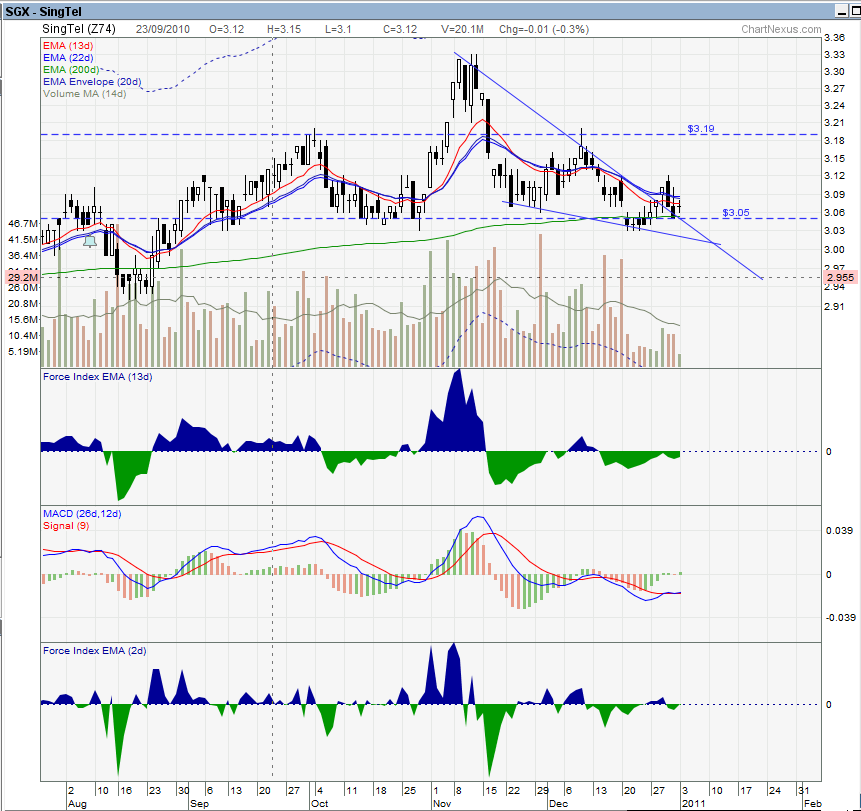
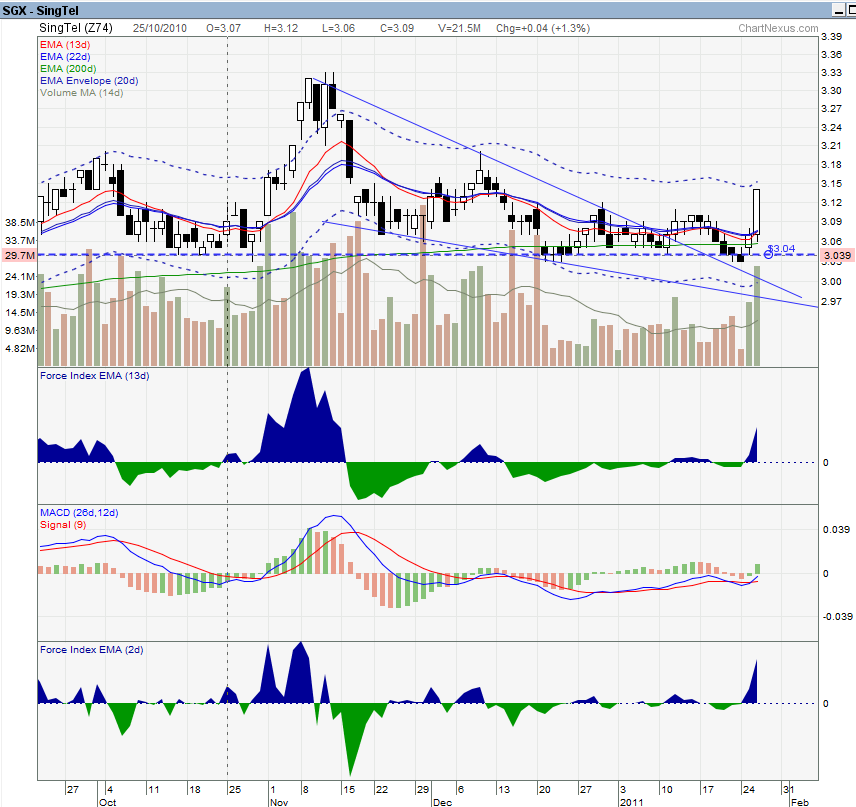
After posting the chart on singtel a couple of weeks back on 10th Jan, I was pleasantly surprised that it 'popped' on 26th Jan, with the price rising 2.3%. I had decided when I've posted the chart earlier on that I would not trade this counter. The reason is that the counter is too heavy, and I do not have a lot of spare cash. At most, I can only do 2 lots, but if I'm stuck with it, I do not have enough to average down nor do I want to lock up my capital there. Then, I've put up a entry price of 3.04 to 3.05 with expected tp of 3.19.


Even though I did not trade this, I thought it'll be useful for me to analyse what is right about the trade. Here's the chart on 10th Jan:


Here's the chart on 26th Jan:


Here's what I think about it:


1. The bullish descending triangle works out very well, with the price popping out of the upper trendline of the triangle with increased volume. It however didn't rose immediately after that. Instead it continued to consolidate before rising up . This might fake people out of the breakout.


2. There is not only a bullish divergence, there's a triple bullish divergence, with the price continually forming lower troughs and the macd histogram forming continually higher troughs.


3. Long term FI divergence.


My initial target price of 3.19 thereabout still holds, though I'll be careful about the resistance cloud of 3.15 to 3.17. If anything is not right, it's really alright to take your profit and live another day.


Another reason why I didn't trade singtel is because at the time when I was tight with cash, I was trading singpost. Even though my singpost trade has lesser ROC than the singtel trade, I can hold more lots because of the price per share, hence my absolute amount for my singpost trade is still higher than if I had committed my capital on singtel. Sometimes, getting the winning trade in terms of the highest percentage might not result in the best outcome in terms of absolute amount. In light of money management and the risk of the possibility of getting my capital stuck in a heavy counter like singtel, I gave up the trade. Come on, singpost, make me proud!

Wednesday, January 26, 2011

Finding a style that suits me

After being in the market for quite some time, I realized the style that is most suitable for me. The style that one adopts is important, because it caters to the different needs that one craves for and yet able to make a decent return. Due to the nature of my work, I cannot have access to internet all the time (nor do I wish to), hence intraday trading which I used to do when I first started is out of the question. That includes things like warrant trading, which occupies most of my time when I first started in the market circa 2006-2007 period. I've not dealt with warrant trading since, because it's just too excited and too distracting to me, to the extent that it takes concentration off my work. So, intraday trading (and warrants trading) is out of the question.


What about value investing? I took to that after recommendation by a few people, read the necessary accounting books (I have no prior background at all in accountings) and the mandatory books in value investing. Tried my hands on plowing through the many research materials available publicly in the form of annual reports and through the internet. The results isn't spectacular. Most likely it's the time period when I'm doing value investing - I didn't give it enough time to see the results come to fruition. Given more time and less work, I think I might have enjoyed researching in depth on any particular companies. There's a certain joy in carrying out detective work on company - I realised that when I tried it out on several companies (hongguo, most notably). However, I find that this is an uphill battle for me as I struggle with difficulty in analysing both the company's business (I don't have practical business knowledge) and the numbers that quantify the financial health of a company (I'm not good at accountings). I can be okay with it but I'll never be good in it - that I realised. For basic accounting, everybody with a mind set to do it can read it up, but without real practical knowledge and years of immersion in working on it, the knowledge is at best superficial. I'm not quite prepared to spend my time on it, hence I realised that this route is not for me. There just isn't enough time at hands to deal with so many things in life, and I can do with one less on my hands. I figured that as one grows older, the commitments that take away one's time will only get heavier and heavier, never lighter. Time being a precious commodity that I have requires me to allocate it to places where I can get the maximum result with minimum effort.


I think I'm a ranger - one who does long range sniping (long time frame trading)
and a touch of ranger spells (FA). The spells cast are used to aid in sniping.


What about trading using TA? Oh, this I can do. The system that I'm trading (it's counter trend trading, for those who are curious) with doesn't require much time to pick up (though it requires a lot of time to master, and I'm not a master) and most importantly, it doesn't generate signal all the time. Funny right? People would have thought that a system that generates signals frequently is a good system. I think that a system that fits into one's routine and is also robust is a good system. I don't have the time to check out the prices every time and I might not be there at THE moment when the timing is at the best, hence it's important that any system that works for me doesn't generate a signal frequently. My ideal trading period is anything from a week to a few months and what's really comforting is that there'll be more signals when the market is down, which fits into my psychology of buying cheap, rather than chasing after high (e.g. breakout). I'm definitely going to do this as and when the signals generate as it had provided me with the occasional 'ang pao' to settle the necessities in life.


Knowing that I have to concentrate on my career where I can get the maximum returns (though not necessary min effort), I'll have to put more money into getting passive streams of income. So far, this is in the form of reits where in this low interest environment and their leverage form of business model, they are thriving pretty well and giving a returns of anything from 5% to nearly 10%. This will not go on forever so there's a time I'll have to give up the passive streams and get my capital out again. The ideal case would be the most inspiring case blogged recently by bro8888 regarding his kepcorp - a blue chip bought cheaply at high double digit yield. Those are the kind of passive income that would be more resilient through the inevitable ups and downs of the market. Still, there is a time and tide to do everything. With the bull market raging on, it's foolish to get blue chip now and I only hope that I'm strong enough to buy it when the bear market comes.


That's it for me - a bulk of capital into dividend yielding counters (Saizen, Aims, SP ausnet, FCT, First Reit, HSBC pref shares A), a dash of trading (ah hock, singpost, sabana) and another bulk of capital at a international blue chip (HSBC). There's a few dud counters that I'm still holding and it's not taking a lot of capital, so I'll just see what surprises it can throw at me (sitraH, sunning tech).

Tuesday, January 25, 2011

Try beating my high score!

I don't know what the fuzz is about the infocomm thingy, but it sounds like a great buzz is generating on the social media. I'm rather attracted by their graphic designs so I clicked in and went around to check it out.


You can go in and take a look around at what's on offer..I think there's a scholarship for those who are interested in pursuing a career in it. What's interesting is that you can also get a chance to win the coveted xbox 360 and the newest Kinect by playing some games! Trust me, Kinect is really fun, haha!


The game is actually a series of 4 mini-games where you are tested on different skills. The first one tests your maths skills, the second on analytical skills, the third tests how good you are at connecting things and lastly, the fourth test is about...erm...it's kind of hard to describe, haha :) Well, if you've played those nintendo brain games, these mini games are quite similar to them. If you win the highest score, you get a chance to win the console! You can try as many times as you like and at the end of the game, you'll get a sort of a verdict on what sort of job you're most suited for. Kinda fun :)


I played it once and got a score of 5640. My second try is 7350 (50%, 30%, 40%, 27%). Not too bad lah, try beating my score, haha!

Sunday, January 23, 2011

Food for thought

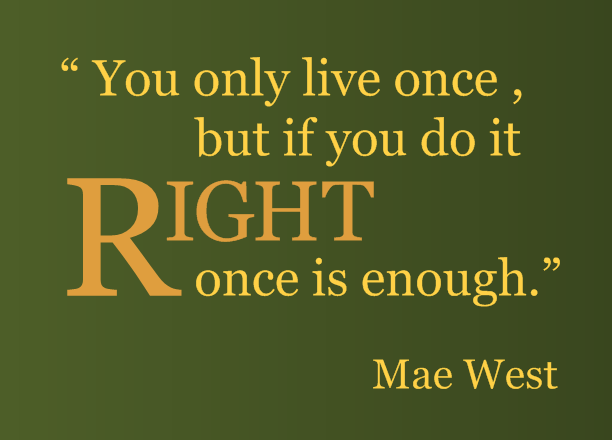
I came across this wonderful quote by Mae West. I thought I should share it with everyone. It captures the spirit of not shortchanging yourself and living a life to the highest potential. What is considered 'right' is different for everyone, but I think the best way to find out if something is 'right' is to consider whether you'll regret how you live your life and the decisions that you've made. If you find that you are regretting less and less, you're probably going towards the right path.


Interestingly, if I replace the word 'right' by 'wrongly', it'll stick make perfect sense, though the meaning is changed entirely. "You only live once, if you do it wrongly, once is enough". That line has a quality more akin to a warning, rather than the original one which is more encouraging and uplifting.


I was reading up on typography recently and I wanted to try out some ideas on some arrangements of words, so I designed up this picture and selected the colours and all. Something doesn't feel quite right with it, but I'm not sure why too. Oh well, hopefully when I did more of such work, I'll be able to say what's wrong with it. I do like the colours though :)


Regarding the quotes, that's food for thought for Sunday :)

Saturday, January 22, 2011

EZ-reload with POSB everyday card

I'm very happy with my POSB everyday card. After using it since May 2010, I realised that I've chalked up more than 60 SGD worth of daily cash rebates that can be used to offset anything from watson's purchases to credit card bills. Not too long ago, I became aware that POSB is offering 2% cash rebates on ez -reload. I think this is a new feature because I remembered working out some sums and concluding that it's not worth the effort.


EZ-reload is the feature where you can link up your ez link card to automatically top up a pre-determined amount. This feature used to be free for the older ez link card, but it is currently chargeable for a fee of 25 cts for every automatic reload. This pisses off quite a lot of people, as far as I remembered. A service that is rendered free suddenly becomes chargeable, so the response is thus understandable, especially to the lower income household where 25 cts can be a part of the cost of a trip.


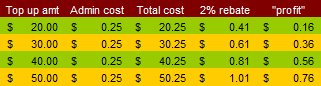
However, with this 2% cash rebate, things will be different. I worked out the maths of the whole deal. No matter how much you pre-set for the auto top up to occur, there will always be a charge of 25 cts. I think it's more worthwhile to put a higher pre set amount (I think you can do $20, $30, $40 or $50) to reduce the percentage of the charges. Here's a table to show you the summary:


As you can see, by getting the ez-reload using POSB everyday card, you can not only offset the admin cost of 25 cts but also earn a tiny sum ranging from 16 cts to 76 cts, depending on the top up amount that you pre-set. Seems like a good deal. The advantages of such a deal is obvious - besides the cost savings (in fact, it's earning you some cents), there's also the time savings feature. In the past, before I used this ez-reload feature, I've to keep in mind the value in my ez link card. If it's nearing $5, I'll top up because if it runs out, I'll be in trouble. Now, it's going to be one less thing off my mind. The final advantage is that you can carry less cards, since a credit card and the ez link card is merged into one.


The disadvantages are as follows:


1. Precisely because there are so many features packed into one card, the card becomes immensely important. It better don't get lost because you'll have to cancel both the ez-link reload feature as well as the credit card. Not for people who are careless and have a history of losing such things.


2. The feature is good while it lasts. Not sure if there's any time duration for such cash rebates. It could be a permanent feature of the card. Citi smrt card is also joining the band wagon to offer 2% cash rebates for ez-link reload.


Anyone who wants to apply can go to this link here and follow the instructions. It's really quite simple.

Tuesday, January 18, 2011

Resolution: To spend more money

These days, I'm thinking how to spend more money instead of saving them. Why the sudden turn of events? I wanted to jump into a new and higher level of doing things (the "work less earn more" paradigm), hence I would have to change to a new and higher 'me'. If we want to have more fruits from a tree, we don't focus on the fruits. Instead, we focus on the roots of the tree, the hidden, the invisible. So, it goes that in order to jump into a new paradigm, I have to change my thinking and my way of doing things.


For the longest time, I'm concerned with savings i.e how to save more money. Besides saving up for certain milestone goals like wedding, housing and renovation, I was reflecting hard on why I need to save so much money for. I realised that I'm hoarding money to feel secure. Somehow, my financial blueprint is telling me this: If I have more money, I'll feel more secure and therefore happy. More money = more happy. But that is not so! I need to change that kind of thinking and re-wire that financial blueprint, otherwise I'm not going to be happy no matter how much money that I make. It might even bring misery to myself because I'll always want more happiness and more security and more money. I want to be able to spend money without feeling guilty, basically. But with my current financial blueprint, I can't spend money and feel indifferent. There'll always be a tingling sensation that questions whether I am overspending. I recognise that this is a problem, perhaps even worse than overspending because people see this frugality as something positive and something to be proud of. It's not to me and I want to change it.


I like the first line and I'm trying to correct that. I'm learning how to spend money.


Once I decided to re-wire my "more money = more security = more happiness" blueprint, I thought about how to do it in the past few days. I already have an inkling that I need to do something and I think this would be the first time I'm really serious about changing it. I wanted to create an account where I would spend a percentage of my income. Since my income is not fixed and it changes from month to month, I'll allocate 5% of previous month income as a 'play jar' for my current month. So, for example, if I earn 3k in January, I'll allocate $150 as a play jar for February. This money is to be spent on things that I value or on people that I value. If I can't finish spending it this month, it'll roll over to the next month but I would have to finish the account by the end of the year. At least I'll try.


I'm not advocating frivolous spending here for my play jar. This money is used as an outlet to reward myself and to reinforce the idea that spending money on things that I value and/or people that I value will bring me happiness, not hoarding the money. In the past, I want to earn more money so that I can save more and hence feel more secure and happy. I'm trying to change all that. Now, I want to earn more money so that I can spend more (again, I cannot over emphasis this enough - spend on things that I value and on people that I value), so that I will feel more fulfilled. Fundamentally, I want to remove the link between security and happiness to the amount of money that I have.


I doubt I've a lot of things to spend on myself, perhaps the occasional gadgets only. But I do have many people around me whom I value and that I would gladly spend on them. Maybe food, maybe gifts or maybe donation. Maybe a year end bonus for my parents. I don't know but I'll try this out for half a year and see how it goes. If I feel good about it, I'll continue or perhaps tweak the 5%. Let's play by the ear.

Saturday, January 15, 2011

Being the right person at the right place at the right time

In life, it's often not enough to be at the right place and at the right time. You also have to be the right person, at the right place at the right time. You'll hear people lamenting that if only I'm born earlier, I would have bought this piece of landed property at cheap and after 20 years, I'll become a millionaire because of the property appreciation. But seriously, if you're not the right person, you might not even buy it even though you're at the right place and at the right time.


The same goes for stocks. You'll hear people lamenting that if I've the money, I'd buy the blue 'cheaps' at super low valuation during the bear market and get all the multi baggers that is the envy of all investors. I think even if you have all the right ingredients, if you do not have the right mentality i.e. if you're not the right person, you'll still not act on it.


Taking a brilliant photo is about being the right person at the right place at the right time


The mentality that shapes us is very important. And this mentality changes over time according to our successes and failures and in general, our life experiences. If I'd met my wife 20 yrs earlier, I might not have loved her as I do when I met her 10 yrs ago. I'm a different person 10 yrs earlier and 20 yrs earlier and I'll bet she's a different person at different times too. So, I think that sometimes, the longer path is actually the shortest path. If you have to take the longer path to reach the same destination, take it that it's the universe's way to make you the right person, so that when you reach the right place and the right time, you'll do the right thing.


Now, isn't that a liberating thought to have - that if you have to take a longer path, it's training you to be the right kind of person so that you'll do the right kind of action at the right place and at the right time? Success will follow you wherever you go.

Friday, January 14, 2011

How to get the most out of a rights exercise?

Regarding rights issue, I've a fair bit of experience dealing with this, hence I would like to share some of my findings regarding the rights exercise. A rights exercise has got 2 components to it:


a. Firstly, the amount of rights entitled to you and the price of the rights shares.


This is basically the terms of the rights exercise. If a rights exercise is 2 for 10 @ 20 cts each, it means that for every 10 shares that you have, you're entitled to 2 rights shares at 0.20 per share. For example, the very recently completed first reit rights exericse, it's a 5 for 4 rights issues @ 50 cts. This means that for every 4 shares that you owned, you'll be entitled to 5 rights shares @ 0.50 per share.


b. Secondly, the excess rights allocation


Besides applying for your entitled rights based on the amount owned before XR, you can also apply for excess rights. These are shares that you apply over and above the ones that you are entitled to. The good thing about the excess rights is that you can get it cheaper than the price of the shares after XR and without paying any brokerage charges. The bad thing is that if you apply 50 lots of excess rights, you might not get any at all.


In this blog post, I'm going to share how to make the most out of a rights exercise. I'll explain in terms of the very recently completed first reit rights exercise, since their numbers are still fresh on my mind.


As mentioned, first reit rights is a 5 for 4 rights exercise, with each right shares priced at 50 cts. The price just before XR is around 0.95 to 0.97 thereabouts. After it goes XR, the price of the mother share will drop to reflect the dilution because of the greater number of shares. Since I do not own any first reit until it announced its intention to have a rights issue, I wanted to own a certain number of lots before XR so that I can maximise the amount of odd shares rounding when they start balloting for excess rights. The whole system works like this - preference for the allocation of the excess rights would be firstly for those odd lots holder. For example, if I own 10 lots of first reit rights, I'll be entitled to 12.5 lots of rights (10/4 x 5 = 12.5), so I'll end up with odd lots. If I apply for 1 lot of excess rights, the chances of me getting 0.5 lots to round up my odd lots is significantly higher than other people who do not have odd lots rounding. In fact, for all of my rights exercise I've been through, there never is a time where my odd lots are not rounded up. I'll say it's a pretty safe bet.


This works because straight away, you'll be entitled to 0.5 lots @ 50 cts each. It contributes more if you're a holder of lesser lots and it's not so significant if you have a lot of holdings to begin with.


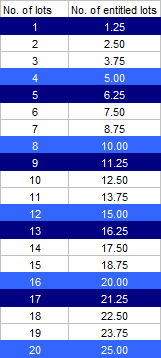
To maximise my lots, I worked out the maths empirically on a spreadsheet because it's easier to observe the relationship. Again, the rights exercise for first reit is 5 for 4.


First reit rights exercise: Optimum lots to get maximum excess rights for odd lots rounding


The lighter blue rows are the round lots. If you do not want to end up with odd lots at all, you should buy in 4, 8, 12, 16, 20 lots etc, i.e. in multiples of 4. Doing so, you'll always end up with round lots. The darker blue rows are the optimum amount of lots to buy in so that you'll end up with the maximum amount of excess rights due to odd lots rounding. The lots are 1, 5, 9, 13, 17 etc, i.e. one more than the multiples of 4. You can work out the formula for subsequent members of this series - it's 4n+1, where n is the any integer starting from 0.


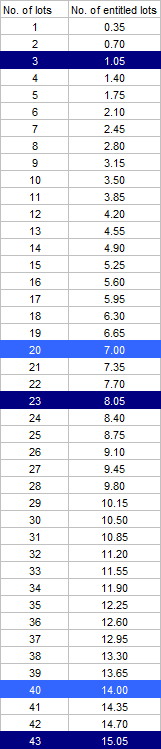
I'll give another example for the sake of illustration. Let's use the not too recent AIMSAMPIReit rights exerise. This one is 7 for 20 rights exercise at 0.155 per rights share. Let's take a look at the allocation:

Aims rights: Optimum lots to get to maximise the excess rights from odd lots rounding


To optimise the amount of lots to hold in order to get the maximum excess rights from odd lots rounding, we have to buy 3, 23, 43 lots, i.e. 3 lots more than the multiples of 20. These are shown by the darker blue rows, as opposed to the light blue rows which are the number of lots for those who do not want any odd lots at all. The formula to optimise this is: 20n+3, where n is an integer starting from 0.


People are afraid of getting odd lots and I do not know why. If you have POEMS or other brokerage accounts that allows you to trade odd lots on the open market, then there's really no problem with getting odd lots. I've traded odd lots on the unit share market on POEMS and they charge a lower minimum commission than ordinary lots, though the spread might be larger because of it's not liquid enough. Still, with the two examples shown above, you should be able to work out the formula yourself if you wish to capitalise on your chances of getting excess rights from the preference given to odd lots holders after the rights exercise.


The second thing to do to make the most out of rights exercise is to capitalise on the factors that affect the allocation. Let's list out all of them:


1. The amount of lots owned before XR


2. The amount of excess rights applied


As mentioned, preference would first and foremost be given to holders of odd lots after XR. Any others would be subjected to balloting or the rules set by them. AK had done a very good post on the possible theory on how first reits distributes its excess rights. It'll make perfect sense to allocate based on the entitled rights (which in turn is based on the amount of lots owned before XR). It would seem that it had nothing to do with the excess rights applied, unless of course the excess rights applied is lesser than the allotment based on AK's theory. An interesting observation is that the excess rights allocated would NEVER exceed the amount of lots owned.


I did put the data collected after the rights exercise of aims together to do some number crunching. Unlike AK, I tried to put it to some model to see if it fits. Upon seeing his post, I think that it's more likely that the companies would stratified their excess rights allocation according to different strata rather than a function like mine. Anyway, here's what I found out:


You'll find that the amount of excess rights allocated (after accounting for odd lots) has nothing much to do with the amount of excess rights applied at all. I'm not looking for some formula that can be applied to all other rights issue (I doubt there is such a thing) but there seems to be no visual correlation between the two.


Looking at the lower graph, there appears to be some positive correlation between the amount of excess rights allocated (after accounting for odd lots) and the amount of holdings owned before XR. I understand that the entire relation is determined by the far flung end point on the right, so let's just ignore it for now. The best I can say is that generally, the higher the amount of holdings that you have, the more excess rights would be allocated to you. Again, the amount of excess rights allocated to you NEVER exceeded the amount of holdings that you have.


With my findings on Aims and that of AK, we can safely conclude the following:


a. Excess rights allocation is based on the amount of holdings that you have. The more holdings you own before XR, the more excess rights would be allocated to you.


b. Excess rights allocation does not seem to have anything to do with the amount of excess rights that you applied. In addition, the total excess rights allocated to you will not exceed the amount of holdings that you have before XR. So, save yourself the trouble. If you have 5 lots before XR, don't apply for 20 lots of excess rights - 5 lots of excess rights would be more than sufficient.


To conclude this very long post, there are 2 main ways to get the most out of a rights exercise. The first is to make sure you get the maximum number of excess rights for odd lots rounding since preference is given to those first. The second is simply to own more shares before XR. This would boost the chances of you getting more excess rights. If you do these two tricks, you'll end up with more bang for the same buck.

Wednesday, January 12, 2011

My money habits

They said that people get their money habits from their background and the kind of cultural baggage that you carry since the moment you are born till now. I think it's true. Let's see what kind of money habits are inculcated in me either subconsciously or directly:


1. I'm thrifty bordering on miserly


My family just had enough, and not much more. Having two boys who are two years apart, my parents must have spent quite a lot on preparing for our education needs. As a result, there's not a lot of excess spent on other things like enrichment or play stuff. I remember I was getting pocket money in secondary school amounting to $60 - $80 and $120 in university, all inclusive. As a result, there isn't any excess to be spent on shopping or trips to orchard road (I didn't go orchard road until army, horrors of horrors...). Most of my meals are settled at home too.


Not a surprise why I turned out to be money conscious. It's a matter of surviving the month with the budget that you're given.


2. I budget and save a lot


My parent gave me a lump sum at the start of the month and I'll have to proportion the amount to be spent on food, transportation, books and stationary. Entertainment and shopping is next to nothing because there isn't much to go around for these. On hindsight, I think it's a good idea to let kids budget their own money - it teaches a lot of value towards money that cannot be learned otherwise. Anyway, because of unexpected events that might arise (suddenly, there might be a need to buy certain books required for school), I've to save up my monthly pocket money for such events. That probably ingrained in me the need to save up in case of rainy days. As for budgeting, I've learned it since young to proportion your money and break it down from months to weeks to days, so that you would not overspend. I didn't keep records of my expenditure at that time, but I mentally record it. For example, if I'd spent a fair bit on food this week, I'll try to cut back on subsequent weeks to live through the month.


3. I treaure my things well


I've a pencil that I bought when I went into JC1 in 1995, and I'm still using that now. All my students knew about it because it's no longer available. Then, I've a red coloured pen that is passed down from my brother to me in primary school, and it's still usable with a few drops of ink inside. I still keep it inside my pencil case for the memory. Unlike other kids, new start of a school year is always unhappy for me. Other kids got to buy new shoes and new books and perhaps new uniform. I've to take hand-me-downs from my brother. My uniform are hand me downs from my brother ever since I'm in primary school, through secondary school and to JC (haha, I went to the same school as him throughout the years). My textbooks are also passed down from my brother. If my parents ever bought me something new, I'll make sure I'll keep it very well simply because it's rare to own something new for me. I think that also explains why I seldom shop. It's just not ingrained in me since young to shop for my own things.


4. I crave for personal freedom


Okay, this isn't exactly a money habit but it's somewhat related. I share a room with my brother since forever, until he got married and moved out. My parents worked from home and was constantly watching over us. Some people might crave for the attention and company but I prefer to have my private space where I could do some thinking and maybe simply doing nothing. As such, my need to have my personal space is very real. When I finally get my own flat, I would never rent a room out to strangers to help supplement my monthly mortgage. I'll rather work harder to pay for it myself. Perhaps because of such intense desire to have my personal space, I'm fiercely independent. A personal space is very very important to me.


I wonder why it's always a pig


I don't despise my childhood and growing up years. It's what made me who I am today. I guess I'll have to be grateful for my parents for bringing me up. It's really pointless to try and compare your life with others who are better because what good can that do. Looking forward, I will have to do a lot of planning to ensure that my child will not be short changed in life. I think everyone parents would want their child to come out ahead of the race and suceed.


I've read newspaper reports that there are preschools that are so hot that even when the fees are doubled to 1.6k per month, the parents still came in droves to enroll. I think it all comes from the desire to want their kids to have a good head start in life. Not easy being a parent huh? I hope I'm in the right kind of line for the next 30-40 years.

Sunday, January 09, 2011

Don't think out of the box

We've seen this advice all the time to think out of the box. However, we've been in the box for so long throughout our entire lives, specializing in what we do best. Now, didn't the great investor Warren Buffett said that we should focus within our circle of competence and don't stray too far from it? I don't think there's much difference between a circle and a square when we're talking about such things. So, should we specialize within our box of competence or shall we stray from it?


I think instead of thinking out of the box, how about we grow the box? We still do what we do best within our area of expertise, but we take potshots at new materials, take them, form new connections and grow our box bigger. By doing so, we have a base area where we're already good at, but we incorporate new materials and expand outwards. This is differently from getting out of what you're doing and coming up with totally new ideas. Being creative is to come up with new ideas,  but I think more importantly, it's coming up with new relationship between existing ideas.


I think that's why it's important to read widely, instead of just deeply. You're building the supports in order to build the interconnecting beams across them, so that the structure will be robust.  I think that if you want to learn more about finances, it's important not only to read finance books and also other genre and then you try to link the connection. That's exactly how our memory functions in our brain - we grow our synapses and the interconnection between brain cells.


I will give some examples of how, in my contorted mind, I tried to link seemingly unrelated topics to derive some new insights about existing ones:


1. In music theory, there are silence intervals called rest. In order for a piece of music to sound nice, there must be periods of silence interwoven in that piece. I think likewise, when you're conversing with others, it's important to have 'rest' in between the 'notes'. It's important to have planned silence when talking to emphasize certain points or create certain effect. This is to make the music of a presentation much nicer. How about in relationships? Should there be a rest between the crescendo and the diminuendo? There is a value in silence.


2. In accounting theory, for every debit, there is an equal entry on the credit side of the balance sheet. It does show that for every good thing, there's a cost to it. When someone gives you something good, there'll be a need to reciprocate that, otherwise the relationship balance sheet won't be balanced. In fact, that's the basis of a relationship - give and take. You can't just take and take or give and give, the whole balance sheet will be upset. Now imagine between any relationship, there is an invisible balance sheet - so how are you going to make it work?


3. In engineering theory, you use the margin of safety to overestimate bad things and underestimate good things. Combined with cost-effectiveness, you derive an optimized solution to situations. There are no perfect answers, just how you want to balance things up. I use it all the time to budget big ticket items and my ability to save for them. Engineering is the art of applying existing theories to practical situations to obtain an optimized solution.


4. In science, you learn about the scientific method of observation, hypothesis and experimentation with independent variable to prove or disprove the hypothesis. When my computer hangs, I'll do the same method for fault finding. If just before it hung up on me, I've installed a new hardware, I'll try removing it first and test the hypothesis that this new hardware is the thing that causes it. I'll be careful to change one variable at a time to observe one factor at a time. This can be used to finetune investment and TA strategies too. Change stepwise to observe before jumping the whole ship in.


5. In air rifle (I was the school team for some years), I learned that in order to shoot accurately and consistently, the psyche is as important as the technical skills. Knowing what to do does not mean you can do it.  Furthermore, the best way to perform at your peak is not to think that you're in a competition. I don't look at what others are shooting nor do I count how many bull's eye I had hit. I just keep on doing what I can control - focus on my breathing, ensuring that my rifle sight is aligned and try to sing myself a melody. Most importantly, I will try to forget that I'm even in a competition.  I still remember all these whenever I'm required to perform under stress.


I think if I'd tried to come up with one new relationship between existing ideas everyday, it'll really allow my box to grow bigger.

Friday, January 07, 2011

My reading list 2010

Since the year 2010 is over, I thought it's a good idea to review the books that I've read. Here are the list:


1. Have Spacesuit Will Travel - Robert A. Heinlein
2. World War Z - Max Brooks
3. The zombie survival guide - Max Brooks
4. Helmet for my pillow - Rober Leckie
5. Glory Road - Robert A. Heinlein
6. Stranger in a strange land - Robert A. Heinlein
7. The cartoon introduction to economics - Grady Klein and Yoram Bauman
8. The Odyssey - Adapted by Roy Thomas and Greg Tocchini
9. Laugh at life - Jane Seabrook
10. The moon is a harsh mistress - Robert A. Heinlein
11. The elephant in the room - Barry Bridger
12. Starship Trooper - Robert A. Heinlein
13. Influence - The psychology of persuasion - Robert B. Cialdini
14. High Fidelity - Nick Hornby
15. The picture of Dorian Gray - Oscar Wilde
16. Buddha: A story on enlightenment - Deepak Chopra
17. Should you judge this book by its cover? - Julian Baggini
18. Late night thoughts on listening to Mahler's Ninth Symphony - Lewis Thomas
19. The life of Pi - Yann Martel
20. With the Old Breed - At Peleliu and Okinawa - E.B. Sledge
21. Pride and Prejudice and Zombies - Jane Austen / Seth Grahame-Smith
22. Through the looking glass - Lewis Carroll
23. Alice in Wonderland - Lewis Carroll
24. Chariots of the Gods -Erich von Däniken
25. Three Tales from the Arabian Nights
26. A Nation Cheated - Chee Soon Juan
27. Killing Sacred Cows - Garrett Gunderson
28. How to Love - Gordon Livingston
29. The richest man in bablyon - George S Clason
30. Plato and a Platypus - Thomas Cathcart & Daniel Klein
31. Now we are sixty (and a bit) - Christopher Matthew
32. Stock Market Wizards - Jack D. Schwager
33. Zero - Charles Seife
34. Infinite ascent - David Berlinski
35. Ten thoughts about time - Bodil Jonsson


I've only read 35 books in 2010, which is about 1 book in 1.5 weeks. This is a far cry from my constant target of reading 52 books per year or 1 book per week. I guess it'll be harder to achieve that (not that I'm dying to achieve anyway) considering the huge amount of time drain that I have as I grow older and have more responsibilities. Still, not too bad :)


After getting a kindle dx, I've changed my reading habit somewhat. First of all, I don't have to make runs to the NLB to get books to and fro. There's also no need to rush to finish the books before the date due. Hmm, maybe that's why I read less last year, haha :)


Amongst the books I've read, I think I'll mention a few of those worth mentioning. One worth mentioning is a book by Dr Chee Soon Juan - A nation cheated. I saw this book lying in a dusty shelf in my student's home. I found it pretty interesting so I borrowed it from him (it's actually from his parents). It's interesting because history is written by the victors, so it's good to read another side of history by those not so victorious. It's a pretty good read, exciting even, if you ask me.


If you've noticed, I didn't read much about financial stuff in 2010. Sort of a general saturation in that area after reading about it intensely for 2-3 years. But among those few financial related books that I've read, I thought I should mention George S Clason's The richest man in bablyon. If you intend to read only one financial book this year, do put this as the top choice. There are many short stories and at the end of each story, there'll be a purpose and a moral to it. I think the stories are touching (hmm, strange description? It's touching because it resonates so much in me) and ultimately very educational. A very easy read and thoroughly enjoyable. This is a re-readable book for me and I'll definitely re-read this again and again.


I never never read so much fiction in my life until 2010. What a grave mistake! There are so many things to learn from seemingly fictional stories. Fiction have very real emotions themes that one can relate to, albeit in a fictional context. I think there's a lot more to learn from fiction in terms of learning about humans and their emotions. Delightful re-discovery of fiction for me, haha :) I'll like to highlight Nick Hornby's High Fidelity. If you're somewhat a music lover, you'll love this book with its sense of humor and constant references to music records. Ultimately, it's about relationships (seriously, almost all fiction is about relationships). Wonderful book!


The second is Deepak Chopra's Buddha: a story on enlightenment. I always find it interesting to know the internal struggles and conflicts that faces Siddhartha as he journeys into a very lonely path towards enlightenment. It's part fiction and part historical but the facts and fictional bits are weaved so tightly that I do not know which is true or false. Which inherently makes me want to find out more. That is an essence of a good book (or blog article by the way) - the fact that reading about it arouses your curiosity and makes you want to acquaint yourself with the subject matter. If there's a book like this about Christ, I'll love to read it too.


I've read so many Heinlein's books that I re-confirm the fact that he's one of my favourite authors now. His books are full of technical details and is deep and well researched. I thought it sort of kindles the engineering mind in me, haha :) I won't recommend him to everyone though. Sci-fi fans, oh, please help yourself to him. Among the ones that I like are Starship troopers, Have spacesuit will travel and Stranger in a strange land.


Stranger in a strange land...isn't that enigmatic? I'll try try try to read wheel of time series. Heard it's super super good :)

Wednesday, January 05, 2011

How to pick the most successful person from your graduating class?

As I was added more friends to my facebook account, I was rather shocked and surprised to see some of my friends in different era of my life doing something totally unexpected. I'm sure some of you had this kind of thinking whenever you go for those class reunion. I think the earlier on in life, the bigger will be the shock factor. You might have known this friend of yours in primary school who is the average typical guy, but boomz, after several years, he's a professor at xyz university teaching physics, specializing in nanotechnology. Then, there is the prince to pauper stories, those who did very well academically but didn't translate to much success in real life.


I'm not saying these people do not deserve whatever bright future they have ahead of them. It's just not expected of them, given the kind of attitude and characteristics that they had shown when I've known them. Okay, I admit, maybe a tinge of jealousy too. Makes me wonder what others would think of me.


So, if you have to pick the most successful person in your graduating class, how do you pick it?


1. Academic success


I doubt this is THE defining factor. There are those who are good in studies and not much good in life. Actually from what I see, it seems like those who didn't do too well in school have a greater 'shock' factor when it comes to working life. I've no evidence, just from what I've observed and I am aware of the data bias that comes with observing with my two jealousy tinted viewpoints.


2. Looks


I think in terms of looks, those who are generally better looking are usually more successful. At the bare minimum, there is an unequal headstart for them. Looks are depreciating assets, so I think if you have good looks, you must learn to convert it to something more permanent and lasting before it all goes away. Try looking for a rich spouse or charm your way up where it's naturally well defended.


3. Height


Those who are taller seems to be more successful, especially for guys. Hmm, on the contrary, I think it works reverse for girls. Again, it's just based on my observations. Perhaps for guys, it makes them more prominent and thus recognizable? For girls, at least in Singapore, I know if they are taller than average guys, it's hard for them to get married. Don't blame me, I don't come up with the social rules.


4. Personality


Generally, those who are quieter are not too successful. Okay, perhaps that's why the studious top 1% of the class are generally not doing too well. The more talkative, the more 'people-oriented' kind of personality, to me, is the best indicator of success. From the many students I've seen, I've already singled out a few such people. If they land themselves in the correct job scope, I think they will excel pretty well. But talk is one aspect, one must do also. All talk and no do kind of people will obviously not fare better than less boisterous people will actually do what they set out to do.


How to choose a nice kitten out of a basket?


5. Family background


Again, this offers an unequal headstart in life that you can't help but wonder why it doesn't happen to you. Needless to say, those who have a better family background will have access to a lot of things that pushes their children up ahead so fast that it's hard to catch up. Just a fact of life.


6. Luck


Can't see this coming until it happens...sometimes the blind hand of fortuna gives and sometimes she takes. Luck plays a very important role in successful. Forget about skill. With bad luck, a skillful person will even lose to a lucky beginner. But I believe we can engineer and attract good luck with both positive attitude and good preparation. Luck is attracted by people who are hardworking, I really believe so.


The funny thing is that all these changes as we grow and nothing is really fixed in stone. I guess it depends on whether you believe in predestined life or a life where you control your fate. The two are not mutually exclusive of course. Hmm, after talking at length, I'm still none the wiser on how to pick the most successful person from your graduating class...anyone have any stories to share? haha :)

Tuesday, January 04, 2011

Singtel chart

Singtel


Thought this is quite a nice chart to look at. There's a descending wedge (with declining volume) and upon breakout of the upper trend line with higher volume and subsequently re-testing it, it seems that it's a good bet. Could be a gap cover too. Expected target is 3.19 thereabout, entry 3.04 to 3.05. Capital requirement is quite high for this counter, so the returns are not as high as a percentage.


If the price goes below the lower trendline, especially with high volume, then the pattern fizzles out. So, I'll be looking at a strong support near 3.04. Goes below that, bullishness associated with the pattern is gone.  As usual, this is not a recommendation to trade. I'm simply looking to see if my skills in TA are sharp or not.

Saturday, January 01, 2011

Repugnant resolution 2011

Today is a brand new year with an auspicious date - 1st Jan 2011 - 010111! Since almost everyone in the blogosphere is doing their resolution for the new year, I thought I should join in the bandwagon and do the same thing, but with a twist! I'll come up with naughty things that I should do for the new year :) Now, whoever says that new year resolution have to be nice and goody two shoes?!


1. Be more irresponsible


The problem about me is that I'm too duty bound. If someone gave me a responsibility and I agree to it, I consider it my duty to carry it through until it's done or I discharged it back. I thought it's time to relax this a bit and take things a little more slowly. Be wild, be irresponsible and most importantly, be free.


2. Spend more money 


It's going to be easy for this one because I have quite a huge big ticket items coming. One of them is going to be my first appointment with HDB where I've to vomit out 35k next week! Besides that, there's going to be major renovation for the flat too. Maybe after all the hardwork I've put in to secure the flat and to do it up properly, I might spend a little on myself to get a xbox and some fancy sound system. My handphone contract is also going to end this year, so maybe I might get myself the popular apple phone? How about an ipad or a new itouch? It's going to be fun! This resolution would be a great winner in the unlikely event that I get myself a car too. Who knows what may happen in the year ahead? haha!


3. Have a more relaxing life


Cancel more classes, take less students, play more, exercise more, sleep more, eat more, drink more wine, drink more beer, go shopping more, watch more movies, smoke more cigars, try some cigarettes, eat more chocolates..


4. Try some durians and the infamous GWPDP!


I know I know, I'm not the typically Singaporean. Which Singaporean eats durian for the 2nd time at my age?! Ok, this is going to be hard. This is going to be my second time trying durians and perhaps the third time trying durian puffs. If I'm going to do it, I might as well eat the best! I'll try to eat some when it's in season this year, after a 2 yr hiatus :) For the un-initiated, GWPDP stands for goodwood park durian puffs, highly recommended by big boss AK :)


5. Come up with 3 impossible things to do before breakfast


Okay, this isn't exactly naughty, but it's one of the things that I wanted to fulfill. Maybe I can do it on a weekly basis. I've had breakfast, but let's try it anyway. Here's my 3 impossible things for today:


a. I can run a 42 km marathon

b. I can save 150k per year

c. I'll be so successful in my career that everywhere I go, I'll see my students/ex-students


Sidenote to self: I've such a hard time coming up with 6 impossible things to do per day, so I changed it to 3 and its per week. Hmm, I'm lacking in imagination. I suspect this might be a good thing to do on a constant basis. I'll try it out and see if I can expand my imagination and be able to really come up with 6 impossible things to do per day before breakfast :)