Friday, August 13, 2010

Marriage is NOT wedding

** "BIAS" is a special feature in my blog where I get to say whatever I want with scant regards for your feelings. I'm not politically correct in this feature, so go ahead, judge me."

Wedding is such a sham!


I've been having a rather bad week because I can't sleep well as my mind is still very active at night. I attribute it entirely to the stress of settling matters pertaining to the wedding preparation. There's a thousand and one thing to arrange and tie up with others and a million others to call up and wait for their reply before you can proceed on. It's really such a hassle! I have no romantic views on wedding and as far as I'm concerned, the marriage is more important than the wedding.


Is there a difference between marriage and wedding? I don't know if there's an official one, but I am going to make a distinction between marriage and wedding. Wedding is a one day event (but the preparation is  definitely not just one day!) where you showcase yourself to others, but marriage is a commitment (legally a contract) between the couple according, but not bounded only, by the marriage vows. I think the most important distinction is that marriage is a lifetime commitment but wedding is just a one-off incident. I might want to hold several more weddings in my lifetime but I only want just one good and long-lasting marriage.


You prepare a year ahead for the wedding so that it will run smoothly in just one day, but you say your vows and sign the papers in less than 30 mins but you are united together for a life time. That's how stark the difference is. For me, I'll concentrate on working on my marriage by ensuring that living together is made emotionally and financially possible. For my wedding, I'm just trying to reduce the cost so that my marriage life can proceed with more savings to pay for the COV and renovation. I'm very glad that my gf shares with me the same ideology and is not caught up by the rituals and rights of the wedding religion. Most people that I know prepare their wedding with 20 times my enthusiasm and energy, but of course, that's their point of view. I think it's only a problem when they try to tell me what a 'proper' wedding should be like.


Take the example of the bridal shop that I visited not too long ago to choose the photos for my wedding album. I was offered 34 poses and 28 pages for a package price of around 3k+. When I had to pick from nearly 200 pictures, we proceeded surgically. The salesperson told us usually it'll take 3 hours minimum to choose the photos but I think we took around 1.5 hrs. The salesperson also tried various methods to tempt us to part with another 1k+ to include more poses/pages in the album. I must say he looked visibly disgusted when we literally cut the amount of photos on the table by 70-80% (i.e. out of 10 photos, we threw away only 8). He then told us what other couples did blah blah blah...


I think many would have succumbed to their partners wishes to include more photos because it's "once-in-a-lifetime" event. Out of respect to some of my dearest friends who uttered the same cliche, I would refrain from discussing why wedding is not such a romantic "once-in-a-lifetime" event.


Going to take a nap now....

Wednesday, August 11, 2010

Living simply

I was quite intrigued by Bro8888's article on living with 100 things only. It's not so much about the number 100 that matters, it could easily be 200 or 1000 articles. Rather, it's those type of questions that when asked, will lead to more questions that will shine light on what really matters to you. It's something like one of the question that Mr WB had asked - if you only have 10 stocks that you can buy in your entire life, which one would it be? Something like that lah :) This kind of question forces one to think about what is really important.


When I told that question to my gf in a cafe for dinner, I replied my own question. I said that I would be quite sufficient to have what I had brought with me when I met her for dinner. This is what I had then:


1. A columbia heavy duty haversack bag
2. My highly durable Nalgene water bottle
3. My pencil case with stationary inside
4. My organiser
5. An umbrella
6. HTC handphone with internet data connection
7. Wallet with the necessary cards inside, for withdrawal of cash, transport and credit purchase etc..
8. Whatever clothes I'm wearing + Jeans. Definitely a pair of hard, worn out jeans
9. My super durable Clarke shoes that I had been wearing for 16 months now
10. Old casio watch with alarm and light


If I can bring along my kindle dx, I'll be even happier. If I have to travel, these 11 odd items will be sufficient for me. A laptop / desktop would be nice but not really essential. These are the objects that I really need in life. Life can be so simple if you limit the number of personal belongings to a certain digit. I think that's really what the original article is trying to point out.


But I guess having those articles with me wouldn't do. While I do not need a lot of material comfort, I do need emotional comfort. I need my gf with me, I need my close friends around me and family as well. There was a time where I was obsessed over a scratch on my new watch or my new phone but I had grown over it. I think one of the most important thing is to distinguish between objects and people. Objects are replaceable but people are not so easily replaceable. If a child drops your ipad, would you rush up to tell her that it's alright or would you give her a good scolding for damaging your new gadget?


As I age, I realise that I do not need a lot of things. There are a few things that I wished to get but the desire wanes over time and I ended up not buying it. There's this headphones that I wanted to reach aural orgasm, this particular graphics card that would make my gaming a few notches higher, this gaming console that would provide endless fun, this electric guitar and awesome amplifier that churns out insane riffs and this hot car that would make my travelling so much more fun and convenient.


Nah, maybe not anytime soon. I'd rather work less and acquire less of such things than to use my limited time to work to save up for it. If the desires boils up to a need, then I'll get it. If the desire boils up until it dries up, so be it. I'm still the same person with or without it.

Friday, August 06, 2010

My experience on using credit card

If you've been following my blog, you'll know that I've trouble applying for credit cards. It's a miracle that I got the POSB credit card when I applied a few months ago. Miracle because all the other cards have rejected me, despite the aggressive sales person pushing the cards, touting them as free.


After a few months of purchasing things on credit, I have very positive comments about it. I'm sure everyone knows about the dangers of bursting your own credit limits and going into debt blah blah. There are very good things to say about credit cards based on my limited experience.


1. It improves my cash flow.

Interesting isn't it? How can being in debt increase my cash flow? Firstly, you must understand that my work does not give me a nice pay check at a fixed date every month. It comes in bits and pieces throughout the month. Sometimes, because of the amount of money I diverted away from my spending account for savings, I do not have much liquidity to pay for things until my 'paycheck' comes in. Thus buying things on credit allows me to have slightly less than 1 month of interest free money for such spending. I especially like how I can control the date in which I have to pay my bills (of course, I pay in full before the due date), thus offering me a lot of freedom to control my cash flow.


I don't think people with a fixed paycheck will understand fully what I meant, so this advantage of having a credit card is no big deal for them.


2. I get points to offset my purchases.

This is not a big deal for me. Since mine is a POSB card, there are cash rebates for spending using the card. So far, I've got less than $10 rebate after using it for 4 months...really no big deal. Nice to have it, but really not essential. Perhaps after some super big expenditure like buying tons of furniture or wedding banquet, would I realise the benefit of having cash rebates. I'll know it soon ;)


3. Great discounts at selected places

I think this is fantastic. Sometimes, by flashing your cards, you get a lot of freebies that spending cash would not entitle you to have. I am often puzzled by how credit card companies manage to pull off such a deal for their customers and what the restaurants that offer such treats got in return. More business? Either way, I'm not complaining. I'm eyeing the buy 1 get 1 free lunch buffet at the chatterbox to see what the famous chicken rice is all about, haha :)


Of course, this post is not to encourage you to start swiping your cards right now. There are two sides of a coin, and thus a credit card is just like a tool - whether it's good or bad depends on how you use it. To those that have been scared by various literature that having a credit card is very risky and you can go bankrupt - yes, it's true, but it all depends on the user.

Friday, July 30, 2010

Cats or Dogs?

I made a poll not too long ago, so I think it's appropriate to conclude it after 1-2 weeks. After a turnout of 11 responses, here's the results:


It's quite surprising to me because I thought more people would love dogs, judging by how people treat dogs as a better companion than cats. Nevertheless, cats win this time round!


In my line of work, it's more usual for me to encounter dogs than cats. I've only have 1 household that keep cats (but they also keep dogs)...1 out of so many many household over so many years! But pets are cute actually, I've befriended quite a few dogs. Whenever I go over to the place, they would recognise me and greet me in the usual dog fashion :)


Here's some cute and funny pictures that I snapped using my lousy hp camera:


Erm...let sleeping dogs lie?


The above picture is a very funny picture I've seen of Mikey. When I first met him, he was growling at me. But after getting to know each other for sometime, he would greet me by grabbing his favourite toy and follow me around, before lying down to sleep near me (and the student). This is one of the funniest pose I've seen Mikey do. I thought cats would do this kind of funny pose, apparently I'm wrong :)


A bundle of fur in a corner of the lift

This is a very very interesting cat. She would follow people to the lift and would stay in a corner to sleep, riding the lift up and down. I call her the lift cat. She had caught me off guard twice, when after a tiring day of work, I entered the lift and see a bundle of fur all cuddled up in the corner of the lift. How can my heart not melt and give it a cat's rub?


Ah...the simple pleasures of life.

Tuesday, July 27, 2010

The Lioness

Recently I had put the ebook Aesop's fables into my hand phone to read during those little bits of time like waiting for buses and mrt. Since the stories are pretty short (most are around one paragraph) and full of meaning, I can spend the time reading a few stories at one go and reflect on them as I travel (I can't read while travelling on buses...makes me giddy).

Here's one that is striking to me. It's called the Lioness. Here goes:


A Controversy prevailed among the beasts of the field as to which of the animals deserved the most credit for producing the greatest number of whelps at a birth. They rushed clamorously into the presence of the Lioness and demanded of her the settlement of the dispute.

"And you," they said, "how many sons have you at a birth?" 

The Lioness laughed at them, and said: "Why! I have only one; but that one is altogether a thoroughbred Lion."

The value is in the worth, not in the number.


One good one is sometimes better than many lousy ones


It's particularly striking to me because it reminded me of the past folly that I've made when I'm a newbie in the market. I used to associate more with better value. Since I have limited capital, I would want to buy as many shares are possible with my capital - that would mean the shares I bought almost always pennies. The underlying thought process is very simplistic - why buy 1-2 lots of blue chips whereas you can buy 10-20 lots of pennies.


I did not see the worth of the stocks in its intrinsic value. Hence when I was introduced to the concept of value investing, I was suitably intrigued by it. It was easy to understand but I didn't think of it that way. It took several more losses in penny counters  before I was convinced that pennies are just not suitable for my liking. I prefer the relative stability of blue chips these days and am wary of anything less than 50 cts in price.


Of course, pennies appreciate much faster when it's their turn to dance. The flipside is that they depreciate much much faster too. It's a peace of mind choosing blue chips as you can really put in a large chunk of your capital and sleep soundly. However, among the pennies, I really hate the ass-chips. Personal feud....No more of such nonsense for me, haha!

Monday, July 26, 2010

Kindle firmware updates

Amazon's Kindle DX or Apple's ipad?


I had a kindle dx and I saw the ipad in action (I've played with it for a while), so I think I'm in a good position to comment on both. The most important thing I want to say is that the ipad is not the 'kindle killer'! Both of them serves a different function, I must stress. If you prefer to read books, the kindle is the only choice that you'll want to get because of the screen. The ipad uses backlighting LED screen to light up, so it's like reading off a monitor. Actually, if you have the iphone, it'll look exactly like that - a very smooth and clear display with adjustable brightness. I've not tried reading a book off an ipad but I can imagine after staring at it for 2-3 hrs in one go, your eyes can feel the strain even if you turn down the backlighting. Kindle uses a e-ink technology - it's hard to describe but it looks very good, almost like reading newspaper. Usually I forgot that I'm reader off the kindle and just read pages after pages for hours in one go with no strain. Unfortunately, you need a light source like a table lamp or natural lighting, just like reading a normal paper book.


Go on and zoom into the picture, it looks even more fantastic in your hands!


Kindle dx cost around 530++ SGD while the cheapest wifi, no 3G version of ipad cost around 760++ SGD. Kindle dx actually has a free 3G network worldwide (not sure if Singapore has it since I had the US version), so it does allow limited but free access to certain websites, though in black/white only. It's not meant for surfing the net, but it does allow for a very good exploration of certain things from wikipedia. Ipad is superb for surfing the net and I've not had such a pleasurable experience doing so from other devices. It's very intuitive and very visually stunning. It's really hard to let it go after playing with it as the colours are very vibrant and sharp. Really got to use it to feel it.


People will kill for this baby. The allure of apple.


Actually the main purpose of this post is to give back to the community that allowed me to know how to 'hack' my kindle dx. Amazon had a new firmware update which had the features that I always wanted (pdf zooming, if you want to know) in my kindle. However, since amazon did not officially launch the kindle in Singapore, I can't register it and hence cannot update the firmware. I searched for a way to register the kindle and found it here. It was a great sharing by 'Nifty' and I'm sure a lot of people would have thanked him tremendously, like I do.


The instructions are clear already enough. For those who had a kindle but wanted to register the kindle under your name, just follow the instructions clearly. I had problems downloading the files so I took the liberty to download it and upload it to another site myself, in case anyone had problems like me. The two files needed to make it work are found right here.


Would I get an ipad? I might. Sure, it's expensive, but it surely expands my fun :)

Thursday, July 22, 2010

How to catch the bottom?

It's hard to buy right at the bottom. From personal experiences, if I ever bought a counter right at the bottom - the elusive inflection point just before it turns up - it's just due to sheer luck rather than any godly skills in technical analysis or fundamental analysis. And because it's just luck, it's hard to replicate it consistently.


Reflecting from previous years in the market, I spent quite an amount of time and effort to learn the how to catch the bottom and sell at the top. Why the obsession over this? Don't the masters say that one must "Buy low and sell high"? Yes, they did, but they didn't say specifically that it must be the bottomost trough and the peakiest peak. Takes me some time to realise that... and I was wondering why I didn't come to realise it sooner. Silly mistakes made in the past are just that, plain silly. But at that moment of time, you wouldn't have the wisdom and experience to know otherwise. Optimistically, I take it as a learning process.


Knowing is quite different from doing, however. We all know that we have to lose weight but all the best laid plans set in the night before the morning jog will be laid aside when the alarm rings at 6am the next morning. Doing something requires more than just knowledge - it also requires a suitable dosage of motivation to start the engine going and another dash of determination to carry it through. But human beings being humans, there are always those who are good at starting things and bad at finishing them and vice versa.


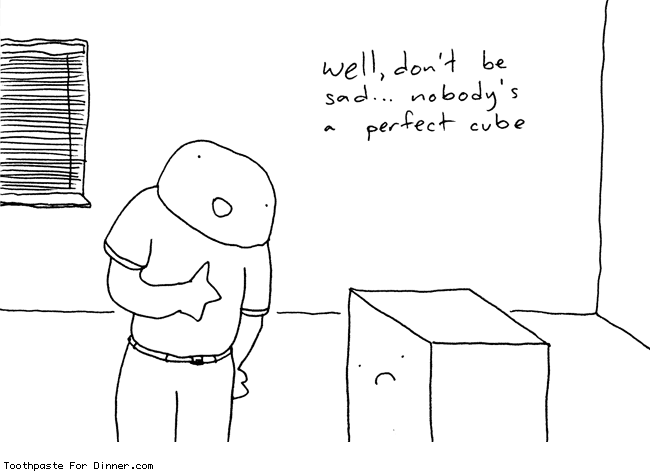
Nah, there are perfect cubes around, like 8, 27, 64, 125...


Take the example of the very recent British Petroleum (BP). The oil leak incident at the Gulf of Mexico causes the share price to plummet. If you're interested in BP, and you're very convinced that the incident is just one-off (never mind the possibility of BP going belly up due to the sheer amount of compensation that is to come in the near future for the cleanup and claims), are you able to put down all your fears and buy it? Lingering at the back of your mind will surely be the formidable 'but' word - "the price is low down but...", "the oil leak is under control now but...", "the dividends are great at the price but....".


I think what I would do are the following steps:


1. Do a FA on the company in question. Read read and read reports on it and try to come out with a numerical value to the company, with the pessimistic scenario in mind.


2. Do a TA on it. Check for signs of bottoming and possible reversal signals before committing your capital on it.


3. Most importantly, start a chihuahua position on it, not a whale-size position straight away. A chihuahua position is just a small 'testing' point. Following the price after this initial position, you can choose the average up or down when the situation becomes clearer.


As a newbie in the past, I almost never follow point no. 3 - money management. Why is that? I was trying to save some brokerage fee by buying in one tranche rather than firing sparingly in several bullets. Don't the masters say, "More action, less wealth" or "Frequent in and out generates frictional cost"? Yes, but there's another group of masters saying that if you do a dollar cost averaging, your average buy price for the stock will be cheaper.


Aiya, so confusing...who to follow?

Tuesday, July 20, 2010

Ramblings

** "BIAS" is a special feature in my blog where I get to say whatever I want with scant regards for your feelings. I'm not politically correct in this feature, so go ahead, judge me."


Most of the time, my thoughts are on various topics. It's not enough to blog a full article about it, hence there will be times that I would have to 'discharge' my thoughts out so that I can stop mulling over it. This is one of the times. I wonder what is the reason for me to start this blog. I looked back and see if my initial reasons are still the same. It's still the same reason - it's for my own record. I needed the blog so as to channel my thoughts into written words (actually, 'cyber' words). If it helps me defray some of my costs for maintaining it, that's good. I'm definitely not going all out to make passive income from blogging. This principle will prevent me from blogging 'commerical' stuff to please sponsors or to attract higher viewership.


For those who had been my avid reader, I thank you for reading my ramblings.  Here's more ramblings:


1. I thought it's very interesting to see that parents are wishing that exams for primary 1 and 2 to be done away and yet there are other parents who signed their kids up for enrichment centres that have tests. I guess it all boils down to the perceived ability of the kid to perform well in exams. Why perceived? It's because when the kids are that young, there are no history to show that the kids can perform well academically, so it's all guess-work here. If I'm a parent who thinks that my kid is going to do well, I wouldn't want to do away with exams. Conversely, if I think my kid cannot do well, I would want to do away with it.


So what do I think about this issue, being no parent and having no kids now?


I think it's good that exams are done away. It'll really be sad if in the process of knowing your standing among your peers, you actually destroy the joy of learning. I don't mind so much if exams are easy, but if you looked at the recent primary 1/2 exams paper these days, you'll be in for a shock. It's definitely not easy at all. If that's the case, I do not see what's the reason for putting unnecessary difficult test to demotivate and demoralise primary school kids. But I think I can understand the parent's concern too - if there are no tests, then suddenly in primary 3 there's a major exams, how do you expect the kid to perform? Sigh...grades inflation - I think it's a structural problem in the education system, not something that can be easily solved. At one extreme, you do want to differentiate the good students from the mediocre, at the other you do not want to demoralise them.


We all tread a thin line of balance.


Good but useless advice


2.  I can think of many good but utterly useless advice. Here are some examples:


a. Buy low sell high
b. Do not spend money on unnecessary things
c. Do not buy stocks that are overvalued
d. Bring an umbrella if it's going to rain
e. Buy more in a bear market


Do you see the similarities between all these advice? They talk about a certain truth but they do not tell you how to recognise the truth and so it's becomes overly simplistic and utterly useless. Take the first one - "Buy low sell high". The problem is not with buying low and selling high as a concept, but rather how to recognize a low and a high. Take the second advice, "Do not spend money on unnecessary things". Again, the concept of not spending on unnecessary things is sound and good advice, but pray tell, what exactly are unnecessary things?


If you read enough books on financial stuff, you can recognise a good and useful book from a good and useless one from the amount of such advice dished out in the pages within.  At best, the former serves as a good reminder not to do foolish things, but at worst, it makes you read a lot without knowing anything.

Wednesday, July 14, 2010

When to buy?

I happened to see my buddy unicorn78's comments that he wanted to get some reits/divy counters but is not sure if now is a good time to get in. I gave that question a fair amount of thought because I've asked myself that question a few times too. So, instead of sharing with him alone, I thought it'll be good once I posted my views, the other more experienced market practitioners can share theirs in the comments.


As we learn more and read more about the market, I've no doubt that you'll definitely come across conflicting advice. One camp would say you should never average down your losses just to get out as it is more risky, the other would say you should buy more as the price gets lower to get a lower average price. Frankly, I've done both before. For longcheer, I averaged down as the price gets down until finally I can't take the losses anymore and cut off that gangrene in my portfolio at a huge loss. For HSBC, I average down and bought even more as the price falls, reducing a huge potential loss and it is now sitting around at breakeven level.


I think advice is one thing but the more important point in making the advice work for you is wisdom. You need to know when the advice is suitable. I believe all the advice works, given the correct condition. Thus, the hardest part is to know when to use which advice. So, that is my disclaimer for all my blog articles.


Here's what I will consider when answering the question of whether this is a good time to buy reits/divy counters:


1. For dividend yielding counters, I would want to look at yield of course. Once it hits a certain percentage, I would nibble a little. I never buy the exact number of shares I want in the first try, always in bullets. I've learnt enough in the market that there's no point timing the exact bottom - it's an exercise in futility. Follow snr bro's advice - buy slowly sell slowly. Depending on market condition (check TA), I'll break down the total batches in 2-3. Once I got in the first batch, I'll be a lot more stingy when entering the second batch, always preferring to look for the right TA set up before entering again, so you can say that my first batch is a test batch. Don't ever worry about transaction cost when buying in batches. I'll treat it as an insurance cost to prevent more capital loss than the minimum $25 paid for brokerage.

Personally, 5% is not enticing enough. There are banks preference shares that are a million times safer than reits/dividend counters with 5% yield. 7% is what I'm looking at. 10% (at suitable gearing) would be what makansutra would say, "Die die must try!"


What's the similarity between this picture and a 10% yield counter? Both have a "Die die must try!" stamp of approval on it


2. I find that reading up extensively before you buy can give yourself peace of mind when you are averaging down. The more you understand the situation, the more you can assess it and you can decide your course of action without fear. If I buy a counter which I did even know much, I wouldn't have the courage and conviction to buy buy to average down when the prices go down. So FA to me is just that - for the courage and conviction to buy when others are fearful.

Once you've read enough about the ins and outs of the counter, I'm sure it'll be easier to hold even when the market crash. In fact, I think you'll be wanting the market to crash to load up another bigger batch after your smaller tester batch.


3. The problem can be looked at in this way - if you wait longer, you miss out on the potential rally and perhaps several batches of dividends coming your way. Conversely, if you buy now, the market might crash and you might lose a lot of capital (albeit paper losses) but you get to have the dividends while waiting. Let's break down the problem:


a. Check the potential downside from the charts. Look at the possible support points. If the price is too far from support, maybe wait at support before buying a batch. Make sure the price at the support level satisfies the yield that you plan for. I don't compromise on yield because if I have to hold a dud for long, I would want to be adequately compensated for in terms of dividend.


b. How much is the upside? Again, look at the charts for possible resistance. Don't ever get near resistance level (unless you want to buy on breakout....I don't do breakouts anymore) because the possible downside risk to the nearest support might not be worthwhile.


c. How much dividend are you going to get? If you know your downside risk to the next possible support in (a) level and how much dividend you are getting in (c) plus the upside you might get from (b), I think you can get a risk/reward calculation whether to get it right now or wait. Especially useful when combined with the bullet system of buying any counters in batches.

Monday, July 12, 2010

To be a cat

I realised that I have a very relaxed stance towards investing my money these days. It's not a lack of interest on my part - I mean who wouldn't want to make more money right? It's more of a change in attitude in me. Perhaps it's the general lack of emotions towards my profits or losses that accompanied this change in attitude. This didn't happen overnight. It happened in bits and pieces over the years, accumulating perhaps like water dripping into a cup until the final droplet of water pushes the surface of the water beyond the boundary of the cup.


In place of viewing my charts and reading up religiously on annual reports, instead of discussing fervently about the entry positions and the merits and demerits of a particular company, I chose to rest and relax. Initially I felt guilt, like I wasn't doing my part in making the best out of my available time on earth. But as time goes, you see life and death of counters in the stock market and you see life and death of people on earth, and you cannot but realise that there must be a better use of time than being obsessed over all things financial. This epiphany must have hit me quite hard, because I always had a tight rein of things on monetary matters - trying to find the best deals, trying to make the most of my time, trying to beat this beat that...


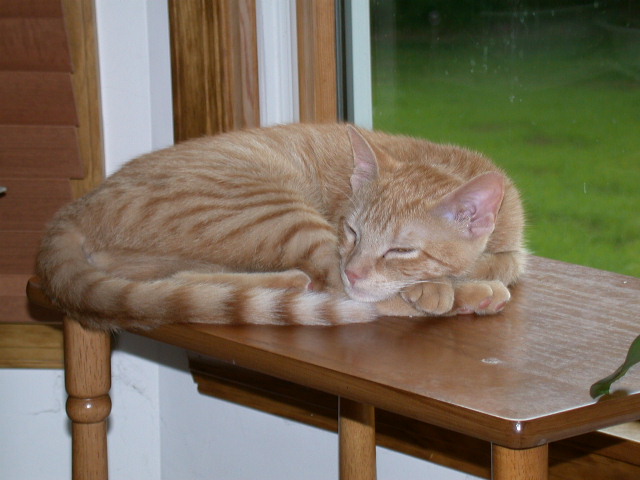
This is not my cat. Though I say that, both have this seen-it-all behaviour typical of cats


...and then I looked at my cat, lazily grooming itself by licking her paws before snugging up her tail as a pillow and drifting into a comfortable nap in the afternoon. Loving cats makes me love watching time goes by, doing nothing.


In view of my current change in attitude, perhaps it's time to look more into instruments with little or no maintenance. For observant readers, you would have noticed that the list of books that I've read or am reading (found on the lower right hand corner of the blog) are filled with books of various topics with the exception of financial stuff. I just can't bring myself to read one of these books nowadays, having read them religiously for so long.


I think I'm getting less practical and more human now. I'm loving every minute of it.

Thursday, July 08, 2010

Retirement

I was intrigued by a newspaper report that in Europe, the retirement age is pushed back to 70 yrs so that the pension scheme that they had there will continue to function fully. I guess with a aging population, it's harder to support with a diminishing working class as the birth rates cannot continue to support an inverted pyramid for long. It's just too unstable.


Retire.


If you break up the word it become two parts - Re and Tire. Re means to do it again as in retry and reboot. Tire means to be exhausted, to be fatigued. The word sounds bleak doesn't it? To retire these days is not to sit back in your home, blessed with people who would support you. I think the image is going to be replaced by one which you have to work to support your own subsistence. Thus to retire means that you have to work again (in an environment that you are not appreciated and are lowly paid) and be fatigued by it all. Gloomy, isn't it?


I don't want to have such a bleak future. Thus, I think it would do good to think about retirement. I think the main concern would be health and money. It's good to think about a time when you can not longer function as well as you do when you're in your prime days. A passive income stream to support your own keep is great. A healthy savings to last beyond what you can spend is a blessing. And most importantly, good health to make it all meaningful and worthwhile.


Got to start planning.

---------------------------------------------------

After reading this again, I felt that I had left out something. I realised it now. It's no point having good health, good money for retirement. You need someone to grow old together too. May be your loved ones, may be your children, may be your best friends or even a cat :)

Tuesday, July 06, 2010

To milk or to slaughter?

Having sold a dividend yielding counter recently, I was thinking about the age-old problems that plagued me. I was suitably reminded of someone's analogy (bro8888's?) that a dividend yielding counter is like a milk cow. Every other time, a milk cow will give off milk, so that you can drink some and sell some, thus giving you a good cash flow. Alternatively, you can sell the milk cow to someone at a good price and get several years worth of 'future' milk money now, so that if there's a mad cow diseases floating around infecting other herds, your future cash stream will be secured because it's in your hands now. This comes at a cost - you'll lose your future cash stream and possibly the price of the milk cow might also increase in the future.


To milk or to sell - that is the question


Quite a good analogy to stocks, no?


The counter I sold recently was singpost. This particular tranche I had held for quite some time - around 3 years in all. I had bought it at a rather high price of $1.18, something that I had regretted for an equally long time. However, I made good on the stocks when I sold it at 1.13, with my dividends covering all my capital losses and making up an 'okay' profit.


The thoughts that ran through my mind was if I should hold on to it longer to get more dividends or should I just sell to lock in my profits to get my hands on cash, and live to fight another day. Here's my reasons for divesting:


1. At 1.18 entry price, I was not doing as good on my yield. Singpost gives quarterly dividends up to a tune of 6.25 cts per annum, thus giving me a yield of 5.3% per annum. Not bad, but not fantastic either, considering other lower geared but higher yielding alternatives out there. Therefore, I was inclined to sell it to get the cash to get into the other alternatives.


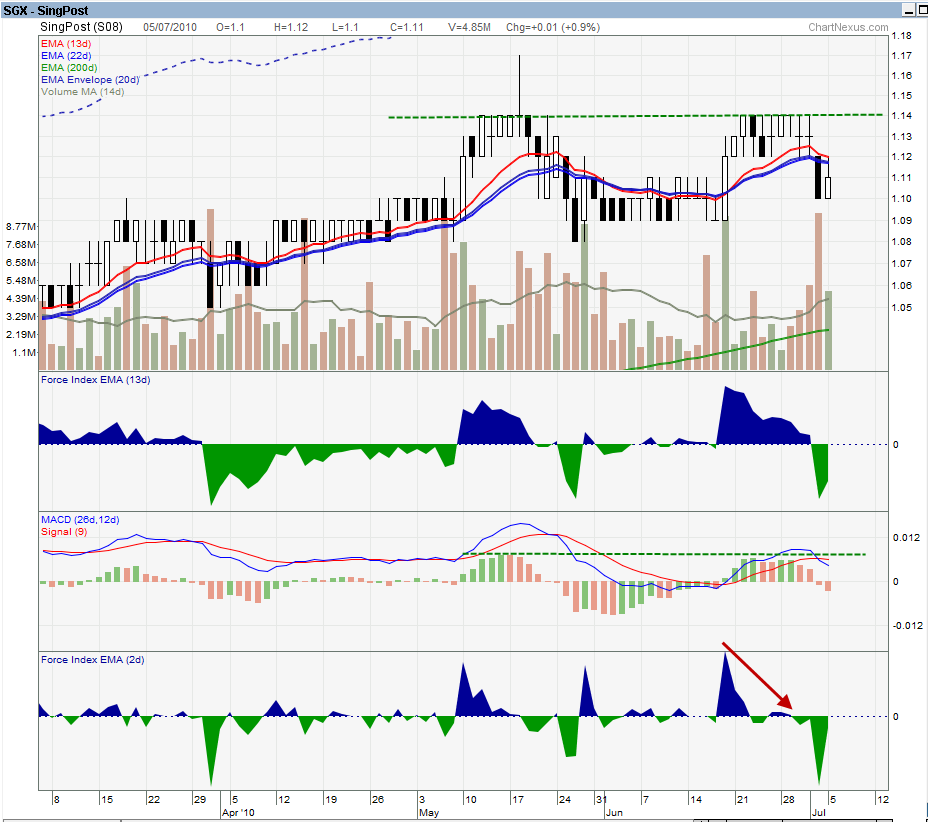
2. A picture tells a thousand words. Let's see what this picture tells you:

Singpost - daily chart

I wanted to sell at 1.14 but after queuing for nearly a week, I couldn't get it done. I just opted for 1.13. This chart was not particularly bearish, but the overall market condition was, so I didn't want to risk what I had out there and just took what I can out of the table. The price dropped due to XD. On hindsight, I could have got the dividend, sell at 1.12 and have both my cake and eat it too. But alas, things are always much clearer after it had happened.


3. I told myself that I would want to 'trade' this counter again, with this as the second round. The time frame for trading this is actually quite long, which is fine for me actually. I'll want to trade it when the signal comes and to hold it for dividend yield when the price reaches around 90 cts level. At 0.90, the yield will be near 7% - that would be something worth holding for.

Tuesday, June 29, 2010

CAGR II

Recently, I was given an opportunity by a reader to explain more about CAGR. It's not a brand of cigar. It's refers to compounded annual growth rate - a calculation to find out the compounded returns per year (note that this is different from simple interest rate). I actually wanted to share how silly this calculation is about but I had a feeling that I've written about it donkey years ago. After searching, I realised I did write an article about CAGR here, so I'll just highlight or perhaps add some points to it.


Frankly, I've not used CAGR for years because of I realised that with one calculation, the whole story can be quite distorted. Basically the calculation of CAGR depends on three variables - Future value, present value and time period. The most significant gripe I have about CAGR calculation is the fact that you can get hugely wide differences in value by just changing the variables. Essentially it boils down to a GIGO (garbage in garbage out) system where the output depends firmly on the input that you put it.


CAGR CIGAR is a stick used for smoking, giving a pleasurable feeling afterward


Take a look at this example. Let's say these are the figures for yearly profit from year 1 to year 4 respectively:

10, 15, 20, 25

Present value: 10
Future value: 25
Time period: 3
CAGR: 35.7% per yr


Here's another example of yearly profit from year 1 to year 4 respectively:

10, -2, 45, 25

For those who are synchronous with me in thought would have realised that the CAGR for the two examples are exactly the same. Why? The first example and second example looks very different but the three variables that affect CAGR calculation - namely present, future value and time period - are all the same.


So, what does that leave us?


1. Firstly, you must realise that the CAGR just draws a straight line between the start value (present value) and the end value (future value) and ignores all the ups and downs in between them. In a non-linear world, this assumption is just plain bullshit. I can make a good CAGR by carefully selecting my base year and my final year, so do be careful of it. Statistical calculation must be treated firstly as a blatant lie.


2. Secondly, it would be better to accompany CAGR calculation with the actual values of the data points in between the present and final values. To make it better, I would suggest a graph. It's like doing linear regression calculation in A'lvls - you must accompany each calculation with a scatter plot. This will give a bigger picture of the meaning of the CAGR value calculated.


3. Lastly, I simply do not use it anymore. From experience, projecting the past into the future is at best a guesstimate because the reality could be more optimistic but usually more pessimistic. Since it's a guesstimate, there's really no need to put a numerical figure to your guesstimate. I do not use it anymore because I fail to see the value of such calculations in fattening my wallet, though it might well do to fatten my ego.

Sunday, June 27, 2010

You need both rainy and sunny days to make life's rainbows

** "BIAS" is a special feature in my blog where I get to say whatever I want with scant regards for your feelings. I'm not politically correct in this feature, so go ahead, judge me."


Time seems to fly these days. It seems like it's the opposite of what Einsten's theory of relativity had proposed. You know, in that theory, if you travel as fast as the speed of light, time seems to stop from your point of view. In work life, it seems that if you work very very hard, time seems to fly even faster. Day and night zooms by, punctuated by meal times and the occasional travelling and before you know it, Monday goes and Friday comes again, thus ending the week.


Since there is really not much activity in the market (okay, except for my sell order that I had been consistently keying in everyday but didn't get filled), I thought it'll be good to talk about things that I'm grateful for and things I'm not so happy about. Here goes:


An unhappy cake. Have you seen a cake that wants to be eaten?


Things I'm not happy about:

1. I spent my morning reading through the Sunday times and saw an article about CEO of SMRT saying that the mrt trains at its peak are carrying 1.4k passengers, compared to its 'crush load' of 2k passengers. She then compared to the peak carrying load in Tokyo and HK and implied that the trains are not as fully packed and Singaporeans can squeeze in if they choose to do so.

I think if she takes a break off her car for 1 month, and try to take the MRT to work everyday, squeezing in with the crowd in the morning and again in the evening, she can better appreciate the implications of her statement. The stress related to being cramped in a tiny morsel of space day in and day out cannot be described to a person who had not experienced it before.

I hate it when people in authority starts comparing to other countries to 'bring out' the goodness in our system. Things are not so easily comparable. I can similarly cherry pick things that are good about other countries to 'push down' our system of doing things here too.


2. I was woken by a sharp diarrhea this morning way before my alarm rings. Must be some nonsense I've eaten last night.


3. Some horrible horrible inconsiderate people are honking their car horns so early in the morning. I'm sure whatever problems might be in front of them can be solved by calmly walking over and talking to the person, or simply by waiting. Honking your car horn doesn't make things any better. When I was a learner driver, I had my fair share of it. It made me worse as I get even more nervous. I'm sure whoever is honked at would feel the same too, or that they are simply immune to it. Either way, honking the car doesn't get things done...perhaps it only serves to wake up some people around the neighborhood.

I remembered a joke from my army daze. A group of us are sitting in the bunk, trying to escape the evil all-seeing eyes of the CSM. One of my buddies asked what should be done if you're driving and the car in front of you starts to slow down. He's studying for his basic theory so he's asking some possible questions.


a. Slow down
b. Speed up and overtake him


Did anyone choose option (a)? Well, not contented, another of my buddies started wisecracking and said that we should honk first, then slow down and honk again. There you go.


I like this picture a lot. Simple and to the point.


Things I'm grateful for:

1. I went to Robinson sales at Singapore expo with my girlfriend yesterday. It was such an interesting experience! There was a concurrent MPH warehouse sales so we went over there first, where my gf bought 9 books (it's considered a few...I'm sure she'll carry more if I didn't force my way with her). I guess she can spend her whole lifetime reading her already immense collection of assorted books lying all over her room and threatening to spill over other parts of her home. Silly girl :)

The books are priced at $8 each for 1 general book, and $35 for 5 general books. The collections are quite varied and I haven't even walked 50% of it. I think they are ending today, so go and check it out if you like a good bargain.

The Robinson sale was fantastic too. Bought some Adidas shirts at over 60% discounts. All sorts of things there, but be prepared for long queues :)


2. I'm grateful for the early morning showers that makes the day much cooler and more pleasing. I was joking to my student one day that we should all go down to Orchard road to grab some floating iphones and hermes bag when one of these high intensity, high duration rain comes again :)


3. Wonderful technology - blue ray. Was at a brother's place watching some 'brue lay' movies and was once again amazed at the crisp clear pictures. I must have said it more than once that I'll be happy just watching the subtitles because they are so pleasing to the eye!


4. School holidays will be over! I can finally get to rest in the morning and resume my vampirish schedule which I think I'm better suited for. Begone early morning classes, welcome night classes!

Tuesday, June 22, 2010

One weekend at Fullerton Hotel

I went over to Fullerton Hotel over the weekend for a break from work. Work had been getting more and more unbearable, so I think a mid term break from all of it, even if it's for a while, is good for my mental well being. Since I've never been to a local hotel before, I thought of going there instead of the slightly more troublesome trip to my favourite Batam. Batam is good for those long stretches of idle days...something I can ill afford now.


Anyway, I signed up for the 1 night stay there, which cost me $340. The package includes a $88 rebate for any amount of money spent in Fullerton (it can be the Courtyard, the bar or the Jade restaurant), so I think it's pretty worth it. Me and my gf are celebrating something over there, so we also get to have some chocolates and a bottle of wine complimentary from the hotel. There was some misunderstanding, so they didn't really send the bottle of wine and chocolates up to our room during our stay there, but they made it up by giving us a pack to bring them home. Quite impressive service.

This is about the only proper picture taken off my hp. The rest are just too shaky to be publicly displayed.


Since Sat was the NDP rehearsal at the Padang, there were plenty of fireworks to be seen. I can't really see them from the hotel room (not dying to see them anyway) but I can definitely hear them. During the evening, as I was waiting around in the swimming pool (it's open air), I managed to spot a few soldiers parachuting down from the sky too. Quite interesting because I've not seen them except on television.


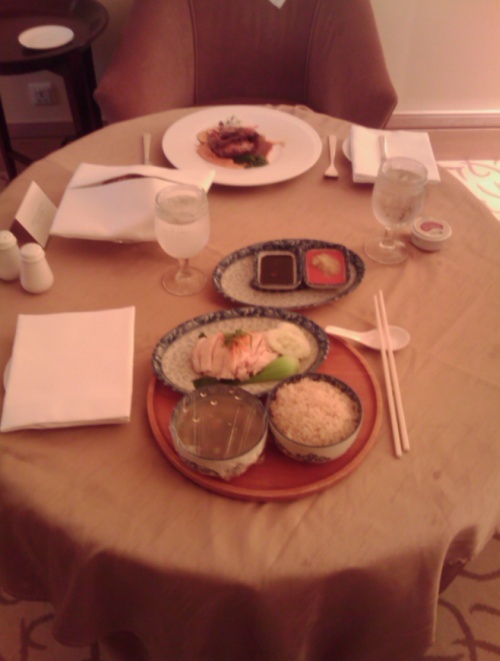
We asked from room service dining. It was quite a good experience because usually when we dine in the hotel room, I was just given a tray with the food. For Fullerton, they did the entire table routine with proper tablecloth and setting, complete with glasses of water and napkins. I was suitably impressed with this, being the mountain tortoise that I was. You really don't know what is good until you've encountered it.


Erm...it looks more impressive when you're there, with the sight and smell thrown in


Even though one night is a tad short to me, I thoroughly enjoyed myself there. I was watching television, reading and basically just resting my entire weekend. I even managed to sneak in a lunch appointment with the brothers here, so it's definitely one of the most memorable weekends that I will remember. I cannot recall when I have my weekend totally devoid of work. Definitely worth it.


That's how life should be right? Spending money to buy back happy memories to savor forever.

Thursday, June 17, 2010

The forgotten habit of reading

** "BIAS" is a special feature in my blog where I get to say whatever I want with scant regards for your feelings. I'm not politically correct in this feature, so go ahead, judge me."


In my job, I talk with many young people. I walk away with the grim knowledge that most of them do not have a habit of reading. I'm not just talking about reading textbooks for academic purposes, but also reading for the joy of doing so. From what I observed, girls read more than guys, though it might be mainly fashion magazines or other lighter fair like 8 days etc. I think one of the main contributing reason is that there are many distractions that are far more exciting than just plain reading.


I was just telling one of my students that I had just bought a kindle dx just three weeks ago. He asked me how much it costs and I told him it's a few hundreds. To this, he exclaimed that he would never spend such money on books. I guess that pretty much sums it up about the youth these days. They would rather spend money to engage someone to teach them then to read it up themselves. It's quite horrifying when I heard that most of them will just throw away the manual for any gadgets they bought and just jump straight into it. Perhaps they are so confident of their ability to trial and error any functions that their gadgets possess (they are afterall, the IT generation).


But why are they so disgusted with reading? I've no idea, but I guess it's good for my job. Most of the stuff I teach can be found in the examples given in the textbooks, so I suppose that if they do read it up, I might not be that busy anymore.


To me, reading is the best way to gain the knowledge and experiences of those that came before us. Culture is retained in the literature and passed down from the past to the present. If you would just read, you'll find that you do not have to keep re-inventing the wheel. I remembered when I was learning FA, I had a goal of reading one finance book per week - that makes it 52 books per year. That was back in 2008. I was reading voraciously on accountings, financial statements analysis and those books by guru investors, and I was greedily lapping it all up. It was until I had finished most of the shelves in the library that I slowed down. These days, I am much more selectively in what I read, choosing instead to re-read some of the best books that I had filtered down through the years.


My gf always wanted shelves of books occupying an entire wall in our home


Just for the records, here's the books that I devoured from 2007 to 2009. I'll highlight the ones that I would want to re-visit again and again.


Books read in 2007

1. Five point something – Chetan Bhagat
2. How to become stupid – Martin Page
3. The curious incident of the dog in night-time – Mark Haddon
4. The stupidest angel – Christopher Moore
5. The way of the cockroach – Craig Hovey
6. Legally correct fairy tales – David Fisher
7. It’s kind of a funny story – Ned Vizzini
8. Jacob’s ladder – Brian Keaney
9. Politically correct bedtime stories: Modern tales for our life & times – James Finn Garner
10. Cathy’s book – Cathy
11. Metamorphosis – Franz Kafka
12. Label – Louis de Bernieres
13. The successful investor – William J. O’Neil
14. Rich dad poor dad – guide to investing – Robert Kiyosaki
15. Do you want to make money or would you rather fool around – John D Spooner
16. Vault career guide to investment banking
17. Financial Statements - Thomas R. Ittelson
18. The four pillars of investing: lessons for building a winning portfolio – Dr William Bernstein
19. Accounting Demystified: A self teaching guide – Loita A.Hart
20. Five rules for successful stock investing – J Wiley, Joe Mansueto, Pat Dorsey
21. The little book of value investing – Christopher H. Browne
22. The little book that beats the market – Joel Greenblatt
23. The unwritten law of business – J.W. King, revised by James.G.Skakoon
24. Stone age company – Sally Bibb
25. The rules of wealth – Richard Templar
26. The laws of simplicity – John Maeda
27. The 5 keys to value investing - Jean Jacques


Books read in 2008

1. Warren Buffet Speaks - Wit and Wisdom from the World's Greates Investor - Janet Lowe
2. Winning - Jack Welch/Suzy Welch
3. The Dividend rich investor - Joseph Tigue/Joseph Lisanti
4. The little books of common sense investing – John C bogle
5. Everyman and his common stocks – Laurence H. Sloan
6. Investment madness – John R. Nofsinger
7. Lessons from the legends of wall street – Nikki Ross
8. Understanding comics – Scott McCloud
9. Free cash flow and shareholder yield – William Priest/Linsay McClelland
10. The ultimate dividend playbook – Josh Peters
11. The five rules of successful stock investing – Pat Dorsey
12. Why smart people do stupid things with money – Bert Whitehead
13. Building the perfect portfolio – Curtis J. Montgomery
14. A concise guide to macroeconomics – David A. Moss
15. Little black book of connections – Jeffrey Gitomer
16. The little book of value investing – Christopher H. Browne
17. The Tao of warren buffet – Mary buffet
18. Monopoly rules – Millind M. Lee
19. Buffettology – Mary buffet / David Clark
20. Common stocks and uncommon profits – Phil. A. Fisher
21. One up on wall street – Peter Lynch
22. The Warren buffet way – Robert G. Hagstrom
23. Anyway – the paradoxical commandments – Kent M. Keith
24. Cut to the chase – Stuart R. Levine
25. The Intelligent investor – Benjamin Graham
26. The bull hunter – Dan Denning
27. The black swan – Nassim Nicholas Taleb
28. The market guru – John Reese/Todd Glassman
29. Liar’s Poker – Michael Lewis
30. Confessions of a wall street analyst – Dan Reingold
31. The Citibank guide to building personal wealth – Leo Gough
32. The essays of warren E. Buffett – Lawrence A. Cunningham
33. Morningstar guide to mutual funds – Christine Benz
34. Benjamin Graham on value investing – Janet Lowe
35. A random walk down wall street- Burton G. Malkiel
36. Even buffet isn’t perfect – Vahan Janjigian
37. Origins of the Crash – Roger Lowenstein
38. Reminiscences of a stock operator – Edwin Lefevre
39. Killing sacred cows – Garett B. Gunderson
40. The real warren buffet – James O’Loughlin
41. 100 cats who made a difference – Sam Stall
42. The little book that makes you rich – Louis Navellier
43. Debt – Juliane Otterbach
44. Saving – Juliane Otterbach
45. V for Vendetta – Alan Moore, David Lloyd
46. Full of Bull – Stephen T. McClellan
47. This is not a book – Michael Picard
48. My Formula! – Thomas Matthew
49. Value Investing – Sebastian Chong
50. Financial statements for non-financial people – Ron Price
51. A primer on money,banking and gold – Peter L. Bernstein
52. The little book that saves your assets – David M. Darst
53. The Joseph cycle (2004 edition) – Simon Sim
54. Animal Farm – George Orwell
55. I.O.U.S.A – Addison Wiggin, Kate Incontrera, Dorianne Perrucci


Books read in 2009


1. Investing against the tide - Anthony Bolton
2. Pit Bull - Martin Schwartz
3. Fooled by Randomness - Nassim Taleb
4. When genius failed - Roger Lowenstein
5. Real tips, real money - Leong CT/Leong SH/Dr David Tay
6. Candlestick charts - Clive Lambert
7. Sell and sell short - Dr. Alexander Elder
8. Come into my trading room - Dr. Alexander Elder
9. Trading for a living - Dr. Alexander Elder
10. Silver Surfer Requiem
11. Free market madness - Peter A. Ubel
12. Sales Bible - Jeffrey Gitomer
13. Avengers Disassembled - Brian Michael Bendis/David Finch
14. Successful Value Investing in Asia - Tony Measor
15. Where are the customers' yachts? - Fred Schwed, Jr
16. The little book of bull moves in bear markets - Peter D.Schiff
17. Keynes and the Market - Justyn Walsh
18. Warren Buffet and the interpretation of financial statements - Mary Buffet & David Clark
19. The physics of superheroes - James Kakalios
20. Motoring Basics
21. Your money or your life - Joe Dominguez and Vicki Robin
22. Bailout - John Waggoner
23. The Millionaire in you - Michael LeBoeuf
24. The 5 lessons a millionaire taught me - Richard Paul Evans
25. How to trade in Stocks - Jesse Livermore (& Richard Smitten)
26. The Wall street Self defense Manual - Henry Blodget
27. Teach yourself to Live - C.G.L. Du Cann
28. How to become a property millionaire - Azizi Ali
29. Cats - the book of the musical - Harvest books
30. The little book that builds wealth - Pat Dorsey
31. Success in the education business - Vincent A. Gabriel


So there!

With my Amazon Kindle, I'll be reading much more fiction and classics that I had always wanted to read, but had difficulty finding in the library. These days, it's hard to find new knowledge in the financial books that I read. After all, there's only so much things to learn about finance. Most of the books will be just talking about the same ideas but phrased in different forms.

Friday, June 11, 2010

The velocity of money

I was re-reading this book by Garrett Gunderson - Killing Sacred Cows. It's a very wonderful book with very refreshing concepts, so I make it a point to revisit some of the concepts espoused in the book every year when I have the time to do so. It's so easy to read that if you only have time to read one financial book this year, make it this one! You can have a sneak preview of the book here. Since it's the preview, not all the pages are shown, but I think it's enough to showcase it's attractive typesetting and page layout.

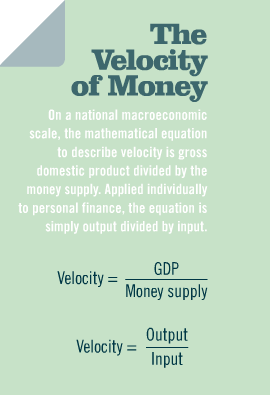
I remembered this particularly interesting concept, called the velocity of money. It is borrowed from the discipline of economics but in this case, it's applied to the field of personal finance. Basically, it's just an equation that is somewhat similar to the the mathematical form of efficiency. No wonder the concept feels similar to productivity.


This is extracted from the book Killing Sacred Cows by Garrett Gunderson

Basically, the concept is talking about how to keep input at a minimum while increasing as much output as possible. The point here is how to continually extract more output and yet at the same time reduce your input. One example of this is to use the savings you had to buy into financial instruments that gives you a passive income. Then you use the passive income to buy more such instruments that will generate even more passive income. While the input remains the same (which is the initial amount of savings that you put into the instrument in the first place), the output keeps getting higher and higher. This is because the principal and the interest both earns you an interest, thus creating a self feeding loop - exactly how compounding works.


Another example will be a business like ebay. When it started, there are not too many buyer and sellers. An effort is spent to set up all the necessary infrastructure for the ebay business to begin. Once time progress, more sellers come into ebay to hawk their wares, which in turn attract more buyers. Seeing more buyers attract even more sellers and so on, creating a self feeding loop. The input is minimized but the output is exponentially increased.


I guess it works for the tuition business as well. As I begin the career, I have to read up on a lot of stuff to have the knowledge. All these are just one time effort. Once I get some students, a proportion of them will turn out to have excellent grades, which in turn will attract more students to come in based on recommendations and so on and so forth. These kind of network effect is not proportional to the initial effort that is put in, hence it's very powerful.


The book mentioned that net worth is like stored potential, while cash flow is like a tap with running water. Having a high net worth does not mean that the person will have high cash flow, but the potential is there. It's like you have a lot of cash sitting in the bank, with little debts (high networth). Cash has low velocity because the output (the interest earned) is very little. If one just utilizes the cash to do create value (here, value is defined loosely as something that is in line with your Soul purpose), then it'll have a higher velocity of money.


Again, liberally taken from the same book

Now, seriously, I think that is a refreshing concept. As of all good speakers and good books, it's not that you do not know the concept that is at work here. It's the flair and the way the concepts are illustrated that makes it refreshing. As of above, so shall below. While the velocity of money is essentially a concept used in the financial field, I guess one can equally apply it to life in generally. I think the concept of the velocity of money forces one to think critically on out to increase the output value of every dollar that is utilized, so as to increase productivity.


Food for thought... would you rather have a high net worth or a high cash flow?

Tuesday, June 08, 2010

Phillips MMF

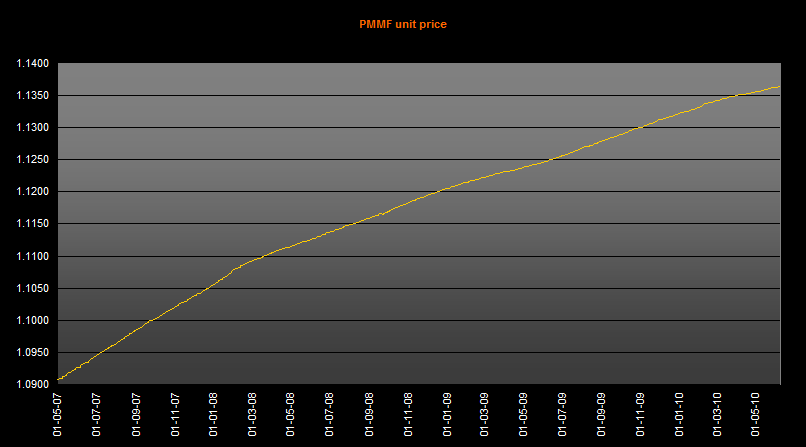
It seems that Phillips Money Market Fund (MMF) is giving lousier returns as more people are aware of it, or simply because that they are fleeing the more volatile stock markets and trying to flock into the safer cash funds. I've been using it since May 2007 and I also tracked the NAV value of the fund since then.


The returns per month for the following years are as follows:

2007 : 0.167% per month --> 2.01% per yr
2008 : 0.111% per month --> 1.33% per yr
2009 : 0.087% per month --> 1.04% per yr


You can see that the returns are dropping. From the fact sheet, I also saw that it is attracting more and more people into the funds, so perhaps there is so correlation. Perhaps they are finding it harder and harder to get the yields as their fund size grew bigger, or maybe it's the fact that the general low interest rate environment makes it hard for them to give us anything more competitive (they invest in low volatility assets like sgd deposits, govt bonds etc).


Can you see the obvious change in gradient over time?


Here's the figures for this yr, 2010:

Jan : 0.071% per month
Feb : 0.088% per month
Mar : 0.053% per month
Apr : 0.044% per month
May : 0.053% per month


The average monthly returns had dropped since the start of the year, giving an average of around 0.062% per month. This means that if all else remains as it is, I'll be looking at around 0.8% per year, which is under 1% per year.


Pathetic you say? Yes, it is. But I guess that's the price of 'safety'. It can't even beat inflation, which is at 3% per year. But for those who needs the liquidity (like me) and cannot safely put it into higher yield assets, I suppose this beats the even lousier interest rates for savings accounts. I think even for fixed deposits, you need a higher deposit amount and longer lock in period for this kind of returns. So, in comparison, it is still okay lah.


One thing about it is that it is not guaranteed, unlike banks. Given the low returns for the MMF, it's been a long while since I've put in any fresh funds inside. Most of my savings are put into my savings account now, because the higher returns is not worth the risk of Phillips going belly up.

Monday, June 07, 2010

A little reflection

These days I hardly look at the market. I remember when I started, I keep staring at the prices, as if by some eye power, I can change the prices of the stocks that I owned. These days, it's just a waste of time.


I suppose as I get more mature and hopefully wiser, my feelings and emotions are kept more constant. There are a lot of things that require my time and presence, and I certainly do not want to spend my life staring at numbers jumping on the screen. It's such a far cry when I first started (on the wrong foot obviously) in the market by trading with warrants. It requires so much time and effort, with my emotion going up and down according to the ups and downs of the ticker. It's very stressful, not to mention distracting, when you have a job to do as well.


I think going forward, I would reduce the time spent on looking at the watchlist. I foresee that I can only get more busy in my work, thus more of my stocks holding had been changed to hold more dividends. Basically I intend to hold more dividend yielding stocks, such as reits and the standard 'defensive' fare, and leave a few bullets here and there to either buy more upon crisis, or trade when I see the opportunities. Unlike in the past, I completely realise that the trading game is not for me, and that is after having experimented with it for myself. I also realised that I cannot be those steadfast investor as well, because it would have completely bore me to dig deep into the statements to find out the business.


I think the self realisation of what you can do and what you cannot do is important, because that will shape your style of investing/trading. To find out the viscosity of honey,  you cannot look at a static jar of honey. You must tilt the jar to one side to find out the dynamic properties of honey. Likewise, you cannot know your risk appetite by filling out some questionnaire, you have to try it out for yourself in the market.

You cannot discover the dynamic properties of honey by staring at it statically


My main income has been, will be, and will always be my main job. Knowing this, I think I would not spend so much time searching the ocean for that one multi-bagger stock that will yield me tremendous profits. Neither will I stare at the ticker all day just to get the perfect entry and exit. I simply do not have the time for such things. I realised that a day will come that I cannot work anymore, I would have to rely on secondary sources of income, and that will have to be from my investments. That will be my second line of defence. I think I would focus on building up a nice passive income to prepare for that eventuality.


It's very different when I first started out because I shun dividend yielding counters, thinking that I'm still young and I should aim for capital appreciation. I can afford to lose blah blah...how foolish of me and nobody told me so. Still, without the past me, there will not be the present me.


May fortune smile on you in the market.

Thursday, June 03, 2010

SGX - trade review

I was reviewing some of my past trades. This is one of them. The counter here is SGX. It's not exactly good for trading because the cost of 1 lot is quite high, so while the absolute value might be the same, a higher amount of capital is tied up in case the trade goes wrong. But I do like the cannot-die type of company for trading, so SGX fits perfectly.

Here's my two trades all depicted in the chart shown below:


What a roller coaster ride we have here...

I had 2 full round trips of SGX. The first was in 15th June 2009, bought at a price of 7.54 (the chart did took into account the drop of the price after its final dividend declared, hence it looks 'funny') and sold on 23 July 2009 at a price of 7.84 (again, the chart took into account the drop in price after its final dividend). Since the holding period is rather short, I did not get to enjoy any dividends declared.

Profit: $0.30


The second trip was in 5th Nov 2009 bought at a price of 7.88 and sold on 14th April 2010 at a price of 8.05. I managed to hold for a round of dividends declared at 0.0375, hence it boosted up my profits a little.

Profit: $0.170
Dividends: $0.0375
Total: $0.2075
Over profits for the 2 round trips:  $0.5075


This is only round 2 and hopefully many more to come. As you can see, my TA skills is not sharp. My entries and exit are less than commendable, but that is the nature of playing a probability game. On hindsight, I should have entered and sold at so and so price, but trading on the right edge of the chart is more difficult than looking back at it after trading it.


The closing price of SGX is 7.33 as of now. So, if I had bought at 7.54 and kept it till now, this will be what it looks like:

Profit: - $0.210
Dividend: $0.2675
Total: $0.0575


I'm not showing this to compare the buy-and-hold strategy versus the in-and-out strategy, because I know fully well that by selecting the appropriate time frames, both strategies will turn out to be winners. There are obvious advantages to both strategies and I would like to employ both of them. For example, if I had bought say 10 lots of sgx, I would have put half as a buy-and-hold positions and the other half as a trading position. The percentage can change according to the times, and need not be fixed in stone.


But I want to make it clear:


1. Buy and hold doesn't mean that you'll make money. Holding it long term doesn't mean that you'll make money. But if the company gives off a good dividend, it makes it that much easier to hold it longer. If the dividend is 10% per year, just holding it 10 yrs will recoup all your capital sunk in, never mind the capital appreciation or not. That's the wonderful thing about holding dividend yielding companies over the long term. But of course, there's a lot more things involved...10 yrs is a long time and they might not be around, that's why there's still a need to monitor the financial health of the company.


2. Using TA doesn't mean that you can catch the top and the bottom. If you can catch the approximate top and bottom, I think you'll boost your profit potential tremendously already. Of course, a lot depends on the person too - the mind, money and method. Fear makes you hesitant to buy when a signal presents itself while greed makes you hesitant to sell when the target price presents itself. These are all monsters that you have to face it if you're in the market.


Good fortune in the market :)