This year, I made a bold move. I started to put my cash into CPF for voluntary contribution. It's a strange idea. When I was younger, I wanted to conserve my cash and invest in it myself. But as I get older, I started to think of things that can go wrong. I wanted some insurance against my own investment, in case things goes wrong.
Rationale for putting cash into CPF
There's not a lot of write up for self employed people out there regarding CPF, so I might as well shed some light based on the findings I've done. So this is really tailored for self employed people who are not employed by any companies. The reasons why I want to contribute are:
1. Tax planning - if you know you'll have good earnings for the year, you'll want to plan your taxes ahead so that you don't have to pay unnecessarily
2. Build up a super emergency cash in the form of CPF, especially in the Ordinary Account, for the sole purpose of paying the mortgage when shit hits the fan. This is so super emergency that I planned never to use it at all unless absolutely necessary. The built in trouble and impossibility of taking out that emergency funds only adds serves to highlight the strict conditions in utilizing this fund. If shit really hits the fan, I'll have to go the nearest CPF building to sign some forms so that I can pay my mortgage loans from the OA account of my CPF instead of the usual cash payment for me.
Take this as the emergency of my emergency cash. Ideally, this should be about 20 to 24 months worth of housing mortgage so that I can
tank for up to 2 yrs living at bare minimum with a roof above my head.
Getting your hands dirty on the bloody abbreviations
With this in mind, I started reading up on 3 things:
A. Self-employed Mandatory Contribution and Voluntary contribution to medisave account (VC-MA)
B. CPF Minimum Sum (MS) topping-up scheme
C. Voluntary contribution to CPF
A. Self employed Mandatory Medisave contribution (Mandatory Contribution)
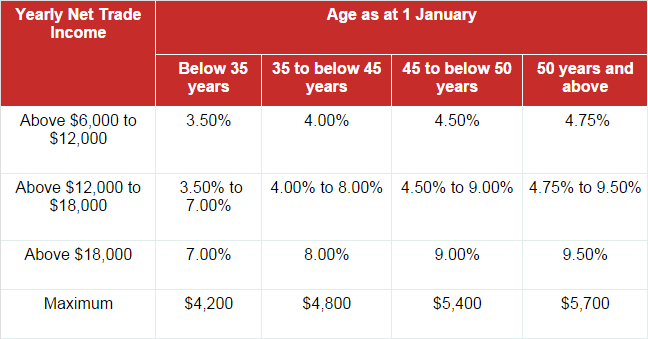
For the self employed, it's voluntary to contribute to CPF. However, the medisave account needs to be topped up, and that's the only thing that is compulsory. As long as you're self employed and is a Singapore citizen or PR making a yearly net trade income of more than $6000, you'll have to contribute to medisave account.
 |
| Table 1: Self employed compulsory medisave contribution rates in 2014 |
This contribution is subject to a cap based on different age groups. For example, if you're between 35 to 45 yrs old, you'll have to pay a max of $4800 that year, which corresponds to a monthly income of $5k. Even if your net trade income is more than $5k per month, $4.8k is the maximum amount that you have to contribute to your medisave account.
Okay
lah, medisave is going to be useful in the future. Sooner or later, the amount will be used, so might as well put it in a good place earning high interest to pay for the future. Pay now and use later. For more information, you can read the
link here.
Self employed Voluntary Medisave contribution (VC-MA)
This is different from the compulsory one, even though both are contributed to the medisave account.
The difference lies in that there is no tax relief for the compulsory medisave contribution. It's by law that you have to contribute. If you have extra cash that you want to top up specifically to the Medisave account, you can do so and also earn tax relief if you hit the following conditions:
1. You are a Singapore citizen or PR, AND
2. You have made a voluntary contribution to your medisave account in the previous year
The key word here is 'AND', not 'or'. A little planning is important, especially if you know that in the next 1-2 yrs, you're going to earn more money and you need that extra tax relief by doing voluntary contribution.
The tax relief is limited to the lower of:
1. Voluntary cash contribution directed specifically to Medisave account (VC-MA)
2. Annual CPF contribution limit ($30,600 in 2014, $31,450 in 2015) less Mandatory Contribution amount
3. Prevailing Medisave contribution ceiling table (MCC). It's $48,500 for 2014.
It sounds really complicated, but I assure you it's not. IRAS website illustrates with very clear examples of what happens when a self employed earning this amount, putting that amount in CPF voluntarily over and above his compulsory medisave contribution can get how much relief. You can find the
link here.
B. CPF Minimum Sum (MS) topping-up scheme
This minimum sum topping up scheme is for you to top up your own or your loved ones' Special Account (SA) or Retirement Account (RA). Whether it's funded to SA or RA depends on the recipient's age. If the recipient (can be yourself) is below age 55, it'll go into the SA. If the recipient's age is 55 or more, it'll go to the RA account. CPF has a strict definition of loved ones. To them, 'loved ones' include only your parents, parents-in-law, grandparents, grandparents-in-law, spouse and siblings. No mistress, no friends, no co-habitants and no dependents.
The amount of tax reliefs is equal to the amount that you topped up, subject to a cap, of course. The maximum tax relief for contributing towards your own SA or RA is $7k per year. The maximum tax relief for contributing towards your 'loved ones' SA or RA is $7k per year also. Remember to read the definition of 'loved ones' above. The tax relief cap of $7k is applied separately, so you can theoretically get a max of $14k tax relief per year if you top up BOTH your own SA/RA and your 'loved ones' SA/RA.
Oh, by the way, it's called CPF Cash Top-Up Relief for a reason. To qualify, you should use cash and you can't transfer your own CPF account to others. Also, for spouse and siblings, they must not have an annual income exceeding $4k in the year of top-up. Otherwise, you won't get the tax relief. You can read more about it in detail in the
link here.
C. Voluntary Contribution to CPF
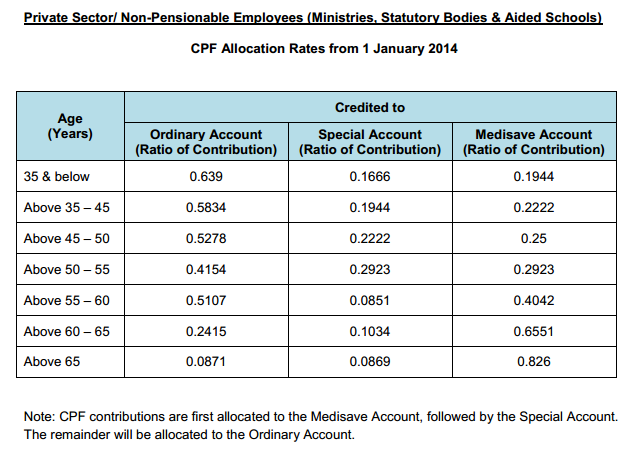
This is different from Voluntary contribution to medisave account (VC-MA). This is where you inject money into all 3 accounts (OA, SA and MA) in your CPF, in a ratio that is dependent on your age.
 |
Table 2: CPF contribution / allocation rates for different age groups in
2014 for wages > $750. For wages <$750, click here to see the table. |
It's not really good to see that table, isn't it? The reason is that the amount of money that you voluntarily contributed to all 3 accounts in your CPF does not have an employer's portion. Let's say you're between 35-45 yrs old, your contribution rate should be 20% and 16% from employers, forming a total of 36%. But since you're contributing voluntarily, your
entire sum will form the 36% normally contributed by both employer and employee, Of the 36 parts, 21 parts, 7 parts and 8 parts will be contributed to the OA, SA and MA respectively.
It's really easier to see the contribution amount in the form of a ratio below.
 |
| Table 3: CPF allocation rates (ratio) in 2014 for different age groups |
Okay, this makes it much clearer. If you contribute $10k voluntarily to 3 accounts, you'll end up contributing $5,834 (10k x 0.5834) to your OA, $1,944 (10k x 0.1944) to your SA and $2,222 (10k x 0.2222) to your MA. But you can only contribute up to a cap. That cap is the Annual CPF contribution limit ($30,600 in 2014, $31,450 in 2015) less Mandatory Contribution amount. The Mandatory Contribution amount for a purely self-employed person not being any employee of any company is also the money that you have to contribute to your medisave account by law every year.
What about tax relief?
First, you must hit the conditions:
1. You are a self employed person and you've a positive net trade income in the yr of assessment and
2. You've contributed to your mandatory medisave contribution in the preceeding year and/or
3. You've made voluntary contributions to your medisave account (VC-MA) in the preceeding year
Basically if you haven't contributed any amount to your medisave account that is mandatory or voluntarily, you won't be entitled to the Voluntary CPF contribution tax relief. If you hit the conditions above, then your tax relief will be the amount contributed subject to a cap, which is the lower of:
1. 36% of your net trade income for 2014 (37% of net trade income for 2015)
2. Annual CPF contribution limit ($30,600 for 2014, $31,450 for 2015)
You can see this
link here to read up some illustrations.
Above all these, there's this site that clarified a lot of queries for me. I don't even know how to do a voluntary contribution for CPF until I read the
FAQ here. It's a very useful read for all self employed people.
Take away:
So, what's the right course of action? Firstly, I have to pay the compulsory medisave account. You can (1) pay it directly to your MA account, or (2) you can do a voluntary contribution to 3 cpf accounts so that a certain % will flow to your MA, but make sure your contribution to MA is equal or higher than the amount of medisave you are legally required to contribute yearly. If not, you still have to top up your MA to hit the legal requirement. That's not a choice.
After that, I'll have to weigh these 3 factors:
1. How much cash do I want to keep for my personal investment as a warchest
2, How fast I want to fill my fund of the mother of all emergencies, in the form of OA in my CPF
3. How much tax reliefs I can knock off my income to bring my assessed income to a lower tax level.
Here's a brief summary of all the schemes. That hardest part of this research is making heads and tails of all the available top ups with their abbreviations and jargons.
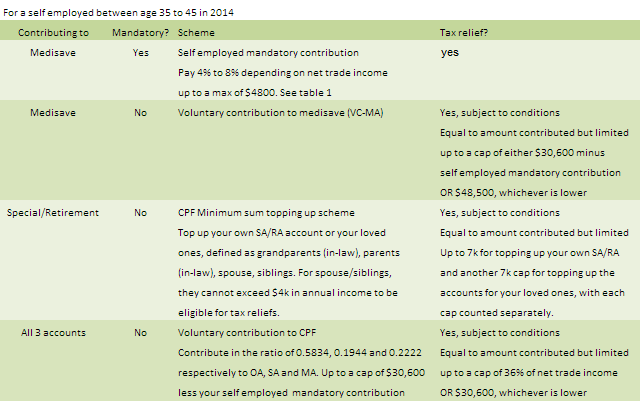 |
| Table 4: Summary of schemes available and tax reliefs |
My answer to the above 3 factors will allow me to decide how much money I can contribute and also into which account. I will be contributing to all 3 accounts (doing a Voluntary contribution to all 3 accounts), and not just contribute to my SA account (through CPF Minimum sum top up scheme). The main reason is that the tax relief for Voluntary contribution to CPF is higher than the CPF minimum top up scheme. The other reason that I need to build up my OA to pay for my housing. I can't pay for my housing using SA, even though the interest rate is higher. It just doesn't serve my purpose and address my concerns.