Friday, December 12, 2014

Short term goals for my long term plan

I was tallying up my numbers to plan for the short term goals in the next 2-4 yrs. I was 'suddenly' inspired to save up again. The last time I did that was because I wanted to save up for my downpayment and renovation for my flat without getting in debts. So there was this period that I was going 50k per year savings for 3 yrs. Looking back, it's a very sad 3 yrs where I worked like a crazy rabbit on steroids.


Here's goes the thesis. I want to earn enough passive income to hit my stage 1 of my financial freedom game. Stage 1 means that I will have enough dividends to pay off my part of the monthly mortgage loans of 1k (total 2k, but split between me and wife). So working backwards, I needed 240k on a basis of 5% returns to get 1k per month. I know I can achieve that because my current Singapore portfolio is getting that returns. My US is getting more than 5% and for my HK portfolio, I subscribed to dividends reinvestment program (gross dividends about 5% before cost), so the dividends are rolling and compounded. Anyway, yield is easy to get, you just need the base to be big enough, which is what I'm working on right now.


Here's the summary:

I need $1k per month
Yield: 5%
Capital required: $240,000

Invested in market: $75,000
Investible cash: $70,000
Total capital so far: $145,000

Capital shortfall: $240k - $145k = $95k or approximately $100k


Okay, so I needed another 100k more to fulfill stage 1. And with that, I would also need to set aside 10k of emergency cash (3 months), 2 yr worth of mortgage payment ($1k from my portion) in CPF OA account.


Probably can hit this in 2 yrs time, provided I'm lucky in my career. Once I hit that stage, I can finally think about going easy. Maybe I'll take 1 day off per week instead of working 7 days LOL! Till then, excuse me while I work on my 50-60k savings per yr. This time, it's going to be more fun than the last time. Somehow after my 1 yr hiatus, my drive and motivation is reset :)

Monday, December 08, 2014

DDM valuation for Blue-black Blue chips

Let's do some low ball valuation for a few blue chips, most of them beaten until blue-black.

I'm using a dividend discounted (DDM) model, with the assumptions:

1. Zero growth rate for dividend
2. Rate of return required = 5% (twice as much as CPF's OA account)
3. Dividends given till perpetuity
4. No special dividends included, unless they occur every year. I'll guesstimate in that case.
5. I'm using a geometric progression, specifically the sum to infinity with first term as the dividend at year 0 and the geometric ratio as the ratio between the 1st yr and the 0th year. The formula is:

Sum to infinity = First term / (1 - geometric ratio)

Here's an example of a company, ACME, that pays 100 cts dividends every year.


The sum is 100/(1-(95.238/100)) = $21.


Alright? Let's go:


1. ST Engineering

Dividends per share: 14 cts
Sum = $2.94
Price now = $3.36

2. OCBC

Dividends per share: 34 cts
Sum = $7.14
Price now = $10.33

3. DBS

Dividends per share: 54 cts
Sum = $11.34
Price now = $19.73


4. Kepcorp

Dividends per share: 40 cts
Sum = $8.4
Price now = $8.21

5. Sembcorp Marine

Dividends per share: 12 cts
Sum = $2.52
Price now = $2.92

6. SIA Engineering

Dividends per share: 20 cts
Sum = $4.20
Price now = $3.95

7. Sembcorp Industries

Dividends per share: 15 cts
Sum = $3.15
Price now = $4.16


Take away:


I highlighted the 2 companies where the current price now is lower than this low ball method of calculating the intrinsic value of the company. If you look at Kepcorp, this method gives a value of $8.4. This means that if you take it that Kepcorp is going to give you dividends forever at 40 cts per year, not a cent more or less, AND if you want a return of 5%, you should get it at $8.21. Any dividends above 40 cts is a bonus (because it's not included in the calculations) for you, so is any special dividend declared if any. So how sure are you of getting the 40 cts dividends? That's the ultimate question.

Saturday, December 06, 2014

Be careful of domain specific expertise

We have very specific expertise in very specific domains. It'll be extremely unwise to think that being an expert in one domain can naturally lead to expertise in other domains. 


For example, you're an economic professor teaching in a local university. Due to the nature of your work, you have to be somewhat of an expert in economics. But to think that your expertise in economics extend to areas like financial investments is delusional. It's just not the same. I can even postulate that real life economics is also different from academic economics. Being an expert in academic economics also doesn't guarantee that you're an expert in real life economics. It's that specific.


Case in point: Me. I was studying civil engineering back in NUS and had to do reservist during the school holidays. I must say I'm quite an expert in soil mechanics. There are numerous modules in soil engineering, and I never fail to get anything less than an A- in them. But I failed miserably when I was asked to hammer in a long iron picket in a dry soil. The soil is just too hard to push it through and several attempts at hammering it didn't really help (I must confess we didn't even have a hammer...guess what we did to hammer it?). Even if it goes in, there's not a lot of friction in the dry soil (it's more like sand) to hold the picket upright. Fortunately, there came along a course mate who is also in my platoon. He suggested pouring some water on the soil to increase the shear strength and then he proceeded to pour his whole water bottle onto the patch of sandy soil. It works damn well! The soil becomes less sandy, with a marked increment in the angle of phi, so the shear strength of the soil also increases. This allows the picket to maintain its upright position.


This episode must obviously had a huge impact on me, knowing that I still remembered it after all these years. Being an expert in soil mechanics on paper doesn't guarantee that you're an expert in soil mechanics in practice. Domain specific expertise is that specific.


A person who is a successful businessman doesn't mean he's good at investing. A mathematician specializing in probability doesn't mean he's good at estimating real life odds. A economics teacher doesn't mean he's good at interpreting global trends. A tutor who had taught for 10 yrs in various fields like maths and science doesn't mean he's good at finance. LOL


So the next time you see anyone claiming to be an expert:

1. Ignore his title. What associate director, what CEO..forget it, it's not important

2. Ignore his qualifications. Paper qualifications, hence academic, does not guarantee real life qualifications. Being an expert in mathematics on paper, doesn't mean that you're an expert in real life mathematics, but at least there's a theoretical background to fall back on. Being an expert in mathematics and thinking that you're an expert in technical analysis (for example) is a big fallacy you must not fall into, or believe that others are capable of. Reminds me of Antony Robbins - the self motivation guru espousing wisdom on investments, lol

3. Ignore his years of experience. Unless you can show that the experience is close to the situation as possible. And you must be really really discerning. 


So in a world of smoke and mirrors, what gives? In my opinion, experience in the exact situation (or similar enough, but be discerning) is the best forecaster of expertise. If you've been hammering nails in metal sheets for 10 yrs, you're an expert at hammering nails in metals sheets. You might be some sort of expert in hammering nails in wooden planks, but it might be kind of far fetch to say you're an expert at working with metals. 


In my line, having 10 yrs of experience teaching good students is equivalent to less than 1 yr of experience teaching bad students. Yes, again, it's that specific LOL

Wednesday, December 03, 2014

Views on CPF contribution by a Self-employed

This year, I made a bold move. I started to put my cash into CPF for voluntary contribution. It's a strange idea. When I was younger, I wanted to conserve my cash and invest in it myself. But as I get older, I started to think of things that can go wrong. I wanted some insurance against my own investment, in case things goes wrong.


Rationale for putting cash into CPF

There's not a lot of write up for self employed people out there regarding CPF, so I might as well shed some light based on the findings I've done. So this is really tailored for self employed people who are not employed by any companies. The reasons why I want to contribute are:

1. Tax planning - if you know you'll have good earnings for the year, you'll want to plan your taxes ahead so that you don't have to pay unnecessarily

2. Build up a super emergency cash in the form of CPF, especially in the Ordinary Account, for the sole purpose of paying the mortgage when shit hits the fan. This is so super emergency that I planned never to use it at all unless absolutely necessary. The built in trouble and impossibility of taking out that emergency funds only adds serves to highlight the strict conditions in utilizing this fund. If shit really hits the fan, I'll have to go the nearest CPF building to sign some forms so that I can pay my mortgage loans from the OA account of my CPF instead of the usual cash payment for me.


Take this as the emergency of my emergency cash. Ideally, this should be about 20 to 24 months worth of housing mortgage so that I can tank for up to 2 yrs living at bare minimum with a roof above my head.


Getting your hands dirty on the bloody abbreviations

With this in mind, I started reading up on 3 things:

A. Self-employed Mandatory Contribution and Voluntary contribution to medisave account (VC-MA)

B. CPF Minimum Sum (MS) topping-up scheme

C. Voluntary contribution to CPF


A. Self employed Mandatory Medisave contribution (Mandatory Contribution)

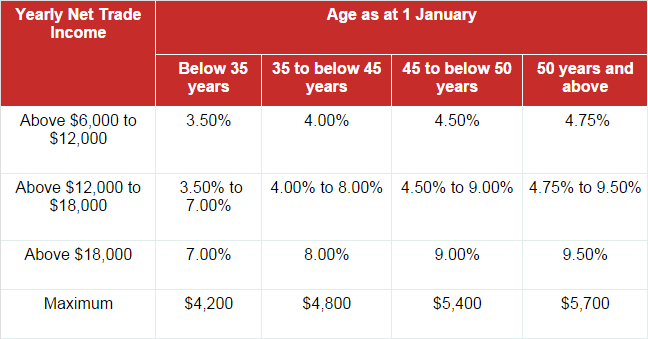
For the self employed, it's voluntary to contribute to CPF. However, the medisave account needs to be topped up, and that's the only thing that is compulsory. As long as you're self employed and is a Singapore citizen or PR making a yearly net trade income of more than $6000, you'll have to contribute to medisave account.

Table 1: Self employed compulsory medisave contribution rates in 2014

This contribution is subject to a cap based on different age groups. For example, if you're between 35 to 45 yrs old, you'll have to pay a max of $4800 that year, which corresponds to a monthly income of $5k. Even if your net trade income is more than $5k per month, $4.8k is the maximum amount that you have to contribute to your medisave account.


Okay lah, medisave is going to be useful in the future. Sooner or later, the amount will be used, so might as well put it in a good place earning high interest to pay for the future. Pay now and use later. For more information, you can read the link here.


Self employed Voluntary Medisave contribution (VC-MA)

This is different from the compulsory one, even though both are contributed to the medisave account. The difference lies in that there is no tax relief for the compulsory medisave contribution. It's by law that you have to contribute. If you have extra cash that you want to top up specifically to the Medisave account, you can do so and also earn tax relief if you hit the following conditions:

1. You are a Singapore citizen or PR, AND

2. You have made a voluntary contribution to your medisave account in the previous year


The key word here is 'AND', not 'or'. A little planning is important, especially if you know that in the next 1-2 yrs, you're going to earn more money and you need that extra tax relief by doing voluntary contribution.


The tax relief is limited to the lower of:

1. Voluntary cash contribution directed specifically to Medisave account (VC-MA)

2. Annual CPF contribution limit ($30,600 in 2014, $31,450 in 2015) less Mandatory Contribution amount

3. Prevailing Medisave contribution ceiling table (MCC). It's $48,500 for 2014.


It sounds really complicated, but I assure you it's not. IRAS website illustrates with very clear examples of what happens when a self employed earning this amount, putting that amount in CPF voluntarily over and above his compulsory medisave contribution can get how much relief. You can find the link here.


B. CPF Minimum Sum (MS) topping-up scheme

This minimum sum topping up scheme is for you to top up your own or your loved ones' Special Account (SA) or Retirement Account (RA). Whether it's funded to SA or RA depends on the recipient's age. If the recipient (can be yourself) is below age 55, it'll go into the SA. If the recipient's age is 55 or more, it'll go to the RA account. CPF has a strict definition of loved ones. To them, 'loved ones' include only your parents, parents-in-law, grandparents, grandparents-in-law, spouse and siblings. No mistress, no friends, no co-habitants and no dependents.


The amount of tax reliefs is equal to the amount that you topped up, subject to a cap, of course. The maximum tax relief for contributing towards your own SA or RA is $7k per year. The maximum tax relief for contributing towards your 'loved ones' SA or RA is $7k per year also. Remember to read the definition of 'loved ones' above. The tax relief cap of $7k is applied separately, so you can theoretically get a max of $14k tax relief per year if you top up BOTH your own SA/RA and your 'loved ones' SA/RA.


Oh, by the way, it's called CPF Cash Top-Up Relief for a reason. To qualify, you should use cash and you can't transfer your own CPF account to others. Also, for spouse and siblings, they must not have an annual income exceeding $4k in the year of top-up. Otherwise, you won't get the tax relief. You can read more about it in detail in the link here.


C. Voluntary Contribution to CPF

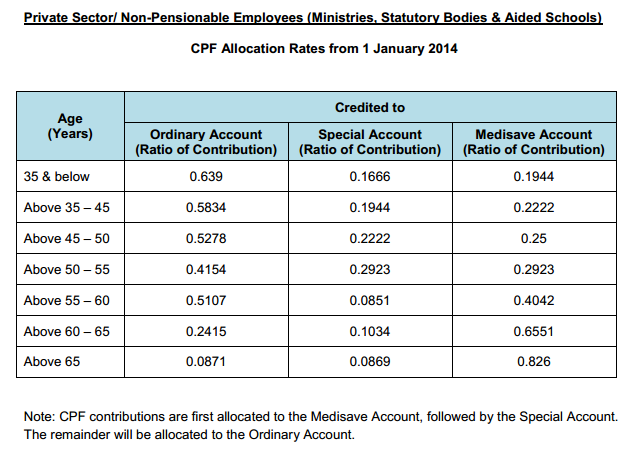
This is different from Voluntary contribution to medisave account (VC-MA). This is where you inject money into all 3 accounts (OA, SA and MA) in your CPF, in a ratio that is dependent on your age.


Table 2: CPF contribution / allocation rates for different age groups in
2014 for wages > $750. For wages <$750, click here to see the table.

It's not really good to see that table, isn't it? The reason is that the amount of money that you voluntarily contributed to all 3 accounts in your CPF does not have an employer's portion. Let's say you're between 35-45 yrs old, your contribution rate should be 20% and 16% from employers, forming a total of 36%. But since you're contributing voluntarily, your entire sum will form the 36% normally contributed by both employer and employee, Of the 36 parts, 21 parts, 7 parts and 8 parts will be contributed to the OA, SA and MA respectively.


It's really easier to see the contribution amount in the form of a ratio below.

Table 3: CPF allocation rates (ratio) in 2014 for different age groups

Okay, this makes it much clearer. If you contribute $10k voluntarily to 3 accounts, you'll end up contributing $5,834 (10k x 0.5834) to your OA, $1,944 (10k x 0.1944) to your SA and $2,222 (10k x 0.2222) to your MA. But you can only contribute up to a cap. That cap is the Annual CPF contribution limit ($30,600 in 2014, $31,450 in 2015) less Mandatory Contribution amount. The Mandatory Contribution amount for a purely self-employed person not being any employee of any company is also the money that you have to contribute to your medisave account by law every year.


What about tax relief?


First, you must hit the conditions:

1. You are a self employed person and you've a positive net trade income in the yr of assessment and

2. You've contributed to your mandatory medisave contribution in the preceeding year and/or

3. You've made voluntary contributions to your medisave account (VC-MA) in the preceeding year


Basically if you haven't contributed any amount to your medisave account that is mandatory or voluntarily, you won't be entitled to the Voluntary CPF contribution tax relief. If you hit the conditions above, then your tax relief will be the amount contributed subject to a cap, which is the lower of:

1. 36% of your net trade income for 2014 (37% of net trade income for 2015)

2. Annual CPF contribution limit ($30,600 for 2014, $31,450 for 2015)


You can see this link here to read up some illustrations.

Above all these, there's this site that clarified a lot of queries for me. I don't even know how to do a voluntary contribution for CPF until I read the FAQ here. It's a very useful read for all self employed people.


Take away:

So, what's the right course of action? Firstly, I have to pay the compulsory medisave account. You can (1) pay it directly to your MA account, or (2) you can do a voluntary contribution to 3 cpf accounts so that a certain % will flow to your MA, but make sure your contribution to MA is equal or higher than the amount of medisave you are legally required to contribute yearly. If not, you still have to top up your MA to hit the legal requirement. That's not a choice.

After that, I'll have to weigh these 3 factors:

1. How much cash do I want to keep for my personal investment as a warchest

2, How fast I want to fill my fund of the mother of all emergencies, in the form of OA in my CPF

3. How much tax reliefs I can knock off my income to bring my assessed income to a lower tax level.


Here's a brief summary of all the schemes. That hardest part of this research is making heads and tails of all the available top ups with their abbreviations and jargons.
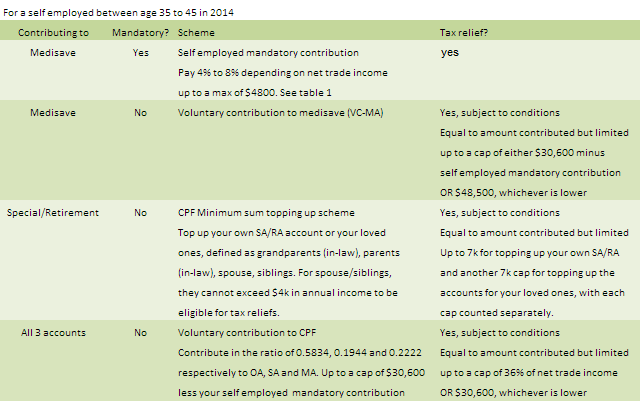

Table 4: Summary of schemes available and tax reliefs


My answer to the above 3 factors will allow me to decide how much money I can contribute and also into which account. I will be contributing to all 3 accounts (doing a Voluntary contribution to all 3 accounts), and not just contribute to my SA account (through CPF Minimum sum top up scheme). The main reason is that the tax relief for Voluntary contribution to CPF is higher than the CPF minimum top up scheme. The other reason that I need to build up my OA to pay for my housing. I can't pay for my housing using SA, even though the interest rate is higher. It just doesn't serve my purpose and address my concerns.

Monday, December 01, 2014

The relationship between ROE and ROA

Been reading a few books on finance recently to brush up some stuff. Things that you don't use it often, you'll forget. So I make it a point to re-read some of the books that I've read and also some books for newbies. It's important to learn as if you are a newbie even though you are not. You'll see things in different light.


Anyway, I was just musing over a key criteria in evaluating companies. Among other things, it must have:

1. High consistent ROE, > 15% over 10 yrs or more, or if 5 yrs, have a higher margin of safety

2. High consistent ROA, >7%, same time criteria as above


ROE is calculated by taking the net profits divided by the equities portion. You can find net profits in the income statement, usually right at the bottom of it (it's literally called the bottom line). Equities is found in the balance sheet. Equities is what you are left with after subtracting total liabilities from total assets. ROE itself changes depending on how much debt you use to leverage to increase your earnings, so it's very important to consider the debt profile of the company together with ROE and not just treat ROE as a stand alone matrix.


You can break up ROE into the following 3 components to better clarify what exactly drives the ROE.


ROE = Net profits/equities = Net profits/Revenue x Revenue/Assets x Assets/Equities


Net profits/Revenue is the net profit margin. It measures how many dollars you book as profits after subtracting all the costs of selling $1 worth of goods/services. It's important to realise firstly this might not necessarily translate into cash straight away because this is just an accounting profit. The actual cash might come in later (or not) and can be seen in the statement of cash flow. Obviously, the higher the net profit margin, the better it'll be.


Revenue/Assets is the component that measures how efficient your conversion of the assets to revenue. It varies widely from a company that sells goods to a company that sells services. Generally, a company that sells services are lighter on assets, so their revenue/assets ratio will also be higher than say, a company that sells shoes. Again, the higher the better.


Assets/Equities measures the gearing (some sort) of the company. Assets (A) = Equities (E) + Liabilities (L). If the company has a lot of debts, their liabilities portion will be substantial, thereby raising this ratio. Out of the 3 components, this is a ratio that might not be good if it's higher. Given the same ROE, a company with low Asset/equities ratio is generally in a better position than one with higher Asset/equities. With debts, you can leverage a higher profit, but it goes both ways too when the economic situation becomes dire. You can lose more than you owe. Short-term wise, with debts, generally ROE will be raised (but at what cost?) because it's just a product of the three components.


But I want to introduce ROA into the picture as well. ROA is defined as follows:

ROA = Net profits/Assets

It measures how efficient the company is at converting its assets into net profits. Generally, the higher the better. However, because the denominator is Assets, and Assets = Equities + Liabilities, essentially:

ROA = Net profits / (Equities + Liabilities)

Now compare this with ROE, which is:

ROE = Net profits / (Equities)

and you'll realise two things:


1. Mathematically, ROE is greater than or equal to ROA, because the denominator for ROA is larger or equal to that when calculating ROE

2. ROA approaches ROE when Liabilities approaches zero. For a company with zero debt, there should be no difference between the ROA and ROE


That was my hypothesis anyway. It formulated when I was at a coffeeshop waiting for my seafood hor fun and I got myself thinking after looking at the 2 criteria stated above (high ROE and high ROA) for good companies. I knew I got to test it out, so let's see it in real life cases.


It's instructive to compare 2 companies with similar ROE and then compare their ROA, after which we see their Debt/Equity ratio.


Observations:

1. The two green columns - ST Engineering and Sheng Siong - have very similar ROE at 26+%. That's very high. But notice also that while ST Engineering has a much lower ROA, Sheng Siong has a much higher ROA. If we look at the Debt/equity, we notice that ST Engineering has a lot more debts than Sheng Siong. This by itself isn't a red flag, but it's just something we have to take note of. Debt is only a problem if they have a problem paying it off. We can see that the high ROE of ST Engineering is partly fueled by its debts.


2. The two purple columns - GDS and Vicom - again have very similar ROE at around 22 to 25%, which is very admirable. This time, both have very low debt/equity ratio and thus their ROA matches very closely to their ROE. GDS especially, is a company that I didn't know existed until I tried finding a company listed in SGX with the lowest Debt/equity ratio. Having a high ROE (25%)  and a high ROA (19%) plus a good yield of about 3.8%, it's one of those small caps that might be worth while for investors to dig deeper.


3. The last 2 red columns - Sembcorp Ind and Hock Lian Seng - also have pretty good ROE of around 16.8%. But we can immediately see the difference in their ROA. Sembcorp Ind has still a decent 8% ROA but Hock Lian Seng's ROA failed the criteria of having ROA being 7% or more (it's 4.8% in 2013). And we can observe why - the debt/equity for Hock Lian Seng is much much higher than that of Sembcorp Ind.


Take away:

I think if we track the ROE and ROA trends of a company across years, we can uncover something interesting. ROE by itself is just a number; we have to check the quality of that number. If it's maintained by higher and higher debts, we can see it in their ROA trends too. Basically you don't want a situation where the ROE keeps increasing and the ROA keeps decreasing. A divergence of this two matrices means only one thing - the debt is piling up.


But of course, I still highly recommend the elegant Dupont's analysis of ROE that I've blogged about at length and summarised here. It clearly shows which of the 3 components are the ones that brings the bacon home and maintains the ROE.

Friday, November 28, 2014

How to begin learning stocks from SCRATCH

Just had a meet up with someone new to investing. I totally understand how hard it is to read up all the jargons and finance related stuff when I started long time ago. It's like this big mountain of jargons in front of you, and in order to hold an intelligent conversation, you first have to learn the language and what those terms mean. That's one of the main purpose of this blog - to help newbies go through this path that I once walked alone.

The very first thing I did was to print out all those investing basic articles from investopedia. They changed their site, and I'm not used to it, so had a little bit of difficult finding the articles that I wanted to read. This is what I'll read first:

1. Stocks Basics: Introduction

Basically these are just very basic things like what are stocks, what's a bull and a bear, and how to buy and sell stocks.

2. Investing 101: Introduction

Here, we go deeper into the different types of investment vehicles, the concept of compounding and portfolio diversification

3. Introduction to Stock Trader Types 

You'll learn about different kind of market participant (they call it trader here). Generally you can break up into two branches - Technical analysis (TA) and Fundamental analysis (FA). There's a lot of sub groups under these two categories...good to know about them.

4. Fundamental analysis

Here you'll learn about the terminology of FA. To really do well, you need to learn the language of business, which is accounting. So here's a few branch off from Fundamental analysis:

A. Accounting

We're not trying to be accountants, but we have to know enough to be able to derive useful information from the financial statements of a company. I'll pay attention to the 3 statements - cash flow statements, income statements and balance sheet and how they interact with each other.

B. Value investing

What's this about? The most famous follower of value investing, Warren Buffett, made this method both highly lucrative and difficult to follow. He's not really a true value investor, but let's just say he is at this point in time. Benjamin Graham is the father of value investing. Don't you want to find out how Buffett make his fortune using this methodology?

Update: 16-Dec-2014

Here's a very good video site by BuffettsBooks. It shows you several videos in a very structured course, guiding your through stocks, bonds, and the various financial ratios and a bit of accountings. From the namesake, this is slightly biased towards fundamental analysis, specifically Warren Buffett's 'way' (he never actually declared his method).

5. How to start trading

This is for the other big umbrella under TA. It's a little bit more detailed about the different kinds of traders. They participate in the market in ways that are vastly different from those from the FA side.

Important downloads (free!):

If you're interested in charts (basically TA requires you to read charts and draw squiggly lines in it), there's a free chart program (but have data for past 1 yr free only) called chartnexus that I've been using since forever. You can get it here.

6. Financial concepts

Still around? Haha, then it's time to re-look in a little bit more detail on some financial concepts like risk/return, diversification, dollar cost averaging, asset allocation etc..This is the big picture view of your portfolio, whereas how you construct your portfolio is based on whether you're more from the FA or TA side.


Read and read and read and read. Or you can always lose $ and learn the hard way.


Alright, if you've survived all the reading, then it's time to get real dirty! You can start reading up on proper books on the 3 separate themes: Accounting, FA and TA. Only the first theme (accounting), you can just read enough to understand what you need to know. For the FA and TA themes, you probably need a few years (hopefully not inclusive of a few $xx,xxx of 'tuition' fees) to form your own opinion and your preferred methodology. I've written a post on the recommended reading list here so I won't repeat it again. But I found that all these books are catered to the US market, so some of the things are not relevant here. That's why there's always a need to contextualise some stuff here.

So here's my sites to read:

1. Bullythebear newbie's FAQ (if the links failed, here's another one straight from my blog, here)

2. SIAS Beginner's guide to investing

You probably want to revisit some of the things you've read. If neither FA or TA interest you because you really can't be bothered with investing and would very much prefer to have a life instead of reading all these stuff, you can read 1, 2, 6 and go straight to this:

7. Exchange traded funds 

Most unit trusts and personal portfolio try to beat the market returns. By that, they usually benchmark themselves with STI (for our case) or DJ / SP500. You can buy the overall market instead of trying to beat it, so here's some info regarding ETFs. This is a passive kind of investing. Read up a bit more about dollar cost averaging (google it if you forgot what that means) and you can heck care about all these funny terminologies for good. Just put in a sum every now and then and get market returns. Minimum effort from your side.


Okay great, once you've done reading up all these stuff, you're at Primary 1 of the great stock market education. Sit for your PSLE, then O'lvls, then A'lvls, then degree, then masters, and finally pHd. Good luck and most importantly, work hard at your craft!


(Don't berate me for oversimplifying stuff...it's necessary to see the big picture here and understand that there's a lot of stuff to read and understand and you'll have to start from someone. This is at best a guide to start somewhere, nothing more.)

Thursday, November 27, 2014

I've Zero networth!

I've finally reached zero! But what's the big deal? Zero is not a big deal, right? Well, not if you begin with positive, became negative, and then back to zero again. Reaching zero means you've erased the negative and now you're on a fresh start to begin being positive again.


What am I talking about? It's my net worth!


I still owe HDB $440k now. I halve this to take into account the portion shared by my wife, so that's $220k. The last I've checked, my current networth is $226k.


This is how I calculated my networth. It's just Assets minus Liabilities.

My assets are: (all $226k of it)

1) Whatever I have in wallet, drawers, mattresses, tin cans
2) All my bank accounts combined
3) Money market fund
3) Paypal and other online cash accounts that have some digital cash inside
4) All my investments holdings, marked to market
5) All my whole life policies surrender value
6) All the amount in my CPF (less than 40k overall, which isn't much)

(Take note that I did not include the market value of my HDB flat)


My liabilities are: (all $220k of it)

1) Credit card bills
2) Car loan (left about 5k)
3) And the biggest meanest of them all, HDB loan of 226k after taking into account my wife's 'portion'

And I'm positive by 6k!

Well, actually there's nothing much to shout about, it's just another day actually and I don't even feel particularly happy. It's a milestone that tells me I'm on the right track. Personally, I think cash flow is more important than networth. I can't just throw in all I've got and sell of half my stake of my HDB to my wife and declare myself free, can I? Of course not. So, this is at best one indicator of my financial health.


To borrow from someone, the best has yet to come.

Saturday, November 22, 2014

Low hanging fruits season

POSB is giving another low hanging fruit for us to pick again.


I've blogged about a previous exercise here and here where POSB celebrates National Day with a 1.5% pa bonus if you put in fresh funds for 3 months, up to a cap of 10k. Well, it must have been hugely successful and drawing a lot of new funds for POSB, because they are doing it again with some conditions upsized.


This new exercise that POSB is doing is a little different. It gives 1.5% pa interest for a period of 6 months, up to a cap of 20k. To qualify, you must:


1) Register here by 22nd Dec 2014 (inclusive of that day)

Take note that the sequence is a bit different from the last exercise. In the last one, you have to deposit your funds first THEN register. For the current one, you have to register first, THEN deposit in your fresh funds. So don't screw up!

2) Complete a one time top up by 31st Dec 2014.

Put in fresh funds between $1k to $20k, in multiples of 1k into any existing DBS/POSB bank account by 31st Dec 2014. Do note the definition of 'fresh funds' cannot include those that are transferred intrabank from one DBS/POSB account to another. But the mode of transfer can be through cheque, cashier's order, demand drafts, cash deposit, FAST. For more details, do read the terms and conditions.

3) Maintain top up amount for a period of 6 months.

This is an example quoted in the terms and conditions.

Customer A registers via online through DBS’ website during the Promotion Period and successfully top-up a lump-sum of SGD 20,000 to a CASA by 31 December 2014.

Cash Gift earned by Customer A under the Promotion as follow:
SGD 20,000*1.5%p.a.*181/365 days = SGD 148.77

(Note: 6 months period is from 1 January 2015 to 30 June 2015 = 181 days)

4) Wait to get your 'cash gift', up to a maximum amount of $148.77, which will be transferred to your registered DBS/POSB account between 1st June 2015 to 30th June 2015.


I know it's might not be much, but hey, it's not hard to do this also. I still have 10k locked up until 30th Nov 2014 from the last exercise. I'll see if they are 'smelly' or not by looking at whether they will pay up. By then, I'll still have more than enough time to put in 20k to get this extra interest.


Low hanging fruits? I'll grab it.

Friday, November 21, 2014

The 10 functions of money

What's money good for? From Richard Templar's book, "The Rules of Money", money is good for 10 things. I found the list quite exhaustively, though some points are really be lumped together as a single point. But here it is:

1. Security

I think money provides a huge security for me. I need to have a certain amount in my bank before I can feel safe that I can tide through the month. I also need to save up a certain amount for my future retirement, and also a bit at hand to tide through life's emergency. I guess this is my number 1 priority in wanting to get more. It could be more psychological, I understand.

2. Comfort

Money can't buy everything, but for the things that it can buy, it does it really well. Don't think of just big cars and huge condominiums to stay in, it can also be a comfortable and good medical facilities for your loved ones and a warm bed and food for your children. I realised I don't need too many comfort items, but money does what it's supposed to do - to satisfy those creature needs. Like a really nice bed to sleep in, and a warm and tasty food afterwards, haha

3. Luxuries

I find that this point is the same as point 2, just on a different scale. It can be grouped together as one single point. Fine wines, good meals at top-notch restaurants, a good relaxing holiday overseas, a branded bag etc...these are what money can buy that you may want, but not necessarily need. Still, life is not meant to be survived - it's meant to be lived. So indulge yourself in such things, especially if it creates an experience that you'll remember for a long time.


4. Mobility

The author put first-class trains seats and plane tickets, as well as trips on cruise ships and chauffer driven cars in this point. Hmm, somewhat like point 3 to me as well - good to have but not necessary. For all purpose, I'll treat this as a luxury items. But money does buy you mobility. I've a student whose parents are very very wealthy. She practically flies in and out of Singapore maybe every 2 weeks or so - sometimes as short as a weekend trip, sometimes as long as a month long holiday. It's disruptive to my lessons scheduling, but hey, I can't help but be a little envious when the furthest country I've ever been is Australia on a NS month long war exercise! With enough money, you can book a ship to Antartica (I heard it's about 16k for a month long journey) and even a space flight. Of course, once Richard Branson's company settled the underlying issues with his space shuttles first.

5. Status

Rich people will have different status, that's for sure. You'll get invited to special occasions and exclusive clubs. But these are none of my concerns. However, money does get you special status - I'm just not sure that status will still be there when your money is no longer around. I highly suspect that acquired status will be gone too. This is never my priority in wanting to get more money, but I think some people might see this as quite a motivation.

6. Influence

Money can buy you influence. Influence will get you power. It's a little more subtle than the previous point of money giving you certain status. A lot of powerful rich people get pull enough strings to make even government bend to their request. America history of wall street is full of such people. A few big names comes to mind - Rothschild, Rockefeller, Astor, Vanderbilt and so on.


7. Freedom

This is what most people want to acquire enough money for. Once you have the capital, you get generate enough passive income so that it will exceed or match your expenses, so you won't have to work for money again. Financial freedom - that journey that begins all journey.

8. Leisure

I think this point is tied to the previous point on freedom. With freedom, you will have leisure time, so in effect, your money buys you time instead of paying time to get money in your earlier part of your life. My take is, don't wait till you are financially free before you start enjoying your leisure time. Hedge your life by taking small leisure with your loved ones every now and then, just like you are hedging your future life by saving up in the present.

9. Popularity

Money can buy popularity, but I doubt the kind of acquaintances and friends are the kind that you really wish to associate yourself with. Still, money does its job of making you more popular - you just have to exercise your own judgement to see who will still be around when you have no more money.

10. Philanthropy

Money enables you to give more. It's strange, isn't it? Spending time and effort to get more money, so that you can give to more people. I think money makes you more of who you are. If you're a jerk without money, you're a bigger jerk with money. Likewise, if you're a generous person without money, you'll be even more generous with more money.


Is there any more uses or functions that money can serve as?

Friday, November 14, 2014

The role of parents in an uncertain world

The hardest thing about bringing up a kid is the values that you want him to inculcate. It's never a straightforward equation, where you put in the right input and you get the right output. Different kids respond differently to the same input and produce vastly different outputs.


Take for example a parent who always tries to teach his kid to save up and be frugal. He did it in a way that forces his kid to scrimp and save and the kid grew up having the mindset that money is very important. Here's two diverging paths that might happen; extreme but entirely in the realm of possibilities. The kid either grows up spending crazily to 'make up' for his lost childhood and his whole adult life will be about reclaiming some parts of his life that he didn't experience but other kids did. Or, he will continue to save and scrimp like his parents did, perhaps to gain their approval and therefore their affection. It's hard to tell in advance which paths the kid will take. It's like the Schrodinger's cat phenomenon where both outcomes are possible but it'll be determined only when it's determined.


Extrapolating this idea, a frugal parent might or might not come from extravagant grandparents. But folklore always mention about having a generation of alternating characteristics. For example, you have a grandparent generation who are frugal, then a parent generation who are extravagant (to make up for their frugal upbringing), then a current generation of kids who are frugal again. This, of course, is not fixed in stone, and the unpredictability of the next generation to follow what the previous generation values are, is what I'm talking about here in the first place.


Given this, can we really engineer the kind of values that we want out kids to have? I guess we can only try our best. This is important because trying our best is the only thing we can do. In light of this, it's also important not to blame our parents for whatever ills that this current generation is suffering. More likely than not, when it's time for you to become a parent, who knows, maybe your kids will also blame you for whatever nonsense you've taught them that works for you but utterly failed on them.


A good example will be the "study hard then you'll be settled for life" myth. I use the word myth because it's a socialised fact; everyone knows it and follows it, but nobody really question why or how effective it is. Until now. Parents growing up without much education, and thereupon seeing their peers who are fortunate enough to study and landing well-paying office jobs, are the ones perpetuating this myth. It's the right thing for their generation because having a O'lvl cert back then is as good as having a degree in university. If you had a university degree back then, you must be the top 1% of the most highly educated, and by extension, the most sought after job seeker in that generation. Is it going to work for this generation now? I doubt so.


Going forward, what other values or ideas have you tried teaching your child that works for you by might not work for them? Who can tell? It takes a rather long time for the kid to grow up before you can say for certain what works and what doesn't. By then, it's too late. It's like you bought into a share to hold it for the long term and looking at it after 20 yrs, you realised it's a dud. By then, the period of remediation is long gone and you have a kid who might have blamed you for what you've taught eons ago.


The physical part of parenting is never easy, but it can be easily outsourced. The ideological part of parenting is the tricky part. Firstly, you don't know whether what you taught them is still going to be helpful for them in their future that you no longer belong to. Second, even if you know for sure, whatever you try to inculcate in them might turn out to be quite opposite to what you intended. Thirdly, it's not like you have many chances to go through trial and error. Unless you have a kid now and after 20-30 yrs you have another kid, you pretty much only have 1 chance. Given the circumstances, how can someone ever say that they are ready to be a parent, don't even talk about being a good one?


Still, in the light of all the uncertainty, we have to make a choice:


1. It's important to teach your kids adaptability and resilience. How? I don't know. I just know that it's important to prepare them for the future they are going to inherit, not yours.

2. Don't blame yourself as a parent if things don't go right. Don't blame your parents if things don't go right for you. Nobody knows what is happening and in the thick of the battle where there's a concealing fog of war, you can only do the best you can taking into account all the information available to you at that moment. Point 1 comes in mind - adaptability and be resilience.

3. Beware of unintended consequences. Beware of it, but ultimately what else can you do?

4. Be prepared to fail as a parent. Be prepared to fail as a person growing up in this world. There's no perfection to be attained, only improvements. In spite of all this, love yourself, love your parents.


After this internal dialogue, I end up still being uncertain. I know nothing but I have a feeling being uncertain and knowing that you know nothing is the destination of our journey.

Tuesday, November 11, 2014

Valuation of ST Eng based on order book

ST engineering had been dropping like crazy the last few weeks, and very recently in the last few days, the sell down persisted at a much greater pace. I know that they had a weak quarter, and possibly they will end this financial year with similar revenue but weaker net profits. My class got cancelled, so I had some time to crunch some numbers.

Here's a fancy 5 yr key financial data taken from their site:


A few things to take note:

1. The net profit margin (Net profit/Revenue) hovers around 8% in 2009 to 9% in 2012.

2. The number of shares taken to calculate the earnings per share (EPS) increases from around 30 units to around 31 units.


(What units? EPS is net profit over shares, so if you manipulate the formula you'll get shares = net profit/EPS. And that's what I did. I took the net profit for each year divided by the EPS to get the shares, but I can't be bothered to convert to the proper units. Not that it mattered later on when I use it for calculations.)


The 10 yr order book is provided in the annual report 2013 too. Here it is:


Since the share price of a company should be forward looking, knowing the current order book for the next 10 yrs should determine the current price of the shares now. What I wanted to find out whether I can use the order book to guestimate future revenue booked. Since I know the historical net profit margins, I can guestimate the future net profits. If I divide this by the number of shares unit by the company, I'll have the future EPS. Multiply EPS by the historical PE ratio, I'll have the future price range, and I can decide from there what to do with this garbage-in-garbage-out number so expertly calculated.

Let's go.

First, a little back testing. Since they have the 10 yr order book data for 2003 and 2008, I can use it to see if this is even worth the bandwidth posting. Here it goes:

Assumptions:
1. Share units of 31 (more conservative than 30)
2. Net profit margins of 8% (more conservative than 9%)
3. PE range from 10 to 20 (theoretically it should be 10 yrs, isn't it, since it's a 10 yr order book)

10 yr order book for 2003: $4.6b
Net profit for 2013: $368 mil (4.6*1000*0.08)
EPS for 2013: 11.9 cts/shares (368/31)

Using PE of 10, share price = $1.19
Using PE of 15, share price = $1.78
Using PE of 20, share price = $2.37


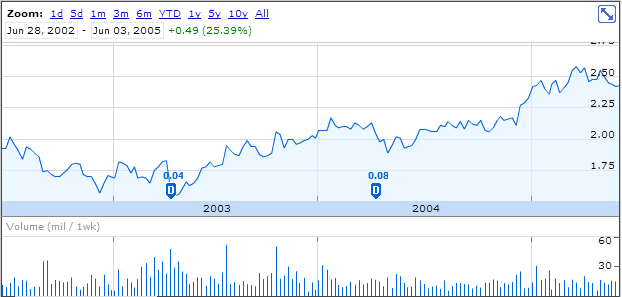
So, based on this order book estimation model, I get around the price range of 1.78 to 2.37. Let's tally it with the historical share price around mid 2002 to mid 2005. You can see that from mid 2002 to end of 2003, the price hovers around a range of 1.6 to about 2. Alright lah.


Let's try for order book for 2008.

10 yr order book for 2008: $10.6b
Net profit for 2018: $848 mil (10.6*1000*0.08)
EPS for 2013: 27.3 cts/shares (848/31)

Using PE of 10, share price = $2.73
Using PE of 15, share price = $4.10
Using PE of 20, share price = $5.47

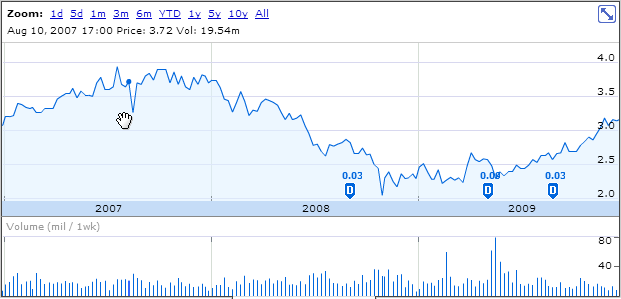
I attach the historical share price from 2007 to 2009 here. Price ranged from about 2 to 4. A little unfair cos it's the global financial crisis, so the PE is depressed by that event. I leave it to you to decide if you can use the order book as a suitable model of valuation based on this 2 samples.


Ah ha, here's what we've been waiting for. Let's try for order book 2013.

10 yr order book for 2013: $13.2b
Net profit for 2023: $1056 mil (13.2*1000*0.08)
EPS for 2023: 34.1 cts/shares (1056/31)

Using PE of 10, share price = $3.41
Using PE of 15, share price = $5.11
Using PE of 20, share price = $6.81


A big caveat here here is that this is of course a simplified model. I'm using net margin of 8% on any revenue booked, but it will change when the composition of the revenue is changed. It could be higher or lower. There's also another consideration - the dividend. Let's say the dividend, which is 15 cts now, will drop to 14 cts in the future. Based on 10 times PE, the yield will be a reasonable 4.1%, with the possibility of the share price 'upgrading' to a PE of 15, possibly booking another 50% capital gain.


My second tranche of averaging down will be a little more pessimistic. Here's a chart that I did quite some time ago before all the plunging of the share price recently.


3.3+ to 3.22 will be where my bullet is aiming. I'll see how it reacts around 3.3+ first before deciding further. And how did I react to the falling share price? Nothing. Unlike the past, I didn't put in more than what I can afford to lose, and this is not an s-chip like longcheer or china milk or ferrochina.


What a journey it had been from then and now lol!

Friday, October 31, 2014

52 books a year challenge

2 more months before the year 2014 is over.


I still have one last major thing to tick off in my goals for this year. This is something pleasurable - reading 52 books per year. I've been doing this for quite a number of years already, so it's nothing new. However, it's always a challenge because I'm operating at a zone just between the impossible and the just possible, which makes this a really good challenge because there's a good chance it may fail unless I change myself. Challenges like these are very satisfying to complete. It has the Goldilock's standard of not-too-hot-not-too-cold optimization.


52 books a year means 1 book per week, regardless of length or thickness. The intention behind the challenge is not for me to read as many books as possible (thought that will be achieved), but to complete as many books that I started as possible. It's very easy to begin a book but after a few pages, you realised that maybe this book isn't as exciting as it looks in the beginning, so you procrastinate and read lesser and lesser before ditching it for another brand new 'exciting' book. If I do that all the time, I'll never finish my 52 books a yr challenge. To prevent myself from not finishing a book when I started it, I set up the challenge. With that target number always in mind, it'll force me to complete books instead of starting them. And thank goodness I did so, because there's a lot of gems that are boring at first but gets better and better as we go along. Imagine how many gems like these will be thrown aside if I didn't adopt this challenge.


I noticed that if I borrowed books from the library, I also tend to finish them faster. I'll plan my schedule such that I'll have time to read them. Books that I had bought, however, are usually left on the shelf. It's silly, but it seems that if there's a time constraint to reading a book, you'll actually finish them faster. I guess it's psychological - it's like you're rushing against time and thus the pressure to complete them. 52 books a year challenge seeks to replicate that time pressure.


Had a chance encounter with this book at NLB Bishan. Been wanting to read this for 1 yr!

So, how many more books do I need to complete the challenge? I'm currently on book 35 now, which means I have another 17 books to go before 31st December 2014. Let's say I've 20 books to complete in 60 days (2 months). That gives me 3 days to finish reading a book.


Challenge accepted!

Saturday, October 25, 2014

Which one suits you better - earn more or spend less?

We all know there are only two ways to save money. The first is to reduce your expenses. If you spend less, then whatever is left is your savings. The second is to increase your income. If you keep your spending to be the same, what you earned after your spending will be your savings. But which way works better?


I think the key point here is whether your income is scalable. If your income can vary according to the amount of work that you produce, then it's scalable. If that's the case, then you might want to focus on earning more income. My job as a tutor is scalable. A salesman job whose income is tied to the commission earned from the sales made is also scalable. Focusing your energy on an active income stream which is scalable makes sense because there's a lot of benefit besides having a higher income (therefore, higher savings).


1. When you're busy, you can't be shopping. 

I'm not sure about others but when I'm in my peak season, I can't wait to go back home to rest. I understand that some others might go on compensatory shopping to alleviate the stress and pain of working so hard, but to each his own. The months that I spend the least correlates to the months that I earn the most. It's during those months that I've half or a quarter of my work load that I spend more time shopping, watching movies and eating out at restaurants.


2. Working harder might lead you to a higher base salary or a better job

If you work hard enough, you might be noticed by your superiors because of your output. This might lead to a better job prospects/promotion which can lead to higher base salary. Certainty in income is better than variability, so if your hardwork leads you to secure a higher base income, why not? Makes it easier to plan ahead too. If that doesn't work out, perhaps you'll be noticed by headhunters who can direct you to a company that pays you better. If all these doesn't happen, surely there's going to be a better bonus towards the end of the year? Still no? Then maybe you should just switch your company.


3. There's a sense of achievement from career satisfaction or from a job well done

It's not just about savings. A feel-good mentality about your work can lead to a multitude of desirable side effects that makes you happier. Imagine you're the top producer in your company. Beside earning the extra income, you'll also be regarded highly by your peers. Just don't take it that you've arrived and buy yourself an expensive car to go along with that status. A feel good feeling is internal, not necessarily externalized by material goods.


What happens if you income is not scalable? That means that the more hours you put in, not withstanding a possible promotion, you're actually getting less on an hourly basis. I think after some years in your company and looking around at your colleagues who are your seniors, you'll more or less know your chances of promotion. If you still want to stay in your company, then working so hard at work doesn't really benefit you. They know it, you know it too.


If that's the case, working on cutting cost is the option to saving more. Cutting cost forms a good foundation in which you can leverage on. Here's a few good points about the cutting cost path towards increasing your savings:


1. You live on less, so that you don't have to accumulate so much upon retirement

This is perhaps the most important reason. If you reduce your expenses until you can no longer cut without sacrificing minimum comfort, you'll increase your savings on a month to month basis. Even if you have bonus, you'll be able to squirrel that away. But in the future, this habit won't likely go away. This means that upon retirement, you don't have to use up so much per month, hence you also don't have to save up so much now. It's about living on less.


2. You can focus on a simple life

There's joy in simplicity. If you don't have the budget to go out and shop and eat out frequently at restaurants, you'll find a substitute for it. You'll find that there are pleasures that you don't need money to enjoy. A simple cup of kopi with a good book or good companionship won't cost much, but you will won't derive less joy from it. You'll be surprised by how much you need and how much happiness you can get from the simple things in life. I can foresee a healthier lifestyle, with more focus on family and relationship and also nature. What's bad about this, seriously?


3. Less stressful at work

I think once the stress of producing more is relieved from you, you might actually start to enjoy your work once again. No longer do you have to play political games to secure a better position so that you can have a higher pay. You can really say no to a couple of networking sessions. And you know even if you're not needed at work, you can survive with very little and still be sane. That's a very powerful psychological advantage out there.


For me, I focus more on earning more because my income is scalable. I also think that there's only so much cost you can cut, so the better option for me is to increase my income to offset against inflation and also save more. I already know my own spending patterns after a couple of years of detailed tracking, so lifestyle inflation (spending more because of earning more) doesn't work on me. The extra amount of spending that I do to reward myself after a month of hardwork is but a tiny fraction of the amount of money earned, so cash-flow wise, it's a net net gain. I know myself hence I can make an informed decision on where to focus my energy on.


Do you know yourself too? Which method of saving suits you best?


Sunday, October 19, 2014

My service standards in tuition

A student asked me a question that I thought is quite interesting. She had been messaging me through whatsapp, spamming (her words) me with questions throughout the day because of the O'lvls and I had been answering them as and when it comes. She asked if I'll be pissed off because of the spamming of the questions and why I'm so free to answer.


The short answer is that I won't be angry. In fact, I'm actually glad that people asked me a lot of queries. It shows that they care about their work and want to do well. If so, then why should I stop them and inhibit them? I should go all out to support their effort! Do I get pissed of answering at odd hours (some can be as early as 8am and as late as 1130pm)? Nah, I won't be, but I might not wake up so early, oops :)


Actually I'm not that free. But not free doesn't mean cannot take some time out to do some problem solving. I take it as a trivial quiz that pops in my phone every now and then. Oh, what is natural number? What is formed when ammonium nitrate reacts with limewater? How to do this question? How to do that question? Luckily I don't mind solving questions on the go - I actually find it quite fun.


I'm one of the lucky few people whom I know that loves his job. To me, my job is not a job - it's more like a hobby where I meet interesting young people and I will try my best to help them. I get paid for doing this and for solving their problem. To me, it's the interaction and mentoring part of the job that I love, and anything that supports that career goal for me, I'll do it.


My service standard in my website states this:


And I clearly mean to fulfill it. So ask away :)

Friday, October 17, 2014

Prepare yourself mentally for bear market

For those of you who had not seen a real mother bear striking down at the market, here's a sneak preview from the past. Unfortunately, I've lost some of the pics when the server I've uploaded them crashed and died. The pictures I saved is meant to serve as a reminder for me when the next bear comes...which might be now.

This one is taken from 2009 Sept 10.


Just look at the Nasdaq and SP500, you'll see why we haven't reached 'there' yet.


This one is for STI. A drop of 5.61% in one day is no joke.


Lastly, this is for the rest of the exchange. As you can see, it's not called the global financial crisis for fun.


Can you stomach this kind of draw-downs in your portfolio value? Surviving is one thing. You must also thrive in this environment. That's how the cash-rich gets richer in every financial crisis. START saving up your warchest now!

Thursday, October 16, 2014

How do you feel in a jittery stock market?

I noticed a big difference in how I handled the bearish stock market sentiments recently. STI had fallen from a high of around 3300 in early-mid Sept to about 3160 in mid October 2014, roughly about 4%. STI closes on 2nd Jan 2014 (the first trading day of this year) at 3180 and now it's slightly under, wiping all all the gains made so far.


Market is getting more delicious 

How do I feel?


Nothing. Is it calmness or simply bo chup? A bit of both I think. If anything, it's slightly hovering on a excitement, because I can get some company at a bigger discount. I remembered vaguely I was quite agitated when I saw that my portfolio drops a few k per day during the deepest parts of the bear market. I was just trying to see if I should cut loss to preserve my limited capital. From thinking how to survive then, I am now trying to see how I should capitalise and thrive during bearish market. It's a 180 degrees change in mentality.


Just fire slowly. Everyone has limited bullets, so getting it all in isn't going to be good to your psychological well-being. So what should we do?


Shortlist a few companies and do the necessary due diligence. Determine the key levels of support or key levels of acceptable yield to buy in. Look and account for how much capital you have (remember to set aside some liquidity for emergency uses). Apportion your capital into several tranches and buy slowly at these key points, close your eyes, and just wait. It's hard not to do anything, I know. Just imagine you are depositing this amount of money into a fixed deposit and you can only look at it 3 to 5 yrs from now.

Monday, October 13, 2014

Bullythebear's 3 Steps Guide to Stock Market (for newbies!)

There’s a lot of people in this last quarter of the year on how they can start investing in the stock market. I always tell them to read up and I’ll get back to them. If there’s a market truism that you need to remember, it’s this:

"The market is not your mother. It consists of tough men and women who look for ways to take money away from you instead of pouring milk into your mouth." 
Alexander Elder

You must not expect the market to give you money without working hard for it. In most cases, the worst thing that you can do to yourself is to make yourself some money without any knowledge, then proceed to throw your entire savings into it only to lose that initial profit plus a lot more. Without ill intent, I always wish stock market newbies to have small failures initially, if only to learn the lesson that the stock market is not your mother who is that to provide and give.


So how do you go about doing it? You can try Bullythebear’s three step method for newbies listed below. I think reading is extremely important in learning how to invest/trade the stock market. If you can’t sit through a reading because it’s very boring or ‘technical’, then maybe you are not ready to delve deep into the subject matter. You might, to borrow the Marine’s jargon, get up and ring the bell to signify that you give up and call it quits. There’s a season for everything.  Perhaps for you, it’s not now.


1. Learn Accounting

If you want to enter the stock market, you cannot help but read. If you do not have the discipline to read, then you might as well just do a dollar cost averaging and keep buying STI ETF.  Whether you are going fundamental or technical, you always need to read. That’s the source where information is passed from one to another.


Why accounting? Accounting is the language of business. If you can’t differentiate between a balance sheet and cash flow statement, then you owe yourself to learn how to do that. But you’re not trying to be an accountant, so learn the basics but ultimately, your job is not to consolidate accounts or trying to balance your accounts. Your job as an investor is to interpret and analyse the company’s health and prosperity by the 3 statements: balance sheet, income and cash flow statements.


If you can’t sit through reading it, maybe you should ring the bell and call it quits from here.


2.Learn FA and TA

There are two branches in stock market. You can be one or the other, or even both. But you need to learn how they operate. If you’re new, you should read up on both to see which side you lean towards. Unlike Harry Potter, we don’t have a magical hat to tell you which ‘house’ you belong to, so you've to learn both to find out your own inclination.


If I’ve to summarise in one sentence what fundamental analysis (FA) is, it’ll be this: The analysis of financial statements and business in order to derive a valuation of a company’s worth to aid in the decision of buying/selling the shares of a company.


Similarly, if I’ve to summarise in one sentence what technical analysis (TA) is, it’ll be this: The use of market psychology in the form of charts and/or indicators to derive the direction and trend of how the price of a company’s shares will move in order to aid in the decision of buying/selling the shares of a company.


Still blur? Read up on both. If you can’t sit through the reading and find it too tedious or boring, maybe you should ring the bell and call it quits from here.


3.Learn stock market terminology and rules

When I started, I struggled to find information regarding the mechanics of buying and selling in SGX. I remembered I was ridiculed by a broker when I told him I wanted to get like 10 shares, because I didn’t know you need to buy 1 lot (which is 1000 shares but going to be 100 shares next year). Little things like this that everyone knows but nobody says it.


That’s why I compiled a list of newbie's FAQ here, in the hope that it’ll one day help others who also walk the same journey as me. I should have update it but I didn’t find the time (and effort) to do so. But these days, with information so widely available, and even local writers publishing books, it’s hard not to find the information you need. There’s a dearth of local books in the past when I started, which always makes me wonder whether the information stated in the book is applicable in our local context.


Here’s another useful FAQ from SIAS, based on local context that I find it very useful for beginners.


As mentioned earlier in the two points, if you don’t want to read, you’ll be severely disadvantaged. If you find it hard to read ‘technical’ financial jargons, just start somewhere. The journey of a million miles begin with by putting one foot ahead of another. Eventually as you read more and more, you’ll soak in all the jargons and can rattle off terms like a pro. But really, just soak up the information whether you understand it or not. You'll reach a critical mass whether things just connect.


Having more knowledge doesn’t mean you’ll make a killing in the market, but having no knowledge will definitely get you slaughtered.

Here's a few books (that I've read) to get you started:

On accounting
(seriously, any books that teaches you how to read and interpret financial statements will do, but I'll highlight the ones that leaves the best impression on me)

1. Accounting Demystified: A self teaching guide - Loita A. Hart
2. Financial statements: A step by step guide to understanding and creating financial reports - Thomas R. Ittelson
3. Financial statements for non-financial people - Ron Price
4. Warren Buffett and the interpretation of financial statements - Mary Buffett & David Clark

On fundamental analysis (FA)


On technical analysis (TA) 


Sunday, October 05, 2014

Storify your facts

My wife and I like to embellish facts with stories.


There's a very recent example of how we do it. There's a blue dustbin that we had in our void deck, that is used to collect bigger pieces of junk for recycling. One day when returning home, wife exclaimed that the dustbin is no longer there. Instead, on the floor where it used to stand were pieces of rubbish that the dustbin is meant to collect.


She told me about it and I told her that the dustbin had worked there for years and had finally saved enough to retire and lead a financially free life. It's a good thing and we should all be happy for the blue dustbin. That was it then and it wasn't until a few days later, that we saw the same blue dustbin on the porch where people usually drop off or pick up passengers because there's a rain shelter there. What an odd spot to see blue dustbin there! I explained that it's because blue dustbin is waiting for the bus to take him back to home. We waved goodbye to him and wished him a good journey. Wife even told him not to take the wrong bus and have himself sent to Semakau, Singapore's (in)famous rubbish island.


I thought that was the end of blue dustbin and we'll never see him again. The rubbish piled up at the usual 'workplace' for blue dustbin and we lamented that a good 'worker' had left the scene. But a few days later, we saw the same dustbin at the same usual workplace. So what happened?


He had missed the bus, what a poor thing, I said. Spent his money on gambling upon his retirement, said my wife. Got cheated of his money on the way back, I suggested. Either way, good old blue dustbin is back at work at his usual workplace but with double or triple the load. My wife threw in a good moral to the story: Be really certain you can reach financial freedom before you leave, otherwise you come back and work your ass off!


Another one?


There's this story of a snail going to the market to buy some groceries after a particularly rainy day. On the way there while crossing a pavement, it suddenly felt a strong pull upwards. Oh no! It must be suffering from heart attack and died or something. This must be the tunnel vision that one experiences when one is out of body! Instinctively it shrank into its shell and waited for the moment to pass and speak to its creator. It waited quite a while but no godly voice boomed to speak to it. Timidly, it popped out its head and lo and behold, it appeared on the other side of the pavement!


What manner of sorcery is this?! It normally take him 5 minutes to walk across if it sprinted there, but this took no longer than 30 s! Still shaken, it went to do the chores required and went home, feeling both grateful and lucky that it's still alive. Later that evening, the snail's news reported of yet another mysterious 'alien' abduction. Statistics show that it's more likely to be abducted by aliens after a rainy day, so it warned all snails around the vicinity to exercise extreme caution and prudence when crossing the mystical 'Pavement 51'.


Life is just that little bit more magical when you do that, isn't it?

Friday, October 03, 2014

Kungfu Cats Academy is here!

For those of you who are regular readers, you'll know what I do for a living. I'm a full-time tutor and had been one for the last 10 years (and counting!). I recently set up a new website to showcase the things that I do as a tutor, and it's called Kungfu Cats Academy. I'll like to share it with you :)


One of the main reasons why I wanted to set up a separate site for my career is so that I can blog about different things that interest me. I find the bullythebear is not the right platform for thoughts and reflections about the education industry in general, so I really really like the idea of setting up a different site to talk about such things. The themes in Kungfu Cats will be about motivational issues, life in general as a full time tutor and other stuff about the educational scene in Singapore. This will be a different platform from what I share in Bullythebear, which is mainly about finance, notably personal finance.


Erm...you'll never walk alone?

The other reason is obvious blatant advertising. I take in students through word-of-mouth alone and it'll be good for the long run if I can increase the number of people who knows what I do. Hence, the site will act as a focal point of my efforts to make my services more visible. It's also so much easier to tell people to go to a site rather than to type out some of the faq that I also put in the site. One time effort but reaping rewards the rest of the time - I love such asymmetry in effort and rewards relationship.


I had also set up a Facebook page for the same purpose. Those who are interested to receive articles regarding education/tuition/motivation might find it useful. I leave it to you to decide whether to 'like' it or not :) I think the whole purpose of setting up a site like this is to let it grow organically, so I realised from past experiences that having 10,000 likes is not the same as having one person who really likes it. The statistics doesn't matter one bit in how I'm going to do my job. I'm used to talking alone anyway, and that's how bullythebear begins. I still remembered the time where there's only 3 persons in my cbox - me, myself and I.


Why cats, you may ask? There's a lot of things we can learn from them - notably creativity, curiosity and independence. These traits are what an educated person should be.

Tuesday, September 30, 2014

Learn from the Ants!

There's a lot of things that we can learn from the ants. Here's a trick on productivity coming straight from the ants colony itself - it's called Ant Colony Optimization.


How does a scouting ant tell the rest of her colony that there's food here? She will secrete more pheromones - some kind of ant perfume - along the path that she found the food. When her colony mates passes by and picks up the pheromones, they will follow the trail, find the food, giving more pheromones and attract more ant mates and so on. Over time, you find that the chemical trail will get reinforced and becomes stronger and stronger.


So how does Ant Colony Optimization works? It works on exactly that principle - that which is useful will be ranked higher than those that are less useful, subsequently reinforced through repeated trials and eventually, the more useful 'path' will be discovered simply by the usage frequency. I'll give a few examples of how this can work in your everyday life:


1. Sorting files

We tend to sort files alphabetically or chronologically. We don't have to. Take for example one file filled with notes arranged chronologically. Every time we take out something from that file, we place it right in front of the rest, ignoring the order. After several iterations, what we use most often will be placed right in front of the file, making it more optimized for your usage instead of arranging in other common order (like chronological or alphabetical or subject matter) but ultimately useless arrangement.

This is exactly what the Noguchi Filing system works. When I read that, I was mindblown. It wasn't until I read and watched a lot of ants video on Youtube before I realized that it's derived from nature.


2. Sorting apps in your smart phone

Same theory. Arrange your apps according to the usage. Every time you use the app, arrange it in the forefront. Upon subsequent iterations, you'll find that the most useful apps will be right in front and the least useful app are right behind. Go ahead and delete that once it crosses a certain time threshold.


3. Internet bookmarks

If you're like me, you'll have so many 'useful' bookmarks in my internet browser that it's not always possible to find the stuff you need anymore. Yet you can't bare to delete them in the event that you might need it one day.


Here's where ant colony optimisation comes in too. You just sort the bookmark by arranging the one that you use right in front. Over time, the most useful bookmarks will be ranked right at the top while the least useful one will be at the bottom of the least. Again, you can delete those at the bottom with the knowledge that you seldom use it anyway, so there's no need to miss them.


These are just 3 examples that you can use to simplify your life. Besides micro things like these, ant colony optimisation can also be used to decide the best route for transportation networks like where to build a highway, bus routes etc. Basically when there's so many choices leading from point A to point B with multiple variables involved, ant colony optimisation will be useful.


Think about it.