Monday, April 21, 2014

MR loh!

I've recently finished the last leg of my national service, the much coveted MR (Mindef Reserve) parade. It has been a very long journey - 13 yrs to be exact - since I was enlisted as a recruit when I was just 18. Some of the people whom I've met when I was 18 was still with me when I went MR. Frightening thought, isn't it? How many 18 yrs do you have? I knew these people for half of my life! What's the feeling of MR? Is it like achieving financial independence or sending the last cheque to HDB because you're finally done with your housing loans?


It's a mix of feelings, actually. There's a tinge of sadness because I don't really mind reservist, especially when you get to enjoy a different pace of life. There's a certain simplicity in army life that I quite like, though I would never sign on as a career soldier because I don't think I'm suitable. There's also a feeling of accomplishment that I've finished this portion of life as a Singaporean male. This is something that not all the people can get to live through. I know how some people hated all things army, but it's still a sort of experience, isn't it? I'm glad I got to experience army life as a Singaporean male.


My unit is special - MR parade at marina floating platform


There's a few things that I'm grateful for in my 13 yrs of service to the nation:


1. Due to some changes in my unit that I'm posted to, I got to experience different sort of management under different commanding officers. I've been though one that is very pro micromanagement and information only flows one direction - from top to down. This is the unit that I've been with since NSF (national service full time) days and I don't really like them. Very rigid. Disciplined? Yes, but only when we need to show it when there are people around. I had a feeling that I always need to pretend that I'm busy so that I won't be 'arrowed' to do some nonsense work because I've finished my work faster than the rest.


Thankfully a small group of my friends got posted out when the former unit was disbanded. The management of this new unit is more hands off, preferring to let individual small groups take over command, while they follow a general orders from higher ups. Is it disciplined? Less so, but there's a great advantage to empowering people from bottoms up. The people in this unit is much more motivated. You see people volunteering to do shit jobs so that the majority can move on in their program schedule. You see people doing extra and giving feedback so that the unit can improve in future events. You even get unit pride so that you don't 'lose face' when doing unit's capability assessment test. Basically, I got a culture shock when I went in because nowhere in my army life had I seen such camaraderie and esprit de corp. This unit went on to get the best NS unit ever in Armour formation, and I'm proud to say that I'm one of their members.


There's life lessons to be learnt from this two opposing views from two different management teams, don't you think?


2. I'm extremely thankful that I have a group of friends that I've known for 18 yrs. When you knew someone that long, you no longer need any pretense. There's no need to talk about the weather and other trivial stuff because these kind of small talk had long gone stale in the first few years of knowing them. These are the people that I've gone through thick and thin with, both in terms of their waistline and also the kind of challenges faced when in service. You knew them so well that you know what they are going to do in the morning when they wake up (brush teeth first or change uniform first?), and who are the ones that will snore and the ones you can always count on for some chocolates or biscuits when you're outfield during exercise. They are perhaps the only group of people who have seen me in various state of undress. If I've not known them for 18 yrs, it would have been creepy. Very creepy.


They are the group of people that you would fight for. Never mind the lofty ideals of serving the nation - that's just pure propaganda. When you're deep in shit, you don't think about serving the nation. You think about not letting your buddies down.


It's great to know these guys.


3. I'm glad that I've been through NS. It's really an eye opening experience that I wish all people can get to experience. But you need to keep an open mind, otherwise everything that doesn't fit your 'normal' experiences will make you unhappy. Angry, even. My philosophy in life is to get as much experience as possible, and not necessarily the good ones only. Just as you need rain and sunshine to make a rainbow, you also need good and bad experience to enjoy life's rainbows. If you go through life like that, then everything is like an achievement waiting to be unlocked in the game of life.


Fired a real bullet from a real rifle - Achievement UNLOCKED.
Thrown a hand grenade without killing yourself - Achievement UNLOCKED.
Not having a proper shower for 14 days -Achievement UNLOCKED.
Shitted outfield? - LOCKED


It just adds on to the variety of experience that life offers. And no matter how much I complain when I'm actually in it, I'll miss those pesky mosquitoes in the jungle and peeing in the bushes, and eating combat rations. These are the things that you will remember in your life, because it's so different from routine.


The BMT recruits are marching out. We've finished out portion and are just watching the parade as a spectator. Kind of strange because this is the first I've watched it as a spectator. Usually just a participant marching.


As a great round up to the whole NSF to NS to MR experience, I've to participate in a big scale kind of MR parade where BMT (basic military training) newbie recruits are graduating to their next phase in their army life while older soldiers like us are graduating to a pure civilian life outside. Passing the honorable duty of defending the nation from one generation to another.


BMT recruits a celebrating their Passing Out Parade (POP). 12 more years to go, newbies.


Last parade of my life carrying a rifle, wearing skeleton battle order (SBO) and a beret and it had to rain. Heavily. Oh well...just take it and suck it up like a soldier.


Wednesday, April 02, 2014

How to party a chaotic good character with a lawfully neutral one?

I read an interesting article from wall street journal by Charles Murray here. In his article, he wrote that punctuality, orderliness and thriftiness are the top three personal habits that may make or break your relationship with your other half. I totally agree. Usually these 3 things are the ones that me and my wife would argue about when we first started our journey together.


We're like polar opposites, so maybe that's why we are attracted to each other. There's something magical about being with someone who is quite opposite from you - all of us will end up having our horizons and experience expanded, if you can tolerate the initial upheaval of your 'system'.


In terms of punctuality, I'm the one who lives by the clock, while she's the one who don't keep time. If we have an appointment at 10am, I'll be ready at 9am, while she's just getting ready to be 'ready' at 9am. This causes much friction while we're dating because I seem to be always waiting for her. But after a long time, I think we're used to each other's sense of time. For me, time is absolute and immovable, while for her, time can be stretched. She has come to realise the value of being prepared ahead of time because of several experiences where she is almost late for some important functions. For me, I've learned to take it easy because even if I'm early, most of the time, the other party will be late anyway. No real harm is done.


Orderliness: In short, I'm the tidy one and she's the messy one. Every day, we'll be fighting a battle of order against chaos. She'll take out stuff from the drawers and leave it lying around, while I'll be busy keeping up to put it back in. It's quite comical and hilarious sometimes. I get energy from having things in a orderly  manner; she don't. After I explained to her, she compromised by keeping certain areas tidy while I keep my eyes closed on other areas. That works very well for us.


Thriftiness: I'm the thrifty, misery one and she's the spender, generous one. She can complain about me being tight about money but when it comes to making financial decisions, I'm the one with all the facts and data at hand and will guide or take her through. I can complain about her spending a lot of money but when it comes to giving, or charity, or helping others she'll take the lead and show me how to be hospitable. I think I can certainly learn a lot from her, just as she can from me.


Being with your polar opposite doesn't always turn out in a good way. Some marriages are broken because of irreconcilable differences. I can imagine how some people cannot embrace diversity and always insists that they are right. If that's the case, then finding someone closer to yourself might be easier to handle in terms of relationship issues. My alignment is lawfully neutral while hers is chaotic good. Not the perfect match alignment wise, but very very versatile in terms of party mix. I think because we mix around so often, I'm slowly changing to chaotic neutral while she's changing to lawfully good. Not a major change but certainly perceptible.


I think the key to a good party combination, regardless of alignment or personal habits, is to be empathetic. If you can put yourself in the shoes of others, you can be with (almost) anyone. Compromising doesn't mean that you're wrong, it just means that you value the relationship more than who's right and who's wrong.

Monday, March 31, 2014

What's good about owning a car?

I had a car for about 2 years now and I dare say it's one of the best things I've bought. This is in sharp contrast to other financial bloggers, who are mostly too quick to dismiss car expenditure as something frivolous and definitely under the category of "wants" and not "needs". I thought I should share what's so good about getting a car in Singapore, rather than just focusing on the dollars and cents, which is pretty much anyone who frowns upon owning a car will say.


Firstly, the bad stuff. Everyone knows that to own a car in Singapore, you need the ultra expensive COE, which entitles you to own a car for 10 years at a cost of about 70k these days, and that's not including the cost of the car. Definitely not cheap. The running cost of my car per month includes the following:


1. Season parking (about $70)
2. Parking at other places ($50)
3. Fuel ($230)
4. Insurance ($90)
5. Maintenance (about $60)

Total: $500 thereabout

So the running cost is about $500. I haven't added in the cost of getting the car yet. I don't think I want to spend anything more than 40k on a car, inclusive of COE. So that means I'm effectively priced out of buying a new car. I went to the second hand car market and got a car for 32k, and that car can still last me for 4.8 yrs before I need to scrap or renew my COE. I paid half of it in down payment and borrowed the rest, so effectively my total cost is about $34k. This is way within my budget, and I really think it's affordable for people who wants to get a car.


Total cost: $500 + $360 (installment for car loan) = $860


Let's just bump it up to $1k per month. I chose to pay 50% and borrow the rest, way before it's mandatory to do so. But think if you're not buying any flashy cars, getting 4 wheels that allows you to move from one place to another should cost around $1.2k per month, everything in. Since I'm sharing the cost with my wife, I think I need about 2-3 more classes to offset this expense. That's pretty alright - essentially I work more so that I can work easier, and that doesn't include other fringe benefits that I'll mention right away.


What's the good thing about owning a car then? I can't speak for everyone, but owning a car is great on several levels for me. Now obviously not everyone works in the same kind of work as me, so the experience for different people differ.


These are the good things about owning a car:


1. You can go to several places in one single trip. Often times, it's impromptu and not planned.

True, you can get a cab, but it's just not the same. Sometimes, thinking about all the hassle of getting a cab to this place, then another trip to another place just make it so troublesome. I ended up just going to one single place to do all my entertainment, groceries and shopping. It just severely restricts your range of mobility because of the hassle of public transport. You can't say I'm spoiled because my family never owned a car before and I've been taking public transport for the bulk of my life, whereas I only had a car for only 2 years. The 2 years is enough to convince me that I should have gotten a car sooner, not later.


2. Saves you lots of energy

Commuting by public transport is tiring and drains my energy level. In a normal workday, it's possible for me to change bus/mrt at least 3 times. It's much more tiring if I've to stand and jostle with the crowd during peak hours. At the end of the day, I'm totally dead from all the energy spent. I don't know about you, but spending my time jostling with crowd drains my energy tremendously. Maybe I'm an introvert, that's why. With a car, I'm relative still full of energy even at the end of my most tiring workday. I don't always get to drive (mostly, my wife drove), so I can compare the difference between taking public transport and a car.


3. Saves me lots of time

Having a car can half my travel time, usually more. A trip from my home to a student's place can take 1 hour. The bulk of the time taken is spent just waiting for the bus/mrt to come. I'll say about 20 mins can be spent just waiting. A longer wait is necessary if you have to change buses/trains. The second biggest time waster in public transport commuting is all the stopping. You have to get to A to B, but in between there are multiple stops for passengers to alight and board. That takes up a lot of time, especially during peak hours. The huge time saver for travelling by car means that I can pack another lesson or two in a day. I think that alone can justify the running cost of the car. I didn't even include taking assignments that is further away from home, but pays a lot more, and is only possible with a car.


I get it that people want to retire early, reach financial freedom, then do whatever they want to do with their lives. Perhaps work life is so terrible that any moment spent working to earn a living is a thought so terrible to stomach. But instead of living a life after retirement, you can also live a life while working towards retirement. A car is just one example where the intangible benefits far outweighs the cost - it might be any other things. Heck, the only reason why I didn't commit to buying one earlier is because I was so put off by the 1.2k per month expense. To this day, I regretted not getting it earlier. I could have spent the same money and got either a better car or a car that I can drive far longer before renewal of COE/scrap.


Don't be blinded by numerical value. Financial bloggers are, by definition, more conservative than the general public. My advice to all financial bloggers is this: Just live life a little. Being a little more risk taking is still less risky than most people, so chillax.


Thursday, March 27, 2014

Which method of savings will you adopt?

I wonder how many people feel the same way that I did. Whenever I'm busy earning more money, I spend much less time outside shopping or eating at restaurants, so my income shot up and my spending shot down. This resulted in my savings rocketing skywards with a boost in earned income and a drop in expenditure. Conversely, when I'm more relaxed and have more free time because work winds down, I spend more despite my lack of income. So savings suffered a massive plunge.


Don't they warn that it never rains but pours? Well, I guess it's the same for my savings too. There's either huge savings, or there's very little of it. Maybe it's just an anomaly for those who are self-employed. I guess for salaried employees, there's very little variability in income. In fact, they have fixed pay but variable hours, so the busier they are, the less they earn on an hourly basis. Not good to be too busy, haha!


I know how to save more money. My way is not to save more by cutting down on expenditures. The reason is that I know that I'm not a spender. I know this is because I've been tracking my daily expenses for so many years. Cutting down on expenditure is a legit method of savings - I'm not denying that, but I dare say that it won't be the main driver in getting my savings up. I know that because I know myself by reviewing the records that I keep. The better way for me to grow my savings is to earn more money. This might not work too well for all, because there could be some people who would reward their hard work by spending more money. The net effect is just running harder on a treadmill - you run faster but you didn't move an inch forward.


I do know that if I spend more time earning money, I will have less time and inclination to spend money. It might not work for everyone, but it works for me. I think when you read about people saving more money through different ways, you got to figure out the best way that works for you. This will require you to know how you react in different situations. If you don't, then you got to experiment and give each method a try. You can't just take a general guideline and follow everything to the T, because you're ultimately not the person who came up with that guide. Whatever works for others might not work for you. And if that method is not suitable for you, you'll give up easily.


I know that my wife won't spend money that she can't see, so the best way for her to save up is to squirrel a part of her income away to some account that isn't easy to withdraw. If she can't see it, she won't spend it. There are also some people who live life dangerously - they save more if they are forced into situations they compels them to. For example, these type of people will buy a condo (regardless of whether they can afford it now), then go and find the money to upkeep it. It works for them tremendously, maybe because they can see why they are working and saving so hard for. If I do that, I'll probably lose sleep.


I'll leave you with this famous quote from Sun Tze- "Know your enemy, know yourself ; A hundred battles, a hundred victories". The biggest enemy towards building a healthy savings habit is yourself. Either from lack of self-knowledge or the inability to control yourself.


Tuesday, March 25, 2014

How to ride through the bicycle of life

I went for a course on learning how to ride a bicycle recently. The course last for 2 days and I just completed the course on Monday. It was great! The experience is well worth the money ($190 per person, including rental of bikes) and is further enhanced by the fact that I'm doing it together with my wife. Coincidentally, both of us didn't manage to learn how to ride a bicycle when we're younger. Kind of rare actually, considering that most people will learn how to ride one during their childhood, so what's the chances of finding a couple who both can't ride a bicycle? Practically zero, I bet.


Anyway, it's good to put yourself in the shoes of a humble newbie again. When we're good at something and we've been doing it again and again for a lot of times, we lost touch with something magical - the joy of doing something for the first time.


I learnt a few things that might be applicable to life in general.


Bullythebear learned how to cycle, and miraculously found how to
ride through the bicycle of life 


1. Learn how to move slower before you move faster

The coach removed all the paddles of the bicycle when we first started. The idea is to paddle by pushing your feet on the ground, so that you can control the bike and learn how to balance before you start paddling. It was such a simple strategy but I wondered why nobody told me that before. All the well meaning advice from people trying to teach me how to cycle is that I should paddle and move as fast as I can. But I never managed to put both feet on the paddles before the bicycle leaned way out of my control and I've to start again.

Trying to save a substantial amount? Try a smaller amount first. Trying to get a huge passive income? Try getting a smaller one first. A journey of a thousand miles begin with just one humble step.


2. Lean towards the side you're going to fall on

Again, another simple instruction that nobody had told me before. I had a preconceived idea that I must steer the bicycle away from the direction that my bicycle is leaning towards i.e. if the bicycle leans left, I must steer right. How wrong am I! I need to steer towards the direction that I'm falling so that my bicycle remains upright! Quite counter-intuitive, I must say.

Are you running away from your fears? Maybe you should face it head on instead.


3. To keep your balance, keep paddling

Once the basics of balancing without paddling is mastered, balancing and paddling at the same time becomes that bit easier. If you keep paddling, it'll be easier to maintain balance. How interesting! Another counter-intuitive action. You would have expected that by keeping still, you'll maintain stability, but who would know instinctively that by moving continuously, you'll also be able to keep your stability?


Next big project, learning how to ride a motorbike :)


Thursday, March 20, 2014

Allocated 2 excess rights units for AIMSAMPI rights exercise

This post wraps up the entire episode about the rights exercise for AIMSAMPI Reit.


Before the counter went XR, I bought 6 lots of aims mother shares at 1.385. I didn't buy any nil-paid rights off the market. I'm entitled to 1050 shares of rights units, and I've fully subscribed and applied for excess rights units too. Today on 20th March 2014, I checked my CDP account and saw that I've a total of 8 lots. The refund is not in yet though. I'll probably see the refund into my bank account on 21st March. This means that:


1) I've successfully converted my 1050 shares of rights units into ordinary units at 1.08 per unit

2) I'm also allocated 950 shares of rights units at 1.08 per unit, rounding up my odd lots to 2 full lots


This brings my total average cost per shares, excluding brokerage, to be $1.30875. If inclusive of brokerage, it'll be $1.31262. Not a big deal right, considering that today's closing is $1.310. Well, I wanted to get into this for some time, so the rights brings me a good opportunity to enter at a good time. All in all, if you want to get into a reits with rights issue, the strategy of buying enough shares to reap the maximum number of excess rights units granted to you, is still a valid and good strategy.


Not such a good deal for existing holders of aims, I'm afraid - it's better for new comers like me.

Wednesday, March 19, 2014

Need a seat? Just ask for it.

I was reading the news about Singapore being unkind and ungracious with interest. There's a lady reporter, being pregnant and feeling nauseous, wasn't offered a seat when she took the MRT. Even our top politicians are remarking on that.


I think that if you are in a restaurant, seated, and nobody comes up to you to take your orders, you should wave your hands wildly and call for attention. That will draw attention to yourself and people will come to service you. But why is it that when someone needs a seat on the MRT, then the person needing service have to wait for others to offer one to him/her? That's an interesting observation, no? I think we have to be a little proactive in what we want, rather than waiting for others to volunteer.


I think people everywhere generally practice polite inattention. You do that when a stranger enters a lift with you, so you look at everything except the person. You do that because you don't want to look like you are nosy and you just want to pretend that you're minding your own business, even if you're very curious. Well, I think the same thing happens in the MRT. When someone exhibits weird behaviour, like stripping naked, or sitting down on the floor, people generally practice polite inattention. You mind your own business.


If I'm needing a seat, I've to break this cultural barrier of polite inattention and the by-stander's effect (which means that in a crowd of strangers, everyone think everyone else will help, so in the end nobody helps). The best way to do is this:

Single out a person, tell him you're unwell and ask politely if it's okay for him/her to give up her seat for you. Giving a reason is important because that is generally more persuasive than just ordering people around. Being polite helps all the time. 


If you do that, and nobody helps you, then I will also conclude that Singapore are generally unkind and unhelpful. Until you try helping others to help yourself, I think it's a bit premature to say that others are unhelpful. There's a million reasons why others are not helping you, and one of the most compelling one is that they are giving you space to be 'weird' by practicing polite inattention. A celebrity might like Singapore precisely because nobody gives a hoot even if they know you're a celebrity. They might give a longer look at you, but generally leave you alone, unlike the paparazzi culture in other countries.


My stand is this: If you need help, and people volunteer to help you out, that's good and an ideal case. If you need help, and nobody volunteers, then you got to be proactive and seek the change that you want to see. Not everything needs a law in order to force certain good behaviour. Sometimes, all you need to do is just to ask.

Monday, March 17, 2014

Elderly folks getting bullish?

I noticed that quite a number of elderly folks wanted to put their money to better use. They realised over time, that the miserable interest offered by banks are not keeping up with the general rise in prices. This had been going on for some time after all. Perhaps they heard stories where their friends, or sons or daughters are making a good harvest from investing in the stock markets. Being in a bull market for 6 yrs is a pretty long time for people to think that the good times will last another 6 years. So, the elderly folks are naturally interested because everyone around them are making money but not themselves.


That is all well and good, but it's a little worrying. Usually the elderly folks are pretty conservative. Look at my own parents. They only put money into fixed deposits and perhaps the occasional savings plan offered by insurance companies (aka endowment plans). When I told them I can get better returns, they jumped immediately. They are still conservative in the sense that they don't want to lose any capital (actually who wants to lose any capital?), but they are also unconcerned that I'm investing in the stock markets to generate better returns to them. My in-laws? They had been asking their daughter whether it's good to invest in this or that because their colleagues or bosses had been making a good profit on certain counters. Generally, I find that the risk profile of the supposedly most conservative bunch of people are rising. If I'm a hound on the scent of greed in the market, I'm sure I can smell a whiff here and there now. Fear, the yin-yang twin of greed, is taking a holiday for now.


This doesn't mean that the market is going to crash soon. But I think everyone should be more cautious and on the look out for more signs of exuberance in the market. The good thing about experiencing through 2 bull markets is that you get to see things and how people react to them. All these forms subconscious cues, or a hunch, that perhaps the beginning of the end is near. I remembered reading news articles of young students, skipping school and wanting to become full time investors because they are earning such a good profit trading in the market. Who needs a degree and a job when they can earn a few thousands per day?


Just start squirreling excess income into your war chest. A market downturn is useless if you do not have the means to make use of it. So save up, do your usual things, and perhaps when an opportunity opens up in the future, we can all be thankful that we still have bullets to fire.


Tuesday, March 11, 2014

To remember, you have to suffer every now and then

People are funny; only when things that matters to them disappear, will they realise how much they lost.


Recently, I had a very bad bout of flu. It's so bad that I was quite immobilised for 2 days. On the 3rd and 4th day, I've no choice but to drag myself off bed and go to work. Thankfully, it's all over now and I'm fully recovered. But the illness did make me so happy that I'm healthy. Imagine suffering from some illness that isn't that readily recovered in 3-4 days. You probably can't imagine it because you have to go through it to know it. Even then, you have to go through it once every now and then to remember it. Such is the forgetfulness of humans.


The air quality is also getting worse. The haze comes early it seems. I just hope that it's not as bad as last year where all outdoor activities had to be stopped. Again, only when the air quality is bad would you realise how good it feels like to breath fresh sulfur free air.


I say it's good to suffer every now and then, if only that we can remember and empthasize with those who are suffering all the time. Knowing is not understanding; you must go through it to remember and hence to truly put yourself in the shoes of others.

Monday, March 10, 2014

Accepted, applied and paid for Rights Units!

Today I went to an ATM and exercised my rights units for AIMS AMP Capital Industrial Reits. I bought 6 lots, entitled to 1050 shares of rights units, applied 950 shares to round up my odd lots and also applied an additional amount for excess rights. All these rights entitled and applied are paid up in full (plus another $2 for the service fees) by the time I leave the ATM.


Again, the last date of exercising your rights units through ATM is 13th March 2014, 930pm. Don't miss that dateline. I've heard a horror story of someone who bought a lot of nil-paid rights off the market during the trading period, and forgot to exercise it. In the end, all the nil-paid rights expired worthless and nobody can save you. You can read this horror story here from Mr. Tan Kin Lian's blog post here.


At the end of the whole transaction, make sure you read the receipt issued. There are two important rows to check and double-check, and these are "Rights accepted" and "Excess Rts appl". Make sure that the "Rights accepted" is the exact number that you are entitled to, plus any nil-paid rights you bought off the market during the trading period. For example, if you have 6 lots like me, you'll be entitled to 1050 shares (6000*7/40 = 1050). If you didn't buy any nil paid rights off the market, then that's the amount you should have for "Rights accepted". If you also buy 3000 nil paid rights off market, then the total number of nil-paid rights you have is 4050 (1050 + 3000 = 4050). So make sure that your "Rights accepted" is 4050.


The "Excess Rts appl" refers to the excess rights that you applied. This one is less of a problem and wouldn't cause a catastrophic financial disaster if you press wrongly. Just press any amount that you want (provided you have the means to pay!). Minimally, you should apply enough shares to round off any odd lots. Anything above that is given lower priority, so it's up to your luck.


The timeline is as follows:

Expected date of issuance of rights units: 20th March 2014
Expected date for crediting of rights units in CDP and refund of money: 21st March 2014
Expected listing of rights units and trading of rights units as ordinary shares: 21st March 2014

Monday, March 03, 2014

Rule 4: Living on last month's income

Had a pleasant surprise this March.


When I opened my YNAB to do my monthly budgeting, I realised for the first time that I'm having a $0 for my budget from Mar instead of having a negative number. For those who don't have YNAB, you might not realise how fulfilling this situation is. Since they are using a system where every dollar has a job to do, having a non-negative starting budget value for the start of the month means that I've succeeded in using last month's pay to settle all the expenses of this month, without including any income stream for this current month. Since I've a variable income instead of a fixed salary, I really have to take a much longer time to get to this state. Exactly 7 months is how long it took to have a non-negative starting value for a new month.


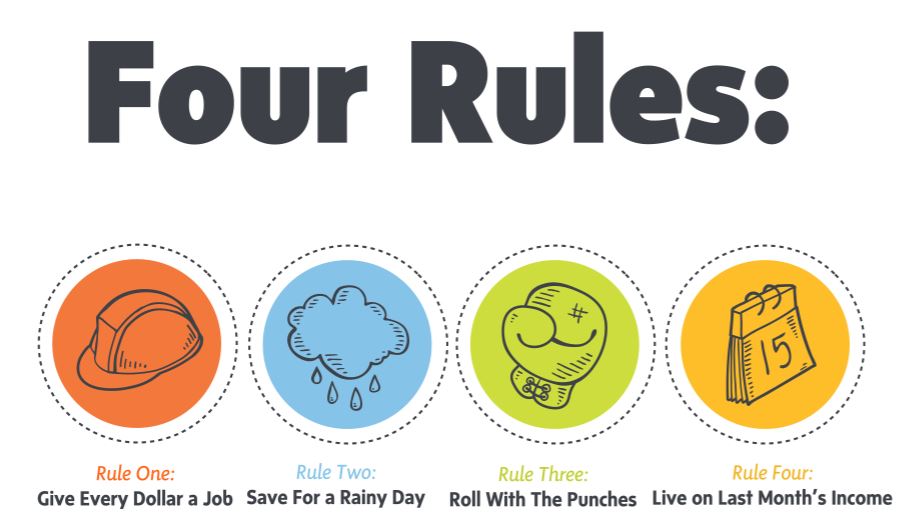
Rule 4: Live on last month's income


This is a sort of gamification to make personal finance fun and interesting. By setting intermediate goals or achievements, similar to playing a game, you'll make it through the tougher months where you feel like giving up. For this case, if you're using YNAB, there's 4 big achievements or Quests to be done:


1. Give every dollar a job

Easily done really, just that I don't use a budgeting system in the past until I started using YNAB. I use the 'pay-yourself-first' system where every drop of income I have I'll transfer some to my savings first. Whatever is left is whatever I spend on. I changed because I see a point in budgeting. Budgeting can average out your expenses for all the months of the year because you break down one-off expenses (like annual insurance payment, planned travel etc) and spread it over 12 months. Easily to handle for those with tight cash-flow. Easier for me too since I've variable income.


2. Save for a rainy day

Not a problem for me because I've been saving way before using this software. Makes it easily to track everything though. You can even save for different things. Really reduce the possibility of doing mental accounting down to zero.


3. Roll with the punches

This is manageable for me - basically this means that you need to cut yourself some slack on months that you can't fit your budget. If you spend above your budget, then whatever excess is subtracted from next month's budget. Conversely, if you spend below, you get to spend more the following month. Great system, I must say.


4. Live on last month's income

Ah.. this really took me some time. To achieve this, you need a combination of saving, reducing expenses, increasing income and really proper budgeting. It's hard to appreciate this without the software really.


Still love this software after 7 months. For those who tried this, any feedbacks on how YNAB makes your life better? Care to share with me?


Friday, February 28, 2014

The hidden effort behind every visible results

In a meritocratic system, where hard work is the foundation of success, does it also mean that failure is the result of the lack of hard work? This question bothers me enough to write about it.


Let's imagine a scenario. John and Jane are in the same class and they took a math exam recently. John got 80 marks and Jane 40. We naturally congratulate John for his good results and at the same time, lament that Jane should work harder. We assume that Jane, because he didn't get a better result, didn't put in enough effort and hard work. It's really very easy to assume that, and don't say that thought didn't creep inside your mind at all. Being a tutor, I made such quick judgement all the time. Sometimes, it's really true, but what about the times that are not?


Let's clarify this by looking at another scenario. Car A is a better quality car and superbly well designed. Its maximum speed is 200 km/h. Car B is an inferior car, and its top speed is 120 km/h. In a particular race, Car A sped off at 150 km/h at 75% effort, and Car B put in maximum speed of 120 km/h, putting in maximum 100% effort. You can't see the effort. You only saw:

Car A: 150 km/h
Car B: 120 km/h

Therefore Car A is faster and therefore better.


But if you open your eyes a little, you'll 'see':

Car A: Puts in 75% effort
Car B: Puts in 100% effort


Berry Hard work (by JD Hancock)


I wanted to point out that if we only look at the results, we might not be able to see the effort needed to produce the set of results. Ultimately, do we praise the outcome achieved or do we praise the effort? In scenario 2, do we praise Car A because it is running at higher speed than Car B, or do we praise Car B because it is putting in maximum effort, regardless of the results? Well, results are easily observable, easily measured and easily comparable, whereas efforts are often hidden and invisible to most unless you're a observer who is privy to the inner circle. Effort isn't readily measurable too. Heck, most times I don't even know what's the maximum effort possible until I push my limit till breaking point.


I have students who are very smart and integrates new information very easily. The only problem is that they are not diligent and putting enough hard work to realize their potential. Potential is just that, more maybe and possibly than certainty. Yet there are some others who work really really hard, often doing the same practice papers again and again just so that they can get it into their mind. It is really sad when I see the latter group (i.e. the hard workers) not performing better than the former (i.e. the smart workers). I feel for them, because nobody sees their effort that is put in and only saw the results that they achieved. Little did people know the immense amount of effort needed to be done by them just to pass the paper.


The worst thing that the hard workers can do is to assume that since working hard is not going to bring them results, they might as well not try. For the smart workers, the worst thing that can happen is that since doing minimum effort can bring good results, they'll put in enough effort just to get by.


What do I believe in? I believe that intelligence is not fixed. Intelligence can be grown by investing in it. You may be born smart, and that's a slight advantage over others who are born average. No doubts about that. But hard work and diligence trumps intelligence in the long run, because you have to constantly force your mind to go beyond its comfort level. It's like a muscle that keeps training until failure, only to grow stronger again. Knowing that you have the ability to grow smarter by working harder seems to be a better world to believe in than a world where your future is determined by your IQ that you're born with and nothing in the world is going to change that.


The next time you pass judgement on others, think about the hidden, un-measurable, incomparable effort that is put in to achieve the visible, measurable and comparable outcomes. This is a good reminder to myself for life in general.

Tuesday, February 25, 2014

AIMS AMP Capital Industrial nil-paid rights counter are listed

Thanks to a reader, I'm alerted to two new counters in SGX that is listed but not traded yet. These are the rights counter set up to allow holders of AIMS AMP Capital Industrial reit to trade their rights issues.


They are AIMS R (counter code: TZ7R) and AIMS R25 (TZ8R). AIMS R should have a board lot size of 1000 shares and AIMS R25 should have a board lot size of 25 shares. With the R25, any holders who don't want to hold odd lots can trade to buy/sell enough 25 shares to round up their holdings. The only thing that is not clear is whether there'll be another counter after the whole rights issue ended, with board lots of 25 shares, just to allow odd lotters to round up their shares after knowing their success with the excess rights application.


The problem with the R25 or the R is that these are only be traded during the nil-paid rights trading period from 27th Feb to 7th Mar 2014. The last date of application and payment for excess rights is on 13th Mar 2014. This means that only after the 13th will you know whether you had gotten any excess rights. By then, the R25 will have long ceased trading.


So, let's say your aim is to get round lots, there's two things you can do:


1. During the nil-paid rights trading period, you sell or buy enough AIMS R/R25, paying brokerage fees too, so that you end up with round lots. Then before 13th Mar 5pm, you go to ATM and pay that $1.08 for every rights shares that you own, after taking into account the amount that you buy/sell during the trading period. And you don't apply for excess rights at the ATM too, in case you get some and end up getting odd lots all over again.


2. Ignore the AIMS R/R25 counters totally. Before 13th Mar 5pm, you go to ATM to apply for excess rights to round off your odd lots, apply for excess rights above and above the ones needed for rounding and lastly to pay $1.08 for each rights share. Then you hope that you get your excess rights because nothing is guaranteed.


For me, nothing is going to change. I'm going to apply for excess rights to round off my odd lots, then I'm also going to apply for excess rights over and above what is needed for rounding. If I get it, that's great because my average cost is lowered per unit share. If not, so be it, because there's always a unit share market (at least for POEMS trading platform) that I can dispose my odd lots to. There's nothing fearful about odd lots.

Monday, February 24, 2014

Why my parents are so eager to invest

My parents passed me another 60k to invest around early Feb. This is after the initial tranche of 50k.


I found out a bit more why they are suddenly so keen to put their money to work. They said that they've put it in the savings account for almost 10 years, then realised that the interest is so pathetic, so they wanted to get their money to work harder for them. Initially they wanted to put into some fixed deposit that pays about 1.18% pa, which is way better than the interest from savings (maybe 0.05% now), but still pathetic. I managed to convince them to buy my LP bonds eventually.


A few thoughts ran through my mind:


1. Why think about such things only 10 years down the road? A few reasons - as a family, we don't really talk much about money between ourselves. I don't know why, but that's the culture. If I know that they have this amount, it might be better to buy endowment products or put them into fixed deposit to squeeze more returns. But would I be willing to invest for them?


I doubt so. I'm a different person 10 yrs ago. I trade warrants in the past, maybe can do around 10-20 trades per day. I would have blown my parent's savings instead of getting more returns for them. On hindsight, we always calculate the possible gains that we can get from investing the money for 10 yrs, but never really think that a lot had happened - most notably you. You're probably a different person now than 10 years ago, with a different temperament, with a belt-full of investing/trading mistakes that you swear never to repeat.


That's just the way it is. This is the right time for me to help my parents, and this is the right time for them to get more returns for their money instead of putting them in the bank.


2. My wife knew about me helping out my parents. She thoughtfully asked whether she will have 60k + 50k when she retires. I get her. My parents finished their payment for their 4 rm hdb in just 2 years. Back then, salary wasn't high because my mum didn't finish her primary school and my father failed most of the subjects for O lvls, but managed to get a job as a clerk. So, that's all it takes...2 years to finish paying the loans. They have a whole long period of their working lives paying for the upkeep of me and my brother, as well as for our education and general living expenses, and also to save up. Me? If I keep to my payment schedule for my HDB, I'll be 60 years old when I finished paying all up. It makes you wonder.


Complaining wouldn't help at all. Might as well work and save hard and try paying off the housing loan early and also save up for retire. All in one shot. Having children? That's the last of my priority.


3. Investing at 4% pa returns of the new 60k will net around 2.4k per year...that's about $200 per month. Is it good enough for my parents? Since the 60k comes from my father, I take it that the 200 per month is for my dad alone (mum has her own 50k). Is it enough?


He don't have to pay for food, utilities, medical expenses. That's provided for by the monthly allowance given to him by me and my brother, while medical expenses are mostly covered by the healthshield plans bought for him. He don't have to pay for lodgings too, because the housing had long been settled. This money is just 'play' money - for the occasional travelling and to buy stuff that he likes. Is it good enough?


I think it's more than enough. Don't squander it and live simply. I think it's enough.


4. When it comes to my turn to retire, I hope it'll be good too. Maybe 300k in today's money is good enough. 300k @ 4% pa returns will be $1000 per month. That's for me alone. For my wife, maybe we need another 300k, so that's a total of 600k. I think a rough figure of between 600k to 900k should be a good amount to plan for. I think we each need to save at least 1.5k per month for our retirement.


Since my expenses is already 3.5k per month, that just means I need to earn at least 5k. But doing that, I can't accelerate the capital repayment of my housing - I need another 1k per month to shorten the debt duration of my housing loan. So, final figure - 6k. No matter how I calculate, it's always down to that figure.


Let's just get on with it.


Thursday, February 20, 2014

How I suck at primary school math

A good friend of mine asked me to solve this primary 5 math problem for her. It goes like this:

At a charity walk, 150 participants were adults. 1/3 of the children were boys. If 1/4 of the participants were girls, how many people were at the charity walk?

Can I do it? Of course, but I've to use algebra. I managed to get it in the first try, maybe in less than 3 mins? But you and I know that primary school maths do not involve a lot of algebra, if at all. And the way to solve such problems is to use the 'model' method and I know how I suck at this method of doing math. I tried for a good 30 minutes before giving up, attempting another question, hit an inspiration and went back to do it for another 15 minutes before I finally got the answers using this weird blocks of rectangle that is so typical of the model method.


Am I bad in math because I couldn't solve the problem using the prescribed method? Obviously not, because I can solve it so much faster using another method of doing it. Similarly, for someone who is so good at using the model method, does it mean that he is good in maths? I've seen many students who had very good scores in primary school maths (obviously they must know a great deal about the model method) but failing miserably when the model is no longer used in secondary school. Does it mean that they are no longer good in maths?


On reflecting, a few thoughts came to mind:


1. Don't be judgemental. Perhaps a person's potential is not shown because the the right method to bring out his best is not there yet. Also don't be judgemental on your own abilities. Just because you can't do it now doesn't mean that you are bad in it. Perhaps you haven't found the way that best suits you.


2. Don't be too proud of your success. Perhaps you just happened to hit on something that just comes naturally to you. When the full extent of the problem is shown to you in the future, you might not be able to transfer whatever worked for you in the past to the future. At best, it's just domain-specific success; once you're out of that specific domain, you're not longer that good.


3. Be open minded and try out new ways to do things. Don't be stuck in ways that worked for you in the past.

We tend to diss things that we're not good at, and praise the system that had been working so good for us. In this case, I can always complain why can't primary school use algebra to solve math problem - it'll be so much simpler (for me). Or I can start teaching primary school kids algebra, because that's the way to solve such problems (for me).

Or if I'm superb at the model method and is very good at primary school math, when I enter secondary school and I suck at algebra, I'll start using modelling model and diss the teacher for teaching me algebra. Why learn something so complicated (for me) when I can draw models and get the answer anyway?


Ultimately, I think that whoever is good in maths isn't necessary someone who is good in maths right now at this moment or worse, in the past. He is someone who exhibits the ability to be good in maths in the future. In the future, there's so many problems and challenges that are thrown at you from all sorts of angles that you have no way to succeed without being non-judgemental (so that you don't give up when you encounter new things), humble (so that great teachers can appear and can teach you) and being open-minded (so that you can use new ways to solve old problems).


That, is why you learn maths. That, is what you tell students when they ask you why they need to learn how to integrate and solve trigonometry problems when in real life they don't even use it. That, is the reason for learning anything at all, really. Because when the subject matter has long been forgotten, the way you approach life's multitudes of problems and the way you tackle them will always be the same as the way you handle your humble maths problems.


(For those who tried the question and wants to know the answer, it's 240. At least that's what I got.)


Wednesday, February 19, 2014

How to apply for rights and what are the options?

Wow, sometimes I surprised myself by my older post.. I did a newbie guide's to shares long long time ago. Happened to click on it again and I saw that I had made a very detailed guide to apply for the rights, right down to which option to choose when pressing on the ATM! It's very useful for me because it's been a while since I last had a rights issue.

So here we go, I attached the part that is relevant here for your reference. But the rest of the newbie's guide is here. I did the same thing on a FAQ site found here too, if you find it a bit hard to find info from a blog post. This is written many years ago, so the information might have changed somewhat. If in doubt, just read the OIS that is going to be sent to holders of the aims mother share before it goes XR.

--------------------------------------------------------------------------

How do I apply for rights? What are the options I have?


If you flip the OIS (offer information statement and look for the section under “Procedures for acceptance, payment and excess applications by entitled depositors” under the Appendix section, you can see that it’s all spelt out clearly for all the possible cases you can imagine.


I’m only going to go through the basics. There are two main ways to subscribe for your rights:

a. acceptance and application by ATM of a participating bank
b. acceptance and application by CDP


First before choosing either options, look at the mailed Form A - white form (ARE for rights shares) or green form (WEWAF for rights warrants). Pay attention to the number of rights shares/warrants provisionally allocated – that is the amount that you are allocated, so you can choose to take it all up, partially, not at all and/or apply for excess. Find out how much you need to pay for and how much you need to pay if you want the excess rights.


If you go by ATM, it’s the easier option. Just go to the ATM screen, click on other transactions, then look for something like “ESA – IPO applications”, then find the company that is relevant. You’ll be guided to type in the amount of rights that you wish to accept out of the allocated (e.g you may be provisionally allocated 5000 rights but may want to accept only 2000), plus another separate screen where you’ll be guided to type how many excess rights you want to subscribe. Then you’ll come to a screen where they will tell you how much you have to pay. Make sure this screen you check carefully before pressing. I know for DBS you need to pay a service charge of $2.00, not so sure of other banks.


If you applied through ATM, then do not send any forms! It’s done – just wait for them to mail you how many excess rights you’ve successfully got and how much you applied for.


If you’re going through application by CDP, then you have to fill form A (the coloured forms). There’ll be instructions to tell you how to fill but I’ll run through a little. First, delete away the I/We* and my/our* that you see accordingly. Then look under Registration – and fill in quantity (the number of rights shares/warrants) you accepted, calculate and fill in the amount payable to CDP (multiply the quantity by issue price per share/warrant). Fill in the number of excess rights you wish to apply and repeat, total it up and sign below.


Next go to the bank to get a cashier’s order or banker’s draft (it’s just a cheque that is issued by the bank – you have to pay the bank a certain fee in addition to the amount for their services) with the following written – “CDP – XYZ RIGHTS ISSUE ACCOUNT” and crossed “NOT NEGOTIABLE, A/C PAYEE ONLY”. On the reverse side, write your name and your securities account number. Finally send the banker’s draft/cashier’s order and the form A to the enclosed envelope mailed to you. Affix your own stamp!

Capital Mall Trust (CMT) bonds balloting results are out!

The balloting results are out for the Capital Mall Trust (CMT) bonds. The announcement is made here.


Some comments:

1. The balloting ratio of 1:1 means that everyone who applies will get some. Might not be all but at least you won't go empty handed.

2. They are quite kind to small investors. Everyone who subscribed 2 to 10 lots will get 100% allocation. This means that if you apply for 8 lots, you'll get 8 lots of the bonds.

3. As usual, those who applied for more will get lesser as a percentage allocated to them. I think it's only fair.

4. On hindsight, next time we should all apply odd number of lots so that you can push to the next banding.


I applied for 25 lots. Since it falls within the range of 21 to 30, I'll get 15 lots. The rest of the fees should be refunded back to me starting from today. By 20th Feb 2014, you should be able to log in to your CDP account and check that the bonds are there. The bonds should commence trading on SGX this coming Fri on the 21st Feb 2014 under "CapMallTrb3.08%210220" with board lot size of 1000 shares, with stock code of "TY6Z".


I can look forward to the first semi-annual payment on 20th Aug this year.

Monday, February 17, 2014

Capital Mall Trust (CMT) bond issue timeline

I finally managed to get a digital copy of the prospectus for the Capital Mall trust bonds. Couldn't find it at MAS Opera site, as promised by them. Anyway, when I tried to get the bonds through internet banking, the prospectus are there for all to read.


No mention of any early redemption or special step up interest. But again, the clauses inside the prospectus must have included something for them to exit the bond, subject to certain conditions happening. Just like the F&N bonds and the very recent DBS preference shares.


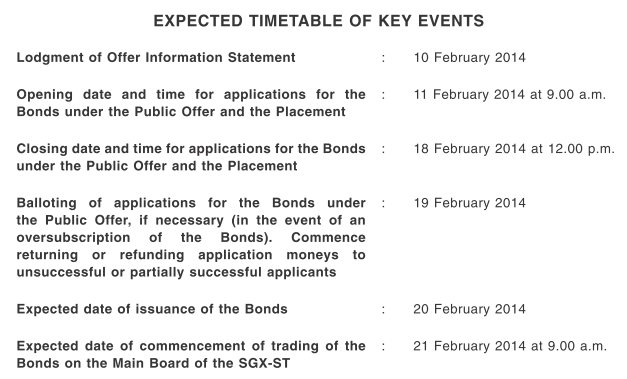
Here's the all important timeline of events:


Seems like we can get the money back a day after the last closing date, which is tomorrow on 18th Feb 2014, noon. You'll be issued the bonds on 20th Feb, meaning that you can check your CDP account to see if the bonds are credited to your account. But usually, just like any IPO, it's faster to just check and do a back calculation to see how much money put in is refunded back, and hence how much is invested. The bonds will commence trading on 21st Feb, which is this Fri.


I'll expecting to see the bond trading above par, maybe around 1.00 to 1.03, the latter giving a yield of 2.99% instead of the coupon yield of 3.08%. We shall see come this Friday.

Sunday, February 16, 2014

How to hack AIMS AMP Capital Industrial reit Rights Exercise

AIMS AMP capital industrial reit announced a rights exercise last Friday. It's a confusing 7 rights units  for every 40 shares of mother shares at a rights unit price of  $1.08. I can never understand how they derive these kind of strange numbers. Anyway, I'm interested to arbitrage on the rights issue and I'm sharing this on the point of view of someone who has no shares of aims at all and is looking to start a position. I've written a post about this in the past - it's here.


There's 2 ways to do this:


1. Get an initial position size before XR that maximizes the number of odd lots that you need to round up to a whole number. You'll end up with a lower average price for all your lots because the rights units are priced at $1.08 while the pre-rights price is at $1.415. This is based on the theory that for those who apply for excess rights (above what is entitled to you) will have priority over others. In my experience in doing rights, I've always been allocated enough excess rights to round off my holdings so that I don't get odd lots.


2. Arbitrage on the possible price difference between the nil paid rights that is traded on the market during the rights trading period and the theoretical ex-rights price (TERP). This is based on the assumption that during different times/day, the supply and demand might push the nil-paid rights price above/below the TERP, providing you with a good opportunity to arbitrage on the difference.


I'll explain the two points in detail below.


For the first point, I've done up a table that shows the number of lots of aims mother shares owned before XR (1st column), the number of lots of entitled rights based on 7 for 40 allocation (2nd column) and the number of odd lots that you need to round up to a whole lot (3rd column). I already arranged them in descending order for the 3rd column.


If you own 40 lots, then obviously you'll end up with round lots. I wanted an initial position smaller than 10k, so even though owning 23 lots will give you the maximum no. of odd lots that you need to round up, that's not for me. The next best option will be to own 6 lots of pre-XR mother shares, which will entitle me to have 1.05 lots of rights units, and I'll have to apply for 0.95 lots of excess rights to round up to a grand total of 8 lots.


Here's a summary:


This will give you a average unit price of $1.33125 (excluding brokerage fees) instead of the ex rights price of $1.365. Is it a lot of discount? Nope, it's about 2.47% discount off the TERP. I think it's more meaningful to consider Option 1 of buying at 8 lots at TERP after the whole rights exercise vs Option 2 buying 6 lots pre rights, get 1.05 lots entitled rights and applying for another 0.95 lots excess rights.


Option 1: Total cost including brokerage = $10,958.27
Option 2: Total cost including brokerage = $10,681.07


In absolute amount, it's about a difference of $277.20. Option 2 has a discount of 2.53% to Option 1. It's not a lot, and it's going to be less worthwhile if you own bigger lots in the first place. Whatever I'm calculated now is only for 8 lots in total of aims shares post rights. So, if you're planning on a bigger exposure (perhaps more than 10 lots), then don't waste your time - go get it after the rights issue when everything is settled.


For the 2nd point, you have to understand that the nil-paid rights will be traded for a short period of time, from 27th Feb 2014 (9am) to 7th Mar 2014 (5pm). This is meant for people who do not want to pay for the rights that are allocated to them and wish to cash it out instead. Since the TERP is $1.365 (btw, this is by no means fixed, hence theoretical) and the rights units are priced at $1.08, the nil-paid rights should start trading at a fair price of $0.285 (1.365 - 1.08 = $0.285).


Whatever nil-paid rights you have, either from buying from the market during the trading period or from the ones allocated to you, you'll  have to pay $1.08 per rights unit before 21st Mar 2014 (9am). If not, they will expire worthless. That's right, money that goes poof and disappears into thin air.

The all-important relationship is this:

Final price of shares post rights = 1.08 + price of nil-paid rights bought during the trading period


In summary:

If the price of the nil-paid rights goes lower than $0.285, after adding 1.08, you'll have a final share price post rights of less than $1.365. That's good.


If the price of the nil-paid rights goes higher than $0.285, and after adding 1.08, you'll have a final share price post rights of more than $1.365. That's not good.


In other words, buy when the price of the nil-paid rights goes way below $0.285. The lower the better.


I leave the post with the all important dates. I think the most important one is the last date of payment for excess rights. I've heard horror stories of people who forgot about that, and all their nil-paid rights vanished into thin air come 13th Mar 2014. Don't let that happen to you.


Friday, February 14, 2014

DBS 4.7% preference shares redemption part 2

Seems like there's a lot more to say about the DBS 4.7% preference shares redemption.


I've been a little unfair to DBS on this previous post here. From well informed friends (thanks cory and pero), I learnt that DBS actually exchange that preference shares with another one with higher payout and shorter tenor around Nov 2013. This is done because the older preference shares no longer qualify as Tier 1 capital under the new Basel III capital adequacy requirements implemented by MAS on Jan 2013.


I cut and paste the notice here, for future reference:

-----------------------------------------------------------------------------------------------------
DBS offers to trade new notes for $800m in preference shares

By Siow Li Sen lisen@sph.com.sg

Nov. 8 (Business Times) -- [SINGAPORE] DBS Group Holdings is offering to buy back $800 million of an outstanding $1.7 billion preference share issue, offering in exchange new notes with a higher payout and a shorter tenor.

Existing note holders can, via a tender, exchange at par for the new notes which will pay out 4.7-4.9 per cent, and has a call date in November 2019, the bank said yesterday.

The callable date for the existing preference shares is 2020. The non-cumulative non-convertible non-voting class N preference shares have a payout of 4.7 per cent.

The reason for the bank's action is that the new shares will be Basel III compliant and qualify as Tier 1 capital.

DBS said that "the fact that the existing preference shares no longer fully qualify as Tier I capital of DBS Bank constitutes a preference share change of qualification event" under the Basel III capital adequacy requirements implemented by the Monetary Authority of Singapore (MAS) on Jan 1, 2013.

In a statement yesterday, DBS said that it was "proposing to accept tenders amounting to $800,000,000 in liquidation preference of existing preference shares, or a lower or greater aggregate amount at (its) discretion".

Holders who wish to participate must do so by 5pm Singapore time on Nov 21, 2013.

The tender does not apply to the retail tranche issued also in 2010 - an $800 million 4.7 per cent non-cumulative non-convertible non-voting class O preference shares callable in November 2020.

"We are starting with the institutional tranche - to see market reaction," said a bank spokesman.

If the response is "overwhelming", a bigger issue of the new notes could be considered, said Clifford Lee, DBS Bank head of fixed income.

The 4.7-4.9 per cent payout and shorter tenor of the new preference shares are seen as "investor friendly" and attractive relative to a recent perpetual issue by United Overseas Bank (UOB).

In July, UOB sold $850 million of perpetual notes paying 4.9 per cent that were Basel III compliant. Yesterday, the notes were quoted at $102.35-$102.85, yielding 4.335-4.219 per cent.

"Instead of a price nearer to 4.2 per cent, they're (DBS) paying 4.7-4.9," said a banking source.

Still, some investors sold off the existing DBS preference shares after the announcement, causing prices to fall to $100.51-$101.398 from $102.52 on Wednesday. They could be only looking at the exchange at par, and not the coupon of the new bonds, suggested the source.

Said Gary Dugan, Coutts chief investment officer for Asia and Middle East: "Anything (bank perpetuals) above 4 per cent is attractive."

Interest rates are likely to remain low for the next 2-3 years and perpetuals still remain very attractive, he added.

Under MAS Notice 637, effective on Jan 1, 2013, Tier 1 securities have a point of non-viability (PONV) loss-absorbing feature. What this means is that investors or debt-holders will have to face a partial principal writedown or conversion into common equity when the PONV is being triggered by MAS. The PONV is triggered when MAS decides that a bank is no longer viable, or when public-sector support is required.

Separately, a UOB spokeswoman said that the bank would not comment on future capital management plans, when asked if it might consider similar exchanges for its non-Basel compliant preference shares.
At OCBC Bank, Ang Suat Ching, its head of funding and capital management, said that "while our existing preference shares are not Basel III compliant, they will continue to qualify substantially as additional Tier 1 capital over the next few years under MAS's transitional Basel III rules".

"Our Tier 1 capital adequacy ratio as at end-September was 14.3 per cent, a level that we are comfortable with. We continuously assess our capital and financial requirements, as well as market conditions, in determining any early redemption or new issuances of capital instruments."

Copyright 2013 Singapore Press Holdings

-0- Nov/08/2013 00:30 GMT


-------------------------------------------------------------------------------------------------

But there's still a bit of problem here:


1. Okay, totally understand that they have to do some engineering to change the structure of the preference shares to fit the ever stricter capital adequacy requirements. But $1.7 billion worth of existing preference shares are exchanged for $800 million worth of new ones. That's less than 50% of the existing shares offered to be exchanged. Exchange seems too strong a word. The proper wording should be "offer to exchange by balloting" because not all who wants to exchange it will get it, from the mere fact that there are lesser new issues than the one to be replaced. For those who had exchanged for the newer shares, good for them. For those who didn't got it, they are now redeemed based on the latest announcement by DBS on 13-Feb-2014.


2. The existing preference shares has a coupon yield of 4.7% pa. The newer one to be exchanged range from 4.7 to 4.9%. The range, I suppose, is dependent on how oversubscribed the new issues are. If there's $1.7 billion of preference shares being cut to $800 million worth, and they are all going to ballot for this newer issues with yield ranging from 4.7 to 4.9, it's not going to take much of a guess where the yield of the new issues will fall. With hindsight, we know that it's indeed 4.7% also. So, that doesn't really qualify as 'a higher payout', to quote the above announcement. If anything, it's "potentially higher payout".

But again, to be fair to DBS, they could have put the yield lower even than 4.7% and nobody can say anything.


Ultimately what am I going to do with the listed DBS 4.7% preference shares that I hold for my parent's account? I'm going to sit tight and do nothing. If it falls really close to par value, I might even add in some. What can happen? If they are going to redeem the listed DBS 4.7%, then they are going to offer new ones in exchange for it. They could go all bastard and reduce the total amount from the existing $800 million worth to something lesser, so all the holders will have to go ballot again for the new exchanged issues. Since I bought it at above par, I'll lose some capital but in exchange I can get newly issued ones at par, which is a good thing for me so that I can properly allocate my resources because of more certainty. I've already accounted for the potential loss in buying a pref shares above par value, so taking the loss wouldn't affect much in terms of the yield I promised to my parents. But a loss is still a loss, so it'll mean I have less buffer for other such things that can be thrown to me as my parent's fund manager.


Thursday, February 13, 2014

DBS 4.7% preference shares redemption

I was alerted this morning by a notice from DBS to redeem the 4.7% preference shares. It's here. My first thoughts are that I haven't even got the interest yet from the preference shares and now they are redeeming it?!


Upon closer examination, I realised that they are redeeming back another preference shares, one with the same coupon interest of 4.7% but not listed in mainboard SGX. This one that they are redeeming is the 250k per bond one.


A few issues:

1. In the prospectus for that preference shares, they noted that the first call date is 22-Oct-2020. Then of course, they also put in a clause that said that they can change the early redemption date under this nice technical name of "Change of Qualification Event". And this notice posted by SGX is that such a change occured and they are now going to have an early redemption date on 21st Mar 2014! How is this fair to people who bought in thinking that they are going to park their money there until 2020, which is another 6 years from now?

Well done. Even preference shares can be hacked by those in power. With a stroke of a pen, the redemption date is changed. Just like that. Of course this is all legal and above board (since there is a clause in the prospectus), but legal doesn't mean that it's fair.


2. The last payout for that preference shares is on 22 Oct 2013. From that date until the early redemption date of 21st Mar 2014, there's a good 149 days (including 22-Oct but excluding 21-Mar). Well, at least they are going to pay the holders the sum owed during that period. I didn't know they are going to do that.


3. The next thing to think about is whether they will also redeem back the dbs 4.7% listed on mainboard SGX. That's the worry, since both of these preference shares belong to the same tranche and issue mostly along the same terms and conditions. So far, nothing is said. But I guess investors are not going to wait around and find out. The price of DBS Bk 4.7% NCPS 100 dropped 0.7% to 106.150 today. Better price on the market than if it's redeemed at par of 100.

Wednesday, February 12, 2014

Growing alfalfa sprouts

As you can see from my previous post on growing wheat grass, I'm starting to become a urban home gardener. It's the first step to take control of the things that we eat, which I believe will directly affect our health. There's a lot of advantages to growing your own produce. I think firstly, you'll be able to save a lot of money. After growing some wheat grass and alfalfa sprouts, I realised that the supermarket variety is just way too exorbitant. The quality of the home grown produce is also much better and you get to control what you put in. If you don't put pesticides, it won't have any traces of pesticides at all. If you grow from organic non GMO seeds, the produce will be as such. The last benefit is that there's an immense sense of satisfaction in growing a tiny seedling to eating your own harvest.


I managed to source out a local place where they sell seeds in packets of 1 kg. It's super cheap. On their site, I also saw that they had alfalfa seeds, so I bought a big packet of 1kg for $25. A small packet of alfalfa sprouts (around 150 to 250g) in supermarkets will cost you around $2.50. Some are not even fresh. I figured that nothing much will go wrong considering that the big packet goes for so little and it can probably last me months.


Alfalfa sprouts are super easy to grow. If I say that growing wheat grass using soil is easy, then alfalfa beats it hands down, legs down. For this, you don't even need any soil. Since we're growing sprouts (think 'bean sprouts'), it'll be super fast and you can harvest in 3-4 days time.


The first 12 hours where the seeds are soaked in water and kept in the dark to germinate


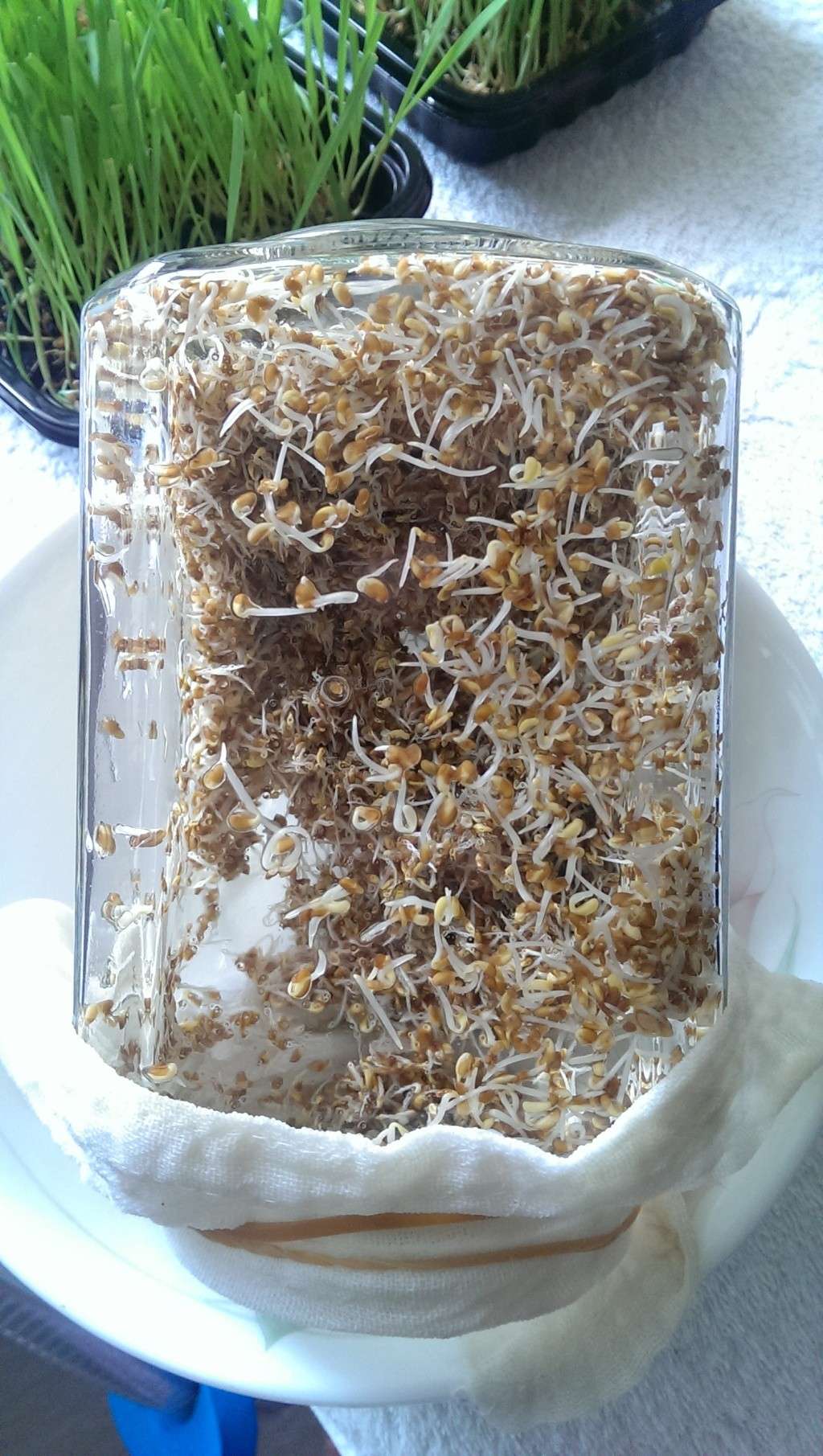
The method is really easy - you just soak one to two tablespoon of the seeds into water, germinate it in a dark place for 12 hours to 24 hours in a glass container covered with a filter cloth. After that, just add water into the container and drain it through the filter cloth. It'll not be totally dry - but that's the point. You want to keep the seeds moist but not drown them in water. Keep them in the dark until you see the first inkling of the leaves.


After 24 hours. The roots are out - they really grow very fast. 

Just keep repeating the watering and draining process, keeping them in the dark, until you see the first signs of the leaves. For me, I saw it somewhere between the 2nd and the 3rd day. Once you see the leaves, you can put them under indirect sunlight for the plants for them to make food.


2nd day - Tiny leaves (still yellowish) started to grow


3rd day, the leaves are fully out. I put them in indirect sunlight around the 2nd-3rd day

On the 4th day, the leaves turned a very beautiful dark green colour. You'll know when you can harvest it. I ate it straight off the jar - a very nutty, bean-sprouty taste. Reminds me of Vietnamese crusine or atas burger joints. More of the former. I can imagine putting these raw in some beef soup with rice noodles, very nice!


Just 1.5 tablespoons gave me some much harvest on the 4th day. This is easily more than 3 equivalent boxes found in supermarket


A close up of the beautiful alfalfa sprouts. 

What's the health benefits of eating alfalfa sprouts? Here's a few that I googled:


1. Full of proteins. Each serving contains 3g of proteins. Vegan eat this for protein as opposed to meat.

2. Can ease chronic constipation and digestion problems

3. Cholesterol reduction abilities - it can reduce both total cholesterol and low density lipoprotein (the bad cholesterol) without affecting high density lipoprotein (the good cholesterol).

4. Reduces cholesterol plagues in heart arteries

5. Contains Vitamin B and K. Esp the latter. It is one of the most concentrated sources of Vitamin K found in nature.


I'm not sure if all are really true. Anyway, it taste good and is easy and cheap to grow, so what's there to lose?

Monday, February 10, 2014

CMT retail bonds

Capital Mall Trust (CMT) made an announcement today that they are going to issue retail bonds. The terms of the bonds are as follows:


1. Years to maturity = 7 years
2. Interest = 3.08% pa, paid semi-annually on 20th Aug and 20th Feb, starting this Aug
3. Capital guaranteed if held till maturity since it is a bond
4. Issue price is $1.00 and the par value is $1.00. Should be in board lot size of 1000 shares
5. To ballot for it, you need a min of $2k, with incremental multiples of $1k 


You can ballot for it by going to ATM at 9am on 11th Feb 2014 and it’ll close at 12 noon on 18th Feb 2014. I think the process is the same as balloting for IPO shares through ATM. You pay the amount first, add on a fee of maybe $1 or so, then you wait for a few days after the closing date to see how many lots you have. The rest of your money that is not used will be refunded back to you. Your shares will be held in your CDP account and it should be able to trade on SGX once they start listing. As of now, I haven’t seen the prospectus yet (going to be lodged today), so you need to confirm some of the details mentioned here again by reading it on MAS OPERA site.


Good deal?

Let's see what's on offer at SGX. The most similar one to this bond is the CapMallA3.8%b220112 traded on SGX. The last done price on 10th Feb 2014 is 1.027, traded in board lots of 1000 shares. Let's see the terms of the bond:

1. Years to maturity = 8 years, maturity date 12-Jan-2022. Optional redemption on 12-Jan-2017.
2. Coupon yield = 3.8% pa. if it's not redeemed by 12-Jan-2017, it'll be stepped up to 4.5% pa. At current price using my way of calculating yield to maturity, you'll get 2.82 % pa to 3.8 % pa. See below for explanation **.
3. This is also a bond, so it's capital guaranteed if held till maturity
4. Issue price is $1.00, but the trading price is 1.034, so when the bond is redeemed, you'll lose $0.034. But all these are already included in my yield of 3.28% pa 


Thanks to sfry, whom I respect as someone who has vast experience in doing bonds and shares, there's an advantage in balloting for the new bonds even though it has lower yield. Firstly, it's easier to get more lots by balloting because like all pref shares and bonds traded in SGX, liquidity is an issue. But if you're just looking to get maybe less than 20k worth of bonds, I think it's not a problem. Secondly, getting through balloting only requires an admin fee of a few dollars (can't remember exactly how much, but I've a feeling it's just $1) compared to a xx% by paying the brokerage fees. Thirdly, there's a real possibility of Capmallasia redeeming back the already listed bond on 12-Jan-2017, leaving you high and dry. This new bond doesn't seem to have an early redemption, though it must be confirmed by reading the prospectus (which I haven't because it's not lodged yet).


There, all the facts are laid out bare. You decide.


** Let's clarify on the yield of capmallasia3.8% bond. If you buy it at 1.027 on 10th Feb 2014, and it matures on 12-Jan-2017, you'll get a yield of 2.82 % pa. If it matures on 12-Jan-2022, you'll get a yield of 3.8 % pa. These yields are calculated with the inclusion of a loss of capital due to the buying of a bond above par value

Thursday, February 06, 2014

Clearing the clutter

Do you believe in clearing clutter?


I do. And I've been procrastinating for years and today I've finally done it! The clutter had been there even before I've moved to my new house and had been lying there for another 2+ years before I finally can't take it anymore and went to settle all of them. Some of the documents go way back in 2010, so it had been lying there for 3 years!


The clutter I had are mostly papers, consisting of bills, statements, annual reports, magazines and worksheets. It's not very messed up though, because I've been adopting this system of clearing things as they arrive. The system works like this. When a mail and a paperwork comes along, I'll decide what to do there and then. I realize that anything that is not decided immediately will be kept a much longer time (and adding to the clutter), simply because I need to have the assurance that when I finally get to act on them in the future, it'll still be there. This is not only delaying whatever needs to be done, it's also pointless because anything that is lying in a pile of 'to be cleared' paperwork probably won't ever be cleared. If acting on one single document is so difficult, what makes you think clearing a pile of document is ever going to be easier?


My room is almost going to be like this...but not yet


Hence, the system involves the following:


1. Bills will be checked against my own records and paid immediately, or the due date be keyed into the calender of my hand phone with the amount owed, so that when the time comes, I'll remember to pay them. This is frequent, because most, if not all my bills are paperless already. It's most likely to appear in my email then in my mailbox. Maybe only for income tax, property tax and insurance I'll receive the bills in physical form.


2. Statements from banks will be checked against my own records. Used to do this anyway. These days, I also switched to paperless system, so the statements will be notified through my email and I'll check them up on the respective website. Since I do this on a monthly basis when preparing for my personal monthly financial reports, I don't even read the statements transactions by transactions. The total amount will tally exactly 90% of the time. If not, I'll check line by line. Bank reconciliation, I heard this is called.


3. Advertisements will be read immediately, and thrown on the spot. For those interesting ones, I'll snap a picture of it in my handphone. I clear my handphone's photos very very often.


4. Any paper mailed to me physically with only one printed side (the other side is blank) will be kept as 'rough' paper.


5. Any other things that doesn't fall into one of the categories (meaning either going to be settled or thrown away),  I'll take a picture, store it in evernote and let it rot there for a while. Usually these are things that has sentimental reasons. And I'm a sucker for such things. Aww...


Most of my clutter comes from the days before I set up the system and before most of my bills are paperless. So I'll receive a lot of statements and bills. Not anymore. I think it's better this way because firstly it's more environmentally friendly, and secondly, it's easier to keep an online storage then to keep a physical one. The latter will take up space and is not easily archived and made searchable.


Now, after clearing it for 3 hours, my whole room looks so much less cluttered! Why didn't I do it sooner?!

Wednesday, February 05, 2014

Running yourself like a company - Cash flow analysis II

I think it's important to take a look at your cash flow pattern throughout a year, so that you can plan out a budget or simply have the cash ready for big payments in certain months. I know, nothing ever works according to plan, but knowing what will definitely happen and what can happen is the first step to navigating this world that is full of uncertainties.


Certain category in my monthly cash flow are fixed. I don't ever want to think about situations where I can skip such expenses. These include parent's allowance, home mortgage, utilities etc. There are others that are more optional in nature. Things like travelling or buying luxury items...not exactly needs but is good to have.  I've some insurance payments that are annual, so during certain months, my cash flow out will be very high. I just have to make sure that I have enough liquidity to pay off them when the bill comes in. That's an advantage in paying premiums annually because you get some discounts from doing so rather than doing it on a monthly basis. Harder to pay one lump sum per year though, I must say.


I think my job as a self employed tutor makes it harder to plan. That's because my pay also varies depending on which month you are talking about. Hence, it's even more important for me to watch my cash flow like a hawk, because I could really have liquidity issues especially in those months where I know my expenses will be higher. How do I know which months I will having higher expenses? There's no other way to know but to track your expenses over several years.


Here's how my cash flow expenses looks like in a typical year:


You can see that Apr and Oct are dreaded months for me. It's so high because of the annual premiums that I have to pay for my insurance. Jun and Dec months are higher because of possible travel plans. Feb is higher because that's when most Chinese New year occurs, so a lot more is spent on meals and ang baos etc. Other than that, most of my expenses are pretty fixed. Mortgage, parent's allowances and food takes up a lot of my monthly cash outflow, easily 70% or so in a general month. I can only dream of the day that my mortgage payment is finally finished! On average, my expenses are around 3.5k per month, all inclusive.


A long time ago, I blogged about the variability of my income. Here's the chart:


Most of my income stream will come in only around Feb period, peaking around Aug to Oct period. After that, my 'winter months' will come from Nov to Jan, where I'll be pretty poor. That's why I need to save voraciously during my fatter months so that the excess can be used to offset my leaner months. Whether I have the income or not, I still have to pay off my fixed expenses.


Just looking at the two charts I'll be able to work out a cash flow plan in my mind. It's quite simple - make sure you have the money to pay off each month! It's important to note that while it's good to have a figure for the average monthly income or average monthly expenses, it's not so good to use these figures for month to month living. If you have a room with two persons, one being 1.8m and the other is 1.5m in height, there's no use knowing the height of an average person in the room when you want to tailor-make their clothes, because such a person with the average height doesn't exist! Likewise, knowing your average cash inflow doesn't help you in knowing whether you have the cash to pay for it.


I think in a way, analyzing a company is the same. It's little consolation in knowing that the income for a company is so high but the cash will only be coming in at a much later date than the debts. This article will round up this series of running yourself like a company.