Tuesday, September 27, 2011

3/4 year reflections and planning

There's a few things that needs to be done before I can open up my classes at home and start on a brand new chapter for my career. I thought it'll be good to list it down both as a checklist for myself and also to bounce off ideas from others who knew me from this blog. Let's begin.


1. Set up the physically infrastructure for the classroom.


As it is now, I've already set up a separate room from my new old flat. That would be the place to work for the next couple of years - an home office if you will. The class room has a wall and a half full of cabinets and shelvings, so I think that's enough space to put in the stuff and I needed for my work, perhaps with extra for my personal stuff too. It'll look something like this,  but not quite, because the flooring is of a darker colour then shown in this realistic computer rendered picture from my interior designer.


It should look bright and energetic. The green colour is specifically selected as a sort of colour therapy in education. I've read up some of this pseudo science regarding colours - orange and yellow is mainly for kids, green can be for teenage students (which is the bulk of my students) and blue is for hyper active students. I think green is the right colour to choose. A tad too neon bright for me, but still good. Keeping fingers crossed.


What needs to be done are the furniture for the room. I think a group size of 4-6 is big enough because I don't think I want to have so many students in one group. It's not going to be very efficient because everyone's learning pace is different, so I got to personalize the tuition for everyone in the group. Going to be kind of difficult if the class size is too big. Let's stick with that for now and adjust on the go a few years later. I'll be checking out Sungei Kadut very soon to see if there's suitable furniture for a group of 4-6 students. Not yet decided on whether to have a big table where people around it or individual small tables. Got to think it through.


2. Revamping my website.


I've a rather neglected website for tuition purpose. Neglected because I didn't really put in much effort to either promote it or utilise it properly. That's going to change. A few things needed to be revamped:


a. Logo - that can come a bit later. Eventually going to start getting some notes/guidebooks/assessment books on my own, so a logo should be a good place to start on. That's just too many things that needed attention, so this would not be the main priority for me right now. The main focus is to get things started, and I can adjust from there onwards. I simply cannot wait for conditions to be perfect before I begin, otherwise I might never begin.


b. Getting testimonials from parents / students. Since I do my business from word-of-mouth alone, testimonials are important to me. But I haven't been pursuing them! Got to start getting written testimonials from existing and past students. Nothing fanciful, just a short paragraph detailing their experiences (both good and bad) with me. They can write their results if they want, but I'm not going to insist. I don't want to go into showing statistics on how many percentage of my students get A1. You can force a student to get A but they might hate the subject forever. Nah, it's too much of a burden to bear for their lifetime hatred for any particular subjects that I teach.


3. Namecards


In the past, I am rather fearful of getting too many students because I only have limited time to work. I don't like to disappoint people by rejecting them, so I didn't go all out to market myself. In truth, I didn't market myself at all. It's through the much appreciated support of students and parents that I manage to find students every year. Now that I've got the capacity to take in more people, it's time to go aggressive in the marketing of my business. I got to print out some name cards to distribute. A small batch of maybe 200 to begin with might be a great idea. Eventually when I've the time to design a logo or ask someone to do it for me, I'll begin a larger print. Sourcing out some quirky designs from websites online. I found something nice for SGD 100 (inclusive of shipping), so might go along with that. Perhaps I'll check out local shops too. But the problem with local shops are that their designs are pretty sucky (forgive me, I've been to a few and they disappoint). Perhaps someone might recommend me someone trusted?


4. Read up on marketing


I've no background on marketing before. But after reading Adam Khoo's book, "Secrets of Building a multi-million dollar business", I've an inkling. Probably need to read up on some of the marketing strategies and techniques. No point being a good teacher if nobody gets to know about it right?


Many many things to do in the coming few months. Firstly, I've got to settle this batch of students. Their exams are drawing nearer and nearer and the drums of war are already beating hard. After that, I'll take a short break to clear my mind for the new year ahead and begin working on all these. Lots of work to be done.


Appendix

After much research following the various comments, I confirmed the 'maximum 3 students' rule given by URA/HDB. Here's the verdict:


Ok, so be it. 3 students max at any one time. Shouldn't be a problem at all, as I do not intend to make the class size big anyway. For all other people who's following my pathway, there you go - the official statement.

Friday, September 23, 2011

The 50k game

I've hit my target of 50k for this year 2011, and I'm ahead of schedule by a month. I remembered when I started this 'insane' savings program in 2009, I was struggling each month to hit the required amount. I had to consciously and subconsciously remind myself that I need to put in that bit more effort and to push that bit harder to put in more hours in my work to get that bit more just to hit the savings target for the month, before starting all over again for the following month. I did that until I reached the amount of 50k. It was really a struggle in the first year.


In my second yr 2010, it was much easier. Perhaps it was due to the fact that I had done it before, hence I know the mechanics and means to achieve the same thing. The first year was the hardest because it taught me a few good lessons regarding sustainability of my effort and the importance of planning ahead to restrict the number of graduating students (those taking O'lvls and A'lvls) I had in a year. I realised that I can push myself up to a certain limit before I start to get annoyed because of a lack of proper rest and simply just a lack of off-time from work. In the first year, I geared up to the max because I wasn't certain I could keep to my target (I intend to hit my target, no matter what). The result? Periods of moodiness and mild depression. I learnt from my lessons and applied to year 2 - 2010. I didn't push myself to the limit and it was the year that I first started taking planned breaks from work. There are times that I hit my monthly savings target in that year, so as a reward for myself, I took a day off or cancelled my classes. I realised this little break off work makes me more happy than the amount of money that it can bring me, should I chose to work. The subtle change in how I value my time makes a very important change in my life. This journey is a life long journey, hence I mustn't burn out prematurely.


The second important lesson I learnt in yr 2 - 2010 - is that of having a quota for the number of graduating students I have for any particular year. The main reason is that these days, the exams start in the afternoon, so by the time the students come back home from school, it's nearly evening time. There's simply not enough time for me to go around and help those needed ones (most students I took are not the As students, so most of them needed some last minute psycho-ing and just some general revision before exams to sooth their nerves). I'll feel guilty for not being able to be there when they needed my help and encouragement most, especially when I know I can make a difference. The other reason is that by maximizing the number of graduating students, the following year I'll have less recurring students, hence there could be a drastic drop in income. Remember that towards the end of each year, I'll be 'retrenched' and I'll have to work hard to enjoy the same salary that I had the year before. I'm trying to remove this sort of limitations by having group lessons in the future, which would satisfy both my financial need to earn money and my desire to reach out to as many people as I can handle. That would be a great way to solve this problem.


Going forward, yr 3 - 2011 - is the most relaxing year to save my 50k. Coming from me, 'relaxing' had to be taken with a pinch of salt. I still had to work 7 days a week, I still have to work when I don't want to work and I still have to teach students that I don't want to teach. So what's the difference? The mindset changes everything. It's just plain ol' good savings habits that I developed over the years. I'm so used to saving this amount of money that I don't have to track my savings so conscientiously. Years of tracking my expenses and income made me so aware of my peak income months and peak expense months (usually those months where I had to pay off lump sum items for the year, like insurance) that I don't have to track it so carefully. I know if I do this amount of work, I can 'agar agar' save this amount of money. Hence without caring whether I had hit my savings target for this month and that, it actually relieves the pressure off me, thus making it much more relaxing this year. It's like a dance routine that  I had been practicing for 3 yrs.  Even blind folded,  I can feel the beat of the music internally and my well rehearsed muscle memory moves my body rhythmically with the melody. It's a dance that I can do again and again and again.


But no, this is not how it should be done. I die in peace and become alive in war. It's time to move on to new grounds and break new limits. As such, the new target of 100k couldn't have come at a better timing. Oh I do have a lot of motivation to save that amount. It's like a game to me., a dance if you will.  I play my savings game hard and I play it seriously, because I know that if I succeed, the rewards are not the amount of money that I can use, it's the satisfaction and the comfort of knowing that I can do what is seemingly impossible. I might not be able to do it by next year, but who knows until I've tried.

Tuesday, September 20, 2011

Reduction in interest for banks

It would seem that the banks to not want our money at all, because they had reduced the interest rates across the board. The majority of my cash is found in posb and standard chartered bank account, hence I only showed these two. For readers with other bank accounts, you might want to check out. I think it's quite uniform across the board.

POSB

Effective date: 14th October 2011


SCB

Effective date: 1st Sep 2011


Does it make a difference to you? It doesn't make much difference to me, since I don't have the bulk of my networth in cash. Used to have a lot more cash of course, but had been paying for my renovation and furnishing. The bulk of my cash used to be in MMF, which at last count, gives an annualised rate of around 0.42% to 0.46% (depending on how you count it). However, with the recent drop in interest across the board for both savings and fixed deposit accounts, I think the returns for MMF will also drop further. 


That goes to show that one needs to know about investment these days. You simply CANNOT survive on fixed deposit or worse - savings account. You've got to dirty your hands in the market because the consequence of not doing so can be quite dire.

Thursday, September 15, 2011

Credit card management

Recently, I've been spending big amount of money - swiping here and there, signing here and there. It's all because of the renovation work being done in my resale flat, so there's a lot of one off expenses that I need to settle during this period of time. While the main contract work is paid by cheque (it'll be excellent if they would accept credit, haha), the rest of the fixtures and furnishings are paid for separately by credit or cash. Hence I need to do some background work on which card to utilize in order to maximize the cash rebates or other benefits dished out by the various cards that I have.


It's interesting how not too long ago, I had been complaining that the credit card companies are biased against self employed people like me. But I realised that after you've proved yourself capable of bearing debts, they will be more likely to give you credit. That's the way banks do their business I suppose - giving more credit to people who are already in debt, haha! Anyway, I've the POSB everyday card, SCB's Manhattan card that I've recently received, Citi rewards visa and Citi dividend card and lastly, though not a credit card, SCB's Xtra saver debit card. The main card I'm using is POSB everyday card. I've even tied my ez-link card to it to enjoy the 'cheat code' so that I can save time and get paid  for doing automatic ez-reloading feature.


Usually, because of the low frequency of my spending patterns, I don't bother with the rebates. What's 0.3% or 0.5% if I'm spending like $50? It doesn't really add up much. I don't have a home yet and neither do I drive, so the rebates that really matter (those 5% on groceries and 15% on petrol) do not matter to me. However, since I'm going to be spending perhaps 4 digit figure per swipe of the card for furnishings and furniture, I've to do some credit card management.


Here's a list of the major benefits of each card that I own. I didn't put in the Citi rewards visa because I'm primarily concerned with getting cash benefits instead of points. I also didn't include many finer detail that doesn't concern me at present, specifically like groceries and petrol rebates.


Beary ge recommended me the SCB's Manhattan card, which I've applied and received and maxed out my benefits. It used to be much better, but the last change to the benefit structure removed some of the goodness. Nevertheless, still one of the best cash rebate cards around. Since the cashback cap is $200 per quarter, that means a maximum spending of $4,000 will get you there. I've already maxed that out with a recent purchase of some fixtures, so I won't be using that card anytime soon. I think the Manhattan card is excellent for purchase of big ticket items. You can even do some tricks to get $200 per quarter by doing some advanced payment of certain things. There are blogs that teaches you to do that, just search around.


The one that I'm using as my main credit card - POSB everyday card, is good for purchases of items from Watsons and carrefour, both of which I'm not a big fan of. Thus, the only benefit is the 0.3% rebate under the category of 'all else'. 0.3% rebate means for every $1000, you get $3. This is not going to be a big deal if you spend less than $1k, which is why I don't even bother to find out the various rebates offered by the different credit cards initially. But for the everyday card, it doesn't come with a cap for the rebates, neither do you have to wait for 3 month before the rebate money is sent to you. The cash rebate will be credited to you once you spent the money. Whether I get the rebate now or 3 months later is not a big concern to me though.


I think that I'm under utilizing my Citi dividend card. I realised (today) that they offer a 2% rebate on all restaurants. Not sure if I'm reading this wrongly, but 2% rebate is much better than the 0.3% rebate that I use to pay for restaurants bills using the everyday card. A restaurant bill of say $60 for 2 person will get a rebate of $1.20 using the citi dividend card, whereas it's only $0.18 using everyday card. And that's not including the more places where there's a discount using the citi bank credit cards in the first place. Knowing this, I'm definitely going to swipe the dividend card when dining next time. There's a cap of $800 per year for the cash rebates though and a minimum of $50 per quarter before you can cash the money out.


Lastly, the debit card from SCB's xtra savers account. This is really a wonderful cash rebate card. Depending on the amount of money you have inside the account, you'll have different strata for cash rebates. I'm going to top up my money inside the account to go beyond 50k to enjoy the 3% rebates. There's a monthly cashback limit of $300, so if I have 50k or above inside the account, the maximum I can spend inside there is $10,000. That's a tall task in a normal month, but these few months are not normal at all.


So this is the plan for the purchase of the fixtures and furnishings. For the first $4k spending, I will max out the quarterly cashback for the SCB's Manhattan card to $200. Then for the next $10k spending, it'll be using the Xtra saver debit card, subject to a cashback rebate of $300 per month. If I do not have enough cash to pay straight, I'll use Citi dividend card to get a 0.5% rebate on any amount spend (up to a cap of 160k - amount that is way out of my spending budget). Alternatively, as long as there's a 6k and above balance in the xtra savers account, I should use the xtra savers debit card to get 2% rebate on any spending, up to 15k a month because of the monthly cap of $300. Of course, one would have to know exactly how much had been spent on which card - information that is easily available since I tracked my expenses closely on a per transaction basis.


On more normal months where I do not have such huge expenses, I would probably be using more of the citi dividend card for restaurants instead of everyday card now. If I do not require credit and I have more than 50k in my xtra savers account, I'll use the xtra saver debit card. I doubt in a normal month, I can spend enough to hit the monthly cap or the quarterly cap anyway, haha!


Let me go transfer money into my xtra savers account to reach 50k now.

Tuesday, September 13, 2011

You have nothing to lose but your chains

I was just chatting with a few others in the cbox yesterday when I was reminded of how important it is to recognise and acknowledge one's self limiting beliefs. Recognising and acknowledging that it's a problem is probably the first step towards doing something (as opposed to just talking) about the problem. After all, if you do not see that there is a problem, you won't spend an iota of brain power to solve it. In other words, after much talking, it's back to square one if you don't think that it's a problem.


I immediately thought of the times when I first started out as a full time private tutor. You cannot believe how many nay-sayers there are that told me I should be getting a proper job. My parents are also saying that I should be getting a full time job until they sort of gave up a few years ago. External factors aside, I think the most important thing about this whole episode is how I handle my self limiting beliefs that hinders my earning power. Here's a list of them and how I managed to break every one of them:


1. I cannot charge more than $22 per hour because some person whom I trusted told me that the going rate is $22/hr. I justified to myself that I'm paid this low because I was a 'newbie' and I wasn't experienced, even though I'm a graduate with a good class honors.


This anchoring effect took me several years to 'correct'. I realised that I was justifying my low pay not because I wasn't experienced or whatever, it's simply because I am not confident enough to charge a high rate. That is stopping me from getting a higher pay even though I was working a lot of hours. I remembered that I was trying to find out how many students I had to take in order to get 5k per month. At 22/hr, I needed  114 students, or 16 two-hour lessons per day, which is impossible. I back calculated to find out what's my maximum income (based on my many self imposed restrictions on working hours) - it's around 2.7k per month. Not exactly a very good amount these days.


This woke me up from the 'dream'. I immediately took action to correct this and never looked back since. With the higher per hour rate, I eliminated a lot of other problems (no payment of fees, disciplinary problems, very low motivation students, low referral rates...) that comes together with the low pay.


2. I cannot work during dinner time because students need to have dinner. I need to have dinner too, so I don't work during normal dinner time. I cannot work late at night because students need to sleep early to prepare for school the next day and I can't get public transport back to my home. Night is also 'rest' time for normal working people, so I don't work after dinner time. I don't work on weekends too because I needed a break.


SO MANY restrictions on myself, all SELF IMPOSED. Because of my need to eat dinner at the proper time and to have a weekend like a proper working adult, I was depriving myself of working hours. Coupled with the low pay, I wasn't basically just part timing this thing instead of doing it full time. What do I do during the non-working hours? Doing lessons plans and preparing for work - things that do not pay me but I deemed important in order to justify my tuition fees, however meager that amount is at that time. As mentioned, it took several years to correct that problem. I simply wasn't out to earn a living. It is like I'm trying to learn how to swim by trying to read a lot about swimming. In fact, I was doing anything BUT teaching. The moment I realised that these is a major problem and that these are just excuses, I leap frogged my earnings multiple times. It isn't that I'm selling my soul or passion for money - no! In a poor man's mind, it's either this or that. You can either have passion or you can have money, but not both. In a rich man's mind, you're always thinking how to be rich and passionate about your job. In fact, the more passionate about your job, the more money you can make AND the more money you get out of your job, the more passionate you are about it (up to a certain limit of course, but I wasn't anywhere near that limit back then).


3. I cannot take too many students because during exams period, when they needed help, I won't be able to spare the time needed to help them. 


In civil engineering, I learnt about queuing theory. In a queue, there is always someone waiting. If you're waiting for a bus, that's because the transport authorities think that it's more worthwhile for passengers to wait for a bus, instead of having many more buses waiting for passengers to arrive. If you're waiting in a long queue to buy a product, it's because the company thinks that it's more worthwhile for the consumers to wait to buy their products, rather than having more products in store waiting for consumers to come buy them. There's always someone waiting!


AND I happen to be on the wrong side of the queue back then! I was waiting for students to come to me. I was at their beckon because I was having so much free time and not enough income, so once they gave me their timing for the lessons, I'll just say yes. That gives me low bargaining power. These days, I'm packed to the brim with students, so the tables are turned and the students are waiting for a free slot to meet me instead. Again, I'm surprised how many other seemingly non-related problems I eliminated by switching the queuing party. Once the students realised that I'm more busy, they started not to waste my time - they get more motivated to do whatever stuff and ask me the really important things during lessons (because they might not get to see me as and when they are free). People think that a busy tutor must be a good one (not a bad assumption but not necessarily true) and I get more referrals. Students quality gets better since I not only handle the really unmotivated students but I get highly motivated ones. I get more satisfaction from teaching motivated students and I get paid more. Everybody wins.


It's so surprising how a bottle neck problem, once identified and rectified, can solve several other problems downstream. Likewise, it's important to know that one or two major limiting beliefs are causing ALL your other problems. It can be stopping you from a breakthrough in your career, a happy marriage life, a good income and on and on. So, instead of spending energy coming up with one thousand and one reasons why you CANNOT make something happen, just think of ONE good way HOW to make something happen.  This is much more useful and practical since you're the only person who can dig yourself out of the shit hole that you've found yourself in.

Thursday, September 08, 2011

Divestment of Cache

Not too long ago, I divested Cache Logistic. I thought my entry and exit are pretty well done, so I clipped an image of the chart showing the day and price that I got in and out to remind myself of the finer detail of this wonderful trade. An excellent entry should be complemented by an equally excellent exit.


Entry date: 16th March

Bullish divergence on MACD on daily chart with the price breaking the downtrend line. I absolutely love this kind of set up and will most likely trade whenever I see such patterns. I also like the sharp spike in FI, which signifies a capitulation of sorts. This is not true when FI spikes up instead.. Somehow the chartnexus chart incorporated the dividend into the chart, so the lowest point of the chart is 0.882, which is my entry point after taking into the dividends received till to date. Entry on the lowest price of a white candle. Fortune must have looked this way when I bought it.


Exit date: 1st Sept

A big A is generated, perhaps will be followed by a B and eventually a C. It's good to reduce positions when it's in phase B. If not, might have to ride it all the way back down below the price of A. I saw a significant top around 4th Aug, with a price of 0.98, so thought it might be a good idea to sell off at that level. It happens to hit that level and I got out of my position. Exit on the highest point of the day's range. Doubly lucky!


Will look forward to getting back this counter.

Monday, September 05, 2011

My new handphone!

Avid readers of my blog would have noticed the slower pace of posting in bullythebear. That's because of the hectic seasonal nature of my work, so it's really tiring to sit down and type out a post instead of relaxing by reading a book or stoning in front of the computer watching streaming movies. But let's talk about spending money today, haha!


I just got a new handphone not too long ago. Every two years you'll see a post on me buying a handphone, so do allow me to do a little tech review here. I've been eyeing the Samsung Galaxy S2 for quite some time before really sinking down the money to buy it. For a two year plan, you'll have to fork out 400-500 bucks to get a new one from telco. The good thing is that I waited 1 month between being ineligible to buy and actually buying it to 'think it through', so the price dropped from nearly 500 for a new year plan to $398. All the better for me, of course! I needed some time to think it through because I'm not sure if this is actually worth it. 400-500 can be the price of a tablet or even a laptop. But I figured that I really wanted a handphone that doubles up as a miniature computer so that it's portable.


Rule #1: Give yourself a waiting period before purchasing big items to cool off your impulsive desires. This will give you time to decide if you really want it or it's just a way to fill up some emotional gaps in your life.


With the price tag of around 400-500 for a handphone, it is as good as an iphone. I've mentioned in the cbox that iphone is used by commoners (go ahead and flame me!). Whenever someone whips out a smartphone on trains or buses, it's bound to be an iphone. So that really shows the popularity of apple products and their immense branding. However, I did some asking around and researching around and decided for myself that android is a better operating system for me. It helps also that most of the usable apps in android are free of charge too, even those that needs paying in the apple apps store (stark example: whatsapp $0.99 in apple store vs whatsapp FREE in android market). Nothing beats free right? The samsung phone is cheaper, faster, more spacious and has a bigger screen compared to iphone, but some people still wants an iphone, haha :)


Rule #2: The most popular choice might not be the best choice for you. If you want to follow others like lemmings down the cliff, go ahead.


The deal breaker for me is that I've earned enough money besides my normal income especially for the purpose of replacing my aging handphone. I was doing some trading on iphones earlier this year and earned around 1k for my effort. I've blogged about this in the past - if I want to buy an item for 1k, I'll earn extra 2k besides my usual income so as to 'grow' bigger than my problem and act as an incentive to save even more. It reinforces the 'growing bigger' and 'spending within your means by growing your means' concepts, which I think is another way to look at things for me.


Rule #3: Before you plonk down your cash to buy the latest gadgets for yourself, earn two dollars for every dollar that you're going to spend on that gadget. This will reinforce the concept that you have to grow bigger than your problem and also to live within your means, not by saving more, but by earning more.


I'll write some reviews for the apps that I've downloaded from the android apps store that works for me. Stay tuned for these apps review!

Tuesday, August 23, 2011

Cash flow management I

We all heard how important managing cash flow is. In business, if cash flow management is not up to par, it'll lead to bankruptcy even though the company has a strong balance sheet and income statement. Cash flow is the life blood of business, and so it is also the life blood of individuals. It is really just about tracking each drop of cash that comes in and out of your bank account so that you know where the cash flows to at the end of each month or each accounting period that you decide.


How to begin, one may ask. I think the very first thing you need to do is to begin tracking the cash that flows out of your pocket every day for a month. If you can have the discipline to do so for around 4 months, you'll get a good picture of what your baseline expenses are. Baseline expenses are what you have to spend on things that are necessary, like food, housing loans, pocket money for kids and parents, bills and so on. Those are the fixed expenses, as opposed to discretionary spending like the occasional gadgets, a new tv or a holiday trip. Discretionary spending are, well, discretionary, so they are variable by nature. It doesn't occur every month, or at least, they shouldn't.


If you sum up your variable, discretionary expenses with the fixed, baseline expenses, you'll get the total expenses for that particular month. It sounds easy, but it requires a lot of discipline to actually track and record every transactions you make. Try it, and see if you can last a week. I think everyone can have the discipline to do this, it's just whether you are properly motivated or not. If you don't see the point of doing so, then you won't be motivated to do it. As for me, I've been tracking my expenses of 3-4 year now. I started off wanting to do it for 1 month only, but it gets kind of fun knowing exactly where my cash flows to at the end of the month, so I carried on doing so. Now, I can tell you a very good estimate of how much I spend per month.


It's as simple as to begin tracking down your transactions


That figure is one of the aims of tracking your expenses. If you know how much you earn per month, and you know how much you spend per month, you can tell if you have positive or negative cashflow. Positive cashflow occurs when you take in more money than when you spend them i.e. cash inflow is greater than cash outflow. Negative cashflow, on the other hand, occurs when you spend more money than what you take in i.e. cash outflow is greater than cash inflow. It is obviously better to have more months in a year where you have positive cashflow.


The only way in which you can have a positive cashflow is to spend less than what you earn monthly. There are no two ways about this. Assuming that you have positive cashflow, so where do the difference between the cash inflow and cash outflow go to? It becomes your savings! It is only when you are disciplined enough to control your expenses below your earnings that you are able to save up every month from your take home pay. If your expenses is 50% of your earnings, then you will save 50% every month. If you spend 80% of your earnings, then you will save only 20% every month. What you do not spend is yours to keep, so try to keep at least 10% of your monthly take home income. If you manage to do that, for every $1 that you earn, 10 cts will be yours to keep!


It's important to have a healthy saving habit. This cash is important to kick start a lot of programs that are beneficial to you downstream. Without this stream of cash that comes upstream, you will have to work forever just so that you can live each month paycheck to paycheck. The good thing about savings is that you can use this to do 3 important things: Emergency funds, Insurance and Investment. The first, emergency funds, are used to deal with immediate life changes like retrenchment, medical fees (the initial cash component that is not paid immediately by insurance) or a punctured tire. The second, insurance, is meant for protection against the loss of life, limb, health conditions and the ability to carry on making an income that generates the cash inflow in the first place. The last, investment, is meant to grow your savings into a bigger sum so that you can achieve the financial goals of your life.


So try it! Begin a new and financially healthy life by good proper cashflow management!

Thursday, August 18, 2011

No eye deer

The very recent market weakness shows how true your steadiness is, in the face of potential losses. There are many newbie market participants who started this journey after the horrible financial crisis and had never seen the market crashing 5% every other day, plummeting the so called defensive stocks like blue chips and high yield dividend counters into smithereens. Well, if you had never witness your portfolio blown away by perhaps 50% or more, if you've not seen the value of your stocks decreasing day by day until to to the point of giving up, whatever fancy theories about holding long term and buying when ABC counter is at X level (where X is usually way below current price) is just bullshit. Merely untested action plans for a bear market that is planned for in the bull market.


There are also people who seems that they are not prepared for a protracted bear market. Seriously, unless you have the unlimited bullets cheat code, you should never fire until you run dry. A typical correction on an uptrend will last perhaps only 1 day or so, but a protracted bear market (where the normal movement is down and punctuated by short upwards correction in price) can last for many months. You certainly do not want to fire at a horde of enemies, emptying your clip, thinking that the worse is over when the next wave of enemies come rushing at you. Bam bam bam, click... The hardest thing is therefore to decide whether a 'crash' in the prices is really just a correction or the beginning of a bear market. You can look at the charts to tell you, but ultimately, when it comes to action, you'll have to employ smart money management. The oft mentioned rules apply - don't put in too much in one counter, always have some cash at hand (even if it is eroded by inflation), fire sparingly...blah blah blah. I'm sure there are plenty of books / blog articles out there that will expand this topic further for your reading pleasure.


When market is highly volatile, you're start seeing a lot of talking heads coming out to talk about the market. Some will no doubt tell you that the worst is over while others will say that they had sold out all their positions and are waiting for STI to reach XYZ. I remember clearly during the great bear of 2008, there are some people in the cbox that mentioned that he had sold out all his positions and is waiting for STI to reach 2000. Eventually when the level broke, he began waiting for STI to reach 1800...then 1600...then 1400...then 1200. I'm not sure if he succeeded in waiting until it reaches there (I think the lowest is around 1450) and bought while the market clears the pivot point and turns around decisively. The point is that there are always people on both sides of the camp - that's why there is a market in the first place. There'll always be people more bullish and more bearish even if the same facts are presented to both. This is where, you, as the sole manager of your own money, will have to decide what to do. While the market is in the recovery phase currently, do your action plan and know what you would do if the market reaches this and that. Know what stocks you're going to get and at what price. Know how much capital you're going to spend at which junction. If you have a plan, you won't freeze like a deer looking at the headlights of an incoming car. In the market, making no decision is a decision. You're just simply passing the opportunity to make a decision back to the market to decide for you.


Is the worst over for now? We're certainly not doing those 3-4% movement per day now but I'm not that optimistic. I'll defer buying because 'the sale worth waiting for' could be coming. Anyway, I've already bought some counters back at great prices in the last round. If anything, I'm actually looking to sell some positions. But don't believe me, I'm just the talking head that I mentioned earlier on.

Friday, August 12, 2011

Stressed

Lately I'm not in a very good mood. I think I'm in quite a stressful part of my life as a lot of things are happening at the same time. Stress is when you are caught in a situation where you are not familiar with, yet you have to perform it as perfectly as possible because the consequence matters. So how do I extricate myself out from this stressful position?


1. Familiarize yourself with the situation

Practice will help to familiarize yourself with the new situation. However, it's not that we can practice and practice. Sometimes the important things in life, you can only do it once and once only. There's no second chance or third chances either because the consequences are hard to bear with or simply that there are no more occurrences.


2. Don't aim for perfection

If you do not aim for 100%, the stress level would be reduced but not eliminated. That should help a great deal in certain situation. I think for a perfectionist, anything less than perfect is unacceptable. I would say that I used to be a perfectionist, but it's such a miserable to be one and it's miserable to be near one, and so, I have to change. Try my best and let god do the rest, I always say.


3. Make light of the consequence

Perhaps the consequence isn't that bad, if you think more in depth about it. Okay, maybe not in depth, but philosophically about it. Life has many forks and just because the pathway you chose is blocked doesn't mean you can't get back to the same path through another lane. I think understanding that most decisions are small and insignificant towards the really important things in life would help to alleviate that stress.


I'll try to remember that 'stressed' spelt backwards is 'desserts'.

Wednesday, August 10, 2011

Kena whacked by bears

Changed a new header to reflect our current situation now. Don't they say that we have to change according to the times? Haha! Well, the times are so bad, with the market eerily mimicking the great financial crisis in 2008. Perhaps I should change the blog title too haha!


This is called kena whacked by bear


But why am I not unhappy? If you take the circumstances that we are at now, where everyone is losing money because their portfolio is being sold down without care, then I should be very sad indeed. But I'm not. If you look at the things that you have right now - like good health, like a paying job, like your loved ones, like a cup of afternoon tea with kaya toast - the loss in your portfolio might not look so bad. I'll link up this post that I had in the past because I thought it's relevant once again - "How my world came tumbling down".

Thursday, August 04, 2011

Home mortgage insurance

Not a lot of people talk about home mortgage insurance, so maybe I should start the ball rolling. This kind of protection is good if you have a mortgage for a property and you want to insure against the risk that you will strike the big three - critical illness (CI), death, total permanent disability (TPD) - while you are still paying the mortgage loan for the property. If it strikes you, then you don't have to pay for the proportion of the mortgage loan that you are covered by the home mortgage insurance. For example, if you opt to cover 50% of the total mortgage loan only under the insurance plan, then when you are struck by the big three, your part of the payment of the mortgage loan will be paid for by the insurance company. If you opt to cover 100% of the total mortgage loan, then the property will be paid fully. Another thing about home mortgage insurance plan is that it is a decreasing term plan. Decreasing means that the amount covered will decrease yearly, which is good because you paid up the mortgage every month so the amount of loan outstanding will also decrease. This should cause the premiums to be cheaper than say a level term. Term plan means that it will stop coverage by a certain age, usually 65 yrs or until the duration of the loan.


Since I bought a resale flat by HDB, they offered me their own brand of home mortgage insurance called the home protection scheme (HPS) offered by CPF. I ran into some problems during the health checkup phase (they sent me a letter saying that because my sum assured was too large, I'll have to go for health checkup) so I wasn't covered by the HPS eventually, though they told me I can re-apply again after 6 months with a report on my health status. That was when I began to check on private home mortgage insurance plans offered by insurance companies.


I found out some interesting observations by making some comparison between the quotations offered and the standard HPS plan. To make it transparent, I was comparing Prudential's PruMortgage against HPS for a 30 yr loan period, 100% coverage of mortgage loan. Here's what I found out:


1. I found out that HPS is more expensive than that by PruMortage. The premium for HPS is 27.1% more expensive compared to prudential. The absolute amount we're talking about is a few hundred dollars (<$200) per year.


2. To make a fairer comparison, I multiplied the premium of both plans by the number of years that you have to pay the premium i.e HPS is 27 yrs and prudential is 30 yrs. I found out that the total premiums paid for HPS is still more expensive than that offered by prudential. It's more expensive than prudential by 14.4%. The absolute amount works out to be 4 digit figure (in my case, it's less than 3k). I just realised that for prudential, there is no need to pay the premiums for the last three years of coverage. This is similar (but not the same) as HPS, which states that the last 10% of the yrs of coverage, you do not have to pay premiums. This means that for shorter mortgage duration (<30 yrs), the total amount of premiums paid for prudential should be lower than that of HPS. For 30 yrs loan period, there is no need to pay premiums for the last 3 yrs of coverage for both HPS and prudential.


I liberally took this from another blog : I hate to plan - http://www.ihatetoplan.com/


3. Actually, the difference in premiums isn't that much after considering the total premiums paid for both plans (for mine, it's less than 5k difference). But is the coverage similar too? A resolute no. For prudential, you can get a crisis waiver that is somewhat like a CI rider on top of the basic plans. The premiums are waived if the conditions for CI are met. This means that all the big 3 strikes are covered. What about the HPS? They only cover TPD and death. 


4. When the conditions for claims are met, the HPS do not give cash at all. It is paid directly to HDB and you will not touch the claim amount at all. For prudential's plan, you are paid in cash if the conditions for claim are met. This means that the options becomes more varied because you can treat the prudential plan like a normal term plan that insures against your health and death risk, besides insuring against the risk that you're unable to pay for the mortgage loan. I might choose to carry on this plan even after I've finished my mortgage and treat this as a normal term plan. Have to find out if this is possible.


5. The premiums for HPS is paid through CPF, so there is no cash outlay at all. However, the premiums for prudential's plan is paid through cash. I've no CPF contribution at all, so it doesn't really matter to me which payment mode is better. But I do suppose that this could be an important consideration, especially to those who have tight cash flow. If you can pay through CPF, that is one less thing to pay out of your pocket. I believe this could be the ultimate deal breaker to choose between HPS and other private home mortgage insurance plans.


Now, who would have thought that CPF's HPS would be more expensive than private home mortgage insurance plans? I certainly didn't think so. Do take note that I'm not a financial advisor nor do I pretend to be so. Without insulting my readers who are all discerning adults, I wish to lay down my disclaimer. The whole of this article are based on my possibly wrong interpretation of facts and analysis, so if you are interested, do find out more from someone certified and qualified.


*This article is contributed to IM$avvy financial portal, which is managed by Central Provident Fund Board and supported by MoneySense. This site has a noble aim of promoting financial literacy to the general population.

Thursday, July 28, 2011

Breaking out of my comfort zone

These days, I haven't been really interested in finding out in detail about my personal financial statements. I mean I do record all my expenses in excel in my hp and track my cash in and out of my account but I do so out of habit and discipline. This is rather different in the past. Instead of feeling the passion and excitement whenever I tallied up the numbers at the end of the month, these days, I'm barely interested in even transferring the information in my hp to my computer. I wonder why there's this sudden disinterest in doing this...okay, maybe it isn't sudden at all. Afterall, I've been tracking it since 2008 - a total of 4 yrs - so it isn't exactly 'sudden'.


I can think of a few reasons why I'm no longer so excited about filling up my personal financial statements. I think the most important reason of all is that things don't move that fast in my life. I track my expenses every month but there isn't much changes from month to month. With the exception of a few months where I've to pay a lump sum (usually insurance payment, or some one-off items), my expenses are nearly the same. What about savings? I used to transfer any excess immediately whenever it drips into my account. However, I realised this is a waste of time, so when I have a bigger sum of money, then I'll transfer them over another account. I still remember me being so anal about meeting that monthly savings target (I broke up my yearly savings goal into monthly targets and since my income varies per month, the savings goal also varies per month) but I no longer do that. I also used to compare my monthly income with past years to see if I've been slacking but again, I no longer do that.


I stop being so obsessive about such things because I've never failed to achieve the monthly saving goals I set for myself. I may struggle over some months but I've never failed to achieve the target. So either my target are too low for me now or I'm getting comfortable with this level of 'tightness' in my belt. Or both. I stop being obsessive about meeting my monthly income targets and bench marking against my past 7 yrs of income (broken up into months) because I've never slacked. The income I get is either the same as the yr before or more. Thus, I think I've reached a level of comfort in my current level of work. Of course, I complain now and then about my harsh work schedule but overall, there's less complains about it now then before because I got used to it.


This is rather scary, even to myself. I know I'm a slavedriver and all, so working hard for extended periods of time can slowly become comfortable for me. I know I can handle that. I remember that when I started working, my hours are like 20+ hrs per week. Now? It's 40+ hrs per week, including sat and sun AND I'm getting comfortable with this?? Something needs to be done to get me out of this 'hardwork cycle'. Yes, I earn more now than before, and that's because I work longer and harder than others. That's nothing to be proud of.


It is possible to work less and earn more. I will have to believe and do it. I want to reduce my working hours to low 40 hrs per week, then 30+ and finally 20+. That would mean breaking out of my comfort zone, even though my comfort zone is actually more work. The big irony is that in order to break out of my comfort zone (which is doing more hours of work - remaining status-quo), I've to put some work now in order to reduce my working hours. Maybe then, I'll have more time to enjoy the excitement of tallying up my personal financial statements again.


I need to be challenged constantly to feel alive.

Tuesday, July 19, 2011

The 2% / 6% rules

I was reading my usual diet of blogs when I chanced upon OT's comments on this article, regarding Elder's rules in his sell and sell short book. It mentioned that there are two important rules to follow when trading:


1. Limit your loss on any trade to 2% of the equity in your trading account


2. Whenever the value of your account dips below 6% of the closing value at the end of last month, stop trading for the rest of the month.


The 2% / 6% rules are designed to prevent two kinds of ways that the market can kill you. I've written about piranha bites and shark bites before here, and the idea behind these two rules are based on these two ways too. The first way that the market can kill you is to kill you quickly and taking a big chunk of your capital in a single trade. That is why we have to limit the loss on any trade to 2% of your equity. I was reading the comments in OT's post and realised that there is a misconception regarding the 2% rule. The 2% rule is to limit your losses to 2% of your equity, and that is not the same as cutting loss if the shares drop 2% in price. What's the difference?


Before you begin a trade, you should have an idea of where you need to cut loss. Let's say you have $50,000 cash and you wanted to buy a stock priced at $1.00. Suppose that the cut loss for that stock is at $0.90. The potential loss is $0.10 (1.00 - 0.90). Since 2% of your equity of $50,000 is $1,000, you can at most lose $1,000 on any trade. We can thus calculate backwards to determine the position sizing of this particular trade in order to limit the loss to a maximum of $1,000. We'll take $1,000 divided by the potential loss of $0.10, and we get 10,000 shares, or 10 lots.


So take a look closely - if we buy 10 lots of the stock at $1.00 and if the price drops by 10% (0.1/1.00), the loss is just limited to $1,000, which is just 2% of our total equity. Thus the 2% rule is not a cut loss rule. By following strictly to the 2% rule, you'll prevent any one trade from wiping you out. In fact, you'll need 50 such trades before your whole capital is wiped out, if you un-wisely choose to enter 50 positions in one go.


To make it clearer, suppose that instead of buying the $1.00 stock with a cut loss of $0.90, you decided to make the cut loss level tighter at $0.95. The potential loss is now reduced to $0.05 but the absolute loss is still 2% of equity, which is $1,000. We can calculate the new position sizing for this particular trade - which works out to be 20 lots. You find that this rule allows you to vary the position sizing or the cut loss, but keeping the absolute amount of loss per trade at 2% of your equity. This means that if you're more confident of the trade, you can increase the position sizing but you have to tighten the cut loss. If you're not too confident of the trade, you can reduce your position sizing but you can also slacken your cut loss. The absolute amount is the only constant here.


The 2% rule can be implemented with sector allocation / diversification rules too. Suppose out of the $50,000, you only want 10% to be in this $1.00 stock. Having a cut loss level at $0.90 will allow you to have a position size of 10 lots of shares. However, having 10 lots of shares means that you have 20% of your equity in that position, which may be risky in terms of portfolio diversification. Since using the 2% rule allows me to have 10 lots, I'll reduce the position size to just 5 lots, so that I'm only 10% into this trade. When I reduce my position size, I have the liberty to slacken my cut loss level to $0.80, which would limit my loss for this trade to be $1,000 (2% of my equity of $50,000). Actually, I wouldn't even slacken my cut loss level, which is silly. But this is based on a maximum loss basis - meaning that you can lose up to $1,000 but not more than that. Again, I must also remind readers that the 2% rule does not mean that if the price drops by 2%, you'll cut loss.


After discussing at length about shark bites, there's still a problem about piranha bites, which is the second way that the market can kill you. If you keep limiting each trade's losses by 2%, you won't get killed by any particular trade but you might be wiped out if you made a string of small losses. So to prevent you from bleeding to death by a thousand small piranha bites (instead of a single shark but heavy shark bite), we have the 6% rule. The 6% rule is stop you from trading whenever you make too big a loss accumulated from many small losses. There is something obviously wrong if you keep making losses - either your method doesn't work in the present conditions or you're getting more emotional about your trades. Whatever it is, the 6% rules stops you from continuing to do silly things.

Saturday, July 16, 2011

Difficulty of arriving on time

Recently, I had a class which I arrived earlier than the scheduled time. I was early by 10 mins but the parent questioned me on why I was so early. In the end, the parent told me a whole lot of story about how the child had to rush back from school and had to run back and that it was so worrying and all that. After all that, she reminded me to try my very best to be on time.


Maybe that parent had been too used to driving, because if she had taken public transport (like I do), the frequency that the bus arrives is hardly something that can be controlled by me. If I didn't come before time, I'll most likely arrive later than scheduled. Long ago, I had been late 15 mins before (to the same parent), but she called me and asked me where I was and that the child was waiting for me. Seriously, some people are just hard to please. I think it's easier to be late and easier to be early but it had to take a lot of luck to arrive just on time. A lot of factors had to be just right in order to arrive at the appointed time.


I think the same thing goes for people in the market who wants to get the peak or the trough of a market movement. Aiming for the bottom-est price just before it reverses is a fool's game. You can aim for the region but if you really get the lowest price, it's more a matter of luck than skill. As you narrow down the time frame, the price movement gets more and more random. Likewise, it's a fool's game to aim for the peak before selling. You can sell a little earlier or a little later but to hit the highest price before reversal, you need lady fortune on your side. This doesn't mean that TA fails - it just shows the limitation of what timing the market realistically can be.


Psychologically, I think it's better to sell earlier and buy earlier, since we cannot sell at the peak and buy at the trough consistently. Selling earlier means that you'll always see the price go up higher after you had sold the stock. Selling later means that you'll see the price go downhill after hitting a maximum. Chances are that after you've seen how high the stock had risen, you've already anchored that particular price in your mind. You'll be less reluctant to sell and you'll end up hoping that the price will still rise up to that particular level. I don't like that and I had several experiences of me ending up turning a profitable positions into a neutral or losing position. Likewise, buying earlier means that you'll see the price go down lower after your purchase, but I feel that this beats seeing the price goes up higher after hitting the lowest price, anchoring that particular price in your mind and missing the whole boat altogether while waiting for the price to come down to that level again.


*This article is contributed to IM$avvy financial portal, which is managed by Central Provident Fund Board and supported by MoneySense. This site has a noble aim of promoting financial literacy to the general population.

Tuesday, July 12, 2011

Charts with potential for reversal

Listed out some charts that have the potential to reverse. It's okay to buy when it's expensive, just make sure it's reversing when you buy them.


Noble is showing my favourite setup - breaking downtrend line combined with an impending bullish divergence on macd histogram. I'll look at it when the time is ripe.


** Updated on 12-July after market close:


NOL is dropping too fast. Let's see how it finishes its divergence before deciding on what to do with it. The downtrend line is going to make it hard to rise up, even after its reversal. If I enter this, it'll be a quick one.


I'm always looking to get more of this. The charts show that there's a very high chance of it going down. The question is till where? I'm wiling to get a batch near 1.46, regardless of divergence or not.


It's important that in the heat of battle, we do not fire recklessly. Bullets are always always in short supply, so it's better to wait patiently for the enemy to come closer before firing a shot. Even if there are 3 enemies coming my way, likely I'll just choose the one that I'm most confident of sniping. Going by the seasonal nature of STI, August/September might have a wave of enemies swarming over, so it's better to keep my powder dry and high.

Thursday, July 07, 2011

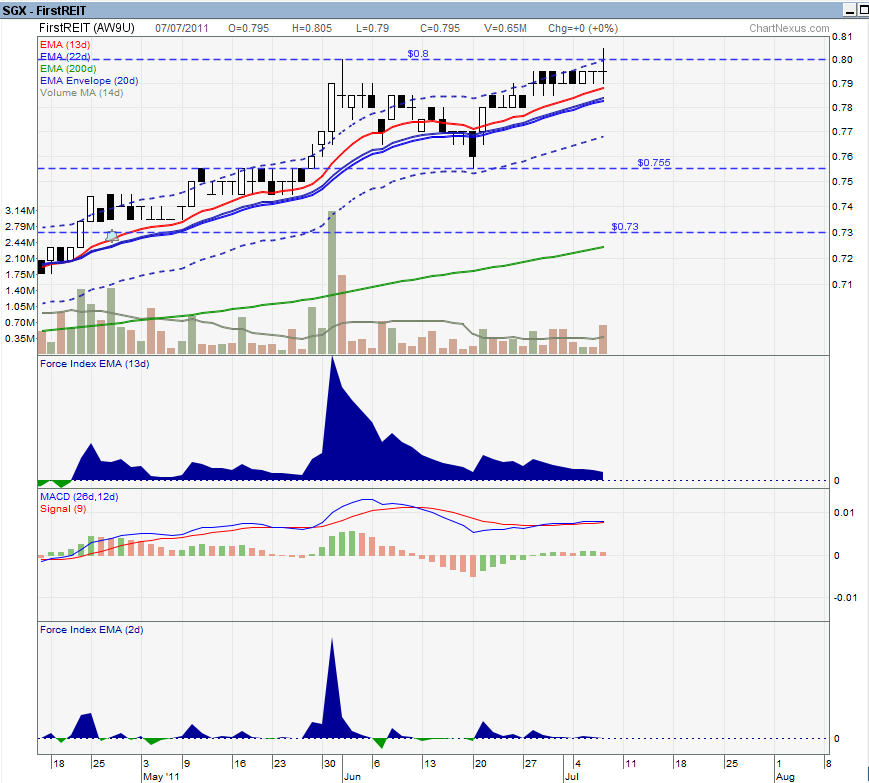
First reit

First reit weekly:


Daily:


First reit had been very good to me, with its high dividend yield and the very low capital cost after the rights exercise. But I had parted ways with it for the time being. The charts both at weekly and daily level doesn't look good. Both weekly and daily show a bearish divergence with today (7th July 2011) showing relatively higher volume plus a doji (you candlestick experts might have a different name for it, pardon me).


I've been doing partial divestment of first reit since June to reduce my position, but it went up and up. It's ok, I don't have to capture the peak and I'm super happy with the returns. Will get it back at another opportune timing again.

-----------------------

As a sidenote, after weeks of queuing everyday after market hours to sell, the queue finally hit around afternoon today. Why today? Perhaps it was after a lunch treat by CJ at his family's Hainanese curry rice stall at Maxwell food centre, no. 68, that brings the luck to me! After eating it, sure 1-6-8 (say it in Cantonese)! In my line of work, I've eaten all the nonsense curry rice all over the eastern part of Singapore, so trust me when I say that CJ's brand of curry rice is among the best. If you intend to beat the lunch crowd and try, do order the curry chicken wings and especially the pork chop. Especially especially the pork chop. The curry is thick and fragrant, and all the dishes are not very oil at all. I'll go back again one day for sure if I've need to make sure money in the market, haha!

Monday, July 04, 2011

Mentor-student relationship

I was thinking to myself about my motivation to share with people about my little knowledge in the stock market. It takes time, energy and effort to go back and fro in the cbox after working for a good part of the day. The time spent could be used to do the things that I like - reading, watching drama series, playing games and to basically relax, so the opportunity cost is actually quite substantial considering that after the whole exercise, I ended up not indulging in my own relaxation time and actually feeling more tired and drained. But don't get me wrong, it's utterly satisfying to do so, which is why it puzzles me. I'm left wondering what motivates me to spend time, energy and effort to share with others.


I think that the reward of teaching people comes not from the money, or from the lunch treats but for the satisfaction of enriching an eager, humble and open mind. I can't say the same for others, but that is what I know of myself. I don't think it's altruistic in nature - I'm not lawfully good in alignment (I'm lawfully neutral). Perhaps when the satisfaction that I desire is not 'repaid', then the satisfaction of getting paid for my time, energy and effort will be somewhat used as a replacement reward. Why is sharing such knowledge satisfying? I think I've this phenomenon I call "teacher's complex" that gives me the kick when sharing about things that I am passionately involved. Perhaps in the beginning it's like a mentor-student relationship, but when the student gets equal or better than the mentor, it'll become more of a two like-minded people who share the similar view of the world. I find that idea immensely satisfying, and I would conclude that this is ultimately the reason why I would forsake immediate gratification of spending my own time to hopefully spread what I know to people who do not.


But do notice that my criteria of teaching is towards someone with an eager, humble and open mind. What is meant by an eager mind? It is the willingness to learn and this can be exhibited by how much effort the student puts in with reference to how much effort the mentor puts in. I think an eager student would put in much more effort than the mentor. I suppose a mentor wants their student to at least show a certain standard of effort before he would willingly spend more time on his part. It's really a relationship marked by reciprocity. Nobody is willing to give and give and don't take. Such relationship would never be sustainable. What about humble and open minded? I think if a student's mind is fixated on an idea and he is very sure that he is right about that particular idea, it's not too incredible to deduce that the person do not have an open mind (at least with regards to this aspect of thought...I do realise that people can be open in one aspect but closed in others).  I think showing a mentor that you have a open mind and is willing to try out new ideas is one of the main reason why the mentor would even want to share with you in the first place. If you insist that you're right about certain things, I don't think anybody would approach you to share with you what they knew.


Thus in discovering my reasons for sharing with people my knowledge in the stock market, I've also uncovered how to find a mentor in different aspects of life. I've a few mentors whom I model after. They might not even know I'm their student, but I am indeed modelling after their thought process and how they behave in different circumstances. But that is being a silent student, quietly observing his mentor at work. If you want to find a mentor in life, or want mentors to approach you to share what they know, remember the three criteria as a student - eager, humble and an open-mind. Only then - and here I would like to paraphrase bro8888's words - would a master come down from the mountain to impart his skills to you.

Monday, June 27, 2011

Financial freedom tag-team

It's important to choose a spouse carefully, it seems. According to the book that I'm reading, "The Millionaire Next Door", it mentioned that for a large proportion of the millionaires that they had interviewed, their spouse are more frugal than them. The constant complain about their spouse is that they can't get them to spend money!


The book mentioned about having quality offense and quality defense when playing this game of financial freedom. One of the couple, usually the male, would play good offense. They would go out and earn a lot of income. It's mentioned that most of these millionaires interviewed have higher household income than average too - so that's the offensive side. The spouse, usually the wife, would stay at home and play quality defense. They are the ones who would manage the household, making sure that as a whole family, they not only stay within budget but way below their income. That's the kind of tag team playing that I found it interesting.


It's hard to say who is more frugal - me or my wife. For the little things (those that cost less than $50), I'm the more frugal ones. I always have to remind my wife not to overspend on such things. However, for big ticket items, my wife is the more frugal one. She would have to remind me that even though I have the means to afford, we should still be careful on how we spend it. For the recent resale flat purchase, I have to convince and reassure her that the 40k cov is worth the money. Same thing goes for the renovation. I guess my wife and I are not spendthrifts and each of us are more frugal than the other depending on the amount spent! That makes us a compatible tag team partners because we defend each other weak points, haha!


Nacho Libre - I absolutely love the movie!


On the flip side, it's very hard to be financially free if your spouse do not support the idea. The journey towards it involves making sacrifices now so as to enjoy greater rewards in the future. Not everyone wants to reach the end point, that I understand. If one of the couple wants to climb a mountain, the other has to belay the ropes and egg each other on, supporting and encouraging each other along the way. If there is only one person actively climbing the mountain, the other would drag along and act as a complaining dead-weight behind you as you climb. It's still possible to make it to the top, of course, but it makes the journey unbearably difficult.


Thus for those of you who so desire to reach the top of the mountain, choose your other half wisely. Pick the characteristics of the person that you think would aid you, for I believe that a marriage is like a partnership - it should benefit both parties, and not just to one only (or worse - none). Choose a tag team partner that you can synergise with - if you play quality offense, pick someone who play quality defense for instance. You can't pick both who play good offense (because you might spend all that you earn), nor both who play good defense (because playing defensively all the time might take too slow to reach the end). When all the beautiful face and great body fades away with age, what is it that still endears you to your spouse?


*This article is contributed to IM$avvy financial portal, which is managed by Central Provident Fund Board and supported by MoneySense. This site has a noble aim of promoting financial literacy to the general population.

Thursday, June 23, 2011

The little boy and the dollar notes

A stranger walked towards a small little boy whom he met along the streets. The man told the little boy that it is most fortunate that fate had brought them together, hence he is going to bestow a gift to the little boy. He can have a choice of a $100 note or a $10,000 note, with no strings attached. He can just take the money and go, with the knowledge that on this particular day, a kind stranger had chosen to bestow a great gift to an unknown boy. By the time the man told the little boy about his choices, a crowd grew around them, eagerly trying to find out what was causing the commotion in the streets. Some of the people in the crowd began to advise the boy, telling him that it is stupid not to take the $10,000. It doesn't even require simple maths or quantitative analysis to figure out which choice is the most rational one to take. There's only one solution to this happy problem, and that is, rationally, the boy should take the $10,000. Such an obvious choice do not even require any thinking at all, some of the people in the crowd thought aloud.


The moment of truth arrived for the boy to pick his choice. The boy took the $100 note instead of the more rational $10,000. Those who had advised the boy scolded him profusely. They told him that he is stupid not to take the $10,000 note. How can anyone be so irrational when it comes to making such decisions, they bemoaned. As the smarter and more rational crowd dispersed in disgust, an old lady walked towards the boy, who was holding the $100 note and positively beaming with joy.


The old lady asked the boy gently why he had not taken the $10,000 note, as advised by the other more savvy crowd. The boy smiled brightly and explained that he took the $100 note because he wasn't sure that the man would really give him such such a great sum of $10,000. However, he was sure that the man wouldn't mind giving him a smaller sum, hence he took the smaller $100 note. 


The old lady smiled at the little boy's train of thought, surprised by how wise this boy is beyond his years. The boy, among all the crowd that gathered around them, is about the only person who had analysed the problem differently from the rest. 


There are often many ways to analyse a problem, and focusing on numbers is just one aspect of the analysis. Why should we be trapped by such quantitative analysis? Is it irrational to place greater emphasis on the psychological aspect of this problem - that is, whether the man is really going to give the $10,000 to the boy? Likewise, is it rational that we focus solely on numbers to analyse a problem? To place emphasis on numbers as the only way to solve a problem seems unrealistic to me. If I'm extreme in advocating moderation, does that make me an extremist too? Sometimes I wonder...