Wednesday, July 14, 2010

When to buy?

I happened to see my buddy unicorn78's comments that he wanted to get some reits/divy counters but is not sure if now is a good time to get in. I gave that question a fair amount of thought because I've asked myself that question a few times too. So, instead of sharing with him alone, I thought it'll be good once I posted my views, the other more experienced market practitioners can share theirs in the comments.


As we learn more and read more about the market, I've no doubt that you'll definitely come across conflicting advice. One camp would say you should never average down your losses just to get out as it is more risky, the other would say you should buy more as the price gets lower to get a lower average price. Frankly, I've done both before. For longcheer, I averaged down as the price gets down until finally I can't take the losses anymore and cut off that gangrene in my portfolio at a huge loss. For HSBC, I average down and bought even more as the price falls, reducing a huge potential loss and it is now sitting around at breakeven level.


I think advice is one thing but the more important point in making the advice work for you is wisdom. You need to know when the advice is suitable. I believe all the advice works, given the correct condition. Thus, the hardest part is to know when to use which advice. So, that is my disclaimer for all my blog articles.


Here's what I will consider when answering the question of whether this is a good time to buy reits/divy counters:


1. For dividend yielding counters, I would want to look at yield of course. Once it hits a certain percentage, I would nibble a little. I never buy the exact number of shares I want in the first try, always in bullets. I've learnt enough in the market that there's no point timing the exact bottom - it's an exercise in futility. Follow snr bro's advice - buy slowly sell slowly. Depending on market condition (check TA), I'll break down the total batches in 2-3. Once I got in the first batch, I'll be a lot more stingy when entering the second batch, always preferring to look for the right TA set up before entering again, so you can say that my first batch is a test batch. Don't ever worry about transaction cost when buying in batches. I'll treat it as an insurance cost to prevent more capital loss than the minimum $25 paid for brokerage.

Personally, 5% is not enticing enough. There are banks preference shares that are a million times safer than reits/dividend counters with 5% yield. 7% is what I'm looking at. 10% (at suitable gearing) would be what makansutra would say, "Die die must try!"


What's the similarity between this picture and a 10% yield counter? Both have a "Die die must try!" stamp of approval on it


2. I find that reading up extensively before you buy can give yourself peace of mind when you are averaging down. The more you understand the situation, the more you can assess it and you can decide your course of action without fear. If I buy a counter which I did even know much, I wouldn't have the courage and conviction to buy buy to average down when the prices go down. So FA to me is just that - for the courage and conviction to buy when others are fearful.

Once you've read enough about the ins and outs of the counter, I'm sure it'll be easier to hold even when the market crash. In fact, I think you'll be wanting the market to crash to load up another bigger batch after your smaller tester batch.


3. The problem can be looked at in this way - if you wait longer, you miss out on the potential rally and perhaps several batches of dividends coming your way. Conversely, if you buy now, the market might crash and you might lose a lot of capital (albeit paper losses) but you get to have the dividends while waiting. Let's break down the problem:


a. Check the potential downside from the charts. Look at the possible support points. If the price is too far from support, maybe wait at support before buying a batch. Make sure the price at the support level satisfies the yield that you plan for. I don't compromise on yield because if I have to hold a dud for long, I would want to be adequately compensated for in terms of dividend.


b. How much is the upside? Again, look at the charts for possible resistance. Don't ever get near resistance level (unless you want to buy on breakout....I don't do breakouts anymore) because the possible downside risk to the nearest support might not be worthwhile.


c. How much dividend are you going to get? If you know your downside risk to the next possible support in (a) level and how much dividend you are getting in (c) plus the upside you might get from (b), I think you can get a risk/reward calculation whether to get it right now or wait. Especially useful when combined with the bullet system of buying any counters in batches.
Monday, July 12, 2010

To be a cat

I realised that I have a very relaxed stance towards investing my money these days. It's not a lack of interest on my part - I mean who wouldn't want to make more money right? It's more of a change in attitude in me. Perhaps it's the general lack of emotions towards my profits or losses that accompanied this change in attitude. This didn't happen overnight. It happened in bits and pieces over the years, accumulating perhaps like water dripping into a cup until the final droplet of water pushes the surface of the water beyond the boundary of the cup.


In place of viewing my charts and reading up religiously on annual reports, instead of discussing fervently about the entry positions and the merits and demerits of a particular company, I chose to rest and relax. Initially I felt guilt, like I wasn't doing my part in making the best out of my available time on earth. But as time goes, you see life and death of counters in the stock market and you see life and death of people on earth, and you cannot but realise that there must be a better use of time than being obsessed over all things financial. This epiphany must have hit me quite hard, because I always had a tight rein of things on monetary matters - trying to find the best deals, trying to make the most of my time, trying to beat this beat that...


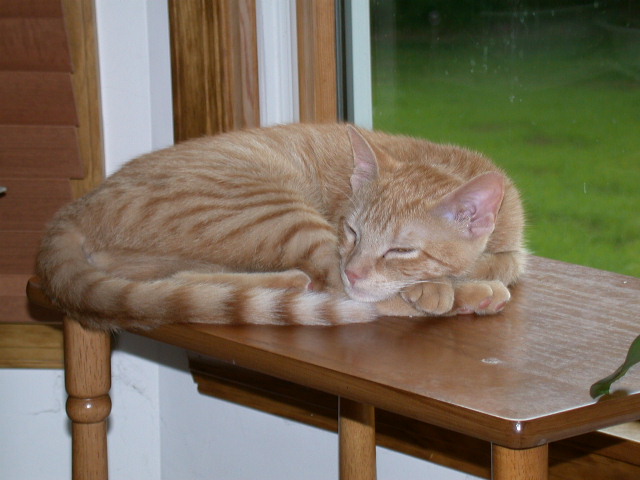
This is not my cat. Though I say that, both have this seen-it-all behaviour typical of cats


...and then I looked at my cat, lazily grooming itself by licking her paws before snugging up her tail as a pillow and drifting into a comfortable nap in the afternoon. Loving cats makes me love watching time goes by, doing nothing.


In view of my current change in attitude, perhaps it's time to look more into instruments with little or no maintenance. For observant readers, you would have noticed that the list of books that I've read or am reading (found on the lower right hand corner of the blog) are filled with books of various topics with the exception of financial stuff. I just can't bring myself to read one of these books nowadays, having read them religiously for so long.


I think I'm getting less practical and more human now. I'm loving every minute of it.

Thursday, July 08, 2010

Retirement

I was intrigued by a newspaper report that in Europe, the retirement age is pushed back to 70 yrs so that the pension scheme that they had there will continue to function fully. I guess with a aging population, it's harder to support with a diminishing working class as the birth rates cannot continue to support an inverted pyramid for long. It's just too unstable.


Retire.


If you break up the word it become two parts - Re and Tire. Re means to do it again as in retry and reboot. Tire means to be exhausted, to be fatigued. The word sounds bleak doesn't it? To retire these days is not to sit back in your home, blessed with people who would support you. I think the image is going to be replaced by one which you have to work to support your own subsistence. Thus to retire means that you have to work again (in an environment that you are not appreciated and are lowly paid) and be fatigued by it all. Gloomy, isn't it?


I don't want to have such a bleak future. Thus, I think it would do good to think about retirement. I think the main concern would be health and money. It's good to think about a time when you can not longer function as well as you do when you're in your prime days. A passive income stream to support your own keep is great. A healthy savings to last beyond what you can spend is a blessing. And most importantly, good health to make it all meaningful and worthwhile.


Got to start planning.

---------------------------------------------------

After reading this again, I felt that I had left out something. I realised it now. It's no point having good health, good money for retirement. You need someone to grow old together too. May be your loved ones, may be your children, may be your best friends or even a cat :)

Tuesday, July 06, 2010

To milk or to slaughter?

Having sold a dividend yielding counter recently, I was thinking about the age-old problems that plagued me. I was suitably reminded of someone's analogy (bro8888's?) that a dividend yielding counter is like a milk cow. Every other time, a milk cow will give off milk, so that you can drink some and sell some, thus giving you a good cash flow. Alternatively, you can sell the milk cow to someone at a good price and get several years worth of 'future' milk money now, so that if there's a mad cow diseases floating around infecting other herds, your future cash stream will be secured because it's in your hands now. This comes at a cost - you'll lose your future cash stream and possibly the price of the milk cow might also increase in the future.


To milk or to sell - that is the question


Quite a good analogy to stocks, no?


The counter I sold recently was singpost. This particular tranche I had held for quite some time - around 3 years in all. I had bought it at a rather high price of $1.18, something that I had regretted for an equally long time. However, I made good on the stocks when I sold it at 1.13, with my dividends covering all my capital losses and making up an 'okay' profit.


The thoughts that ran through my mind was if I should hold on to it longer to get more dividends or should I just sell to lock in my profits to get my hands on cash, and live to fight another day. Here's my reasons for divesting:


1. At 1.18 entry price, I was not doing as good on my yield. Singpost gives quarterly dividends up to a tune of 6.25 cts per annum, thus giving me a yield of 5.3% per annum. Not bad, but not fantastic either, considering other lower geared but higher yielding alternatives out there. Therefore, I was inclined to sell it to get the cash to get into the other alternatives.


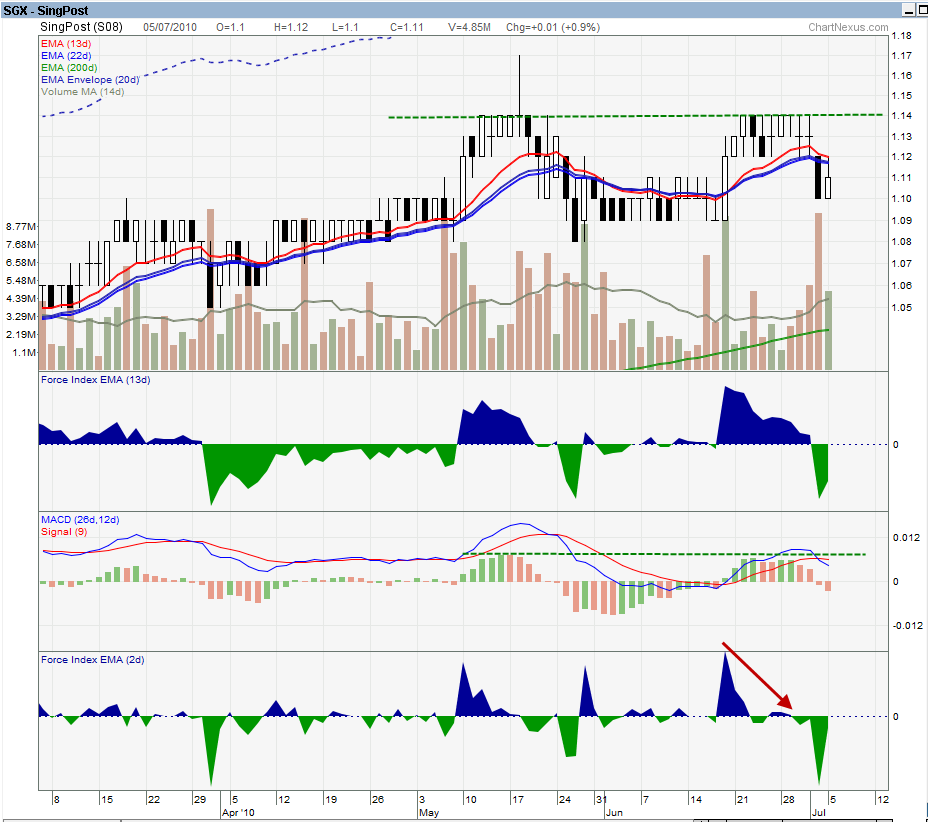
2. A picture tells a thousand words. Let's see what this picture tells you:

Singpost - daily chart

I wanted to sell at 1.14 but after queuing for nearly a week, I couldn't get it done. I just opted for 1.13. This chart was not particularly bearish, but the overall market condition was, so I didn't want to risk what I had out there and just took what I can out of the table. The price dropped due to XD. On hindsight, I could have got the dividend, sell at 1.12 and have both my cake and eat it too. But alas, things are always much clearer after it had happened.


3. I told myself that I would want to 'trade' this counter again, with this as the second round. The time frame for trading this is actually quite long, which is fine for me actually. I'll want to trade it when the signal comes and to hold it for dividend yield when the price reaches around 90 cts level. At 0.90, the yield will be near 7% - that would be something worth holding for.

Tuesday, June 29, 2010

CAGR II

Recently, I was given an opportunity by a reader to explain more about CAGR. It's not a brand of cigar. It's refers to compounded annual growth rate - a calculation to find out the compounded returns per year (note that this is different from simple interest rate). I actually wanted to share how silly this calculation is about but I had a feeling that I've written about it donkey years ago. After searching, I realised I did write an article about CAGR here, so I'll just highlight or perhaps add some points to it.


Frankly, I've not used CAGR for years because of I realised that with one calculation, the whole story can be quite distorted. Basically the calculation of CAGR depends on three variables - Future value, present value and time period. The most significant gripe I have about CAGR calculation is the fact that you can get hugely wide differences in value by just changing the variables. Essentially it boils down to a GIGO (garbage in garbage out) system where the output depends firmly on the input that you put it.


CAGR CIGAR is a stick used for smoking, giving a pleasurable feeling afterward


Take a look at this example. Let's say these are the figures for yearly profit from year 1 to year 4 respectively:

10, 15, 20, 25

Present value: 10
Future value: 25
Time period: 3
CAGR: 35.7% per yr


Here's another example of yearly profit from year 1 to year 4 respectively:

10, -2, 45, 25

For those who are synchronous with me in thought would have realised that the CAGR for the two examples are exactly the same. Why? The first example and second example looks very different but the three variables that affect CAGR calculation - namely present, future value and time period - are all the same.


So, what does that leave us?


1. Firstly, you must realise that the CAGR just draws a straight line between the start value (present value) and the end value (future value) and ignores all the ups and downs in between them. In a non-linear world, this assumption is just plain bullshit. I can make a good CAGR by carefully selecting my base year and my final year, so do be careful of it. Statistical calculation must be treated firstly as a blatant lie.


2. Secondly, it would be better to accompany CAGR calculation with the actual values of the data points in between the present and final values. To make it better, I would suggest a graph. It's like doing linear regression calculation in A'lvls - you must accompany each calculation with a scatter plot. This will give a bigger picture of the meaning of the CAGR value calculated.


3. Lastly, I simply do not use it anymore. From experience, projecting the past into the future is at best a guesstimate because the reality could be more optimistic but usually more pessimistic. Since it's a guesstimate, there's really no need to put a numerical figure to your guesstimate. I do not use it anymore because I fail to see the value of such calculations in fattening my wallet, though it might well do to fatten my ego.

Sunday, June 27, 2010

You need both rainy and sunny days to make life's rainbows

** "BIAS" is a special feature in my blog where I get to say whatever I want with scant regards for your feelings. I'm not politically correct in this feature, so go ahead, judge me."


Time seems to fly these days. It seems like it's the opposite of what Einsten's theory of relativity had proposed. You know, in that theory, if you travel as fast as the speed of light, time seems to stop from your point of view. In work life, it seems that if you work very very hard, time seems to fly even faster. Day and night zooms by, punctuated by meal times and the occasional travelling and before you know it, Monday goes and Friday comes again, thus ending the week.


Since there is really not much activity in the market (okay, except for my sell order that I had been consistently keying in everyday but didn't get filled), I thought it'll be good to talk about things that I'm grateful for and things I'm not so happy about. Here goes:


An unhappy cake. Have you seen a cake that wants to be eaten?


Things I'm not happy about:

1. I spent my morning reading through the Sunday times and saw an article about CEO of SMRT saying that the mrt trains at its peak are carrying 1.4k passengers, compared to its 'crush load' of 2k passengers. She then compared to the peak carrying load in Tokyo and HK and implied that the trains are not as fully packed and Singaporeans can squeeze in if they choose to do so.

I think if she takes a break off her car for 1 month, and try to take the MRT to work everyday, squeezing in with the crowd in the morning and again in the evening, she can better appreciate the implications of her statement. The stress related to being cramped in a tiny morsel of space day in and day out cannot be described to a person who had not experienced it before.

I hate it when people in authority starts comparing to other countries to 'bring out' the goodness in our system. Things are not so easily comparable. I can similarly cherry pick things that are good about other countries to 'push down' our system of doing things here too.


2. I was woken by a sharp diarrhea this morning way before my alarm rings. Must be some nonsense I've eaten last night.


3. Some horrible horrible inconsiderate people are honking their car horns so early in the morning. I'm sure whatever problems might be in front of them can be solved by calmly walking over and talking to the person, or simply by waiting. Honking your car horn doesn't make things any better. When I was a learner driver, I had my fair share of it. It made me worse as I get even more nervous. I'm sure whoever is honked at would feel the same too, or that they are simply immune to it. Either way, honking the car doesn't get things done...perhaps it only serves to wake up some people around the neighborhood.

I remembered a joke from my army daze. A group of us are sitting in the bunk, trying to escape the evil all-seeing eyes of the CSM. One of my buddies asked what should be done if you're driving and the car in front of you starts to slow down. He's studying for his basic theory so he's asking some possible questions.


a. Slow down
b. Speed up and overtake him


Did anyone choose option (a)? Well, not contented, another of my buddies started wisecracking and said that we should honk first, then slow down and honk again. There you go.


I like this picture a lot. Simple and to the point.


Things I'm grateful for:

1. I went to Robinson sales at Singapore expo with my girlfriend yesterday. It was such an interesting experience! There was a concurrent MPH warehouse sales so we went over there first, where my gf bought 9 books (it's considered a few...I'm sure she'll carry more if I didn't force my way with her). I guess she can spend her whole lifetime reading her already immense collection of assorted books lying all over her room and threatening to spill over other parts of her home. Silly girl :)

The books are priced at $8 each for 1 general book, and $35 for 5 general books. The collections are quite varied and I haven't even walked 50% of it. I think they are ending today, so go and check it out if you like a good bargain.

The Robinson sale was fantastic too. Bought some Adidas shirts at over 60% discounts. All sorts of things there, but be prepared for long queues :)


2. I'm grateful for the early morning showers that makes the day much cooler and more pleasing. I was joking to my student one day that we should all go down to Orchard road to grab some floating iphones and hermes bag when one of these high intensity, high duration rain comes again :)


3. Wonderful technology - blue ray. Was at a brother's place watching some 'brue lay' movies and was once again amazed at the crisp clear pictures. I must have said it more than once that I'll be happy just watching the subtitles because they are so pleasing to the eye!


4. School holidays will be over! I can finally get to rest in the morning and resume my vampirish schedule which I think I'm better suited for. Begone early morning classes, welcome night classes!

Tuesday, June 22, 2010

One weekend at Fullerton Hotel

I went over to Fullerton Hotel over the weekend for a break from work. Work had been getting more and more unbearable, so I think a mid term break from all of it, even if it's for a while, is good for my mental well being. Since I've never been to a local hotel before, I thought of going there instead of the slightly more troublesome trip to my favourite Batam. Batam is good for those long stretches of idle days...something I can ill afford now.


Anyway, I signed up for the 1 night stay there, which cost me $340. The package includes a $88 rebate for any amount of money spent in Fullerton (it can be the Courtyard, the bar or the Jade restaurant), so I think it's pretty worth it. Me and my gf are celebrating something over there, so we also get to have some chocolates and a bottle of wine complimentary from the hotel. There was some misunderstanding, so they didn't really send the bottle of wine and chocolates up to our room during our stay there, but they made it up by giving us a pack to bring them home. Quite impressive service.

This is about the only proper picture taken off my hp. The rest are just too shaky to be publicly displayed.


Since Sat was the NDP rehearsal at the Padang, there were plenty of fireworks to be seen. I can't really see them from the hotel room (not dying to see them anyway) but I can definitely hear them. During the evening, as I was waiting around in the swimming pool (it's open air), I managed to spot a few soldiers parachuting down from the sky too. Quite interesting because I've not seen them except on television.


We asked from room service dining. It was quite a good experience because usually when we dine in the hotel room, I was just given a tray with the food. For Fullerton, they did the entire table routine with proper tablecloth and setting, complete with glasses of water and napkins. I was suitably impressed with this, being the mountain tortoise that I was. You really don't know what is good until you've encountered it.


Erm...it looks more impressive when you're there, with the sight and smell thrown in


Even though one night is a tad short to me, I thoroughly enjoyed myself there. I was watching television, reading and basically just resting my entire weekend. I even managed to sneak in a lunch appointment with the brothers here, so it's definitely one of the most memorable weekends that I will remember. I cannot recall when I have my weekend totally devoid of work. Definitely worth it.


That's how life should be right? Spending money to buy back happy memories to savor forever.

Thursday, June 17, 2010

The forgotten habit of reading

** "BIAS" is a special feature in my blog where I get to say whatever I want with scant regards for your feelings. I'm not politically correct in this feature, so go ahead, judge me."


In my job, I talk with many young people. I walk away with the grim knowledge that most of them do not have a habit of reading. I'm not just talking about reading textbooks for academic purposes, but also reading for the joy of doing so. From what I observed, girls read more than guys, though it might be mainly fashion magazines or other lighter fair like 8 days etc. I think one of the main contributing reason is that there are many distractions that are far more exciting than just plain reading.


I was just telling one of my students that I had just bought a kindle dx just three weeks ago. He asked me how much it costs and I told him it's a few hundreds. To this, he exclaimed that he would never spend such money on books. I guess that pretty much sums it up about the youth these days. They would rather spend money to engage someone to teach them then to read it up themselves. It's quite horrifying when I heard that most of them will just throw away the manual for any gadgets they bought and just jump straight into it. Perhaps they are so confident of their ability to trial and error any functions that their gadgets possess (they are afterall, the IT generation).


But why are they so disgusted with reading? I've no idea, but I guess it's good for my job. Most of the stuff I teach can be found in the examples given in the textbooks, so I suppose that if they do read it up, I might not be that busy anymore.


To me, reading is the best way to gain the knowledge and experiences of those that came before us. Culture is retained in the literature and passed down from the past to the present. If you would just read, you'll find that you do not have to keep re-inventing the wheel. I remembered when I was learning FA, I had a goal of reading one finance book per week - that makes it 52 books per year. That was back in 2008. I was reading voraciously on accountings, financial statements analysis and those books by guru investors, and I was greedily lapping it all up. It was until I had finished most of the shelves in the library that I slowed down. These days, I am much more selectively in what I read, choosing instead to re-read some of the best books that I had filtered down through the years.


My gf always wanted shelves of books occupying an entire wall in our home


Just for the records, here's the books that I devoured from 2007 to 2009. I'll highlight the ones that I would want to re-visit again and again.


Books read in 2007

1. Five point something – Chetan Bhagat
2. How to become stupid – Martin Page
3. The curious incident of the dog in night-time – Mark Haddon
4. The stupidest angel – Christopher Moore
5. The way of the cockroach – Craig Hovey
6. Legally correct fairy tales – David Fisher
7. It’s kind of a funny story – Ned Vizzini
8. Jacob’s ladder – Brian Keaney
9. Politically correct bedtime stories: Modern tales for our life & times – James Finn Garner
10. Cathy’s book – Cathy
11. Metamorphosis – Franz Kafka
12. Label – Louis de Bernieres
13. The successful investor – William J. O’Neil
14. Rich dad poor dad – guide to investing – Robert Kiyosaki
15. Do you want to make money or would you rather fool around – John D Spooner
16. Vault career guide to investment banking
17. Financial Statements - Thomas R. Ittelson
18. The four pillars of investing: lessons for building a winning portfolio – Dr William Bernstein
19. Accounting Demystified: A self teaching guide – Loita A.Hart
20. Five rules for successful stock investing – J Wiley, Joe Mansueto, Pat Dorsey
21. The little book of value investing – Christopher H. Browne
22. The little book that beats the market – Joel Greenblatt
23. The unwritten law of business – J.W. King, revised by James.G.Skakoon
24. Stone age company – Sally Bibb
25. The rules of wealth – Richard Templar
26. The laws of simplicity – John Maeda
27. The 5 keys to value investing - Jean Jacques


Books read in 2008

1. Warren Buffet Speaks - Wit and Wisdom from the World's Greates Investor - Janet Lowe
2. Winning - Jack Welch/Suzy Welch
3. The Dividend rich investor - Joseph Tigue/Joseph Lisanti
4. The little books of common sense investing – John C bogle
5. Everyman and his common stocks – Laurence H. Sloan
6. Investment madness – John R. Nofsinger
7. Lessons from the legends of wall street – Nikki Ross
8. Understanding comics – Scott McCloud
9. Free cash flow and shareholder yield – William Priest/Linsay McClelland
10. The ultimate dividend playbook – Josh Peters
11. The five rules of successful stock investing – Pat Dorsey
12. Why smart people do stupid things with money – Bert Whitehead
13. Building the perfect portfolio – Curtis J. Montgomery
14. A concise guide to macroeconomics – David A. Moss
15. Little black book of connections – Jeffrey Gitomer
16. The little book of value investing – Christopher H. Browne
17. The Tao of warren buffet – Mary buffet
18. Monopoly rules – Millind M. Lee
19. Buffettology – Mary buffet / David Clark
20. Common stocks and uncommon profits – Phil. A. Fisher
21. One up on wall street – Peter Lynch
22. The Warren buffet way – Robert G. Hagstrom
23. Anyway – the paradoxical commandments – Kent M. Keith
24. Cut to the chase – Stuart R. Levine
25. The Intelligent investor – Benjamin Graham
26. The bull hunter – Dan Denning
27. The black swan – Nassim Nicholas Taleb
28. The market guru – John Reese/Todd Glassman
29. Liar’s Poker – Michael Lewis
30. Confessions of a wall street analyst – Dan Reingold
31. The Citibank guide to building personal wealth – Leo Gough
32. The essays of warren E. Buffett – Lawrence A. Cunningham
33. Morningstar guide to mutual funds – Christine Benz
34. Benjamin Graham on value investing – Janet Lowe
35. A random walk down wall street- Burton G. Malkiel
36. Even buffet isn’t perfect – Vahan Janjigian
37. Origins of the Crash – Roger Lowenstein
38. Reminiscences of a stock operator – Edwin Lefevre
39. Killing sacred cows – Garett B. Gunderson
40. The real warren buffet – James O’Loughlin
41. 100 cats who made a difference – Sam Stall
42. The little book that makes you rich – Louis Navellier
43. Debt – Juliane Otterbach
44. Saving – Juliane Otterbach
45. V for Vendetta – Alan Moore, David Lloyd
46. Full of Bull – Stephen T. McClellan
47. This is not a book – Michael Picard
48. My Formula! – Thomas Matthew
49. Value Investing – Sebastian Chong
50. Financial statements for non-financial people – Ron Price
51. A primer on money,banking and gold – Peter L. Bernstein
52. The little book that saves your assets – David M. Darst
53. The Joseph cycle (2004 edition) – Simon Sim
54. Animal Farm – George Orwell
55. I.O.U.S.A – Addison Wiggin, Kate Incontrera, Dorianne Perrucci


Books read in 2009


1. Investing against the tide - Anthony Bolton
2. Pit Bull - Martin Schwartz
3. Fooled by Randomness - Nassim Taleb
4. When genius failed - Roger Lowenstein
5. Real tips, real money - Leong CT/Leong SH/Dr David Tay
6. Candlestick charts - Clive Lambert
7. Sell and sell short - Dr. Alexander Elder
8. Come into my trading room - Dr. Alexander Elder
9. Trading for a living - Dr. Alexander Elder
10. Silver Surfer Requiem
11. Free market madness - Peter A. Ubel
12. Sales Bible - Jeffrey Gitomer
13. Avengers Disassembled - Brian Michael Bendis/David Finch
14. Successful Value Investing in Asia - Tony Measor
15. Where are the customers' yachts? - Fred Schwed, Jr
16. The little book of bull moves in bear markets - Peter D.Schiff
17. Keynes and the Market - Justyn Walsh
18. Warren Buffet and the interpretation of financial statements - Mary Buffet & David Clark
19. The physics of superheroes - James Kakalios
20. Motoring Basics
21. Your money or your life - Joe Dominguez and Vicki Robin
22. Bailout - John Waggoner
23. The Millionaire in you - Michael LeBoeuf
24. The 5 lessons a millionaire taught me - Richard Paul Evans
25. How to trade in Stocks - Jesse Livermore (& Richard Smitten)
26. The Wall street Self defense Manual - Henry Blodget
27. Teach yourself to Live - C.G.L. Du Cann
28. How to become a property millionaire - Azizi Ali
29. Cats - the book of the musical - Harvest books
30. The little book that builds wealth - Pat Dorsey
31. Success in the education business - Vincent A. Gabriel


So there!

With my Amazon Kindle, I'll be reading much more fiction and classics that I had always wanted to read, but had difficulty finding in the library. These days, it's hard to find new knowledge in the financial books that I read. After all, there's only so much things to learn about finance. Most of the books will be just talking about the same ideas but phrased in different forms.

Friday, June 11, 2010

The velocity of money

I was re-reading this book by Garrett Gunderson - Killing Sacred Cows. It's a very wonderful book with very refreshing concepts, so I make it a point to revisit some of the concepts espoused in the book every year when I have the time to do so. It's so easy to read that if you only have time to read one financial book this year, make it this one! You can have a sneak preview of the book here. Since it's the preview, not all the pages are shown, but I think it's enough to showcase it's attractive typesetting and page layout.

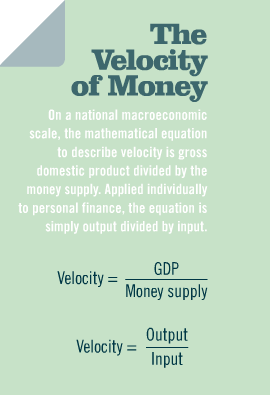
I remembered this particularly interesting concept, called the velocity of money. It is borrowed from the discipline of economics but in this case, it's applied to the field of personal finance. Basically, it's just an equation that is somewhat similar to the the mathematical form of efficiency. No wonder the concept feels similar to productivity.


This is extracted from the book Killing Sacred Cows by Garrett Gunderson

Basically, the concept is talking about how to keep input at a minimum while increasing as much output as possible. The point here is how to continually extract more output and yet at the same time reduce your input. One example of this is to use the savings you had to buy into financial instruments that gives you a passive income. Then you use the passive income to buy more such instruments that will generate even more passive income. While the input remains the same (which is the initial amount of savings that you put into the instrument in the first place), the output keeps getting higher and higher. This is because the principal and the interest both earns you an interest, thus creating a self feeding loop - exactly how compounding works.


Another example will be a business like ebay. When it started, there are not too many buyer and sellers. An effort is spent to set up all the necessary infrastructure for the ebay business to begin. Once time progress, more sellers come into ebay to hawk their wares, which in turn attract more buyers. Seeing more buyers attract even more sellers and so on, creating a self feeding loop. The input is minimized but the output is exponentially increased.


I guess it works for the tuition business as well. As I begin the career, I have to read up on a lot of stuff to have the knowledge. All these are just one time effort. Once I get some students, a proportion of them will turn out to have excellent grades, which in turn will attract more students to come in based on recommendations and so on and so forth. These kind of network effect is not proportional to the initial effort that is put in, hence it's very powerful.


The book mentioned that net worth is like stored potential, while cash flow is like a tap with running water. Having a high net worth does not mean that the person will have high cash flow, but the potential is there. It's like you have a lot of cash sitting in the bank, with little debts (high networth). Cash has low velocity because the output (the interest earned) is very little. If one just utilizes the cash to do create value (here, value is defined loosely as something that is in line with your Soul purpose), then it'll have a higher velocity of money.


Again, liberally taken from the same book

Now, seriously, I think that is a refreshing concept. As of all good speakers and good books, it's not that you do not know the concept that is at work here. It's the flair and the way the concepts are illustrated that makes it refreshing. As of above, so shall below. While the velocity of money is essentially a concept used in the financial field, I guess one can equally apply it to life in generally. I think the concept of the velocity of money forces one to think critically on out to increase the output value of every dollar that is utilized, so as to increase productivity.


Food for thought... would you rather have a high net worth or a high cash flow?

Tuesday, June 08, 2010

Phillips MMF

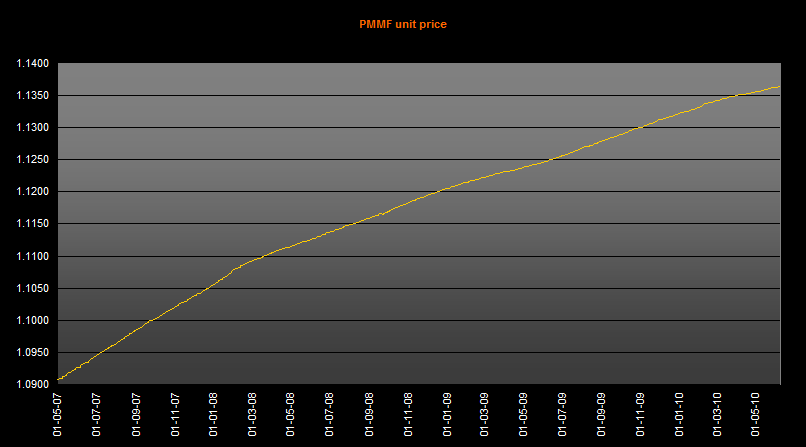
It seems that Phillips Money Market Fund (MMF) is giving lousier returns as more people are aware of it, or simply because that they are fleeing the more volatile stock markets and trying to flock into the safer cash funds. I've been using it since May 2007 and I also tracked the NAV value of the fund since then.


The returns per month for the following years are as follows:

2007 : 0.167% per month --> 2.01% per yr
2008 : 0.111% per month --> 1.33% per yr
2009 : 0.087% per month --> 1.04% per yr


You can see that the returns are dropping. From the fact sheet, I also saw that it is attracting more and more people into the funds, so perhaps there is so correlation. Perhaps they are finding it harder and harder to get the yields as their fund size grew bigger, or maybe it's the fact that the general low interest rate environment makes it hard for them to give us anything more competitive (they invest in low volatility assets like sgd deposits, govt bonds etc).


Can you see the obvious change in gradient over time?


Here's the figures for this yr, 2010:

Jan : 0.071% per month
Feb : 0.088% per month
Mar : 0.053% per month
Apr : 0.044% per month
May : 0.053% per month


The average monthly returns had dropped since the start of the year, giving an average of around 0.062% per month. This means that if all else remains as it is, I'll be looking at around 0.8% per year, which is under 1% per year.


Pathetic you say? Yes, it is. But I guess that's the price of 'safety'. It can't even beat inflation, which is at 3% per year. But for those who needs the liquidity (like me) and cannot safely put it into higher yield assets, I suppose this beats the even lousier interest rates for savings accounts. I think even for fixed deposits, you need a higher deposit amount and longer lock in period for this kind of returns. So, in comparison, it is still okay lah.


One thing about it is that it is not guaranteed, unlike banks. Given the low returns for the MMF, it's been a long while since I've put in any fresh funds inside. Most of my savings are put into my savings account now, because the higher returns is not worth the risk of Phillips going belly up.

Monday, June 07, 2010

A little reflection

These days I hardly look at the market. I remember when I started, I keep staring at the prices, as if by some eye power, I can change the prices of the stocks that I owned. These days, it's just a waste of time.


I suppose as I get more mature and hopefully wiser, my feelings and emotions are kept more constant. There are a lot of things that require my time and presence, and I certainly do not want to spend my life staring at numbers jumping on the screen. It's such a far cry when I first started (on the wrong foot obviously) in the market by trading with warrants. It requires so much time and effort, with my emotion going up and down according to the ups and downs of the ticker. It's very stressful, not to mention distracting, when you have a job to do as well.


I think going forward, I would reduce the time spent on looking at the watchlist. I foresee that I can only get more busy in my work, thus more of my stocks holding had been changed to hold more dividends. Basically I intend to hold more dividend yielding stocks, such as reits and the standard 'defensive' fare, and leave a few bullets here and there to either buy more upon crisis, or trade when I see the opportunities. Unlike in the past, I completely realise that the trading game is not for me, and that is after having experimented with it for myself. I also realised that I cannot be those steadfast investor as well, because it would have completely bore me to dig deep into the statements to find out the business.


I think the self realisation of what you can do and what you cannot do is important, because that will shape your style of investing/trading. To find out the viscosity of honey,  you cannot look at a static jar of honey. You must tilt the jar to one side to find out the dynamic properties of honey. Likewise, you cannot know your risk appetite by filling out some questionnaire, you have to try it out for yourself in the market.

You cannot discover the dynamic properties of honey by staring at it statically


My main income has been, will be, and will always be my main job. Knowing this, I think I would not spend so much time searching the ocean for that one multi-bagger stock that will yield me tremendous profits. Neither will I stare at the ticker all day just to get the perfect entry and exit. I simply do not have the time for such things. I realised that a day will come that I cannot work anymore, I would have to rely on secondary sources of income, and that will have to be from my investments. That will be my second line of defence. I think I would focus on building up a nice passive income to prepare for that eventuality.


It's very different when I first started out because I shun dividend yielding counters, thinking that I'm still young and I should aim for capital appreciation. I can afford to lose blah blah...how foolish of me and nobody told me so. Still, without the past me, there will not be the present me.


May fortune smile on you in the market.

Thursday, June 03, 2010

SGX - trade review

I was reviewing some of my past trades. This is one of them. The counter here is SGX. It's not exactly good for trading because the cost of 1 lot is quite high, so while the absolute value might be the same, a higher amount of capital is tied up in case the trade goes wrong. But I do like the cannot-die type of company for trading, so SGX fits perfectly.

Here's my two trades all depicted in the chart shown below:


What a roller coaster ride we have here...

I had 2 full round trips of SGX. The first was in 15th June 2009, bought at a price of 7.54 (the chart did took into account the drop of the price after its final dividend declared, hence it looks 'funny') and sold on 23 July 2009 at a price of 7.84 (again, the chart took into account the drop in price after its final dividend). Since the holding period is rather short, I did not get to enjoy any dividends declared.

Profit: $0.30


The second trip was in 5th Nov 2009 bought at a price of 7.88 and sold on 14th April 2010 at a price of 8.05. I managed to hold for a round of dividends declared at 0.0375, hence it boosted up my profits a little.

Profit: $0.170
Dividends: $0.0375
Total: $0.2075
Over profits for the 2 round trips:  $0.5075


This is only round 2 and hopefully many more to come. As you can see, my TA skills is not sharp. My entries and exit are less than commendable, but that is the nature of playing a probability game. On hindsight, I should have entered and sold at so and so price, but trading on the right edge of the chart is more difficult than looking back at it after trading it.


The closing price of SGX is 7.33 as of now. So, if I had bought at 7.54 and kept it till now, this will be what it looks like:

Profit: - $0.210
Dividend: $0.2675
Total: $0.0575


I'm not showing this to compare the buy-and-hold strategy versus the in-and-out strategy, because I know fully well that by selecting the appropriate time frames, both strategies will turn out to be winners. There are obvious advantages to both strategies and I would like to employ both of them. For example, if I had bought say 10 lots of sgx, I would have put half as a buy-and-hold positions and the other half as a trading position. The percentage can change according to the times, and need not be fixed in stone.


But I want to make it clear:


1. Buy and hold doesn't mean that you'll make money. Holding it long term doesn't mean that you'll make money. But if the company gives off a good dividend, it makes it that much easier to hold it longer. If the dividend is 10% per year, just holding it 10 yrs will recoup all your capital sunk in, never mind the capital appreciation or not. That's the wonderful thing about holding dividend yielding companies over the long term. But of course, there's a lot more things involved...10 yrs is a long time and they might not be around, that's why there's still a need to monitor the financial health of the company.


2. Using TA doesn't mean that you can catch the top and the bottom. If you can catch the approximate top and bottom, I think you'll boost your profit potential tremendously already. Of course, a lot depends on the person too - the mind, money and method. Fear makes you hesitant to buy when a signal presents itself while greed makes you hesitant to sell when the target price presents itself. These are all monsters that you have to face it if you're in the market.


Good fortune in the market :)

Sunday, May 30, 2010

Lazy sunday

This is one of those lazy Sunday that I didn't have to work and have the time to read newspaper at a very leisurely pace. This is so unlike the past few weeks where I've to scan the headlines and basically leave it at that. So, naturally, my eyes focused on the investing segment of the Sunday Times. This person was giving 5 tips on how to invest despite the bear.

My first impression is that how come nobody is giving tips on how to invest despite the bull. Perhaps it's our natural inclination to see prices rise up. Even the major stock exchanges in Germany and US are setting up measures to prevent short trading in case the market plunges too fast and too soon, but they did not do anything to prevent long buying in case the market rushes up too fast and too soon. Quite bias, don't you think?

Anyway, here are the 5 tips. Having nothing better to do, I thought it'll be a good idea to reflect on how these tips are useful to me or not.


1. It is better to remain focused and stay invested during volatile times.

It further elaborates by saying that over the long term, you can ride out the volatility. I hate it when people say that. It oversimplifies a lot of things. So do we stay invested in one company over the long term or do we put all our investing money in the market (regardless of the companies actually invested) over the long term? From the people I talked to, they seem to think that the former is the way. They then quote Warren Buffett doing that too (if you think so too, read more about him).

In my opinion, I think that staying vested in the market for the long term is the right thing. But you need no stay invested over the long term on the same companies. Just do the necessary adjustments from time to time.


2. The three Rs: Revisit goals, review portfolio and rebalance your investments.

Ok, this I agree. I made a mistake in the past of not reviewing my investments. A good profit thus turned to a very bad loss. I guess everyone does that kind of mistakes. It's a very very good idea to rebalance your investments. It's like a garden full of plants that you want and a lot of weeds. Just take out those weeds so that you can clear more space to grow the plants you wanted.


3. Spread out your risks, diversify

The article says to diversify across different asset class. Ok, it's great advice. But to a common retail investor, it's hard to do spread out your assets into more than 2 classes, unless you have a lot of bullets to fire everywhere. To me, if you have less than half a million to invest, you might want to concentrate on just one or two asset class. Perhaps stocks and bonds? If you have more than half a million, then capital preservation might play a more important role, hence the need for a more robust portfolio to weather the shit in life. Stocks, bonds, properties, commodities might even out just nice.

Please don't quote me Warren Buffett's style of focusing. You're not him and he's not you. Besides, he has many many more companies than you will ever have.


4. Have a balanced portfolio

Erm, isn't this tip the same essentially as tip no. 3? I guess the author elaborated more on using the funds approach. Coming from the head of UOB deposits, investment and insurance branch, I guess it's normal to talk about this.


5. Market corrections can mean opportunities; use dollar cost averaging to smoothen price swings

I'm not such a big fan of blindly doing DCA. I believe that the market can be timed, not precisely, but approximately. We do not have to buy every month because we cannot time the market. Just do DCA with some chartings, and I think you can do a lot better and save yourself on the transaction costs.


As with all articles, they never never talk about selling. It's all about entering the markets and giving the impression that by holding long enough, you'll have a good return in the end. To me, selling is the other half of buying, and there really is too much literature on how to buy and when to buy. How about doing a DCA on selling? As market goes up, you sell a little more and a little more so as to average up your selling price?

Monday, May 24, 2010

The flight of Icarus

I would like to share a Greek mythology with you. This is not about Odysseus nor Sisyphus - it's about the story of Daedalus and more importantly, his son Icarus. You might not have heard of Daedalus but surely, you must have heard of the Minotaur. The Minotaur is the half man half bull creature that is found in the Labyrinth of Crete. There is a great story of how Theseus, the 'real' son of Poseidon (not the Hollywood fake version of Percy Jackson), survived the labyrinth and defeated the Minotaur. Daedalus, the craftsman who built the labyrinth, had to escape with his son Icarus. He thus built a pair of wings, one for each of them and gave his son strict instructions not to fly too high up near the Sun for the wax on the wings will melt and he will surely perish.


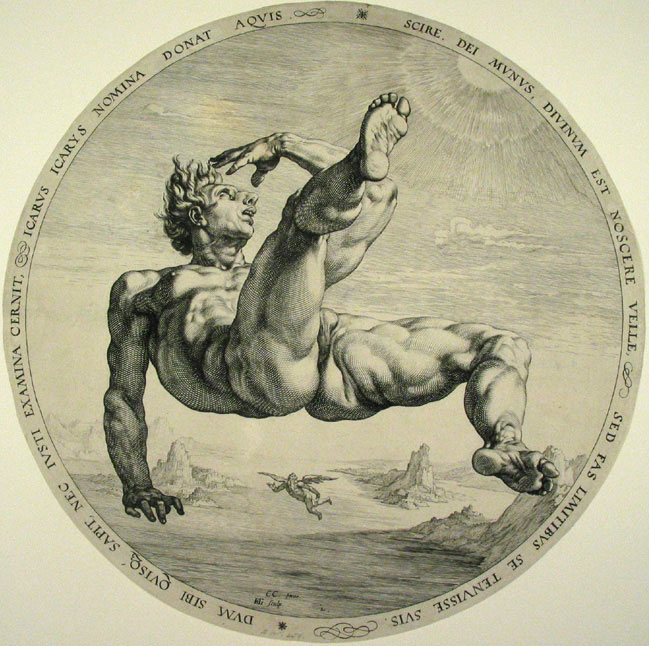
Icarus's over-confidence got the better of him


Icarus followed his father closely in the beginning, never straying too far from him. However, the adrenaline that surely must have pumped in his veins made him high and most importantly, made him forget about the dangers that was warned by Daedalus before taking on this journey. The initial cautiousness gave way to recklessness as Icarus flew higher and higher up the sky. So confident of his own ability to control his flight that Icarus could no longer hear Daedalus's warning.


Alas, it was too late. As Icarus flew higher up towards the Sun, the wax that attached the wings to his body melted and soon, he was flailing his bare hands in vain as he dropped like a stone into the sea.


Moral of the story:

If it's quite a bullish time, always be careful when the price of your stocks go higher and higher. Icarus had forgotten that the half-bull had been killed by Theseus and ignores his father's warning not to aim so high up the sky... to his own peril.

Friday, May 21, 2010

Reality check 2

This is more of a personal reminder not to over invest in the market. There's a lot of uses for my cash these days and the problem becomes a little bit more thorny when the market is showing more value these days, after crashing and crashing when the Olympian Gods turned their backs on the troubled Greece. Better do a little back-of-the-envelope calculation to ensure that I have sufficient cash for immediate use.

Here's a quick breakdown:


1. Housing - 110k

This gets a little bit more troublesome since I entertained the idea of getting a 5 room flat. This is different when I started writing about some details with regards to the amount of cash I needed. Just based on 4 room with a price tag of 400k, I need around 60k cash. If I get a 5 rm, which cost around 500k, I think I need to raise that amount to 110k cash.


2. Wedding - 32k

A few things are set in stone. I already got the suffer rings and the package, and paid for a deposit for the hotel. What's left are some miscellaneous and the rest of the banquet. For worst case, I do not assume that I can get back anything after the banquet. I know I know, I'm sick.

Suffer rings + Package + deposit = 9k
Miscellaneous = 5k
Hotel banquet = 18k


Maybe I should dangle a carrot in front of me while carrying my burden...


Drum roll please....... Ladies and gentlemen, I need 140k by end of the year. Hmm, based on what I have now and my savings target by end of the year, most likely I will be able to hit 85% of the target without any help from the market. THAT is quite reassuring. This means that I can tap maybe 10k of my reserves to average down some holdings, but when the market rebounds, I'll have to take an equivalent amount or more of my capital out. In other words, USE SPARINGLY.


Okay, by next yr, I would need to renovate and furniturised my new home. Based on the estimate I did in the previous post, I would need 50k. But that's another 365 days more to go - I'll just walk ahead by putting one foot ahead of the next. The situation might change drastically by the end of the year, so no point planning so far ahead.

Wednesday, May 19, 2010

Of rainy days

I was walking my way to work and when it was about to rain. Not just the typical afternoon showers but it was this gigantic, monstrous, end-of-the-world kind of rain. The clouds are so dense with water vapor that it seems as if the mothership from Independence Day are coming to consume all lifeforms on Earth.


It seems that I'm going towards Mount Doom


I was just enjoying the sights, sounds and smell of the impending rain. I was so suitably impressed that I took a picture of it to keep, and that's the picture you see above. Believe me, it's much worse when you're actually there because it seems that the darkness is about to touch and consume you.

However, since I vowed to myself never to be delayed by rain or shine, I just marched on.

Isn't the stock market the same? There's this big impending cloud of doom creating an overcast in the global market, seemingly about to consume it all. I've read an article yesterday saying there we should liquidate all the stocks that we have and buy gold. I do not dispute that, but I think we ought to be careful not to over-react to both market extremes. In good times, be a little bearish and hold on to your purchases. In bad time, be a little bullish and buy a little at suitable levels. Most importantly, do not let the market determine your mood.

It was 2 hours later after I left that area. It didn't rain at all.

Monday, May 17, 2010

An hour to eternity or an eternity in an hour?

I saw this panel from my favourite one-panel comic site : Wulffmorgenthaler. As always, it always inspired me to write certain things after reading it. One panel comic also makes me think a lot, despite its apparent simplicity. So this is one of the latest one from those comic genius:


We have a very short time to spend with people before we each go our own separate ways


I like this one because it reminds me that we have a short moment to spend time with each other before our paths diverge and we all go our own separate ways.

I think while it's important to delay our wants and settle our present needs first, so that we can save up for the future, we cannot forget to enjoy ourselves. While it is wise to save up for the future, it requires wisdom to decide when to live for the moment. In that sense, I need to work on the wisdom part. I mean that is the problem with savers - they tend to save too much, perhaps even accumulating money for security sake. While spenders had their own sort of problems, I guess spenders wouldn't regret their experiences at all.

I had a wonderful day with brothers and sisters just dining and chatting. I'm going to buy a kindle dx to reward myself for the insane months of hardwork and oversaving (Can you imagine that? Oversaving! Is there even such a term?). I'm going to have a planned relaxing week ahead.

I live for the moment now, at least for this week :)

I leave you with this beautiful poem by William Blake, Auguries of Innocence:

To see a World in a Grain of Sand
And a Heaven in a Wild Flower,
Hold Infinity in the palm of your hand
And Eternity in an hour.

Fair value of noble after XA

When I saw noble, I suddenly remembered that they are going to go XA today. Haha, it just slipped my mind, if not I'll have calculated the fair value of noble before today.

BTW, I chose option 3. Seriously, I didn't really choose it. I can't sell it at the price I wanted, so no choice but to hold it then :)

They are going to give a dividend of 0.036 USD per share, payable on 6th July. I didn't read closely and I suppose that the dividend is only for shares held before XA and doesn't include the new rights shares.

Here's the information required:

Dividend: 0.036 USD per share
Forex: 1.38 (assumed)
Bonus exercise: 6 for 11
Last closing on 14th May: 2.98

The fair value, defined as the price of noble after XA NOW such that there is no change in one's profit/losses BEFORE XA but after distribution of dividend, can be calculated as such:

[2.98 - (1.38 x 0.036)] x (11/17) = 1.896 = 1.90

Currently, noble is having a buy/sell bid of 1.89/1.90 and it opens at 1.90. How would it close?

Saturday, May 15, 2010

What are your reasons for having kids?

** "BIAS" is a special feature in my blog where I get to say whatever I want with scant regards for your feelings. I'm not politically correct in this feature, so go ahead, judge me."


I was talking to a few people about the cost of rearing a kid in Singapore. It dawned on me that there are so much responsibilities and duties, not to mention the financial cost, associated with bringing up a kid. That makes it strange because when I (casually) ask people why they want a kid, the most common answer is that it's the most natural thing to do. It's almost like no second thought is needed. Just snap your fingers, let's have a kid.


Not that it's not a valid reason, of course. It's just that if my kid is suffering in the world and he asks me why did I bring him here to suffer, I better have a proper explanation for it. I can't just say that it's the natural thing to do after getting married. Having said that, I think some people better not have kids, despite whatever the government is trying to promote here. Have a kid so as to have some months of paid leave? Have a kid to reduce your taxes? C'mon, it's not as simple as just a money problem, even though it can form a big part of the stress faced by parents.


It's not always so romantically happy in having a kid


I think the biggest problem is time and effort. Some people just do not want to spend the necessary time and effort to raise a kid. They just throw money at them, perhaps to replace their guilt or simply their lack of interest in having a kid in the first place. I might even think they regret the whole thing. Hey, if you are going to screw up your own life, don't screw up an innocent life.


Is my generation the selfish lot?  The generation who only cares about self-interest and throw away all the goodness of family life? I do not think so. I do not speak for others, but at least for me, I think I couldn't be more self-less. If I cannot make sure I can do my best to bring up a kid that will make the world a better place than without, I would rather not have a kid. If you went through the system while growing up and suffers through it, would you want your kids to go through the same routine? I have my reservations on that.


Having said so much, do I like kids? Yes, I do. Would I want children? Yes, I do. But it is not a light decision to make, nor will I make it a hasty one. No amount of tax rebates nor months of paid leave can push me to have a kid. Do you really want parents who would have more kids to have such incentives? If you can make the environment and social institutions more friendly towards parents, then perhaps it can push me and others to have more kids. Until then, I'm sorry, I really do not think all the campaign will work well. The pull factors are just simply not attractive enough.

---------------------------------------------------------------

As an afterthought, what about push factors? Pay triple the tax if there's no kid in the family? No buying of subsidized housing? When all the nice candies do not work, maybe the pushing and shoving just might. I hope I do not live long enough to see such acts here.

Thursday, May 13, 2010

Musing over my options for noble

For some strange unfathomable reasons, noble had decided to issue a bonus exercise of 6 bonus shares for every 11 shares held before ex date. Why 11 - a prime number? Wouldn't it round off nicer if the exercise is 6 for 10, or even 6 for 12? In order to round up nicely, investors must hold shares in multiples of the lowest common multiple of 11 and 1000 (who say maths is useless?). However, 11 is a prime number, so you must have 11 lots at the minimum in order not to end up with odd lots. If not, I think the trailing decimal places in the calculation of your bonus shares will be rounded down.


Each share is trading currently at around $3, so 11 lots will cost $33,000. Not a small sum of money at all for retail investors.


I am holding 2 lots of noble, so I'm trying to find ways to circumvent the problem of odd lots. I knew about the unit share market from poems trading platform. It's used to trade shares lesser than the board lot size of (usually) 1000 shares. I think somehow, I've got to use this feature in order not to end up with odd lots.


Here's a few ways that I can think of:


1. Buy 2 more shares from the unit share market, to arrive at a total of 2002 shares of noble before ex date. Since 2002 is a multiple of 11, I'll end up with 1092 bonus shares, giving me a total share after ex date of 3094 shares. Commission structure of unit share market is 0.28%, with a minimum of $10 charge.


Great...it's still odd...not a fantastic idea. I'll have to sell 94 shares or buy another 906 shares from the unit market to end up with nice board lot size.


2. Buy 9 more lots of noble to arrive at a total of 11 lots of noble before ex date. This will entitle me to 6 bonus lots, with a total of 17 lots of noble after ex date.


If not for the exorbitant extra 27k needed, this will be a good solution. I don't think I want to put so much into noble just so that I can skip the odd lots...bad idea.


3. Do nothing before ex date and get a bonus share of 1090 (rounded down), arriving at a total share of 3090 after ex date. Then go to the unit share market to sell off 90 shares of noble or top up with 910 shares to get 3 lots or 4 lots respectively.


The added advantage of topping up with 910 shares is that I would expect a selloff immediately after ex date as investors go to cash out their odd lots, so I might be able to buy at a much cheaper price to average down my overall purchase.


The estimated price after XA is $1.95. Assuming I want to buy 910 shares off the unit share market at 2.20 (I assume an even higher buy price at unit share market), it'll cost be $2002. Add in minimum commission of $10, it'll be roughly $2020.  The dividend of roughly $100 can be used to offset the cost of purchasing the odd shares too.


Might not be such a bad idea.


4. Sell off noble before ex date and buy it back a few days after ex date.


I like this idea a lot, so I've been queuing to sell for the last couple of days. If there really is a sell off after ex date, I'll be able to skip all the nonsense odd lots and even get a cheaper price for the shares. However, doing so, one will not be able to get the dividends. This should not be a big deal, considering how little the dividend is. I wouldn't be worried about this.


Do note that due to the low liquidity at the unit share market, the buy/sell spread can be quite big. You also have pay the minimum of 0.28% of transactions or $10, even if you buy/sell 1 share. Proportionally, the cost is higher. As such, I think no.1 is a very bad idea. I'm just wasting money doing it that way. No. 2 is out for me as I do not wish to be overexposed to noble, given my capital size.


So, it boils down to no.3 or no.4. Let's see which one the market throws at me.