Friday, May 15, 2015

Fraser Centrepoint Limited 3.65% pa bond (part 3)

Someone asked me what the returns are like when FCL do an early redemption. The bond is widely published as having a maturity period of 7 yrs, but we have to be mindful of the possibility of early redemption. I wrote more about the details here.


They have an interesting way of paying back the investor if they do an early redemption. The earliest optional redemption is on the 4th year, which is 22nd May 2019. They will redeem back at a price higher than the par value of $1. I've not seen such feature before in the bonds that I've studied. I think it's only fair to compensate the investors by giving them a higher par value for the interest payments that will be forfeited if FCL decided to redeem back the bonds early.


I did out a table to show the returns if they decided to do early redemption of the bonds. There are two factors here at work. Firstly, if instead of redeeming the bonds on the 7th year, they choose to redeem back on the 5th year, you will lose out on 2 years worth of interest payment. Secondly, because they choose to redeem back at a price higher than par, you will get a capital gain if you've bought the bond at a par value of $1. Which of the two factors will dominate?


I did out a table below to see the different returns on an annual basis.


You'll notice that it's actually quite a good deal if they choose to redeem back the bonds early. The missed interest payments is much lesser than the effect of boosting the redemption price of the bonds, netting you a return of 4.106% pa. Obviously as the date of redemption approaches the 7th year, the returns get lesser and lesser until it reaches 3.65% pa on the 7th year.


Is the chances of them redeeming early high? I'll say it's not. Interest rates should go up in 7 yrs time. Unless they do not need the money for working capital or have found a cheaper source of financing, I think they will want to drag out the debt to its full term of 7 years. Anyway, for a good bond, you'll want them to continue paying you forever!


What's the implication of this? I think even though the possibility of them redeeming the bonds is low, it still serves as a value point where the price of the bond will hover around. On May, 4th year of the bond, the price of the bond should be lower than 1.01825 and on Nov, it should be less than 1.014600. It doesn't make sense that the market price of the bond is higher than the possible redemption price at that point in time. But 4 years is a long time...who knows what will happen then? I'll still suggest that whoever wants this bond must be willing to wait out for the full term of 7 years, if not, you shouldn't be in this.


The last post I'll do for this FCL bond series is probably on the results of the balloting.

Here's the rest of the post:

1. FCL bond (part 1)
2. FCL bond (part 2)

Thursday, May 14, 2015

Fraser Centrepoint Limited 3.65% pa bond (part 2)

This is the second part of the Frasers Centrepoint Limited 3.65% pa bond. The first part is here. I managed to get a copy of the prospectus and read it. Hence, for ease of reading, I summarised the main points of the bonds again here, with some additional information:

-------------------------------------------------------------
Duration: 7 years until 22nd May 2022. 
Option for early redemption: Earliest date for optional redemption is 22nd May 2019 and on each interest payment date thereafter
Interest payment dates: 22nd May and 22nd November. First payment on 22nd Nov 2015.
Coupon yield: 3.65% pa

Open for subscription: 13th May 2015, 9 am
Closing: 20th May 2015, 12 noon
Minimum amt for retail: $2000, with integral multiples of $1000 thereafter

Retail (public tranche): $150 million
Institutional tranche: $50 million (closed!)
--------------------------------------------------------------


I decided to do a FAQ of questions that I had gathered from interacting with others on facebook and the comments from my previous post. The information is laid bare here. It's up to you to decide if this is a good deal or not and I won't answer questions regarding whether it's suitable for you.


1. Can we use CPF to apply?

No

2. Can we use funds from Supplementary retirement scheme (SRS) to buy?

There are two stages in this. Firstly, there is an initial offer of the bonds, which is what they are doing now. Consider this the same as the IPO of stocks. After this initial offer, the bonds will be listed on SGX, where you get to buy at whatever market price the bond is offered.

You cannot use SRS funds to buy this bond at the initial offer stage. However, you can use funds from SRS to purchase the bonds from the market after it is listed on SGX.

3. How long do you have to hold it?

7 years, if you want 0% chance of losing your initial capital. There is a slight complication in the redemption date, so please read point number 4 below. You can sell it anytime like stocks on SGX since the bond will be listed there, and you’ll be subjected to the market price of the bonds then. Hence, you might suffer a loss if you sell below $1 or book a profit if you sell above $1. Brokerage fees and comms apply too.

4. Can the issuer redeem the bonds earlier than the maturity period of 7 years?

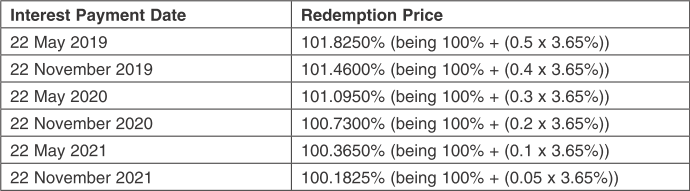
Yes. In the prospectus, page 47, it is stated that the issuer can choose to redeem back the entire tranche but not in part, of the bonds starting from 22nd May 2019 (inclusive), on 22nd May and 22nd Nov each year. They will have to give 1 month to 2 months of notice to the holders if they choose to do so. Furthermore, should the issuer choose to redeem early, they will not redeem back at par value of $1.

The table, also taken from page 47 of the prospectus, state the redemption price of the bond in % of the par value of the bond at different possible redemption date starting from 22nd May 2019.


For example, if they choose to redeem on 22nd May 2020, which is earlier by 2 yrs from the maturity period of 7 years, they will have to redeem back the bond at 101.0950% of the par value of $1, which is $1.01095.

5. When are the interest payment dates?

The bonds pay out interest twice a year, on 22nd May and 22nd Nov each year, from 22nd Nov 2015 (first payment) to 22nd May 2022 (last interest payment). 22nd May 2022 is also the maturity date of the bond

6. What’s the par value?

The par value of this bond is $1. When it’s listed, it will come in board lots of 1000 ‘shares’. Par value is what the price of the bond is when it is first issued out, and also the price that the issuer will redeem back from you, regardless of market price, at the end of 7 yrs on 22nd May 2022. There is a slight complication, so please read point number 4.

7. What are the returns like?

If you bought the bond at par value of $1, and hold it for 7 yrs, you will be guaranteed your capital. On top of that, you will have interest paid to you at 3.65% per year, paid out twice a year.

If you bought the bond on the secondary market after it had been listed, the returns will then depend on the market price of the bond. If you buy it above par of $1, you will be guaranteed a loss upon maturity of the bond, because the issuer will redeem back the bond at $1, regardless of how much you bought it. On the other hand, if you buy it below the par value of $1, you will be guaranteed a profit at the maturity of the bond. 3.65% pa yield is only for a par value of $1, so if you buy above or below par, the yield will decrease or increase proportionally. For bonds, it’s better to calculate the yield to maturity if you buy it at any market price other than the par value, and at any other times other than the initial offer of the bond.

8.  How does the bond work? Can you explain how the process is like for us to be paid?

If you’ve experience in buying shares, this analogy should clarify your fears. If a company wants to be listed on SGX, they will do an IPO for investors to get in. So investors will buy at the IPO price through ATM or internet banking. If it is oversubscribed, the issuer will do balloting, so you might not get everything that you bid for. They will have an allotment table to tell you how many lots of this IPO you get based on how much you want to subscribe.

After this IPO is over, the company becomes listed on SGX and you can buy/sell it, subject to market price. The shares certificates are kept in the CDP account, which can be linked to your bank account. If the company gives dividends, they will check if your name is under the registrar by checking up the CDP account. If it is, then you’ll be entitled to the dividends. Once the dividend is paid, it’ll be transferred to your bank account tied to your CDP account.

If you sell the shares, the share certificates will be transferred electronically to the buyer after a few days. The money you get from selling it will be transferred to your bank account tied to your CDP account again.

That’s for shares.

For bonds, they will also do an IPO. The ‘IPO’ price of the bond is called the par value. Investors participate in the bond IPO by going to ATM or internet banking to subscribe for it. Again, if the bonds are oversubscribed, the issuer will do balloting so you might not get all that you subscribed for. The allotment will be based on a table just like the IPO of shares. I will highly suggest applying odd and not even number of lots if you want more.

After the IPO of the bonds is over, the bond will get listed on SGX and you can buy/sell subject to market price. The bonds are in board lots of 1000 ‘shares’, so the minimum you need to buy is $1000 (exclude brokerage and comms). The bond certificate is also placed in your CDP account and when interest is paid (twice yearly), they will check if your name is under the registrar by checking your CDP account. If you have the bond certificate in your CDP account, the ‘dividends’ of the bond will be paid to the bank account tied to your CDP account.

Should the issuer redeem back the bonds, the money that you get is again transferred to the bank account tied to your CDP account.

9.  Is it really guaranteed?

The guarantee of a bond is only as sure as the solvency of the underlying issuer. You will have to do your own judgement whether Fraser Centrepoint Limited will still be around in 7 years. If you think they have problems surviving till 2022, then it's better not to buy the bond.


Update: I did a post on the returns that you can if they choose to redeem it early on the 4th year. I'm just expanding a little more detail regarding the possibility of early redemption. Please read it here.

Wednesday, May 13, 2015

Frasers Centrepoint Limited 3.65% pa, 7 yrs bonds

I was alerted to a facebook feed regarding this year's first retail bond launch. This is more exciting that the savings bonds thingy to me.

Frasers Centrepoint Limited (FCL) is offering a bond, open to both retail and institutional investors. The terms of the bonds are as follows:


Duration: 7 years
Coupon yield: 3.65%
Open for subscription: 13th May 2015, 9am
Closing: 20th May 2015, 12 noon
Minimum amt for retail: $2000, with integral multiples of $1000 thereafter

Retail (public tranche): $150 million
Institutional tranche: $50 million

This is likely the first bond I've seen in which the retail tranche is bigger than the institutional tranche. This will create a lot of good will for FCL. The usual way to apply is like applying for IPO, which is through participating banks like DBS, POSB, OCBC and UOB ATMs. Take note that you need to put in a min of 2k, with subsequent addition of 1k thereafter.

I suspect this will be taken up like hot cakes. I will personally bid a big part into this, if not for myself, it's also that I can 'sell' some to my parent's retirement portfolio that I'm managing for them. This is quite likely going to be traded in the open market like other bonds. There's a lot more details that I wish I can elaborate, but these details are found in the prospectus that is lodged in Opera MAS site. It's down now and I can't access it. I'll do another post on it soon.


Update: Here's the second part of the FCL bonds. There are very important information that I added after reading through the prospectus, including the optional redemption. Please do read it.

Monday, May 11, 2015

Why am I interested in personal finance?

I thought this is a more relevant question that we can answer for ourselves, instead of why other people are not interested in it. As personal finance bloggers, we tend to think that the people from the other side of the fence are not as enlightened, at least in financial matters, as us. I guess those who are not interested in such matters will likewise make similar stereotypical viewpoints regarding these people are are obsessed over money. So I think the best way to convince is to let people hear your story, and how your personal experiences make you who you are. Hence, let's start with me.


Primary school:

When I was in primary school, I was just a normal kid who receives pocket money from parents. There's no entrepreneurial streak in me, as you would typically see in the childhood of people who are great business people. They would have started trading cards or doing some basic buying/selling right from the start. That's not who I am. I did receive a weekly pocket money though. I know some of my friends are getting money from their parents as and when they need to buy stuff. Some received money daily from their parents, but somehow mine is done on a weekly basis. On hindsight, this taught me a lot of knowledge regarding budgeting, that would have been completely missed out by folks by received their pocket money daily or on a needs-basis.

Verdict: I'm not financially acute then. Quite clueless regarding money.


Secondary school to JC:

The weekly pocket money upgraded to a monthly one. And that covered everything single thing - from bus stamps to food to entertainment and books. It wasn't a lot, though I can't remember how much. But thankfully, there isn't a lot of distractions anyway. The monthly pocket money that covers every single thing, means that I have to be a lot tighter in my personal accounting. I've to make sure my money last the entire month. Again, there's no desire for me to work for more money and I did zero vacation work in my entire secondary to JC life.

Verdict: I'm still not interested in money, though the lessons in budgeting due to the monthly pocket money is actually quite a good start to teach about how to maximize your output given constraints in your resources.


Army:

That was the time I stopped taking pocket money from my parents, but instead gave them half of my allowance as a pocket money to them. The money back then wasn't a lot. It's about $360 towards the end of my 2.5 yrs, which means it's substantially lesser in the earlier part of my NS days. I spent very little amount in the canteen. I doubt I can afford it, so I always visited the cookhouse for the free food, no matter how sucky it is. If I can do extra duty to earn money, I guess I would at that stage. But my camp do not practise that sort of thing, so my NS allowance is all that I have to survive. Again, not much spending because I don't think I could afford it, though I remember I bought my first CD player from Sony from my hard earned IPPT and marksman award.

Towards the end of the whole army, I saved about 5k from the lot. It's the most amount of money that I have in my entire life, at that point in time.

Verdict: With more exposure to consumerist lifestyle, I realise more and more the importance of having money. I was constantly reminded of the lack of money. I couldn't spend all that I want and expect my parents to bail me out of my debts. The responsibilities of giving money to parents taught me how important it is to pay your salary to something important first, before you proceed to spend it. Again, monetary constraints is the most important lesson to teach regarding budgeting. In army, I learnt how to set aside money for something important. In this case, it's giving money back to my parents.


University:

With more exposure to more social life and a introduction to a young adult socio-sphere, the need to spend more money on clothing and entertainment increases. And hence for the first time in my life, I had to work during the vacation. It was cheap, uninspiring kind of work. I remember that I had to complete 30 mins of work in 1 full working day, dragging longer than necessary because otherwise I had nothing else to do. It was just unbearably painful earning that miserable $5-$6 per hour for 1 month. I also had my first handphone, which I paid out of my own savings. The monthly plan is also paid for by me, using the monthly pocket money given. Thus, I can only afford those free $0 handset that comes with the plan. I remembered at that time, I wish I can start work sooner so that I can start earning my own keep.

Dating is also incredibly expensive. An average restaurant meal will mean I have sacrificed about 1 week of school canteen's meal money. That means I couldn't afford it. That applies to my then girlfriend (and now, wife) too.

Verdict: While I can work my life within monetary constraints in the past, it's getting harder and harder because you need money to have a normal kind of social life. I also realised how expensive dating can be - that need to impress and show generosity. Income needs to be raised because there's only so much things you can limit yourself from buying.


Working life:

For the first 2-3 years, suddenly I have this huge income coming in that I never had in my life. I proceeded to spend it, perhaps partly to compensate for the 'sufferings' I had in the earlier part of my life. I don't recall that I have much savings, if at all. But at least, I didn't bust my budget at all. Even with credit cards, the training from the earlier part of my life kicks in. I paid my bills on time, took advantage of the rewards granted by the usage of the card, and never exceeded more than what I earned.

But I wasn't going anywhere.

During the bull market phase, someone asked me to open a brokerage account together so that we can learn about the stock market. We heard that we can earn a lot of money from there. From there on, it was a roller coaster ride in the stock market. I wrote my journey all over the blog so I won't repeat it here. But after losing and winning money, it makes me want to find out more about it, so I read and read and read. I started reading 52 books a year to cram in all the information available so that I can make more. Those books are initially almost all personal finance, accountings, market analytics based.

It was during that period in time that I started my blog also, which is one of the smartest thing to happen in my life. It gave me a chance to meet like minded people and form an environment in which financial success can take place. You can't expect to fly if you keep mixing around with chickens, so they say. It's this immersion in an environment where I'm constantly reading financial news that makes me want to keep on reading and learning all that is about the money game. You start to form models of people whom you can emulate, and you realise that hey, it's possible to reach a certain level of financial enlightenment. Others can do it, so can I. That belief is very very powerful - that others can do it and so can you.

That's the pull factor. There's also a push factor towards learning more about personal finance, and that leans towards the darker side of motivation.

Sometime during that period, I felt that I was sold a big fat whole life plan that it constantly eating at me. I felt there's something wrong about it but I couldn't figure it out. I was that clueless in financial matters. That feeling eventually accumulated until I was so fed up, I need to research and read more about insurance. That started the whole ball rolling with regards to personal finance. There's a lot of incentives for me to find out what the hell is wrong with my feelings with regards to that big fat whole life plan I was sold to. On hindsight, I took personal responsibility and didn't blame the agent. Though it's a painful experience, it literally KICK start my ass to learn more to cover up my lack of knowledge in this area.

Also due to the nature of my job, I have to be my own HR manager and accountant. I have to keep track of where my income is coming from to see how much money I'm making per month. I didn't keep track of my expenses though because I thought it'll be too troublesome. I don't want to be fixated on money. Panzergrenadier, a blogger, introduced me to this book called "Your money or your life" by Joseph R. Dominguez that literally changed my life. In the book, the author talked about tracking your expenses. I wanted to start tracking for 1 month, but it gradually became 6 months, then 1 yr. I've been doing it since 2008, always taking care to update my spreadsheet and improve my tracking. Basically I'm hooked on improving my own personal productivity, and that includes productivity in terms of spending money.

On-going verdict: It started from greed in wanting to get more money, then the winnings/losses make me want to find out more about money. I would say that the fact that my skin is involved in the money game makes me want to find out more about the rules and how the money game is played. If there's no skin involved, we're just armchair critics. Of course, my childhood training in working tightly within budgets makes it one full package. Immersion into the conducive environment is extremely important too. If you want to be financially acute, join such a group in facebook or blogs. It's like learning a language, the more you read and hear, the better you'll be.

We have to learn how to unwind our money journey we had in our childhood. For mine, it's about learning how to relax and spend more. For others, it might be the complete opposite. I'm still learning how to relax a little and spend on things I should spend on, instead of living in a survival mode that I had been in the earlier part of my life.

Thursday, May 07, 2015

The price and value of deprivation

Price is what you pay for and value is what you get. Usually this is applied for things that you purchase. But I guess it's equally applicable to things that we choose not to purchase.


If we choose not to buy something for $10, then we would have saved that $10. That's the price we had saved. But did we also correspondingly lost $10 worth of value? Rationally, we should choose to deprive ourselves of something if we can lose a value much lesser than the price of the goods or services that it costs. However, just like when we purchase things and we tend only to look at the price, we also NOT purchase something by only looking at the price, and not the value of the goods that we cannot enjoy.


Let me some examples. In my crazy 50k saving days, I used to scrimp and save on food. I would choose not to eat even when I'm hungry just to save a few dollars. Or, I'll buy low quality food that isn't healthy but is cheap. The price I've saved from not buying better quality food is perhaps a few dollars, but the value I lost is definitely more than the price I saved. Who knows what kind of long term health effects I could get from this? How about shoes? I used to buy cheap-skate shoes that wouldn't last me 1 month. Compared to a better quality branded shoes that cost up to $150 a pair, I might have saved $100 or more dollars. But the value I lost from not purchasing a better pair of shoes and not enjoying them, and even have to keep hunting for a pair constantly, is much more than $100.


Is it worth it?


That depends on where you are in your life stage. When your human asset is low, you have plenty of time and energy but likely have very little money. So, we don't mind going all the way out to save that few dollars. Of course it's worth it to save a few dollars. But when our human asset is built up to a point where we would rather spend money to save energy and time - those two most important and finite things that each of us have, then it's definitely not worth it.


Having said that, do know that while price is uniform, the value that we derive from the same goods and services is different for different people. To a foodie, spending $120++ a meal on an atas Japanese Omakase is a experience well worth the price. The value derived for that foodie is much more than the price of $120 paid. To deprive that joy of eating that meal can save him $120, but he correspondingly lost much more than $120 (If he eats Sucky Sushi, he will lose perhaps $10,000!). To a person who neither appreciates nor care about authentic Japanese cuisine, eating a $120 or a $10 Japanese meal makes no difference. It might not be worth it to spend that money.


So, spend on things you truly enjoy, regardless of how other people think. You are not others, and the value you lost by depriving yourself of something, just to save the price of paying for them, is not worth it, at least to you.


My friend Rolf will said this very aptly - Know yourself.

Sunday, May 03, 2015

Is financial freedom a competition?

Recently, I saw this article that resonates deeply with me. It's about how we shouldn't be jumping from the corporate rat race to another unlikely race - that of financial freedom.


It's interesting to think of financial freedom as a competitive sports. Not too long ago, there's this massive spontaneous competition, likely sparked by the Sunday Straits times section, where 'competitors' take part to see if they can hit 100k by age 30. Why 100k? Why age 30? Asking these questions is like asking why we have to do a 100 m sprint, or why certain sports have an artificial demarcations of people above and below 60 kg. It's just arbitrary.


I think the most important essence of financial freedom is the freedom from thinking about money. And since the pursuit of money takes up a majority of our lives, freedom from money also gives us the freedom of time. Deconstructing financial freedom is important, because ultimately, after chipping away all the pieces that are not David, we end up with a splendid Michaelangeloestic piece of sculpture.


Thus, to understand what is financial freedom, we have to know what is not financial freedom. It's not to see who saves the most. It's not to see who gets the most passive income. It's not to see who can survive the longest with the least resources. It's not about living a frugal life of extremes and forgoing the things you really want because others are also not doing it. If we remove all these things that are not financial freedom, what do we get? We get a life where we're not concerned with the pursuit of money anymore. We also get a life where we stop the incessant comparison with others.


Now, I get it that you need benchmarks to pace yourself and know when you're slacking off. But the benchmark should be motivational. Motivation is a good emotion. Jealousy and envy isn't. If you can benchmark other people's achievements without the negative emotions, then I think you already have the financial freedom mindset. If you see someone having a much higher passive income than you, or having a higher savings ratio than you, and you start tearing down his achievements by looking at how his parents helped him or how he is born with a silver spoon, then you're still trying to win in a competition that you had subconsciously taken part.


If in the pursuit of financial freedom, you're still bounded by the rules of the rat race, then what had changed? You're still a competitor, even though you're taking part in another event.

Tuesday, April 28, 2015

Fooled by randomness?

I've ever seen a student who is delusional. When he gets right, he'll claim that he's smart and clever. Especially if he didn't put in the effort compared to those 'muggers' who studied all day and night but scored worse than him. When he gets it wrong, he'll blame circumstances (oh he's sick, the paper is too hard, he's studying for another subject etc). What I think is that he didn't study at all, and it's just luck that got him good results, or luck that got him bad results. Basically, it's not consistent.


There are people like that when they participate in the stock market too. Except that they research deep into the company and bought it, and when the bullish market brings everything up, they mistook it for skill. These are the people whom you see screaming x% returns in y days. But when the market turns down, will they blame bad luck instead? People should read Nassim Nicholas Taleb's Fooled by Randomness. It's a good thesis on how we are fooled by seemingly random events, taking those good events as your own achievements, label it as 'skill' while discarding those failures and call it 'bad luck'.


I think it's useless to think whether your method of participating in the stock market is successful if you didn't test it in at least one cycle of bull/bear. Even then, I can't be sure if the method is successful. It's always work in progress and earning in progress. What the market provides, it can just as easily take it away. Don't ever think that because you reaped so much from the stock market, you're a smart market participant. The market might be starting the next round of fighting while you're still celebrating your victory from the previous round.


It's not easy behaving with the carefulness and humbleness of a newbie when you're no longer one. That's the lesson we all have to learn, if we want to be a long term survivor.


Saturday, April 25, 2015

The conversation between a caterpillar and a butterfly

Somtimes, the strangest tale comes from the inspiration of fellow bloggers. In this case, SMOL's post on butterflies got me thinking. I'll be the first to admit. This short story below is adapted from another book that I read.


Emile the butterfly floated down to the Francis the caterpillar, who is her friend. But Francis didn't seem to recognise who the butterfly is. I mean, how could anyone blame Francis? Emile looks so beautiful and was floating with the wind! Nothing could be more different than a hairy caterpillar!

"Follow what I do, Francis! You'll be free from your earthly bounds! Oh goodness, why can't Francis understand what I'm saying?!" Emily nearly screamed in exasperation.

Just a few days ago, Emile said goodbye to Francis because she's going on a personal journey.

"Where to?" Francis asked sadly. "Can I tag along please?"

"No, Francis," Emile replied firmly. "This is a personal journey. And I have to go alone. Sorry."

But Francis didn't let Emile go alone. He followed her quietly, and saw Emile crawling up a branch solemnly and started pulling white threads all around herself, until she was fully covered with this white silky tent. Francis was still faithfully waiting for Emile to emerge out from her strange retreat, believing that she just needed some time off for herself. He was there waiting, every single day. But one day, seemingly overnight, Francis noticed that there is an opening at Emile's silky tent. Cautiously, Francis crawled near to it to check if Emile is finally out of her retreat.

There's nobody around.

Except now there's a strange colourful winged creature near Emile’s empty tent. It's floating near to Francis, seemingly trying to tell him something. It landed near to the ground at Francis, and then floated to Emile's empty tent, then again to an empty spot on a branch. This creature repeated the same pattern again and again.

-----------------------------------------------------------------------------------------------------------

This is how I 'saw' the conversation between the caterpillar and the butterfly. How would the story end? Would the butterfly give up and join the rest of the butterfly? Would the caterpillar give up and grieve for his lost friend? Or would the caterpillar have an epiphany that he also had to follow the unknown and uncharted path that his friend Emile had hinted him?


Some things just cannot be taught - it had to be experienced. If you had not experienced the transformation, you wouldn't be able to speak the same language as those who had been metamorphosized. You can show others, but you cannot make them change. And yet everyone has the potential to be transformed, if you'll only want it.

Thursday, April 23, 2015

Saying 'I CAN'!

When I first started working as a full time tutor 10 years ago, I had many self limiting beliefs. Looking back now, it seems rather ridiculous that I had those beliefs, but I remembered that these beliefs were very real and very limiting to me at that point in time. Let me list down some of them:


1. No working during standard meal times

I thought that I'm normal and I should have a normal working hours. I assume that students will also have fixed meal times, so I didn't want to schedule my lessons around 12 to 130 pm and 6-8 pm. It was such a limiting idea, because it restricts the number of lessons, and hence working hours, that I can do. It took me about 2 years to fix this limiting belief. After that, I'm all set. I can have my dinner at 1030 pm, which is what happened yesterday night after my lessons. Or I can eat my lunch at 1030 am. Makes no difference to me, though I try not to eat my dinner late at night because it'll disrupt my sleep routine.


2. No work during public holidays and on weekends

Again, when I first started, I thought I should have a normal working hours with normal social life. This is one of the first self limiting belief that I discovered I had, and the first one to go. It just wouldn't do if I can't work on weekends and public holidays, as I know I wouldn't be able to clock enough hours to make a reasonable pay working as a full time tutor. These days, public holidays and weekends are my busiest, as it should be.


3. I can't teach what I didn't know

I used to reject assignments that I deemed are beyond me. I started teaching secondary school Emaths. Then someone asked me to teach them Amaths, so I was very reluctant to do so because I'm not confident. But confidence comes from preparation, and the fact that I can work harder and longer and do more than my tutee. It's a mind blowing principle. If you're not confident to teach, prepare harder than your students. They cannot know more than you do, otherwise you're not doing your job. So one thing leads to another, I'm soon teaching the entire spectrum of secondary school subjects, jumped to Primary school subjects, next to A'lvl, then IB, and after that it's poly engineering modules, followed by business statistics modules and then to university's statistics and financial modules.

If I had listened to my inner voice not to step outside my comfort zone, to only teach what I know, then I wouldn't have expanded the repertoire of what I can teach. I wouldn't be able to learn independently what I needed to do to teach someone.


4. I'm not worth the fees

I'm constantly upgrading my self worth. Funny isn't it? Sometimes I still think that people shouldn't pay me so much for tuition. I think my tuition fees is as high as my own self worth with regards to my career. I started off with $22/hr, and every other year I'll have to reason to myself whether I added value to others before I can increase it. There's a mental block inside me to ask for higher fees. And I realised not every tutor has this mental block. It's a confidence issue, I believe. Some undergraduate fresh from A'lvl charges even higher than what I charge as an experienced full time tutor. They can do it, but I can't. This is something that is still work in progress.


The very first step to remove self limiting beliefs is to identify them. It can be so pervasive and ingrained that you do not even think of it as a self limiting belief. It's the ability to hide among your consciousness that causes these beliefs to become your reality. Let's say you want to save money. Perhaps these are the self limiting beliefs that you have:


1. I don't earn enough money like the rest, so how do I save?

2. I'm not like the rest - I've a family and a lot more commitments, how can I compare with them?

3. I need my car (or coffee, or bags, or gadgets, or whatever other material things). Life's not worth living without it. What's the point of suffering so much to save?

4. YOLO (you only live once), might as well enjoy while we can.


Everyone of these is a self limiting beliefs. If you believe it enough, they will become a reality. If you don't question your basic assumptions about how you live your life, then how can you change it? Start by taking charge of your life. Be open to changes and just say YES first. There's enough naysayers around you who do a very good job of saying NO, so be the first to say YES to yourself. Give it a go...what's the worst that can happen?


At most just F.A.I.L. That's just a First Attempt In Learning.

Thursday, April 16, 2015

You see what you want to believe

This picture is too important not to share it. A friend posted on facebook a long time ago and I was immediately struck by it. Once I recovered, I've saved it and kept it until I saw it recently again. The message behind the picture is as true now as before.


I think I shouldn't spoil the reflection part for you. Different people will see touch different parts of the elephant.

Wednesday, April 15, 2015

As strong as the obstacles we're facing

When I was in army, I got a silver for IPPT, so I thought I'm very strong. Until I tried to do a pull up 15 years later and realised I couldn't even do one. And so I trained hard for the past few months and now I managed to do 6 perfect form pull ups, then I know that I am strong.


Until I tried to do a dumb-bell lift for 10 kg, and realised that I couldn't do it properly and effortlessly. And so I trained every other day, lifting progressively heavier and heavier weights from 8 kg until I can do 10 kg effortlessly without feeling my muscles screaming. Then, I know that I am strong.


Until I tried to do 3 sets of 10 push ups yesterday, and realised that I couldn't lift myself off my bed this morning. My whole arm is like lead. And so I know what I will be doing in the next couple of months to get stronger.


You'll be surprised how similar other aspects of your life is with regards to what I've described earlier. In life, it's important to be progressively defeated by bigger and bigger challenges. Being good in one thing doesn't mean that you'll be good in another. There's domain specific knowledge that's not really transferable to another domain, so it's important to stay humble and keep improving.

Saturday, April 11, 2015

The inattentive one

She walked into the classroom and the class quietened down. She immediately went to the whiteboard, and scribbled down the homework for the day and tasked the children to do them right away.

Except that he didn't. He was just looking everywhere except at the textbook. She can see his eyes roaming around the classroom. Sometimes they will settle on his classmates, sometimes the interior of the classroom but often they are looking out of the window. His eyes also seemed to follow where she went, like she's the jailor of the prison he's incarcerated in. Once a while, he'll flip the pages of his textbook. But the boring texts always manages to push him away into the welcoming arms of the distracting world.

With fists clenched, she called his name out. She scolded him in front of everyone. She insisted he stay back after her lesson so that he can properly impound onto him the seriousness of his transgressions.

Bell rang and school ended. Everyone packed up their school bags to leave this high noon showdown. The ceiling fan whirled in grave anticipation. Even the chirping of the birds came to a halt outside the window.

He walked up to her and stood there, deathly still. She scolded him and threatened to call his parents. But still, he stood there, not defending himself for his actions.

"How dare he challenge me with this passive aggressive attitude! Still no remorse! ", she thought. She can feel her heart pounding heavily.

"Sorry teacher...", that's all he managed to say.

This is all quite strange for this troublesome kid. Going to the discipline master's office for counselling is a common occurrence for him. Why is he so placid today?

Still not satisfied with him, he punished him by asking him to stay back for another 3 hours for detention, so that he can reflect on his mistakes. With that, she dismissed him and he began to walk out of the classroom without a word.

Is he so hardened that he didn't even bother to reply? Why is he not doing his work? Partly to start a new round of scoldings and partly out of curiosity, she demanded his replies just before he is about to disappear behind the classroom doors.

"I don't wish to upset you, ma'am, " he answered softly.

"I saw people passing the answers of the homework on pieces of paper around the class and was deciding if I want to tell you or join them."

"I saw one of the fluorescent lights in the classroom is of a different shade of colour than the rest. It's a bit more whitish compared to the rest. They must have used a different wattage. The lights cast strange overlapping shadows on the floor, sometimes growing in length and sometimes shortening and I was fascinated by it"

"I followed the smell of rain on grass through the windows and I was so excited because there's a rainbow arcing across the fields! The birds are chirping as if to beckon everyone to look at it but everyone seems too busy to notice it,"

".. and ma'am, I don't want to upset you because since the beginning of this week, you're not wearing the ring that you've been wearing since you've been teaching us here. "

She cried.

Her tears are not for herself alone - the teacher who only pays attention to the wrong done by the boy and nothing else. It's also for the inattentive boy in class who pays attention to everything else.

Saturday, April 04, 2015

To create a masterpiece

Michelangelo is a great sculptor. His great masterpiece is David, a sculpture of a person which is so lifelike that it amazes anyone who had glanced upon it.

One day, he was asked about his great masterpiece and how he had managed to carve a lifeless rock into something that is so lifelike.


He said this, "It's easy. All you have to do is to chip away everything that didn't look like David."

And so that is the way to create life's masterpieces. How to find the meaning of life? Simply remove the parts that is not meaningful to you. How to create a great blog post? Remove the parts that are not great.

Sounds like a stupid obvious statement, isn't it? But I think if you sit on it and mull over it, there's much wisdom in those few simple words.

Friday, March 27, 2015

To him whom you love to hate and hate to love

It hadn’t always been a smooth relationship.


When I was young, I respected him as I would to any adult, especially one who so crucially shaped Singapore the way it is today. Back then, he was still the Prime Minister of Singapore and I remembered fondly the crowds that stood up and cheered loudly for him whenever he arrived on national day parade every year. I must be one of the last batches of people who had him as the Prime Minister of Singapore before he handed it to the next.


Like a teenager, I went through a period of rebelliousness. That is the phase where I learnt and read a lot more things about the kind of ‘fixing’ he did to his political opponents and how he bulldozed his way and imposed his strong obstinate views on things that matters to him, and to us. Hate might be too strong a word to use, but if all the adjectives in the world can be split up into ‘nice’ and ‘not-so-nice’, I would certainly put my relationship with him then under the same category as the latter.


That phase lasted quite a while, until I started working in the society for a few years. You look at the things you rebelled against in the past, and you shrugged. You go to another country and then you look at your own country. You noticed things that are bad in your own, but there are things that did go right too. In the end, are there more rights than wrongs? At the time when it matters, would anybody who is made of lesser stuff be able to achieve what we had for the past 50 years? Nobody can answer that, but I believe he did what he could at that point in time to ensure that we survive. Philosophy can wait till the war is over. Until then, a strong leadership using more sticks than carrots will have to do.


I started to forgive him. He did his best and nobody could have asked for more. When rumors of his many ‘deaths’ circulated around in social media in recent years, I thought to myself that they should just leave him alone. When his wife left, I didn’t see a politician out to dictate his views on everyone. What I saw was a father, a grandfather and a lonely husband, something everyone can certainly relate to.


In life, he is feared. Oh, how greatly he is feared! It's his intense stare, or maybe it's his no nonsense way of cutting to the heart of any problems that sends the shivers up anybody who dares to face him. He cares not for any public opinion and will gladly be the lone voice of truth, even if it’s his own version of truth.


And in death, he is loved. Oh, how deeply he is loved! It’s his soft touch on anything pertaining to Singapore, even if it’s a trash that floats down the river. It’s his Red Box that is filled with all the necessary documents and observations he had made, marking the start and the end of each day with his country in his thoughts.


Why couldn’t all these human side of him be shown earlier? That would soften his harsh image tremendously. But perhaps this is not what he wants after all. With his boxing gloves ever ready, he would gladly step onto the ring to take on whoever dares to fight Singapore. Maybe, that is how he wants to be remembered as – a fighter who fights for his beliefs.


Like I’ve said, it’s not always a smooth relationship. Like a kid, you love your parents, and then rebel against them and hate them, before growing up to forgive them because you know that they tried their best in their own circumstances that you might never understand. And finally, you came to love your parents and you remember them for all the good things that they had done for you.


All the juicy bits of a roasted chicken that they insisted you eat because they prefer to eat the bonier parts. All the last piece of each year’s log cake that they insisted you take because they were too full. All the understanding and forgiving they had shown you, even when you broke their favorite vase and forgot their birthdays.


All the things we took for granted.


Sleep well, Ah Gong, and thank you for taking care of us when we’re too young to understand what’s at stake.

Monday, March 23, 2015

Algorithm to find the Chinese horoscope sign of any year

After learning about modulo function, I finally have an elegant algorithm to find out the Chinese horoscope sign based on the year of input. It came from an innocent enough question from facebook - what's the value of m+n, such that 2012^m and 2012^n has the same last 3 digits, if m and n are integers are m is greater than m?

I did a bit of exploring and found out the answer by doing it through excel. Then I discovered the modulo function, and then I also discovered the theorem that if a = b (mod m), then a^c = b^c (mod m). It's vastly different from learning about mathematical theorem through books or teachers, and learning about it through discovery. The joy of solving the puzzle is immensely satisfying.

But first of all, what's the modulo function?


Modulo function has two inputs i.e. MOD (a, b). Basically the function just returns you the number that is the remainder if a is divided by b. For example, MOD (12, 3) = 0 because 12 divided by 3 gives no remainder. MOD (12, 5) = 2 because 12 divided by 5 gives a remainder of 2.


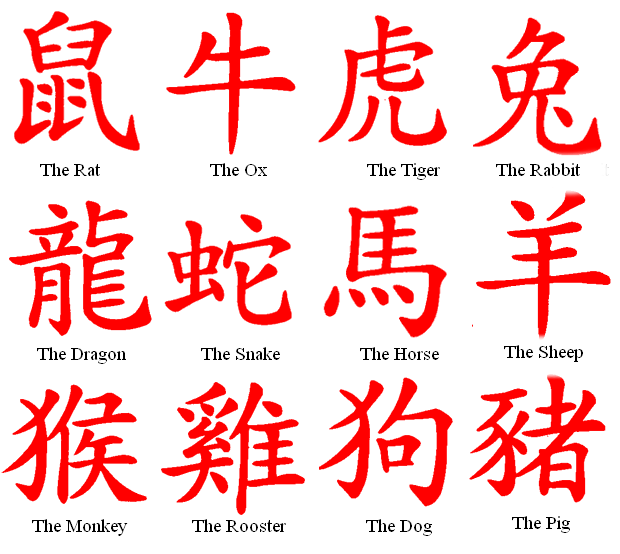
My algorithm to find out the Chinese astrological sign is to take the input year, subtract 4 to it, modulo it to 12, then add 1 to the result. You can use it on excel.

i.e. Let x be the input year

y = MOD(x-4, 12) + 1

The output y will give you a number ranging from 1 to 12, so

1 is rat,
2 is ox,
3 is tiger,
4 is rabbit,
5 is dragon,
6 is snake,
7 is horse,
8 is goat,
9 is monkey,
10 is rooster,
11 is dog and
12 is pig.

To illustrate this, let's try out the year 3194:

So in the year 3194, y = MOD(3194-4, 12) +1 = 11, so it’s the year of the dog.

My Two Rolex

I never wanted to have a Rolex. But today I realised that I have not just one, but two! Two Rolex right in front of me and I didn't know!


A Rolex watch is a status symbol, a hallmark of those who had arrived. But I think I'll never ever buy one. I prefer my time pieces to be digital, so that time telling is precise. I also need my time pieces to have a stop watch, water resistant, have night light and able to tell the date accurately. I'm slightly allergic to leather and dislike those thick metal straps because the weight will cause the watch to slide down my bony wrist. All these restrictions and preferences make it highly unlikely that I'll ever buy a Rolex.


So where did I get my two Rolex from?


My two Rolex are priceless. Even with money, you can't buy it. It's also limited edition and it's out of production worldwide. It's not made of cold steel and definitely won't cause irritation to my wrist. It tells the time gently by a little nudge, perhaps a little pinch. Quite water resistant, but if you soak it in water for too long, the surface might get a little crinkled, but nothing is damaged permanently. It grows old with time but always soft to the touch. Both the Rolex fits my hands perfectly - sometimes the strap holds it strongly and sometimes loosely. It seems to have a mind of its own. When I made it angry, it will refuse to wrap around my hands. The pinches are a little more painful and time seems to slow to a crawl. When I made it happy, it will refuse to leave my hands. Its warm touch quickens my heartbeat and makes me smile.


Limited edition Rolex. Value: Priceless

Saturday, March 21, 2015

Book review - The Singapore Permanent Portfolio by Alvin Chow

Alvin from BigFatPurse is very kind to pass me a copy of his newest book, The Singapore Permanent Portfolio. I've always wanted to know more about the Permanent portfolio, so this comes as a godsend. Why is it named the permanent portfolio? I think I'll answer that question at the end of this post.


The permanent portfolio is an investment idea that comes from US in the 70s, but the idea is that you hold 4 different types of assets in equal proportion (25% each) that will allow you to profit no matter what the economic situation is. There's an asset that will thrive in the growth, inflationary, recessionary and deflationary phase of the economy. Think of it as planting 4 different types of crops that will thrive well in the 4 seasons of the year - spring, summer, autumn and winter. When spring comes, crop A will grow exceedingly well, so you harvest it and use the proceeds to grow more of the other crops. When summer comes, it's crop B's turn to grow very well, so you harvest it and use the proceeds to grow more of the other crops.


It's a fascinating idea - one that allows the investor to dissociate human tendency towards greed and fear when it comes to investing. Think of it as a sort of standard portfolio re-balancing process but with a twist.


The idea is easy enough to follow, and the book succinctly illustrates the ideology behind the permanent portfolio. If that's all that the book offers, then you can easily google it from the internet. What this book offers is something that you won't find in any others - applying the investment idea to the Singapore context. So while the idea of a permanent portfolio comes from US, Alvin's book illustrates clearly how to actually apply it in our local context. What are the 4 assets to own in the permanent portfolio? Where to get them? How to do the re-balancing? All these and more are answered in the book.


For a portfolio that can weather all economic situation, producing reasonable returns with low volatility, as well as minimal work, what's not to like about it?


So why is it called the permanent portfolio? What is the thing that is permanent about the portfolio? Knowing that you have to re-balance the portfolio mix perhaps once or twice a year or whenever necessary, the portfolio allocation of the 4 assets is definitely not permanent. It will vary accordingly to the rise and fall of the 4 asset class. Or perhaps the term is coined because you never have to sell any assets completely? I think I have an answer. It's called the permanent portfolio because this portfolio will stay with you regardless of the bigger economic situation. And you have to keep balancing the asset classes to keep it permanently balanced. It's like dynamic equilibrium - everything is moving so that there's a balance.


Maybe you should read about it and think for yourself why the name of this peculiar idea is called the Permanent Portfolio?

Friday, March 20, 2015

SMART expo

SMART expo had been around organizing events and seminars for quite a while. This March is their 38th one running in the series. The event is free and it's good if you're interested or want to find out more about investing in properties around the region or if you want to know more about investing/trading in the stock market and achieving financial freedom. The list of speakers include Ken Chee, Dato Eric Cheng, Conrad Alvin Lim, Vina Ip from Property Soul, Jeff Sun, Getty Goh, Calvin Yeo from DrWealth and many more.


There are many interesting seminars and I even discovered one of my long lost secondary school classmates giving one of the talk! What a coincidence! Here's some of the seminars that I'm personally interested in:


1. The mastery of money, what I didn't learn in school - Jameson Chia
2. How to setup basic asset allocation - Calvin Yeo
3. Dirty truths and profitable secrets to building wealth through properties - Vina Ip


There are many many more such free seminar, so do check the full timetable for the different seminars and their timing by clicking here.


Frankly, I'm not so interested in the property part of the seminar, especially those that deal with overseas market. I think it's the lack of information and mostly fear from the unknown. I'm more interested in the personal finance, stock market investing/trading and perhaps some fortune telling, tarot reading and fengshui seminars. Nevertheless, this seminar provides a free platform for people who want to find out more. No obligations of course, so just take this as an opportunity to educate yourself further.


Venue: Marina Bay Sands Expo & Convention Centre, Hall B
Date: 28th and 29th March
Time: 11am to 7pm
Price: Free with registration


For the first 150 visitors each day, you can also stand a chance to win free supermarket gift vouchers worth $10 SGD. No harm right? Free to attend, can educate yourself and possibly get some gift vouchers for your supermarket groceries. So if you're free to attend, do register early if you want a shot at the free gifts ;)

Good luck!

Thursday, March 19, 2015

FREE Jim Rogers seminar

I know some of you are fans of Jim Rogers, so here's a lobang you can't miss. To those who don't know who he is, here's a quick description of him. He is a astute investor who is quite unlike others. He is a top down kind of investor who bets on big macro trends in the economy, unlike some other gurus who go from bottom up. He had said before that commodities will be the thing to look out for in the near future and even thinks that being a farmer in the future will be the best occupation to be in. He wrote several books like Street Smarts, Hot Commodities and Investment Biker.


InvestGlobal kindly sponsored a ticket to Jim Rogers' seminar, titled "2015 Market Outlook and Strategies". Here's the details of the event:

Venue: Suntec Convention and Exhibition centre, Hall 404 Seminar Room

Date: 11th April

Time: 1230 pm to 230 pm

Price of ticket: $298 (early bird price: $198)

Topic: Jim Rogers will share about the 2015 market and give a glimpse about his portfolio and where he will be putting his money this year. There will also be tips, advice and strategies and what his views are regarding Russia, USD and so on.


The seminar is part of a two day event called InvestGlobal (admission free) on 11th and 12th April which will cover segments from stocks, shares, forex, option, futures, property markets etc. There are 15 exhibitors at the fair, which includes venture capital, broking firms, trading firms, banks, property companies, investment educators, franchise and other business opportunties. For more info, you can click here.


Interested? I won't be going because I have work, just to let you know. If you want this free seminar worth up to $298, just comment below or email me, telling me:

1) Why do you want to go?
2) If you've read his books, which one do you like the best? And why?
3) What do you hope to get out of this seminar?


I'll contact you if you're the winner of the free ticket. After that, you must be willing to give me your full name, NRIC, email address and mobile number so that the organiser can register the ticket under your name. Don't worry, your details are safe with me, and will be purged from my email and system the moment I've passed it to the organiser. If you've a problem with sharing your privacy (I'll understand), then do not participate in this.


If there are no takers, I'll let it lapse. I've no vested interest in this.

Good luck!

(Closing entry: 23rd March, 12 noon)

Monday, March 16, 2015

The 3 Wishes

Saw AK's post, and decided to write a short story on it after AK's posting of a picture composition in his facebook. So here goes:

---------------------------------


One day, AK went to a mee pok stall for dinner. When he drove there, he spotted a car park, but unfortunately a BMW arrived at the same time and parked before him. The BMW is so huge - it occupied more than the space demarcated. AK told the driver of the BMW to shift it a little but the driver ignored him and went on his way.


Incensed, AK was too shocked to reply. Just then, a smoke and a jingle and a genie appeared, asking for a wish from AK. In the fit of anger, AK wished that he is the owner of the BMW, so that he can also bully other drivers.


And so lo and behold, AK turned into the owner of the BMW. His mum, who is in the hospital for some surgery, wanted to eat the famous mee pok noodles. He is going to have a meeting soon but decided to rush down to get his mum's favourite noodles. So he hurried to their BMW and drove over to the stall. Didn't took them long to park the car, though there was a small mazda behind them. The owner of the mazda wind down his window and asked AK to shift their car a little so that he can park. AK looked at the time. He's going to be late and the mee pok stall will be closing soon, so he ignored the driver and went to queue for his mee pok.


In his hurry, he accidentally knocked a bowl of noodles from the ledge of the stall. Incensed, the stall owner scolded AK and refused to sell the noodles to him. To think that he had hurried here to satisfy his mum's craving, possibly being late for his meeting and not being able to get any noodles! Nonsense!


Just then, a smoke and a jingle and a genie appeared, asking for a wish from AK. In the fit of anger, AK wished that he is the owner of the noodle stall, so that he can bully other customers too.


And so lo and behold, AK turned into the owner of the mee pok stall. Day in and day out, he had been working in the stall just to break even. The lack of helpers and the high rental certainly didn't help his situation. No choice, he will have to continue working till kingdom come. One day, he was working in the stall as usual and feeling very tired. He had been there since 6 am till 930pm. Even though he is closing at 10pm, there's still a long queue ahead, so he guessed he will have to work OT as usual.


Just then, a customer came and knocked a bowl of noodles onto the floor. Immediately, AK's blood pressure shot up! It's nearing closing time, there's so many customers in front and I have to endure this! Why can't he be like the owner of ASSI who is famous for his passive income and is going for semi-retirement now? Why?? Why does he have to endure and suffer all these nonsense working?


Just then, a smoke and a jingle and a genie appeared, asking for a wish from AK. In the fit of anger, AK wished that he is the owner of ASSI.


So lo and behold, he became the owner of ASSI.

Thursday, March 12, 2015

Unactionable advise

Things should be made simpler, but not to such an extent that a big part of the meaning is lost. We often hear of market truism like the following:


1. Buy low, sell high
2. Don't lose your capital
3. Diversify diversify diversify


and many many more. I'm sure if we look hard enough, we can find contradicting truism that runs contrary to an existing one. With regards to the above 3 truism, I can think of the following contradicting ones:


1. Buy high, sell higher
2. If we win more than we lost, we still end up being profitable
3. Focus focus focus


To a newbie, everything is so confusing. If you follow this guru, he'll recommend that you focus all your energy to just a few companies and learn everything you know about it. If you follow another guru, he'll recommend that you'll diversify to reduce your risk and as long as you win bigger than you had lost, you'll still come out ahead winning the game. Who to believe? Who to trust?


The problem with such market truism is that the context that such truism is applied is often lost when reduced to a single sentence. The particular is sacrificed for the general, and in return, we immortalised the real market observation with a catchy soundbite that the public consume readily.


Buy low and sell high. Sure, but how do you know when it is a low and when it is a high? Is there a situation when you can justify buying high and selling it higher? Isn't it what growth investing is about? Don't lose your capital. That's both rule number 1 and rule number 2, repeated ad nauseum to a hungry crowd of fans. Who in the right mind wants to lose capital? Of course nobody expects to lose their capital, but how does one NOT lose capital? By not investing? By investing wisely? Then what's wisely? Even the guru himself lost money, so what can we minions do about it? Diversify to reduce market risk, says one guru. Concentrate and don't diworsify, says another. What is happening?


It doesn't take a lot of intelligence to understand these market truism, but it takes a lot of wisdom to know when each will apply. How does one gain wisdom? By making mistakes and learning from them. How does one make mistakes? By trying, failing and getting up all the time until you learn from it. Do you really think after attending a course and reading a few books, you can start getting double digit yields?


Similarly, a lot of advise are also inactionable, because by immortalising them in short soundbites, we lost the context in which the advice works. Think about these:


1. Bring an umbrella when it rains
2. Be careful, don't make careless mistakes
3. Check their financial statements; you don't know if they will have accounting irregularities


When do you know it will rain? If you can careful, how do you make careless mistakes? If their accounts are rigged, why do you still read them? These are all very nice and well meaning advise, but I think ultimately, they are unactionable. You can't act because you don't know when the advise will apply. It's only after the deed is done can you sit back, reflect and rationalise the facts leading up to the deed and say, oh, I should have done this and that. Perhaps after a few rounds of iteration, we will finally know the when part of bringing an umbrella when it rains.


Perhaps, not even then.

Monday, March 09, 2015

Wishing for rain to come

In this very hot and humid weather, we all wished for rain to come. We already had our umbrellas and raincoats packed ready just for that rainy day. Even our hearts wished to see rainy days. Conversations go from "Hello, good morning" to "Bloody weather so hot, when is it raining?". Below are some of the conversations that I took note:


"Oh, it had been sooo long since it had last rained, so a rain should be coming soon. Mark my words!"


"The change in the weather and the drop in the seasonal winds indicate that rain will come, and very soon, within plus minus 2 weeks from now. Our weather charts here and here shows the inevitability of this. Bring your umbrellas! Don't say we didn't warn you! You first hear it from us before all the other weather forecasters say it!"


"When it finally rains, I'll carry my brand new umbrellas that I bought so long ago! It had been wrapped in its plastic coverings since I bought it but never had the chance to use it. I even had my special raincoat that I bought, also long time ago, just for this long awaited rain. I'm very sure my umbrella and raincoat is more than enough to survive any rainstorm that comes. Come and hit me!"


Some people are so sure that their raincoats and umbrella can withstand whatever rain that will come. I don't know. I've seen really bad weather before and I was caught out with a broken umbrella and non water proof shoes. Usually I wear boots that can withstand 30 mins of mild rain hitting on it, without my socks getting rain. But that particular day, I still remembered, the wind was so strong that it blew my umbrella inside out! The wind practically made the rain go horizontally, so it didn't really matter if I'm bringing an umbrella or not. My shoes didn't disappoint, but in my haste to correct my upended umbrella, I stepped into a puddle of water that is caused by that intense rain. It didn't matter if my boots can take 30 mins of rain - it just got soaked straight through. And guess what, while walking on the road, a car zoomed past a big puddle of water and soaked my clothes in muddy water.


I learned from that lesson. When it's raining heavily, I watch out for that puddle of water by the roadside. I will use my umbrella to shield my side that faces the road with the puddle on it, and let the rain fall onto me from above. Rather clean rain than muddy water! My umbrella is titled towards where the wind blows so that it will not upend itself in the strong wind. Heck, I even make sure that the metal part of the umbrella is made of sturdy steel rather than the cheaper aluminium. I always carry an umbrella with me in my bag, no matter how many people say that I look so unfashionable carrying a teenager's secondary bag instead of a more up fashion corporate looking men's clutch bag. And yes, my shoes still can withstand 30 mins of rain but I learned to focus on not stepping on puddles of water simply because my boots are water proof. You know, sometimes we do silly things - just because we wear water proof watches, we purposely wash our hands with it. Tempting fate, I call it.


I know the rain will come eventually but I don't really wish for it. Some people will be caught in it, just like I did in the past. I'm still afraid of getting caught unprepared in the heavy rain but I no longer fear it. Hey, after all, it's just rain. I'm still alive, maybe a little wetter, but I'm still alive. That got to count, isn't it?

Friday, March 06, 2015

Old posts made new: Multiple brokerage platforms

When market crashes, you thought that you can be nimble and sell your stocks if you’re in the wrong side of a trade. But have you encountered situations where your brokerage platform failed on you?


I looked through my 2007 posts and realized that I posted about it before. It’s found here:

1. The sky is falling
2. SPECIAL DAY – TAKE NOTE
3. DAMN U DBS
4. Finally logged on to DBS


Back then, I only had one brokerage platform which is under DBS Vickers online. It had failed miserably on me back then when I was trading warrants. In the midst of the trading, the whole platform went offline and I couldn't sell it. From a winning trade to a losing trade because of platform issues isn't funny. What’s worse is that warrants trading for HSI closes earlier, so it's nearing the closing time and I didn't want to hold on to a volatile warrant overnight.


Needless to say, it’s an incredible stressful time for me. I swear never again! That’s why I got another few backups as my brokerage platform. In fact, now I had several backups, even though I use mainly just one for my transactions. In the past, I used to log in all the time to trade. I seldom do that now, but I think it's still good to know that if I need to buy/sell, I had the options to go to different brokerage account to do it, just in case it fails on me again.


Again, the idea of redundancy applies. If you have a margin of safety on your stock purchases, do you also have a margin of safety for your transaction platform? Being prepared also means getting all your resources ready, for that moment when you need them the most, during the moments when you need them the least.


I think my thinking back then of having multiple brokerage platform, still applies to the context now, and possibly in the future.


Wednesday, March 04, 2015

Old posts made new: Warrants Trading

I'm starting a new series in my blog, called "Old posts made new". I know, the name is quite lame and I'm not in a creative mood to come up with fancy name now. In this series, I'll look back at some of the past articles I've posted in my site and compare to see if it still stands true now. Most importantly, I'll share some of the psychology behind my thinking in the past and contrast against that of now. I hope that in this series, I can reflect and think about whether I had aged AND grown wiser over the years.


In this debut of the series, I'll talk about my trading of warrants way back in 2006. Using the word 'trading' might be a bit kind to myself - the actual situation is just whacking. If you look at the posts in my 2006 history, it's all about warrants. Why did I choose to enter the stock market using such an exotic instrument instead of the more normal blue chips or small caps?


It's capital. I only have a very small capital to begin with, and naive as it sounds today, I thought that if I can buy more because it's cheaper, I can make more. At that time, I didn't know that warrants are highly leveraged and also highly cornered. It's a wonder, even till today, that I didn't blow my account out.


My trading size back in 2006 was about 10k a pop. Since warrants are about 20 cts to 60 cts, I'm holding about 20k to 40k number of warrants. Scalping is what I think is the closest term I can use to describe what I'm doing. Since I hold such a large number of warrants, a small tiny movement enables me to reap profits (or losses) after transaction costs. And back then, I didn't know anything about charts so I was scalping without any guide or roadmap. Basically, I'm just picking pennies in front of a bulldozer.


I was going in and out several times a day. My stock screening 'technique' is just to see which counters are the top volume of the day, and trade that particular warrant. It was so incredibly funny looking back at how I 'played' the stock market, treating it like a casino betting on BIG or SMALL. Some days, I'll make 1k, sometimes I'll lose 2k, but I think most of the time, I'm making a few hundreds a day. Back then I just started my career as a tutor, so I'm earning less working for 6 hours a day, compared to just a few minutes trading the warrants. It was an amazingly f up realisation that you can earn more money in the stock market compared to your work, and that makes you NOT want to work. Back then, it was the height of the bull market and the music in the party was especially loud and intoxicating with everyone almost drunk with all the money they had made from the stock market. Who would know that in a span of 1 to 2 years, everything will come crashing down?


So why did I stop trading warrants?


Ironically, it was when I read more about it. I bought a book on warrants trading and initially I wanted to master it. I also picked up more books about technical analysis and charting. The more I read, the more I realised I can do it and I went in with greater and greater sizing, thinking that if I'm smart without knowing all these and I can still make money, I'll be invulnerable now! Such hubris!


In 2007, my position sizing increased to a staggering 40k in one single position. Let me break this down for you. The warrant is about 73 cts, and I went in 55 lots at 1000 shares per lot. One tick of 0.01 movement means $550 dollars. And warrants are very volatile and they move A LOT! I lost 1.5k on that trade alone. It could have much much worse, on hindsight.


In 2006, I was ahead by 3k but in 2007, I was down by 9k. Overall, I lost about 6.2k trading warrants, with most of it lost in 2007. It's like I've lost my magic touch. But no, I knew that I don't have any magic touch at all and it's really thankful that I didn't lose much more than that.


What are the lessons that I drew from this?


1. Everyone has a gambling nature. It's just whether we can find the proper channel to unleash that beast inside you. I think it's more important to honestly recognise that you are addicted than to say, oh, I won't ever gamble and I'm risk adverse and all the other bullshit you kid yourself so that you don't have to face your inner demons. I'm generally a careful conservative person who is extremely prudent with money. I'm shocked at how I can totally reverse 180 degrees to be a 'warrant prince'. It can happen to me, and it can happen to you too. Be honest and recognise that you have a Dr Jekyll and a Mr Hyde within you - it's just that most of the time, you kept Mr Hyde on a leash.


2. Position sizing and loss cutting. The relation between these two are inversely related. If you have a huge position sizing, you must have a strict cut loss. If you have a smaller position sizing, you can have a wider cut loss. If you already planned out your portfolio such that no position is more than x% of your total portfolio, then you might never have to cut loss if you're not of the trader mentality. The point I'm making is that you should make sure that any individual counter CANNOT rock your entire boat. It applies equally to nonsensically averaging down techniques. You can literally average down a sinking stock all the way to kingdom come. If you use leverage, and you screw your position sizing, and have a lax cut loss, I hope you have a put warrant out there so that I can buy it to short you!


3. In bull times, everyone wants to be a trader. When you see your returns from the stock market earning more than the time and effort from your work, it can seriously f up your mind. History repeats for those who do not know them. I'm very sure in the future, I'll see a new batch of young punks wanting to earn easy income from the stock market and complain about the purpose of studying/working/earning active income etc etc. I might already be seeing signs of them now.


4. Greed and fear can work magic on your mind. I noticed during my warrant trading days that if I'm wearing a certain T-shirt, I usually win more than lose. So, I try to wear my lucky shirt in order to win from the market. Stupid shit like these are warning signs that my emotional state is fragile and I need astronomical and godly help for everyday life to function in the way I want it. You'll notice that I always pay attention to my emotions and psychological state. Now you understand why.


It wasn't easy talking about old battle scars. I wasn't proud of them and I wouldn't normally revisit and peel off those scabs just to see if the wounds are still bleeding red or not. But I think it's important to make your mistakes, own them and make f-king sure you won't ever repeat them.


Gosh...I lost count of how many 'F' I mentally scolded myself during the course of writing this post.

Tuesday, March 03, 2015

The recipe


85 grams butter, 175 grams sugar and 120 grams of flour,
3 large eggs, 200 degrees – bakes into 1 delicious cake

2 cups water, 3 cups sugar and 1.5 tbsp of yeast,
6 cups flour, 175 degrees – kneads you a warm loaf of bread

250 grams butter, 140 grams sugar and 300 grams of flour,
1 egg yolk, 180 degrees – one motherful tray of cookies

8 hours sleep, 3 square meals, and 2.5 litres of water,
1 brisk walk, 2 servings of fruits – 90 healthy years of life

2 parts savings, 1 part temperament and 3 parts sitting with patience,
1 bear market, 3 parts gusto – 50 years free from toil

2 understanding hearts, 4 listening ears, 2 tender hands to hold,
1 cupid’s arrow, 2 sweet lovers– a reason to live that old


Monday, March 02, 2015

Of men and women

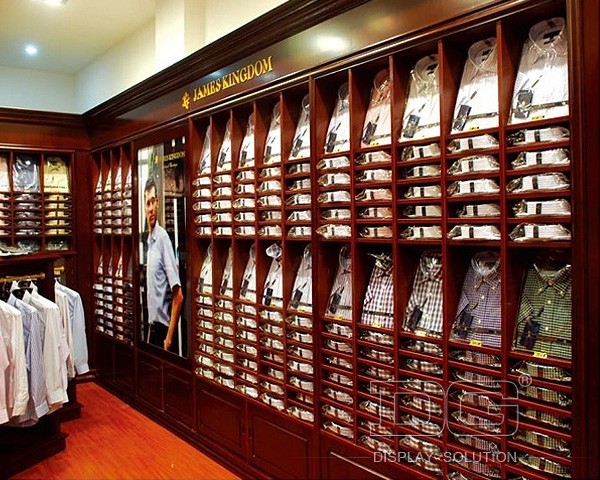
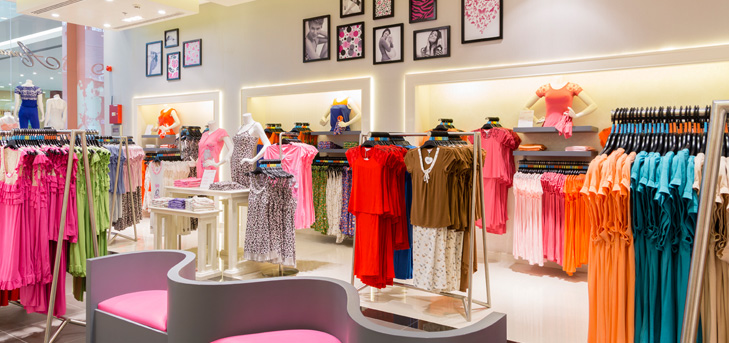
If you go to any shopping mall, you will notice how the goods in the men's department and ladies' department are arranged in different manner.


1. The items in men's department are packed in nice boxes. Shirts are sold in transparent packages and neatly arranged in colour, size and cutting. If you know what you are looking for, you can swoop in and get the right package, pay for it and it's yours.


2. For the ladies' department, you'll seldom see cloths packed, if at all. They are often found hanging on racks so that shoppers can browse them easily. I don't recall seeing any packages at all, which is quite unlike those in the men's department.


3. From the layout of different shops, you can see whether they are meant for females or men. If it's meant for men, you'll see them all packed neatly in boxes or packages. For females, it's all laid out for you to see. If there are 3 colours for the same model, you'll see 3 colours all laid out in front. In general, shopping centres are meant to entice female shoppers than male shoppers. Go look around and see if I'm wrong.


Men's shirts. Neat rows and columns and packages.


Ladies' dresses - Spread out, displayed and no packages.


There must be some kind of behavioural science involved in this. Otherwise, why would every shopping centre that I go to adopt this kind of goods arrangement? Maybe men are hunters, so they prefer hunting for their things when they shop. So if the goods are arranged neatly in a logical fashion, it'll be easier to look for them and go off. Females are gatherers, so they are good at picking good items from a wide variety of things. Their eye for detail enables them to pick things that usually eludes men. It's almost like all the concentration powers in their vision is narrowed down to a small beam in front of them, so they see 200% in clear, zoomed in details. For men? Their concentration powers in their vision is spread over a wider range of view (more than 180 degrees), so that they can see more, though in lesser detail.


Knowing this might present some interesting information on how you do things, depending on who your target audience is.


1. If you're selling to men, put in nice boxes and arranged them in a logical fashion, so that they don't have to ask for help and can find their way around independently.


2. If you're selling to women, put all your goods out to display, so that they can feel and touch and compare and contrast. Putting in nice boxes to display your items must be quite a turn off for them, I suppose.


3. For men, because they loath to ask for directions, it's better to have all the information available on the boxes. For women, even if it's there, they'll ask. I'm, of course, generalizing and stereotyping here, but this works most of the time.


Can we apply the same standards to financial blogs? Is my blog more catered towards women or male readers? I think mine is more feminine than masculine. Do you think so?

Sunday, March 01, 2015

Hurray for redundancy

I saw B's post on market valuation here and I thought he did a good job to remind people about not investing when market valuation is high. I'm here to warn about another thing - that disasters does not strike alone. Usually we're well equipped to handle one big disaster in our life, but we're seldom well equipped to handle 2 or more in quick successive hits.


We talk about employing our war chest and how when the market is crashing, we'll swoop in and buy at cheap valuations. But we seldom talk about the circumstances that happens when the market crash. Usually our jobs is at stake. You wouldn't dare to invest all your war chest, even though it's meant for that purpose, because you're worried now whether your emergency cash is enough should you lose your job. The circumstances when the market crashes is very different from now, when you're sitting in your chair comfortably reading this post. It'll be anxious, uncertain and gloomy.


So the real question is whether you can still secure your own active income in the form of your job, have enough cash to tide over while your spouse look for another job because he/she is retrenched, handle the increasing stress level and possibly adversely affecting your health, AND also invest at cheap valuations?


I'm not sure if I can do it, but I'll try. I hope I did everything I can and I'm still worried.


The key is to survive first then we talk about thriving. Be resilient to any crisis, and then have the means to take advantage of it. If you can't even survive, don't even talk about striking it rich by buying OCBC at less than $5 when it crashes.


To survive, it's about combining all the factors of job security, insurance, emergency cash, family support, belt tightening measures etc etc. To thrive, it's about having the means to take advantage of the general gloom. That's just having ample liquidity.  Always plan to survive first and check and double check what can happen if your mortgage loan increase, you lose your job, your passive income stops giving you money and your spouse gets retrenched, you have health problems and you're the last man standing holding everything together.


We talk about having a safety margin for our stock purchases. But do you have a safety margin over your emergency cash?