Friday, February 14, 2014

DBS 4.7% preference shares redemption part 2

Seems like there's a lot more to say about the DBS 4.7% preference shares redemption.


I've been a little unfair to DBS on this previous post here. From well informed friends (thanks cory and pero), I learnt that DBS actually exchange that preference shares with another one with higher payout and shorter tenor around Nov 2013. This is done because the older preference shares no longer qualify as Tier 1 capital under the new Basel III capital adequacy requirements implemented by MAS on Jan 2013.


I cut and paste the notice here, for future reference:

-----------------------------------------------------------------------------------------------------
DBS offers to trade new notes for $800m in preference shares

By Siow Li Sen lisen@sph.com.sg

Nov. 8 (Business Times) -- [SINGAPORE] DBS Group Holdings is offering to buy back $800 million of an outstanding $1.7 billion preference share issue, offering in exchange new notes with a higher payout and a shorter tenor.

Existing note holders can, via a tender, exchange at par for the new notes which will pay out 4.7-4.9 per cent, and has a call date in November 2019, the bank said yesterday.

The callable date for the existing preference shares is 2020. The non-cumulative non-convertible non-voting class N preference shares have a payout of 4.7 per cent.

The reason for the bank's action is that the new shares will be Basel III compliant and qualify as Tier 1 capital.

DBS said that "the fact that the existing preference shares no longer fully qualify as Tier I capital of DBS Bank constitutes a preference share change of qualification event" under the Basel III capital adequacy requirements implemented by the Monetary Authority of Singapore (MAS) on Jan 1, 2013.

In a statement yesterday, DBS said that it was "proposing to accept tenders amounting to $800,000,000 in liquidation preference of existing preference shares, or a lower or greater aggregate amount at (its) discretion".

Holders who wish to participate must do so by 5pm Singapore time on Nov 21, 2013.

The tender does not apply to the retail tranche issued also in 2010 - an $800 million 4.7 per cent non-cumulative non-convertible non-voting class O preference shares callable in November 2020.

"We are starting with the institutional tranche - to see market reaction," said a bank spokesman.

If the response is "overwhelming", a bigger issue of the new notes could be considered, said Clifford Lee, DBS Bank head of fixed income.

The 4.7-4.9 per cent payout and shorter tenor of the new preference shares are seen as "investor friendly" and attractive relative to a recent perpetual issue by United Overseas Bank (UOB).

In July, UOB sold $850 million of perpetual notes paying 4.9 per cent that were Basel III compliant. Yesterday, the notes were quoted at $102.35-$102.85, yielding 4.335-4.219 per cent.

"Instead of a price nearer to 4.2 per cent, they're (DBS) paying 4.7-4.9," said a banking source.

Still, some investors sold off the existing DBS preference shares after the announcement, causing prices to fall to $100.51-$101.398 from $102.52 on Wednesday. They could be only looking at the exchange at par, and not the coupon of the new bonds, suggested the source.

Said Gary Dugan, Coutts chief investment officer for Asia and Middle East: "Anything (bank perpetuals) above 4 per cent is attractive."

Interest rates are likely to remain low for the next 2-3 years and perpetuals still remain very attractive, he added.

Under MAS Notice 637, effective on Jan 1, 2013, Tier 1 securities have a point of non-viability (PONV) loss-absorbing feature. What this means is that investors or debt-holders will have to face a partial principal writedown or conversion into common equity when the PONV is being triggered by MAS. The PONV is triggered when MAS decides that a bank is no longer viable, or when public-sector support is required.

Separately, a UOB spokeswoman said that the bank would not comment on future capital management plans, when asked if it might consider similar exchanges for its non-Basel compliant preference shares.
At OCBC Bank, Ang Suat Ching, its head of funding and capital management, said that "while our existing preference shares are not Basel III compliant, they will continue to qualify substantially as additional Tier 1 capital over the next few years under MAS's transitional Basel III rules".

"Our Tier 1 capital adequacy ratio as at end-September was 14.3 per cent, a level that we are comfortable with. We continuously assess our capital and financial requirements, as well as market conditions, in determining any early redemption or new issuances of capital instruments."

Copyright 2013 Singapore Press Holdings

-0- Nov/08/2013 00:30 GMT


-------------------------------------------------------------------------------------------------

But there's still a bit of problem here:


1. Okay, totally understand that they have to do some engineering to change the structure of the preference shares to fit the ever stricter capital adequacy requirements. But $1.7 billion worth of existing preference shares are exchanged for $800 million worth of new ones. That's less than 50% of the existing shares offered to be exchanged. Exchange seems too strong a word. The proper wording should be "offer to exchange by balloting" because not all who wants to exchange it will get it, from the mere fact that there are lesser new issues than the one to be replaced. For those who had exchanged for the newer shares, good for them. For those who didn't got it, they are now redeemed based on the latest announcement by DBS on 13-Feb-2014.


2. The existing preference shares has a coupon yield of 4.7% pa. The newer one to be exchanged range from 4.7 to 4.9%. The range, I suppose, is dependent on how oversubscribed the new issues are. If there's $1.7 billion of preference shares being cut to $800 million worth, and they are all going to ballot for this newer issues with yield ranging from 4.7 to 4.9, it's not going to take much of a guess where the yield of the new issues will fall. With hindsight, we know that it's indeed 4.7% also. So, that doesn't really qualify as 'a higher payout', to quote the above announcement. If anything, it's "potentially higher payout".

But again, to be fair to DBS, they could have put the yield lower even than 4.7% and nobody can say anything.


Ultimately what am I going to do with the listed DBS 4.7% preference shares that I hold for my parent's account? I'm going to sit tight and do nothing. If it falls really close to par value, I might even add in some. What can happen? If they are going to redeem the listed DBS 4.7%, then they are going to offer new ones in exchange for it. They could go all bastard and reduce the total amount from the existing $800 million worth to something lesser, so all the holders will have to go ballot again for the new exchanged issues. Since I bought it at above par, I'll lose some capital but in exchange I can get newly issued ones at par, which is a good thing for me so that I can properly allocate my resources because of more certainty. I've already accounted for the potential loss in buying a pref shares above par value, so taking the loss wouldn't affect much in terms of the yield I promised to my parents. But a loss is still a loss, so it'll mean I have less buffer for other such things that can be thrown to me as my parent's fund manager.


Thursday, February 13, 2014

DBS 4.7% preference shares redemption

I was alerted this morning by a notice from DBS to redeem the 4.7% preference shares. It's here. My first thoughts are that I haven't even got the interest yet from the preference shares and now they are redeeming it?!


Upon closer examination, I realised that they are redeeming back another preference shares, one with the same coupon interest of 4.7% but not listed in mainboard SGX. This one that they are redeeming is the 250k per bond one.


A few issues:

1. In the prospectus for that preference shares, they noted that the first call date is 22-Oct-2020. Then of course, they also put in a clause that said that they can change the early redemption date under this nice technical name of "Change of Qualification Event". And this notice posted by SGX is that such a change occured and they are now going to have an early redemption date on 21st Mar 2014! How is this fair to people who bought in thinking that they are going to park their money there until 2020, which is another 6 years from now?

Well done. Even preference shares can be hacked by those in power. With a stroke of a pen, the redemption date is changed. Just like that. Of course this is all legal and above board (since there is a clause in the prospectus), but legal doesn't mean that it's fair.


2. The last payout for that preference shares is on 22 Oct 2013. From that date until the early redemption date of 21st Mar 2014, there's a good 149 days (including 22-Oct but excluding 21-Mar). Well, at least they are going to pay the holders the sum owed during that period. I didn't know they are going to do that.


3. The next thing to think about is whether they will also redeem back the dbs 4.7% listed on mainboard SGX. That's the worry, since both of these preference shares belong to the same tranche and issue mostly along the same terms and conditions. So far, nothing is said. But I guess investors are not going to wait around and find out. The price of DBS Bk 4.7% NCPS 100 dropped 0.7% to 106.150 today. Better price on the market than if it's redeemed at par of 100.

Wednesday, February 12, 2014

Growing alfalfa sprouts

As you can see from my previous post on growing wheat grass, I'm starting to become a urban home gardener. It's the first step to take control of the things that we eat, which I believe will directly affect our health. There's a lot of advantages to growing your own produce. I think firstly, you'll be able to save a lot of money. After growing some wheat grass and alfalfa sprouts, I realised that the supermarket variety is just way too exorbitant. The quality of the home grown produce is also much better and you get to control what you put in. If you don't put pesticides, it won't have any traces of pesticides at all. If you grow from organic non GMO seeds, the produce will be as such. The last benefit is that there's an immense sense of satisfaction in growing a tiny seedling to eating your own harvest.


I managed to source out a local place where they sell seeds in packets of 1 kg. It's super cheap. On their site, I also saw that they had alfalfa seeds, so I bought a big packet of 1kg for $25. A small packet of alfalfa sprouts (around 150 to 250g) in supermarkets will cost you around $2.50. Some are not even fresh. I figured that nothing much will go wrong considering that the big packet goes for so little and it can probably last me months.


Alfalfa sprouts are super easy to grow. If I say that growing wheat grass using soil is easy, then alfalfa beats it hands down, legs down. For this, you don't even need any soil. Since we're growing sprouts (think 'bean sprouts'), it'll be super fast and you can harvest in 3-4 days time.


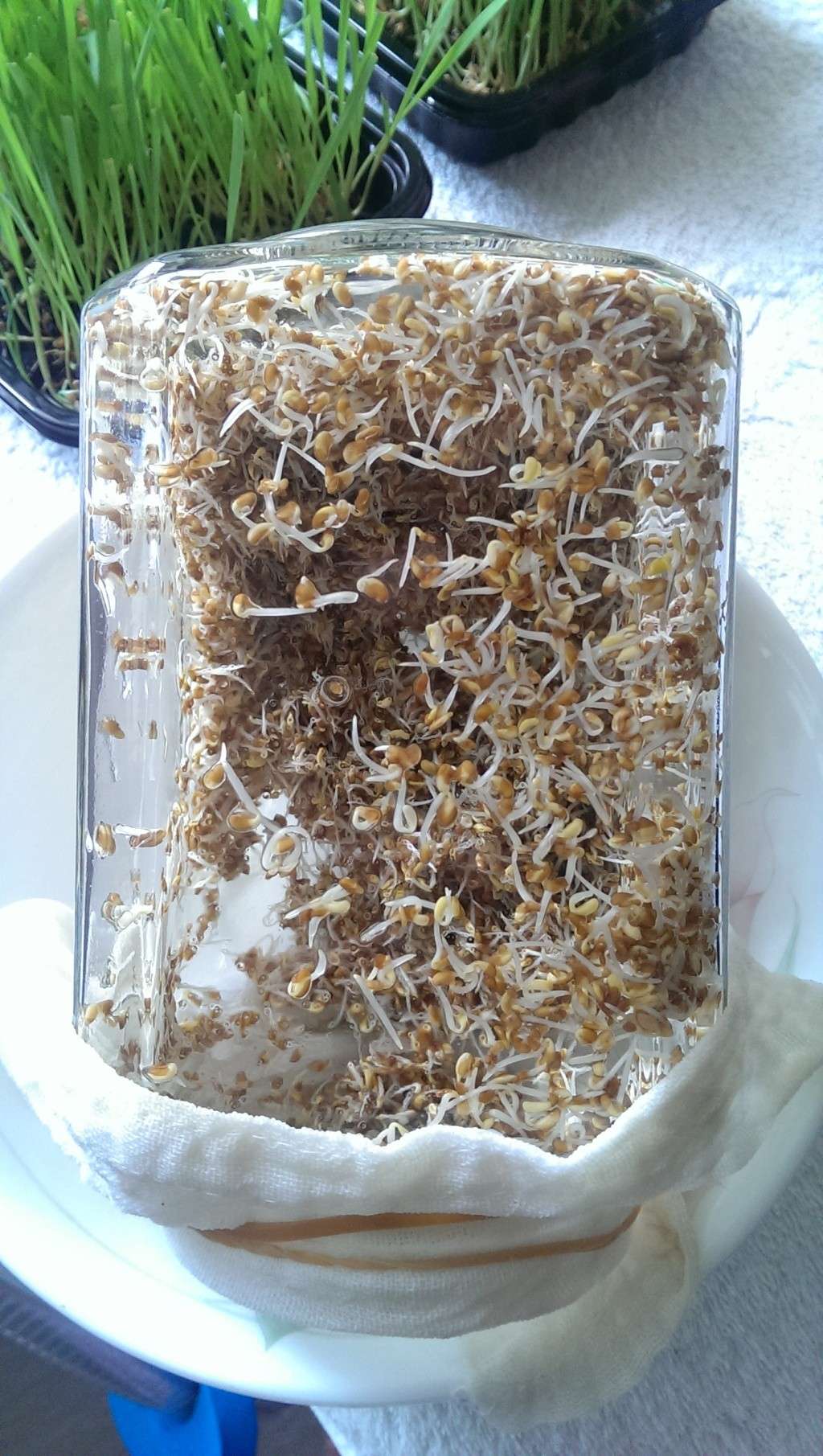
The first 12 hours where the seeds are soaked in water and kept in the dark to germinate


The method is really easy - you just soak one to two tablespoon of the seeds into water, germinate it in a dark place for 12 hours to 24 hours in a glass container covered with a filter cloth. After that, just add water into the container and drain it through the filter cloth. It'll not be totally dry - but that's the point. You want to keep the seeds moist but not drown them in water. Keep them in the dark until you see the first inkling of the leaves.


After 24 hours. The roots are out - they really grow very fast. 

Just keep repeating the watering and draining process, keeping them in the dark, until you see the first signs of the leaves. For me, I saw it somewhere between the 2nd and the 3rd day. Once you see the leaves, you can put them under indirect sunlight for the plants for them to make food.


2nd day - Tiny leaves (still yellowish) started to grow


3rd day, the leaves are fully out. I put them in indirect sunlight around the 2nd-3rd day

On the 4th day, the leaves turned a very beautiful dark green colour. You'll know when you can harvest it. I ate it straight off the jar - a very nutty, bean-sprouty taste. Reminds me of Vietnamese crusine or atas burger joints. More of the former. I can imagine putting these raw in some beef soup with rice noodles, very nice!


Just 1.5 tablespoons gave me some much harvest on the 4th day. This is easily more than 3 equivalent boxes found in supermarket


A close up of the beautiful alfalfa sprouts. 

What's the health benefits of eating alfalfa sprouts? Here's a few that I googled:


1. Full of proteins. Each serving contains 3g of proteins. Vegan eat this for protein as opposed to meat.

2. Can ease chronic constipation and digestion problems

3. Cholesterol reduction abilities - it can reduce both total cholesterol and low density lipoprotein (the bad cholesterol) without affecting high density lipoprotein (the good cholesterol).

4. Reduces cholesterol plagues in heart arteries

5. Contains Vitamin B and K. Esp the latter. It is one of the most concentrated sources of Vitamin K found in nature.


I'm not sure if all are really true. Anyway, it taste good and is easy and cheap to grow, so what's there to lose?

Monday, February 10, 2014

CMT retail bonds

Capital Mall Trust (CMT) made an announcement today that they are going to issue retail bonds. The terms of the bonds are as follows:


1. Years to maturity = 7 years
2. Interest = 3.08% pa, paid semi-annually on 20th Aug and 20th Feb, starting this Aug
3. Capital guaranteed if held till maturity since it is a bond
4. Issue price is $1.00 and the par value is $1.00. Should be in board lot size of 1000 shares
5. To ballot for it, you need a min of $2k, with incremental multiples of $1k 


You can ballot for it by going to ATM at 9am on 11th Feb 2014 and it’ll close at 12 noon on 18th Feb 2014. I think the process is the same as balloting for IPO shares through ATM. You pay the amount first, add on a fee of maybe $1 or so, then you wait for a few days after the closing date to see how many lots you have. The rest of your money that is not used will be refunded back to you. Your shares will be held in your CDP account and it should be able to trade on SGX once they start listing. As of now, I haven’t seen the prospectus yet (going to be lodged today), so you need to confirm some of the details mentioned here again by reading it on MAS OPERA site.


Good deal?

Let's see what's on offer at SGX. The most similar one to this bond is the CapMallA3.8%b220112 traded on SGX. The last done price on 10th Feb 2014 is 1.027, traded in board lots of 1000 shares. Let's see the terms of the bond:

1. Years to maturity = 8 years, maturity date 12-Jan-2022. Optional redemption on 12-Jan-2017.
2. Coupon yield = 3.8% pa. if it's not redeemed by 12-Jan-2017, it'll be stepped up to 4.5% pa. At current price using my way of calculating yield to maturity, you'll get 2.82 % pa to 3.8 % pa. See below for explanation **.
3. This is also a bond, so it's capital guaranteed if held till maturity
4. Issue price is $1.00, but the trading price is 1.034, so when the bond is redeemed, you'll lose $0.034. But all these are already included in my yield of 3.28% pa 


Thanks to sfry, whom I respect as someone who has vast experience in doing bonds and shares, there's an advantage in balloting for the new bonds even though it has lower yield. Firstly, it's easier to get more lots by balloting because like all pref shares and bonds traded in SGX, liquidity is an issue. But if you're just looking to get maybe less than 20k worth of bonds, I think it's not a problem. Secondly, getting through balloting only requires an admin fee of a few dollars (can't remember exactly how much, but I've a feeling it's just $1) compared to a xx% by paying the brokerage fees. Thirdly, there's a real possibility of Capmallasia redeeming back the already listed bond on 12-Jan-2017, leaving you high and dry. This new bond doesn't seem to have an early redemption, though it must be confirmed by reading the prospectus (which I haven't because it's not lodged yet).


There, all the facts are laid out bare. You decide.


** Let's clarify on the yield of capmallasia3.8% bond. If you buy it at 1.027 on 10th Feb 2014, and it matures on 12-Jan-2017, you'll get a yield of 2.82 % pa. If it matures on 12-Jan-2022, you'll get a yield of 3.8 % pa. These yields are calculated with the inclusion of a loss of capital due to the buying of a bond above par value

Thursday, February 06, 2014

Clearing the clutter

Do you believe in clearing clutter?


I do. And I've been procrastinating for years and today I've finally done it! The clutter had been there even before I've moved to my new house and had been lying there for another 2+ years before I finally can't take it anymore and went to settle all of them. Some of the documents go way back in 2010, so it had been lying there for 3 years!


The clutter I had are mostly papers, consisting of bills, statements, annual reports, magazines and worksheets. It's not very messed up though, because I've been adopting this system of clearing things as they arrive. The system works like this. When a mail and a paperwork comes along, I'll decide what to do there and then. I realize that anything that is not decided immediately will be kept a much longer time (and adding to the clutter), simply because I need to have the assurance that when I finally get to act on them in the future, it'll still be there. This is not only delaying whatever needs to be done, it's also pointless because anything that is lying in a pile of 'to be cleared' paperwork probably won't ever be cleared. If acting on one single document is so difficult, what makes you think clearing a pile of document is ever going to be easier?


My room is almost going to be like this...but not yet


Hence, the system involves the following:


1. Bills will be checked against my own records and paid immediately, or the due date be keyed into the calender of my hand phone with the amount owed, so that when the time comes, I'll remember to pay them. This is frequent, because most, if not all my bills are paperless already. It's most likely to appear in my email then in my mailbox. Maybe only for income tax, property tax and insurance I'll receive the bills in physical form.


2. Statements from banks will be checked against my own records. Used to do this anyway. These days, I also switched to paperless system, so the statements will be notified through my email and I'll check them up on the respective website. Since I do this on a monthly basis when preparing for my personal monthly financial reports, I don't even read the statements transactions by transactions. The total amount will tally exactly 90% of the time. If not, I'll check line by line. Bank reconciliation, I heard this is called.


3. Advertisements will be read immediately, and thrown on the spot. For those interesting ones, I'll snap a picture of it in my handphone. I clear my handphone's photos very very often.


4. Any paper mailed to me physically with only one printed side (the other side is blank) will be kept as 'rough' paper.


5. Any other things that doesn't fall into one of the categories (meaning either going to be settled or thrown away),  I'll take a picture, store it in evernote and let it rot there for a while. Usually these are things that has sentimental reasons. And I'm a sucker for such things. Aww...


Most of my clutter comes from the days before I set up the system and before most of my bills are paperless. So I'll receive a lot of statements and bills. Not anymore. I think it's better this way because firstly it's more environmentally friendly, and secondly, it's easier to keep an online storage then to keep a physical one. The latter will take up space and is not easily archived and made searchable.


Now, after clearing it for 3 hours, my whole room looks so much less cluttered! Why didn't I do it sooner?!

Wednesday, February 05, 2014

Running yourself like a company - Cash flow analysis II

I think it's important to take a look at your cash flow pattern throughout a year, so that you can plan out a budget or simply have the cash ready for big payments in certain months. I know, nothing ever works according to plan, but knowing what will definitely happen and what can happen is the first step to navigating this world that is full of uncertainties.


Certain category in my monthly cash flow are fixed. I don't ever want to think about situations where I can skip such expenses. These include parent's allowance, home mortgage, utilities etc. There are others that are more optional in nature. Things like travelling or buying luxury items...not exactly needs but is good to have.  I've some insurance payments that are annual, so during certain months, my cash flow out will be very high. I just have to make sure that I have enough liquidity to pay off them when the bill comes in. That's an advantage in paying premiums annually because you get some discounts from doing so rather than doing it on a monthly basis. Harder to pay one lump sum per year though, I must say.


I think my job as a self employed tutor makes it harder to plan. That's because my pay also varies depending on which month you are talking about. Hence, it's even more important for me to watch my cash flow like a hawk, because I could really have liquidity issues especially in those months where I know my expenses will be higher. How do I know which months I will having higher expenses? There's no other way to know but to track your expenses over several years.


Here's how my cash flow expenses looks like in a typical year:


You can see that Apr and Oct are dreaded months for me. It's so high because of the annual premiums that I have to pay for my insurance. Jun and Dec months are higher because of possible travel plans. Feb is higher because that's when most Chinese New year occurs, so a lot more is spent on meals and ang baos etc. Other than that, most of my expenses are pretty fixed. Mortgage, parent's allowances and food takes up a lot of my monthly cash outflow, easily 70% or so in a general month. I can only dream of the day that my mortgage payment is finally finished! On average, my expenses are around 3.5k per month, all inclusive.


A long time ago, I blogged about the variability of my income. Here's the chart:


Most of my income stream will come in only around Feb period, peaking around Aug to Oct period. After that, my 'winter months' will come from Nov to Jan, where I'll be pretty poor. That's why I need to save voraciously during my fatter months so that the excess can be used to offset my leaner months. Whether I have the income or not, I still have to pay off my fixed expenses.


Just looking at the two charts I'll be able to work out a cash flow plan in my mind. It's quite simple - make sure you have the money to pay off each month! It's important to note that while it's good to have a figure for the average monthly income or average monthly expenses, it's not so good to use these figures for month to month living. If you have a room with two persons, one being 1.8m and the other is 1.5m in height, there's no use knowing the height of an average person in the room when you want to tailor-make their clothes, because such a person with the average height doesn't exist! Likewise, knowing your average cash inflow doesn't help you in knowing whether you have the cash to pay for it.


I think in a way, analyzing a company is the same. It's little consolation in knowing that the income for a company is so high but the cash will only be coming in at a much later date than the debts. This article will round up this series of running yourself like a company.

Monday, February 03, 2014

Running yourself like a company - Cash flow analysis I

I've been running a series of posts on the theme of managing yourself like how you would run a company. There are three important financial statements to report to regulating authorities or to investors; these are the income statement, balance sheet and cash flow statement. I've already commented on the first two. The links for them are listed below:


1. Running yourself like a company - income statement
2. Running yourself like a company - balance sheet


The third one, cash flow statement, is really important in a company because of the way the income statement is derived. The report is prepared under the accrual basis of accounting, hence as long as the sales/services are fulfilled by the company, there will be an credit to the income. Since it's normal to give customers credit, the actual payment of the goods and services might not come in until a while later, thus whatever increment in income reported reported is essentially 'on paper' only with no corresponding increment in cash received. That's why it's important to see the cash flow statement because however healthy your reported income is, it's ultimately cash that is king.


You find that when you are preparing your own income statement, it's unlikely to be prepared under the accrual basis of accounting. Most likely, when you receive your salary, you receive it in cash or cash equivalent. In other words, you don't report that salary as your income until you received it in cash or in your bank account. Likewise for dividends and all other cash items like paying for your food and other stuff. Hence essentially, your personal income statement can also double up as your cash flow statements. They are not that different.


There are some things that you might use an accrual basis to record down your spending though. For credit cards, let's say you spend $100 on a restaurant dinner today but your credit card bill payment only comes a month later. Do you record your expenses for $100 on food today or do you record $100 on food a month later when you actually pay the bills? The question boils down to whether you record the amount spent when the services/goods are received or when the bills are paid. There's no right or wrong answer, because ultimately, it's your system we're talking about here. For me, I'll record when the services or goods are received for credit card expenditures. This makes my income statement a little different from my cash flow statement, if I am to compare between the two.


But it's not a big deal though. I used to have a separate income statement and cash flow statement, but I no longer do that. That's because my income, at least in the past, are recorded when the services are given out but not paid to me. I'm a tutor, so when I give lessons, I don't always get paid on the spot. Usually there's a credit period of roughly 2 weeks to 1 month before I received cash payment for the services rendered out. However, I realised that while it serves no purpose having two such statements, it certainly adds to the work I've to do. After 10 years, I scrapped that system.


I'm happy with just one income statement on the basis that :


1. Income is recorded only when I received cash. Works the same for dividend and interest received; I only record them when I received it.

2. Expenses are recorded when I paid for them, or when I received the goods/services, whichever is earlier. E.g. If I buy a shirt for $10 using credit card but only pay the shop a month later, I'll still record the $10 that I spent today. If I buy a shirt online for $10 and paid them today, but I can only receive the shirt a month later, I'll record the $10 now too.

3. Loans/mortgages: The day that I pay my monthly loan amount, I'll record it down.


The last and (possibly) final post on this series will still be on cash flow. I'll be posting my thoughts on looking at the stream of cash outlay that occurs monthly over a period of one year. Having this idea will help you to plan ahead so you'll never be caught with a huge monthly cash outlay that you knew about but forgotten.

Monday, January 27, 2014

Running yourself like a company - Balance sheet

The next report to look at is the balance sheet. This shows how your liabilities are like against your assets, and also the breakdown of the liabilities and assets. The sum of your assets minus your liabilities will be the book value of a company. In terms of your personal balance sheet, this is known as your net worth. I know there are a million ways to calculate net worth, so it's up to you to decide which definition you want to adopt. It doesn't really matter as long as you keep the standards the same when you compare yourself against different time periods. Just don't change the yardstick all the time. It'll be like a company that changes their way of valuating their biological assets or the rate of depreciation or their accounting period.


It's important to know that similar to the balance sheet of a company, a personal balance sheet is a static picture of a company's assets and liabilities at a particular point in time. The balance sheet of a company taken at different times will likely be different. Just pick a time period that is significant. I think doing a balance sheet monthly is kind of pointless, because there isn't much changes in the items (though I still do it). A comparison of your personal balance sheet across different years should be good enough.


Anyway, this is the way how I calculate my net worth:

Net worth = All bank accounts + cash + money market funds + surrender cash value of whole life + marked to market value of stocks + scrap value of car + CPF - (car loans + credit card debts)


Notice that I did not include the marked to market valuation of my residential property , but neither did I include the loans that I borrowed to buy that property. The mortgage payment part is included in the income statement and I'm contented to treat it this way. As mentioned, there are a lot of ways to do your net worth, so just pick something that works and make sense to you.


An illustration of how the personal balance sheet is compared across years


A company that can withstand financial stresses are those that are light on debts. But more importantly, it's whether the company can service their debts without breaking a sweat. You can thus calculate a variety of ratios, each of which can be used to analyse how robust you are to financial stress. Here's but a few:


1. Years to service debt

I don't care how others define the ratio, but this is what make sense to me. My way of calculating is this: (All loans and debts - cash/cash equivalent - 50% market to market value of stocks) / (net savings per year). I do not include CPF because I don't use that to pay off my housing loans. For someone who does, you can easily tweak the formula to include all the cash that you can use to pay off the housing loans from your CPF accounts. Basically, the aim is to only use those money that are liquid enough to subtract off your total debts in the numerator of the formula. There's no point deluding yourself that you have a lot of money stuck in some illiquid asset, say like your cpf account, but those can't be used to pay off your debts when crunch time hits. I also did not include the full marked to market value of the stocks to account for the fact that when the shit hits the fan, your portfolio value will also drop. You can still liquidate it but it won't be at the price you want to sell.


For example, in the balance sheet above for 2013, the housing loan is about 430k and car loan is 7.2k, total being 437.2k (let's ignore credit card debts, which isn't significant). Subtract off all my cash/cash equivalent plus 50% of portfolio value gives me 353.7k . If my savings per year is 30k, 353.7/30 = 11.8 years. This means that if I dedicate all my liquid assets to the repayment of debts, I should be debt free in 11.8 years. Probably shorter than that, since I didn't include my wife's contribution in the savings. I think what's more important is that while the debts and liabilities are certain, my income and hence the savings are not certain. Can I save that much for another 11.8 years? If not, then I better accelerate it, work harder and save harder to bring the ratio down. It's also silly to sell of everything and use all the cash to pay off the debts. This is just a stress test scenario to see if you can withstand financial difficulties.


If you have a negative number, congrats! That means that your debts can probably be covered by your liquid assets. You have a healthy balance sheet!


2. Current ratio

Current ratio is current assets over current liabilities. This will see whether you have problems paying off things like credit cards, income tax, annual insurance premium and very near term loans. I'll treat current assets as cash/cash equivalent (like money in money market fund, fixed deposit, savings account etc). If you have this ratio being less than 1, better watch out. Again, relative numbers are more important than absolute numbers. If last year your ratio is 1.1 and this year, it's 0.8, you should go and find out what is happening in your financial health. It doesn't mean that there's something wrong and you should correct it, but it's could be a symptom of something bad that could be coming.


3. Liquid vs illiquid assets

Liquid assets are those assets that can be easily converted to cash. Illiquid ones are those that need a long time to convert to cash. Things like property can be rather illiquid. Stocks are liquid, but they might not be able to sell at the price you want when you need to sell it. The really liquid ones are cash /cash equivalent and money market fund. CPF accounts are not liquid at all, unless you're near the withdrawal age. I'm rather ambivalent about cash surrender value of whole life insurance plan. It's not that it's illiquid, but I'll rather treat it as untouchable.

This ratio will allow you to analyse whether you are one of those cash poor, asset rich folks who have a lot of their net worth locked up in things that do not generate cash. You might have a property worth 1 million dollars but you can't really break off a brick to pay for food. I suppose when we get older, we need to see this ratio gearing towards the liquid side, because we no longer have a income stream from work due to retirement / retrenchment.


It's important not to look at just one slice of your financial health to conclude whether you are well off financially or not. Looking at just the balance sheet does not give you a full picture. For example, consider a scenario where there is a person with high net worth. His personal balance sheet consists of large assets and very little debts. However, his balance sheet has a large percentage of the assets that are fixed (i.e. illiquid) with very small percentage in current assets, like cash or cash equivalent. Though this person may have a strong balance sheet, he might not be able to live comfortably day by day because he has very poor cash flow. If his cash flow is insufficient to pay off his expenses, specifically his debt commitments, he might even have to sell of his fixed asset in order to generate that cash flow. We have to look at the income statement too to see a better picture of his financial health.


Saturday, January 25, 2014

Beware of percentages

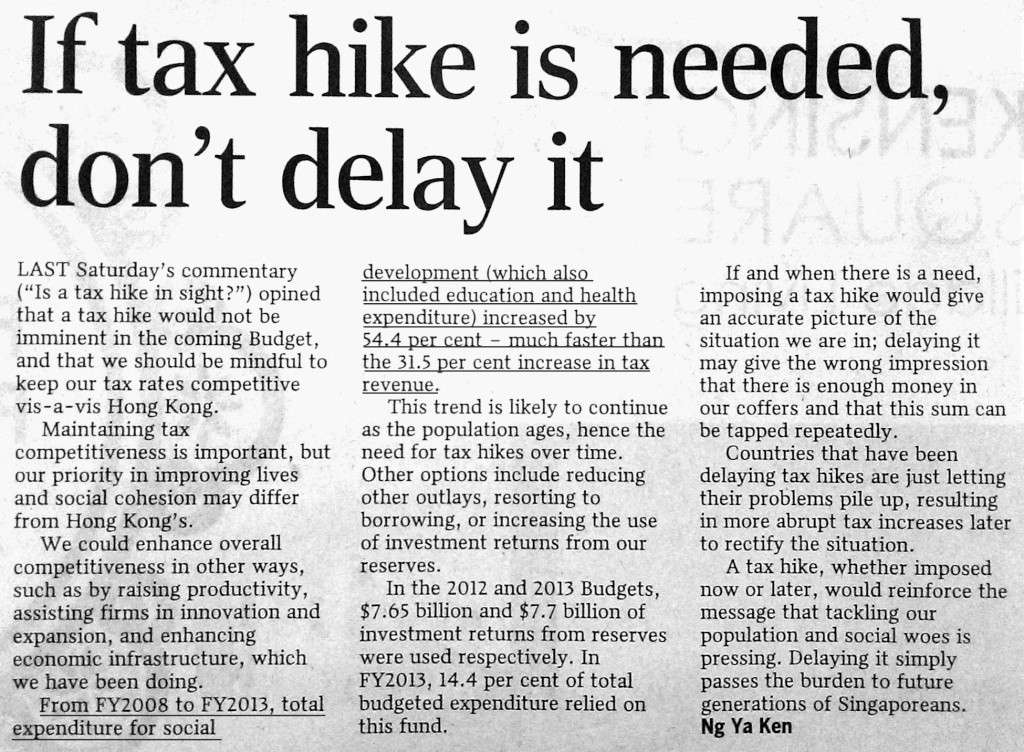
On Saturday, I saw this newspaper clip on the Forum section of Straits Times, where readers write in to comment on issues. I put a copy here, with my own underlined paragraph:


Click on it to enlarge. Taken from ST, 25/01/14 (my own underlined paragraph though)

The author wrote that "total expenditure for social development (...) increased by 54.5% - much faster than the 31.5% increase in tax revenue". I take issue with the fact that using percentages are highly misleading. The reason is that percentage calculations are relative, hence they are always based on something. If the basis of comparison between two computations of percentages are different, there's really nothing to compare. In other words, it could be misleading.


Let me illustrate further. Suppose my salary is $3,000 and I spend $150 on food per month in January.

Let's consider this statement: The amount that I spend on food for February increased by 50% while my salary only increased by 5%.

It's not stated explicitly, but this seems to imply that the increment in salary is unable to cover the increment in food expenses.

This means that:

January: Salary = $3,000, Food = $150
February:  Salary = $3,150, Food =  $225
Absolute increment:  Salary = $150, Food = $75


I can also say: The amount that my salary increases is more than enough to cover the increases in food expenses. Absolute increment shows that is the case, even though relatively speaking, the rise in food is indeed faster than the rise in salary.


Both statements are not wrong, it's just that without digging deeper, it's quite easy to make a hasty conclusion if someone uses that first statement. Hence, when the author uses percentages to compare the increment in expenditure for social development and the corresponding increment in tax revenue, it seems to imply that tax revenue collected are unable to sustain the extra spending.


I didn't check out the actual values in tax revenues and social spending. But it doesn't matter, because no matter what values I put in as the base for 'tax revenue' and 'social spending' in 2008, where the increment is 31.5% for increment in tax revenues and 54.4% for increment in social spending from FY2008 to FY2013, the result is the same. I always end up with more 'Savings' (calculated by subtracting 'social spending' on 'tax revenue') yearly from FY2008 to FY2013.


So...even though more is spent on social spending in percentage terms than tax revenue collected, I still end up with more unused tax revenues year by year that can be used for other stuff? The tax hike doesn't sound so urgent now, it seems.


Note to self: When someone uses percentages, check the base in which the percentage is calculated. The absolute value might be quite a different picture from a relative one.


I know there are other issues involved, but my main point is just to be careful when percentages are used in presentation. There's usually more than meets the eye. Both percentage and absolute values need to be presented to see a clearer picture in case hasty conclusions are drawn. And seriously, I'm not for tax hikes (like most people, I assume).

Thursday, January 23, 2014

The poor who commutes by public transport

We all heard about this ang moh Anton Casey who post in his facebook that people who took public transports are poor. Hmm, really?


Well, for one thing, a Porsche (a car that he reportedly drives) cost around half a million. If I can save half a million dollars from buying that porsche and take public transport, wouldn't that make me half a million dollars richer? And why is he taking public transport in the first place? It seems that his car was sent for maintenance. Then why don't he have another spare car to drive if he's rich? Why squeeze with all other commuters? Maybe he's not rich enough too. If he is so satki, buy a freaking mrt with tracks for his own use lah, why bother to take other people's train?


A porsche - the mark of the wealthy?


It's quite sad to see people who view their possessions as indication of wealth. It's also very interesting to see that his private post to his facebook went public, so apparently somebody who is his 'friend' went ahead and made the post viral. He must really have made some hidden enemies among his facebook friends. Maybe his EQ is not that good. Or perhaps he just don't care how others think about him.


Not all ang mohs are like that. I've quite a couple who lived around my neighborhood (in flats) and they are generally very friendly. In fact, Singaporeans are super friendly to them too, because they are generally nice and cheerful to people who served him in coffee shops. I think it's important not to generalise that all ang mohs are like that, because there'll always be a few black sheeps. I'm sure there are true blue Singaporeans who had never taken public transport in their entire lives and also think that people who took them are poor. It's just that they know better than to say it out. Or they are not stupid enough to post everything on facebook, even though they are private posts meant for his friends and family only. Well, you never know when something you post in the internet will come back to haunt you one day.


Just a fact of life.


Wednesday, January 22, 2014

Running yourself like a company - Income statements

You should run yourself like a company. There are certain beneficial practices in running a company that we can learn from. There are 3 important reports that can determine the state of the health of a company. These are the balance sheet, the cash flow statements and the income statements. A company needs to have these reports generated so that the managers and also the investors can have a look at whether the company is doing well and also for transparency, good corporate governance and accountability. This should also be the reason why you should do up your own personal financial statements so that you can see if you're doing well financially or not.


Of course, before you can even prepare such statements, you need to keep records. Since you're not listed nor fall under ACRA, you don't have to follow any accounting guidelines nor will you be fined for not meeting standards and regulations, as is the case for public and private companies. Feel free to include or exclude things that don't help you. The first step before you can improve your own situation is to take stock of where you are now. A good record of your financial situation, which involves keeping track of your income and expenses, will allow you to analyse how healthy you are financially.


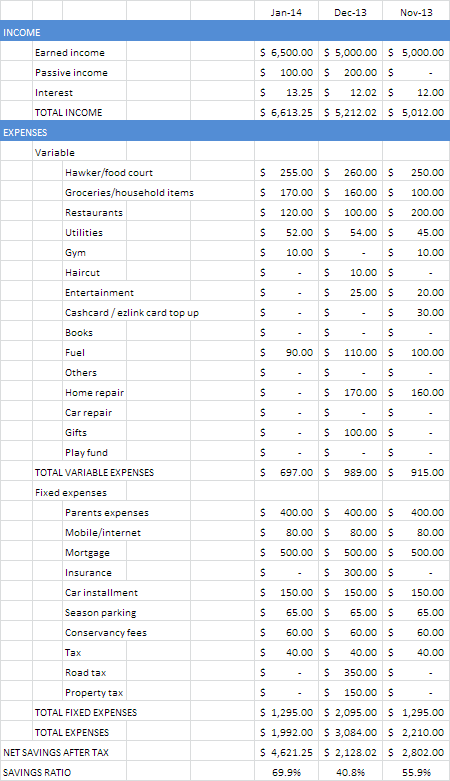
I've prepared a sample of what a personal income statement looks like in a 3 months period from November to January. I think doing this on a monthly basis is good. However, there are some months that you spend more or less, depending on the holiday season and the variability of your income stream and expenses calender, so you can also consolidate the monthly in quarterly or semi-annually too, to even out the odd months. The statements are really prepared for yourself, so feel free to do anything that makes sense to you.


This is just an example of a personal income statement. The categories for expenses might be useful for your reference though.


In the income statement for a company, you look at the top line, i.e the revenue. This is equivalent to your total income streams coming either from work that you do or money working for you. Then we have to look at the expenses. Some of them are fixed, some are variable. If you take the revenue minus off the expenses, you'll get the gross profit before tax. That's also your savings if you minus your expenses off your income. After paying taxes, what's left will be your net profit for a company. That's your net savings per year. And this is ultimately what counts at the end of the day, not your gross revenue.


You can further crunch the numbers in the personal income statement to see the following:

1. Percentage change in income (equivalent to % change in revenue)

2. Percentage change in expenses

3. Your savings ratio, which is net savings as a percentage of income (equivalent to profit margin, which is net profit over revenue)

4. Expense ratio, which is total expenses as a percentage of income


Different companies doing different industry will have different profit margin. You can't expect a company in the service industry to have the same profit margin as a manufacturing one. Likewise, different person will have different savings ratio. It depends on how 'light' or how 'heavy' that person's burdens are. Just like there's no meaning to compare the profit margin of a property developer company to that of a shipping company, there's also no meaning to compare the savings ratio between different people. The better way to compare is to compare your own performance metrics across different time periods of your life. For example, you can compare your % income or savings ratio between the year 2008 and the year 2009. The competition should be directed internally, not externally. In other words, you should compare how you do now against how you did in the past, not between how well you do against how well others do.


Remember that savings is like the net profit of a company. You do not want to invest in a company that shows ever increasing revenue but stagnant or decreasing net profits margin, neither do you want to become a person with increasing income but decreasing saving ratio!


A good personal income statement should have the following characteristics:

1. A stable income that is high enough to cover the expenses and then more. This will ensure that there will be some excess left over for savings. Savings is the first step to let your money start working for you. There's no other way that a self-made person can make money work for him without having savings in the first place.

2. Increasing income and decreasing or constant expenses. What's important is not the absolute but the relative. Preferably, the income should increase over time while the expenses are kept constant or increases at a lower rate than the income.

3. Consistent and increasing savings ratio. Savings is all that matters at the end of the day. You work for an income to get the savings; all other expenses can be treated as cost for getting the savings. If you cannot have some savings, you need to increase your income or decrease your expenses. There's no other way around this.


Interestingly, I can imagine a retiree who is not working any more but is drawing down on his assets accumulated over his working years. In such a case, his personal income statement will look extremely unhealthy, with very little revenue on the top line and negative balance each month after subtracting off expenses. But such a person is like a holding company (a company that does not provide a service or produce goods). So, to see if such a company is a good one to invest, you look at the balance sheet and see what kind of assets and liabilities that he owns. I'll talk about balance sheet next in my future posts.


In essence, whatever is described above is really just for a growth company, defined as a company that produces goods or provides a service, and seeking to grow its profits. This is similar to a person who is not retired yet, and not drawing down on his accumulated earnings/assets.


Maybe next time before you get married, you should ask for a person's personal income statements before you choose to invest in him/her LOL

Monday, January 20, 2014

Wheatgrass: from seedlings to harvest

Not sure if you've heard of the benefits of drinking wheat grass. Apparently, it's good for the health, but of course there'll be naysayers who say that it's over-rated. Whatever the case, drinking it certainly won't cause harm, but might or might not have a good effect. Good risk-reward LOL!


Anyway, I went to Katong flower shop near my place to look around for some Chinese new year flowers. Having no intention to get anything, I was surprised when I came back with 40 dollars plus of stuff. I bought a start up kit for growing wheatgrass for $16 and felt cheated. Inside came with two plastic trays, similar to the ones that you can get from eating salad takeaway. There's also a packet of soil, but filled with tiny flakes of some shiny metal, presumably to add some minerals into the soil for better plant growth. Inside is a small packet of seeds. The seeds are rather large, something like soya beans size.


After germinating the seeds by placing them in water overnight, I transferred them to a soil medium. They germinate really really fast. Just overnight, you can see the roots coming out. This is what it looks like after 1 day in the soil:


These baby shoots are very reactive to the sunlight. I read them I should place them in direct sunlight; just near a light source will do. They can see them moving towards the window (on the left), pointing towards the sun. I was visibly excited of course, having last grown something in primary school. What did I grow? Bean sprouts obviously!


On the 2nd day, they grew up to about 1 inch already. That's very very fast. By this time, the soil are no longer loosely packed because all the roots interweave to form a very tight netting of roots and soil. I water them about twice a day, but I did spray them with some water occasionally when I walked past them.


This is another shot of them. There's always this tiny drop of water just right at the tip of each blade of grass. I'm not sure what those are.


On the 4-5th day, the grass are about as tall as the ones you can buy off the shelves. But I read that I must wait until the blades of grass starts to divide at the base near the roots. That's when they have reached their peak nutritional value. No signs of these yet.


Actually having a living plant in the home has a very nice feeling to it. The green gives a very vibrant energy to my home. It makes me happy just looking at them basking under the sun. This is also a very satisfying plant for a beginner like me to grow because not a lot of things can go wrong. Besides, they have a very short payoff period - in about 7 to 10 days, you can harvest the wheatgrass already.
.


A tray of the wheatgrass, plus a small amount of water, when blended will give about two shots of wheatgrass juice. When I want to juice it then I'll harvest it, instead of harvesting them first and putting them in the fridge. The whole process is really very satisfying - from the seeds germinating to the first planting, to seeing how they grow rapidly and basking in the sun to harvesting them. I guesstimate that I will have about 3 days worth of wheatgrass juice from all my harvest.


This is what is looks like after juicing them. I decide to blend them and just add some water to make it blendable. The fibrous husk will be left inside the blender, together with the juice, and all I have to do is to run them through a sieve. Pressing the husk hard onto the sieve with a spoon will squeeze the remaining water out of it, to give this beautiful dark green essence of awesomeness! You can add some lemon or honey to it, but I prefer to have it raw.


Take note of some known side-effects:


1. You can feel nauseous after drinking. I did feel a little, but I thought nothing of it until I read some articles online about the side effects. Nothing serious, it all dissipated after some time. I need to do some more testing to see if I'm nauseous because of the side-effects or it's just that the taste is not very appealing to my untrained tongue.

(Note: After 3 days of drinking raw wheatgrass juice, I think the nauseous felt in the 1st day is just an odd occurrence. Maybe I'm already used to it already)

2. You can have diarrhea. I didn't have any, but I read that drinking lots of it can cause a laxative effect.

3. Do not drink it if you've allergic reactions! This can cause your throat and face to swell, and it's no joking matter. Check it out first before you consume. If you're allergic to grass, or wheat, or gluten, you might want to dab a bit on your lips without drinking. If nothing happens to your lips after 30 mins, then consider drinking a sip. Wait another 30 mins and drink in progressively bigger portions. It's a method to test whether something is poisonous to your body or not.


On a side note, my chilli seeds are sprouting! That's after one week of waiting! Imagine this, the wheatgrass take 7 days from seeds to harvest while the chilli seeds take 7 days to just germinate, haha! Different plants, different timing :)


Oh, and I've also ordered a huge pack of seeds locally for $10 in a 1 kg packet. Going to try mass cultivating soon ;)

Thursday, January 16, 2014

The year 2013 in terms of books read

As per tradition, I always like to mark the year that had just passed by looking at the books I've read. Long time ago, I made myself a challenge that I would read 52 books a year - that's an equivalent of 1 book per week, regardless of length. I no longer do that, though I must admit that with the challenge, I did treat reading books with a lot more discipline and thus allocate more time towards it. Let's see how many books I've devoured in the year 2013.


To Catch a Tartar - Francis Seow
Go down together: The true, untold story of Bonnie & Clyde - Jeff Guinn
The happy prince and other tales - Oscar Wilde
Mockingjay - Book 3 - Suzanne Collins
Catching fire - Book 2 - Suzanne Collins
Hunger Games - Book 1 - Suzanne Collins
The Accidental Buddhist - Dinty W. Moore
You Need A Budget YNAB - Jesse
The Last Threshold - Neverwinter saga Book IV - R.A. Salvatore
Charon's Claw - Neverwinter saga Book III - R.A. Salvatore
Neverwinter - Neverwinter saga Book II - R.A. Salvatore
Gauntlgrym - Neverwinter saga Book I - R.A. Salvatore
The Two Swords - R.A. Salvatore
The Lone Drow - R.A. Salvatore
Tesla: Man out of time - Margaret Cheney
Badass - Ben Thompson
Survivors - Z.A. Recht / Thom Brannan
Thunder and Ashes - Z.A. Recht
Plague of the Dead - Z. A. Recht
Antifragile - Nicholas Nassim Taleb
Answers of an alien from andromeda galaxy - Mythi (?)
Harry Potter and the Chamber of Secrets - J.K. Rowling
Ghost World - Daniel Clowes
Harry Potter and the Philosopher's Stone - J.K. Rowling
Yes! - Noah Goldstein & Robert Cialdini
Kick Ass comics - Mark Millar & John Romita Jr
Kick Ass 2 comics - Mark Millar & John Romita J
The miracle of mindfulness - Thich Nhat Hanh
The Tibetan book of living and dying - Sogyal Rinpoche
Hit girl - Mark Millar & John Romita J


This is a total of 30 books. Not too shabby eh? I've kept a list of the numbers of books that I've read since I've started in 2007. Here it is:


2007 - 27 books
2008 - 55 books


As usual, I've highlighted a list of books that are the top 5 reads for me in 2013.

1. To catch a Tartar - Francis Seow


At once an engaging and exciting read from someone who is a political refugee and living in US now, it shows you accounts of our government you would not read of in local media. I've not read the autobiography of LKY (in fact all his books) yet, so I thought this would form the first of the series of reads to find out more about the history of Singapore in different players' perspectives. He writes clearly and in that old educated style of language, not unlike those great writers of olden days. Everyone should read this.

2. Tesla: Man out of time - Margaret Cheney


This year I've developed a liking for autobiography. I've read a couple - Francis Seow, Bonnie and Clyde, and Nikola Tesla. This book talks about his feud with Thomas Edison in the AC vs DC war and also about his remarkable memory and visions. He alone holds 300 patents under his name, and probably more because he has not the time to file them, most of which are revolutionary and way ahead of his time. What interests me most is how he is in the process of researching on wireless power (he succeeded but no one can replicate his experiments since it's destroyed in a fire) before the cruel world decide it was way out of time and cut short his work. A very engaging read from cover to cover.


3. Antifragile - Nicholas Nassim Taleb


I'm always a big fan of his books, so this is not any different. I've made a post here after reading his thesis that binds all his other books together, so I shall not elaborate further here, other than to highly recommend it again and again. If you like his previous Black swan, fooled by randomness, you'll find yourself praising this ground breaking work of his again in Antifragile. Here's an original author whose thoughts are so original that he had to invent new words to form his thesis.


4. Yes! - Noah Goldstein & Rober Cialdini


If you've ever wondered how certain people have this magnetic and persuasive powers that can sell you anything and convince you to do things you wouldn't normally do, you need to read this book. From the same author who wrote the "Influence: The psychology of persuasion", this book details many more ways to persuade people to do your bidding and/or to prevent others from persuading you to do theirs. I think it's very insightful in how little things like the sequence of the lists can make a huge difference in persuading people to choose certain outcome. Am I using it here, you suspect? Haha!


5. The Tibetan book of living and dying - Sogyal Rinpoche


This is somewhat religious and scientific way of looking at the process of dying, and hence living. Magical and true all at once, you'll realise how true these are if you've ever watched someone in a dying process. Older folks? Pets? It's the same process. Certain parts of this book are rather dry, I must admit. Worth a re-read because there's just too many information packed here. Very suitable for Buddhists, especially the Tibetan kind, but equally a good read for anyone.


Do you have any top 5 reads for the year 2013 that you'll like to share with me? The whole world has so many old books and still more books are added every year, so we all would appreciate a recommendation of books that are worth reading. 

Monday, January 13, 2014

13 things that happens when you don't work a 9 to 5 job!

I saw this great article posted on facebook here that talks about the 13 things that happens when you don't work a 9 to 5 job (while others do). I found it totally relevant to me. For those looking to be self-liberated and join the ranks of the self employed, do check them out!


1. You learn that having the workday open is a solid foundation upon which to build friendships. You have a group of “day” friends who you might not have been close with were it not for your shared schedules.

True. I probably have less colleagues and friends than other people who are working in normal jobs. Multiply that by the number of companies that they worked for plus the number of external vendors and clients they meet along the way, I think their contact list probably runs in hundreds. Not all of them are true friends, but they have a bigger pool of people to which good friendships can be formed, ya?


2. Every day tasks feel like a luxury because stores and gyms are empty. Sales people cater to you because you’re the first person they’ve seen in an hour, and you always get the best machines at the gym to yourself. Plus, no one cares if you take a two hour lunch to read magazines at the table at your neighborhood cafe.

So totally true. I go shopping when everyone is working. If you love to mingle with the crowds, you'll probably go into depression. But I don't like to queue, wait or hustle and bustle with other people, so this is something that I find that is truly blessing for people like me.


3. There’s at least one thing in your life you can always count on– you always get enough sleep because you don’t have to get out of bed at 7am like everyone else.

Partly true. I think it depends more on the kind of work that you do. I wake up early when I have to, but usually it's around 930 to 10am. It's much later than normal people because I also work late into the night too, long after others have stopped and started relaxing.


4. Time means less to you than it does to other people. People place a premium on like, 6pm and dread Sunday nights. You may have similar ups and downs but you’ll also wonder why asking someone to meet for a drink at 2pm is “weird.”

Not true. Rather, the timing and days that I dread are completely opposite to people who work 9 to 5. TGIF "Thank God It's Friday"? Not for me - it's TGIM "Thank God It's Monday!" I dread sat and sun because it's my busiest day. So, all of us still have days we love and days that we dread, it's just staggered.


5. Dating becomes more difficult because you don’t have the same availability to go out as most people. Plus despite whatever your individual situation is, 9-5 is still some kind of milestone of having “made it” (ironic, right?) so it comes across as immature when you have any other schedule.

No idea about that. Wife works in the same kind of hours as me so we go gym and shopping in the weirdest hours when everyone else is busy. A great thing, seriously.


6. When you’re out on a weeknight with your friends there’s a moment where you remember they have to get up early the next day that makes you eternally grateful for your schedule.

Yes! They looked so drained and sian on Sunday nights. Reminded me of the times I've to book in on Sunday before 2359. I, on the other hand, can't wait to start my Monday for a well deserved rest.


7. On the other hand, usual invitations to things like dinners are complicated for you, but easy for everyone else. It’s hard to explain to people that you do, actually, have to be working at 7pm.

Yes, totally! I always explain that I'm like a vampire. My works starts late, around mid-afternoon and ends late night. And that's normal for me. Meeting for breakfast and lunch is way more convenient for me than meeting for dinners. Except weekends, of course, where every meal is out of bounds because of work.


8. You’re closer with your co-workers than most people are, since they’re the only ones that understand your bizarre schedule.

Don't have co-workers, perhaps if you include wife, then yes. We always complain to each other about stuff that only people who had done such work hours will understand. Just like people who work 9 to 5 complain about having bosses or KPI or meetings....I won't be able to empathize.


9. You never worry about commuter traffic.

Mostly true. Since I arrange my own time, I'll try not to meet with peak hour traffic. So mostly, I'll not so bothered by traffic conditions, whether it's private transport or public transport.


10. Even if you still have to leave your apartment to go to an actual job, pants are more option than they’ve ever been before. Blame it on the fact that your roommate’s already gone for the day by the time you wake up, or the fact that you don’t actually have to go anywhere for hours, but pants-free is your default setting.

True! I don't actually own a work pants. My standard wear are cargo pants and jeans. Used to wear bermudas to work but realised it's not professional enough, LOL! Long sleeves shirts? No way, I'm not going to wear it for work unless I've a function to attend after. It's mostly T-shirts or short sleeves.


11. Suddenly having to be home for a 4 hour chunk of time in the middle of the day for the cable repair guy to show up isn’t the worst thing in the world, so you make sure to store up some karma by being nice about it and not complaining.

True! I never have to take sudden leave just to accommodate someone servicing something in my home, but I can really appreciate how angry I'll be if the person come in late or worse - not come in without giving me a call. It's like I've to stay at home waiting for nothing while work piles up. Seriously sucky.


12. You’ve discovered how great eating lunch alone can be… or going to a movie alone… or shopping alone.

Yes! I really don't mind eating alone or watching movies alone, but it's better with good company of course. My wife usually accompanies me these days, so we go lunch, watch weekday movies and shop alone, together, LOL


13. You’ve finally been able to kick your coffee addiction.

Never have a coffee addiction, but I think this point is trying to say that because you have to reach office at the appointed time rain or shine, you'll have to have some external help to tide through the day. I tide through the day by taking an afternoon siesta, LOL! If it's too tight to take a nap, I'll have some tidbits and brew some tea while working, but it's super rare for me to do that.


So, who is still interested to be a self-employed? Haha!

Friday, January 10, 2014

The musical chairs of investment

I saw this comment in one of my blog post recently. It goes like this


"Bullion Invest - Invest $500 Return $350 daily for 50 days

Program A: You will receive Receive 70% daily for 50 days for every deposit made to the Standard Program. You will get your principal back immediately after your investment term is expired.. Minimum spend is US$350

Program B Receive 200% daily for 20 days for every deposit made to the Premium Program. You will get your principal back immediately after your investment term is expired.. Minimum spend is US$3500

Program C: Receive 1000% daily for 5 days for every deposit made to the VIP Program. You will get your principal back immediately after your investment term is expired.. Minimum spend is US$20000 and maximum is US$150000 .

Invest Here
http://www.bullioninvest.net

Investment Insurance
http://www.payinghyiponline.com/bullioninvest.html"


Wow, here's the % returns pa (annualized) for the different programs:

Program A: 255.5% pa
Program B: 730% pa
Program C: 3,650% pa

This means that if you put $100 in, you'll get back $255.50, $730 and $3,650 for programs A, B and C respectively!


This is exactly what I said to my parents before they part with their money LOL


Why would anymore not want to jump in? Maybe you need to ask a few pertinent questions before jumping in:


1. What sort of thing did they invest in order to give you such a super incredible yields?

2. Is this sustainable, given that for every dollar anyone puts in, they would have to generate at least 200% for each dollar, and not to mention keeping a part of it to maintain their business and have a profit?

3. Can the site be trusted, given that the links provided didn't work and it's posted by someone named 'anonymous'?

4. Can you trust what they promise to give you, given that the best money managers yield around 30% pa max, and this company promised to give you something like 8 times better than the best money managers?


But I think I'm barking up the wrong tree. People who choose to invest in such schemes can broadly be divided into two groups : one who don't know what he is getting into and one who knows what he is getting into. Someone mentioned that people who choose to put their money into such schemes knew what they are getting into. It's clearly a ponzi scheme - where the company take in fresh funds to pay off the promises of previous funds. They knew that it's a ponzi scheme and yet they choose to partake in it.

Why?

It's because they are confident that they can get out of it before others do. Well, just remember to get out before the music stops, or you'll find yourself stranded like all the rest who didn't even hear the music from the start.

Wednesday, January 08, 2014

The allocation of my parent's 50k

On the last day of 2013, I've finished investing all the 50k entrusted to me into the market. I didn't do it irrationally. I've been thinking about it for a few weeks already.


My aim is to invest the 50k for a min of 2% and above, with very good chances of not losing the capital. This is not a growth-dividend portfolio, because I'm guaranteeing the capital. This is also not a high dividend yield portfolio, because I don't need to take the necessary risk to get the 2%, and neither can I guarantee the capital if the market goes down. As such, I'm only putting the money into pref shares/bonds. I choose bonds because as long as I hold till maturity, the ups and down of the price wouldn't affect me. Pref shares because they have a very low volatility; even during the financial crisis, it dropped 20+% but recovered. Most of the time the share prices are range bound. I just need to worry about whether the underlying companies are steady enough and won't go bankrupt throughout the holding period, hence I only pick government-linked companies and banks. Especially banks lol


I've put the money into 4 counters with the respective % (included commission) in brackets:


1. CapMallA3.8%b220112 (10.3%)
2. DBS Bk 4.7% NCPS 100 (42.9%)
3. OCBC Bk 4.2% NCPS (24.6%)
4. OCC 5.1% NCPS 100 (21.3%)
5. Cash (0.8%)

Total: 100%


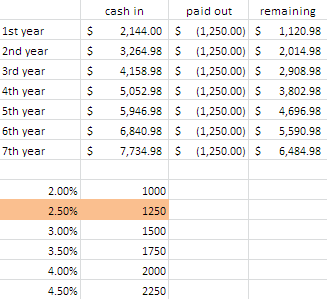
By allocating as such, I'll have a cash flow of $2,144 per year, which is equivalent to a 4.29% portfolio yield, inclusive of commission. I plan to give my parents 2.50% pa, keeping the remaining 1.79% to buffer against the loss of capital when the pref shares and bonds are redeemed at par value when they mature. With this spare cash accumulated over 2 years plus, I can also buffer against a drop in prices of around 10 to 15% (amounting to 2.3k to 4.8k), in case they want to get the money out before maturity and I have to sell below my buy price.


Estimated cash flow. Things will be a bit hairy upon the 5,6 and 7th year as some will be matured. But no point thinking so far ahead. A step at a time.


1. CapMallA3.8% (5 lots, board lot size 1000 shares)

This is the only bond that I have. The maturity date is 8.1 yrs from now, on 12-Jan-2022. There's optional redemption on 12-Jan-2017, 12-Jan-2018, 2019, 2020 and 2021. If they didn't redeem on 2017, then the interest will step up from 3.8% pa to 4.5% pa. It's a good thing if they redeem early, because by then, the higher interest rate environment might offer me more choices of bonds/pref shares that pay a higher yield too. If they don't redeem, I'll get a stepped up interest of 4.5% pa, so it's good too. Capmallasia is just more risky as a company compared to banks, so I only allocate 10% of the portfolio to it.


Do take note that if you buy now, you won't be in time to get the payment on Jan because the counter just went XI. The price, however, also dropped, so the total returns will be a little different from what I've put up in previous posts.


2. DBS 4.7% NCPS (2 lots, board lot size 100 shares)

They can first redeem on 22nd Nov 2020, which is 6.9 yrs from now, but this is an option for the issuers, not a requirement. You'll get 4.7% pa flat while holding.


3. OCBC 4.2% (12 lots, board lot size 1000 shares)

For this one, it's the more risky of the pref shares that I had bought. This is because the optional redemption date is on 14th July 2013, which had long passed. They can have the option to redeem anytime when they give the payments on 4th Jun and 4th Dec every year. Since I bought it above par, if they decide to redeem on the 4th June this year, which is one of their payment dates, I'll lose money. Based on my entry of 1.025, I just need to get 1 full year of interest at $0.042 and I'll be safe. That said, I think the chances of them redeeming on this kind of environment is going to be low. If anything, they shouldn't redeem this. They had already redeemed the higher interest bearing pref shares, so this is one of the lower one. It's a good bet, I think.


4. OCC 5.1% (1 lot, board lot size 100 shares)

For this, there's two interest rate. Before the first optional redemption on 20th Sept 2018 (4.7 yrs from now), the interest is 5.1%, based on $100 share price. If they did not redeem on that date, the interest will be 2.5% + 3mth SOR. Currently, the 3mth SOR is about 0.2 %, and 4.7 yrs from now, it should increase, not decrease. Since I'm happy getting a minimum of 2.5 % + 0.2% = 2.7 % pa, I got this too.


Tuesday, January 07, 2014

SPRD Gold and OCBC charts

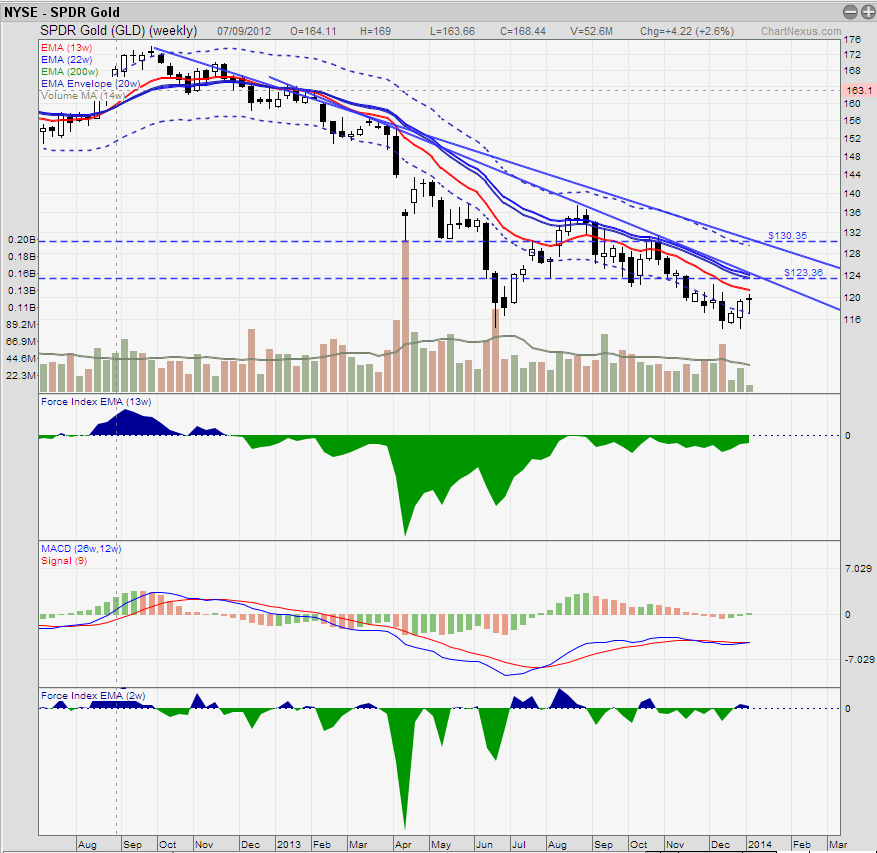
Haven't posted charts for ages! I haven't decide to enter or not, so this is just my trading thesis. Here's the two:

1. SPDR - Gold


Weekly bullish divergence.
A good entry price will be around 116.7 to 118.
Exit around 124 (1st target) and 130 (2nd target)

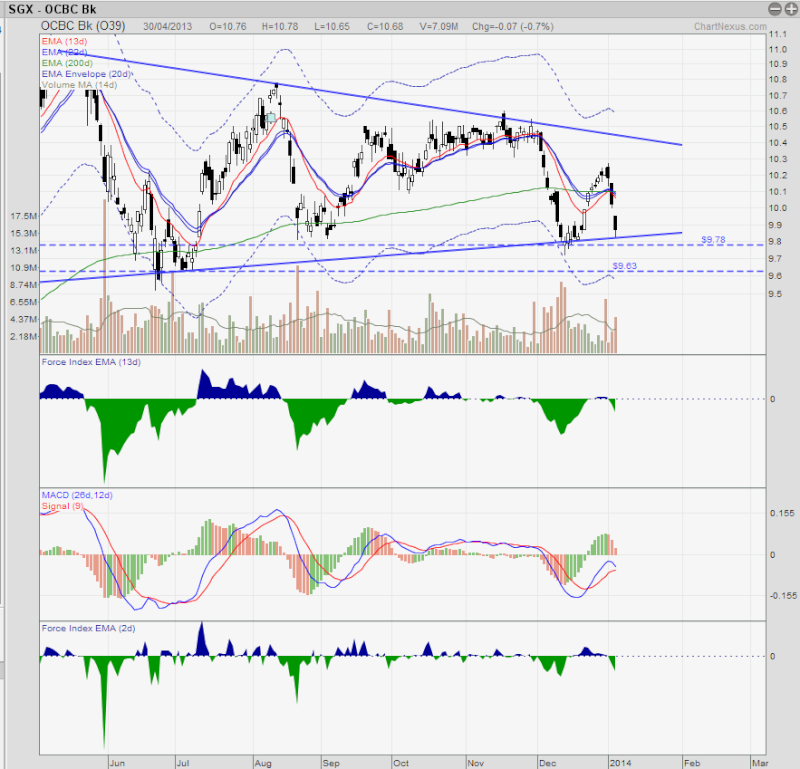
2. OCBC


Possibly daily bullish divergence
Let's see how it handles 9.71 first, but a good entry price (depending on conditions) should be around 9.63 to 9.71, with exit price at around 10.1 minimum. They have up to 31st Jan to finalise their ill fated deal. If it didn't go through, that should be a catalyst to return the price to mean. If it goes through, price might fall a bit more, considering that the price drop now is due to the uncertainty of the deal. At current price of 9.78, it's about 3.5% yield pa. Might be a good bet on the upside if you don't mind collecting the yield if you're wrong.

Monday, January 06, 2014

Systems vs Goals

I don't know if you've noticed, but suddenly everyone seems to be talking about the difference between goals and systems. I'm not going to define these terms, but I'm influenced more by Scott Adams way of throwing goals away and adopting a systems approach towards life. You can read his books about it but there's a short extract found here. It's not that goals are not important to me, it's just that I know how I react to not meeting them. You either achieve your goals and you feel happy and satisfied but suddenly you're at a lost of what to do now (I'm guilty) or you didn't achieve your goals and you feel unhappy so you either abandoned your goals or change it (guilty too).


I've a few examples of where setting goals didn't work for me:


1. When I was actively trading in the past, I wanted to earn xyz per day. That became so overbearing and pressurizing because I focused so much on it that I gave up after a string of failures.


2. I was trying to train up to run 10km. From 2.4km, I progressed to 3km, then 4km, then 5km and I hit a roadbump. It's just getting tougher and tougher to hit that distance and the longer time needed to run a longer distance makes it even more painful. I gave up and stopped going to the gym for 5 weeks before picking myself up recently again. The constant focus on the goal of running 10 km means that I'm constantly failing to hit the goal while building towards it. To continue on, I need will power and I only have that much will power to spare. Eventually when it depleted completely, I gave up on that 'impossible' goal.


3. Also on the same thread of exercising, I started training for my IPPT earlier last year. My focus is always to pass it, having failed the pullups and 2.4km for a few years already. So I went to the gym with that focus. It's a short term goal because after 2-3 months, I will take the test. I think precisely because it's short term, my will power can last that long. Upon accomplishing that goal, I suddenly don't know what to do in the gym. It's like I've lost my purpose. That's when I started trying to set a longer term goal of running 10 km and failed miserably.


I figured that goals are good for short term achievements. How short depends on your willpower storage capacity and the drainage level which is domain dependent. I figured something that can be achieved in less than a year wouldn't drain my willpower to the extent that I'll give up, but other people might have different threshold. My willpower also drains more when I'm doing physical activities than when I'm doing mental activities. For example, if my goal is to read 52 books per year (i.e. 1 book per week), I can summon up all my reserves to do that. However, if my goal is to run once per week, I might find it hard on some days just to put on that running shoes to do it. If it's just to run once per week for 1 month, no problemo. But if this is to last for one full year, I suspect I'll fall out in 6 months.


I lived my life setting goals both unrealistic and realistic and achieved a good proportion of it to know that it works for me. But the alternate system approach is worth a look. I figured, without testing it experientially yet, that adopting a systems approach will work much better for those super long term goals. For these long term goals, adopting a systems approach should cheat my body of replenishing my willpower instead of depleting it. If it doesn't replenish it, at least it wouldn't drain it that much.


So, how does it work?

1. Instead of having a goal of running 10km, scrap that target and try running once a week until I feel a runner's high. When I feel good after a run, that's a good run regardless of the intensity, the distance or the timing. Each good run will make the next run more likely to happen. The goal will take care of itself in due time.


2. Instead of focusing on earning xyz per day, or per month, just concentrate on having a good entry and a good exit. If I make sure I have a good entry point and an equally good exit point, the profits will take care of itself.


3. I want to save 30-40k a year every year, so that's a goal. To achieve that, I need to get x number of students every year. To strip it down further, in order to achieve this, I need to make sure I add value to students and make sure the parents understand I added value. A systems approach will be to forget about the savings target and instead make sure that every lesson I 'perform' adds value to them. I also have to make sure that this value added is repeatable and visible. The savings target will take care of itself.


4. I recalled the times when I was in the air rifle team. When I focus hard on the score, it adds so much stress that the result is often dismaying. In the old days, you have to put in a target, roll the target using a pulley system to a certain fixed distance, shoot, roll it back and repeat for 100 to 200 times. I'll feel very happy when I scored a bull's eye and unhappy when I didn't hit it. This emotional ups and downs makes it hard to shoot well. Ultimately, I came up with a system where I concentrate on my breathing and the whole shooting process but ignore the target. In fact, when I rolled back the shot target, I'll purposely not look at it and just place it aside. I realised back then that the short term focus on results will create unnecessary stress that will affect long term performance.


Some may see that goals and systems are related. In every system there's a goal and in every goal there's a system to achieve it. For me, I'm going to adopt short term goals and long term systems - the best of both worlds. You have to know yourself and how you react to goals and more importantly, in failing to achieve goals, to appreciate the the advantage of having a systems approach.