I was re-reading this book by Garrett Gunderson - Killing Sacred Cows. It's a very wonderful book with very refreshing concepts, so I make it a point to revisit some of the concepts espoused in the book every year when I have the time to do so. It's so easy to read that if you only have time to read one financial book this year, make it this one! You can have a sneak preview of the book here. Since it's the preview, not all the pages are shown, but I think it's enough to showcase it's attractive typesetting and page layout.
I remembered this particularly interesting concept, called the velocity of money. It is borrowed from the discipline of economics but in this case, it's applied to the field of personal finance. Basically, it's just an equation that is somewhat similar to the the mathematical form of efficiency. No wonder the concept feels similar to productivity.
Basically, the concept is talking about how to keep input at a minimum while increasing as much output as possible. The point here is how to continually extract more output and yet at the same time reduce your input. One example of this is to use the savings you had to buy into financial instruments that gives you a passive income. Then you use the passive income to buy more such instruments that will generate even more passive income. While the input remains the same (which is the initial amount of savings that you put into the instrument in the first place), the output keeps getting higher and higher. This is because the principal and the interest both earns you an interest, thus creating a self feeding loop - exactly how compounding works.
Another example will be a business like ebay. When it started, there are not too many buyer and sellers. An effort is spent to set up all the necessary infrastructure for the ebay business to begin. Once time progress, more sellers come into ebay to hawk their wares, which in turn attract more buyers. Seeing more buyers attract even more sellers and so on, creating a self feeding loop. The input is minimized but the output is exponentially increased.
I guess it works for the tuition business as well. As I begin the career, I have to read up on a lot of stuff to have the knowledge. All these are just one time effort. Once I get some students, a proportion of them will turn out to have excellent grades, which in turn will attract more students to come in based on recommendations and so on and so forth. These kind of network effect is not proportional to the initial effort that is put in, hence it's very powerful.
The book mentioned that net worth is like stored potential, while cash flow is like a tap with running water. Having a high net worth does not mean that the person will have high cash flow, but the potential is there. It's like you have a lot of cash sitting in the bank, with little debts (high networth). Cash has low velocity because the output (the interest earned) is very little. If one just utilizes the cash to do create value (here, value is defined loosely as something that is in line with your Soul purpose), then it'll have a higher velocity of money.
Now, seriously, I think that is a refreshing concept. As of all good speakers and good books, it's not that you do not know the concept that is at work here. It's the flair and the way the concepts are illustrated that makes it refreshing. As of above, so shall below. While the velocity of money is essentially a concept used in the financial field, I guess one can equally apply it to life in generally. I think the concept of the velocity of money forces one to think critically on out to increase the output value of every dollar that is utilized, so as to increase productivity.
Food for thought... would you rather have a high net worth or a high cash flow?
I remembered this particularly interesting concept, called the velocity of money. It is borrowed from the discipline of economics but in this case, it's applied to the field of personal finance. Basically, it's just an equation that is somewhat similar to the the mathematical form of efficiency. No wonder the concept feels similar to productivity.
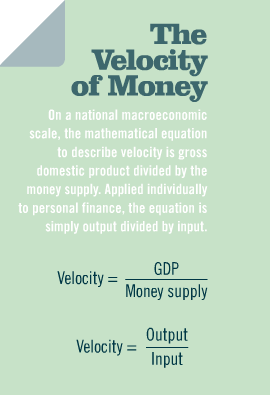 | |
| This is extracted from the book Killing Sacred Cows by Garrett Gunderson |
Basically, the concept is talking about how to keep input at a minimum while increasing as much output as possible. The point here is how to continually extract more output and yet at the same time reduce your input. One example of this is to use the savings you had to buy into financial instruments that gives you a passive income. Then you use the passive income to buy more such instruments that will generate even more passive income. While the input remains the same (which is the initial amount of savings that you put into the instrument in the first place), the output keeps getting higher and higher. This is because the principal and the interest both earns you an interest, thus creating a self feeding loop - exactly how compounding works.
Another example will be a business like ebay. When it started, there are not too many buyer and sellers. An effort is spent to set up all the necessary infrastructure for the ebay business to begin. Once time progress, more sellers come into ebay to hawk their wares, which in turn attract more buyers. Seeing more buyers attract even more sellers and so on, creating a self feeding loop. The input is minimized but the output is exponentially increased.
I guess it works for the tuition business as well. As I begin the career, I have to read up on a lot of stuff to have the knowledge. All these are just one time effort. Once I get some students, a proportion of them will turn out to have excellent grades, which in turn will attract more students to come in based on recommendations and so on and so forth. These kind of network effect is not proportional to the initial effort that is put in, hence it's very powerful.
The book mentioned that net worth is like stored potential, while cash flow is like a tap with running water. Having a high net worth does not mean that the person will have high cash flow, but the potential is there. It's like you have a lot of cash sitting in the bank, with little debts (high networth). Cash has low velocity because the output (the interest earned) is very little. If one just utilizes the cash to do create value (here, value is defined loosely as something that is in line with your Soul purpose), then it'll have a higher velocity of money.
 |
| Again, liberally taken from the same book |
Now, seriously, I think that is a refreshing concept. As of all good speakers and good books, it's not that you do not know the concept that is at work here. It's the flair and the way the concepts are illustrated that makes it refreshing. As of above, so shall below. While the velocity of money is essentially a concept used in the financial field, I guess one can equally apply it to life in generally. I think the concept of the velocity of money forces one to think critically on out to increase the output value of every dollar that is utilized, so as to increase productivity.
Food for thought... would you rather have a high net worth or a high cash flow?