Sunday, May 09, 2010

For whom is the whole life insurance meant for?

Just for whom is the whole life insurance meant for?


I've heard a number of people saying that they don't want to buy whole life because when they get older, their dependents would have grown up and thus there's no need to cover them anymore. The alternative is thus the term life plan because it's cheaper. This seems to suggest that the whole life plan is just for the coverage of their dependents in case the sole breadwinner (the person insured whose life is insured by the whole life policy) passed away.


My post here is to question that very assumption - that the whole life plan policy is to cover dependents in case you pass away prematurely, thus leaving them with a huge lump sum.


I do not use the whole life for such purpose. There are cheaper alternatives for such lump sum gift for those loved ones you leave behind to take care of financial matters. I propose that a whole life plan can be used to protect your own savings that had been built up thus far, from events that can erode it considerably. Events such as cancer, stroke, heart attacks and any other events that are debilitating yet not fatal immediately. In this sense, whole life policy will act like compulsory savings to force you to save up for such events.


Term plan can work the same, yes. But the catch is that term plan coverage only last around 60 yrs whereas whole life plan cover for an extended period till 100 yrs old.


So what happens between the years when your term plan coverage ceases? I think whole life can be used precisely for that purpose - to cover for the period when your term plan no longer covers you, until the day you pass on.


If something strikes you after 60 yrs old, and you do not have whole life coverage, someone will have to foot the bill. There are hospital and surgical fees to take care of, and there are other fees that had to be incurred that do not require hospital stay. Only the former are covered by H&S plans, so what about the latter? Things like non-standard drugs, stay home nurses and maid, overseas treatment....who is going to pay for them? The H&S plans do not cover things like that and I do not want to burden my spouse, relatives or dependents, so I have to depend on myself. But I do not trust myself that I can save up enough for such purposes, hence a whole life plan is critical for me to hedge against my own ability to prepare for such events.


I think of my own situation. I am sandwiched between two parties - the needs of my parents and the needs for myself. I've to buy insurance for my parents because they only have enough savings to take care of themselves if nothing extraordinary happens. If something is to happen, it will firstly wipe out all their retirement savings and secondly tap into my savings too.


They told me if something bad is to happen to them, I don't have to treat them because there's no point. I do not think I can do that. Can anybody do that? Not me. I only have limited amount of savings to handle my own affairs. If I have to help my parents, who would foot the bill for me if something is to happen to me? My dependents? Then this whole cycle will repeat again!!


I'm not a saviour nor a hero to rescue my future generations from this vicious cycle. I'm just a normal person struggling to make good on my dual duty as both a kid to my parent and a parent to my kids. It is only responsible for my kids to be born into this world without the excess baggage of the previous generation. I might not be able to do it, but hey, guess what, I'm doing my best.


It's also a bit too much to ask for a product to cover all of this stuff that I've talked about. It's not possible. I'll try to cover as many loopholes as I can foresee and do my best to steer my ship as danger free as I possibly can.

--------------------------------------------

Do note that I'm not a financial advisor. Of course I'm not. I'm just trying to make sense of all the debate here and there and reason out for myself on the actual purpose of certain insurance policies. I believe that no financial advisor can do that for you - you've got to think and reason it out for yourself. I do not presume to think for everyone, because my situation is uniquely mine. So do not follow me, because I'm not your leader. Do not walk ahead of me, because I might not be able to follow you. Do however, walk beside me as a friend, so that we can all share and discuss all our interesting life experiences together.

Friday, May 07, 2010

The official reason why MBS screwed up

** "BIAS" is a special feature in my blog where I get to say whatever I want with scant regards for your feelings. I'm not politically correct in this feature, so go ahead, judge me."


I saw from my favourite one panel comic site, Wulffmorgenthaler, dated May 7th, regarding this picture shown below. I liberally changed the script and inserted my own as a dig at the latest Marina Bay Sands (MBS) saga over the kind of world crass standard they exhibit recently.

I mean, they are hosting lawyers. MBS sure knows how to pick their fight. They could have screwed up on a conference by the society of garang guni, or the hen pecked husbands club, but they had to pick their fight on lawyers. Bummer...

I thus present to you, my interpretation of the issue. No need to thank me, MBS, for giving you an idea on the official explanation for the screw ups. There's only one thing worse than lawyers...

The official reason why some of the rooms in MBS are not air-conditioned


---------------------------------
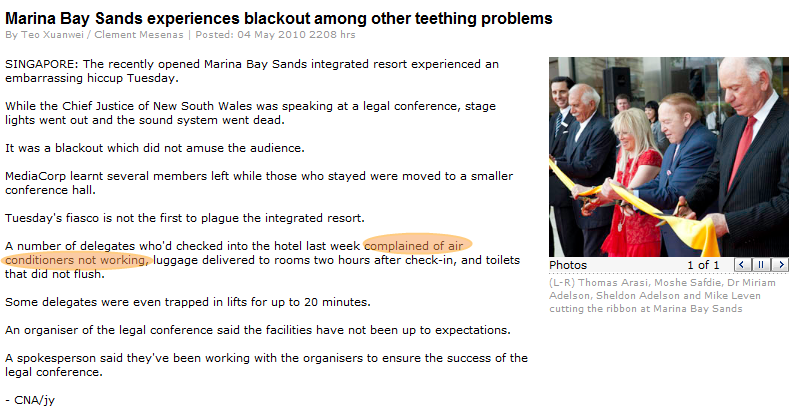
For the benefit of those who did not read up on the news, here's the article, reproduced from channel news asia site:


Thursday, May 06, 2010

How my world came tumbling down

After a few people smsed me and emailed me, I kind of realised that this post is a bit too much. Hence the disclaimer before the actual post itself. Do know that while reading this letter, it's supposed to bring out a certain point that is found only towards the end of the letter. SO, while reading it, the scenario painted out are NOT TRUE. While writing this disclaimer will spoil the "ah-ha" effect, I think making people unnecessarily worried about me isn't exactly the intended point either.

-------------------------------------------------------------------------------------------

Dear readers,


I had a very very bad week.


I fell down the stairs when I was going for my dinner last week. Dropped down a flight of stairs, sprained my left hand and broke my leg, leaving my leg in cast now. That was after I received a letter from the hospital after a full body check up the previous month. What can I say? The results are...not optimistic at all. It says that I've a growth in my right forearm, so more needs to be done before it can be ascertained whether it's malignant or not. As I was musing over the possibility of a cancerous growth, I must have lost my concentration and fell over the flight of stairs.


How can a spate of bad news hit me so relentlessly and furiously? Didn't my mum's high blood pressure got worse this month and had to be sent to the hospital? My pet cat's recent death already had me sleeping with my pillow wet and my eyes puffed up with all the crying. I don't think I've anything left to cry anymore. My gf had threatened to leave me after a very bad spate of arguments, so I can't seek consolation with her. Can I talk to my friends? They had 'left' me because while I was busy with my work, I didn't have time for anyone except to make more money. While they are physically there, our frequencies no longer resonate. It's just an empty feeling talking to them, because it reminds me of how things were in the past and how different they are now.


But all these did not happen at all. I did not fall off the stairs. I did not go for a medical checkup and neither did I receive any letter sentencing me to death. My leg is perfectly fine and my hands are still as dexterous as ever. My mum's blood pressure did not get worse and she did not go to the hospital at all. My cat is still very much alive and mewing for attention occasionally. My pillow and bed sheet are crisp and fresh as it had been changed just last week. I did had arguments and disagreements with my gf but she did not threaten to leave me. We are still very much in love. My friends are still there with me and though our frequencies no longer resonate perfectly, they are still in phase with each other. Conversations with them are no longer are as satisfying as I used to remember them, but we still know each other like a connoisseur to his favourite vintage wine.


So why did I tell you this? I just lost a few k in the stock market as the price spirals down and I want to let you see things in the proper perspective. Things are not as bad once you realised that you have a wonderfully blessed life right now, at this very moment. What is a few k of losses? Don't wait for the moment when you lose the things you have now to realise how fortunate you are.


Life is still very wonderful :)


Yours truly,

La Papillion

Of fishes and men

You must have heard of this story, it goes like this:

--------------------------------------------------------
An American investment banker was at the pier of a small coastal Mexican village when a small boat with just one fisherman docked. Inside the small boat were several large yellow fin tuna. The American complimented the Mexican on the quality of his fish and asked how long it took to catch them.


The Mexican replied, "only a little while."


The American then asked why didn't he stay out longer and catch more fish?


The Mexican said he had enough to support his family's immediate needs.


The American then asked, "but what do you do with the rest of your time?"


The Mexican fisherman said, "I sleep late, fish a little, play with my children, take siesta with my wife, Maria, stroll into the village each evening where I sip wine and play guitar with my amigos, I have a full and busy life."


The American scoffed, "I am a Harvard MBA and could help you. You should spend more time fishing and with the proceeds, buy a bigger boat with the proceeds from the bigger boat you could buy several boats, eventually you would have a fleet of fishing boats. Instead of selling your catch to a middleman you would sell directly to the processor, eventually opening your own cannery. You would control the product, processing and distribution. You would need to leave this small coastal fishing village and move to Mexico City, then LA and eventually NYC where you will run your expanding enterprise."


The Mexican fisherman asked, "But, how long will this all take?"


To which the American replied, "15-20 years."


"But what then?"


The American laughed and said that's the best part. "When the time is right you would announce an IPO and sell your company stock to the public and become very rich, you would make millions."


"Millions.. Then what?"


The American said, "Then you would retire. Move to a small coastal fishing village where you would sleep late, fish a little, play with your kids, take siesta with your wife, stroll to the village in the evenings where you could sip wine and play your guitar with your amigos."


The moral of the story… Know where you’re going in life — you may already be there.
---------------------------------------------------------

I disagree with the moral of the story. In my own twisted interpretation, the moral of the story, to me, is:


1. If the Mexican is already a millionaire and is thus living the life doing what he wants (i.e. fishing leisurely). then the moral must surely be that you must work hard to have a certain amount before you can do what you want in life. In other words, work hard now, so that you can enjoy your retirement doing what you like without worry for money.


2. If the Mexican is not a millionaire, then there is some difference between a millionaire-turned-fisherman and a fisherman, even though there are doing the same things now (which is fishing leisurely). I do not know if the Mexican's wife and family will argue with him everyday to bring in more money to feed the family or not. It's not stated in the story, but I would imagine so. There are responsibilities to fulfill, and so I would not seek to do what I really wanted before settling those responsibilities.


3. I remember what snr bro said the other day. Young men must spend more time and energy to earn money. Older men must spend their money to earn more money. Perhaps the Mexican is doing that, or had some other income stream so he do not have to be there physically to earn the money.


The fisherman's tale is not as romantic as first thought. Life is inherently harsher than a fairy tale.

Wednesday, May 05, 2010

STI spooked by the PIGS

Who's afraid of the big bad PIGS? In the real world, the wolf should be afraid of the PIGS. One little pig knocked on the wolf's door and caused such a panic around the world. Now, the wolf is afraid that other little PIGS will come to knock on his door.

Let's take a look at STI weekly:


Weekly chart shows a bearish divergence on long term force index, but not on macd histogram yet. The degree of selldown isn't as much as that experienced in January earlier this year. Maybe not yet? haha! The previous selldown took 4 weeks (4 bars) before stabilising, so perhaps we'll see the same too? The selldown had brought STI to the value zone already, so the minimum target of the selldown had been reached. It will most likely over-react to the downside.

STI daily:


There's a gap support around the region of 2790 to 2820. Looks like that level also coincides with the mid term trendline established in Aug last year. Another 1.5% to 2.5% to go? I don't think now is the time to sell your cats and dogs to raise capital to buy up stocks. I finished my first wave of buying...will wait for clearer signs before putting in more money.

When there's nothing to do, do nothing.

Thursday, April 29, 2010

Solution to problem sum

Here I shall reveal the calculations that I had based on the problem posted in this earlier post. I sort of figured out that nobody will be so bothered enough to go and try calculating the theoretical price of ARA after XA, so I might as well show the answers now. Thanks HH for trying it! Haha :)


Since in the real world, there are no teachers to check for you and no answers behind the textbook to assure that you're right, we always have to try solving the problem using different methods. If all the methods arrive at the same conclusion, then chances are, you're right until someone proves you wrong.

First method:

I tried using numbers to have a feel of how it works:
Let's say I have 10 lots of ARA shares @ $1.00 average price. Since the dividend is declared at $0.025 per share, or $25 per lot, I'll have $250 dividend for my 10 shares. The closing price a day before XA was $1.15, so I can calculate what's my profits so far.

My inventory before XA: 10 lots of ARA shares bought at $1.00

Sell price : 1.15

Profit from shares : (1.15 - 1) x 10,000 =  $1,500
Dividend : $250

Total profit before XA: $1,750 (1500+250)

Now, what happens after XA? The price of ARA drops because there are more shares floating around due to the 1 for 5 bonus issue. This means that for every 5 lots of ARA shares you own, you will now have 1 lot of bonus ARA shares. The price drops accordingly to reflect the fact that the market value of ARA remains the same. Do note that only the ordinary shares are entitled to dividend; Bonus shares are not entitled to this round of dividend but they are eligible for future dividends.

Let y be the price of ARA after XA.

My Inventory after XA: 10 lots of ARA bought at $1.00 PLUS 2 lots of bonus shares

Sell price : y

Dividend : $250

Profit from the original 10 lots of shares : (y - 1.00) x 10,000
Profit from the bonus share : y x 2,000
Total profit : 10,000y + 2,000y -10,000+ 250 = 12,000y - 9,750

Since y should represent the theoretical price such that my profit/loss before and after XA is to be the same, I equate the two profits,

12,000y - 9,750 = 1,750
Solving,           y = 0.95833

Hence $0.958 is the price such that my profits before XA and after XA is the same.


Second calculation:

I noticed that several terms can be removed without changing the answer. First of all, dividends doesn't matter as both sides of the equation contain the $250 divy term. Next, even if I tried different no. of shares bought at different price, it doesn't change the answer. I changed all the variables to algebra, and confirmed that the calculation remains the same. Without bothering you with the details, here's the much simplified formula:

Price = 5 x (closing price before XA) / 6

Since the closing price is 1.15,

Price = 5 x 1.15/6 = $0.958


Third calculation:

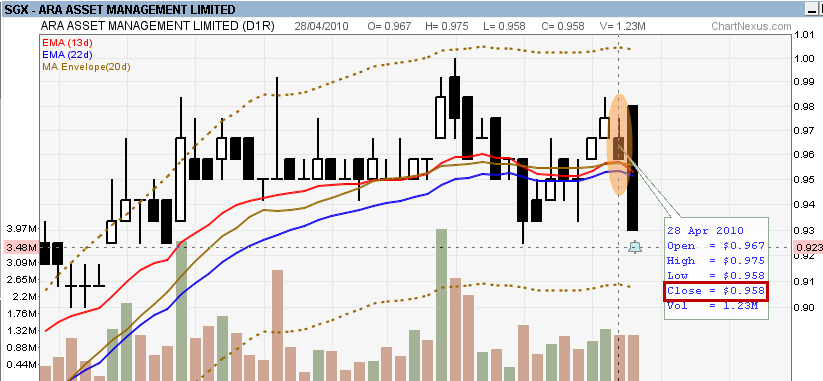
Not really a calculation. It's more like to show you that chartnexus had worked out what I had worked out in the morning. The chart clearly shows that the price before XA, on 28th Apr, had a closing of $0.958 whereas it was 1.15 just the day before the software updated the changes.


The closing price a day before XA clearly shows $0.958 instead of $1.15

The theoretical price is definitely different from the closing price. I cannot predict how the price will close and I know that the theoretical price will only be there for a fleeting moment. So, isn't it a waste of time trying to calculate something that only exists for a moment?

Not to me. I take great pleasure in such intellectual masturbation. It's like an unreachable itch behind the back, irritating me until I can solve it :)

Problem sum

This morning, I was trying to settle a problem related to the market. In real life, much of the challenge lies in defining the problem, rather than solving it. Once the problem is defined clearly, the solution can be found, or you can find people who can help you solve your problem. I shall spend some time defining the problem.


The problem is laid out here. I had bought shares of ARA on three separate occasions. They declared a dividend of $0.025 per share and thereafter a 1 for 5 bonus share issue (meaning that for every 5 shares held, you'll get 1 bonus share). The bonus shares are not entitled to the dividend because it comes after the dividend is declared. The last closing price of ARA yesterday before it went XA (ex-all) was $1.15. So, the question is, what should the theoretical price of ARA shares be, after it goes XA today? The theoretical price is the price of the new ARA shares after XA, such that the gain/loss before XA but after XD (ex-dividend) is the same as the gains/losses after XA. To put it more simply, what is the price of ARA today upon XA, such that my gain/loss is the same as my gain/loss yesterday, before XA?


A good problem will generate sparks in your neurons


I had worked out the answer, but I thought it'll be a nice exercise for those interested to solve this mathematical problem sum related to the stock market. I'll share the answers that I had worked out in a few days to give time for people interested to work it out :)

Wednesday, April 28, 2010

Don't be the last fool standing

As I see more and more newbies coming in to the market, I thought it'll be only right to warn them that the market is not their mother to give them money, but to take it away from them. I must have repeated this countless times in previous post, but it seems I only see more clueless newbies coming in to participate in the market.

Some of the gripes I had with newbies are:


1. I'm in it for the long term

I cringed whenever I heard the word investing for the long term. It shows a few things - firstly, the person saying it believes that in the long term, every mother father stock in the market will rise. How long is long? From historical data, if you invest in STI, you won't lose any money after putting it there for 14 yrs. If you look at Joseph's theory in cycles, you also need around 12 yrs before we can say that we're peaking. All these are related to STI only, so if you're investing in individual companies, then you also assume the individual company's risk, which may not be correlated to STI at all.

So, the ultimate question is - are you prepared to hold it for the really long term - 10-15 yrs - all the time while your stock is bleeding, your capital locked up and seeing light only after that time period had passed? If you do not have the conviction, don't tell me you're buying for the long term.


2. While the attitude is to hold it for long term, there is no corresponding attitude to learn the market properly for the long term.

First deserve, then desire. If you do not wish to learn more about the market, yet wish to profit consistently in it, then you're like the weekend jogger who wants to compete with an Olympian athlete in a race. You might win him occasionally when he's not paying attention but when he does, you're dead. The odds are so against retail investors already, so why make it worse by not learning it properly?

Putting money in the market is like playing musical chairs. While the music is playing, everyone is happy. But when the music ends, do not be the last fool standing around mystified while everyone had found their seats. I repeat - do not be the last fool.


5 individuals but 1 chair - who's going to be the last fool standing?

3. The interest rate in banks is so low, so investing is good as it gives high returns

Yes, the interest rate is miserably pathetic at 0.125% per annum, but who ever heard of someone losing their principal sum by putting money in the bank, to the tune of 30-50%? That's how much you can lose by risking your money in the market. Don't just look at the returns, look at the possible losses! If you think you have a strong risk appetite (by filling those silly forms), ask yourself what you will do if you invest 30k but you are left with only 15k. Don't learn the lessons the hard way like me.


4. Greedy not to miss the run, yet no fear that the market will turn against you

Afraid to miss the market? Why so eager to lose money? If I know anything about the market, it's that it always give you second/third chances. There will always be opportunities, so why so eager to jump on in? Sincerely, without any malice, I wish that any newbies who put their money into the market loses their money when they first started. That will put them into the correct mindset. If anyone makes money, they start thinking that the market is like an ATM machine.

That's when the market starts clawing back the money given to you, often with a hefty interest put in.


Will people heed the advice? I bet most won't, there's why the market is as it always had been. Sounds harsh? Well, I know that money is hard earned, so don't waste it like that. Go smoke a cigar and have a good meal, at least you'll have some fun and entertainment.

Monday, April 26, 2010

Of Dragons and Men

On Sunday, while waiting for my gf to appear, I was spending the time at the MPH browsing some books. I picked up T.Harv's Secret of the Millionaire Mind from the shelf and started reading some chapters of it. It was a wonderful recap of what I had gathered from the book, since the last reading maybe like 1-2 years ago.

A phrase caught my attention. It goes something like this, "Rich men grows bigger than their problems. Poor men tries to solve their problems".

I took my eyes off the page and reflected on that line. It struck me like a chord that resonates within me...how true! The line simply means that if we grow bigger than the scope of our problems, than the problems cannot even harm us significant. In fact, some of the problems might not even be problems anymore.

This message drives in deeply, especially after I've watched the 3D version of How to Train a Dragon (btw, a wonderful and touching story). I watched in glee as the Vikings throw their catapults at this giant dragon that just leaps out of the screen. The boulders just bounced off its thick hide whereas earlier on, the same catapult just knocked off some of the smaller dragons.


Problems are relative, it seems. If you're a big dragon, you're not bothered by the relatively small stones. But if you're a small dragon, you're especially bothered by the relatively big stones, but quite immune to the smaller ones. This idea of growing bigger than your problems focuses the attention not on the problems, but on the one thing you can control - yourself.

That's quite refreshing to me. Some examples of how this works:


1. In the past, I tried not to take cabs because I always think that it costs several bus/mrt trips and I could save that few dollars. As I grow out of this problem by earning more and valuing my time more, I no longer worry about taking cabs. I might just take it when I'm tired and had a hard day, or simply to save time.


2. I used to fret when students cancel my lessons and drop off the tuition classes. But as I get more and more students, the percentage of cancellation drops as I grew 'bigger'. It doesn't affect me much anymore. In fact, sometimes I would be very happy as I can get to rest or spend more time with people I value.


Maybe it's time for me to re-read that book again after so long. Might want to add it to the list of books that I must read every year :)

Saturday, April 24, 2010

The stress faced by a teacher

These few weeks I'm ultra busy. Normally, I'm just busy. The mid year examinations are coming, so that's bringing a lot of extra work to me. When you read this post, I'm probably out working already - I just scheduled this article to be posted at this time and date. Ah, the magic of technology.

In the past, during this period, I'll be quite stressful. This is because I've to push students to cramp a lot of things in their mind to prepare them for this major examination. I certainly don't like doing this because it's a mad rush of time. But can you imagine the students? It'll be worse because they are the ones taking the examinations and facing the consequences in the end.

Over the years of tutoring, I realised these truths:

1. Some students just do not want to get A. You might want them to get it, but if they do not desire it, they will just put in enough effort to get whatever grades they think is fair for them. I realised it's more of a motivational issue than a knowledge issue. I blogged about motivational methods in the past, and I employed every single trick that I talked about, to various outcomes. I can't do it consistently so I usually try to do everything and see if it hits something. If I managed to motivate them, they will do all that is necessary to get it done.

2. I fully understand the stress of teaching students. It should be (if it isn't already) the first thing they warn you about when getting your teaching degree. You say something important, students do not get it. You say it again, they got it, then after a while, they forgot about it. So you repeat and if they still do not get it, you get frustrated. This is because there's no reward in your actions. Action without reaction leads to frustration. But what happens if you give up? Then there's no hope anymore.

This is of course easier said than done. I had given up hope on students too (maybe less than 5 out of so many over 7 years) because I'm only human and can only take a certain amount of punishment before I give in. But remember, if you give up, there's no more hope.


3. It's possible to win a battle but lose the war in teaching. While stressing the importance of major examinations, you can actually create such bad vibes in learning that it might lead to bigger problems downstream when it comes to anything school related.

I remember teaching a JC student about maths. Though he didn't do very well in statistics when I taught him (he always get mediocre grades for his tests), he found the topic fascinating. I jumped on that curiosity and introduced him a few things that are not required in the examinations but can expand his views on the topic itself. So years had passed and sometimes when I met him on the street, he'll shout out to me and said that he remembered me teaching him statistics and had a fun time together. He even wanted to do a statistics course in university.

I pointed out the story to highlight the fact that it's sometimes easy to forget the perspective in things. Being zen-like and having the belief that things will work out well in the end will remove some of the stress in teaching students. I always say this: Things could get worse ...but it didn't.


So, for all the parents and tutors out there teaching their kids, I hope this article gives you something to think about over the weekend. Have a great weekend :)

Thursday, April 22, 2010

Changes in the education system

** "BIAS" is a special feature in my blog where I get to say whatever I want with scant regards for your feelings. I'm not politically correct in this feature, so go ahead, judge me."


I read with interest regarding the latest changes to our education system. Most of the time, the changes will relate to mother tongue - a misnomer for the second language we learn besides English. The bugbear had always been the teaching of chinese, which many found it extremely hard. Interestingly, scant little had been done for tamil and malay when compared to chinese, where many innovative and creative ways to teach are reported in the newspaper. I could be wrong, but if there's any changes, it is definitely not as 'reported' as those changes made in the chinese language. Maybe the advocates for changes in the malay and tamil languages are not as loud as those for the chinese language.

What's the problem with the current psle system? There are 4 subjects in the psle scoring system - english, 2nd language, maths and science - all of them had equal weighting in the final tally of the psle score. The new change is to correct the weighting of the 2nd language, so that it will count lower towards the final score.

I'm thinking aloud to myself :

1. From what I observed, most of the kids from the upper echelons of society speak English at home. I'm from the middle class, so of course I do not have the same opportunity to mix with those who are really in the top of the top. I would assume that, they too, will have kids who speak English at home, and not their mother tongue.

2. Again, from what I observed, those who do not speak the language naturally at home will not do very well in exams. If the kids do equally well, they must have spent a lot of effort and money to raise their proficiency in what must have been their 'weaker' language. Since effort and money is limited, the same amount could have been applied to their other subjects to achieve higher results.

3. I tend to teach the middle and lower classes more often that I do to the upper classes. Their main language at home is either their mother tongue or, for those from the chinese ethnic group, their individual dialects like teochew and hokkien. While I won't say that they will naturally do better in their second language, they certainly do not display the same agony when learning them. In fact, quite a few of the students I know actually rely on their second language to push up their grades in the exams. 

So, is it possible that the latest changes to the psle subject weightings can cause a change in the playing field among the different societal classes? Could the changes benefit some classes of society more than others?


If you throng the forums regarding the latest changes, you might have heard variation of conspiracy theories regarding some MPs with kids who are going to sit for the psle soon, and so they are pushing for the change. I couldn't help but nod understandably that such a situation might be true. Whether the rumors are unfounded or not, the fact they people are thinking like that suggest that more explanations and studies are needed to reassure Singaporeans that the changes are in fact for the benefit of the majority, not just for the powerful minority.

Do understand that while the upper echelons might suffer in their education because their weaker language is dragging their results down, at least they have an option to leave Singapore for better opportunities. The rest of us who do not have the means to leave Singapore are stuck with whatever changes and decisions that are made in the education system.

Life is never fair, it seems.

Wednesday, April 21, 2010

I'm credible now

Sometime last year, I tried to apply for credit cards but failed miserably. I blogged about how frustrating it is to be bombarded by sales people egging me to get their free cards but when I filled up the long forms and submitted the required documents, they rejected me without any explanation.

After a few tries last year, I gave up. I tried a few things but didn't work. These include:

1. Showing them a fat bank account flushed with cash
2. Sending them 3 years of tax assessment notice
3. Paying 5 bucks for a CBS report to check my credit worthiness

It seems a funny thing right? Banks consider self employed as less credit worthy as someone who is employed. That's how the world works, I can do nothing much about it. But recently, just 2 weeks ago, my application for POSB everyday credit went through and I received the card through my mail.

Plastic plastic - life's fantastic


It was a joyous occasion to me, not because now I have a piece of plastic dangling in my wallet. It's because my concerns - about not being able to borrow money to finance my purchase of property - might not be a problem anymore. It's important to have a good credit history so that institutions can lend you money when you need it. This is definitely the unexpected disadvantage of being a full time tutor. Maybe I shouldn't generalise because it might just happen to me only.

I'm going to apply for a few more cards.

Sunday, April 18, 2010

Another way to beat inflation

I was looking at Adrain Khiat's column in the straits times this morning. Wow, he made it to the newspaper already, especially after he revamped his blog. I wouldn't say I'm a fan of his, but I do read his posting on and off. I stopped because there is just to much negativity in the comments. Might want to visit it again soon :)

Anyway, he mentioned something about child education and how inflation can cause the tuition fee for local universities to rise up to an astronomical sum, 20 yrs later. Somehow, I caught on to the idea of inflation after reading this.

I though that yes, inflation will cause the price of things to go up. But wouldn't inflation cause your salary to go up as well? Basically, the price of goods and services go up because the cost of producing these goods and services go up as well. Your salary will form part of the rising cost of these services. I think the bugbear here is not inflation per say, but rather the fact that while your salary increases, it might not rise as high as the cost of goods/services sold. If that happens, then it'll be a problem. You just have to look at the percentage rise in median salary vs the percentage rise in HDB flats over the last 20 yrs to see how HDB is still very 'affordable' to everyone.


Haha, the inflation monster is hiding in the closet!


When I started tutoring 7 years ago, I'm charging a rate of $22 per hour. Now I'm charging a rate of $40-60 per hour. Take $50 as the average rate per hour, this would mean an average inflation of 12.4% per yr. I think this would beat the average 3-4% inflation per year in Singapore.

Am I excessively worried about inflation? Not really. I just make sure that my salary can catch up with inflation. How? Ensuring that I do the best in my job so that I can command a premium rate. I have an advantage that employees do not have - I can determine my own hourly rate and float it accordingly to the times. While I realize that there is a cap to how much I can raise my rates for 1-1 tuition (since it would inevitably lower the demand), I can always aim for another model of business- the low rates, high volume kind, which is typical of group tuition.

Saturday, April 17, 2010

4 panels say it all

Sorry, I just couldn't resist it when I saw this picture :) This picture is taken from this hilarious site, but I had to censor some naughty bits before posting.


4 panels to tell a story that everyone who had dabbled in the market knows, haha! As I'm blogging, US is on a pretty major slide because of news of SEC's prosecution on one of the giants of Wall Street - Goldman Sachs.

Thursday, April 15, 2010

First deserve, then desire

It's been a long while since I returned to CNA forum (I linked it up in my blog, near the header). I used to go there everyday in the past just to read some of the entertaining banter that goes there. I stopped around 1-2 yrs ago because there isn't anybody there anymore. So, it's a surprise to see that the activity over at cna forum is getting quite hot.

I also realised that more people are jumping into the market. Just yesterday, I looked in fascination at someone trading using the IG platform with a netbook on a bus. I looked at the time - it's 2153 - so he must be trading the US market. The netbook was still opened when he alighted the bus. Watching the prices ticking, I suppose.

People are definitely returning to the market, though not yet in droves. But the signs are there. I've been noticing more and more activity, especially of newbies, entering the market. People whipping up IPOs, chasing after dual-listing candidates, more stocks breaking 52 weeks high....heck, even STI broke through the 3000 mark yesterday with ease and high volume.

I believe one must deserve before desiring to win in the market. If newbies are whacking the market and boasting how easy it is to make money from their pickings, something is very wrong. The market works in such a way to funnel the money from the masses to few professionals. If anyone without an iota of technical nor fundamental knowledge also starts making big money, I think the party is going to end soon. Not without the customary fireworks, of course -  the climatic grand finale so typical of bull runs.


"Are we there yet? Are we there yet?", the donkey in Shrek kept asking. I don't think so. I'm just waiting for the newspaper headlines to say that we've reached a new high or something. Bulls always climb higher up a wall of worry, I guess.

What's my action plan? I've cashed out quite a few positions that I've no intention to keep and getting ready for a near term correction to buy up some bargains if any. If there's no correction, so be it. I'm not going to let the market control my mood. Definitely no seller's remorse for me.

Tuesday, April 13, 2010

Hedging

As the market marches on and ever upwards, we've to start thinking whether to cash out some profits or to ride it further. I've posted here that STI shows signs of weakening already, so it's always prudent to take some profits off and to have more cash in hand to snap up good bargains when the correction comes in. This is to hedge your opinion in case they are wrong.


1. If the market goes up, you'll still have some stocks in it to ride the uptrend.

2. If the market goes down, you'll have some cash in hand to seize the opportunities offered.


You'll notice that either the market goes up or down, there's always something to cheer for. I think that is the ultimate emotional state in the market - you don't really care if it goes up or down. You'll also notice that by hedging, we will not gain as much as we possibly could, neither would we lose as much as we possibly could. That's the point - we don't want extremes.


I think this advice applies to life as well. It's good to hedge your life in case it didn't turn out to be as planned. You know, we tend to think years ahead to plan for the future. We want to reach financial freedom by a certain age so that we don't have to work anymore and can enjoy our retirement. But what happens if that doesn't happen?

I think we have to take small 'profits' along the way in case the longevity of our lives are overestimated. While you are working towards that dream life of yours, do remember to live a life and enjoy the little things. We live once and it's regrettable if we didn't experience as much as we can.

I'm really just advising myself here, being such a workaholic.

Friday, April 09, 2010

I'm grateful for...

The hot weather plus the frentic pace of work makes my temper volatile. I think it's good to think about the things that I should be grateful for. These are written as they come to my mind, so it's not in any particular order of importance.


1. I'm grateful for a hand to hold and a heart to understand, which all comes in a package as my gf - the source of my many troubles and many many more joys.

2. I'm grateful for the sisterhood and brotherhood formed in my blog. Hey, never in my wildest dream did I think that setting up a blog can have so many fringe benefits. They had spent their time with me generously, where instead they could have spent it on their own pursuits and for that I'm doubly grateful.

3. I'm grateful for a healthy body and an inquisitive mind. Without each, I would not be able to do what I can do with the energy and drive that I had.


4. I'm grateful for the bountiful food and drinks that I can eat and taste, made all the more sweeter and delicious by the wonderful company that I had.

5. I'm grateful for healthy and living parents. Despite all the misunderstandings, I know they still love me as a child and I to them as a parent.

6. I'm grateful for the cool quiet nights as I walked home from work. It feel very serene and I almost feel ashamed as my footsteps broke the silence of the night.

7. I'm grateful for the cats in the world. Without them, the world would not know the softest spot to sleep. None can rival the cat in the way they can provide a quiet companionship, sitting just beside you, contented to be just near your presence and asking for nothing more.


Upon reaching no.7, I feel much much better already, so there isn't a point to move on. What a wonderful exercise! I would do more next time when I'm feeling, to lack a better word, ungrateful.

Wednesday, April 07, 2010

Dubai or not Dubai - that is the question

Seems like the IPO market is hotting up. I've seen a lot of people asking whether to subscribe to the IPO and how many lots to bid. Personally, I hate to bid for IPO. Why?


1. IPO stands for It's Probably Overpriced. Mw told me this before, I agree.

2. You do not know how many lots you are going to get, hence people will usually bid more lots than they really want. It's a catch-22 situation - if you get it, it means that people do not want it. If you don't get it, it means that the IPO is hot.

3. Money will get tied up for some time while the ballot is taking place. Unsuccessful bids will have your money refunded after another period of time. Of course, there will be a placement fee which is not refunded. I don't like getting my money tied up like this.

4. Based on experiences, the price will fall after the first day of trading. Hey, if you can think that you're going to make a profit by selling on the first day of its trading, so will others.


It's the last point that I'll be looking into with more details. I want to find out if my experiences is grounded in reality, or I'm just suffering from schadenfreude. Let's take a look at some of the IPOs listed in the last two years:


Do take note that there could be errors in my interpretation of what is considered bottom. The data is gathered with the best of what my tired eyes provided me.

Based on the simple assumptions, I proceed to make some daring but hasty conclusions. Here's what I found out:


1. Out of 29 IPO samples taken since last year, 26 of them had the highest price of its first trading day above its IPO price. Only 2 of them had their highest price below the IPO price on the first trading day, and 2 of them with the highest price being the same as IPO price.

It would seem that betting on IPO offers quite a good bet, regardless of fundamental. The probability of winning seems rather good (if you sell at the high). I'm thinking that even if you didn't sell at the high, you would have made a pretty good quick profit. That statement remains untested.


2. Of the 26 which had a high above IPO price, they have an average gain of 35% gain on its debut day. That is if you managed to sell at the highest point. Of the 2 that had their highest price below IPO price, the average loss was 2.5%.

Well, not only is there a high chance of a winning trade, the rewards of a winning trade is also much more than the loss of a losing trade.


3. Based on my subjective view of a bottom, only 9 out of 29 samples (I exclude TTJ because it's too young) had a closing price at the bottom being higher than the IPO price. 1 remained unchanged, so that leaves 19 samples with the closing price at the bottom being lower than the IPO price.

This means that if you're an investor looking to get a good yield on low price, you might as well wait instead of punting on the IPO. You have a good chance to get a lower price later.


4. Out of those 19 samples that had their closing price at the bottom being lower than the IPO price, the average drop in price is 15% below the IPO price. Out of those 9 samples, the closing price at the bottom rose 22%, on average, above the IPO price.

While it seems that a quickie is quite a good bet in the IPO market, it's not so good if you're planning to invest for a longer term. If you're looking to invest, I think it's better to wait for the price to drop below IPO price. There are times when your plan to get a lower price than the IPO price may fail...but I think you stand a good chance.


5. Out of those 19 samples that had their closing price at the bottom being lower than the IPO price, the average waiting time to wait for a bottom is 33 days.

However, do take note that this period of time suffers from a huge variation, possibly depending on market sentiment. From a visual glance, I noticed that in 2009, the wait for a bottom is longer. The few IPOs that we had this year...their wait is much shorter. Around 2-3 weeks only.


I think the key takeaway is this:

1. If you're looking to punt for a quickie, go ahead.

2. If you're looking to invest, wait a while for a lower price.

As for me, I don't think I have the luck to get a successful bid. Don't think I'll be going for any IPOs. This is not the kind of money I make and I understand that. Let others take the thrill.

Monday, April 05, 2010

I just want a checking account

I wanted to open a joint account with checking facilities (meaning you can write cheques) with my gf. The main purpose of it is to allow each of us to contribute a part of our income to pay for joint expenses like mortgages, groceries, furnitures etc. Since I was at suntec yesterday and OCBC had their branch opened on Sunday, I popped by to enquire.

It seems that we intruded on their private small talk because the lady serving us seemed very annoyed and impatient. I asked her some simple questions but she didn't seem to know her stuff that well (she was reading it in front of us), so my gf asked her some stuffs about the practice of other banks and she replied that we have to check it out ourselves. Okay, I seriously must thank her for her good advice to check it out ourselves. Otherwise, I wouldn't have known that even a simple thing as opening a checking account can have such a wide differences between the major banks in Singapore.

You must hear it from me - OCBC offers the worst deal if you ever wanted to open a checking account in Singapore. Out of all the banks I compared, OCBC is the only one that requires a $2 fee per cheque written. Do check out this table for more details:


The above table is correct as of 5th April, 2010. You know how hard it can be to navigate and understand those statements and fine print, so I did my best. If there's any objections or mistakes, pls pls correct me.

That includes you, OCBC.

----------------------------------
After showering, I thought I was being unfair to OCBC. They do have an advantage over other local banks. It's the only bank that operates on Sunday. That is an extremely value added (costly, perhaps) service to busy people in Singapore.

If we compare local and foreign banks, you'll find that foreign banks generally offer more incentives to attract customers. It's the oh-so-valuable deposit money that is the lifeblood of banks. I suppose that the local banks already have high deposit ratios, hence they are not so eager to create new incentives to attract people to deposit. Just my hypothesis.

I'm not so excited over the 'high' interests in some checking accounts. A MMF fund easily beats it at around 1% per annum. Yes, it's a little tiny bit riskier and it's not guaranteed. Free cheque book is doesn't attract me much either, because I doubt I'll be using that often. It's one of those things that is good to have, in case you need it. I absolutely do not want to pay a fixed monthly fee, though a fall below fee is fine.

That being said, I think Citibank and Stanchart xtrasaver seems like a mightily good idea. Both are open on Sunday too, in case I need their services.

Sunday, April 04, 2010

Spend too much on savings

My gf coined that title, when I told her I saved this and that every month. It was a very interesting way to put it, as the contrast between spending and spending cannot be more stark when they are forced into one single statement like that. How can someone spend on savings?

The story goes like this.. Sometimes when I see something that I that interest me, my gf would tell me to just get it. But I told her that for this month, I do not have the budget for it.


"How can it be? You saved so much every month!"

"Aiya, the savings is used for other purpose, not to buy this mah."

"You must have spent too much on your savings lah"

"...."


Come to think of it, it's quite true isn't it? 1.5 years ago, I'm an incidental saver. It means that even though I save a portion of my monthly income, I do not have a goal and neither did I track my savings. I just spent what I had for the month (which is not much) and saved what is left. However, since I started tracking things a little more seriously, I realised this is not sufficient.

I began to treat 'savings' as an expense, something like how you would treat money spent on food and gadget and movies. Everything I have some income, I would squirrel a portion of it into another account so that I do not touch it nor see it. I would continue to do so for the rest of the month until I have met my savings target for the month. If I keep on track of my monthly savings target, I would hit my yearly savings target - a grand total of 50k (again).

This is essentially the same as 'paying yourself first'. I think it works tremendously. I particularly like the philosophy:


If you save 20% of your income, for every 5 years you worked, you can don't work for 1 year.

If you save 50% of your income, for every 2 years you worked, you can don't work for 1 year.


Well, not really. I didn't mean to say that you REALLY don't have to work for x years if you hit a certain percentage savings. I'm saying that if you don't pay yourself, you're really just working for others.

So far, I've stashed away 10k, so I'm quite on track. Another 40k more...