Showing posts with label Productivity. Show all posts

Thursday, March 25, 2021

Learning from Asta (Black Clover)

I seldom watch anime, but this year it seems I watched a fair bit from Netflix. While waiting for more episodes of Demon Slayer, I started watching Black Clover. It just happened to be in the feed so I clicked on it and realised how great it is. It's very inspirational. 

Pic from Amazon

One of the main characters in the anime is a young boy called Asta. He lived in a kingdom where everyone can use magic. It's like us using smartphones - everyone has one (or two), once they had reached a certain age. However, Asta did not have an ounce of magic inside of him. It's extremely rare to find such a person. The kingdom is governed by a magic emperor who once slewed a demon with his powerful magic. And in spite of all his limitations, Asta's goal is to become a magic emperor. Most people would have censored themselves and realised that in a world of magic if you are not a magic-user, you have zero chance of being a magic emperor. But certainly not Asta. 


He trains and trains until he can run as fast as if he is aided by magic. He trains physically until his reflexes and capabilities are no less powerful than a magic-user. And that's what so interesting about this anime. It's super inspirational. I'll watch it at the end of the day at night and will feel recharged and motivated. I make it to point to follow his way of getting through difficulties or obstacles. You just try and try again, even if you are 'beaten' till half dead. You get up and try again. 


But it's not like Asta will never give up on anything. It's more correct to say that he will never give up on the goals that he set for himself. There are so many people asking him to give up on his goal to become the magic emperor but he didn't care about that. I think setting his own goal makes all the difference to him. From here, we know a thing or two about setting goals:


1) If the goal is not set by you, you'll likely give up. This is the key difference between being intrinsically motivated or extrinsically motivated. Finding the point of trigger to activate a person's internal motivation is the number one thing that I am preoccupied with when I'm teaching my students. Not imparting knowledge, not correcting habits, not preparing them for exams. If I can find the correct button to press, they will fire themselves up and exceed even my expectations. I've seen that before.


2) Even if the goal is not set by you, as long as you don't give up, I think you've internalised the external goal. Well, somewhat. Otherwise, the instance you face obstacles or difficulties, you'll surrender. So I guess for all goals, try attempting more times than comfortable. Fail better. Learn from it and have another go. Sometimes the act of attempting more will also force you to internalise the goal, making it intrinsic. Why? Sunk cost. Since you've spent so much time attempting it, maybe you're 1 more try away from being successful!


I've not finished the anime series (from Netflix, there are 3 seasons there) so no spoilers in the comments! Looking forward to seeing how it goes. Now who says watching Netflix is a waste of time? lol


Live long and prosper.
Thursday, February 25, 2021

How to save time?

To save time, there are really just three ways. The first way is to make our usage of time more productive, hence we use less of it, thus saving it. If instead of accomplishing just 1 thing, we aim to accomplish 2 or more things at the same time. That's saving time. The second way is to change our perception of how we utilise time to 'save' it. If we hate reading and doing any reading is perceived as a waste of time, then changing our attitude towards reading will make our usage of time more productive. Not doing something you dislike is time saved. Nobody wants to save time when doing something that they like. The third way is to spend other resources to save time. Usually, that means spending money to save on time, but not always. I can use relationship points to save time too. If I've accumulated many points to strengthen my relationship with a friend, I can ask my friend to help me to do something that saves me lots of time. 


This post complements the previous one. There are so many things to do and so many projects to accomplish that you might ask how can anyone do that? Here, I will share how I handle some of these tasks. It's easier to give examples:


1) Laundry/folding

Nobody I know likes doing laundry and folding clothes. You either outsource this to a domestic helper or you do it yourself. I like to do chores in front of my kid. Doing so will accomplish two tasks - firstly, I can teach my kid to do chores and not to take such things for granted. I believe in teaching young children without explicit instructions through modelling and setting good examples. There's no formal instructions or a PowerPoint presentation on folding clothes - he sees me doing it, if he shows a little more interest, I'll guide him and let him help me in what ways he can. So far so good. Secondly, I get to change my perspective on folding clothes, from an unpleasant but necessary task to a teaching moment for my kid. Thus, I saved time by accomplishing more things in the same duration (completion of chores and teaching kids) and also remove the unpleasantness of the task. Two birds with one stone.


2) Blog articles

I mentioned in the previous post that I give myself a quota of writing 2 articles per week. Until the experiment ends, I'm going to have to squeeze some time out to brainstorm for ideas and also to write/edit the articles. How to find the time for this? For the creatives out there, you should know that brainstorming is not something you can force out in a scheduled time. Just feed brain food (aka reading) then hopefully something good will appear at random when you're doing something else. So, the brainstorming part is already a time-saving activity, because it can't be scheduled anyway. When I shower, or when I'm falling asleep, some good ideas for an article pop up in my head, then I'll just quickly jot it down in my phone for future reference. What about the actual writing? This activity takes about 2 hrs, and I usually do it while working. There are some lull periods when students are doing work, so I'll just flesh out the articles (like now, lol). 


3) Reading

To reach my goal of 52 books a year, I have to read ebooks on my mobile phone. I very much prefer paperbacks, followed by a dedicated ebook reader like Kindle, but I've no choice. With a kid, I just don't have the time to sit down to read 1 to 2 hrs in one sitting. I've to do stealth reading - stealing minutes here and there to read. Quite irritating at first, but I get used to it by now. If I can, I'll also borrow a paper version of the same ebook that I am reading. I like to read in front of my kid, to let him see me reading. These days, I can see him picking up books to flip through and pretend to read, so I know it works. It's quite charming actually. Again, I want to stress that I'm trying to tick as many things as I can while focusing on one thing. 


I think giving three examples should be good enough to illustrate my point. I want to highlight the fact that I'm not multi-tasking. I'm just doing one thing at a time, but accomplishing many goals at the same time. Research shows that multi-tasking is not possible - what we're doing is actually just switching tasks frequently to simulate the appearance of doing tasks simultaneously. I don't recommend that because we'll end up doing things half-heartedly or absentmindedly. 


Live long and prosper.

Monday, February 22, 2021

Why am I pushing so hard?

My wife asked me an interesting question recently. I was telling her that I'm quite relieved because I've completed the week's quota for my blog articles. The quota stands at 2 articles per week, rain or shine, until an undetermined period of time. So she asked me why am I pushing so hard? It's not like I am being paid or sponsored right? And there's no manager behind my shoulders barking at me to fulfil my quota. So why?


Her question makes me realise that I am indeed pushing myself on different aspects of my life. I didn't even realise that. Here's a list of the stuff (I call them projects) that I'm currently doing:


1) 30 to 60 mins of practice on the piano every day

2) exercise every weekday for at least 1 hr, except on Wonderful Wednesday, which is my break. There are more detailed fitness goals to do on each gym session, like 30 pullups, at least 30 mins of running, 30 mins of weights training or bodyweight exercises 

3) 2 blog articles per week

4) 1 book per week (on average)


That's a crazy amount of things to do on top of work and family time. And I'm still deciding if I can add one more project - to practise digital drawing. One quick sketch per day. But back to the question, so why am I pushing myself like this? I can come up with a few reasons:


1) I value personal growth. Every year, I strive to be a better version of myself.

2) This builds up willpower. There are days where I don't feel like doing anything (like exercising), but if I push through that feeling and still do it anyway, this will build up a reservoir of mental willpower to tap on whenever I'm doing something difficult in the future. Willpower is a very valuable and scarce resource. Like mana.

3) I try to fulfil the 10,000 hours needed to master anything. At 1 hr per day, I need 28 years to clock 10k hours. At 2 hrs per day, I'll need 14 years. At  3 hrs daily, I'll need 7 years. At 4 hrs daily, I'll need 6.5 years. I don't have a lot of 6.5 yrs, not to mention 28 yrs left, so I better get moving right now and seize each moment as best as I can.

4) I try my best to be a good role model for my son. I want him to know that failing is okay, I just need to fail better the next time and try again and again until I get it. I want him to see first hand that as long as I keep trying, my practice will see some results.

5) It's important to keep me in a newbie mode. See this post to learn why.


Every person has 24 hours each day. That's 3 buckets of time with 8 hours in each. After subtracting 8 hrs to work and 8 hrs to sleep, we still have our last bucket of time. What we choose to do with this last bucket will determine how we are going to be like in the future. Choose carefully.

Thursday, January 21, 2021

Blogging about blogging

Ever since I resumed blogging this year, I have been quite disciplined in writing. Each article takes about 1 to 2 hrs time to write, edit and essentially just be ready for publishing. This doesn't include time to brainstorm for articles. Hence, you can see it requires a certain discipline to churn out consistently. I'm trying to hit about 2 articles per week, usually published on a Monday and a Thursday to spread them out. 


The writing and editing is the easy part of the job. What's the hardest part? It's to come up with ideas to write on. And for this kind of creative process, you can't just set a goal and say I want to come up with 10 great ideas by this week. It just won't happen this way. It can't be forced like that. Some days you are wet with ideas, and some days you are just dry as a bone. In the past, whenever I felt that I have a brilliant blogging idea, I'll just leap up and type out a draft straight away. But these days, being busier, I have to quickly jot it down digitally before I self-censor or forget about what I wanted to say. 


Self-censorship during blogging is very real. There are so many drafts stored in my blog that failed to publish because halfway during the writing, I decided that it's not worth my readers' time (or my time to write). The article is either too lame or just too painful to flesh it out. These will go straight to the bin. If I keep doing that, it'll be a phenomenon known as writer's block. I read a book that says that to fight this ailment, we just have to keep writing and stop the self-censorship. Oh, and having a routine helps too so that the brain knows that say, after drinking a cup of coffee in the morning, it's time to do some writing. After a series of really lame and bad blog articles, something fresh and unique will (usually) appear. Then we can proceed from there. If I have no bad ideas at all, I think I haven't tried hard enough. There is a saying that an expert fails more times than a newbie had tried. Or a Chinese expert ate more salt than the rice a newbie ate. You get what I mean.


Over the years, I found that the drier periods usually coincide with days when I didn't have time to read. I think reading is a habit that keeps on giving and compounding throughout my life, and in this case, it helps tremendously in blogging as well. Reading is like brain food. If you don't eat food, you don't have energy. If you don't read, you don't have materials to write. As simple as that. My main brain food is reading. I think for others, it could be podcast or youtube or people that you meet up. Whatever floats your boat, man.

There is a certain sense of freedom in not caring about personal branding
and to simply blog without an agenda. It's like financial freedom, but on blogging.

To streamline the work process for blogging, I came up with the following steps:

1) Read daily and consistently to get ideas. The goal of 52 books per week still stands after all these years. In addition to that, I am also getting warmed up to the idea of audiobook summaries and podcast during transit times. Book summaries (I'm using Blinkist) are just summaries of books that are condensed into less than 10 pages. I used this service to get the main ideas of books (especially those themes that I normally wouldn't read) and if I really like it, I'll read the book from cover to cover.

2) As soon as a blogging idea comes up, note it down. I am using Google keep because it allows me to sync between desktop and mobile phone, but it can be any other note-taking app. I prefer digital app because of the syncing, and also because while I don't always have a pen and paper with me, I am very likely to have my mobile phone with me at all times. Since I wanted to write 2 articles per week, I need to have at least 2 ideas added per week to my note-taking app.

3) If I know in advance that I have a block of time (roughly 30 mins), I start to flesh out the ideas noted down in the previous point. This need not have to be free, undisturbed time. I can write while waiting for food or any other such times. Being a parent means free time is a luxury, so sometimes I'll have to multitask and flesh out articles when watching my child watch cartoons, for instance. It's not ideal, I know, but hey, not every minute spend with family is quality time. 2 to 3 such sessions of 30 mins each should be sufficient to flesh out an article. Unless I'm doing a creative post, like writing poems, or short stories, then it might take a very very long time. But it's fine because then, I'll be having lots of fun :)

4) Since I'm writing way ahead of self-publishing deadline, usually a week ahead, I have the time to edit and add some pictures. My picture quality can be improved, I know, but currently, my addition of picture within the article is simply to break up the passage into digestible chunks for easier reading. There are many should-haves regarding pictures - I could have selected more relevant pictures, arranged and edit more attractive ones etc. In fact, I have a grand plan to include my own drawings or illustrations, but it might add an extra hour or two. We shall see how that ambition goes. I've always wanted to do a long term project like drawing something every day and see where that takes me. But I'm afraid it might be too much of a commitment right now. KIV.

5) Publishing. I know some days are better for publishing than other days. Heck, even some timings are better than others. So far, from trial and error, it seems that the best timing is just after lunch. I guess a lot of people just returned from lunch and still getting their gears warmed up before starting work. So they will check their social media platforms to procrastinate a little. I don't know, it's just a wild but reasonable guess. It's not very important also, because these days, this blog is not written with the aim of making ad revenue, or for exposure, or fame. I'm not slamming people who are doing that, and personally, I've done that before too. It's just that at this stage in life, I don't need this anymore. I just want to consolidate my thoughts, gift aways some ideas and maybe, receive ideas in return. The plus point is that I can also freaking write whatever the crap I want to with nary a care about my 'branding', hahaha


That's all folks, enough of this meta-post on blogging about blogging. Live long and prosper.

Sunday, January 29, 2017

Marginal utility of Time vs Money

I'm always fascinated by my earlier 'miserly' behaviour, like how I used rusty shavers to save some money or how I worked like crazy to save my first 50k until I get so burnt out. I framed it as a growth mindset, where I grew bigger than my problems, hence it's not that my problems became smaller and therefore manageable, but rather I grew bigger, so the problems no longer affect me that much.

This three articles I blogged about has the same underlying theme:

1. Frugality isn't just about saving money
2. Being frugal with your time
3. Of Dragons and Men

Recently, while reading Tools of Titans by Tim Ferriss (I could not recommend that book enough), I came across another interesting framework to use. It's the idea of the marginal utility of an extra minute vs an extra dollar.

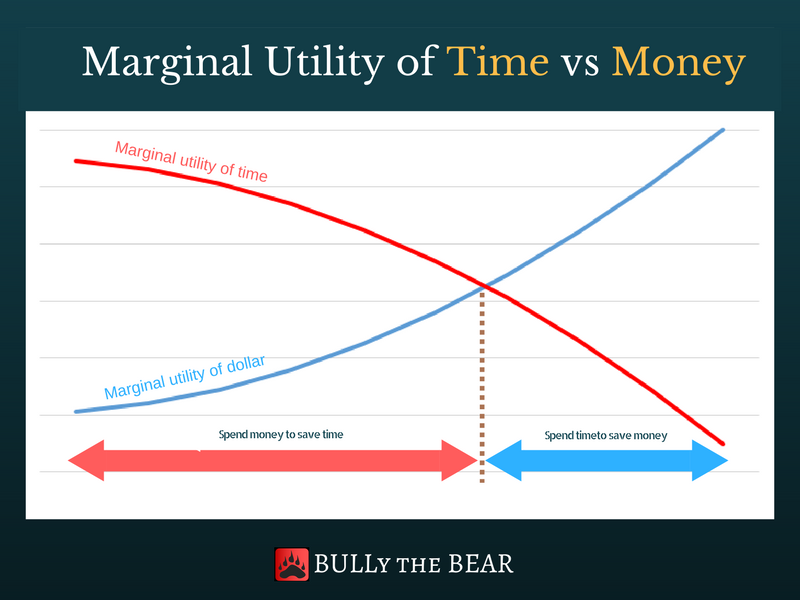
The idea is simple: Imagine you want to go to another place, and you can go by either taking a cab or walking there. Taking a cab is definitely faster but more expensive, so you spend money to save time. On the other hand, walking is slower but cheaper, so it allows you to spend time to save money. By comparing the marginal utility of time vs dollar, you can make a rational decision. If the utility of one extra dollar is more than the utility of one extra minute, save the dollar and spend the time i.e. walk there. If the utility of one extra minute is more than the utility of one extra dollar, save the time and spend the dollar i.e take a cab there.


Here's a few more illustrations:

1. In the past I used to go all the way to Pennisular Plaza to get sports shoes. The reason is that because there are a lot of similar shops there, so the greater competition combined with the great variety makes it a cheaper place to shop. However, the savings is probably not much, perhaps only 10-20% only. So to save that few dollars, I would spend the time to go over there, because I have more time than money, so the utility of that extra dollar is more important to me than the utility of that extra minute, hence I spend my time to save the dollar.

2. Until about 5 years ago, I used to go to my student's place for lessons. These days, I would charge a lesser amount if students come over to my place for lessons instead, because I don't have to spend the extra time travelling. Even though I can earn more if I go over, I normally don't do that anymore. The reason is that the utility of an extra minute is now much more than the utility of an extra dollar, hence I would rather spend money to save time by letting students come over to my place instead of the other way.


But please do not treat this as a mathematical model. At best, it's a philosophical concept. If you want, you can valuate your hourly rate, but I think it will be hard to valuate your time. So agar agar (estimate) will do and there's no need for complex computation to derive whether your marginal utility of time is more or less than that of your money.

Why?

Because the marginal utility of your time is more valuable than the marginal utility of doing the computation LOL

Thursday, July 09, 2015

Half year review

Tracking is different from managing goals. If you track your goals but didn't do any reflection, then the feedback system is lost and you might not really use the data that you've tracked wisely. You can even say that tracking is a tool to mine data for reflection, so that you can have a better outcome at the end of the day.


Time flies, and the more I age, the faster it flies. Days zoomed by, followed by weeks and then months. Before I can unwrap my Chinese new year's ang bao, which is still placed at the same location where I've left it months ago, half a year had already flew past. It's good to sit back and see what I've done in the past 6 months.


1. Savings

I've increased by savings goal to 60k this year and I'm about 2/3 done. This is a great year for me in terms of work and I'm working like crazy because of the workload carried over from last year. But as mentioned before, even though I worked very hard, it's not as stressful compared to the times when I first tried the 50k savings challenge. I think primarily, the difference lies in the mindset. Back then, I was cutting back on a lot of things to achieve it. It wasn't sustainable and it sure didn't make me happy. This time round, I didn't even consciously do it because my expenses are so SOP (standard operating procedure) that I don't have to think much about it. That's why they say saving the first 100k is the most difficult but it'll get easier as you build your 'savings muscles' by practicing it all the time.


Reflection: Good pacing of goal. I like it that I achieved much more without trying hard. All the right practice must be in place already. And as always, I'm very grateful for all the recommendations of students and all the LP's parent and student word-of-mouth advertisers for helping me all through the years. I'll never know when my work will dry up, so it's good to make hay while the rain shines.


2. Books

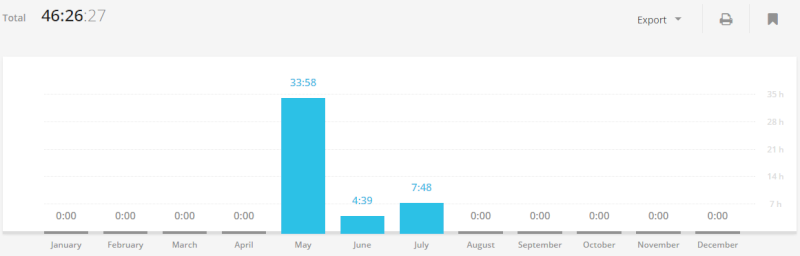
I don't think I've read so many books in half a year before in my life. I'm currently on book 30. I'm interested in exactly how much time I'm spending on reading, so I downloaded this desktop/mobile app called Toggl. I know this app is not used for this purpose, but whatever..


The blue column represents the number of hours reading. I only started using the app in May, so there's no data before that. June was horrible in terms of energy lack and general fatigue, because I adjusted my schedule from afternoon to late night and go from morning to late afternoon. It totally drained my energy level because I think I'm really a night person.


I'm usually only book 30 near to the end of the year, so I'm about 2-3 months early. I should be able to go past my goal of 52 books a year very very comfortably with perhaps a good lead. I usually start reading a lot more once my work winds down towards Oct and Nov.


Reflection: I was reading so many books that even my wife starts to read a lot now. Talk about good healthy contagious habits! Financial books some more! It would have killed her years ago, so I'm secretly happy about it, haha! It's very good for us to read the same books, because we'll bounce ideas off each other and discuss about the book's major themes and examples. I think it's important for couples to share the same cultural background, so that there's a lot more common points to bond together. That's why people do sports together, or movies, or just general dating.


3. Parent's investment funds

I'm now managing a total of 220k of my parent's retirement fund. The amount is crazily huge, even bigger than my own funds. I'm grateful that they trust me with their hard earned money and I'm doing what I can to make sure their trust in me is well justified! Most of the money is in bonds/pref shares. With the new fraser centrepoint limited (FCL) bonds ipo-ed a few months ago, I subscribed a lot more than what I wanted and passed a bulk of them to my parents. Just a few days ago, my parent's fixed deposit amount is released from holding, so they wanted to inject more capital in. I just transferred the FCL bonds that I hold and pass it to them.


So far, so good, even with all the turmoil in the market. I'm giving them about 2 to 2.5% pa, which is set to rise year by year to about 3-4% until they choose to withdraw out the funds. Then I'll give them a bonus based on whatever cash is left after subtracting from the guaranteed capital loss of buying bonds/pref shares above par value.


Reflection: 220k...it's a huge sum if I sit and think about it. What happens if the amount is lost? That's why I only put it in traded bonds and spread it over a few counters like banks and government linked companies. I wonder which is better? A) Getting those bad ass 250k a pop institutional bonds but getting only 1 lot, or B) spreading it over above par bonds/pref shares that are already trading in the secondary market on sgx.


Well, I choose the latter. I hope more good quality bonds are out there, then I'll switch some of the above par bonds with the new issues and rejuvenate the portfolio.


Monday, June 22, 2015

My thoughts on Pre/Post Financial Independence schedule

I read B's post on pre and post financial independence (FI) schedule here. In it, he put in his planned timetable for pre and post FI. He also encouraged everyone to try it and have a little fun imagining what it'll be like upon reaching FI.


I thought about it. I'm not reaching FI anytime soon, though I'm sure I'll certainly reach it one day. I'm a full time private tutor. People thought that this means I'll have a lot of freedom in my time, plus the fact that I'll have a few months of holidays during June and Dec period when students are generally having their holidays. The truth cannot be further from this. Weekends are burnt and holidays are spent preparing students to handle one major exams after another. The whole mantra is that if you're free, I'm not going to be free. If you've just finished work and going to a nice restaurant to eat, I'm the server who takes your order and serves you your steak. In other words, I work when others are not and vice versa.


My timetable for work is easy. I work 7 days a week, with 5 days of weekday being lighter and weekends being much heavier. 4 to 6 hours of work during weekdays and 6 to 10 hours of work during weekends is very much the norm, if you want to push up your income. These days, I don't work a full Sunday too, preferring to spend my time having a proper rest before I tackle a new week refreshed again. This only happened on my 10th year for tuition work. Due to the fluctuations in my work schedule, I guess I will work about 35 to 45 hours per week on average, with 40% of my workload on weekends. That's my pre-FI schedule for work.


What will I do once I reached FI? I love my work, but I don't like the intensity of it. If I can have a full day off on a weekday, I'll be happy as a bird already. In this line, it's too much to ask for to have a break on a weekday, because there's where most students will come. You know, after earning a certain amount of dollars, the only purpose of taking in more students is not to earn that incrementally less significant amount of tuition fees, but for the purpose of helping students. It's like you're a doctor and you're just closing your clinic before a patient who is seriously ill comes in. Are you going to reject him and say that your family is waiting for you for dinner? Come again tomorrow? I know I have the ability to help them, and I'll feel bad that I didn't because of selfish reasons like wanting to enjoy my life a little more. And hence I help them.


You just can't say no, especially when you know you have the ability to change another person's life. Come back again? There might not be another 'again' for that person.


Actually I have a plan in place for slowly weaning off work. Once I've reached an investible cash/investment of about 240k, and assuming I have a yield of about 5% off it, I'll be able to get $1k per month. I will give myself a 'reward' of having a weekday off. I haven't though much beyond that, like what happens if I can get $2k per month from investment. But the idea is to have a staggered exit from working based on the ability to exchange active income from passive income. I guess once I can cover all my expenses, my workload should drop to 0, but I doubt that kind of life will suit me very well.


I will definitely work as a tutor for as long as I can help others. Perhaps I won't charge as much. Perhaps I'll give a tuition scholarship to deserving students. Perhaps I'll volunteer at different organisation in what I do best. There are so many ways to give back to society and at the same time, enrich my own life experience. I think this can only serve as an addition incentive to be financial free - the idea of not trying to escape work but to actually do those work that you couldn't afford to do when you're still eking out a living.


That idea appeals to me very much. I guesstimate I'm about 1 to 2 yrs away from reaching that milestone of a quarter million. Can't wait to see what I'll evolve to become when that happens. Maybe my life will take on a life of its own!

Monday, June 15, 2015

Being frugal with your time

I was discussing some stuff with the finance gang, and we came up with the idea of being frugal. You know the usual stuff about being frugal with money, but there's also another less discussed but related topic - that of being frugal with one's time.


First of all, my definition of being frugal is to be efficient and not be wasteful. The action you do must be aligned with your values. So the distinction between stingy and frugal is that - whether what you do are aligned with you values. If you like being sociable, and like hosting parties and cook outs with people, then spending money along that direction is not wasteful. It's aligned with what you want to do. But if you can't tell sage from rosemary, and don't care less about food, spending money on such things will be a waste of resources. That's not being frugal. 


Knowing that, we can equally apply this to the concept of being frugal with one's time. Do you waste time on things that don't matter to you? Do you spend a lot of time on unproductive things while doing your work? Could you have reduced or eliminate time that is wasted, and channel it to something that you truly value? That's being frugal with time. 


Time is perhaps even a more limited and more valuable resource than money. You can use time to exchange for money, but it can seldom be done the other way. It's also possible to be frugal with money but not being frugal with time. For instance, you could be travelling a long distance to get something that is sold at net 50% discount to where you usually shop (even after accounting for travelling cost). But because the journey took 2 hours to and fro, you wasted 2 hours of your life travelling to save the money. For me, my per hourly rate is pretty easy to calculate. It might or might be be worthwhile to do it, depending on your per hourly rate.


That's why when I'm younger, I would go travel to far places to shop, just to save maybe $50 dollars or something on a pair of shoes. But when I'm getting older and my time is more precious, I no longer do that. I'm not saying paying the most expensive things will result in time savings. But usually good brands have a certain quality to it that a sub $10 item will not be able to match, especially if it's something that you value.


With that insight, I realised I'm not necessary frugal with money but I'm definitely frugal with my time. I don't like to waste a drop of time doing nonsense, and I don't like to waste other people's time too. That is probably the best reason to be financially free. You stop wasting your time doing non-productive work, earning money just to spend it on things that are not aligned with your values.


Ah, that's more holistic than looking at just money, isn't it?

Thursday, May 07, 2015

The price and value of deprivation

Price is what you pay for and value is what you get. Usually this is applied for things that you purchase. But I guess it's equally applicable to things that we choose not to purchase.


If we choose not to buy something for $10, then we would have saved that $10. That's the price we had saved. But did we also correspondingly lost $10 worth of value? Rationally, we should choose to deprive ourselves of something if we can lose a value much lesser than the price of the goods or services that it costs. However, just like when we purchase things and we tend only to look at the price, we also NOT purchase something by only looking at the price, and not the value of the goods that we cannot enjoy.


Let me some examples. In my crazy 50k saving days, I used to scrimp and save on food. I would choose not to eat even when I'm hungry just to save a few dollars. Or, I'll buy low quality food that isn't healthy but is cheap. The price I've saved from not buying better quality food is perhaps a few dollars, but the value I lost is definitely more than the price I saved. Who knows what kind of long term health effects I could get from this? How about shoes? I used to buy cheap-skate shoes that wouldn't last me 1 month. Compared to a better quality branded shoes that cost up to $150 a pair, I might have saved $100 or more dollars. But the value I lost from not purchasing a better pair of shoes and not enjoying them, and even have to keep hunting for a pair constantly, is much more than $100.


Is it worth it?


That depends on where you are in your life stage. When your human asset is low, you have plenty of time and energy but likely have very little money. So, we don't mind going all the way out to save that few dollars. Of course it's worth it to save a few dollars. But when our human asset is built up to a point where we would rather spend money to save energy and time - those two most important and finite things that each of us have, then it's definitely not worth it.


Having said that, do know that while price is uniform, the value that we derive from the same goods and services is different for different people. To a foodie, spending $120++ a meal on an atas Japanese Omakase is a experience well worth the price. The value derived for that foodie is much more than the price of $120 paid. To deprive that joy of eating that meal can save him $120, but he correspondingly lost much more than $120 (If he eats Sucky Sushi, he will lose perhaps $10,000!). To a person who neither appreciates nor care about authentic Japanese cuisine, eating a $120 or a $10 Japanese meal makes no difference. It might not be worth it to spend that money.


So, spend on things you truly enjoy, regardless of how other people think. You are not others, and the value you lost by depriving yourself of something, just to save the price of paying for them, is not worth it, at least to you.


My friend Rolf will said this very aptly - Know yourself.

Thursday, January 29, 2015

My chin up journey

For the past weeks since the start of the year, you can see 2 persons in the east near to a pull up bar, around 10pm to as late as 11pm. One of them would go near to a bar first, mount it by jumping up and the other would as quickly as possible, grab the ankles and help to assist the person to go up. It'll be 2 sets of 6 assisted chin ups, if they are feeling strong and energetic, or 3 sets of 4 reps if they are not feeling up to it. Always, there'll be rest in between the sets.


Those two persons is me and my wife. For some reason that I'm still trying to figure out, we decided to train to do at least 1 chin up by CNY. Both of us are zero heroes, meaning we can't even do one chin ups. For me, I'm a serial zero hero. At the peak I could do 10+, and that was back in my prime during army days.


During end 2013, I managed to do 3 to 4, so that I could pass the more stringent IPPT before they revamped it all over again. Anyway, I have a lot of experience in going from zero chin ups to 1. The journey from 0 to 1 is immensely harder than from 1 to 2 and from 2 to 3. So a lot of effort had to be done to build up the back muscles and the arms. Esp the back muscles, which is kind of hard to train unless you go to the gym purposefully. For my wife, she never had the experience of doing 1 chin up before, so it's a brand new experience for her.


This is where I want to be


In the past, when I was going from 0 to 1, I was doing all sorts of things except going to the bar to attempt to pull myself up. I would be doing weights, then push ups and dips and those assisted pull up machines found in the gym. The settings of the chin up machine is set so that I can do 10, which means that it's not hard a setting. After training for some time, I would test myself by going to the bar and attempt to do one. A few grunts and a few kicks, I still can't do one. How disappointing, I thought. Didn't I train hard?


If you want to learn how to swim, you can buy the best swimming trunks, the best anti-fog goggles, a nice Speedo swimming cap and even a mp3 player that is water resistance so that you can listen to music while swimming. You can read all about how to do it from books, talk to swimming enthusiasts to ask them to give you some tips and watch youtube videos. But if your feet is not even dipping into the swimming pool, it's not going to help. To learn how to swim, you need to jump into the water. Might not be initially, but eventually you'll need to.


I guess the same lesson applies for my chin ups...if I want to do one chin up, I need to go to the bar and attempt to do it. All other things are peripheral. The most effective way to do it is to attempt to do it. Invariably, you'll encounter problems. Like, I can only do less than half a chin up. Since the back muscles are the ones that do the initial lifting, I concluded that my back muscles are weak. The only way to train is to do more assisted chin ups, until you can do half a chin up (this means that you can lift yourself up to the point where your elbows are about 90 degrees).


And that is where I am right now.


To go further, I need to build up my biceps. That's why I'm doing weights. Out of all books that I read, it's Antifragile by Nassim Nicholas Taleb that I learnt how to build more powerful muscles so that you can lift heavier weights. You just need to take the max weight that you can lift for about 5-6 times, instead of doing multiple times on lighter weights. When I mean 5-6 times, I really mean the last lift you can do is 6. You'll be struggling on the last rep and you possibly can't do anymore after that. The theory is that if you want to lift heavier weights (which is essentially what chin up is about), you need to practice lifter heavier weights. Doing lighter weights multiple times can only make you...lift lighter weights multiple times. So right now for me, it's 8.75 kg for 6 times, 3 sets, with rest in between.


It just takes less than 10 mins to waste my arms totally. On top of this, I'm still doing the die-die-do-12-chins-up-by-any-means exercise with my wife. I tried it yesterday night, and I can barely even do 1/4. It's like that, my muscles are totally wasted. To become stronger, you need to destroy and rebuild. That's how nature works. I just need to supply it with nutrients and water and the rest would take care of itself.


This is where I am now. From Freddy Thorn Illustration

LP the personal trainer? No lah. Knowing me, you know where I'm going to end this post with. Seldom do we see new things, but we consistently find new ways of doing old things. From my chin up journey, you can see a few important points:


1. If you want to do something, go do it. Don't do everything except the things you want to do. I know sometimes we need to psych ourselves to the task. Go do it then, but ultimately remember this, to do chin ups, you need to go to the pull up bar and do chin ups. Any other things are peripheral and at most plays a supporting role. Do the thing that you fear the most.


2. Push your limits to grow. Doing the same thing that you can already do multiple times is a different sort of training if your goal is to do even bigger things. Of course you'll suck at it initially, but that's the only way to push yourself out of your comfort zone.


3. To grow anew, you need to destroy. By going about your old ways yet hoping to see new results is insane and delusional. If you don't remove the old, it's hard to find new space to fit in the new.

Tuesday, September 30, 2014

Learn from the Ants!

There's a lot of things that we can learn from the ants. Here's a trick on productivity coming straight from the ants colony itself - it's called Ant Colony Optimization.


How does a scouting ant tell the rest of her colony that there's food here? She will secrete more pheromones - some kind of ant perfume - along the path that she found the food. When her colony mates passes by and picks up the pheromones, they will follow the trail, find the food, giving more pheromones and attract more ant mates and so on. Over time, you find that the chemical trail will get reinforced and becomes stronger and stronger.


So how does Ant Colony Optimization works? It works on exactly that principle - that which is useful will be ranked higher than those that are less useful, subsequently reinforced through repeated trials and eventually, the more useful 'path' will be discovered simply by the usage frequency. I'll give a few examples of how this can work in your everyday life:


1. Sorting files

We tend to sort files alphabetically or chronologically. We don't have to. Take for example one file filled with notes arranged chronologically. Every time we take out something from that file, we place it right in front of the rest, ignoring the order. After several iterations, what we use most often will be placed right in front of the file, making it more optimized for your usage instead of arranging in other common order (like chronological or alphabetical or subject matter) but ultimately useless arrangement.

This is exactly what the Noguchi Filing system works. When I read that, I was mindblown. It wasn't until I read and watched a lot of ants video on Youtube before I realized that it's derived from nature.


2. Sorting apps in your smart phone

Same theory. Arrange your apps according to the usage. Every time you use the app, arrange it in the forefront. Upon subsequent iterations, you'll find that the most useful apps will be right in front and the least useful app are right behind. Go ahead and delete that once it crosses a certain time threshold.


3. Internet bookmarks

If you're like me, you'll have so many 'useful' bookmarks in my internet browser that it's not always possible to find the stuff you need anymore. Yet you can't bare to delete them in the event that you might need it one day.


Here's where ant colony optimisation comes in too. You just sort the bookmark by arranging the one that you use right in front. Over time, the most useful bookmarks will be ranked right at the top while the least useful one will be at the bottom of the least. Again, you can delete those at the bottom with the knowledge that you seldom use it anyway, so there's no need to miss them.


These are just 3 examples that you can use to simplify your life. Besides micro things like these, ant colony optimisation can also be used to decide the best route for transportation networks like where to build a highway, bus routes etc. Basically when there's so many choices leading from point A to point B with multiple variables involved, ant colony optimisation will be useful.


Think about it.

Thursday, September 25, 2014

Winning the skirmishes but losing the war

We are sometimes so caught up with our lives that we neglect the big picture. We often keep doing the things that are urgent, but forget about the things that are less urgent but nevertheless are important.


Study the matrix above.


Urgent means that it has a time factor to it. It needs to be done as soon as possible in order to meet datelines that are either self-imposed or externally imposed. Important means that it fulfills certain long term goals or mission.


Quadrant 1 are the tasks that are both urgent and important. These are crises situation and are emergencies. Priority should be given to these. But how many crises situation are there in a day? If everything is a crisis, your workflow is not set up yet, so you might need to work on that. An example of such a situation is when your client calls you for an important presentation that may lead to a sale. Everything else needs to be put on hold while you pursue this lead.


Quadrant 2 are the tasks that are not urgent but are important. These are the tasks that are often neglected because of the lack of urgency. A good example is retirement planning. Retirement is a goal that is years away for working adults but if you don't start planning now, it might reach a point of no return. So for such situation, we need to sit down and think about what are the things that are potentially urgent in the future and has great impact on your life. These, we need to do long term planning. You can probably delay for a week or two, but certainly not delay in years.


Quadrant 3 are the tasks that are urgent but not important. At best, these are interruptions to your workflow. It could be your boss asking you for yet another board meeting. It could be your mum asking you to get something for her while you are doing your work.


Quadrant 4 are the tasks that are not important and not urgent. I try to push a lot of task into this category as I grow up. Not a lot of things are as important now as it seems in the past. An example of this is playing games. It serves at best as a time waster event, though we all need such activities to relax and wind down. Just don't make this a priority when there are Q1, Q2 and Q3 things left undone.


The ideal workflow goes like this:


  1. Classify all activities into the four quadrants 
  2. Settle all the Q1 (urgent and important) activities first
  3.  Then try to push those activities from Q3 (urgent but not important) into Q4 (not urgent and not important), as much as possible.
  4. Settle the remaining Q3 activities
  5. Schedule the Q2 stuff daily or weekly into your timetable. They are not urgent but they are still important. So do them on a daily/weekly/monthly/yearly basis. The key point is to plan it into your timetable, otherwise they will not be missed until it's too late.
  6. Do the Q4 activities the last. Or when you need a break from your suddenly productive life.

I'll proceed to give an example of how to use this in a typical student's life.

  • Do all assignments that is due this week first
  • Pass down some 'arrows' that are shot by your group leaders in your co-curricular activities to others. Those that can't be passed down, just settle it as soon as you can
  • Exams are in 2 months time. Have a plan of how your revision schedule will be like. Stick to it every week. Start early, finish leisurely. Start late, finish panicky.
  • Stop watching you-tube videos or korean dramas when you don't even have time to finish the above. Allow yourself only a very limited time to do these per week, and only after you've had a good productive week.

You can be surprised how many people cannot find the time to study for exams until it's too late. Too swamped by everyday living that they miss the big picture. Are you doing that in your financial life too? Too concerned with day to day living and miss planning for longer term goals?