Showing posts with label Market strategy. Show all posts

Saturday, March 14, 2020

War strategy in a bear market

The recent market meltdown prompted me to re-organise what I classify as emergency cash and war-chest and better fencing of cash and cash equivalents. This comes about as I increased my emergency cash from 3 months of expenses to 12 months. By doing so, I'll fence up more cash that I can't touch for investment, hence the exercise to really look into this.

I have various issues of Singapore savings bonds (SSB), as well as Frasers 3.65% bond and Azalea bond. I decided to classify those under emergency cash. The SSB can be redeemed at par value, and while the two bonds that I held had their prices falling from their highs (Frasers went below par even), I think they are still safe storage of emergency cash. Unlikely for them to do a Hyflux on me, again.

 After accounting for the switch in portfolio counters, I realised I've spent about 15% of my war-chest in a week or two of buying. In this kind of climate, you can buy something and have it fall 10% the following day or so. Crazy times. How does one cope with this? Just be 'delusional', in the sense that you keep thinking the market will return to its formal glory, that this will all pass eventually, that the enterprising human spirit will somehow get you over this and that a few years down the road you'll be wondering why you are even fussing over this minor hump on the road.



I think I've experienced a few crashes in my investing journey so this is not going to be any different. The first few I've 'wasted' it by not being emotionally steady, and/or didn't have enough cash, so I'm determined to make the best out of this. I've some support groups - people who share the same philosophy in money management - so they helped a lot to allay whatever fears in buying up while others are fleeing. Grateful for that. I've seen enough people who made it out of market crashes like this, emerging from the ashes of their portfolio with their net-worth doubled or tripled, to believe in it, so I'll try my best to emulate them.

That said, hope still has to be tempered with ground-level reality and practicality. I must survive all these in order to have a chance to thrive later when all these are over. The top 2 priorities are really health and job security. If that fails, all else fails.

How to spend the remaining war-chest? I think the problem can be split into how much and how long. STI has fallen about 27% from the last peak to the last close, while SP500 is down 20% and HSI about 28% down. Most often, crashes recover after about 30% down. Rarely does it do a 50 to 60% crash and then once in a lifetime, you might see a more than 85% crash. I think based on past history, we should spend the bulk of our war chest preparing for the 30% to 50% crash, rather than the world-changing 85% crash. I think when it comes to that, nobody is really prepared for that. If that comes, there will be more things to worry about survival than about thriving. That should settle the part about how much.

How long then? History shows that it can take 1 to 3 yrs for the bear market to play out from peak to trough. Counting the last peak for STI to be in May 2018, we're about slightly less than 2 yrs right now in Mar 2020. Perhaps it'll end by 2021, in about a year's time. That correlates to what PM Lee said about how long the coronavirus will play out. I wouldn't take it so literally to be exactly 1 year, but that should give a helicopter view of how fast to deploy.

Take care of your health, and prosper.


Monday, February 10, 2020

Am I prepared?

Back in 2003/2004, there is the SARS outbreak. Back then, I just started work and didn't think too much of the possibility of getting infected. That's stupid and reckless of me, but now I have too much to lose. I can see people are avoiding shopping malls and restaurants are mostly empty even during the weekend peak dinner crowd. You can practically walk into a restaurant and see that there are more staff than customers during peak hours. It's that bad.

In this post, I'll like to focus on the things I'm doing to protect myself. My chief concerns are:

1) My family's health
2) My work income
3) My financial status


1) Family's health

The current Wuhan corona virus is still largely unknown, but it seems from official statistics that it is highly infectious but with low mortality rate. Thank goodness for that. I'll rather take my chances with this than another strain with low infectious rates and extremely high mortality rate. Ultimately, mask or not, it just depends on our immunity system to survive.

As 2020 started, I did 3 things that helps a lot regarding health. Firstly, me and my wife had been going to the gym almost everyday. 30 mins of intense cardio really does help a lot, I feel. That should do for the exercise part of keeping healthy. Secondly, every gym day, we had almost carb free salad for lunch. That's the diet part of keeping healthy. Thirdly, I started doing cold showers. I read from Tools of Titans by Tim Ferriss (Wim Hof/Tony Robbins section) that having cold showers can boost the immunity system and willpower, among other things. Been doing it for 3 weeks, not bad, will continue doing so.

Other than that, I didn't join the groceries store run, nor the mask buying queues to avoid crowds. I did go out to shopping malls now because it's largely empty. My mum prepares some herbal concoction for us to drink, and hopefully all these measures will help. Not necessarily in preventing us from getting infected, but to recover swiftly once infected.


2) My work income

I'm a private tutor. Students come over to my place for lessons, so I'm potentially exposed to a higher chance of infection that most people I guess. I accept that. From the start of the pandemic in China, I've already anticipated that parents will stop and cancel lessons. Just last week, I had two cancellations. I think primary school tutors will be hit more severely than me, not to mention those running group lessons. I think we just need one cluster to form in schools and that's it. Back in SARS period, primary school was stopped for about 3 weeks, secondary schools about 2 weeks and JC about 1 week. Why? JC students can die is it? It's about the immunity system - those who are elderly and very young have weaker immunity system, making them more susceptible to infections.

What happens if the situation gets worse and tuition stops? I have a plan B. I got a webcam from a good friend, got my wacom drawing tablet/digital pen and an online whiteboard with video conferencing/chat capabilities ready. I've also asked for permission from students and parents in case the situation warrants it. And so now we wait.


3) My financial status

What if I've no active income for a stretch of say 1 year? Can I take the hit?
Yes - my CPF has enough to last me 1 yr of mortgage payment, which is my biggest expense and greatest worry. I'll transfer more warchest to emergency cash too, so I can tide over more than 1 yr if needed.

What if I've no active income for 1 yr and I'm hospitalised? Can I take the hit?
Yes - hospitalisation plans are still in place and I've enough funds to cover any deductibles/co-insurance. Same for all my family members. Insurance plans also cover ICU should that need arises. If there are worse scenario I've not imagined, there's also a reserve battalion of Singapore savings bond, equivalent to 6 months of monthly expenses, waiting for me.

I took account of all my liquid cash, minus 1 year of monthly expenses, and the remaining is my war chest. It's still good enough to fire substantially, so that's good. My plan, as always, is to survive first, then thrive. And I'm determined to thrive.

Thursday, April 04, 2019

Can smell be captured like a photograph?

We can take pictures to freeze a memory at a single instant in time. We use a camera for that purpose. But memories aren't just made up of lights and colours, they consist of smell and tactile sensation too. How come there isn't a device to capture the smell at any particular instance? Or the warmth of the sunlight hitting your face? Or the gentle caressing of the breeze that tussles your hair?

I guess that's why looking at pictures feels like the copy of a copy to me. It's like eating aspartame - your tastebud feels the sweetness but it is ultimately empty in calories.

There are a few things in the future that I'm looking out for:


1) A transparent metallic material

I'm in the market looking for a water bottle, but whenever my wife asks me what sort of water bottle I'm looking out for, I'll reply it must be made of metal (so that it's more durable and doesn't have chemicals leaking into the water) and transparent (so that I can know how much water is left). I'm still searching for one, so let me know if you know one lol

2) A device that can change the size of things

Whenever I'm tired of walking in the shopping centre, I told my wife to shrink me and put me into her pocket and carry me around. I guess the device can also be used to shrink a car and save everyone more land space instead of building car parks. I'll be willing to buy such a device.

3) A 'camera' take captures smell

Imagine taking a picture of the sea, and looking at the pictures will immediately trigger smells of the salty breeze. The best I can think of are those scratch-and-sniff stickers, that is said to take over the gaming world (imagine in a first-person shooter game, you walk in a sewer so you scratch a sewer sticker and sniff it for the atmospheric immersive experience) but ultimately became as extinct as a technological dodo. That'll be something to look forward to.


I'm sure in the 1800s, there'll be someone wishing for a list of things like these too. And when it happens, a lot of the old ways of doing things are disrupted. Gone like the buggy whips companies used for horse carriages. If I can imagine this wishlist, I'm sure it'll become a reality one day. Perhaps not in my lifetime but it'll be possible in somebody's lifetime.

Are there any investments now that you have that are on the cusps of extinction? The closest one that I have is perhaps Singtel. We all say that the fall in price for Singtel is due to the competition locally and worldwide...but what if it's the beginning of the fall of traditional telco business? How about banks? Will banks be obsolete in the future? Is there truly any business that you can guarantee that will stand the test of time?

I can't answer that, hence I will invest accordingly to my lack of knowledge. I will never be able to concentrate my stock holdings, and can never be able to sleep well with just 8 stocks in my pocket. This company might be so good and I'll whack 80% of my networth inside? Some people might be able to do so, but I'm quite sure I'm not one of them.

Wednesday, February 28, 2018

Portfolio sector breakdown

The market had been down in Feb and I had been spending my cash to whittle it down to a manageable level. If not, the cash will be like a runner wearing parachute while running. It's safe but it'll drag me down. I took stock of what I had and what the different sector allocation relative to each other. It's right below in the pie chart. Take note that the percentage is based on capital allocated and not based on market value.


You might not agree with how I labelled the different companies in my portfolio though, but that's what I thought of their characteristics:

Reits:
1) Aims
2) Capcomm trust
3) First reit
4) Mapletree com trust
5) Fraser cpt trust
6) Capitamall trust
7) CDL H trust
8) RHT health trust

Top two in the Reits sector are Aims and First reit

Bonds/cash equivalent:
1) FCL Trea 3.65% bond
2) Vicom
3) Hyflux 6% CPS
4) Feb 2018 savings bond

Top two in the bonds/cash equivalent sector are Feb 2018 savings bond and Vicom

Small caps growth:
1) Sheng siong
2) Kingsmen creative
3) Isoteam
4) Food empire

Top two in the smalls caps growth sector are Food empire and Kingsmen creative

Oil/commodities
1) Sembcorp industries
2) Sembmarine
3) Olam

Top two in the oil/commodities are Olam and Sembcorp industries

Bank
1) UOB
2) OCBC

Top most in the bank sector is OCBC.

Others
1) ST engineering
2) SIA engineering

Top most in the Others sector is SIA engineering

Pure Cash
1) Savings accounts
2) Cash
3) Poems money market fund
4) Fastsaver CIMB

Top 2 in the pure cash sector is Fastsaver CIMB and Poems money market fund


Based on marked to market value of my portfolio, my pure cash position is about 30%. If I needed to raise more cash, I could sell off some of the bonds/cash equivalent to boost up the warchest if needed. This feels about right. Since my work is starting to get busy, I expect my cash position to boost up even more as I can begin the 50k savings challenge for the year 2018 again.

I forgot that there's a small percentage of crypto currency too, about 2.3% currently of total capital allocated. I intend to raise it to about 3.5% of total capital allocated. It's money I hope I won't lose but can afford to lose.

Thursday, September 21, 2017

Getting the most out of a Rights Exercise

Just got news that Capitacom trust (CCT) is issuing rights to acquire Asia square towers 2. It's a 166 per 1000 shares @ $1.363, renounceable rights issue. This means that for every 1000 mother shares you hold before it goes ex-rights (XR), you are entitled to 166 shares of rights, which you then need to go to the ATM before a dateline is up to subscribe to it by paying $1.363 per right shares.

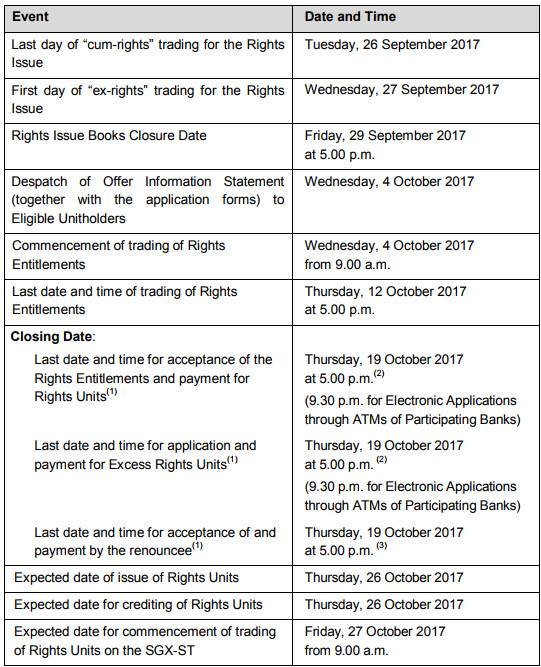
Here's the timeline for the major events of the rights issue:


I've been answering a lot of posts on rights recently, especially on Investingnote, so I thought I might want to consolidate all the stuff and recap all the posts I've made on the rights. I don't think I have updated my information on rights exercise in this blog ever since SGX implemented the 100 shares board lot instead of the 1000 shares. 100 shares makes it less complicated actually; less things to hack.


Basic rights information

Before going into the strategies part of rights exercise, let's have a breakdown of what to expect. The timeline for rights goes like this:


1. You get announcements of a rights exercise. Pay attention to the x per y shares @ z price. "z" is the subscription price for the rights exercise. For example, a 25 for 1000 shares @ $1.25 means that for every 1000 shares of the mother shares you hold before XR, you are entitled to a 25 rights that you need to subscribe at the atm for @$1.25 per rights price. Take note that upon subscription of the rights (by paying $1.25 per rights), you are converting the nil paid rights (so called because you haven't subscribed to it; you are just holding the rights to convert to ordinary shares) to ordinary shares.

nil paid rights => before you subscribed by going to atm for it
paid rights = ordinary shares => after you go to atm to pay for the subscription per rights shares

If you don't subscribe to the rights before a certain date, the rights will expire worthless.


2. There is "renounceable" and "non-renounceable" rights exericse. Sometimes non renounceable rights exercise is called a "preferential offering". Renounceable rights means that the rights can be sold off if you don't want to subscribe to it. This means that there will be a nil-paid rights trading period where you can sell off your nil paid rights. Note that if you don't want to subscribe to the rights by going to the atm, the rights will expire worthless. I can't stress that enough. If you don't want to subscribe, go and sell your nil paid rights during the nil paid rights trading period. For this CCT rights exercise, it's renounceable, so the nil paid rights trading period is from 4th Oct 2017 to 12th Oct 2017. During this period, you can sell off your nil paid rights or buy more if you want.

The mathematics of it all is described elegantly below:

Nil paid rights price + Subscription price = Price of mother shares after XR

The subscription price for this cct rights exercise is 1.363. Let's say upon XR, the price of cct mother share is at 1.450. The nil paid rights price should be trading at 0.087 (1.45 - 1.363). If the price of the nil paid rights is way below 0.087, then the logical question to ask if this: is the mother share overvalued or the nil paid rights undervalued? It presents an arbitrage opportunity here. But this is advanced technique to play with rights, and it's highly advisable for newbies not to do it unless you know what you're getting into. Don't want you to get into a quagmire of doom.

Link on difference between preferential offering and renounceable rights: here


3. Know how many entitled rights you have. You can calculate yourself by dividing your shareholdings by 1000, round down to the nearest integer and multiply that by 166. For example, you have 5500 mother shares before XR, so you'll be entitled to 5500/1000 = 5.5 = 5, then 5 x 166 = 830 rights shares entitled. ** If you don't want to calculate manually, or want to confirm, wait for the Offer information statement (OIS) to be sent to you. In it, there'll be a circular on the whys of the rights exercise, and the how to the different scenario where a shareholder can subscribe to the rights. Most important, there will be a form where they will tell you explicitly how much rights you are entitled to. You can either fill the form, send a cheque and post it to them for rights subscription, or just ignore the form and go to the atm to subscribe for the rights. In the above example, you are entitled to 830 rights @ 1.363 each, so you have to pay $1,131.29 to convert the nil paid rights to ordinary shares. And you have to do so by 19th Oct 2017, if not it'll expire worthless.

** update on 22nd Sept 2017: I asked my broker whether we will get fractional and proportional allotment of rights, meaning that if we have 900 shares, do we get (900/1000*166 = 149.4) 150, 149 or 0 shares? He said we will get 149 and not 0, because it is proportional, and 149 and not 150 because it is rounded down, not up. I learn new things everyday.


4. You can also subscribe to excess rights above and beyond your entitled rights. Using the above example, you have 5500 mother shares before XR, so you are entitled to 830 rights shares. Beyond that, you can apply for another 1000 excess rights. In total, you have to pay (1000+830)*1.363 = $2,494.29 for all the rights. You will definitely be able to get 830 new shares, because well, that's your entitlement. But for the excess rights, preference will be given to round off odd lots and the rest is luck. The issue here is, after the new board lots is changed from 1000 to 100 shares per board lot, it's unclear whether the rounding of odd lots is still based on 1000 shares or the newer 100 shares. If it's based on 1000 shares, it's likely you will get 1000 - 830 = 170 excess rights, minimally. If it's pegged to 100 shares per board lot, it's likely you will get 900 - 830 = 70 shares minimally. I am for the latter, not the former.

How much to subscribe excess? I think if you hold very little holdings before XR, you can potentially double your holdings by getting a lot more excess rights. Let's say you have only 1000 shares, you'll be entitled to 166 rights shares. Rounding to 200 shares will likely give you another 34 excess rights. But you might get another 500 shares of excess because you're lucky and you have small holdings. So in total, from 1000 shares before XR, you might get 1000 + 200 + 500 = 1700 shares, of which the extra 700 shares, 166 is your entitlement, 34 is for rounding off odd lots, and 500 is just that lady luck shines upon you. 700 shares @ $1.363 each will lower your average price way below the theoretical ex rights price (TERP).

If you have much more holdings, then don't think so much lah, just put 1.0 times the holdings before XR. It's unlikely you will get excess rights beyond the number of shares you hold originally. Let's say I have 5000 shares, I'll be entitled to 830 rights shares. I'll just apply 5000 - 830 = 4170 excess rights, so that in total, I'm applying for 5000 rights. Likely you won't get it all, but you'll hit some and the rest will be refunded back to your account.

Link to step by step guide on using ocbc atm to subscribe for rights: here


5. Check for the rights shares to come in. For this cct rights exercise, the expected date of commencement of trading for the rights shares is 27th Oct 2017, 9am. The expected date of crediting of rights units is on 26th Oct 2017. I'll check the CDP account around night time to ensure that the rights shares are credited into my account if you're using non-custodian brokerage. If that's slow, try checking the refund in the bank account where you applied for the rights. From the amount of money refunded to you, you can back calculate to see how much excess rights you got. The slowest confirmation is after a few days, you will get a snail mail of the rights shares you get through your physical mail box.

From fastest to slowest:

a. Check refund of funds in same bank acct linked to atm during subscription
b. Check CDP for stock holdings. Will need a pin number from them, so go apply beforehand
c. Check physical mail box for snail mail confirmation


Strategies for rights player

Now that the basic is covered, let's talk about strategies. There are strategies for existing shareholders who already holding shares before the rights exercise is announced, and there are also strategies for people who want to take advantage of the rights to get into the company at a favourable time. These are the wannabe shareholders. I must say rights issue favour the latter rather than the former. That's just the way it is.

I further define two types of player: the casual and the advanced one. Casual ones are usually newbies, but need not be, and quickly wants to get over the rights issue as soon as they can. Advanced players want to hack the rights and get a more favourable price, meaning getting their average price below the theoretical ex rights price (TERP).


w: no of mothers shares before XR
x: no of rights shares successfully subscribed
y: price of mother shares before XR
z: subscription price of rights shares

TERP = [(w*y)+(x*z)] / (w + x) 


As you can see, to get a lower average price, you need to get much more excess rights beyond the rights ratio. If the rights ratio is 166 shares for every 1000 shares held before XR, to get a lower price than TERP, you need to get more rights shares than 166.


Link for casual rights player: here
Link for advanced rights player: here


For existing casual shareholders:

a. Just wait for offer information statement (OIS) to come in. It'll inform you of the number of entitled rights shares you have.
b. Go atm and subscribe to the entitled rights
c. At the same time, apply for the excess rights. There's also a $2 admin fee charged by every bank.
d. Wait to see how much excess rights you get
e. Update your spreadsheet/program on your holdings


For existing advanced shareholders:

1. Sell all your mother shares before XR, buy back after XR and after the price drops lower than TERP
2. Buy more mother shares before XR and take adv of the drop in price, be entitled to more rights, apply for excess
3. Buy nil paid rights during nil paid rights trading period, esp when there are opportunities for arbitrage, subscribe to entitled and also apply for excess

* 2 and 3 can be combined, but make sure you know what you're doing


For casual wannabe shareholders:

a. Buy the mother shares before XR
b. Wait for OIS to inform you how much entitled rights you have. If you bought too close but still before XR, the OIS might not reach you on time. So calculate manually.
c. Go atm and subscribe to the entitled rights
d. At the same time, apply for the excess rights
e. Wait to see how much excess rights you get
f. Update your spreadsheet/program on your holdings


For advanced wannabe shareholders:

1. Buy in after XR, at or below TERP, and skip all the rights exercise
2. Buy in before XR, get your entitled rights, apply for excess

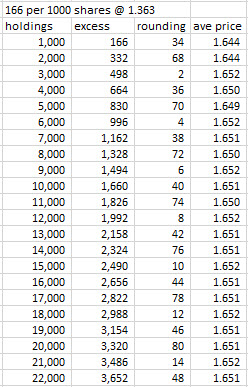
2a. To decide how many lots to get in, look at the table below:

Since preference is given for excess rights applicants to round off odd lots, and assuming that the rounding of odd lots is for 100 shares per board lot, it make sense to change the number of shares you want to buy before XR to maximise the odd lots rounding. For example, if you get 1000 shares before XR, you are entitled to get 166 excess. To round off to the next nearest round lots, you are almost guaranteed to get 34 excess rights (to round to 200 shares). Can we maximise that rounding so that you can get the best out of it?


I didn't show the whole table, but you need to get in 47,000 shares so that you can get 98 shares of rounding. But we haven't looked at the average price of all the shares, after including the rights exercise. No matter what price you got in (must be reasonable of course) for the mother shares before XR, the advantage of getting more 'guaranteed' excess rights for the purpose of rounding odd lots reach a diminishing returns after 5000 shares. For the above table, I use an entry price of 1.70 for the mother shares. You can see that there's a slight dip on the average price for 5000 shares.

But all these just to shave off less than 0.005 cts on your average price? That's why I don't do such hacks anymore. It's just not worth the time. In the past, where the board lot is 1000 shares, there's some savings to be had, but not anymore.

Just ignore this method safely, knowing that you are not going to hack a lot to get a lower average price using this method.

3. Buy nil paid rights during nil paid rights trading period, subscribe to entitled

* 2 and 3 can be combined, but make sure you know what you're doing


This should do it! The end-it-all guide to rights exercise for newbies and a good refresher for oldies!

Wednesday, August 02, 2017

CDL Htrust rights are out

The CDL H trust rights are out. I applied with DBS atm and I've received the refund this morning already.

I don't have any mother shares before the whole rights exercise and before it goes XR, I bought 3000 mother shares at $1.645 each. My entitled rights for this 5 for 1 rights issue @ $1.28 means that I have 600 entitled rights. I applied for excess rights and got 500 shares. In summary:

Mother shares: 3,000
Price of mother share before XR: $1.645
Entitled rights: 600
Excess rights: 500
Total rights: 1,100 @ 1.28

Average price before comms: $1.547
Average price after comms: $1.55411


Since the price of the ex rights mother share is now at $1.610, it's already in the money. Damn, I love entering reits/trust when they exercise rights. Good quality ones will bounce back within months.


Wednesday, December 21, 2016

Sabana Reit 42 for 100 rights exercise

Sabana just announced a rights exercise. For every 100 shares that you have before XR, you're entitled to 42 rights shares priced at $0.258. Based on their track record, I don't think it'll be well received.

I once bought Sabana reit at 0.960 back in Nov 2010 and sold it at a 0.910. After dividends, thankfully I still make a very slight profit of 0.7%. I told my wife to get rid of it too. From then, the share price just went lower and lower until it hits 0.435 today. Imagine a 50% loss but with a yield of 8 to 9% pa! The dividend is not going to be enough to cover the loss in capital.

There's quite a few people asking around on what to do with their Sabana reits. I think we can safely classify into 2 types:

A. Those who had shares in this
B. Those who don't have any shares but wanting to get into it.

I can tell you frankly, rights issue is going to benefit people in group B more than group A most of the time.


Don't slip on this slippery banana skin

For people in group A:

1. You can decide on a fundamental basis whether you want to sink in more money into this or not. If you don't want to, you should sell it as soon as possible and close off the case. It'll be silly to subscribe to the rights and put more money, and after XR, the price likely will go down lower and wait for extended periods before going up again. If you're okay with this, then go ahead and subscribe to the rights entitled to you and apply for excess. This will lower down your average price and hopefully it'll come to light one day.

Do look at this post here. Most of the companies that issue right will recover back to the price before announcement of rights exercise between 1 month to 1.5 years. That's just based on statistics on a small sample size. So take it with a pinch of salt.


For people in group B:

1. You can buy nil paid rights during the trading period for the rights shares. But remember, you do have to go to the atm to subscribe (and pay) for them, otherwise they will expire worthless. There could be arbitrage opportunities when the difference between the nil paid rights and the mother share is not 0.258.

2. You can buy the mother shares before XR, get the entitled rights and then apply for a lot of excess rights. This way, you might get a lot more excess rights than the prescribed ratio of 42 for every 100 shares, so you might end up with a lower average price.

3. Buy after XR. Since you have 1 month to 1.5 yrs before the price recovers, you'll have plenty of time to pick and choose a right point to enter.


After the change in lot size from 1000 shares to 100 shares, things need not be so complicated anymore. I'll just go for strategy (3). I'll be looking at this to see if I can get just one more puff out of this used cigarette.

Friday, August 12, 2016

The difference between preferential offer and rights

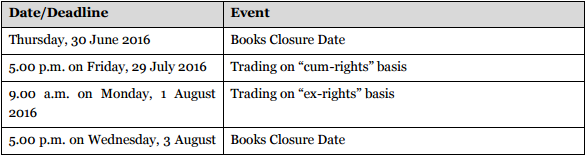
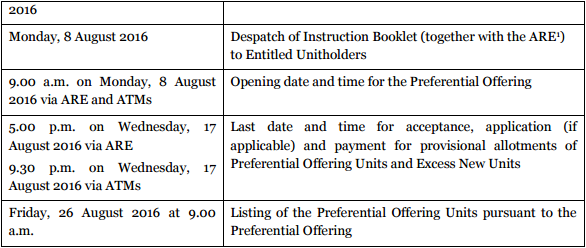
I just received the booklet from Croesus regarding their preferential offer of 10 new units @ 0.797 for every 259 shares owned on ex-offer date of 3rd Aug 2016 that I blogged about here. I initially thought this is like rights exercise, which I'm very familiar with. But on closer inspection, it is not. Let's explore what's the major difference.


I think the most important difference is that rights are usually renounceable. This means that if you do not want to take part in the rights and subscribe to it, you can do so by selling it. If you're a shareholder, you'll be entitled to rights shares. These are called nil paid rights, because you haven't gone down to the ATM to pay the subscription price for it to be converted to ordinary new shares. There's a nil paid rights trading period, about a week or so, where people can buy or sell their nil paid rights. If you do not want to take part in the rights, you can sell the nil paid rights in the market during the nil paid rights trading period, so you're sort of compensated for the eventual dilution in your shareholdings upfront.


So, renonuceable means you can sell/buy and transfer to others, and there'll be a nil paid rights trading period to facilitate this. The nil paid rights counter is usually accompanied by a letter R, so there's no question that this is the rights share you'll be buying or selling.


Preferential offer is non-renounceable. Well, at least the one offered by Croesus is not, so I'm not sure if I can extend it to all other such preferential offerings of other companies. Non-renounceable means you cannot sell/buy and transfer the new units to others. This also means that there will not be a nil paid rights trading period. You either subscribe to your entitlement by going down to the ATM to pay for it (in this case, $0.797 each) or you can walk off. But what you can't do is to sell your nil paid rights away, unlike a proper rights exercise. In other words, you either subscribe or you get diluted because of the injection of new units that you refuse to participate in.


To summarise, in all purpose, a preferential offering is like a rights exercise without the ability to buy/sell your nil paid rights because it's non-renounceable. 

If you really don't want to take part in the preferential offering, I see only a few options available:

1. Sell off the mother shares before the ex-offer date (I did sell off a part as I don't want to be over exposed here). But it's kind of late for Croesus now, since the XO date is over on 3rd Aug.

2. Ignore the entire thing, and let your rights expire without paying the $0.797. This is not a wise thing to do though.

3. Subscribe to the rights by paying $0.797 by 17th Aug 2016 and then sell it on the market when the new units gets listed on 26th Aug 2016. I am even going to apply for excess to see if I can get back cheaper for the holdings that I sold before XO.


I suppose those people who are really forced to put in more capital will be doing number 3. Might expect the Croesus price to drop after 26th August 2016.

Friday, July 29, 2016

The first domino falls

We just heard news of Swiber sudden winding down. DBS is one of the main banks that loans money to Swiber, so their exposure is about 700 million. That's not a lot of loans, relatively speaking. 700 million is about 0.25% of their total outstanding loans in 2015 and it's about 15% of their total 2015 net profit. But they are confident of getting half of it back and after tapping onto their general provision, they are net loss of about 150 million. How much is that? It's about 3.3% of their 2015 net profit.


Is that significant? No, but the trouble is that it might not end there. Most likely, this is just the beginning of the oil and gas sector contagion that will spread eventually to the banks. When Swiber falls, people will be wondering who is the next company to fail. Ezra, ezion, vallianz, swissco and even sembcorp marine are possibly candidates. They might also have inter-related business interest that joins each other like blood brothers and sisters. So if one fails, it might cause a whole domino effect cascading down the entire oil and gas sector in Singapore.


Whoever is lending most aggressively to them will suffer the most. In their heydays, Swiber is a $6 stock and easily one of the most anticipated growth companies here in SGX. Heck, I even traded Swiber before. DBS and OCBC seems to be the more aggressive of the big local 3 banks, UOB being the more conservative one, so it seems. Maybe that's why the share price of the three banks dropped proportionally to the level of loans linked the the troubled oil and gas sector.


I heard news of 98 million shares of Ezra pledged to DBS and another 98 million shares pledged to OCBC as collateral. When the contagion spreads and the share price falls, it will lead to even more selling as nobody wants to be left with a worthless piece of paper as a collateral. We should expect more of such news in the coming months to come.


Is it a good time to scope up bargains in the oil and gas sector? Be greedy when others are fearful and fearful when others are greedy? I think it depends on your skill in navigating the rubbish from the gems. If you understand the sector well and can see which are the companies that can survive and thrive after the crisis blows over, you'll be the biggest winner. But I know I don't know anything about this, hence I will skip it. In the event of a major market sell-down catalyzed by the bankruptcy of the oil and gas companies, I will rather buy those companies that having nothing to do with this sector but nevertheless got their share price marked down severely, than to buy the troubled oil and gas company at a cheap price and hope that they will survive and thrive.


a) Good company, non troubled sector, low price
b) Good company, troubled sector, low price
c) Bad company, troubled sector, low price


Between the a,b and c, I think (a) should be the top most priority. (b) and (c) are the ones that can make you really rich, but do you have the skills to see separate the (c) from the (b)? It's not as if there's only this sector to focus on, so I'll skip it and live with my choices.

Thursday, July 21, 2016

Trying to be SMART on SMRT

Stupidity induced by greed.


That's the only way to describe it. Upon announcement of the offer by Temasek holding for the delisting of SMRT at $1.68, I wanted to arbitrage on any possible price difference between the opening price and the offer price. These are the assumptions I make:

1. There's a dividend of 2.5 cts waiting for me

2. The price that Temasek Holdings offer is too low ball and will be revised upwards


With that, I queued overnight at a limit price of 1.675 and got it this morning at a entry price of 1.665. With that entry price, I will make about 2% after comms and I'm okay with that. It's like a fixed deposit. I was happy for a while until the news kept streaming in that destroyed my underlying assumption.


Firstly, the dividend of 2.5 cts had already been declared and had gone xd on 18th July 2016. So no more dividend and no safety margin for me to fall back on to make this deal work out right.

Secondly, it's not a general offer in the usual delisting lingo but a scheme of agreement. I thought it meant the same but apparently it's not. This 1.68 is the final offer price and if the resolution is not passed, then Temasek holding will not make another offer until 1 year later. And in order for the offer to be passed, at least 50% of the shareholders present in the meeting must vote yes, and they must collectively hold at least 75% of the shares not owned by Temasek holding. And Temasek hold about 54% of the shares.


That means if the offer is passed through, I get $0.015 returns and if I didn't go through, I might potentially lose anything between $0.125 to $0.150. In dollar terms, if it goes through I win $30 (after comms) and if it didn't I lose $500 to $700? The risk reward is so bad that I cut loss at 1.655 and take a loss of about $100 in all.

Stupidity induced by greed.

The good thing in all these is that upon realization of how stupid this deal is, I cut loss immediately and immediately felt much better.

Friday, July 01, 2016

Croesus Retail trust preferential offering

Those holding Croesus retail trust needs to fork out money again. This was after their most recent rights back in Oct 2015 which I've blogged about here, here and here. There is now a preferential offering exercise going on, and in all respects, we can treat this as a rights exercise.

Here's the details:


The dilution isn't that much. It's an offer of 10 new shares for every 259 shares held before it goes XR, priced at $0.797 for every new shares. Why 259? I've no idea, must be the doing of their financial wizards. If you own 10,000 shares of Croesus before XR, you'll need to fork out $307.72 to subscribe to the new shares. It's not that much, really.

The price went up to a high of 0.82 today strangely, but perhaps not surprisingly. It wouldn't look too good if the new shares is priced at $0.797 but the share price is trading below that.

I'll be subscribing to it, and applying for excess if available.

Wednesday, May 18, 2016

Hyflux 6% perpetual securities

This morning, I was quite excited to receive news of another retail bond. This time it's from Hyflux. The last they did that was in 2011 and I made a 4 part series on preference shares here. Back then, they are issuing 6% cumulative, non-convertible, non-voting and perpetual preference shares. This time, this issue seems more like perpetual shares than bonds. The difference is not significant though, given that it's a perp, so there is no maturity date even though there is a optional but not obligated redeemable date.


Terms of the security 

The terms of the perps is spelled out very clearly in the announcement here:


1. Public offer of up to 230 million (can go up to 250 million), out of total size of 300 million (can go up to 500 million) if oversubscribed


2. Opens on 18th May, close on 25th May noon


3. Min amount is $2k, thereafter in multiples of $1k.


4. This is the interesting feature about the issue. They are giving 6% pa, paid semi-annually (on 27th May and 27th Nov every yr) for first 4 yrs until and excluding 27th May 2020. From 27th May 2020 (inclusive), it'll not be 6% pa anymore, but will be at reset distribution rate.

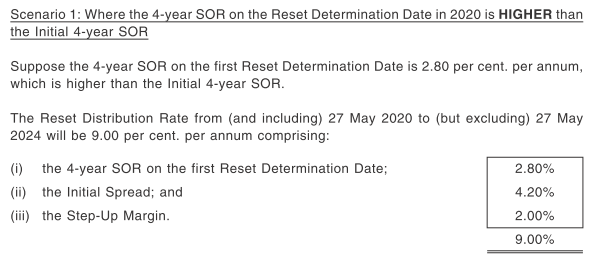
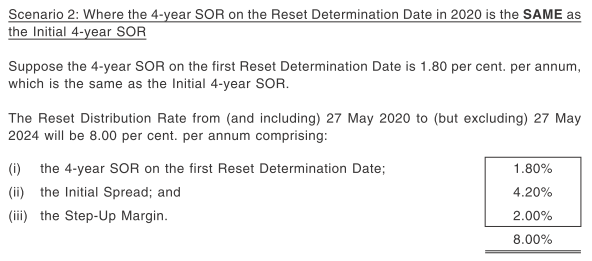
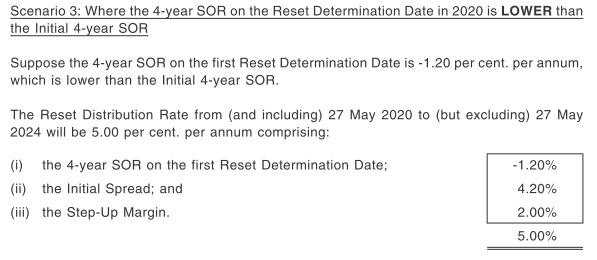
Reset distribution rate = 4 yr SOR on the reset date + 4.2% pa, + step up margin of 2% pa

They gave excellent illustration for 3 different scenario after 2020 to 2024, shown below:


5. From 2024 onwards, the distribution will be reset again using the formula shown in point 3, but with a new 4 year SOR rate at the reset date in 2024.


6. Is there guarantee of payment if you're a holder of the security? The prospectus states that "each security confers a right to receive distribution on its outstanding principal amount from the issue date at the applicable distribution rate". The word 'right' doesn't sound right. It offers them a possibility to defer distribution under certain conditions and is no way guaranteed. Reading further from the prospectus, it mentioned that the issuer may elect not to pay a distribution (or to pay a part of) by giving ample notice. They may not elect to defer any distribution if 6 month before the scheduled distribution payment date, one or both of the following occurred:

a. A dividend is paid to its junior obligations. I take junior obligations as the ordinary shares of Hyflux. I may be wrong.

b. If the junior obligation is redeemed, reduced, cancelled or bought back.

This means that if they give out dividends in their junior obligations (I take it as the ordinary shares of Hyflux, which I may be wrong), and/or they did not redeem, cancel or bought back all the junior obligations in a period of 6 months before the distribution payment date, they cannot defer distribution to this security.

Don't ever think they are obligated to pay holders of this security. You have a right to receive but they are not obligated to do so under the stated conditions. But it's not as bad.

They have a feature in this issue that is quite similar to any cumulative pref shares or bond. If they did not pay out any distribution in full or in part, that portion that is not paid out will be placed under arrears of distribution. They will have to pay out the arrears, plus any distribution, by the time they redeem back the securities, or by the next distribution payment date, or before they wind up, whichever comes earlier. If not, they cannot declare or pay dividends to its junior obligations or to redeem, back buy, cancel, reduce it.

I think in simple layman's language, it just means that they must pay out the dividends on the distribution date, unless they are also not giving dividends to hyflux ordinary shares/bond/pref shares holders. That is your sort of guarantee that they will pay out what they should pay out.


7. First redeemable date is on 27th May 2020, which is about 4 years from now, at the par value. They have to redeem all the outstanding amount or none at all. Thereafter, on each distribution payment date, meaning 27th May or 27th Nov after May 2020, they have an option to redeem back too. As mentioned earlier, this is a perp, so there is no fixed maturity date.


Financial strength of Hyflux

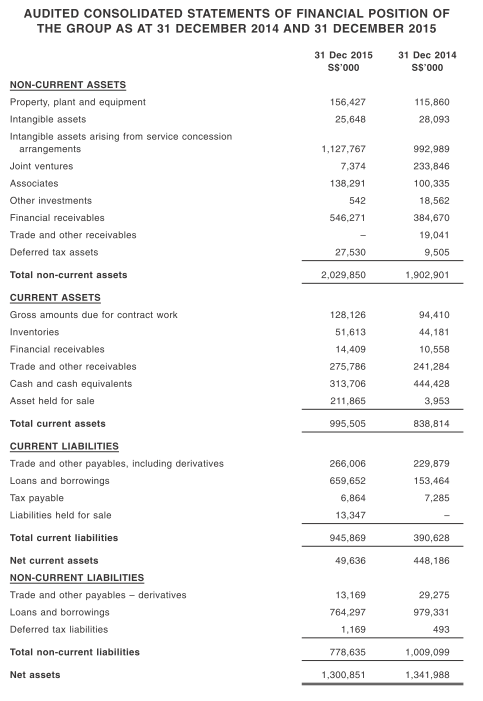
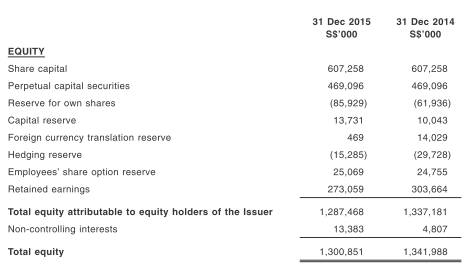
Alright, so far that's just the details of the perp. It's quite a complex issue, if you ask me. My initial excitement becomes a lot more muted once I took a look at Hyflux results.


Debts debts debts. Just mountains of them. I think they are rolling about in their notes and preference shares debts, issuing new ones to redeem older issues. Even this current issue is to redeem back the older issued notes. Specifically, 91.66% of the proceeds is to be used for the repayment of the $100 million 3.5% notes done in July 2008 and updated on Jan 2016, and another $175 million 4.8% outstanding perps (this is not the retail 6% one).

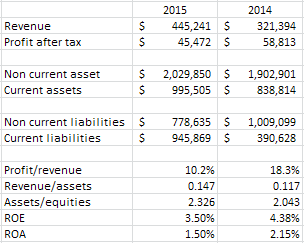
I'm too lazy to dig out past 10 yrs of financial statements, so using the last 2 yrs should suffice:


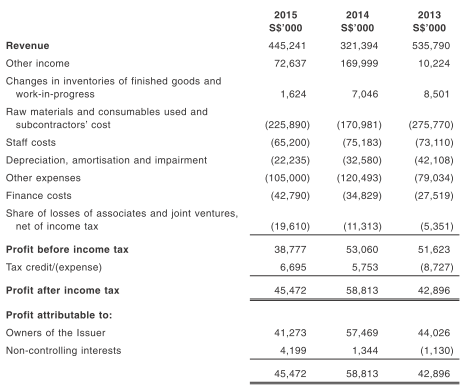
With a ROE of 3.5% in 2015, this isn't a company that I would have invested. But the pref or bonds issued might be a different story. Are they highly leveraged? Below is the ROE for Oxley. They also recently issued a new bond less than a year after their had their first retail one.


Looking at their financial leverage (Assets/equities), Oxley is the more leveraged one, but they are different industry of course. There really isn't a direct comparison for Hyflux. The question is, can they survive for 4 years or more and continue giving dividends to their ordinary shares as well as their bond/perps holders? I'm not confident. Revenue is contract and order based, so a bit lumpy. Even with their leverage, their ROE is not fantastic too. Their free cash flow isn't exactly very stable, and most years are just negative. I suppose they will have to continue borrowing from Peter to pay Paul.


Existing Hyflux 6% CPS


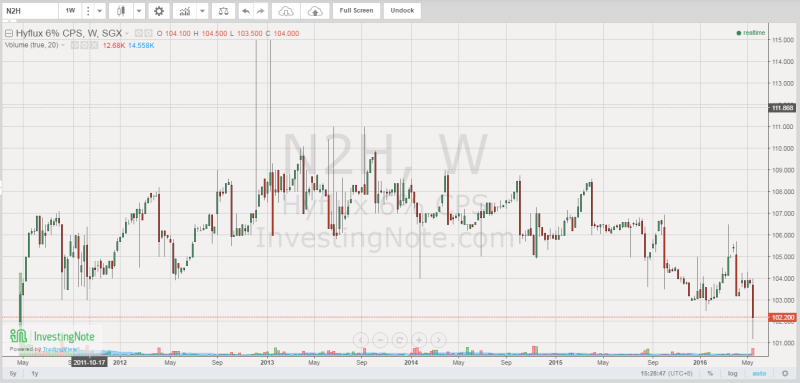
Throughout their listing, the hyflux 6% retail preference shares had never once dipped below its par value of $100. May 2011 to the present time isn't exactly kind to the stock market, so having maintained its share price above par is a great comfort to its holders. It acts as a good place to store their cash - it's a good cash equivalent that pays 6% pa, if you want to see it that way.

Their terms is 6% pa, payable semi annually on 25th April and 25th Oct every year, with first redemption on 25th April 2018. Thereafter, they will step up the rate from 6% to 8% if they don't redeem back.

Based on current price of 102.2, the yield to maturity until first redemption date is about 5.8%. Maybe by then, Hyflux will issue another preference shares, either institutional or retail, to roll over the debt. Considering that their pref shares at this kind of environment is still 6%, I think it'll be cheaper than to pay a higher stepped up rate of 8%. Maybe that's why the price of the pref shares is dropping steadily to par value. We're about 2 yrs shy of that first (optional) redemption date.

Note that the price shot up 3% on the first day, and thereafter within 2 months, shot up to about 7%. Not too shabby for a pref shares with 6% yield.


Conclusion

In summary, weak company but strong pref shares and dividend paying record. But that's all in the past, will it continue in the future? I think so and the gameplan, like Oxley and Perennial, is to continue issuing such bonds in the future. This should be quite a hot issue, I suspect. Actually, anything that is higher than fixed deposit rate is hot in Singapore these days, lol


Good for a stag. I'll expect it to be very hot.

Friday, April 15, 2016

Post-rights price recovery period for reits

If you get into reits, make sure that you have some spare warchest to prepare for rights issue. It's not a matter of if, but a matter of when. In the past, if you do not have any reits yet, I will recommend buying the mother shares during rights issue so that you have the ability to hack your way to capitalise on the excess rights application process. I blogged various articles in this blog but let's just put down the two most important ones:

1. How to get the most out of a rights exercise
2. How to hack AIMS AMP Capital Industrial reit Rights Exercise

But recently with the change of the board lot from 1000 shares per lot to 100 shares per lot, I think this strategy is getting outdated. The amount of excess rights will be based on the lower 100 shares instead of 1000, which means you won't get much out no matter how you hack it. It's about 10 times difference. Not very effective.


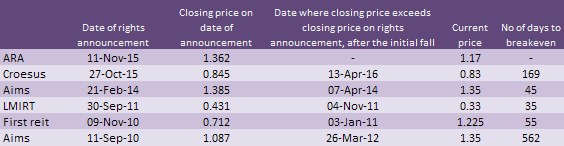
If you look back in the chart history of those reits that had undergone rights exercise, you'll see that the price will drop immediately following the date of announcement of the rights. Then, it'll start to rise up. This happens every single time - the key difference being how long the drop will be, and how long it'll take for the price to go back up to pre-rights price. This means that if you have not bought any reits yet and had intention to buy, buying during the rights exercise, specifically after the announcement of the rights, will be a good time to take advantage of a short temporary inefficiency to get some. You might want to ignore all the rights and just get it after the mother share goes XR. It'll be less troublesome and you'll likely get a lower price out of it anyway.


Take note that the price are all post rights price. It's too troublesome to convert back to pre and post rights price, but this doesn't dilute the force of the argument 

The table above shows the rights exercise I've taken part in recent years. Here are some observations:

1. It takes anytime between 1 month to 1.5 yrs to get return back to pre-rights price. This means you have plenty of chances after the announcement of the rights to get the reits, assuming that the fall of the price is solely due to the rights issue. In real life, it's most definitely not. There are macro trends and various other factors that contribute to the rise and fall of any stock prices. And, the sooner you get it, the faster you can be entitled to the stream of income from dividends declared. So wait, but not too long.


2. Aims took the record for waiting 1.5 yrs to recover. It may be an outlier, considering that from my limited list of rights exercise participated, most take about 1 to 2 months to recover back. Talking about reits or trust here, not companies. ARA is not a reit, though it's a reit manager, so probably will be more enlightening to compare the rights issue of non reits companies separately.


3. The other factor I didn't take into account is the dilution of each rights. Some are diluted more, some are less, and I think that might be a contributing factor in deciding how long duration before the price goes back up to pre-rights price. I'm not an academic, so I'm just interested in the final verdict of what to do.


And what do we do? If you haven't had any shares in a reit, consider buying after XR and skip all the excess rights and what not. The price is likely to be cheaper even with all the excess rights included in. If you already had shares and wanted to accumulate more, consider waiting for them to announce rights. The risk is that your cash will be rotting while you wait, and the other is that some reits just don't have a habit of issuing rights - like Suntec. So you can wait till the cows come home lol

Thursday, February 11, 2016

My Saizen arbitrage

Just received a circular for Saizen unit holders, telling us a lot of finalized details about the upcoming disposal of their entire portfolio to Trangle TMK. Of note here is the special distribution of $1.056 per unit to unit holders. I bought and sold a few rounds already, but after they made the announcement near Nov in 2015, I bought it again at $1.0938 (inclusive of comms), hoping to arbitrage on this, which I blogged about it here. Let's see how it goes.


About 30.3 million SGD is to be paid out as special distribution, representing $1.056 per unit. From here, I worked out the number of outstanding units to be 287,026,515. Another 25.7 million SGD ($0.0895 per unit), amounting to 5% of the purchase price is to be kept in an escrow account for up to 4 months after the completion of this entire exercise and liable to be claimed. The cost includes 3.4 million SGD ($0.0118 per unit) for expenses related to post completion maintenance of the company, plus another $1.2 million ($0.0042 per unit) for the manager.


Not to forget the normal (as opposed to special) distribution in Mar 2016, amounting to about $0.0310 per unit (from Jul 2015 to Dec 2015), which is based on last year's DPU.


The summary is as follows:

Special distribution: $1.056
Normal distribution: $0.031
Escrow account: $0.0895
-----------------------------------
Sub total: $1.1765

Post completion expenses: $0.0118
Cost paid to manager: $0.0042
-----------------------------------
Sub total: $0.016
-----------------------------------
Total: $1.1605

Buy price inclusive of comms: $1.0938
Percentage profit: 6.1%


That represents the max amount provided that none of the escrow account set aside is withdrawn to paid for anything PLUS the distribution in March matches last year's distribution at $0.031. If say, we take 50% of the amount set aside in the escrow account, my returns will be 2.3% in less than a year. Not impressive, but okay lah.


The actual amount remains to be seen, and I might have to wait till Aug 2016 to see it all completed.

------------------------------

After throwing this post to the universe, I was reminded that there's another distribution not counted in. It's the period from Jan 2016 to the completion date, which is stated as "on or before 31st March 2016". The income collected during this period is technically not TMK but the unit holder, hence there should be another final distribution amounting to about half of the 1st half DPU, which stands at roughly $0.014. This is a significant amount, pushing the max returns to nearly 7.4%.

So good ah? Did I miscalculate? How come the price of Saizen still lingers around 1.09, which is my buy price? Haha

Thursday, January 14, 2016

The Greasy Panda crash of 2016

As I type out this post, STI is down another 47 points to 2650. Everyday you'll see the oil and gas sector, as well as the banks going down and down and down. For every bear, there's always a name attached to it. In my little group, we call this the greasy panda - greasy because it's oil related and panda because the last straw that broke the camel's back seems to start from China.


For those who had the cash to capitalise on this, it's a dream come true. Such events, should we survive, will propel us a few years forward. The key word is that we need to survive through it. I think now we shall see whether you can take the risk that people talk about in the stock market. If you're a Kepcorp investor, seeing your holdings drop 5% everyday is not funny at all. In order not to panic sell and capitulate, I think it's important to sit tightly in your 3 legged chair.


There's a lot of bargains out there. Singtel and Starhub are around the same price now, battling each other to see who can go down more. Since they are at the same price, which would you buy? All the banks are priced below their book value now, which means they are really at a very good valuation. The problem is whether the book value (Asset minus liabilities) can be trusted upon. The banks hold debts for oil and gas companies, as well as their bonds, so if one topples will it drag the rest down with it? Reits are priced at ridiculously high yields now, but between a blue chips at near reit yield vs a reit at super high yield, which would you rather buy? And then there's the oily stocks like semb corp industries, semb corp marine and kep corp. Do you catch a falling knife and hope for mean reversion to kick in? Or is this time different?


These and many other questions are not easy to answer because nothing is clear. If you wait until it's very clear, you'll likely miss out the initial reversal. But if you don't wait until things are clear, you might risk entering too soon. Again, more questions and no answers. More doubts and not enough cash.


What would I do?

1. Proportion each investment with a fixed %. If things go sour, it won't drag your entire portfolio down with it. Do not average down blindly.

2. Stop staring at the watchlist if it affects you. Life goes on with or without the stock market. If you didn't do point (1) properly, you'll get unduly worried, then perhaps you should reduce your holdings. Sell down your holdings to sleeping point. Don't lose sleep over such things.

3. Work hard and save up more. If stock market is a precursor for the economy at large, it doesn't bode well for sg economy in the next 6 months to a year. If your income stability, one of the legs of your 3 legged chair, is threatened, then things will get even harder for you. So save up for both your emergency funds and also your warchest. Survive first, then we can talk about prospering. Be robust first, then we talk about anti-fragility.

4. Buy something in the stock market. We're at this stage where the odds are that in 5 yrs times, we will wonder why we didn't put in more money in the market.


For the uninitiated, welcome to your first bear.

Friday, December 18, 2015

ARA rights are out

ARA right shares results are out. It might not be out officially, but I saw the amount of refund from my bank account and deduced the amount of rights shares that I got it. To double confirm, I will have to check my CDP account to see that the shares are physically transferred into the account. Either way, I'll receive a snail mail from them to inform me of the rights results.


ARA had been pretty good to me but I cashed out and subsequently left with 550 shares before the rights exercise. Many transactions in and out resulted in me having a very odd average share price of $1.39217 for my 550 shares. Don't ask, it's complicated, lol


Here's the details:

Shares before rights: 550 @ $1.39217
Entitled rights: 99
Excess rights applied: 901

Success rights acquired: 650 shares @ $1.00 per right shares
Total number of shares: 1200 shares (550 + 650 = 1200)
Total cost of shares: $1415.69 (550 x 1.39217 + 650 x 1)

Ave cost of shares after rights:  $1.17974


A few interesting take-away:

1. Rights are great if you are super minority shareholders. I'm talking about less than 1000 shares. I have 550 shares before the rights issue but ended up having 650 rights, which is more than the amount of original shares that I have. It's crazy that I get to reduce the average price of my shares so much because of the rights exercise.


2. If you have very little shares and the company started a rights issue, apply somewhere between 5 to 8 times of your entitled rights as your excess rights. Don't know what I'm talking about? In my case, I'm entitled to 99 right shares, so that means the minimum I will get is 99 shares. It's entitled, so I will get it no matter what. But I can also apply for more rights beyond what I am entitled, and that's called the excess rights. 5 to 8 times of my entitled rights of 99 shares means 495 to 792, so I should apply that amount as my excess rights.


However, if you have more like 10k to 20k shares, then this wouldn't work anymore. Usually you get an excess rights less than the amount of entitled rights. Maybe applying an excess rights equivalent to 1 to 2 times is more than sufficient. I don't know how many shares you need before the 'model' changes, but these are all based on actual experience and observations.


So in other words:

Small holdings: apply 5 to 8 times your entitled rights as excess
Large holdings: apply 1 to 2 times your entitled rights as excess


Nobody is going to stop your from applying 100 times your entitled rights of course, especially if you have spare cash sitting there doing nothing at all.


3. The share price of ARA had been dropping closing and closer to the rights price of $1.00. It is always like that, no matter how strong the company is. The only difference is that for stronger company (hopefully I can say, "like ARA"), the share price will go back up again. ARA has a lot of corporate actions, like bonus shares (I recalled they had it twice?) and now it's the rights. Very complicated company to keep track of your average share price if you don't keep records diligently. After a few bonuses and rights and what not, you won't know your entry price anymore!

Tuesday, November 03, 2015

Croesus rights allocation is out

A quick update before I start work.


The rights allocation for Croesus is out. I haven't got the refund of money yet in my bank account and to check how many rights you're allocated, just go to CDP site here, log in (hopefully you've got all the password and token access) and check how many rights you have.


I have 10,000 shares of Croesus and I have 13,100, so I know my entitled amount is 2,200 and excess is 900 shares. Since I have full rounding, I'm pleasantly surprised to see that I have excess. Not too bad at all. My strategy for the rights is to subscribed for all the entitlement and double it to apply for the excess. From experience of rights exercise from reits, the excess never exceeded the amount of entitled rights, so this is a sound strategy. You also don't want too many when others don't want it haha!


Have you checked?

Monday, November 02, 2015

Saizen reit - the strange beast

This is a strange beast. You would have expected that because there's a stated acquisition price of $1.172, the price of Saizen reit would have traded closer to that price as arbitrators close in to profit from it. But the price jumped to 1.09 from 0.925/0.930 expectedly, then went to a high of 1.14, before lingering around the 1.10/1.12 range and closing at 1.10 for Monday.


If you buy in at 1.12 for example, you would easily have made 0.05 cts, about 4.5% off this arbitrade. This doesn't even include the dividend (from July to Dec 2015) that is going to be declared, which amounts to about 0.03, bringing the total reward to 0.08 cts, or 7.1%. And quite possibly, there should be another partial dividends from Jan 2016 to whatever date that Saizen assets are scheduled to be sold. So the important question is, if we choose to arbritrade, are we the smart ones or are we the suckers? Is there something they know that we don't?


I didn't know Saizen also represent the best, or forefront, in Japanese


Let's see what's the risk involved here. I think the primary risk is that the deal will not go through, and it's really not a done deal yet, though it's a fairly confirmed one since the management of Saizen had accepted an offer already. As such, the longer this drags, the higher the risk of the deal not going through. The deal is conditional upon a few things, but I think the most important ones are (1) approval by SGX and MAS and (2) the approval of unit holders. I don't think both are serious issues, especially the second point. The offer is ridiculously generous, considering that the stock is lingering about 0.8+, which is way below NAV. The unit holders should be jumping for joy at having such so many years of income all squeezed into one.


The secondary risk is how this is going to benefit unit holders. Technically, after Saizen sells off their assets, they will be loaded with cash and with no real business. It's stated that the manager will distribute the net proceeds from the deal to unit holders as soon as practicable through a special distribution. They will cease to be a reit and should likely choose to delist. Could it be possible that they will change their mind and choose to invest or acquire other business, change its name and still operate as a company? If that's the case, the unit holders of Saizen reit will not get the full 1.17 per share. Perhaps a fraction of it or none at all. There's a lot of uncertainties here, but this will be set out in a circular that will be mailed out to unit holders soon.


Let's see who are the possible sellers of Saizen?

1. Insiders who had gotten wind of the information and bought in way before it's announced, bringing up the price from 0.8+ to 0.9+ last week. They might want to sell out to seal their profits.

2. Investors who wanted income and wanted to take the money to invest in other reit before others come crowding in. A bird in the hand is better than two in the bushes. Something like that ;)

3. People who had borrowed money to get into reits might want to sell off. If you borrow at say 5% and get into this reit at 6%, you'll get a kind of leveraged yield or a dangerous kind of passive income stream. It's like picking pennies in front of steamrollers. They would want to sell off upon such news since they are using money they don't have.

4. Blur sotongs who don't know why the price went up so high and sold off to take profit.


Are there any more reasons? Wish me luck. I'm vested as of today.

Monday, August 03, 2015

5 ways to avoid emotional capitulation

I know quite a lot of people are sitting on a huge pile of cash, waiting to be deployed into the stock market when the situation presents itself. I'm always very interested in the psychology of investors and how they intend to cope with the volatility of the market. It's really easy to rationalise and say you will cut loss when the counter goes below a certain level and you will buy in when others are fearful. It's even easier to say that when your cash hoard is very high and you have very little skin in the market.


It reminds me of the difference between a chicken and a pig. When you're served breakfast, a chicken is involved while the pig is committed. A chicken will lay an egg and it won't be any more different before and after giving you the egg. On the other hand, a pig will have much more to lose when it gives you the ham.


Are we also like that? When we have huge pile of cash, we can say a lot of rational stuff and quote a lot of Buffett's sayings. That's because we're involved but not yet committed. When you put in a huge percentage of your networth into the stock market, it might be a different story altogether. Things that you thought you should do suddenly becomes so hard because a huge part of your emotional well being is tied to the money you've put into the market i.e. you have skin in the game now. Welcome to real life, committed pigs!


There's a few ways I can think of to mitigate this risk of emotional capitulation:


1. Research and read up really really in depth into the company you're buying. The level of commitment is directly proportional to the homework you've done into it, and not by the amount of articles you've read that is written by a stock market guru. I personally find that the more you know about the company you've bought in, the higher your confidence in buying an unloved counter. If you just follow others, a little spook will get you running and peeing in your pants.


2.  Invest passively into an ETF. Most of the fears comes from losing your money, and that can come from a company going belly up. Buying into ETF will remove that possibility of individual company going bust because an ETF rejuvenates itself by changing the components. It's like a hydra with the ability to regenerate another head when you cut off one of its many heads. That should provide some confidence in the solvency of the companies you've invested, and hence you can really put in a bigger capital when the going gets tough, instead of cashing out and running away.


3. Diversify your investment. Diversification can come in two forms - firstly diversification in terms of companies and industries, and secondly diversification in terms of timing. Unless you know what you're doing, putting 100% of your money into one or two companies can be a strategy to be a millionaire from a billionaire. It can work tremendously well, but it can fail spectacularly as well. For general folks, it might be better to have at least some semblance of diversification across different companies and different sectors. You can take this further by going into different countries, different assets etc. As for diversification in terms of timing, this is another strategy to enter the markets at different intervals instead of one concentrated timing. The underlying principle is that you can't pick the bottom, so dollar cost averaging will likely make your pickings better. If you're a trading god, then forget what I said here because it doesn't apply to you.


4. Just buy and forget. An ostrich approach will work well if you get into blue chips. Looking at all the gyrations of the price will make you want to act, whereas the correct action is simply to do nothing. So stop staring at the counters in your portfolio and get a life! Come back and see once all the smoke and gunpowder smell dissipates, and you might find a dead body or two, together with a handful of gems.


5. This last strategy is controversial. It's just holding a bigger percentage of cash. I know how useless cash is generating for your passive income, but it serves a purpose. It gives you the options to act on the opportunities that may come and this gives hope. From my experience, those who cut loss and run away from the market are those that are over invested either in one or two companies (lack of diversification) or over invested in terms of total networth. Imagine 80% of your networth is in the stock market and when it crashes, leaving only 40% left, you'll start to panic. Having a buffer of cash will help to stabilise the overall volatility of your portfolio and also allows you to keep on getting in on the good deal that comes in.  I seriously doubt I can invest 100% into the market, even in the deepest depth of the market, because that will make me very jittery. It's like telling a frugal man that he has only 1 week to live and he should spend all his money within that week. What if he somehow out live the week? Thus having some cash left over is going to be more calming on the mind, despite his one week dateline to spend.


So, are you going to remain chicken or are you going to be a pig?

Wednesday, July 22, 2015

How best to utilize the Singapore Savings Bond?

With the recent announcements of the Singapore Savings Bond (SSB) coming up in Sept, which is just 2 months away, there's a lot more thinking on my part regarding how best to utilise this new instrument to preserve and grow our wealth.


The advantages of this savings bond is widely reported in the newspaper. It's that you can cash in and liquidate the bond any time without price risk. For bonds, there is a maturity date and if you hold the bonds till maturity date, there is a guarantee on the capital invested. The price in between the purchase date (if you buy on par) and the maturity date can fluctuate widely, and possibly go down because of the near certainty of a interest rate increase in the short term, but you can sleep well on it. Because if you hold the bonds till maturity, you'll get back the par value of the bond. However, if you cash in early before the maturity date of the bond, you stand to lose (or gain) depending on the price that the bond is trading at that point in time. Well, the SSB don't have this advantage at all.


The other advantage is that the interest rate will pro-rate according to how long you hold. If you hold it for 1 yr, the interest rate of the investment sum will approach the 1 yr bond interest rate. If you hold it for 10 yrs, then you will get the interest rate equal to that of a 10 yr bond interest. Add to the fact that you don't have price risk when you cash out early, this serves as a quick and dirty way to hold your excess cash.


The last good thing about this is that it's guaranteed by the Singapore government. Ultimately, a bond is an IOU from the debtor to the lender, where the lender lends a sum of money to the debtor, with the debtor promising to pay the sum borrowed plus another interest to compensate the lender for lending. Hence, a bond is as guaranteed as the solvency of the debtor. If the debtor crash and burn, so too will your piece of IOU. In this case, the debtor for the SSB is the Singapore government. As good as gold, as they say.


Do bear in mind that you need about 1 month's time to liquidate the bonds. So, it's probably not good to leave ALL your extra cash inside. What happens if you have an emergency where you need a sum of money NOW? Got to think about that.


So how am I going to utilise this new instrument?


1. I'll first put in about 3-6 months worth of emergency cash in it as a first tranche. Since I'm paying my mortgage using cash, and I'm filling up my CPF with cash as an emergency hoard for paying my mortgage, and the CPF pays higher rates than the SSB, I'll likely put in an amount equivalent to 3 to 6 months of expenses WITHOUT including mortgage. I'll rather put my mortgage money in the CPF, thank you very much. Some people are funny, they are actually asking whether they can buy using CPF...


2. Next will be my war chest. Currently they are sitting in my POEMS money market fund, getting about 0.5% pa. If I put it in SSB for 1 yr, I'll get around 0.9% pa. For 2 yrs, it'll be about 1.2% pa and so on until 10 yrs, which is about 2.4% pa (and expected to rise too). Maybe I'll put in 2/3 of war chest inside here and will keep the rest as cash. The exact proportion I haven't worked it out yet..we'll see how it goes.


I'll put in my 3-6 months emergency cash in first, get to know how the system works, and see how to do it regarding my war chest. I'll be a great additional weapon to use, but I still wish we have more retail bonds lol