Showing posts with label BIAS. Show all posts

Tuesday, June 04, 2019

The Death of Cbox

For those who didn't know, my blog has been around for a very long time. And it had always been accompanied by the cbox. Remember that this is the time before any of the social media groups are up. The best groups to talk about investing comes from CNA forum. There are no WhatsApp, telegrams or facebook messenger. But my blog always has a cbox for the regulars to chat with each other.


From the cbox, I knew many people both offline and online. Some of them went on to become bloggers themselves. I can remember a few of them: Cory, AK, SMOL, Cookie, momoeagle... among others. The cbox community grew together with my blog, and I say that it is an integral part of the bullythebear experience. Some are just students when they first came in, graduated to become accountants and doctors. Some came in to find their apple trees, and from what I've heard, grew so many apple trees that they bought many more lands to grow many more trees. I'm glad to have shared the experience and their journey together with them.


I've written some articles about the cbox. Some of them are articles to raise funds to get the premium edition of cbox so that everyone has a better experience. Here's a few of them:

1) How do you know if you are addicted to the cbox?

This is interesting because I was addicted to it. Just click refreshing to see who posted anything new, so that I can respond. Some even choose a certain model of cbox so that the handphone can access it.

2) Circular to shareholders

This article gives me a kick. I've adapted a typical circular sent to shareholders to really just ask for funding for the premium edition of cbox instead of the free one. That is essentially crowd funding. Haha, I did crowd funding before it was even popular!

Brings back fond memories reading my past articles, isn't it?


I noticed that the cbox premium membership had expired. I think it had served its purpose in forming a community of like-minded people together to form a sort of support group. But the function of the cbox had been replaced by Whatsapp group and Facebook groups, to the extent that even I am no longer visiting it. A few years ago, I shifted it down to a less prominent position to the bottom of the blog. Now, I think it's time to bury it and remove it altogether. Some of the friendship I've made are real and had been transferred online to offline. Some of my best brothers and sisters I still keep in contact with, and they sprung from the tiny cbox.


Thanks for the fond memories. Goodbye.


Saturday, December 08, 2018

Nuances of financial independence

When we talk about financial independence, it suggest that we are trying to stand alone and be self sufficient. It reminds me of those doomsday preppers, where they store their own preserved food, carefully canning them to hoard a stash of years to come. Self-sufficiency is the key. And for a while, I thought that model is what I aspire to become too.


After becoming a father, I saw from first principles how relationships are formed. My boy is the catalyst to forging new relationships. He is like the fire in the forge, melting hard cold steel together. I think my neighbor's place is like a second home to him. They are a couple with an adult child that had long since flew off the nest to start a new life. Hence, they welcomed my boy with open arms each time. It started from there, then my mum starts preparing some meals for them, and before I knew it, our relationship had elevated to just mere acquaintance. As my boy runs around in his whirlwind of activity, he spreads joy all around him. Strangers sometimes step in to help him when he falls while I stand there and just observe (I don't tend to help him unless it's serious; and it's seldom serious). The entire market near my home probably knows him, and because of my boy, I share with him the joy of having new found friends. This is not something I do very well, as I tend to keep to myself. Don't we all?


Humans are not meant to be isolated. And so when we talk about financial independence, we should steer away from the idea of being self-sufficient. There is value in being dependent on others, but the key is whether you have the strength to let others be dependent on you as well. That is how new relationships are formed. You treat me a meal, next time I treat me, ad infinitum. There is something to look forward to, and the relationship is sustained through such relational transactions. If you're self-sufficient, and I'm self-sufficient, and I don't want to owe favours to you because I want to maintain self-sufficiency, then the whole thing breaks down. I know I'm in a better relationship with someone if I'm getting fuzzy with money. I'm very sensitive to money and that's how my mind works, but I don't necessarily show it. If I want to strengthen a relationship from acquaintance to friends, I will get more and more fuzzy about money. On the other hand, if I just see someone as a hi-bye acquaintance, I'll pay the exact right down to the cents. I won't want to owe them any favours because I don't want to have to expend the energy and time to return it.


No relational transactions equals no relationship.


What has this got to do with financial independence? I want to be financially free so that I can have the freedom to build deeper relationships. With whom, with what? I want to build deeper relationships with my family, but more importantly, to expand my circle of what is commonly termed 'family' so that it grows bigger and bigger to encompass more people. It is NOT based on an ideology of self sufficiency, but that of mutual dependence, and hence as a result, creating deeper relationships with people. Family shouldn't be just related by blood; it should be defined by how much blood you are willing to shed for another being, and him to you.


And now I know why I dislike the idea of 'FU' money. It is so antagonistic. It implies the breaking down of relationship with a certain degree of arrogance and anger in it too. It suggest you want to flip the table and flip someone the bird.


No, that is not what I aspire to be. Someone is looking up to me as a model, and thus I must be exemplary in conduct and manner.

Sunday, October 07, 2018

Cars as memory markers

There was a time when I thought I will never get a new car. Why pay a premium for the smell of ‘newness’, I said. That was part of a conversation that I had with my wife many years ago. It goes something along the line that when we retire (without kids at that point in time), we should ‘heck care’ and get a 2 seater mini coupe to drive. That was when we had a debate on the merits of buying a new vs pre-owned car. You can see which side we are won over because we went on to have 2 pre-owned cars.

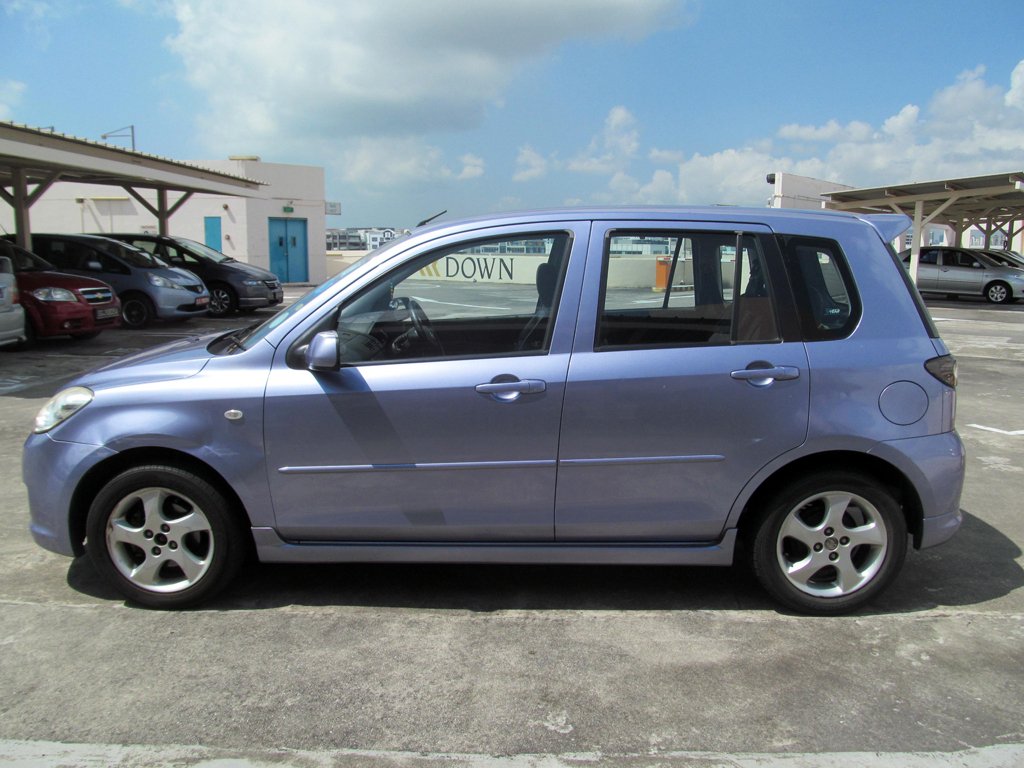
Each of our pre-owned cars represents a certain epoch of our lives. Our very first Mazda 2 hatchback represents a very significant change in my career. I had been going around on public transport for 30 over years. My tuition career back then involves going around in Singapore to my student’s home. It was a very tough period because, in my peak season, I could be going around to 4 or 5 different homes over the span of one day. With the waiting time and travelling time, I could be spending another 2 hours just to get to the venue where I will work. My meal times are not included because I will eat on the go, or just spend like 10 mins eating at the nearby hawker centre or fast food. Or, I could be eating a very late dinner at 1130pm. It was crazy, and I knew it was unsustainable especially when I have a family in the future. The purchase of our first car changed all that. It practically erased the annoying waiting time and so I can go to and from work with a lot more reserve energy at the end of a super long day. To me, saving and protecting my reserve of energy is far more important than the monetary value of the car. During those times, I don't have much life after work and this is important for me.

Our very first Mazda 2 hatchback

The first car is also the car that we went around Singapore, going to different places that we normally wouldn’t go on public transport. We could be having lunch at Liang Court, then pop over to Suntec city for a coffee and then back to Bedok for grocery shopping. It was ideal for us as a couple as we had a lot of utility for the car and the travelling to different places created a lot of experiences and happy memories. When times are tough in taking care of our baby, this is always the epoch that we will reminiscence. We’ll say in our past life, we used to watch a movie without a care in the world. Or, in our past life, we used to spend the whole weekend outside just trying out different cafes.

So you can imagine how hard it was to let go of our first car. Understandably, my wife cried when we handed it over to the dealer. It was like letting a part of our memories go. That was the end of the first epoch.

Our second car is also a Mazda 2, but this time it’s a sedan and not a hatchback. We bought it over from a dear friend, who is also a financial blogger. While our first Mazzie, as we affectionately call it, was a little cranky with the air-conditioned sometimes spewing hot air, this new Mazzie was in a very good condition. Personally, I would never go for a bright red car, but we have to work with what we have. This brings about the second epoch in our lives. If the first epoch signifies my change in career and a focus on living together as a couple, then the second epoch represents the start of my journey as a father and for my wife, a mother.


Our second Mazzie 2, a rare sedan instead of the usual hatchback

It was during this epoch that I learnt for the first time I’ve become a father. With this new Mazzie, I will always remember driving my wife to the hospital for her checkups and also eventually for the delivery of the baby. It was in this car that two persons went but three persons came back. We sneaked out after the confinement period to breathe a little and came back with a bagful of groceries each time. We installed baby seats for our little one, and also had very memorable trips when we can still carry him around while he looks around the world he inherited with his big curious eyes. When he grew a little older, he even recognised the car among all the cars in the car park and will run-walk over to Mazzie, waiting to be carried into this throne in the car. I’ll remember this Mazda 2 as our baby car and it represents our transition into parenthood. Our previous identity as a couple is all but wiped out with the coming of this car.

And that brings us to the third epoch with our newest car. It is the very first car that we bought that is not pre-owned. It’s a Hyundai Elantra that was bought at a steal when the COE comes tumbling down from its zenith just one or two years ago. I know how silly this will sound when the COE plunges even lower, but let me have my fantasy. As mentioned earlier, I thought that I will never ever buy a new car in my lifetime, but I did. It was very exciting viewing the car, waiting for the car to drop to our price range and eventually buying it

Our 3rd car: Hyundai elantra. So, do we call it Trannie or Lannie? LOL

What new adventures and new experience will this new epoch represent? What new memories will we create together as a family of 3? I suspect it has a lot to do with bringing out son to the zoo, the bird parks, Sentosa, science centre and all the other ‘touristy’ attractions. It will also be about bringing him to enrichment classes, ferrying him to and from school and all the other admin runs. This car will witness our son growing from a babbling toddler to a talkative primary school kid taking PSLE.

I wait with bated breath to soak in all these experiences.

Saturday, September 29, 2018

My thoughts on the Mid-year exams removal

There are quite a few people in my circle asking me what I think of this news here. This news is regarding the planned removal of the mid-year exams for primary 3 and 5, as well as secondary 1 and 3. The intention is to withdraw from the narrow focus on grades so that students can discover the joy of learning. I can put on two hats to analyse this. One is that of a parent and the other is that of a tutor.


As a parent:

1) My first thought is that there will be less feedback on how my child is performing in schools. As a result, I will get more anxious as the whole focus will now be on the final year exams.

2) I will have to spend more time and effort to check if my children really understand what is happening in school. There are no more mid-year exams to alert me to take actions or to remedy the situation.

3) With the removal of the mid-year, will there will more of the less formal assessment and grading? If that's the case, then the stress is not concentrated on 2 major exams, but throughout the school semester.


As a tutor:

1) There are usually more students signing up after major exams. One is in May (mid-year exams) and the other is around Oct (final year exams). With the removal of the mid-year exams, my first thought is that I might have fewer students signing up. Thinking about it a bit more, I think it'll work out to be the same. Now my intake of new students will probably come towards the end of the year.

2) I kind of like it that there are no mid-year exams now because currently, it is one major disruption to teaching. Every time there is a major exam coming, I will have to stop teaching and focus on revision and drilling. That's not teaching. It's super boring for me and super boring for the students as well. With the removal of the mid-year exams, I will probably have to test the student's understanding myself. That might be better and should have a better workflow.

3) Without a reason to study, some students might really slack throughout the year and study seriously only towards the end. With the removal of intermediate assessment, I hope I won't have to face more attitudinal problems when tutoring.

4) Those vendors selling mid-year exams packages either huat because these are now precious resources, or they will lose a lot of revenue because now nobody will be buying them. Somehow, I think it's more likely to be the former than the latter. Each package can cost up to $50, consisting of several top schools and worked solutions. It can be serious money for a one-time effort in compiling.

5) Those tutors who are not so good might end up having less 'grading', since there is no feedback mechanism for the parents to tell if their children had improved, and so neither can they tell if the tutors had helped in their children's grades or not. It might be harder to differentiate between the good tutors and the truly bad ones since it's now an annual assessment of the tutor's prowess in teaching vs semi-annual assessment.

Saturday, August 04, 2018

On why we do anything

There are 3 reasons why we have to do anything:

1) We want to do it
2) We have to do it
3) We do it so others don't have to do it

Reason (1) is more ego-centric, where we focus on the needs of ourselves. Reason (3) is more focused on the needs of a larger community of which we are a part of. 

This concept came to me when I observed my 17-month-old child transition from (1) to (2). Initially, all the things he does is just because he wants to do it. As he slowly understands our household rules, and later, the rules of the society of which he is a part of, he starts doing things because he has to. He might not like it and it might not be what he wants to do, but he will have to do it. I have not seen him doing things because of reason (3) and hopefully, that will come when he gets older.

I have an example that illustrates these 3 reasons - that of clearing trays in hawker centres. Usually, nobody wants to do the dirty work of clearing trays. In Tampines, at the site of the old Tampines stadium, there is a food court when there is an automated tray clearing thing that looks somewhat like those conveyor belt system carrying plates of sushi around. I thought that was pretty cool, so I really wanted to clear my trays just to see how it works. I guess the novelty wears off after a while. But when do we really have to clear trays? Maybe when they start charging a fine? Or giving an incentive? In another perspective, the cleaner is the one who has to clear the trays, because he/she is employed for that purpose.

The really interesting part comes when we talk about clearing our own trays so that others don't have to do it for us. Or we clear trays left by others that are not even on our table so that a person carrying a tray of hot food does not have to clear it. I thought that idea really gels with the philosophy of leaving the place better than when we came in. I think the Japanese are really great at this. We always read reports of Japanese football fans picking up rubbish and clearing the place after the event ended.

I also realised that after having a kid, I tend to do things based on reason (3) more often. My wife and I are the primary care-takers and we have no domestic helpers. After work, I'm usually tired and what I really wanted to do is to have my own me-time to recuperate. But I have to do some baby stuff so that my wife doesn't have to do it. I mean there's only me and her. If not me, then who? Perhaps I can also extend this idea to the larger society, treating them like my family. If I don't do things, then who shall do it? If I see a piece of rubbish on the streets, and I didn't throw it there, so while I don't want to pick it up, neither is it my responsibility to pick it up, I should pick it up so that others don't have to do it.

That should make Singapore a much better place to live it for everyone, yes?

As such, I strive to teach that to my kid. I want him to take care of himself first, then take care of others. He cannot be doing things mainly because of reasons (1) and (2) alone. He exists in a larger community of which he is a part of, and he ought to do more things out of reason (3). For him to do so, I must also show him that I am doing so. I need to be a good role model for him to follow.

Thanks, son, for making me better than I am now.

Monday, July 30, 2018

The problem with grit

Grit is defined as the ability to keep persisting in something, regardless of personal discomfort, until you succeed or die trying. Grit is said to be a good predictor of future success, meaning that grittier kids have something in them that makes them able to take the necessary beatings in life to make it work out in the end. This concept is popularised by Angela Duckworth's TED talk, which I think many of you had seen before.

Let's deconstruct grit.

VALUE JUDGEMENT

Grit involves value judgement. When someone didn't do homework all the time, that is grit. When someone plays truant in school despite knowing all the possible punishment that may come, that is also grit. When a gamer sits at home all day to work on his Xbox, that too is grit. But somehow these activities are perceived unfavourably by society, hence it is not considered as examples of grit. Usually, when we talk about grit, we see them through a lens of what we think is the idealised version of a successful person. Working through the night to do homework, or sucking it up and working OT to do a project, or working over the weekend...these are activities that are judged favourably by society. Hence, when we say someone has grit, it also means that society has judged whether it is worthy or not.

Look at the picture below. 


The person below doesn't have grit because he didn't persist. And he is inches short of hitting pay dirt and would have realised his rewards if he just persists for a little longer. That is a value judgement. Why? Economic work and earning more money is seen as a good thing by society. Nobody talks about the sacrifices these people have to give in order to do these work.

Perhaps the person below gives up digging because he realised that having more diamonds isn't what he wanted in the first place. He already had diamonds, in the form of living, warm-blooded people sitting at the dining table waiting for his return. There's no need for more. But somehow he is defined as a failure in the eyes of society, for having given up early before hitting pay dirt. He doesn't have the grit in him to succeed.

Did we also impose our values onto others when we use the word grit?


WHO BENEFITS?

Who actually benefits from people having grit? To persist in doing something despite it being boring and still continue doing so seems a little psychotic to me. It depends on who says that, isn't it? If it's the employers complaining that workers are not gritty these days, then we need to think why they want employees to do that. Perhaps the conditions are really bad and the salary really low, and since there is nothing material to be hopeful of, they use ideology as a self-control mechanism to exert influence on behaviour. Employers do need employees to have grit if they are going to exploit them by squeezing more of their labour output for the salary given to them.

If it's by teachers, we also need to think hard on who benefits. Maybe grittier students are less troublesome to teach and it's much less work compared to a student who is less gritty. When we frame it like this, the conversation shifts away from asking ourselves why the students are subjected to learning uninteresting things, rather than something that interests them. I've not seen people describing doing something that they are passionate about as grit. The usage of the word implies doing something distasteful in the hope of getting something good in the future.

Usually, grit is determined by people with positions of power and authority. We just need to trace the path to see who benefits to understand why they complain people are not gritty enough. 


MARSHMELLOW TEST

In the 1960s, Mischel did an experiment regarding children and different treats, including the infamous marshmallow. Basically, the children are given a treat, which they can choose to eat right away or wait until the researcher comes back with two. This becomes known as the marshmallow test that is designed to determine self-control and delayed gratification and how it leads to success, better health, happiness and so on. Though it's not specifically used to test for grit, it's related. Grit is how much you can endure shitty situations while waiting for the payload at the end, and that requires a lot of self-control plus the ability to delay gratification. It's commonly concluded that those children who pass the marshmallow test, meaning that they get two treats by waiting instead of satisfying their gratification of one treat right away, are predicted to be more successful in the future.

But there are many reasons for this. It could be a sign of class differences. If you are a child who has access to different kinds of treats all day long, (including marshmallows), you can delay your gratification longer than someone who only eats it once every blue moon. The different access to treats, because of the child's background, could play a part.

And there is a value judgment again when we deem that the child who eats two later is somewhat stronger in willpower than a child who chooses to eat it right now. In an environment where food is scarce, it is irrational to delay satisfying your food craving and hold on for a bigger reward in the future. Due to the difference in the child's background, forgoing present rewards and gunning for a bigger one in the future might not be rational because trusting that the future is going to be better is highly dependent on past experiences by the child. A promise of a better future is going to be harder to fulfil to a child in a lower class than a higher one.


HOW THIS CHANGED ME

In light of these reflections, I want to be less judgemental. I'm a tutor and I face students who don't want to study all the time. Not too long ago, I have a tendency to judge students who are less gritty as having less motivation to do well and thus, a predictor of future failure. I mean it's so easy to blame it on grit and wash my responsibility off because I don't have to do more work for students who are gritty. The truth is a lot more complicated than this. Judge less.

I think being a parent made me a much more empathetic person. I can imagine all the good and bad students as being an innocent baby once. No matter what I do, at the end of the day, show compassion and show love. Long after the incident, that might be all that they remember of your interaction with them.

I also want to stop using grit, because it's so cringe-worthy. It's like the word 'passive income'- everytime someone uses that, my soul dies a little. There's a lot of negative connotation in using the word 'grit', so I'll stop using it.

Wednesday, July 18, 2018

Analyzing an Aphorism

Have you seen this quote before?


On my social media feeds, I've been fed this quote a couple of times this week. The first time I read it, it seems pretty logical. In fact that's the thing I told my wife too when she goes on some bulk purchase to save a couple of dollars. The second time I've seen it, I had a nagging feeling that something isn't quite right. So I went to think and analyse deeper into this statement.

Firstly, what is savings? Savings is what's left of your income after spending. Mathematically, the formula is:

Savings = Income - Expenses

Let's just put a number to these items in order to illustrate the situation better. Let's assume the following:

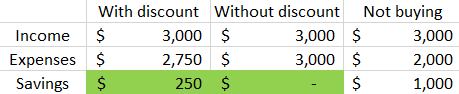
A) Income = $3000
B) Expenses = $2000
C) Savings = $3000 - $2000 = $1000

The above illustrates the base situation where we did not make the purchases. In our base scenario, our savings is $1000.

Let's analyse 3 possible cases:

1) Discretionary purchases (things you can do without)

For frivolous and discretionary purchases, we usually compare against the case of not buying it vs buying it. Why? Because we can well do without it. If you spend $750, your expenses increases by $2750, so your savings becomes $3000 - $2750 = $250. Between not buying and having a savings of $1000, vs buying and having a savings of $250, you save lesser by $750.


2) Non-discretionary purchases (things you can't do without)

For non discretionary purchases, we usually compare against the case of buying the item at non-discounted price vs buying at discounted price. If u buy at a non-discounted price of $1000, your expenses increases to $3000. Hence your savings becomes $3000 - $3000 = 0. If you buy at a discounted price of $750, your savings becomes $250. Since it's an item that you have to buy anyway, you save $250 if you buy at this discounted price. Notice that we do not compare against the case of not buying it and having a savings of $1000, because it is a purchase that we must make.


3) Investments (things you buy that increases your income)

For purchases that increases your income, the spending of $750 may result in a rise in future income. If your future income increases by more than the amount spent, you save more even after the purchase. If future income increases less than the amount spent, then net net there will be less savings. So, it depends on the investment returns to see if we save more or we save less or we don't save at all.


It's not so simple now, isn't it? As with all aphorism, the simple statement works as a good soundbite - catchy, memorable and impressive. But it simplifies the truth of the matter too much. There's a lot of details that need to be mentioned.


We can put this analysis to the test by analysing the purchase of a car. If a car is a discretionary purchase, the fall in COE has nothing to do with you. Having the cost of the car dropping from 100k to 80k still means that you have to spend 80k. However, if a car is a decision you are going to make anyway, a drop in the cost of the car is great for you. Now you can make the car purchase at a cheaper price, resulting in a net savings of 20k. Finally, if your car can make you earn more income because it extends your range and reach and allows you to save time and energy, it doesn't mean you should commit to the purchase immediately. The next step is to see if the potential increase in income is worth more than the purchase. Frankly, it need not even be just the increase in income, because we could be looking at other intangible stuff that we cannot put a money value to it. If after weighing all the good against the total cost of the car, and you think it's worth it, then we can go on and make the purchase.


Next time when someone says buying something is not a good purchase, you'll have to ask yourself first : out of the 3 scenarios, which one fits your situation the best?

Thursday, July 05, 2018

Learning new things for fun

In the last week or so, I've been learning programming. I've done programming in the past using an ancient computing language typically used in old ancient physics or engineering lab (Fortran, if you must know) back in my university days. This time, it's a new age computing language called Python.

I've never been so excited about learning new things for a long while. One fine day, I just decided I wanted to continue my coding journey, so I just picked a language and started reading about it. I downloaded the python software (free) and started working on it. The time that I usually spent playing games is now replaced with learning and playing with Python.

The very first thing that I did is to code this algorithm I came up with 3 yrs ago here. I've been thinking about this problem for quite a long while (easily 6 to 8 yrs), but chanced upon the most efficient way to mathematically describe the problem 3 yrs ago while teaching some new subjects to a new student. Once I know the math behind it, the next logical step is to code it in this new language.

Next, I tried to code this problem that I knew will be somewhat challenging to me at my current skill level. I want the user to key in the birth month and date, then the program will be able to give the appropriate astrological signs (e.g. Taurus, Aquarius, Libra etc). I like the challenge of transforming a simple idea into something concrete and I was definitely in the flow yesterday as I came up with the process. 3 hrs flew by and I didn't even notice!


A few interesting insight:

1) This is the first few times I do something first before knowing something. What do I mean? I have an objective in mind. I just try coding it immediately. I fail because there are some things I don't know. Then I'll read up and search around, and try again until I succeed. This problem-based learning makes it frustrating but it's this frustration that the thing is nearly within your grasp that pushes you to dig a little deeper. This exponentially increases the way I pick up and retain new knowledge. This iterative process is usually not the way I learn something.

2) I didn't learn this for work purposes, nor for some certification. I did this purely for fun. I'm actually dreaming up interesting projects every now and then, and try seeing if I can succeed. Actually I'm not so interested in the actual coding part, but more about how to come up with the algorithm of doing things. Might be useful in life, but hey, I'm having fun, and that's the most important!

3) A student asked innocently if I teach coding. Hmm, maybe this might turn out to be a money making hobby after all. Totally unexpected and I definitely didn't plan it this way, so it's quite a bonus for me if I did make some income out of it.

4) How come I didn't sign up for those courses at Udemy or skillsfuture? I don't know. I am 'iron-teeth' (colloquial slang for stubborn) perhaps, wanting to do things my own way. I just got a textbook and jumped straight in. I think structured courses makes life easier, but I prefer charging up the hill. The learning is more robust, more practical to my needs and also more open ended. It's important for me to feel like a total newbie trying to master a new skill, based on my own effort. Puts me deep in the seat of a beginner, and so I can understand the difficulties of learning new things. As a tutor, it's important for me to experience being a beginner every now and then. This will put me in the right perspective when I'm teaching.

5) I'm definitely playing. How do I know this? I didn't just code it, I played with the code. I tried ways to make it more efficient, or set my own limiting constraints. Basically I don't just want to see a program done, I want to keep working on it until it's no longer fun. If I just want to get it done, I'll have paid a small sum and used fiver or other freelancing work to outsource it to an expert.


With the internet and google plus youtube, all the information in the world is out there waiting for an interested student to read it and learn.

Saturday, June 30, 2018

The key to unlock doors

Today, my wife and I went to grocery shopping. We're looking for a pack of Origins Organic hulled millet that my son is eating as a porridge daily. It's running out and we desperately needed a packet to refill it up. It probably didn't help that it was about to rain heavily and I only have about 30 mins turnaround time to get back home because a student is coming for lessons. In other words, I'm looking for a grab and go situation, not really in the mindset for shopping around.

Not my wife.

I went to the usual shelf where the millet is, but it was empty. I searched around neighboring shelves to see whether there are any hidden packs, but I couldn't find any. I thought that it's time to go back empty handed now, and I'm all ready to give up and go home.

Not my wife.

She saw a employee packing some stuff at a nearby shelf, with several large carton of unpacked boxes on a trolley near her. My wife went ahead to ask her if there's any more stock left for the hulled millet. She said it's still in the process of packing. Right now, most people would have left there and then and accepted the fact that nobody is going to buy any hulled millet today.

Not my wife.

She asked if she can help her unpack the cartons containing the hulled millets. And we started partly opening each carton on the trolley to see if they contain the stuff we wanted. If not, we pack it up and move it to another spot, and repeat the process. To an oblivious observer, it seems like we're actually packing the store. Eventually after moving like 5 to 6 big cartons, we managed to find the exact carton with the hulled millet. I think in the process of helping ourselves, we also helped the auntie just a little to unpack the super heavy cartons off the trolley.


This is one of the lessons I'm trying to learn after coming out of school, that there's no definite yes and no and everything is negotiable. Life is not an MCQ (multiple choice question) where there is only one answer in the marking scheme. Human relations is the key to unlock a lot of locked doors out in the real world. Apparently, I needed a revision course on this particular lesson.

Not my wife.

Thursday, June 28, 2018

Evolution of worry

Before my kid is born, I am worried about whether he will have genetic faults. The worry is real so both of us went to do some checkup to see if we have any hereditary illness that might be passed down to the next generation.

Then when he is born, I'm worried about whether his hearing is alright. He initially failed the test, but was okay after a second try the following day. When he is still crawling, I worry about whether he can walk. When he starts walking, I worry about when he will start talking.

Basically the worry is always there, just that the thing I worry about changes. That itself is a good thing because the nature of my worry evolves as we grow and mature. It'll be a problem if we keep worrying about the same thing over and over again, because that will mean that we never grow bigger and thus our problems remain the same.

It's interesting being a parent to a growing kid, because you start to see things from its very basic form, evolving to become more complex, and I hope that in the future, it'll become simpler again. A to B and back to A, isn't that back to square one? Isn't that a waste of time? No, I believe the journey itself is the point, not the end point.

My student is sitting for his common test these few days. He worries about whether he will complete the exam on time. But not too long ago, he was worrying about whether he will even pass his O'lvls. I reminded him of it, and he smiled. I also smiled. At the same time, I worry about whether my income can feed the family. Maybe in the future when my health deteriorate, I will worry about whether I can still see my family in the next hour.


While I worry about when my son will start calling me 'papa', I think back about the time when my biggest concern is whether he will be born healthy. All in due time.

And I smile.

Thursday, June 21, 2018

MyRepublic's Uno plan speed testing

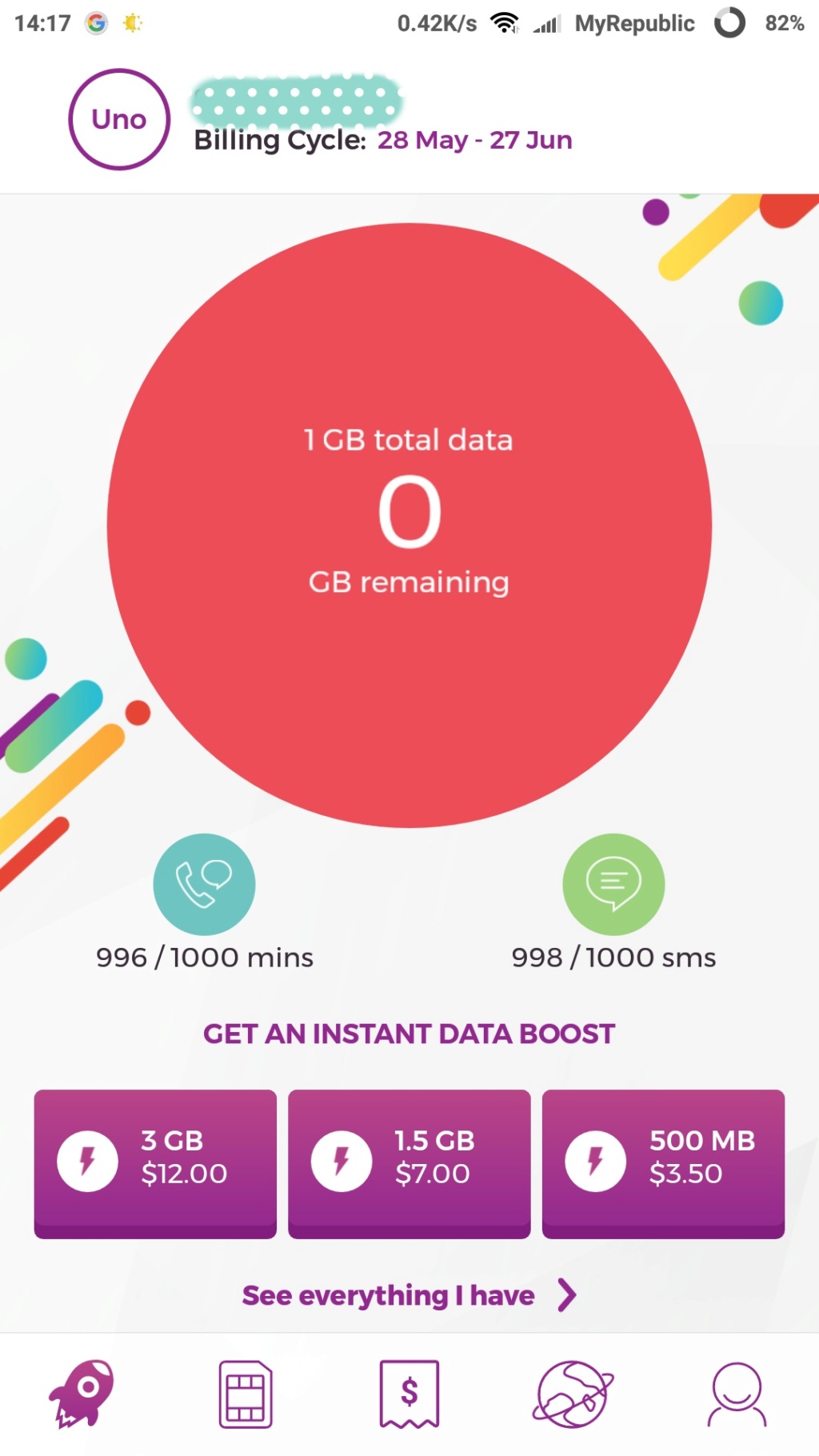
Towards the end of May, I switched my mobile plan from a sim only plan from M1 @ $25 per month to MyRepublic's Uno plan @ $8 per month. This plan suits me to a T, because I don't like having a lot of excess data since I only use only 1 Gb per month working at home. I love the free caller id and best of all, there's this thing called boundless data. The plan gives me 1 Gb but if I exceeded 1 Gb of data in that month, I won't be charged for it. Instead, they will throttle the data speed so that you can do the bare minimum of things. If you want a speed that you don't have to rage, then you just need to top up the data and pay more.


The full details of the plan are as follows:

MyRepublic Uno plan 
 - 1Gb data
 - 1000 min talktime and 1000 sms
 - boundless data (throttled speed after 1 Gb)
 - free caller id
 - free incoming calls and sms
 - No contract

The main aim of this article is to highlight the throttled data speed after exceeding the allocated 1 Gb. Does the throttled speed allow you to do the basic stuff like checking email, surf, call (using data) and youtube?

These are the test parameters:

1) I stay in the east, specifically Bedok/Tanah merah area. I work at home and occasionally I'll travel also around the east side. It matters because MyRepublic is under Starhub, so the coverage for different areas will be different.

2) I'm using Android phone, Xiaomi Mi5 and my app for the speed test is Speedcheck Pro.

3) I tested the speed at various timing throughout the day during working hours. No early morning or midnight tests. Also the places where I tested is not crowded with people.

4) I did not do any speed test at any mrt lines while travelling

I'm going to comment on the data speed and quality, email checking, surfing, data calls and also some common apps before and after the throttle.


Here's my data speed before and after the data throttle:


* DL - download speed
* UL - upload speed

I did 6 sets of speedtest before my 1Gb limit is up, and another 6 sets after my 1Gb limit is up. Test parameters of the test had been described above already. You can see that before the throttle, the average download speed is 33.6 Mbps and the upload speed is 9.45 Mbps. After my data limit is hit, the download and upload speed of my data is throttled to 0.23 Mbps and 0 Mbps respectively. In fact, the speed test is interrupted by intermittent connection, especially during the upload part. Can't blame it...each test sends takes 100 Mb of data.


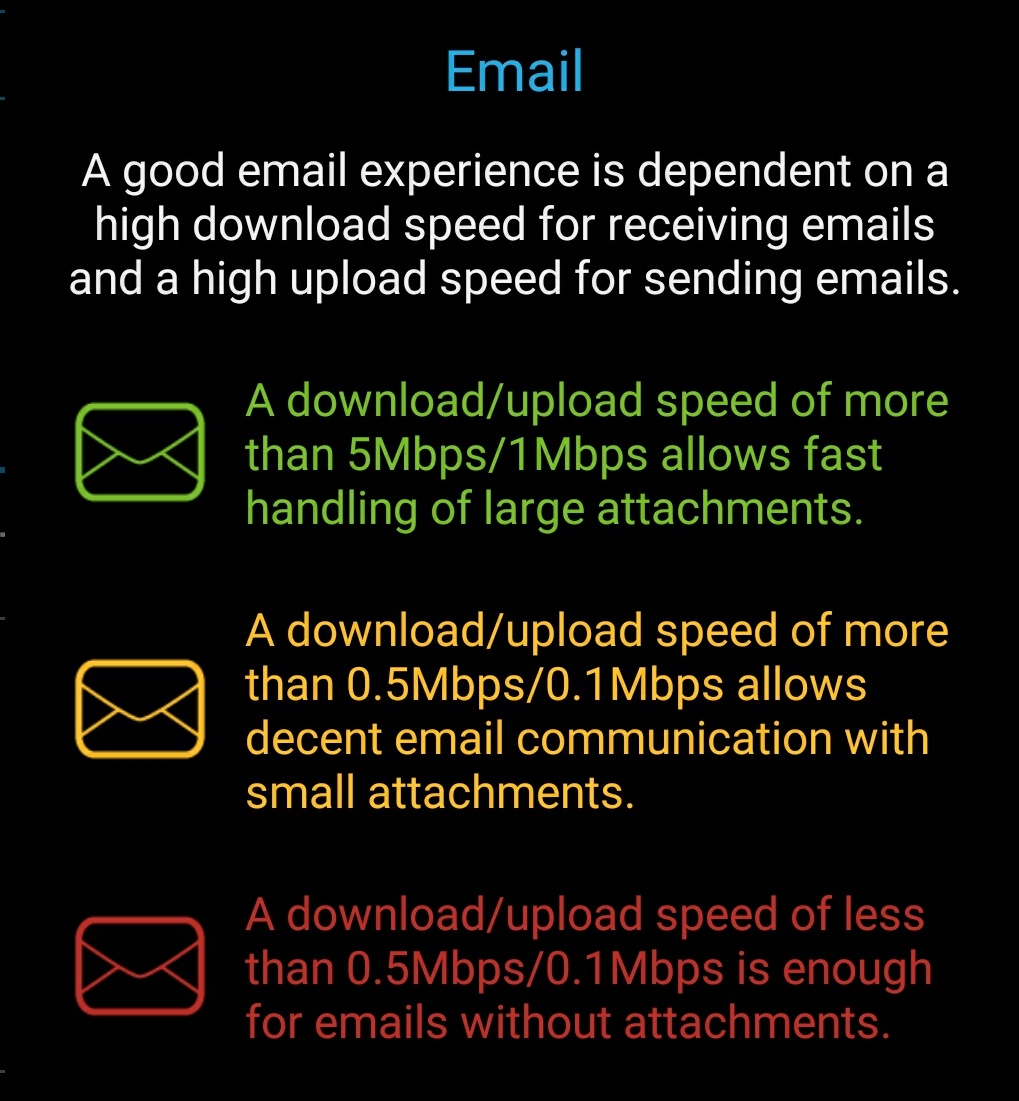
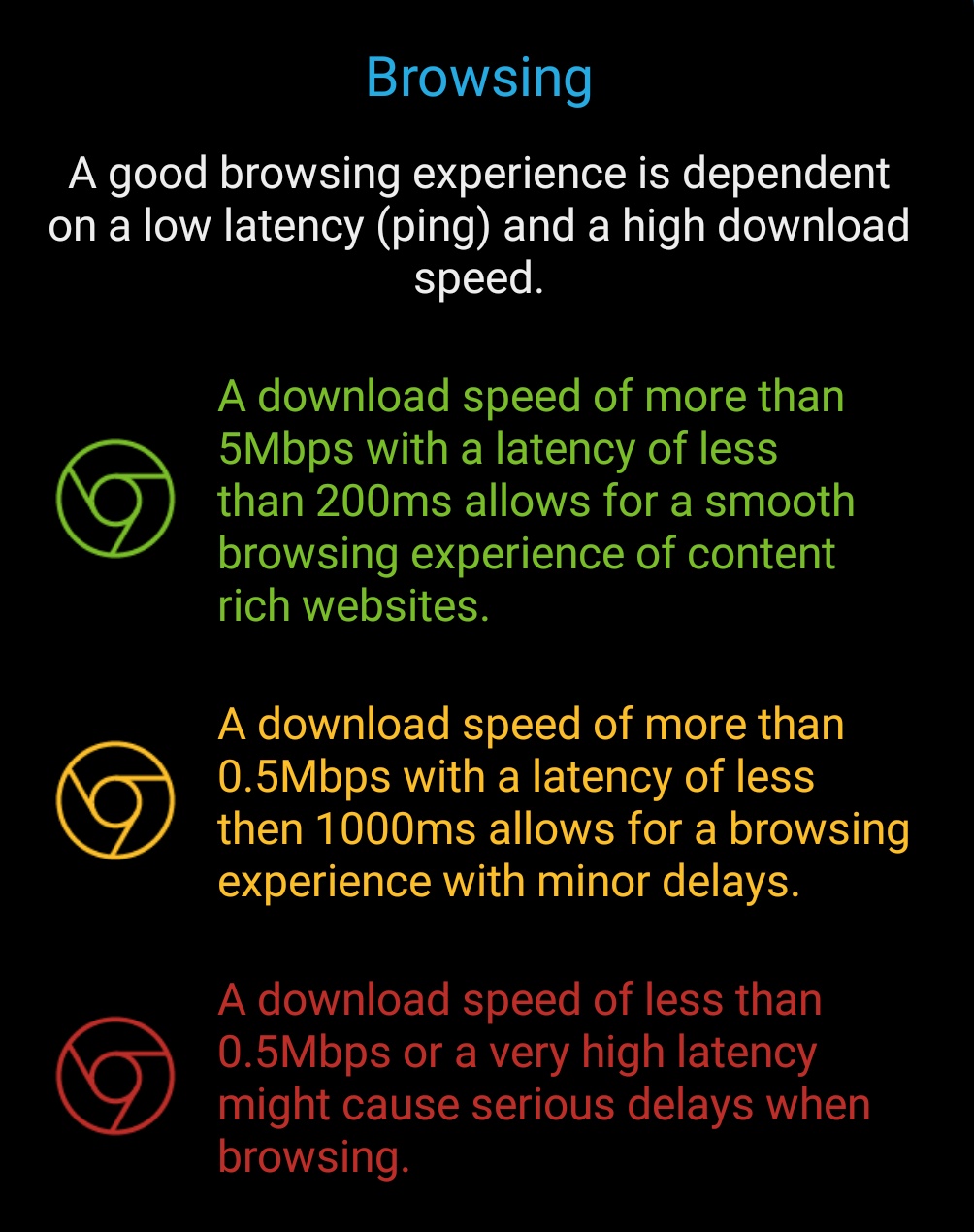
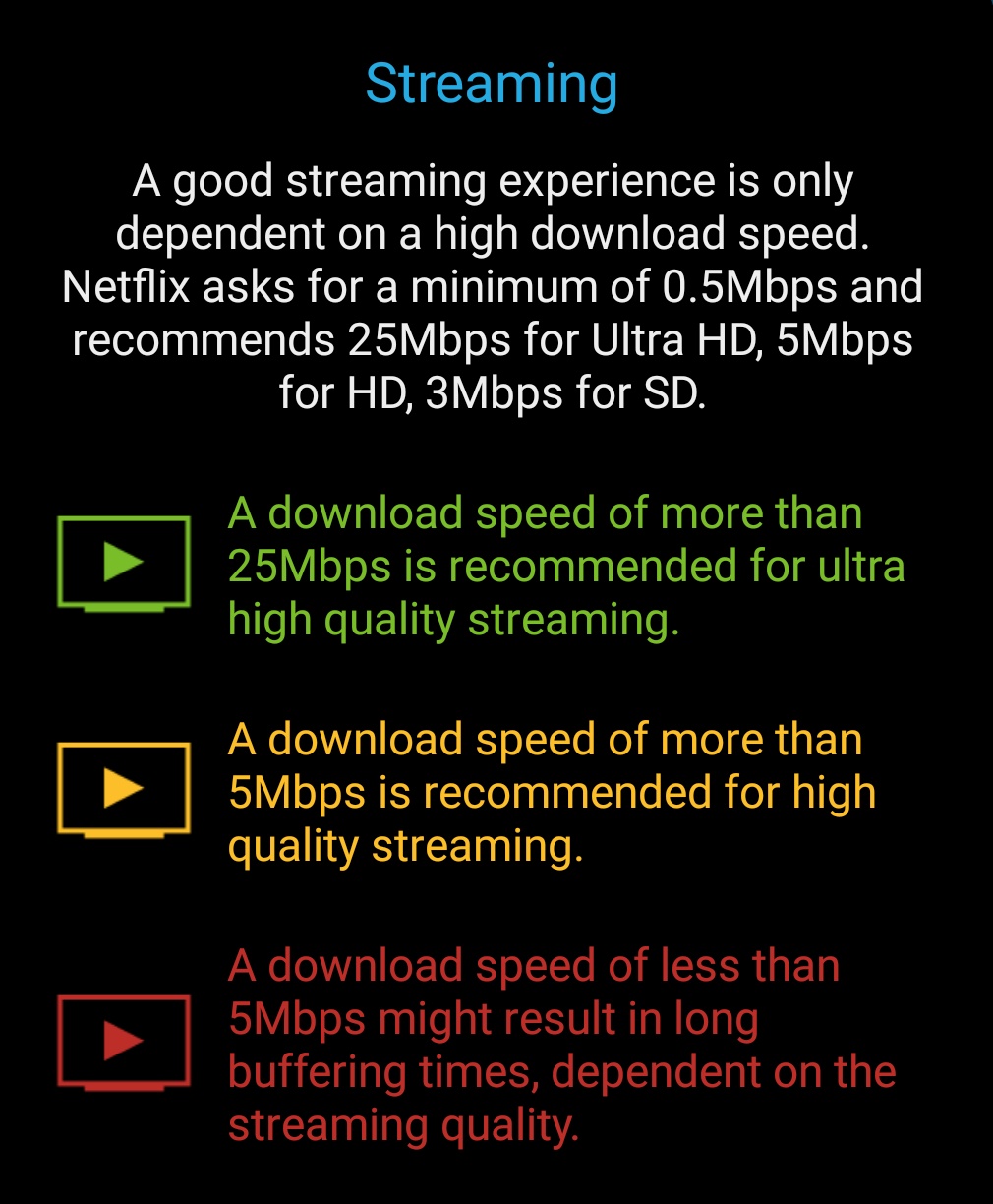
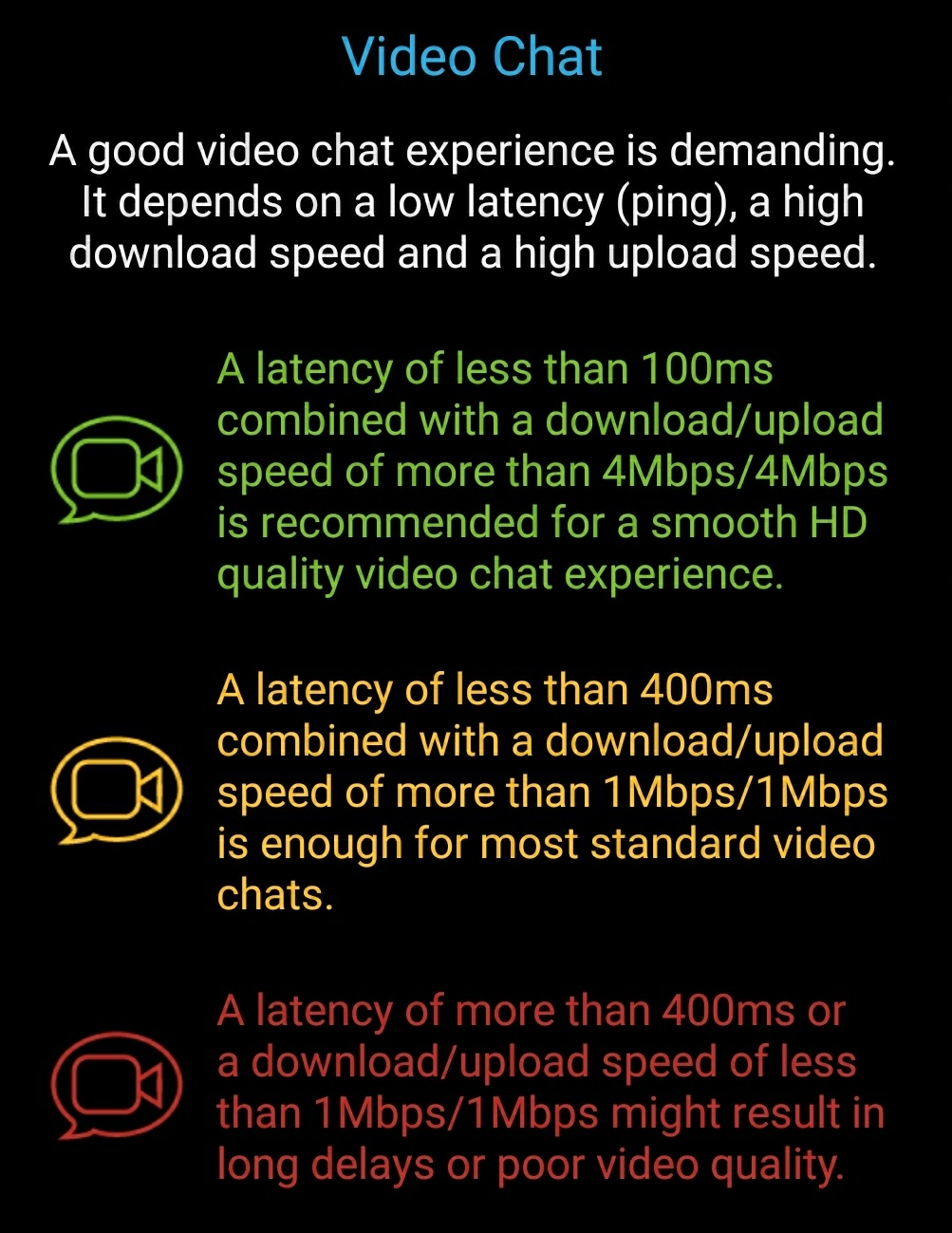
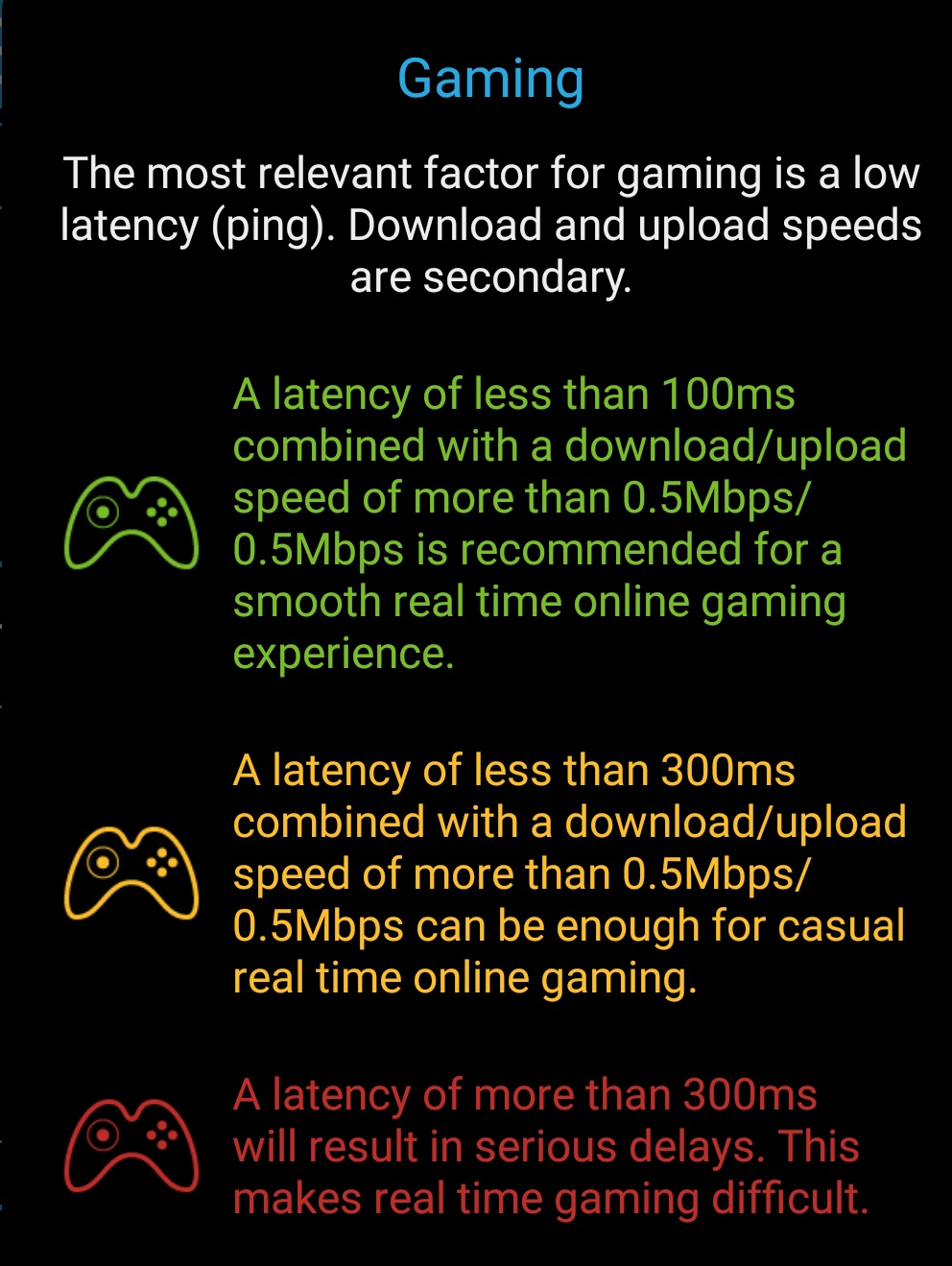
According to the speedcheck pro app that I'm using, they mentioned a rough guide on what is considered laggy and good speed (DL/UL) for different uses. These are screenshot as follows:

Email:


Browsing:


Streaming:


Video chat:


Gaming:


Based on the above guidelines, my usage experience before throttle gives me this:

Email: green
Browsing: yellow
Streaming: green
Video chat: yellow
Gaming: yellow

And after throttling:

Email: red
Browsing: red
Streaming: red
Video chat: red
Gaming: red

Wow..is it so bad after my 1Gb limit is reached? I tried emailing myself using a small attachment of about 200kb and felt no difference. Maybe it's a bit laggier, but I wouldn't know much because I don't have a lot of experiences sending email with attachment using my mobile phones. But normal email experience is perfectly fine. While the rating for email is red, I will say it's still usable. Just don't attempt to attach big files to your email and it should be fine.

Browsing feels appreciably laggier. I have to wait for the entire site to load and you can see parts of the site being loaded while others are still waiting. Pictures takes forever to load. I mean I can finish the entire text and still the pictures are still loading. I think browsing experience really deserves a red rating. Don't do serious browsing here, or you'll go crazy and start pulling your hair.

Streaming is a mixed bag. Netflix recommended at least 0.5 Mbps download speed, and we don't have that kind of speed after throttling. I tried to watch Netflix and the "loading...." screen seems to be there all the time. I gave up after a while. As for youtube, you can still continue watching. I find that the best experience for me is to watch it at 240p. Anything higher will have to be continuously interrupted by the loading every 10 s or so. I think 360p is also okay, but you might have to wait a while longer for the loading to be done in ahead before you actually view it. I'm actually surprised I can watch a you tube video after throttling.

Facebook work fine, until you start clicking on the video or the comments. It'll take a little longer than usual to load but it'll work. It's not as irritating as browsing though, so I feel it's still acceptable. Whatsapp messaging feels as normal and I tried the data call from whatsapp too. To me it's okay, and not especially lagging (data call are already laggy). But why would anyone want to data call when there are 1000 mins from voice call? I didn't switch on the face mode though, so perhaps there might be a suitable lag with the data throttle.

I don't game online with my handphone, so I've no comments on that.

Someone did a speed test before and after throttle too and got about the same result as me. The post is linked here. He practically got the same numbers as me, with the download/upload speed as 0.25 Mbps / 0.08 Mbps, so altogether we have 2 sets of independent study on the data throttling by MyRepublic after hitting the data limit of 1 Gb on the Uno plan.

As a side note, I really love their app. At a glance, I can see how much data I have, the number of sms and min of voice call left. If needed, you can top up and get instant data boost. This is one of the most friendly app I've used. I've used starhub and M1, but not circle line. But I suspect these days the telcos are really ramping up on their app to boost user experience.


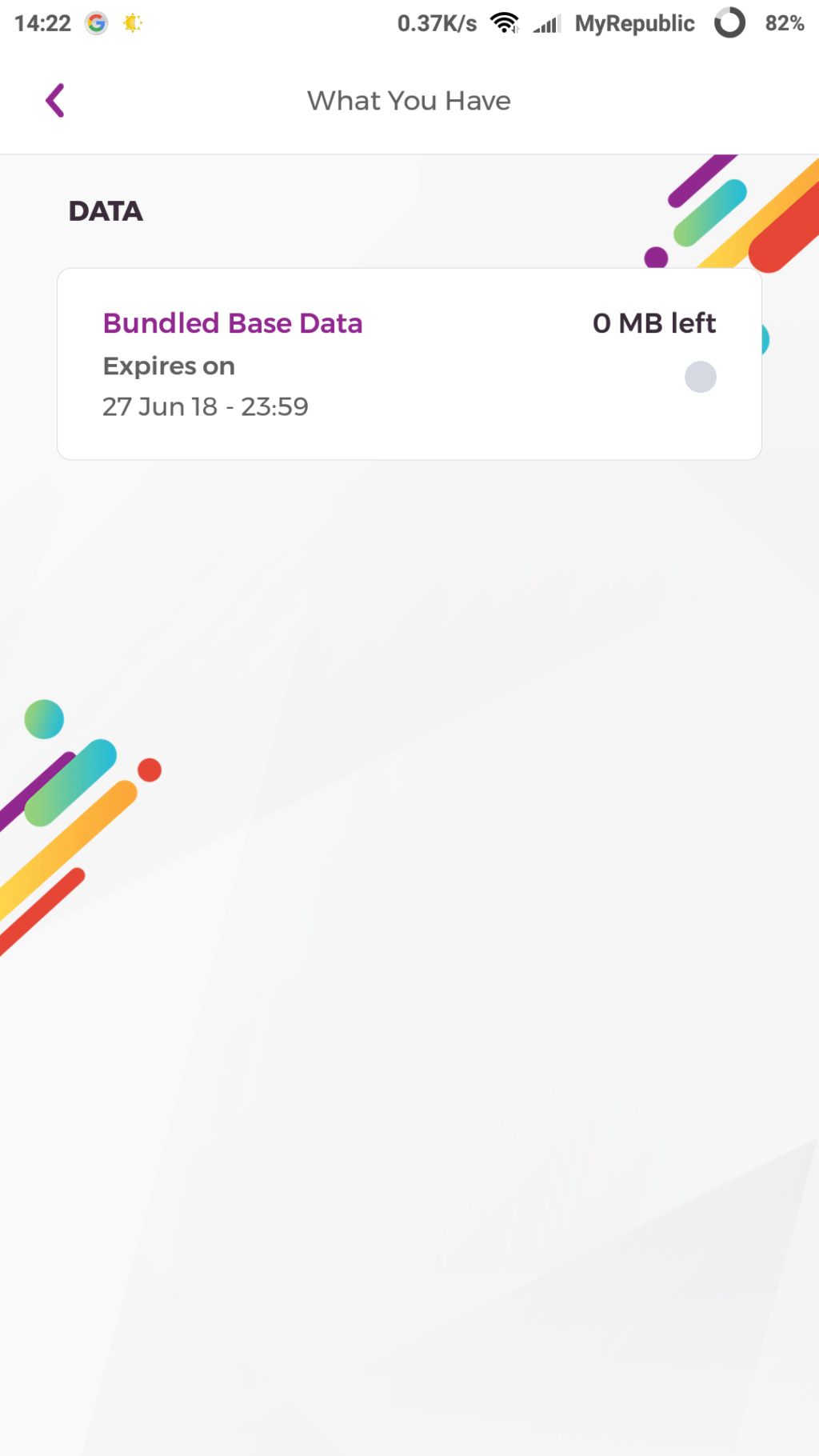
I especially like it that the app have a date and time to tell me when the next reset is. There are many times when I have to check my contract and guess when the reset is when I'm with starhub and M1. Their app is just not that intuitive. This app even give me the exact time of the reset.


Verdict:

What's not to like about this? As I said, this plan fits me to a T. I understand that there are people who uses more than 1 Gb and this will not be a good fit. As for me, I'm smiling broadly because I save about $200 per year off my handphone bill.


Update 1: 21st Jun 2018 2pm

I just got wind of the fact that 3-4 hrs after I posted this article, MyRepublic no longer have this plan. Now they have 3 plans with the cheapest at $35/mth. Thankfully I didn't wait longer, otherwise I will regret for the rest of my life! Haha, I exaggerate, but yeah...

Update 2: 21st Jun 2018 5pm

A bigscribe member told me that the Uno plan is still available.
1) Go to : https://mobile.myrepublic.com.sg/plans/promotions
2) Go check out forum to see the promo code to get the Friends Of MyRepublic
3) Sign up Uno plan for $8/mth

But better hurry, not sure when they will really stop the plan once and for all.

Monday, June 18, 2018

Easier to be a good dad than a good mum

When I go out, I always see wives scolding or complaining that their husbands are doing a super bad job taking care of kids. The husband literally just stand there and suck it up while their furious wife is pouring out all her troubles in public. I ever asked my wife if she'll do that to me in the future, and she asked if I'll do that to her instead.

The truth is that it's easy to be a good dad. In fact, it's easier to be a good dad compared to a good mum. The standard of a good dad to hurdle over is way way lower than that of a good mum. I mean a dad just needs to do a little housework, maybe cook a little, wake up at night perhaps once a week and change the diapers once in a month, and he'll be hailed as a national hero to be lauded with praises. "He's a good catch!", says random friends and relatives.


But the mum, despite having to work, look pretty, do housework, cook daily, do night duty almost every day and change the diapers almost every time, will still fall short of expectations. "How come you're still so fat 2 yrs after giving birth?", asked concerned random relatives during family gathering. "How come the baby is waddling in the mud, tsk tsk...the mum is not doing a good job", says observant random passerby.

I see it and I try my best to correct the inequality and unfairness in the whole dynamics. I did my fair share of work, but due to conflict of interest, perhaps only my wife can comment on whether I am really fair and equal in sharing the duties of child caring between ourselves.

To all the fathers who are ticked off by their wives in public, I wish I can help you deflect some of the attention, but you know I can't. The best thing you can do is to step up to the challenge and start being a good dad, by living up to the standard of being a good mum.


Happy Father's day.

Friday, May 11, 2018

Surviving vs Thriving part II

I talked about thriving and surviving in this post here. That theme keeps creeping into my mind in the quieter hours and I thought more about it. Decided to post it here to further consolidate my thoughts on this subject matter.

There are three categories here:

1) not surviving
2) surviving but not thriving
3) thriving

Basically these are states which describes your level of excess mental and physical energy. Not surviving means you don't have enough physical and mental energy. Surviving means you just have enough and not much to spare. Thriving means you have more than enough.


SYMPTOMS 

Those description above are too fuzzy, so I'll describe how each category will look like to you.

1) Not surviving

This is when a person do not have enough physical and mental energy. He will feel tired and sleepy, always wanting to rest more. There could be psychosomatic illness, like migraines, vomiting or fever and flu when going to work, which miraculously recovers when work is stopped. This person complains all the time. This is not a good state to be in. This is not a state of equilibrium and there is a lot of push factors to establish a new equilibrium state. Over time, either the person will be forced to leave the task or the task is forced to leave the person.

2) Surviving

This is when a person have just about enough mental and physical energy. There is enough skill to reduce the energy expended to do things mechanically. This is a comfortable state of equilibrium to be in, where the energy spent to do things is about the same as the energy you have and this state can be continued perpetually. But there is a hint of resignation that this is the best that life can offer you. There is not enough push or pull factor to jolt the person out of this stage of balance, or status quo. In temporary moments of sanity, the person might regret not taking on more risk to expand his circle of competence, and fight for something more meaningful to live for. But when such moments passes, the person shrugs and concludes that he is waiting for the right time to move on. Maybe tomorrow will be a better day to move on, but he does not realise that today can be a very very long day.

3) Thriving

This is when a person has excess physical and mental energy beyond what is needed to do the task. So what does one do with the excess energy? The person engages in free play. Free play is when the purpose of the play is the play itself, and not some rational outcome to be derived from the play. The person will be like a baby with an abundance of excess energy, and he  experiments just to see what will happen. Maybe some good will come out of it, or maybe not, but that's not the point. The important thing is that it is fun. However, this is not a state of equilibrium too. Perhaps one of the creative experiments will lead the person to explore a tangential path, and he starts the cycle from category 1 again. Or that abundance of energy is sucked into some black hole or to fight some energy vampire somewhere. Or perhaps there is only so much things to experiment with and eventually one will get bored and have to find a new pasture to play again.


APPLICATIONS

In terms of work, I'm thriving. I usually don't get drained by work. On the contrary, work tends to revitalise me somewhat, as long as I'm not doing 14 hours a day. My free play will be to experiment with different ways of teaching the same thing and to come up with better worksheets or analogy to explain something better. Recently I am teaching a poly engineering student some really hard engineering math, involving Laplace transformation and Fourier series. If you've not heard of it, you it's only natural. Nobody except those doing some deep calculus or electronics will get to do such stuff. I took home the lecture notes and had a good time 'playing' with the tutorials. If I'm just surviving, then this will be yet another chore I had to do. Instead, I treat it as play.

Last year, I was on survival mode in terms of taking care of my kid. I'm just taking care of him mechanically because I've barely had enough energy and will power to do anything extra. Now, he is about 1.5 yrs old and just starting to walk in his quirky way. I've started a night reading program to expose him to written words and dictation. Also starting to treat him as an adult, talking to him despite him not knowing how to talk. I've no idea whether it will work, but I'm experimenting. And since I'm experimenting new things, I must have energy to spare. 

But the thing about parenting is this. Just when you thought you had mastered everything, the baby evolves to a new higher level and you start scrabbling to unlearn and relearn how to survive and then to thrive. Rinse and repeat. Hence, I think as a parent, being on survival mode with occasional sparks of thriving will be quite good already. Come to think of it, I think for everything else, being on survival mode with infrequent thriving mode is a very ideal situation.


Maybe that's what cruising is all about. I'm not young anymore. I know my strengths and I know my weaknesses. I also know what I want out of my life. I don't need to pursue every opportunities that comes my way. I have the power to say no, and I intend to say that to most of things that come my way. If I don't feel 'hell yes', then it should be a 'no'.


Thursday, April 26, 2018

11 questions from Tribe of mentors

I'm about to start reading on Tim Ferriss's Tribe of Mentors. If Tools of titans is a great encyclopedia of self help knowledge, I think tribe of mentors wouldn't do much worse. Tim went ahead to ask several people the same 11 questions, which are listed down below. Since I haven't start reading, I thought I will try to answer them first so that I get more out of reading what others have to say. So, here's my answers to the 11 questions:


1, What is the book (or books) you’ve given most as a gift, and why? Or what are one to three books that have greatly influenced your life?

Without any doubt, the most given book is The Giving Tree by Shel Silverstein. It's a children's book, and I love it because it has deep meaning for an adult to take home and reflect too. I've given it (together with my wife) to at least 3 different people. It just takes 5 mins to finish reading from cover to cover, but the lessons stay.

Which 3 books greatly influenced my life? This is a hard one for me, because I read so much. To just pick 3 is going to be really difficult, so I'll just pick the first 3 books that comes to mind. They are:

a. Trading for a living - Alexander Elder

It changes the way I look at charts. I'm still using the techniques first espoused in the book. I read this every now and then to refresh the knowledge.

b. E-squared - Pam Grout

Wow...this book changes the way I think about reality. How to convert thoughts to reality is what this book is about. It seems like pseudo science and magical mumbo jumbo, but I don't care. If it works for me, it's good enough for me.

c. The miracle of mindfulness - Thich Nhat Hanh

This is the first book that I've read about meditation and mindfulness. Greatly changes the way I handle my emotions and it profound effects on me. Even started a 30 days mediation practice that still affects me till now.


2. What purchase of $100 or less has most positively impacted your life in the last six months (or in recent memory)? My readers love specifics like brand and model, where you found it, etc.

The one thing that comes to mind is the Oral-B genius 8000 electric toothbrush I bought from Amazon during a discount. After shipping, it works out to be about $140, which I shared with my wife. It started as an experiment to see what is the fuss about electric toothbrush. I was against it in the past, because I thought it was such a waste of money. What can an electric toothbrush do that a normal sub $10 can't do? After using, I though it was the best thing I ever upgraded in my life. You don't spend $140 on an electric toothbrush, you spend $140 to have the feeling of having visited a dentist to wash your teeth every night.


3. How has a failure, or apparent failure, set you up for later success? Do you have a “favorite failure” of yours?

A hard question for me. I was racking my brains to think of a major failure...then I thought of my stock investment 'failure'. I had my stint of value investing, went deep into longcheer thinking that it's a value buy, averaging all the way down until I capitalised and cut loss. What a loss it is. Looking back, it's just 20 to 25k max, but it was a lot of money to me back then and it's a big part of my networth. I went into depression, at a point even having weird thoughts about jumping off. It's that bad.

I self healed after a month or so of hating everything, especially myself. Work brought me out of the misery. No matter how angry and frustrated I was, I'm never angry with my students. They are innocent. So after every lessons, I felt a little better. It was then that I discovered work is more than about making money to me. As much as I am making a difference to my student's grades, they are also making a difference to me. It's an epiphany.

After that bout of depression, I grew much stronger mentally. I grew a lot more chillax about life and money especially.


4. If you could have a gigantic billboard anywhere with anything on it—metaphorically speaking, getting a message out to millions or billions—what would it say and why? It could be a few words or a paragraph. (If helpful, it can be someone else’s quote: Are there any quotes you think of often or live your life by?)

This is on my whatsapp profile for a while already:

"You may shoot me with your words,  You may cut me with your eyes,  You may kill me with your hatefulness,  But still, like air, I’ll rise."- Maya Angelou

It's a sort of resilient guai-lan-ness that I like. I strive on your negativity and your discouragement. There is a very strong motivation to prove naysayers wrong. But these days I'm not so angsty anymore haha


5. What is one of the best or most worthwhile investments you’ve ever made? (Could be an investment of money, time, energy, etc.)

It has to be my blog called Bullythebear. From it, I derived so much things out of it that it's just ridiculous. Here's a list of what the site did for me:

a. Met a group of close like minded friends. Some of them I knew for over a decade already!
b. A place to crystallise my thoughts. I don't know what I know until I type it out and see for myself
c. Some cheap thrills like ad money that I collected over the years. Not a lot but still thankful
d. Opportunities opened up for me, like a few business ideas, recommendations for tutors etc
e. Tremendous improvement in writing skills and editing
f. Leads me to learn blog related things like digital art, image edition etc

I've been writing on this blog since 2006, so it's nearly 12 years of writing and finding my writing voice. Hands down one of the best thing I've done for myself.


6. What is an unusual habit or an absurd thing that you love?

I have a little bolster that I've been using since I was a kid. It's still with me, and I still hug it to bed every night. I call it some name that I'm too embarrassed to say, so don't ask me. I love it because it's an 'old thing', and it reminds me of a lot of things. It's sort of like a memory time capsule, except it's soft and hug-able. And I've threatened a few people who wanted to throw it away.


7. In the last five years, what new belief, behavior, or habit has most improved your life?

I've a few systems that I've set up that greatly improves my workflow:

a. I'm a tutor. After each lesson, I will write what transpired during the lesson and the reflection, and putting it up on evernote. I used to do this by memory, only writing it fairly recently on my notebook and even more recently, 'upgraded' to put it on cloud via evernote. This way I can take it everywhere I go.

b. Started doing homework on charts using investingnote. I used to do it on an infrequent basis, but I ended up missing some of the things that fit my system. These days, I spend like 10 mins or less running through the whole watchlist, and put those under close watch for needed actions within a week. This means that during a week, I will just focus on those under close watch. It improves my workflow and lets me know what to do if it happens.

c. Writing a diary. I started this habit last April and had been jotting down my daily affairs almost every day since. I use an app on my handphone and I will take a few minutes just before I sleep to 'close off' for the day. Not sure what benefits it brings to me yet, but when I do, I'll let you know through an article. This is still an experimental habit to see if there's improvement in my life. Still work in progress.


8. What advice would you give to a smart, driven college student about to enter the “real world”? What advice should they ignore?

Advice: Unlearn everything you learn in school. Don't think that having theoretical knowledge beats practical skills. It doesn't. Be humble, be curious and learn how to take shit. Say yes to everything because you're not ready to know what's not a 'no' for you yet.

Advice to ignore: Go for passion over money. You need both, probably more of the latter than the former.


9. What are bad recommendations you hear in your profession or area of expertise?

I'm a tutor. I've heard many people saying rote learning is bad. They should learn smart. It's bad recommendation because while we have all the information we want at our fingertips, if you don't memorise certain things, you won't be able to use them. I've students who don't want to memorise formulas, saying that there is a formula sheet given during exams. But if it's not in your mind, it's not going to get used, that's what I always tell them.


10. In the last five years, what have you become better at saying no to (distractions, invitations, etc.)? What new realizations and/or approaches helped? Any other tips?

I've becoming better at saying no to projects that doesn't excite me and doesn't make me want to wake up in the middle of the night to think about it. If it's not hell yes, then it's a no. I get better at saying no because I realised that I'm at this age where I don't have to live other people's dreams and aspirations. It's time to live for myself. It might be a little selfish, but not now then when. There's also much more clarity in knowing what you want to do in your life.


11. When you feel overwhelmed or unfocused, or have lost your focus temporarily, what do you do? (If helpful: What questions do you ask yourself?)

I think the first thing is to be aware that I'm actually losing focus. It's not always apparent. Once I know it, then it's much easier. I can either tell myself I will do it anyway because of constraints, or say that I will come back to it when I have more will power and energy. A lot of time and energy is wasted when I wasn't even aware that I'm not focused...you sort of just drifts along without that realization.

I don't ask questions to myself. Usually I'll just tell myself mentally, or voice it off silently, "Okay, I can do this, I can do this".

Wednesday, April 25, 2018

Did you give away your equity freely?

I wanted to share this idea regarding child caring. The default way these days is for both parents to work while hiring a foreign domestic worker (or two) to take care of the kids. That is the most economic and financially savvy way. Hiring a domestic worker is much cheaper than going to infant care or child care, and have more utility. That is also the reason (I suspect) why my mum-in-law insists on wanting us to hire one. I vehemently refuse.

I seek to explain why here. But let us go to a separate domain of raising capital for companies first. I'll show you why knowing that stray bit of information is important in understanding my decision in not hiring a domestic helper.


HOW TO RAISE CAPITAL 

There are two ways in which a company can raise capital. Either give up some ownership by selling equities or retain ownership by borrowing money using debt. Most companies do a mix between these two extremes because there are some advantages and disadvantages for doing so.

If a company raises capital by selling equities, they lose ownership in the process. Future profits might be more but the original owners will get a lesser cut out of it. On the other hand, they don't have to pay anything now (let's exclude the fees to raise the equities now to simplify matters). The 'payment' is taken from the potential future profits of the company, which may or may not materialise. The company essentially raises cash in the present by paying from their future. Examples of raising capital by issuing equities are issuing new shares, rights and ipo.

If a company raises capital by borrowing money, they lose money right now in the form of interest paid on the borrowed sum. On the other hand, they retain full ownership and they don't have to pay any potential future profits to their debtors as the interest is fixed at the time of borrowing. The company is essentially raising cash in the present by paying right now. Examples of raising capital by issuing debts are loans from banks and bonds.

I want to highlight that neither methods are superior in itself. It's all based on circumstances. However, there seems to be a bias against borrowing money. Well, don't be. Borrowing money is perfectly fine, especially if you didn't over leverage and have the means to pay off. Businesses borrowing money to earn a greater profit by taking on projects that they can't otherwise undertake, is perfectly normal.


HOW TO RAISE HELP FOR CHILDCARE 

There are two ways to do this. You can ask someone to do it or you can do it yourself. When I mean someone, I mean anyone other than the parents. It can be a foreign domestic helper, a nanny, your mum in law or any of those commercial child care services.

If you raise help by asking someone else, you are like a company issuing equity. You are giving up ownership of your child to them. That someone else have a claim on the future relational profits that came from taking care of your child. Some parents are afraid that their hired helper (or mum in law) is getting too close to their child, to the extent that they prefer to be with the helper rather than the parents. This is a good example of a future claim on relational profits. The disadvantage is that you can't control formation of habits and values because transmission of such things are formed through daily contact, and you had already given up ownership on this.

If you raise help by doing it yourself, you are like the company borrowing money by issuing debts. You have full ownership of your child, and what values and habits you want to inculcate. Any future relational profits will be yours to gain. The drawback is the time spent and the potential income lost from doing it yourself. That is the interest you have to pay for 'borrowing', but you retain full ownership of any relational profits (or losses) yourself.

Most parents do a mix between these two extremes. Some activities they choose to do it themselves, while others they choose to seek help. The actual percentage varies according to circumstances, just like how the companies will choose their own debt/equity ratio. I've seen extreme cases too, where a household hires a foreign domestic helper while both parent works. Maybe a grandma stays in to watch over things. This is nearly 100% equities already. Another extreme case is where father works, mum quits her job to be full time housewife. She takes care of home matters all by herself. That's like a 100% debts scenario, based on my definition.


CONVERTIBLE BONDS?

This way of looking at child caring in household leads to interesting situations if we take the model of raising capital by companies to the extreme. Let's take a look at just one funny case.

Companies sometimes issue convertible bonds, so it's a mix between debt and equity. It's initially a bond paying fixed interest until a certain call date where the holders of the debt can convert it to equities, thus having a partial ownership of the company's future profit. If we extend the concept of convertible bonds to raising help in child care, then it's like a household hires a nanny to take care of the child, then after a period of time, marries the nanny into the family and thus the bond becomes an equity! Sacrilegious!

I'm sure readers can think of even more ridiculous application, so do share at the comments below.


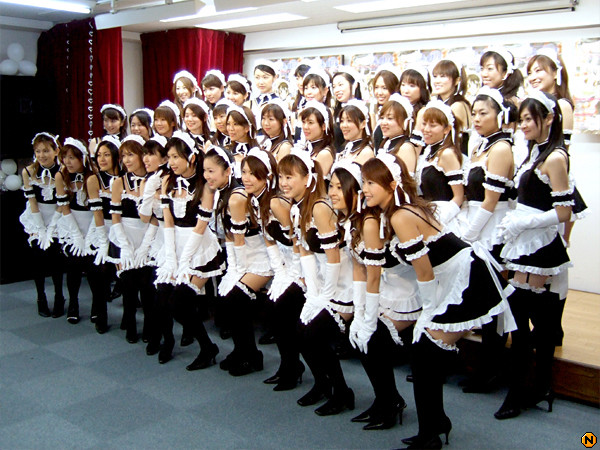
I've seen a family with a household of 3 maids. One to cook, two to take care of household chores because the home is damn damn big. He is one of the bigshots of a media company living in the heart of Orchard road. Of course, this suaku Singaporean that is me is stunned like vegetable. Still yet to see a house filled with a harem of manga inspired 'maids'. That will be a sight to remember, haha


MY HOUSEHOLD

I work at home, so do my wife. Sometimes we have to go out for work, but that's just a few hours. My mum comes over to help out during the day, but leaves at night, so we take over the night duty. It's my wife who mainly handles the night part while I'm the backup because I have more work than her so I can't rest during the day time while she can (when my mum takes over). Selected activities are done by my mum while the rest are taken up by both of us. So, I'll say for my household, we're like 40% equities, 60% debts. Remember? Equities mean giving up ownership by asking for help, while debts mean retaining ownership by doing it yourself. So, I'm about 60% hands on and 40% outsourced.

My brother does quite the opposite from me. He hires help and outsourced the work to my mum who stays for about 6 years at his place. Both wife and himself are working full time, so it's a 100% equities for his household. I can see that the child is more attached to the helper and my mum, and there are periods of tension between my brother's wife and my mum because of this relational profits issue. They should have known better I suppose, because by issuing equities, they are giving away future relational profits to the very people who took care of the child. It's unavoidable - we like people more if they spend time more with us. Being a parent is not a right, it's something you have to spend time to grow into. Learning from this experience is also why I am a bit more cautious in giving away equity so freely.

Not wanting to hire help is a personal choice and personal preference. To be honest, I've seen families work well too with both parents working and the kids are taken care of by foreign domestic workers. But take note, usually the success cases I've seen are where the helpers are staying with the family for prolonged periods of time. 5 to 10 yrs? The helpers are not the come and go type. And there must be a family member at home together with the helper, so it's usually the grandma from either side of the parents. There is also a critical period too, usually before the kid enter primary school. Hence the first 6 years is the most important part of the kid where a lot of things are set right or failing which, it'll be hard to reverse.

Dad working + mum working + helper - family member at home = High chances of failure. Not going to take the chances after seeing what I see.


FINANCIAL SENSE NOT EQUALS COMMON SENSE

You are losing common sense if everything fulfills financial sense. These days, everything seems to be poisoned by financials. If it doesn't make sense economically, it's a bad decision. You weigh the decision of whether to have a child by looking at money. You weight the decision of buying a car by looking at money. You weigh the value of a university degree by looking at money. It's not wrong to make a decision by analyzing it financially; it's wrong if you make a decision only by analyzing it financially.


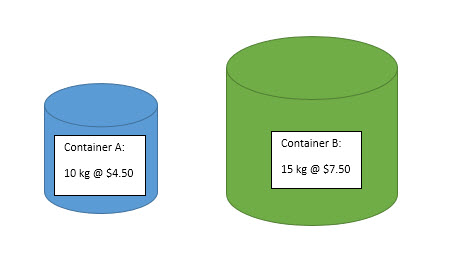
Look at a typical school based question. Container A has 10 kg of say milo powder selling at $4.50 each. Container B has 15 kg of the same milo powder selling at $7.50 each. The typical question is, which of the two containers should a fictitious person, say Mary, buy?

The unit price for container A is $0.45/kg, and that for container B is $0.50/kg. If you did not choose container A because it is cheaper per kg basis, I'm quite sure you'll be marked wrong. A more clever question is this: given that container A has a lower unit price, why should Mary buy container B instead?

a) Mary needed between 10 to 15 kg but not more than 18 kg, so 2 containers of A will be too much but one container of B is just enough

b) Mary needed the size of container B to store things

c) Container A has an expiry date that is nearer than container B

d) Mary likes the green colour of container B. She hates blue.

Must everything be in dollars and cents? That's just one perspective, isn't it?

Financially, it's better for both parents to work to earn the income, hire a foreign domestic helper with the earned income, take care of the kids and settle everything. In reality, it doesn't work as nicely as it should be. I've seen a lot of cases where the parents did not build a strong foundation with the kid, and when the kid starts to have behavioral issues (especially when they started school and mix around with others) and the parents start realising something is wrong. One of them, usually the mum, quits her job to oversee things, but it might be too late. If the parent did not reach a certain level of trust in the relationship, he or she can't start issuing advice. The kid just won't be able to accept. This is especially so for boys, because I think they are genetically programmed to rebel against his parents in order to forge his own sense of identity.

Parents, don't just be an ATM to your kid, please.

Monday, March 26, 2018

Feed the fish, or fish to feed?

Ever since I became a parent, every day I have to think about choices and its implication. I often wondered about my role as a parent, and thought about whether I am making the right choices right now that might affect my son in the future. So sometimes, I feel guilty that I am relaxing in front of the tv, instead of teaching some stuff to my kid. You know, stuff like that.

As a parent, my role to my son is two-fold:

1) Make sure he survives, so that will include feeding, bathing, changing his diaper and be safe from harm.
2) Make sure he survives without me around.

The first goal is easily done. You can do it with a foreign domestic helper. You can do that with any grandparents around. You can outsource it to a childcare center or infant care center. It took me a few months to get to a stage where it became routine for me. Me and my wife knew what to do everyday and we can do this all the time without much disruption to our own personal lives.

But the second goal...that is something. If the first goal is to feed the fish, the second one involves teaching my son how to fish. This will broadly encompass education, including teaching of moral values to the alphabets and the plus minus times divide, to learning how to pick up after himself, feed himself and so on.


I have a feeling the second goal is a goal that will take me all the way up until my grave. It is never ending, and in a good way too. I hope I am wise to always have something to teach my son too. But it is so hard. Say for example changing his clothes. It's so efficient to just take it off him, whether he is struggling or not. A few things will go through my mind: do I involve him in the process, no matter how clumsy or how distracted he will be? Or do I quickly go through the routine without his involvement so that I can move on to the next task at hand? I know what I should do, but sometimes the mind is willing but the body is weak. And I suspect these kind of choices are making me guilty every now and then.

I think my job as a tutor is the same. Student asks a question. I can answer it straight away and we can move on to the next agenda. Or I can take the time to make him understand, so that the next time he encounters such questions, he don't have to ask me again. While it is right to always do the latter, sometimes circumstantial time constraint means that I have to make a judgement of whether to feed him or to teach him how to fish. It's a balance between the two. If I keep feeding him, he won't be able to survive without me (hmm, that's a evil thought as a per hourly paid tutor). If I keep teaching him to fish, he'll starve to death right now, nevermind the future.

Balance, balance, balance. Everything in moderation.


Sunday, December 31, 2017

Reflection of 2017

Today is the last day of 2017. Like previous years, I will grow reflective and think what I've done in the past year. I usually begin by asking questions to myself (and everyone) whether the year 2017 is a good year or not, and how anyone would grade this year out of 10. This year, I imagine having a conversation with myself, sort of an interview between me and myself.

Interviewer: I
Myself: M

I: I'd like to ask you this question. How would you grade this year 2017 out of a scale of 10? Can you share how and why you grade yourself this score?

M: This year is a fantastic 10 out of 10 for me. My usual categories are Finance, Mind, Body and Spirit.

Financially I did better than expected. I didn't do as much work because I had a child earlier this year, so I had to forgo some work scheduling so that I can be more present for my kid. But the lack of income is made up by other sources of income, so I ended up the year with nearly 70k of savings, when I only expected 30 to 40k. I was pleasantly surprised by that. I also managed to accumulate 240k, which means I can activate my plan to invest it at 5% pa to get a dividend income of $1k per month.

On the Mind part, I only managed to read 11 books instead of the usual 52 books a year. This is because the time I usually spent reading is now spent watching Netflix instead because I have only so much energy to spare throughout the day. I expect myself to start reading when things are more stabilised, but it doesn't seem like anytime soon. I did however read a few great books and I still take with me the lessons right now.

On the Body part, this is a total flop. No exercises, no more strict diet, no more pullups and pushups. No excuses for me.

On the Spirit side, I stopped meditating, but even after more than a year of stopping, I still think I got the positive effects of practising both mindfulness and meditating. There's nothing new on this front for me in 2017, just more of the usual stuff.


I: Hmm, from what you've described, it seems that 2017 is not such a good year isn't it? Why did you say it's 10 out of 10? Are you delusional?

M: Haha! Perhaps I am delusional. But there are people scoring 100% on every front yet they are also unhappy, so how do you make sense of it all? I think happiness is not just tied to these categories. More importantly, happiness is a state of mind, and this year 2017 is a joyous year for me. The birth of my son overshadows all the little things I had not achieved. My son is healthy and well, my mum who is recovering from cancer is also doing very very well and I am generally healthy. There's a lot of bad things that might had happened, but it didn't, so I am thankful and grateful for it. I make it a point to make every year a better year than the year before, and so far it had been true.


I: Alright, I see. So where do you see yourself at the end of 2018? 

M: My big plan had been established a few years ago and I'm still following it. More of the usual, like saving 50k (or more) per year, and reading more often instead of watching Netflix. I don't think I still have the energy to exercise, but we'll see what we can do on that front. I want 2018 to be better than 2017 too.


I: What are your major challenges that you've encountered in 2017 this year?

M: It's getting used to a new regime and schedule after taking on a new identity - that of a involved father. I've seen a lot of tuition kids who fathers are absent and I am not going to let that happen to me, hence the conscious decision to be present to my kid. This means that there's a lot of personal time and work time that is sacrificed. I take it gladly.

The other thing is how not to not just survive but also to thrive in my caretaking of my son. I don't want to just feed and change the diapers, but also to build a relationship and really want to spend time with my son. I'm still learning to do well, but there's still room for improvement. At least he called me papa before anyone else and I'm secretly happy and glad that I must have done the right thing.


I: You said that this year you read less than your usual 52 books a year. How do you feel about that?

M: I think after a few months into the year 2017, I already had an inkling that I am not going to hit that figure, so I took it in my stride. I started taking down notes instead of just reading, so instead of going for breadth, I went for depth. I am practically studying the things I was reading this year, so it is very refreshing for me. I took a long break from reading and I felt better of it. I had been reading intensely ever since I started that habit in 2007, so a break after 10 yrs seem appropriate. It's a liberating feeling to be honest. I always felt that I had to continue reading and reading, because I had a target to meet. That was like being disciplined and goal oriented. I'm still learning to take things easy.


I: How do you feel about being a father?

M: That is one of the best thing that happened to me. I didn't know I am capable of giving love to another person, not even to my wife. I didn't know that I can be melted just by a flash of a smile and with tiny fingers wrapped around mine. I thought I won't be able to handle taking care of babies too. But I believe I handled it pretty well. I think my relationship with my wife also improved tremendously. We always think to ourselves, whether it'll be better being younger parents. But I think the answer is no. We're more ready now than before, and if we have our child before we're ready, we will be much more anxious and subjected to peer pressure. This is the best time for us.


I: Alright, we know you're a good father, but besides the baby, what's the scariest thing you've done in 2017?

M: It must have been the public speaking gig I had at DBS NAV. I had to prepare some presentation slides on powerpoint, and the last time I did that was back in my university days when I had to present to a panel of lecturers who are grading my thesis. It had been decades since I last did any sort of such speaking. That was some scary shit, but I think I managed to pull it off. It's definitely the scariest and the most stressful thing that happened to me in 2017. Even way above seeing my wife giving birth naturally to my son, for sure. I'm not the one in pain and I'm not scared of blood lol


I: Last question for you. If there's one thing in 2017 that you would like to repeat in 2018, what would that be?

M: I'm quite torn by this question. There's the bullishness of the stock market that propelled by networth quite a bit. Do I want to repeat that? I think not. It might feel good, but I'm about 45%+ in cash, and I would like to have some chance to utilise that at some good point in 2018, haha! I think I'll go for great health for everyone that I love. I want that to repeat again in 2018 and I will be so thankful and blessed by it.