Showing posts with label Education. Show all posts

Monday, January 18, 2021

Big fish small pond OR small fish big pond?

 If you have to choose, would you rather be a small fish in a big pond or a big fish in a small pond? 


I ask this question because my students just had their O'lvl results. After so many years in this line, I tend to get less excited about their results. I fully understand how getting a great result will lead to undesirable consequences in life. I don't know whether to be happy about good results or be sad about bad results anymore. I'll explain more.


This student of mine, let's call him John, got a fantastic result of  L1R5 of 8 points. That is a freaking good showing in the O'lvl. It means almost all the subjects scored an A1 (the highest possible grade), except for 2 subjects which are A2 (the second highest possible grade). Fantastic right? So naturally, John will want to go to the best JC. But I know John since primary school; he's quite a nervous wreck and will often breakdown due to stress. As in, really breakdown, go nuts, need to visit psychiatrist kind of break down. If he goes to an elite JC, I'm worried about whether he will suffer another depression episode because we all know how crazily hard Singapore A'lvl JC course can be. 


So the question again: is it better for John to be a small fish in a big pond and go join a more neighbourly JC and be the top dog there? Or is it better for him to be a big fish in a small pond and go join that elite JC and possibly be crushed by the competition there and suffer any mental breakdown?


I tend to favour the small fish big pond idea, especially since I know John's 'pattern'. The education system is not worth shedding tears and blood, with the real cost of having a mental breakdown. I think the most important thing is to survive the education system with your confidence level intact. You do not want to come out of your schooling year thinking you are not capable of success. I've spoken to some NA/NT students and it's quite sad. After years of being hammered by the system, they have a tendency to think that their lot in life is only this high. They don't want to aim high because 'people like them' can only get this far.


In the past, I've seen a very clever and bubbly girl who got 250+ for PSLE, went to a top integrated programme school and got crushed alive. Does it happen to everyone? Of course not, but as parents, you really have to know the personality of your own children and most importantly, how they handle stress and adversity. Some will crumble and avoid stressful situation, while others will fight even harder. Choose carefully. Being in a top school does not guarantee anything with regards to grades. From what I've seen, most of the elite school assumed that the students have outside help (aka tuition) and so will go at breakneck speed.


For John, I've spoken to the mum about all these issues that worry me. She knows it too, so we'll be keeping tabs on him (if I'm still tutoring him, that is). I don't know which type of fish he'll choose to become, but I sincerely hope it'll be a salmon that swims against the current, jumps repeatedly over white waterfalls, in order to reach their destination. Because that is one fish, big or small, that is a real survivor. 

Thursday, September 21, 2017

Getting the most out of a Rights Exercise

Just got news that Capitacom trust (CCT) is issuing rights to acquire Asia square towers 2. It's a 166 per 1000 shares @ $1.363, renounceable rights issue. This means that for every 1000 mother shares you hold before it goes ex-rights (XR), you are entitled to 166 shares of rights, which you then need to go to the ATM before a dateline is up to subscribe to it by paying $1.363 per right shares.

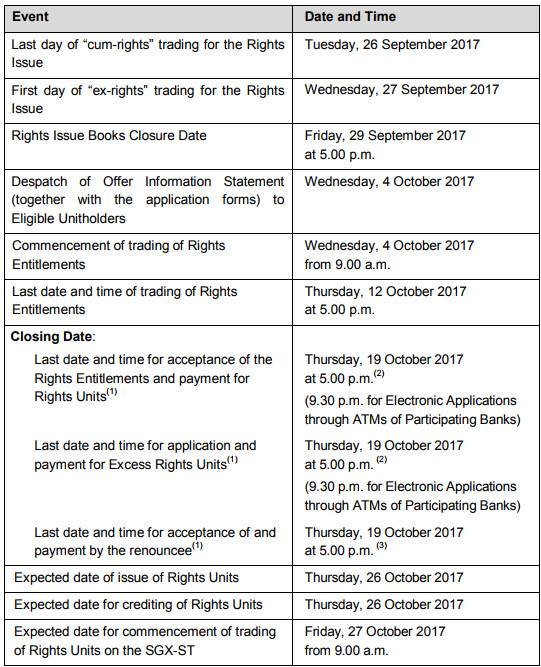
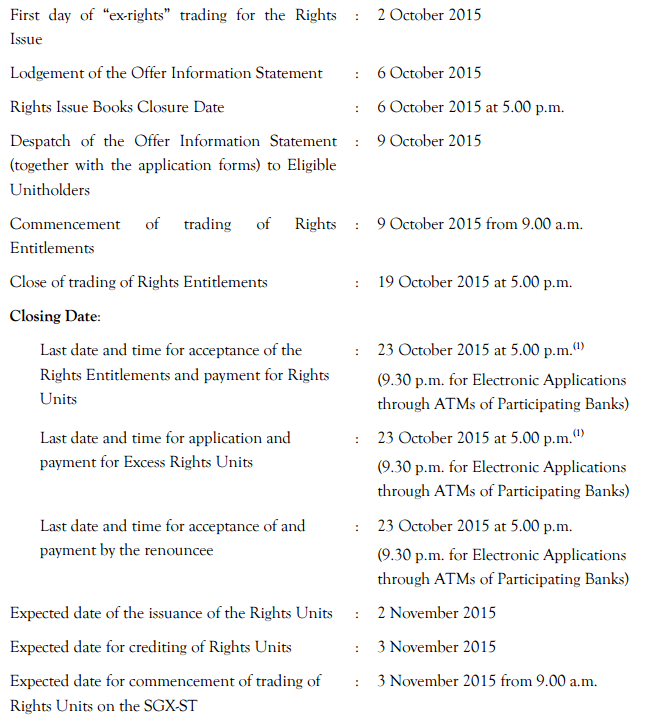
Here's the timeline for the major events of the rights issue:


I've been answering a lot of posts on rights recently, especially on Investingnote, so I thought I might want to consolidate all the stuff and recap all the posts I've made on the rights. I don't think I have updated my information on rights exercise in this blog ever since SGX implemented the 100 shares board lot instead of the 1000 shares. 100 shares makes it less complicated actually; less things to hack.


Basic rights information

Before going into the strategies part of rights exercise, let's have a breakdown of what to expect. The timeline for rights goes like this:


1. You get announcements of a rights exercise. Pay attention to the x per y shares @ z price. "z" is the subscription price for the rights exercise. For example, a 25 for 1000 shares @ $1.25 means that for every 1000 shares of the mother shares you hold before XR, you are entitled to a 25 rights that you need to subscribe at the atm for @$1.25 per rights price. Take note that upon subscription of the rights (by paying $1.25 per rights), you are converting the nil paid rights (so called because you haven't subscribed to it; you are just holding the rights to convert to ordinary shares) to ordinary shares.

nil paid rights => before you subscribed by going to atm for it
paid rights = ordinary shares => after you go to atm to pay for the subscription per rights shares

If you don't subscribe to the rights before a certain date, the rights will expire worthless.


2. There is "renounceable" and "non-renounceable" rights exericse. Sometimes non renounceable rights exercise is called a "preferential offering". Renounceable rights means that the rights can be sold off if you don't want to subscribe to it. This means that there will be a nil-paid rights trading period where you can sell off your nil paid rights. Note that if you don't want to subscribe to the rights by going to the atm, the rights will expire worthless. I can't stress that enough. If you don't want to subscribe, go and sell your nil paid rights during the nil paid rights trading period. For this CCT rights exercise, it's renounceable, so the nil paid rights trading period is from 4th Oct 2017 to 12th Oct 2017. During this period, you can sell off your nil paid rights or buy more if you want.

The mathematics of it all is described elegantly below:

Nil paid rights price + Subscription price = Price of mother shares after XR

The subscription price for this cct rights exercise is 1.363. Let's say upon XR, the price of cct mother share is at 1.450. The nil paid rights price should be trading at 0.087 (1.45 - 1.363). If the price of the nil paid rights is way below 0.087, then the logical question to ask if this: is the mother share overvalued or the nil paid rights undervalued? It presents an arbitrage opportunity here. But this is advanced technique to play with rights, and it's highly advisable for newbies not to do it unless you know what you're getting into. Don't want you to get into a quagmire of doom.

Link on difference between preferential offering and renounceable rights: here


3. Know how many entitled rights you have. You can calculate yourself by dividing your shareholdings by 1000, round down to the nearest integer and multiply that by 166. For example, you have 5500 mother shares before XR, so you'll be entitled to 5500/1000 = 5.5 = 5, then 5 x 166 = 830 rights shares entitled. ** If you don't want to calculate manually, or want to confirm, wait for the Offer information statement (OIS) to be sent to you. In it, there'll be a circular on the whys of the rights exercise, and the how to the different scenario where a shareholder can subscribe to the rights. Most important, there will be a form where they will tell you explicitly how much rights you are entitled to. You can either fill the form, send a cheque and post it to them for rights subscription, or just ignore the form and go to the atm to subscribe for the rights. In the above example, you are entitled to 830 rights @ 1.363 each, so you have to pay $1,131.29 to convert the nil paid rights to ordinary shares. And you have to do so by 19th Oct 2017, if not it'll expire worthless.

** update on 22nd Sept 2017: I asked my broker whether we will get fractional and proportional allotment of rights, meaning that if we have 900 shares, do we get (900/1000*166 = 149.4) 150, 149 or 0 shares? He said we will get 149 and not 0, because it is proportional, and 149 and not 150 because it is rounded down, not up. I learn new things everyday.


4. You can also subscribe to excess rights above and beyond your entitled rights. Using the above example, you have 5500 mother shares before XR, so you are entitled to 830 rights shares. Beyond that, you can apply for another 1000 excess rights. In total, you have to pay (1000+830)*1.363 = $2,494.29 for all the rights. You will definitely be able to get 830 new shares, because well, that's your entitlement. But for the excess rights, preference will be given to round off odd lots and the rest is luck. The issue here is, after the new board lots is changed from 1000 to 100 shares per board lot, it's unclear whether the rounding of odd lots is still based on 1000 shares or the newer 100 shares. If it's based on 1000 shares, it's likely you will get 1000 - 830 = 170 excess rights, minimally. If it's pegged to 100 shares per board lot, it's likely you will get 900 - 830 = 70 shares minimally. I am for the latter, not the former.

How much to subscribe excess? I think if you hold very little holdings before XR, you can potentially double your holdings by getting a lot more excess rights. Let's say you have only 1000 shares, you'll be entitled to 166 rights shares. Rounding to 200 shares will likely give you another 34 excess rights. But you might get another 500 shares of excess because you're lucky and you have small holdings. So in total, from 1000 shares before XR, you might get 1000 + 200 + 500 = 1700 shares, of which the extra 700 shares, 166 is your entitlement, 34 is for rounding off odd lots, and 500 is just that lady luck shines upon you. 700 shares @ $1.363 each will lower your average price way below the theoretical ex rights price (TERP).

If you have much more holdings, then don't think so much lah, just put 1.0 times the holdings before XR. It's unlikely you will get excess rights beyond the number of shares you hold originally. Let's say I have 5000 shares, I'll be entitled to 830 rights shares. I'll just apply 5000 - 830 = 4170 excess rights, so that in total, I'm applying for 5000 rights. Likely you won't get it all, but you'll hit some and the rest will be refunded back to your account.

Link to step by step guide on using ocbc atm to subscribe for rights: here


5. Check for the rights shares to come in. For this cct rights exercise, the expected date of commencement of trading for the rights shares is 27th Oct 2017, 9am. The expected date of crediting of rights units is on 26th Oct 2017. I'll check the CDP account around night time to ensure that the rights shares are credited into my account if you're using non-custodian brokerage. If that's slow, try checking the refund in the bank account where you applied for the rights. From the amount of money refunded to you, you can back calculate to see how much excess rights you got. The slowest confirmation is after a few days, you will get a snail mail of the rights shares you get through your physical mail box.

From fastest to slowest:

a. Check refund of funds in same bank acct linked to atm during subscription
b. Check CDP for stock holdings. Will need a pin number from them, so go apply beforehand
c. Check physical mail box for snail mail confirmation


Strategies for rights player

Now that the basic is covered, let's talk about strategies. There are strategies for existing shareholders who already holding shares before the rights exercise is announced, and there are also strategies for people who want to take advantage of the rights to get into the company at a favourable time. These are the wannabe shareholders. I must say rights issue favour the latter rather than the former. That's just the way it is.

I further define two types of player: the casual and the advanced one. Casual ones are usually newbies, but need not be, and quickly wants to get over the rights issue as soon as they can. Advanced players want to hack the rights and get a more favourable price, meaning getting their average price below the theoretical ex rights price (TERP).


w: no of mothers shares before XR
x: no of rights shares successfully subscribed
y: price of mother shares before XR
z: subscription price of rights shares

TERP = [(w*y)+(x*z)] / (w + x) 


As you can see, to get a lower average price, you need to get much more excess rights beyond the rights ratio. If the rights ratio is 166 shares for every 1000 shares held before XR, to get a lower price than TERP, you need to get more rights shares than 166.


Link for casual rights player: here
Link for advanced rights player: here


For existing casual shareholders:

a. Just wait for offer information statement (OIS) to come in. It'll inform you of the number of entitled rights shares you have.
b. Go atm and subscribe to the entitled rights
c. At the same time, apply for the excess rights. There's also a $2 admin fee charged by every bank.
d. Wait to see how much excess rights you get
e. Update your spreadsheet/program on your holdings


For existing advanced shareholders:

1. Sell all your mother shares before XR, buy back after XR and after the price drops lower than TERP
2. Buy more mother shares before XR and take adv of the drop in price, be entitled to more rights, apply for excess
3. Buy nil paid rights during nil paid rights trading period, esp when there are opportunities for arbitrage, subscribe to entitled and also apply for excess

* 2 and 3 can be combined, but make sure you know what you're doing


For casual wannabe shareholders:

a. Buy the mother shares before XR
b. Wait for OIS to inform you how much entitled rights you have. If you bought too close but still before XR, the OIS might not reach you on time. So calculate manually.
c. Go atm and subscribe to the entitled rights
d. At the same time, apply for the excess rights
e. Wait to see how much excess rights you get
f. Update your spreadsheet/program on your holdings


For advanced wannabe shareholders:

1. Buy in after XR, at or below TERP, and skip all the rights exercise
2. Buy in before XR, get your entitled rights, apply for excess

2a. To decide how many lots to get in, look at the table below:

Since preference is given for excess rights applicants to round off odd lots, and assuming that the rounding of odd lots is for 100 shares per board lot, it make sense to change the number of shares you want to buy before XR to maximise the odd lots rounding. For example, if you get 1000 shares before XR, you are entitled to get 166 excess. To round off to the next nearest round lots, you are almost guaranteed to get 34 excess rights (to round to 200 shares). Can we maximise that rounding so that you can get the best out of it?
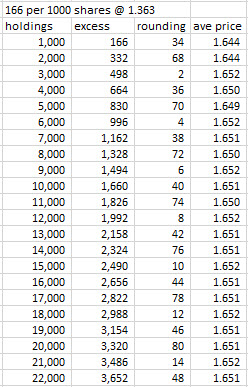

I didn't show the whole table, but you need to get in 47,000 shares so that you can get 98 shares of rounding. But we haven't looked at the average price of all the shares, after including the rights exercise. No matter what price you got in (must be reasonable of course) for the mother shares before XR, the advantage of getting more 'guaranteed' excess rights for the purpose of rounding odd lots reach a diminishing returns after 5000 shares. For the above table, I use an entry price of 1.70 for the mother shares. You can see that there's a slight dip on the average price for 5000 shares.

But all these just to shave off less than 0.005 cts on your average price? That's why I don't do such hacks anymore. It's just not worth the time. In the past, where the board lot is 1000 shares, there's some savings to be had, but not anymore.

Just ignore this method safely, knowing that you are not going to hack a lot to get a lower average price using this method.

3. Buy nil paid rights during nil paid rights trading period, subscribe to entitled

* 2 and 3 can be combined, but make sure you know what you're doing


This should do it! The end-it-all guide to rights exercise for newbies and a good refresher for oldies!

Wednesday, April 12, 2017

Newbie's guide to market depth

SGX is running a promotion for free market depth information, limited from 3rd April to 30th June 2017. I’ve not seen them done this ever before, so perhaps they are doing this to boost the liquidity of the market, or to sell them the subscription. Either way, take this as a free trial and see if it’s useful for you or not. Quite a few brokers are participating in this, like CIMB, DBS Vickers, KGI, Lim&Tan, Kim Eng, OCBC, Philips, RHB and UOB Kay Hian. And before you ask, no, stanchart is not part of it, but you can always access the market depth information from other brokerage platform.

The more important question is how to use market depth. I’m the first to confess that I’m not an expert, but I’ve read and researched enough to know a tiny bit about it, so I’ll share with readers here. I divide this into two sections, the first are the points to look out for when using market depth and the second is about the limitation of the information you get from it. It’s good to know both the usefulness and the limitations of it. By the way, I’m using poems, so it might differ a bit from yours if you’re using other brokerage platform, but it’s largely similar.

Section 1: Points to look out for

1. Is it a buyer or a seller’s market?

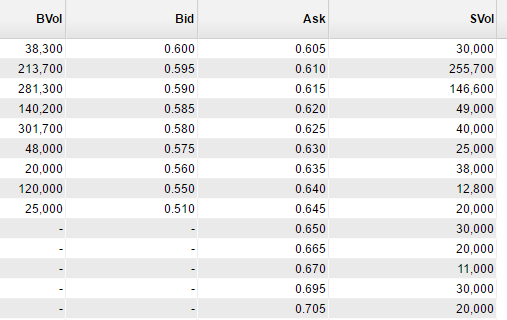
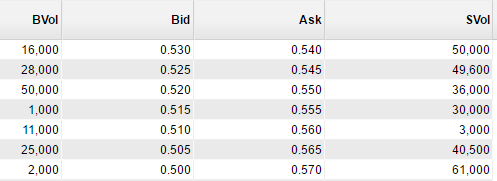
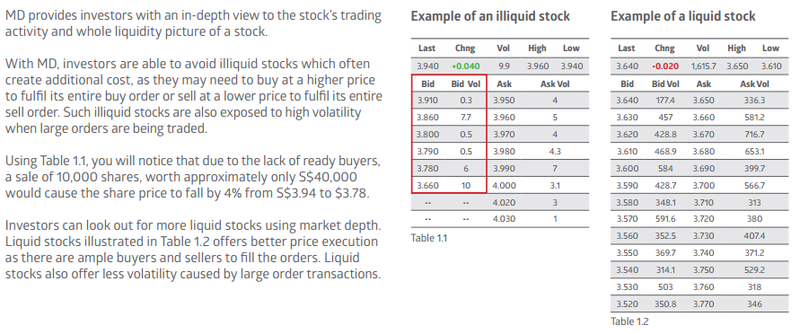
By comparing the total buying volume on the left side and the total selling volume on the right side, we can see if it's a buyer or a seller's market. Buyer's market means that the selling will be very well absorbed with very little price movement downwards, because there are a lot of buyers waiting in line to buy. Conversely, in a buyer's market, any buying up will be met with lesser resistance because there are not a lot of sellers waiting to sell at higher price than the current price. In other words, in a buyer's market, the ease of movement of price upwards is easier than the ease of movement of price downwards. In a seller's market, the reverse happens - the ease of movement of price downwards is easier than the ease of movement of price upwards.

Buyer's market - note that there is so many pple waiting to buy on the Bvol side (left)

Seller's market - note that there are more pple waiting to sell on the SVol side (right) than the left

2. Check immediate resistance and support level

This is a TA concept. Resistance refers to a price where the price will likely hit a wall and move downwards. Support refers to a price where the price will likely hit a springboard and rebound upwards. Here, we are looking for big volume camping around a price range. If the normal queue is 1000, 800, 1500, and suddenly we see a 200,000 queue, then that is significant.

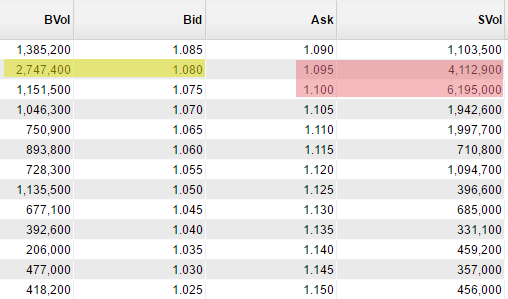
The left side represents the possible support level at 1.080. It's going to be hard to go below 1.080 for the time being. The right side represents the resistance level at 1.095 and 1.100. It's going to be hard to go beyond 1.100 for the time being.

Looking at the above pic on the left side, we can see that there's a huge volume camping of about 2.7 million shares at 1.080. If the price is to go below 1.080, it will have to break that huge wall first. Hence, for the time being at least, it's going to be hard. On the right side, we can see an even bigger wall of about 10 million shares distributed over 1.095 to 1.100 range. It's going to take a while to break that wall and go to 1.105.

If you're buying, and you want to jump the long queue, you might as well queue at 1.085. If you're selling and you want to jump the queue, you might as well queue at 1.090. That's just one way to see it. You can also set a order to buy at 1.105 once the market price reaches 1.110, because it means the the stock broke out of the huge wall block and that's usually a good sign. Go back to TA to decide what to do with the information you get from the support and resistance levels.


3. Can the market absorb my buying and selling?

If you want to sell a huge volume, you want to ensure that the price remains as stable as possible. You don't want your huge order to bring down the price and end up having a lesser amount at the end of your selling. Likewise, if you are buying a huge volume, you don't want the price to be bidded up too huge so that at the end of the day, you'll end up paying more for your shares. All these requires the market to have enough 'depth' to absorb both your selling and your buying, without affecting the price too much.

A good analogy is that of a reservoir. If you scoop up a cup of water from it, the water level is not going to change much because it has a lot of 'depth'. Conversely, if you pour a cup of water into it, the water level is also not going to rise much (not even perceptible!). If you do the same experiment on a pail of water, you can see the water level rise and fall much more appreciably. This whole concept is market depth.

SGX guide here already have a great example, so I'm not going to reinvent the wheel. I reproduce it here for your reference.


Section 2: Limitations of market depth

1. Market depth is dynamic.

The information is probably only valid for a day. Maybe just for a few hours. We don't know. The volume reflects the live order keyed into the system, so it keeps changing. In a fast moving market, a static picture of the live market depth information probably should have an expiry date of only a few minutes.


2. Order volume might be hidden

I know institutional traders can have an option to disclose a certain percentage of their trades in the system only, called disclosed quantity buying/selling. Let's say that a big boy (BB) wants to sell 500k shares at a certain price, it can choose to disclose only 5k shares in the system, so only 5k is seen in the market depth, and not 500k. Is this available in Singapore, I'm not sure about that though as this is something I've read about in US markets. If it's available here, then whatever you see in the market depth is just what others want you to see.


3. Order volume might be fake

The orders placed might not be real. By fake, I mean that there is no real intention to buy or sell the entire order seen in the market depth. The volume in the market depth can be removed at any time. It could be used to test the market or to find out who the counterparty is. There are several reasons why they want to do this. One reason could be to prevent the price from going above a certain price. Whenever the volume gets depleted, more volume will be topped up to discourage buyers from bidding higher. This same trick can also be used to dispose of shares in a very orderly manner without people knowing it. Only people with too much time watching the 'tape' can see it. In structured warrants, you will see lots of such actions happening.


4. There are buyers or sellers who do not queue.

You’ll only see something in the market depth if people queue for it. There are companies where buyers or sellers do not queue at all. Immediate transaction will happen if you sell at bid and buy at ask, so in such cases, it won’t be so useful.


Conclusion:

Market depth is paid for under a subscription. I didn't use it in the past because I'm too cheapskate to have it. Is it useful? Yes it is, but it's not essential. Good to have but not that important in the longer run. Perhaps it'll be more useful for intra day traders, which I'm not.

Wednesday, February 15, 2017

What I learnt from 14 years of tutoring

I was filling up some forms for baby bonus and all the other paper work, when I realised that I had worked as a tutor for 14 years! That represents so much of my life, so I think I should reflect and think about some of the things I've seen and learnt from my students and their relationships with their parents and school in general. It'll be a good thing to do less of the wrong stuff and do more of the right stuff. Here it goes:

1. Daddies are mostly absent

Throughout my entire career as a tutor, daddies are mostly absent. I dare to guesstimate that the actual percentage of dads who care is less than 10%. They are not around to fetch their kids, or ask about their homework. I think the ideal stereotypical father is someone who is there to dispense out money or to be a disciplinarian. Some of my students don't even know what their father do for a living. Being a father now, I should also think about the kind of father I want to become. It helps that I'm working at home and I deeply appreciate the sheer amount of time I had with my baby boy. I want to be there around with him to observe all his 'firsts', and not to leave home when he's asleep and come back home to see him sleeping again. That's a promise from me to him.

2. The years that matters are the years before you start formal schooling

I've taught older students and I wondered why their learning abilities and motivational levels are so different. When I taught secondary school students, I thought primary school makes all the different. When I taught primary school, I thought pre school makes all the difference. When I taught pre school, I realised the environment at home makes all the difference. Any thing beyond that will be genetic influences already. If you want to make a difference, spend more time before your kid goes to formal school. Cultivate the right values and the right habits. It'll create a world of difference when he begins formal schooling. It also helps that when kids are younger, they will listen to you. Once they are in secondary school, good luck to you if they listen to whatever you ask them to do.

3. Give your kids responsibilities and duties befitting their age and maturity

I've seen upper secondary school students having their school bags packed by their mothers. I've seen JC students still asking their parents what their schedule is like for the week. I think we should all watch Diana Ser's programme on TV, with the title translated as Child Labour, in mandarin. I watched it today and there's this 10 years old kid from Thailand who has to work as a Muay Thai fighter to win prize money to feed his family. Diana Ser wisely brought his boy along to observe and film it. I think his kid is going to treasure his life back in Singapore. Are we creating chances like that for our kids to empathise and learn not to take things for granted? I think if we hand over the reins to our kids, we shouldn't expect perfections. It's all the little screw ups that will let the kid grow and mature.

I remember a parent whose child is in sec 4 but she always have to chase her child all over the place in order to arrange the child's tuition. I told her that she has to let go and let the child handle it alone. So she agreed and tried it out. For the first few times, the child forgot that we have scheduled lessons and missed it entirely. The mum, in anger, wanted to revert back to the original arrangement but I told her to have faith in the whole process. It's important to screw up and learn to move on from there. So one day, after yet another major screw up, the child finally realised the mistake and apologised to me and her mum. Such incidents dropped to zero afterwards.

I guess if you don't let the child make and own his own mistakes, you will forever be chasing after him. So, let go.

4. A good school might not be good for your child

Most people I know are very anxious when it comes to primary school selection. Some of them even moved to a good prime location near to a prestigious school so that their kids can have a good headstart in life. I haven't even talked about volunteering at the primary school yet. I've seen my fair share of students who went to a supposedly good school, but because they can't handle the stress, they ended up doing very very badly. There are others who strive in neighborhood schools and because of the good conducive environment, grew in confidence and did pretty well in the end.

I think the point is that there are two ways in which children handle stress. They either crumble or they rise to the challenge. It's important not to force a child into a good school. Afterall, a good school is good because of the students who went in, not because of some special geographical location or special syllabus. I do understand the need for parents wanting their child to socialise and mix in with people from better backgrounds so that they have a good network from young. But let's leave this until much much later, perhaps in university or JC.


5. How you do anything is how you do everything

I tend to nag students on little things, like writing the wavy lines underneath a letter when denoting vectors, or putting in the degree symbol after the numbers and so on. Some students obviously find it frustrating, so they will tell me that they would remember do such things only during exams. It doesn't work that way. There are only 4 major exams in a year, but there are countless practice sessions. If you are going to do the right things only during exams, I'll bet that you won't remember to do it during exams as well. It's about the attitude to do the right thing every time also. If you don't practice during peace time, you don't do it during war times. I really think that discipline is the thing that gets you to places, not motivation. Motivation is that single moment where you feel like doing something for the first time, and thereafter you have to reply on just discipline to get you there.

6. Set high standards 

I usually give worksheets that are way harder than what the students perceive themselves capable of. If they are in combined science, I'll give them pure science questions. If they are in NA level, I'll give them combined science questions. This is like wearing iron weights during practice runs, and when the weights are removed, they will literally fly. When done properly, they will experience immediate small success in school based exams and hopefully their confidence and desire for more success will form the next level of motivation to bring them greater success. It's a way to get them 'hooked' with success, hence providing that intrinsic motivation to want to do better.

7. Hardwork beats talent anytime, unless talent becomes hardworking

There are students who grasp new concepts immediately, while others I'll have to explain in a variety of ways. Some students are just more talented in doing math or science. But if I have to bet who will have greater academic success, I'll bet on the kid who is more hardworking. I've seen countless examples of students who beat talented ones through sheer hardwork. Of course, if they are competing against students who are hardworking and have talent, it's not going to be that easy anymore. The good thing about hardwork is that we can always strive to be more hardworking. You just can't say I'm born this way, so it places the blame solely on yourself. This fits in with the growth mindset - that our abilities are like muscles and will grow when we practice more, instead of a fixed mindset where our abilities are based squarely on the roll of the dice on our genes.

8. Be the example that you want your kid to become

I've seen children whose parents wanted them to stop using their handphones, but they themselves uses it all the time. I think children are smart enough to detect double standards, and they will follow what you do instead of what you said. If you want children to do their work, you have to show them how you do yours. If you want children to have a reading habit, you have to show them how you read all the time too. I think children is really just a reflection of yourself. I'm sure your children will hold you to the same standards just like how you exert yours on them.

9. Listen more, judge less. 

This is a reminder to myself. Sometimes we live in the world, we become proficient in the ways of the world, and then forgot that our children are pretty new to it. We tend to judge them using our own yardstick. I'm guilty of getting irritated by my students when I've said the same things over and over again. To them, maybe they had heard it for the first time, but for me, I've said the same things probably a thousand times. I think it's important to listen to what they think, and don't judge prematurely. Don't think about a response while your child talking. Listen actively.

10. In the end, show love

This is also a reminder to myself that no matter how irritated or frustrated I am, at the end of the day, show love. We can't get so absorbed by our own anger and frustrations that it becomes self feeding, treating every little wrong behavior or mistakes done by the child as if it's a big mistake that feeds the anger and frustration even more. I think parenting is the same. There will be times when you feel negative emotions towards the child. Remember to show more love at the end of the day. It can be a little apology to explain why you are so frustrated and show some encouragement. It can be a little pat on the back or a hug, just to tell the child that we still love them.

Monday, November 30, 2015

Free lance tutoring as a business - Part 3

Cash flow. This business is all about cash flow. In fact, shall I say all business is about cash flow? You can boost about how high your revenue growth is, but without actual cash flowing into your coffers, the revenue you noted down might not be translated to actual money. And we have to pay our bills with money, not with revenue.


Here's a few key issues to think about:

1. Variability of cash flow
2. Recognition of income
3. Cash flow management


Unlike employed people, my salary as a tutor is not fixed. Nobody will magically give you a sum of money at the end of the month, every month for a year. You will have to secure your own students, carry out your services, and then receive money. Hence, there's a certain variability in the income that flows in. How much I earn really depends on the month in which you are asking. Generally, there is a seasonality to your income which is based on the exam cycles, and hence there is also seasonality to the cash flow you receive. It can really vary a lot from month to month.


Below is a picture of my income over 7 yrs, written in this blog article here.


On a quick glance, you can see that the off peak season income can be quite negligible. The debt you owe is to be paid monthly, but if your income (and hence cash flow) is seasonable, that might pose a serious issue, especially if you do not have savings. I'll talk more about it under cash flow management later.


But I do get paid weekly, in various sums. It's just that during the off peak periods, the cash flow tap runs a little dry. That could get some people jittery, especially when your family sees you sitting at home, watching tv or reading a book and not working. I realised this can be quite stressful for people used to getting a fixed pay at the end/start of each month.


The only way to mitigate this is to have different levels of students. You cannot do this if you have all sec school students or all JC students.  A mix of different levels will ensure that the exam cycles of each level overlap. It's important to set a predetermined level of graduating and non graduating students, something like 7:3 ratio or 6:4 will ensure good continuous flow of cash throughout all months.


Here's a question: Do you recognise your income the moment you carry out the service or do you recognise your income only when you receive your fees? In my personal accounting, I do the latter. Fees are paid either in advance (usually 1 month ahead) or paid on the last lesson of each month, or on a per lesson basis. I do all three, depending on the preference of the parent. But for new students (defined as those who are not recommended by my usual network and are 'cold'), I usually collect the fees ahead. I've a few bad debt cases in the first few years of my job, so I do not want to repeat that again. It's emotionally draining and it eats up your soul. These days, there's strict cut loss practice when collecting the fees, rather than to carry on the service and hope that the payment will come through eventually. So far, I do not have to bring anyone to the small court tribunal to claim my fees, but I'll not hesitate to do so should the circumstances arise. If I do my fees management properly, I won't even have to be anywhere near the small court tribunal.


I believe in fair practices too. There's risk to parents if they pay their fees in advance. There's also risk to tutors who can't claim back their rightful fees. So if I'm going over to the student's place (tutor-moving model), I'm okay to collect my fees at the end of a set of 4 lessons. The credit given to the parents is to assure them that I'll not run away with the prepayment of fees. On the other hand, if the student is coming over to my place (student-moving model), then my usual practice is to collect fees in advance since I'm the party holding the higher risk. I'm afraid the student will run away before the fees can be collected. Most people are forgetful and not malicious, but again, I've my own bad cases so I'll rather be safe than sorry.


Regarding the management of the cash received, I think it's important to have a buffer of savings against the drier months. I know that my work will dry up in around end Oct until Feb (nothing serious gets done until after Chinese new year). Hence I'll have to save up during the peak period to offset the lack of income in the off peak period. Savings to me is not a luxury, it's the way to survive. I guess the same can be said for farmers who have a harvest period too. You can't spend all the money you have during the good months, only to starve in the drier months. For this year, I've saved up enough money to last from Nov to Dec without doing any work, so I know I'm covered. The next thing to do is to do some work during the drier months. I mean I'm prepared not to work for the next 2 months, but it doesn't mean I'll just sit at home and use up that reserve.


So there you go, hopefully people will open their eyes wide before jumping into this line!

Saturday, November 28, 2015

The Lesson from the Death of an Ant

Recently, I made acquaintance with a long time student of mine that I taught way back in 2006. He had since become a private tutor like me. Back then he was a chubby kid who is bright and always very inquisitive. I met him up this year for lunch and we kept in contact ever since. He’ll sometimes text me to ask for my feedback and advice on stuff related to students and work in general. All in all, a nice feeling to this because I see that I did help him in some meaningful ways or another.


Just yesterday, he texted me and told me an incident with a student that left him very distraught. The student killed an ant and he told me that he was so upset with the whole incident that he didn’t talk for 5 mins. I guess it’s his way of mourning over the passing of a life so carelessly and needlessly taken away.


And then he told me it was me who taught him to value the life of an ant back way when I taught him as a student.


Frankly, I couldn’t remember that incident. I have a habit of asking students not to kill ants when I see them crawling over their textbooks or notebooks. For my student, he reminded me that he was going to kill it with liquid paper but I told him not to do it. I vaguely recalled that he was toying with the life of a sentient being and I was disgusted with that attitude, so I had this huge  argument with him over it.  However, he told me recently that it took him nearly 10 years to learn the lesson.


I’m both proud and humbled by this incident. As teachers or tutors, we have to be careful of what we say and how we treat others. Eventually the integration and trigonometry that we teach the students will be long forgotten, but the values and the life lessons will remain. Well, at least some of it,  and to some people. Ultimately, we need to show more love at the end of the day.


I’ll continue doing what I do – changing the world one student at a time.

-------------------------------------
This post is first published from my tuition website Kungfu Cats Academy link located here.

Friday, November 20, 2015

Free lance tutoring as a business - Part 2

Revenue is not the main thing we should be looking at. Afterall, not all the revenue you earned is going all into your pockets because there is cost involved. Revenue, after all the costs had been deducted, becomes the profit. And that's what we're looking at in this post.


I like to see myself as a company. What I earned for a living is my revenue, while all that I spend are the cost of earning that revenue. So what's left after all the costs are subtracted will be my profits. Some people operate like a heavy capex company, with huge capital expenditures that keeps increasing so as to generate more revenue and high profits. Imagine someone who earns 10k a month and spends 8k a month in order to continue earning 10k a month. This is an example of a high capex individual. Quite tough, I'll say, because you have to keep on running on the treadmill just to stay at the same place. There are others who are like the service industry, light on costs and generally have much higher profit margins. I think I'm more of this type of company.


When we look at profits, we have to look at the cost. Here's a few things worth mentioning with regards to free lance tutoring:


1. Cost of rental + utilities
2. Cost of transport
3, Cost of raw materials


I've analysed quite a few companies listed in sgx. The three main cost are typically rental of premise, wages of labour, and cost of raw materials. For a free lancer tutor, the cost consists of rental + utilities, cost of transportation and cost of raw materials. There are different models of doing this and it depends on who is moving - the student or the tutor. In the student-moving model, the tutor stays put and the student travels over to a place where the tutor rented. The rental premise can also be at the residential property of the tutor, though some of my tutor friends die die refuse to do that. Invasion of privacy they say. The other tutor-moving model means that the student stays put in their own home, while the tutor moves around. I used to operate under this model for nearly 6 to 7 years until I have my own property. Now, I'm mainly adopting the student-moving model, although I still have to travel to some students place for work. 


That's my actual classroom, by the way


Now if you're the tutor who is moving around, then you'll incur transportation cost. If you don't take cabs all the time, the cost will be about $100 to $120 per month if you work 7 days a week. This will of course increase substantially if you take cabs every now and then. This model will have transportation cost incurred but there's no rental or utilities cost. But trust me, if you have to take 3 students a day, you'll end up about 2 hours on the road waiting and travelling. It's low cost but it comes at a heavy price of taxing your time and energy. Hence, I'll typically charge a higher rate to off set this cost, but it's still not fully recoverable. Some tutors might also buy a non-weekend car for the purpose of work too. I'll say it's a great investment, especially if you buy 2nd hand ones with about 3-5 yrs left. Some of the hardest places to go are also the ones that pays the greatest in tuition fees, but you have to work out the sum yourself.


On the other hand, adopting the student-moving model, you'll incur rental cost plus the cost of air-conditioning etc. Those who are using a room in their property will have to put in some renovation costs, and have to add in some teaching aids and a printer, but that's just one off. I always switch on the aircon in my classroom, though I can't be sure if that's a common practice for other tutors. I've been to student's place drenched in sweat from the walking and with no fan for 2 hours. It's not a nice feeling and it affects your concentration level as it's not conducive enough for learning. The good advantage is that you don't have to move about, and can typically save tremendous amount of time that can be better spent on other things, including adding one more extra class per day, if you're so inclined. 


Cost of raw materials is near minimal. There's printing cost of in-house worksheets and past year papers, but that's not usually a lot. Sometimes there's cost incurred in buying books for self reference or for the student, but again, this are far and few. Perhaps with the exception of the first few years when you are still learning your craft, the cost of raw materials for teaching is not especially high.


These 3 are the cost of doing the business but we should look at the non accounting cost of the business too. As an individual, we have to spend on food, entertainment, material goods etc. I count this as the cost of doing business too, though I'm fully aware the standard accounting practice do not count that. Generally, if you're in a high stress job, you will need to spend more to de-stress. A low stress job will require less retail therapy. Some bankers, typically a high stress job with quotas to meet, have to spend tremendous amount of their 'revenue' (i.e. salary) in order to continue working to earn that salary. The end result is that the profit of such people might not necessary be higher than someone earning an average pay in a low-stress job with little or no retail therapy needed. 


If I may be so bold to change the lyrics of that popular song, it's all about the profit, 'bout the profit, not revenue, it's all about the profit, 'bout the profit, not revenue...


Hence, profit is actually the savings you have at the end of your month. Profit margins of a company is your savings rate. If you save 30% of your salary, you're like a company with 30% profit margins. The truly great people-company are the ones with 70 to 90% profit margin, spending only 10 to 30 cts to every dollar they earned. They will have so much cash flow that the happy problem is what to do with it. Pay an interim dividend to themselves or their shareholders? Invest in another stream of revenue? Acquire and merge with another company? Spin off another subsidiary or two with the merger company? LOL


Going to talk about cash flow in the next part. Stay tuned.


Thursday, November 19, 2015

Free lance tutoring as a business - Part 1

The more I understand how to valuate a business as an investor, the more clearly I can see what makes a good company from a bad. I think some of these skills can be applied to myself since you can say I'm also doing a business as a self employed, being a full time tutor for about 10 years. I'm not a business owner in the sense that there is a system where I can hire people without me having to teach, but more like a sole proprietorship. Think of it as a one man business where you're both the boss and the employee. Think of me as a sweat soaked hawker in a wet market stall, holding a wok with a dirty towel slung over my neck, selling education in a paper plate. Want chilli or not?


The top line of a business, or revenue, is the first thing that people will have to look at when they peruse the income statement. In my case, it's the fees that I get paid for doing a service, which is to tutor the students. The things that are worth taking note are listed below:


1. Percentage revenue growth
2. Seasonality effect
3. Concentration risk
4. Multiple streams of revenue


Percentage revenue growth is obvious - it measures how much revenue is increasing as a percentage of the revenue earned last year. Higher is not necessary better, as I realised from experience. The main contributor of earnings comes from the graduating students (JC2, IB yr 6, Sec 4, N lvl) because as the national exams spreads way after school ended, there'll be more lessons needed for extra revision and preparation of exams. If I want to increase the revenue earned this year by multiple times, I will take in more of such graduating students, so I will see a huge increase in percentage revenue. But I know the following year will be worse off, because when the graduating students leave, I'll have to build up my student base again to match my income for the year. It might not always be that smooth sailing. Hence, it's better to smoothen out the difficulty of finding new students by having a mix of graduating and non-graduating students. More is not necessary better.


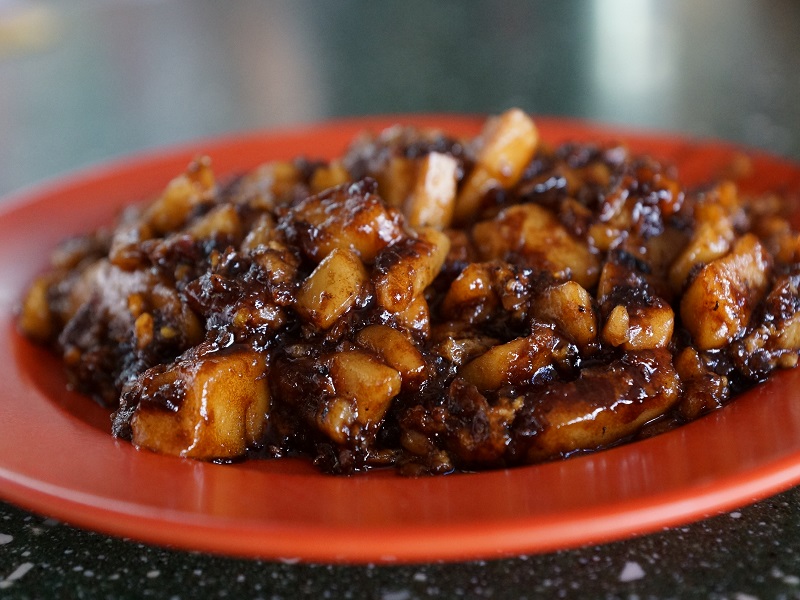
You can increase your revenue by either increasing your students, increasing the fees charged, or teaching more students together over the same time slot. That's in order of ascending preference. Why? Each day you only have 24 hours. Each student you take will take 2 hours (usually), which means your income is capped, hence you can't keep increasing the number of students you can take. It just couldn't scale up. Increasing fees is okay, but as all economist knows, it'll possibly result in lowering the demand. If you price yourself too far out of the market, you might end up with much lesser students than is worth it. It also depends on your area of operation too, because you just can't sell atas organic chocolate mille crepes priced at $9 per piece in a neighborhood wet market stall. That's more for Bukit Timah, Orchard Road-ish type of area of operations. Mine is in humble Bedok where the world's most delicious carrot cake can be had at $2.50 per plate.

Black or white? I say black, from Song Zhou Lou Bo Gao near Bedok interchange hawker centre (pic taken from ieatandeat)
What's the third option of increasing revenue? It's to have lessons in a group. Charge a cheaper rate but group them together, effectively increasing your income per hour multi-fold. I limit my class size to 4 because there's diminishing returns in students learning from huge class size, and all the students in the group comes from the same class/school. It's not always easy to find such groups, but it's always more fun because of the group dynamics.


Seasonality effect of the revenue comes from the nature of the business itself. Some people think that as a tutor, I'll be very free during June and December period because there's where the school holiday lies. That's not true. Usually these period is the busiest. Think of me as a bus captain. When you're going home from work, I'll be working. During public holidays, I'll be working. During weekends, I'll be working. The general rule of thumb is this: The more free you are, the more busy I am. Vice versa. Understanding the seasonality of my revenue stream allows me to act in a manner that will smoothen my income. The way to do this is to take have multiple streams of income. I'll discuss about this in detail later.


Concentration risk refers to whether you have a huge percentage of your revenue coming from a single subject, or a single student, or a single group of students, or from one tuition centre. For example, if I'm only teaching chemistry as the sole subject and one very unfortunate day, MOE decided to adopt a campaign "Teach nothing and learn something", so they scrapped off chemistry as a subject. If that unlikely event is to happen, my revenue stream will go to straight to zero. Don't say it won't happen. I know of a tuition centre that specialises only in Chinese. In the past 10 yrs, MOE had major changes in the structure and content for Chinese. I can't remember exactly what the announcement was about, but I remembered within a fortnight, the student intake of the student dropped to single digit and they had to close down by the end of the year. That's subject concentration risk.


There's also concentration risk arising from having a single big group of students. It's really good revenue since you spend the same amount of time but earn a lot more per hour, even though each student pays less. Think of it as a leverage on time. If this group of student forms 80% of your income stream and they graduate this year, the following year you'll have to find students to replace them. It's just something that you have to think about. Always the next year and the next year. Nobody will hand you a salary for free, but hey, that's what you signed up for as a free lance tutor.


Multiple streams of revenue is always better than a single stream. I'm not even talking about passive streams like dividends or from book sales, blog advertising etc. Different levels of student have their own unique peculiarity and seasonality. For example, for lower sec 1 students, they will usually not have lessons during the holidays because they had just finished a major exam (PSLE). Parents will be more lax while they concentrated on their primary school siblings, or they just want their kid to have a break before the more 'important' years. Sec 2 you'll see a lot more help during June and Sept holidays because that's the streaming year where students bid for their subjects combination for upper sec. Sec 3 you'll see a lot of activities even during the end of year holidays as they try to gear up for the all important O'lvl years. The different seasonality will help to even out drier non-peak months so that your revenue stream will have lower volatility. This will make sure you don't have to pluck grass from the roadside to eat during the winter months and freeze to death like a ill-prepared grasshopper.


I'll talk more about the profit part in future posts. Look out for it.

Monday, October 05, 2015

For the Advanced Croesus Rights players

Alright, now that you've read the basics here, you can progress to more advanced stuff.


Nicholas Nasim Taleb (NNT) is my favourite modern philosopher and it's a good thing that he dabbles in the market too. His concept about antifragility - to make it out better when crisis strikes and not merely to survive it - is enlightening. So with regards to the rights exercise of Croesus Retail trust, how do we best capitalise on this?


First, you need to know the Theoretical Ex-Rights Price (TERP), which is the theoretical price of the stock after all the rights exercise. Since the price of the Croesus is about 80 cts (plus minus 1 ct), let's just say it's 0.80. The rights exericse states that you'll get 22 rights shares for every 100 mother shares @ 61 cts each. Hence the TERP = (0.80*100 + 0.61*22) / (100 + 22) = $0.766. Bear in mind that this is all theoretical and the TERP will vary according to which starting price (I picked 80 cts) you choose. I like to choose the price when the counter goes XR, but there's really no reason why you couldn't choose others.


Why is it important to know the TERP? To maximise your benefits from the rights exercise, you need to get as low a price for the shares as possible. This usually means you want to get as many rights shares at 61 cts as you can possibly get in order to get an average price per share below the TERP if possible. And there are 3 ways to do so:


1. Get as many mother shares before XR as you get. The more mother shares you have, the more entitled rights shares you will get, based on the ratio of 22:100. This is a lousy way to do so because it will give you proportionally the number of right shares, not more and not less. Anyway, Croesus went XR last Fri, so this option is not available anymore.


Scenario 1: I have 1000 shares which I bought at 87 cts, so I'm entitled to 220 rights @ 61 cts each. I'm a casual rights participant, and I just want to get it over and done with. Before 23rd Oct, I go to the ATM and pay $134.20. I will now have 1000 + 220 = 1,220 shares. 

My average price is : (1000 * 0.87 + 220 * 0.61)/1220 = $0.823 per share


2. Buy more nil paid rights during the nil-paid rights trading period. During the nil paid rights from 9th Oct to 19th Oct 2015, you can buy or sell the rights that you are entitled to. If you have 100 mother shares, you will have 22 entitled rights that have not been subscribed or paid for yet. Some investors, for whatever reasons, might choose to subscribe partially or not at all. So this period is important for these people to sell. Otherwise, if you don't subscribe by the closing date (23rd Oct 930pm by ATM), the nil paid rights will be rendered worthless.


This is so important, so let me repeat. If you do not wish to subscribe for your entitled rights (in our example, the 22 nil paid rights), you need to sell it between 9th Oct to 19th Oct. If you don't sell it, you'll just lose money that you're entitled to. You also need to pay brokerage like the trading of normal shares.


Now here comes the interesting part. You can choose to buy more nil-paid rights during the trading period also. If the TERP we calculate initially is $0.766 and the rights shares are priced at $0.61, then the nil paid rights should also trade at $0.156 (0.766 - 0.61 = 0.156). The equation is this:


Price of nil-paid rights + 0.61 = TERP


Now, the theoretical price of nil paid rights is $0.156, but the market price varies according to sentiments. If the price of the nil paid rights on the market is trading at less than 0.156, then it represents a good buy. If the price of the nil paid rights is trading at more than 0.156, then it represents a good chance to sell off any that you don't wish to subscribe. But remember, in total, your total nil paid rights = (entitled nil paid rights + nil paid rights bought during trading period). You need to subscribe by paying for both before 23rd Oct.


Scenario 2: I have 1000 shares which I bought at 87 cts, so I'm entitled to 220 rights @ 61 cts each. During the nil paid trading rights period, I saw that the nil paid rights are trading at $0.150, which represent a good value. I proceed to buy 200 shares at $0.150. Before 23rd Oct, I subscribe by ATM for all the entitled rights (220 shares) and nil-paid rights that I bought (200 shares), paying a total of $195.2 (420 x 0.61 = 195.2).

My average price is : (1000 * 0.87 + 200 * 0.150 + 420 * 0.61)/1420 = $0.814 per share (does not include cost of brokerage incurred when buying 200 shares @ $0.15)


3. Apply for excess rights shares. There will be people who do not want to subscribe to it and people who wants more of the rights units because it's cheaper than the mother shares. You can apply for more than the amount of shares allocated to you. For example, if you have 1000 shares and you are entitled to 220 rights, you can go ahead and apply for 500 rights shares. During the subscription period before 23rd Oct, you need to pay 500 x $0.61 = $305 first. The 380 shares that you are not entitled for but nevertheless applied for is called the excess rights.


But subscribing more doesn't mean that you will get all. Priority is given to those who wants to round off their odd lots. Since the board lot size is reduced from 1000 shares to 100 shares, there is less rounding to do. Those excess rights shares that you applied and paid for without success will be refunded to you automatically to the bank account that your ATM is tied to.


For hot counters (possibly this one), there's really no point subscribing for more than the amount of lots that you have. If you have 10 lots initially, you will likely not get more than 10 lots of excess. My rule of thumb is just to put in twice the amount of money that you are entitled to. If you have 1000 shares, you're entitled to 220 shares and you have to pay $134.20. Just apply 440 shares (220 allocated and 220 excess), paying $268.40 will be more than sufficient to 'tikam'.


Scenario 3: I have 1000 shares which I bought at 87 cts, so I'm entitled to 220 rights @ 61 cts each. I want to apply for excess rights and I hate odd lots, so I applied for 80 more excess rights through the ATM @ 61 cts each and paid $134.20 (for the entitled 220 shares) + $48.80 (for the excess 80 shares to round up a lot of 100 shares), giving a total of $183. Assuming I got all the excess 80 shares that I applied for, I effectively have 300 shares @ 61 cts each (220 + 80 = 300).

My average price is : (1000 * 0.87 + 300 * 0.61)/1300 = $0.810 per share


4. If you don't have any mother shares of Croesus, rights exercise present an excellent opportunity to enter before XR. Since the counter went XR last Fri, this option is no longer available, but for educational sake, let's just run it through.


You generally want to buy enough mother shares before XR so that you have the number of excess rights furthest away from one round lot of 100 shares. The table below shows some of the 'correct' number of mother shares you need in order to maximise the number of excess rights needed for rounding. Since priority is given to people who need to round off their odd lots, it's wise to maximise the number of excess rights needed for rounding, so that you will have the greatest probability to get them at a cheap price of 61 cts each.


As a counter example, If I have 4500 mother shares before XR, I'll be entitled to 990 rights. To round it to one full lot, I just need 10 shares, so that's not really good. 98 is the highest ever you are going to get based on the 22:100 ratio. For those mathematically inclined, the number of mother shares to own before XR to maximise shares for rounding is (5000n - 900), where n are the positive integers beginning with 1.


Again, this option is no longer available since Croesus went XR last Fri, so don't do it. With the board lot size changed from 1000 shares to 100 shares, this is getting less significant too.


Scenario 4: I've heard of Croesus but have zero shares now. I'm excited because Wong Fei Hong also have it. I want to maximise the number of excess rights that I have. Since greater priority is given to people who applies for excess rights to round their odd shares, I want to buy mother share now before XR so that I can have the maximum number of excess rights. Hence, I want to buy 4,100 mother shares so that my entitled rights is 902 shares. This will ensure that the chances of me getting 98 excess rights @ 61 cts is given the highest priority.

Before XR, I bought 4,100 shares at $0.81. I'll then be entitled to 902 nil paid rights. Before 23rd Oct, I go and pay up $550.22 for my 902 entitled rights and also subscribe for another 98 excess rights for $59.78, paying a total of $610.

My average price is: (4100 * 0.81 + 1000 * 0.61)/5100 = $0.770 per share (does not include cost of brokerage incurred when buying 4,100 shares @ $0.81)


In summary, regardless of which options or combinations, it's important to remember the following basic rights information:


1. Nil paid rights entitled to you need to be subscribed by paying 61 cts before 23rd Oct. As for the nil paid rights bought during the nil paid right trading period between 9th and 19th Oct, you will need to pay brokerage fees AND also to pay 61 cts before 23rd Oct. Failing which, it will be worthless after 23rd Oct. In fact, any nil paid rights not subscribed will be worthless.


2. If you don't want to subscribe or choose to subscribe partially, you need to sell off your entitled rights during the trading period from 9th to 19th Oct. Failing which, it will be worthless after 23rd Oct.


3. Any transactions using brokerage platform need to pay brokerage fees. Any transactions using ATM need only to pay a service fee of $2, if I recall correctly. Hence, there's brokerage fees to be paid for nil paid rights bought or sold during the trading period and there's no brokerage fees needed to be paid for application of excess rights because it's done over the ATM.


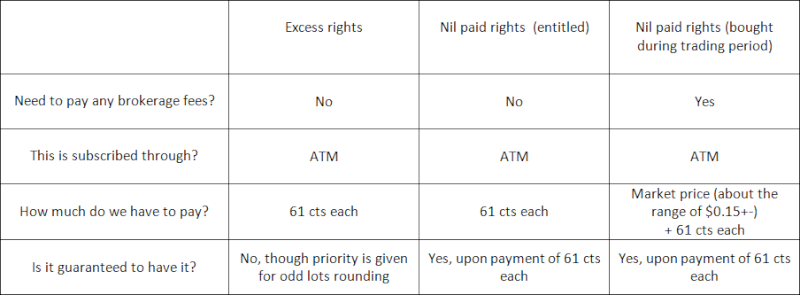
4. The difference between excess rights, nil paid rights entitled to you and nil paid rights bought during trading period is this:


For the Casual Croesus Rights players

Croesus retail trust is doing a rights exercise. The mother shares just went XR last Fri and I thought I should highlight the important points to remind myself to take action. I always remember someone losing a huge amount on rights exercise in the past because of some misunderstanding. I hope this won't happen to any holders of Croesus.


Here's the details from here:


The most important dates are the trading of rights entitlements, otherwise known as nil-paid rights, from the 9th Oct to the 19th Oct 2015. The second important date to take note is the closing date of the rights payment by ATM, which is on the 23rd Oct 930pm. Please do not forget to subscribe to your rights by paying for it, usually through the ATM, by 23rd 930pm. If not, all your rights will be rendered worthless!


For those who are new to rights, here's the main flow of events.


1. The company issuing the rights, called the mother share, will announce the rights issue. They will go cum rights (CR). If you buy the mother shares while you still see the CR status, you'll be entitled to participate in the rights exercise. After ex-rights (XR), you can't participate in the rights on any mother shares you bought from XR onwards. In other words, you're not entitled to any rights shares from this point onwards. The mother share, Croesus retail trust, went XR last Fri. So, if you only buy it today, you won't be participating in the rights.


2. After XR, in about a week or so, you'll receive a thick set of documents in your mail called the Offer Information Statement (OIS). In it, you'll get a set of documents detailing why they are doing the rights, the timeline (as shown above) and the way to go about subscribing for the rights. It's very detailed, so for first timer you should read all of it to get a gist of what to do. They even give different scenarios as an illustration, so really, go read it because it's very informative.


Inside the OIS, there is also a white form, I think it's simply called Form A or the ARE. In it, they will state the number of rights shares you are provisionally allocated based on the number of mother shares you have by XR date. Since this rights exercise is 22 rights for 100 shares @ 61 cts per rights shares, if you have 1000 mother shares by XR, you'll be provisionally allocated 220 rights shares. These 220 rights shares are known as nil-paid rights.


Why nil-paid? Because they have not been 'paid' up, or subscribed. You still need to pay 61 cts for each nil paid rights allocated to you. So, in our example above, since you have 220 nil paid rights, you'll need to eventually cough up $134.20 to subscribe for it. Thereafter, the nil paid rights gets transformed into normal shares. To differentiate this new addition of shares from the original mother shares, they call it the rights units. So after subscribing or paying up 61 cts for every right entitlements (or nil paid rights), they get transformed into normal shares (or rights units).


The last step on subscribing is important. Again, if you didn't subscribe and pay up, the nil paid rights provisionally allocated to you will be rendered worthless. And the last date to pay for it is on the 23rd Oct, 930pm, if you choose to pay through ATM.


3. How to subscribe and pay so that your nil-paid rights get converted to rights units? There are two ways - firstly it's through form A that is mailed to you together with the OIS. I blogged about this here.


The second and easier way is to apply through ATM. I always do it through ATM.


Just go to the ATM screen, click on other transactions, then look for something like “ESA – IPO applications”, then find the Croesus Retail trust. You’ll be guided to type in the amount of rights that you wish to accept out of the allocated (e.g you may be provisionally allocated 5000 rights but may want to accept only 2000), plus another separate screen where you’ll be guided to type how many excess rights you want to subscribe. Then you’ll come to a screen where they will tell you how much you have to pay. Make sure this screen you check carefully before pressing. I know for DBS you need to pay a service charge of $2.00, not so sure of other banks. If you applied through ATM, then do not send any forms! It’s done – just wait for them to mail you how many excess rights you’ve successfully got and how much you applied for.


On 3rd Nov 2015, the rights units will start trading as normal original mother shares. There will be no distinction between these two and the rights exercise is deemed to have completed.


That's all, three basic steps. Okay, ready for complications? There are 2a, 2b 2c etc and 3a, 3b and 3c etc, which I'll give fuller details in future post for more advanced rights participants. I'll share some information regarding excess rights, how to make the best out of the rights exercise and also the part about trading of the nil paid rights in near future post.


Monday, July 13, 2015

6 problems that prevent students from scoring

This article is first published in my tuition site here. I thought it'll be great to share this with the parents and students who sometimes read this site.

------------------------------------------

In my years of tutoring, I found that there are 6 categories of problems that students faced. I’m going to list out all these potential problems and then we will see how we can reduce or eliminate them.

1. Not knowing the content well
2. Lack of exposure to different types of questions
3. Unable to finish exams in time due to lack of speed in finishing the questions
4. Poor exam skills
5. Stress related issues during exams
6. Carelessness


1) Not knowing the content well

This can be the easiest problem to solve, but can potentially be the hardest too. Lack of knowledge can be caused by a variety of problems that may occur during the transmission of the knowledge by the teacher to the student. It can range from a noisy classroom, teachers who don’t know the content well themselves, unmotivated students, lack of proper note taking etc. It’s not a major problem and most students want to do well in school, so the motivation is somewhat there already if the knowledge can be packaged and structured in such a way to make things easy for the students to grasp. But if the problem comes inherently from a lack of motivation, then this can be a tricky issue.  Students don’t always come into classes all prep up and motivated to learn. They may have a whole baggage of issues that needs to be unraveled in order for them to be ready to learn anything. A lot more counselling with both the parents and the student will be the usual practice in such circumstances.


2) Lack of exposure to different types of questions

The symptoms usually go like this: Student can do all the simpler questions during lessons and when doing homework, but when it comes to exams where the questions are trickier, they crumble and can’t do it at all. This shows a superficial understanding of the content such that when the question is not presented in a standard format, the students are unable to recognize them immediately. Lack of exposure can be reduced by exposing them to harder and more challenging questions. But the trick is not to let them tackle the hardest one immediately. An ascending progression towards more challenging questions of the same topic or theme can be prescribed to slowly ease the student towards tackling the ‘funnier’ sort of questions. Usually other school prelim papers will help a lot in exposing students to non-standard questions.


3) Unable to finish questions in time

Knowing something and able to do a question given unlimited time is quite different from being able to finish it efficiently within the time constraint. In exams, there is always a time limit and students who can do the questions but unable to finish it in time will be severely penalized. This is actually a good problem to be in because it shows that the student can do the questions, but just not fast enough. Not a lot of students will fall under this category. In this case, the remedy is to drill the student.  Constant practice will streamline thought process and develop the necessary muscle memory to do different types of question efficiently within the time constraints. Every question will be a timed practice. Like an athlete preparing for a sprint, timed practice will stress students sufficiently and force them to always keep a watchful lookout to finish the question in time. Such speed drills are different from accuracy drills. The general principle is to expose oneself to different sort of questions so that one can do at least 80 to 90% of the whole exam paper regardless of the time taken. Thereafter, speed drills will force the student to confirm to the time constraints of the exams. Usually speed and accuracy are inversely related, so by doing it faster, accuracy will be lost and there will be more careless mistakes. The student will then learn the right balance of speed and an acceptable loss of accuracy to maximize their marks.


4) Poor exam skills

This is an important component but seldom taught to students. Best practices include knowing how much to write given the marks allocated, definition of keywords in the question so that one is answering the question adequately, techniques in doing MCQ papers, checking of answers, knowing when to cut loss and move on, choosing option questions to maximize marks, time management in handling different sections of the paper etc. A good student with minimal exam skills will be unable to maximize the marks scored.


5) Stress related issues during exams

There is a small percentage of students who behave like a different sort of person when the word ‘exam’ or ‘test’ is mentioned. This group of students can handle everything competently during non-examination time but when it comes to crunch time, they will have a nervous breakdown. The symptoms are: Very good results during non-major exams but just passing or failing when it comes to the major ones, with the heightened possibility of having stress related psychosomatic illnesses like severe headaches, fever and general unwell. This is a very difficult problem to solve and the success rates of the remedy vary widely with individual students. The remedy is to let the student have as many stress practices as possible. Usually this will involve timing them during their practice sessions and giving them lesser time than normal to complete them. Hopefully, and that is all we can do, that they will get used to the elevated stress level and learn to treat major exams as mere practice. Even with many hours of tuition, we cannot really get to the root of this problem easily.


6) Carelessness

This is a spectrum of effects ranging from very careful (less than 5% marks lost) to normal (about 10% marks lost) to the extremely careless (20 to 30% marks lost). This is not easy to root out. Carelessness can be masked as a defense against not knowing how to do. Usually the self is more comforted by the fact that it's a random and unavoidable careless mistake rather than under preparation of the exams and general lack of content etc. Genuine carelessness comes when the students settle on the very first answer that comes to their mind (or had worked out) without the expectation that their answers may be wrong. Even with checking, they can miss out the careless mistakes that are hidden in plain sight because they are not really looking out for errors, since they believed the answers they had given are correct in the first place. Therefore, reducing carelessness is a matter of following a set of procedures that iterates in a loop until the correct answer is found:

(1) Read the question
(2) Find the answer
(3) Check to see if the solution answers the question
(4) Repeat (1) to (3), until (3) is satisfied

Most students will do (1) and stop at (2), without going through the all-important step (3) to reflect and examine the solution to see if it really makes sense. The balance, really, is to do all these steps within the time constraints while maintaining accuracy and speed.

These are not isolated problems and most are actually dependent on each other. If you manage to solve one, you’ll likely reduce other problems as well.


Some students will no doubt ask why they have to learn trigonometry or integration when they have no need of such knowledge in real life situations. The skills needed to perform well in exams are part of this hidden curriculum that is not taught formally. After all, once you had left school and returned all the academic knowledge back to your teachers, what’s left in you are all these skills of success, of determination, of building a proper system of feedback and reflection that will guide you in through the tougher, the crazier and higher staked game of life.

Thursday, May 21, 2015

Frasers Centrepoint Limited bonds allocation table (part 4)

Bonds allocation for FCL is out. The allocation table is shown below for future reference:


A few observations:

1. Everyone will get something because the balloting ratio is 1:1

2. A lot applied between 41 to 50 lots, including yours truly.

3. The allotment favours those who bid 25 lots and below. If you bid anything less than or equal to 25 lots, you get exactly what you want. Does it mean that it's not as hot, as say CMT bonds?

Friday, May 15, 2015

Fraser Centrepoint Limited 3.65% pa bond (part 3)

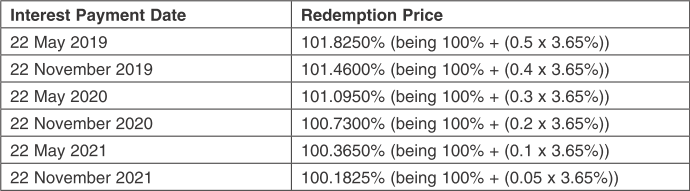
Someone asked me what the returns are like when FCL do an early redemption. The bond is widely published as having a maturity period of 7 yrs, but we have to be mindful of the possibility of early redemption. I wrote more about the details here.


They have an interesting way of paying back the investor if they do an early redemption. The earliest optional redemption is on the 4th year, which is 22nd May 2019. They will redeem back at a price higher than the par value of $1. I've not seen such feature before in the bonds that I've studied. I think it's only fair to compensate the investors by giving them a higher par value for the interest payments that will be forfeited if FCL decided to redeem back the bonds early.


I did out a table to show the returns if they decided to do early redemption of the bonds. There are two factors here at work. Firstly, if instead of redeeming the bonds on the 7th year, they choose to redeem back on the 5th year, you will lose out on 2 years worth of interest payment. Secondly, because they choose to redeem back at a price higher than par, you will get a capital gain if you've bought the bond at a par value of $1. Which of the two factors will dominate?


I did out a table below to see the different returns on an annual basis.


You'll notice that it's actually quite a good deal if they choose to redeem back the bonds early. The missed interest payments is much lesser than the effect of boosting the redemption price of the bonds, netting you a return of 4.106% pa. Obviously as the date of redemption approaches the 7th year, the returns get lesser and lesser until it reaches 3.65% pa on the 7th year.


Is the chances of them redeeming early high? I'll say it's not. Interest rates should go up in 7 yrs time. Unless they do not need the money for working capital or have found a cheaper source of financing, I think they will want to drag out the debt to its full term of 7 years. Anyway, for a good bond, you'll want them to continue paying you forever!


What's the implication of this? I think even though the possibility of them redeeming the bonds is low, it still serves as a value point where the price of the bond will hover around. On May, 4th year of the bond, the price of the bond should be lower than 1.01825 and on Nov, it should be less than 1.014600. It doesn't make sense that the market price of the bond is higher than the possible redemption price at that point in time. But 4 years is a long time...who knows what will happen then? I'll still suggest that whoever wants this bond must be willing to wait out for the full term of 7 years, if not, you shouldn't be in this.


The last post I'll do for this FCL bond series is probably on the results of the balloting.

Here's the rest of the post:

1. FCL bond (part 1)
2. FCL bond (part 2)

Thursday, May 14, 2015

Fraser Centrepoint Limited 3.65% pa bond (part 2)

This is the second part of the Frasers Centrepoint Limited 3.65% pa bond. The first part is here. I managed to get a copy of the prospectus and read it. Hence, for ease of reading, I summarised the main points of the bonds again here, with some additional information:

-------------------------------------------------------------
Duration: 7 years until 22nd May 2022. 
Option for early redemption: Earliest date for optional redemption is 22nd May 2019 and on each interest payment date thereafter
Interest payment dates: 22nd May and 22nd November. First payment on 22nd Nov 2015.
Coupon yield: 3.65% pa

Open for subscription: 13th May 2015, 9 am
Closing: 20th May 2015, 12 noon
Minimum amt for retail: $2000, with integral multiples of $1000 thereafter

Retail (public tranche): $150 million
Institutional tranche: $50 million (closed!)
--------------------------------------------------------------


I decided to do a FAQ of questions that I had gathered from interacting with others on facebook and the comments from my previous post. The information is laid bare here. It's up to you to decide if this is a good deal or not and I won't answer questions regarding whether it's suitable for you.


1. Can we use CPF to apply?

No

2. Can we use funds from Supplementary retirement scheme (SRS) to buy?

There are two stages in this. Firstly, there is an initial offer of the bonds, which is what they are doing now. Consider this the same as the IPO of stocks. After this initial offer, the bonds will be listed on SGX, where you get to buy at whatever market price the bond is offered.

You cannot use SRS funds to buy this bond at the initial offer stage. However, you can use funds from SRS to purchase the bonds from the market after it is listed on SGX.

3. How long do you have to hold it?

7 years, if you want 0% chance of losing your initial capital. There is a slight complication in the redemption date, so please read point number 4 below. You can sell it anytime like stocks on SGX since the bond will be listed there, and you’ll be subjected to the market price of the bonds then. Hence, you might suffer a loss if you sell below $1 or book a profit if you sell above $1. Brokerage fees and comms apply too.

4. Can the issuer redeem the bonds earlier than the maturity period of 7 years?

Yes. In the prospectus, page 47, it is stated that the issuer can choose to redeem back the entire tranche but not in part, of the bonds starting from 22nd May 2019 (inclusive), on 22nd May and 22nd Nov each year. They will have to give 1 month to 2 months of notice to the holders if they choose to do so. Furthermore, should the issuer choose to redeem early, they will not redeem back at par value of $1.

The table, also taken from page 47 of the prospectus, state the redemption price of the bond in % of the par value of the bond at different possible redemption date starting from 22nd May 2019.


For example, if they choose to redeem on 22nd May 2020, which is earlier by 2 yrs from the maturity period of 7 years, they will have to redeem back the bond at 101.0950% of the par value of $1, which is $1.01095.

5. When are the interest payment dates?

The bonds pay out interest twice a year, on 22nd May and 22nd Nov each year, from 22nd Nov 2015 (first payment) to 22nd May 2022 (last interest payment). 22nd May 2022 is also the maturity date of the bond

6. What’s the par value?

The par value of this bond is $1. When it’s listed, it will come in board lots of 1000 ‘shares’. Par value is what the price of the bond is when it is first issued out, and also the price that the issuer will redeem back from you, regardless of market price, at the end of 7 yrs on 22nd May 2022. There is a slight complication, so please read point number 4.

7. What are the returns like?

If you bought the bond at par value of $1, and hold it for 7 yrs, you will be guaranteed your capital. On top of that, you will have interest paid to you at 3.65% per year, paid out twice a year.

If you bought the bond on the secondary market after it had been listed, the returns will then depend on the market price of the bond. If you buy it above par of $1, you will be guaranteed a loss upon maturity of the bond, because the issuer will redeem back the bond at $1, regardless of how much you bought it. On the other hand, if you buy it below the par value of $1, you will be guaranteed a profit at the maturity of the bond. 3.65% pa yield is only for a par value of $1, so if you buy above or below par, the yield will decrease or increase proportionally. For bonds, it’s better to calculate the yield to maturity if you buy it at any market price other than the par value, and at any other times other than the initial offer of the bond.

8.  How does the bond work? Can you explain how the process is like for us to be paid?

If you’ve experience in buying shares, this analogy should clarify your fears. If a company wants to be listed on SGX, they will do an IPO for investors to get in. So investors will buy at the IPO price through ATM or internet banking. If it is oversubscribed, the issuer will do balloting, so you might not get everything that you bid for. They will have an allotment table to tell you how many lots of this IPO you get based on how much you want to subscribe.

After this IPO is over, the company becomes listed on SGX and you can buy/sell it, subject to market price. The shares certificates are kept in the CDP account, which can be linked to your bank account. If the company gives dividends, they will check if your name is under the registrar by checking up the CDP account. If it is, then you’ll be entitled to the dividends. Once the dividend is paid, it’ll be transferred to your bank account tied to your CDP account.

If you sell the shares, the share certificates will be transferred electronically to the buyer after a few days. The money you get from selling it will be transferred to your bank account tied to your CDP account again.

That’s for shares.

For bonds, they will also do an IPO. The ‘IPO’ price of the bond is called the par value. Investors participate in the bond IPO by going to ATM or internet banking to subscribe for it. Again, if the bonds are oversubscribed, the issuer will do balloting so you might not get all that you subscribed for. The allotment will be based on a table just like the IPO of shares. I will highly suggest applying odd and not even number of lots if you want more.

After the IPO of the bonds is over, the bond will get listed on SGX and you can buy/sell subject to market price. The bonds are in board lots of 1000 ‘shares’, so the minimum you need to buy is $1000 (exclude brokerage and comms). The bond certificate is also placed in your CDP account and when interest is paid (twice yearly), they will check if your name is under the registrar by checking your CDP account. If you have the bond certificate in your CDP account, the ‘dividends’ of the bond will be paid to the bank account tied to your CDP account.

Should the issuer redeem back the bonds, the money that you get is again transferred to the bank account tied to your CDP account.

9.  Is it really guaranteed?

The guarantee of a bond is only as sure as the solvency of the underlying issuer. You will have to do your own judgement whether Fraser Centrepoint Limited will still be around in 7 years. If you think they have problems surviving till 2022, then it's better not to buy the bond.


Update: I did a post on the returns that you can if they choose to redeem it early on the 4th year. I'm just expanding a little more detail regarding the possibility of early redemption. Please read it here.