
Showing posts with label My adventure into accountings. Show all posts

Monday, February 03, 2014

Running yourself like a company - Cash flow analysis I

I've been running a series of posts on the theme of managing yourself like how you would run a company. There are three important financial statements to report to regulating authorities or to investors; these are the income statement, balance sheet and cash flow statement. I've already commented on the first two. The links for them are listed below:


1. Running yourself like a company - income statement
2. Running yourself like a company - balance sheet


The third one, cash flow statement, is really important in a company because of the way the income statement is derived. The report is prepared under the accrual basis of accounting, hence as long as the sales/services are fulfilled by the company, there will be an credit to the income. Since it's normal to give customers credit, the actual payment of the goods and services might not come in until a while later, thus whatever increment in income reported reported is essentially 'on paper' only with no corresponding increment in cash received. That's why it's important to see the cash flow statement because however healthy your reported income is, it's ultimately cash that is king.


You find that when you are preparing your own income statement, it's unlikely to be prepared under the accrual basis of accounting. Most likely, when you receive your salary, you receive it in cash or cash equivalent. In other words, you don't report that salary as your income until you received it in cash or in your bank account. Likewise for dividends and all other cash items like paying for your food and other stuff. Hence essentially, your personal income statement can also double up as your cash flow statements. They are not that different.


There are some things that you might use an accrual basis to record down your spending though. For credit cards, let's say you spend $100 on a restaurant dinner today but your credit card bill payment only comes a month later. Do you record your expenses for $100 on food today or do you record $100 on food a month later when you actually pay the bills? The question boils down to whether you record the amount spent when the services/goods are received or when the bills are paid. There's no right or wrong answer, because ultimately, it's your system we're talking about here. For me, I'll record when the services or goods are received for credit card expenditures. This makes my income statement a little different from my cash flow statement, if I am to compare between the two.


But it's not a big deal though. I used to have a separate income statement and cash flow statement, but I no longer do that. That's because my income, at least in the past, are recorded when the services are given out but not paid to me. I'm a tutor, so when I give lessons, I don't always get paid on the spot. Usually there's a credit period of roughly 2 weeks to 1 month before I received cash payment for the services rendered out. However, I realised that while it serves no purpose having two such statements, it certainly adds to the work I've to do. After 10 years, I scrapped that system.


I'm happy with just one income statement on the basis that :


1. Income is recorded only when I received cash. Works the same for dividend and interest received; I only record them when I received it.

2. Expenses are recorded when I paid for them, or when I received the goods/services, whichever is earlier. E.g. If I buy a shirt for $10 using credit card but only pay the shop a month later, I'll still record the $10 that I spent today. If I buy a shirt online for $10 and paid them today, but I can only receive the shirt a month later, I'll record the $10 now too.

3. Loans/mortgages: The day that I pay my monthly loan amount, I'll record it down.


The last and (possibly) final post on this series will still be on cash flow. I'll be posting my thoughts on looking at the stream of cash outlay that occurs monthly over a period of one year. Having this idea will help you to plan ahead so you'll never be caught with a huge monthly cash outlay that you knew about but forgotten.

Monday, January 27, 2014

Running yourself like a company - Balance sheet

The next report to look at is the balance sheet. This shows how your liabilities are like against your assets, and also the breakdown of the liabilities and assets. The sum of your assets minus your liabilities will be the book value of a company. In terms of your personal balance sheet, this is known as your net worth. I know there are a million ways to calculate net worth, so it's up to you to decide which definition you want to adopt. It doesn't really matter as long as you keep the standards the same when you compare yourself against different time periods. Just don't change the yardstick all the time. It'll be like a company that changes their way of valuating their biological assets or the rate of depreciation or their accounting period.


It's important to know that similar to the balance sheet of a company, a personal balance sheet is a static picture of a company's assets and liabilities at a particular point in time. The balance sheet of a company taken at different times will likely be different. Just pick a time period that is significant. I think doing a balance sheet monthly is kind of pointless, because there isn't much changes in the items (though I still do it). A comparison of your personal balance sheet across different years should be good enough.


Anyway, this is the way how I calculate my net worth:

Net worth = All bank accounts + cash + money market funds + surrender cash value of whole life + marked to market value of stocks + scrap value of car + CPF - (car loans + credit card debts)


Notice that I did not include the marked to market valuation of my residential property , but neither did I include the loans that I borrowed to buy that property. The mortgage payment part is included in the income statement and I'm contented to treat it this way. As mentioned, there are a lot of ways to do your net worth, so just pick something that works and make sense to you.


An illustration of how the personal balance sheet is compared across years


A company that can withstand financial stresses are those that are light on debts. But more importantly, it's whether the company can service their debts without breaking a sweat. You can thus calculate a variety of ratios, each of which can be used to analyse how robust you are to financial stress. Here's but a few:


1. Years to service debt

I don't care how others define the ratio, but this is what make sense to me. My way of calculating is this: (All loans and debts - cash/cash equivalent - 50% market to market value of stocks) / (net savings per year). I do not include CPF because I don't use that to pay off my housing loans. For someone who does, you can easily tweak the formula to include all the cash that you can use to pay off the housing loans from your CPF accounts. Basically, the aim is to only use those money that are liquid enough to subtract off your total debts in the numerator of the formula. There's no point deluding yourself that you have a lot of money stuck in some illiquid asset, say like your cpf account, but those can't be used to pay off your debts when crunch time hits. I also did not include the full marked to market value of the stocks to account for the fact that when the shit hits the fan, your portfolio value will also drop. You can still liquidate it but it won't be at the price you want to sell.


For example, in the balance sheet above for 2013, the housing loan is about 430k and car loan is 7.2k, total being 437.2k (let's ignore credit card debts, which isn't significant). Subtract off all my cash/cash equivalent plus 50% of portfolio value gives me 353.7k . If my savings per year is 30k, 353.7/30 = 11.8 years. This means that if I dedicate all my liquid assets to the repayment of debts, I should be debt free in 11.8 years. Probably shorter than that, since I didn't include my wife's contribution in the savings. I think what's more important is that while the debts and liabilities are certain, my income and hence the savings are not certain. Can I save that much for another 11.8 years? If not, then I better accelerate it, work harder and save harder to bring the ratio down. It's also silly to sell of everything and use all the cash to pay off the debts. This is just a stress test scenario to see if you can withstand financial difficulties.


If you have a negative number, congrats! That means that your debts can probably be covered by your liquid assets. You have a healthy balance sheet!


2. Current ratio

Current ratio is current assets over current liabilities. This will see whether you have problems paying off things like credit cards, income tax, annual insurance premium and very near term loans. I'll treat current assets as cash/cash equivalent (like money in money market fund, fixed deposit, savings account etc). If you have this ratio being less than 1, better watch out. Again, relative numbers are more important than absolute numbers. If last year your ratio is 1.1 and this year, it's 0.8, you should go and find out what is happening in your financial health. It doesn't mean that there's something wrong and you should correct it, but it's could be a symptom of something bad that could be coming.


3. Liquid vs illiquid assets

Liquid assets are those assets that can be easily converted to cash. Illiquid ones are those that need a long time to convert to cash. Things like property can be rather illiquid. Stocks are liquid, but they might not be able to sell at the price you want when you need to sell it. The really liquid ones are cash /cash equivalent and money market fund. CPF accounts are not liquid at all, unless you're near the withdrawal age. I'm rather ambivalent about cash surrender value of whole life insurance plan. It's not that it's illiquid, but I'll rather treat it as untouchable.

This ratio will allow you to analyse whether you are one of those cash poor, asset rich folks who have a lot of their net worth locked up in things that do not generate cash. You might have a property worth 1 million dollars but you can't really break off a brick to pay for food. I suppose when we get older, we need to see this ratio gearing towards the liquid side, because we no longer have a income stream from work due to retirement / retrenchment.


It's important not to look at just one slice of your financial health to conclude whether you are well off financially or not. Looking at just the balance sheet does not give you a full picture. For example, consider a scenario where there is a person with high net worth. His personal balance sheet consists of large assets and very little debts. However, his balance sheet has a large percentage of the assets that are fixed (i.e. illiquid) with very small percentage in current assets, like cash or cash equivalent. Though this person may have a strong balance sheet, he might not be able to live comfortably day by day because he has very poor cash flow. If his cash flow is insufficient to pay off his expenses, specifically his debt commitments, he might even have to sell of his fixed asset in order to generate that cash flow. We have to look at the income statement too to see a better picture of his financial health.


Wednesday, January 22, 2014

Running yourself like a company - Income statements

You should run yourself like a company. There are certain beneficial practices in running a company that we can learn from. There are 3 important reports that can determine the state of the health of a company. These are the balance sheet, the cash flow statements and the income statements. A company needs to have these reports generated so that the managers and also the investors can have a look at whether the company is doing well and also for transparency, good corporate governance and accountability. This should also be the reason why you should do up your own personal financial statements so that you can see if you're doing well financially or not.


Of course, before you can even prepare such statements, you need to keep records. Since you're not listed nor fall under ACRA, you don't have to follow any accounting guidelines nor will you be fined for not meeting standards and regulations, as is the case for public and private companies. Feel free to include or exclude things that don't help you. The first step before you can improve your own situation is to take stock of where you are now. A good record of your financial situation, which involves keeping track of your income and expenses, will allow you to analyse how healthy you are financially.


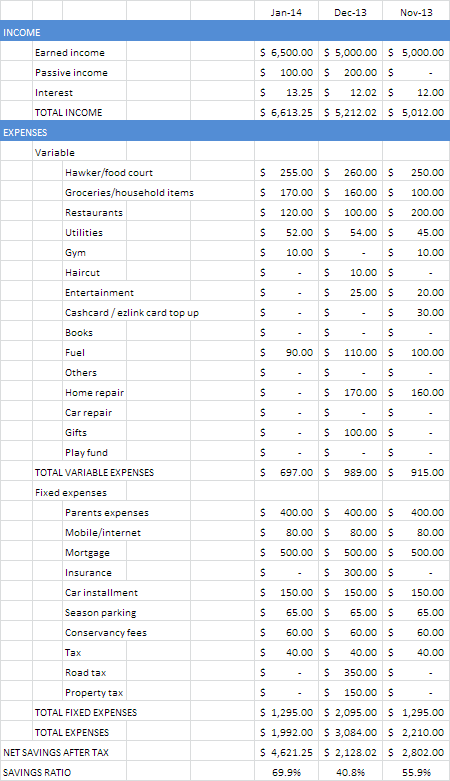
I've prepared a sample of what a personal income statement looks like in a 3 months period from November to January. I think doing this on a monthly basis is good. However, there are some months that you spend more or less, depending on the holiday season and the variability of your income stream and expenses calender, so you can also consolidate the monthly in quarterly or semi-annually too, to even out the odd months. The statements are really prepared for yourself, so feel free to do anything that makes sense to you.


This is just an example of a personal income statement. The categories for expenses might be useful for your reference though.


In the income statement for a company, you look at the top line, i.e the revenue. This is equivalent to your total income streams coming either from work that you do or money working for you. Then we have to look at the expenses. Some of them are fixed, some are variable. If you take the revenue minus off the expenses, you'll get the gross profit before tax. That's also your savings if you minus your expenses off your income. After paying taxes, what's left will be your net profit for a company. That's your net savings per year. And this is ultimately what counts at the end of the day, not your gross revenue.


You can further crunch the numbers in the personal income statement to see the following:

1. Percentage change in income (equivalent to % change in revenue)

2. Percentage change in expenses

3. Your savings ratio, which is net savings as a percentage of income (equivalent to profit margin, which is net profit over revenue)

4. Expense ratio, which is total expenses as a percentage of income


Different companies doing different industry will have different profit margin. You can't expect a company in the service industry to have the same profit margin as a manufacturing one. Likewise, different person will have different savings ratio. It depends on how 'light' or how 'heavy' that person's burdens are. Just like there's no meaning to compare the profit margin of a property developer company to that of a shipping company, there's also no meaning to compare the savings ratio between different people. The better way to compare is to compare your own performance metrics across different time periods of your life. For example, you can compare your % income or savings ratio between the year 2008 and the year 2009. The competition should be directed internally, not externally. In other words, you should compare how you do now against how you did in the past, not between how well you do against how well others do.


Remember that savings is like the net profit of a company. You do not want to invest in a company that shows ever increasing revenue but stagnant or decreasing net profits margin, neither do you want to become a person with increasing income but decreasing saving ratio!


A good personal income statement should have the following characteristics:

1. A stable income that is high enough to cover the expenses and then more. This will ensure that there will be some excess left over for savings. Savings is the first step to let your money start working for you. There's no other way that a self-made person can make money work for him without having savings in the first place.

2. Increasing income and decreasing or constant expenses. What's important is not the absolute but the relative. Preferably, the income should increase over time while the expenses are kept constant or increases at a lower rate than the income.

3. Consistent and increasing savings ratio. Savings is all that matters at the end of the day. You work for an income to get the savings; all other expenses can be treated as cost for getting the savings. If you cannot have some savings, you need to increase your income or decrease your expenses. There's no other way around this.


Interestingly, I can imagine a retiree who is not working any more but is drawing down on his assets accumulated over his working years. In such a case, his personal income statement will look extremely unhealthy, with very little revenue on the top line and negative balance each month after subtracting off expenses. But such a person is like a holding company (a company that does not provide a service or produce goods). So, to see if such a company is a good one to invest, you look at the balance sheet and see what kind of assets and liabilities that he owns. I'll talk about balance sheet next in my future posts.


In essence, whatever is described above is really just for a growth company, defined as a company that produces goods or provides a service, and seeking to grow its profits. This is similar to a person who is not retired yet, and not drawing down on his accumulated earnings/assets.


Maybe next time before you get married, you should ask for a person's personal income statements before you choose to invest in him/her LOL

Wednesday, February 04, 2009

Woe be to those who missed out ROE

I was just waiting for the bus to come when I thought more in depth about the concept of return on equities, otherwise known as ROE for short. It’s not those little things that you put onto sushi though.


WARNING: THIS IS ONE OF THE MOST CHEAM AND LONGEST POST I EVER DID ON ACCOUNTINGS. PROCEED WITH CAUTION.

ROE, usually denoted as a percentage, is defined as the net profits per equities of a company. Equity is the amount that is left when you subtract total liabilities from total assets. In this article, I’ll explore the idea of how difficulty it is to maintain a consistent ROE throughout the years. I figured out an example while waiting for the bus, so I’ll just use that one to illustrate.

Suppose Bullythebear Company (BTB for short) is opening for business. To start off the business, BTB managed to raise $150 from venture capitalist. However, because BTB still needs to buy some fixed asset to kick start the business, it’ll have to borrow $50 from the Kingpin. Being a kind soul, Kingpin do not require any interest to be paid up, so there is no interest charged on the $50. BTB will immediately have a cash/cash equivalent of $200, listed as a component under the assets column. The balance sheet will look somewhat like this:


BTB proceed to buy a piece of machinery (that can be used forever and hence do not need depreciation charges at all) that is used to produce the revenue, costing a princely sum of $120 paid up front without credit. Hence, from the cash/cash equivalent of $200, $120 of which will be used up, leaving $80 (200 – 120 = 80) left. The balance sheet looks like this:


So after the first year of business, BTB made a revenue of $100, and after all the costs and taxes involved, retains a net profit of $52. The $52 will be received immediately and will add to the initial $80 cash, hence the cash/cash equivalent will be raised from $80 to $132 (80+52 = 132). There is a corresponding entry in equity under retained earnings, which is the exact amount as the cash/cash equivalent, being $52. The balance sheet and income statement looks like this:


Let’s do some FA for the company at this present moment.

ROE is 25.74% (52/(150+52) = 25.74%).
Net margins is 52.0% (52/100 = 52%)
Financial leverage is 1.25 ((132+120)/202)
Asset turnover is 0.40 (100/(132+120))

Hey, not bad numbers at all!

Into the second year, BTB manages to raise revenue by 15%, which is pretty decent. Unfortunately, the direct and indirect costs associated with making the revenue also increases proportionately, creating a net profit of $59.80. Again, this sum is collected in full without credit and thus increases both the cash/cash equivalent and the retained earnings. The balance sheet and income statement looks like this:


Take a look at the figures now
Revenue increment: 15%
ROE is 22.84%
Net margins is 52%
Financial leverage is 1.19
Asset turnover is 0.37

Hey, the ROE drop from 25.74% in the first year to 22.84% in the second year, even though the company is pretty decent. The net margin remains the same and the revenue increase by 15%. This is the difficulties that company faces when they want to maintain their ROE – it’s not easy, especially when they hold their retained earnings in cash which is sitting there earning a miserable interest. The more the company earns, the harder it will have to work in order to maintain the same ROE because the asset base increases!

Let’s see what happens in year 3 when there is a great year for our BTB company, with revenue increasing by 29.6%. Here’s the balance sheet and income statement:


Here are the figures:
Revenue increment: 29.6%
ROE is 22.84%
Net margins is 52%
Financial leverage is 1.15
Asset turnover is 0.38

Here, the ROE is maintained at 22.84%, same as the previous year. But look what it takes to achieve this same consistent ROE feat – a revenue increment of nearly 30%. Can you see how hard it is to keep on maintaining the same ROE again and again, year after year? It takes not only good use of the retained earnings, but also great management insight to invest the excess earned every year to good use. It’s not easy at all!

Here's a few insights that I gained by doing this rather rigorous way of exploring how ROE numbers are generated:

1. ROE is very difficult to maintain. Every year, the management will have to decide on how to maintain ROE, which isn't fun at all. Holding too much cash is great, but it'll drag down the ROE. Invest more into their business - what if they can't generate the kind of returns? Management will also have to think about giving back earnings in terms of dividends, especially when they are not confident of using it wisely. The worst they can do is to invest in non-core business for the sake of expanding their empire. It'll drag down ROE, suck up precious cash, and even have to spend money to get out of it eventually.

2. This comes as a surprise actually. I knew it but never really thought hard about it. Financial leverage drops as one gets more and more asset base. This is the result of increasing the asset faster than one's borrowings. Just by retaining cash, the financial leverage ratio drops substantially.

3. I've a much better understanding of the relationships between the 3 statements found in financial reports. I used to do all these accounting in the past (I blogged it an article found here), as part of my journey to learn fundamental analysis, and I remembered I took half a day to do just a simple tracking. This one, I did it in 1 hour. Hey, practise do make prefect - just keep staring and crunching numbers for 1 full year, it'll work wonders.

4. I start to appreciate more when I see companies with high and consistent ROE. Take a look at Hongguo:

----------ROE(%)
2003------19.68
2004------20.49
2005------22.46
2006------22.31
2007------22.30
2008------19.7 (*)

* estimation based on 9M08's ROE

Friday, November 16, 2007

Capital structure of companies

Time to do something about my accountings again.

Learnt more and subsequently got a bit confused over credit/debit - the details behind accountings. I guess I do not have to know that since my job is not to be an accountant but just to know enough to comment on the ratios and the main jargon surrounding accountings.

But it's interesting that the monthly statement that we get from banks for our savings account is actually based with reference to the bank, not us. What I mean is our view of credit and debit is totally different from the view of the banks, and this apparent paradox arises because we're simply on different sides of the balance sheets :) One person's account payables is another person's account receivables, one's cash is another's fixed asset, one's interest payment is another's interest received and so on. After going through the whole thick book on accountings, I think this idea is very important - the ability to think through your expense and revenue in terms of balance sheet. Opened up another aspect of my viewpoint :)

So today is going to be simple concepts - going to explore about the difference between the capital structure of a company. I used the word 'explore' because I do not know is going to be like. I'm basically thinking of hypothetical scenario and trying to fit into the financial statements. If they don't balance, something is wrong. If it does (and I have people ;P to help me proof read), most likely it's correct.

------------------------------------

Let's take a look at the different capital structure of the hypothetical company - Bully the bear sausages.


The first is a pure private company - meaning that the owner cough out the money and use it for his own purposes. The accounts of such are normally not important to anyone except IRA :) The whole business belongs to the owner.

The second one I think can be called public company. Need some explaining to do. Suppose that the owner of a business needs $1000 to start up a business. He needs the money to buy his equipments, some cash for change, stockup his inventory, pay rent, salary and so on. The problem is that he don't have this amount of cash and does not want to beg/borrow/steal from his frens and relatives. He decided to take his company to public - so that shareholders can own a piece of the company (let's assume in this fairytale world that you don't need a track record in order to publicly list your companies, not a far off assumption considering a lot of such things happened in the IPO craze of the dot.com era).

He wants to make this is a penny stock (<$1) so that a lot more people are willing to buy ownership of his business. He decided to split up his $1000 into 10,000 shares, each having a par value of $0.10 ($1000/10,000 shares). Even if he buy 2000 shares (say) costing $200, this would have nothing to do with the company because as far as things are concerned, the business and the owner are separate entities. One cannot mix personal accounts into company accounts.

Compare this with another structure - where the owner cough up 200, then divided $800 ($1000 - $200) into 8,000 shares each having a par value of $0.10 ($800/8000 shares). The total outstanding shares is 8000. This would have a balance sheet looking like this:


Basically the company with the above structure will have a smaller float, it's a little more volatile (all things being equal) than another with a larger float. A good example is THEBV - Thai Beverage. This company has such a huge float that the price is very hard to move (either up or down). Just look at the charts, it's as stable as it can get.

The third kind is a combination of own money, stocks and long term borrowings from banks. The good thing about borrowing from banks is that the highly leverage (or highly geared) company can raise money fast and enter into opportunities fast. The downside is that in recession, the interest payment of the loan will reduce the cash holdings of the company and may raise cash flow problems as well as reduced retained earnings and profits. In this case, assuming , the par value of the stock is $0.10 each ($400/4,000 shares), with total outstanding shares as 4000.

What's important about the capital structure of the business?

1. If it's heavy in debts - it means ownership of the business belongs mainly to the banks. In the case of liquidation (or unwinding of business), the company would hold a 'fire sale' selling everything from investment holdings, accounts receivable (also called factoring), raw materials, finished goods, office equipment, patent, brand names etc, in order of most to least liquid. The amount raised together with the cash holdings would be used to pay debtors first.

So the pile of cash would be given in order of priority:

a. Debtors - banks, suppliers
b. Preferred stock holders
c. Common stock holders

Banks always get paid first. So bloody smart.

Basically, highly geared companies better have enough earnings to pay off the interests generated by the loan, otherwise in recession, these companies would be the first to face liquidity crunch. If they can't pay the bank, they would rupture the bank aka bankrupt.

2. If the company keeps issuing new shares to raise funds, then the new shares would be added to the shares outstanding of the company. This would be bad for shareholders are it would 'dilute' the value of the company of they hold the same amount of stock. Not to mention reduce the attractiveness of key ratios like Earnings per share. That's why in financial reports, sometimes there are diluted and non-diluted information - diluted ones just means the shares take into account of future dilution in the shares outstanding.

Miss out any points?

One important thing: Does the stocks under the equities in the balance sheet change in value according to the market price? NO - it doesn't change. Once IPO-ed, the stock would remain the same value unless there are other exercises which increase or dilute the stocks. The company already sold you the stocks during their IPO, so the subsequent rise in value (or fall) of the stocks have nothing to do with the balance sheet anymore.

Phew, what an adventure :) Enough for today. I think I have enough of accountings. Think next time I'll talk about key ratios. Woah, a lot more to learn :)

Friday, November 09, 2007

My adventure into accountings

Phew, nearly 'dieded' trying to put all the accountings I've learnt today into practice.

I went to the library to borrow this book, "Accounting demystified - a self-teaching guide". I long wanted to pick up accountings so that I can understand financial statements better, so what better time than now? :) I tried to read up on the financial ratios but doesn't make sense to me, cos I think I do not know what those entries in the statements mean, and what is the relationship between balance sheet, statement of cash flow and income statements.

I want to break out of the accounting jargons (like I did for TA), so I went to read up about it. I guess I don't need a very detailed knowledge, just a very fundamental knowledge of the principle of accountings should suffice. I came home inspired and ready to do my first balance sheet.

Balance shit! Can't balance...then after trying for nearly 2 hrs, I think I got the hang of it. Now I really understand what is meant by the double-entry system and the accrual method of accounting. Hmm, damn interesting :) Finally made sense to me.

Here's what I did (WARNING: This is going to be long)
-------------------------

I opened a stall called Bully the bear (BTB) to sell some sausages. I think it'll make a great snack at a nearby traffic junction (it's illegal, i know, but this is fictional yah?). This shall be my first step to my first million :)

I only have $1000, which is my seed money to start the whole business. So initially, my statements look like this:


Not very impressive, yes. To start my business, I need $500 to buy 250 sausages, and another $200 on a fryer, pan and other fixed assets. Those high grade sausage are oil free, so I just need a fryer and pan to start cooking them. Other fixed assets include perhaps a signboard, some gloves (I'm a illegal BUT hygienic hawker) perhaps.


Now my statements look like that above. I paid $700 (500 + 200) in cash to get my sausages and fixed assets, so immediately in my cashflow, I subtract $700. At the same time, I converted the $700 into $500 worth of inventory (that's my sausages) and $200 worth of fixed assets (that's my fryer,pan,signboard etc). The link between cashflow statements and balance sheet is that the cash at the end of the period becomes cash at the left side (asset side) of the balance sheet. Did I put in double entries? Yes, that's the point. Oh btw, I capitalise my fryer/pan/sausages instead of expensing it. More of that later.

Now I'm ready to do some business. First I must decide the price to sell my sausages so as to make a profit. I will get a profit as long as I sell each sausage above the cost used to produce the sausage. This cost can be divided into 2 types - direct cost and indirect cost. Direct cost are cost that goes directly to produce the sausage (duh) - like the raw sausages itself. Indirect cost are cost that are used to pay for the things that will generate the business - like my fryer, pan, signboard (debatable issue - is fryer/pan indirect? I put it as indirect because one day I plan to expand my business to sell not only sausage. So if I sell other things like chicken wings, the same fryer and pan can be used, hence the fryer/pan isn't used to exclusively make the sausage, so it's indirect).

Each sausage cost $2 (500/250 = 2). The indirect cost I calculate my capitalising it, instead of expensing it. These are just 2 ways of depreciating assets. I'll skip expensing it till next time. I'll just capitalise my fryer/pan/signboard. You know, after frying my sausages, my fryer and pan starts to break down. The signboard also like want to spoil don't want to spoil already. This means that the fixed assets loses its value, so I must find some way to devalue it - or depreciate it over time. For me, I just use the $200 indirect cost, divided by number of sausages, which gives me $0.80 per sausage.

In summary,
my direct cost - or cost of goods sold (COGS) - is $2
my indirect cost - or operating expense - is $0.80

Let's sell something! Since my total cost is $2.80, I just agar agar sell at $3.50, sure make my first million like that.

First day of business, I sold 100 sausage at $3.50. I do not accept credit, so customers pay me on the spot when they get their delicious sausages. For that,

I collected $350 in cash (3.50 x 100 = 350) with
COGS as $200 (2 x 100 = 200) and
operating expenses (indirect cost) as $80 (0.80 x 100 = 80).

All the above can be found in the income statement, which just records the sales i did, regardless of whether I actually received the payment in cash or credit. More of that later.

Here's how my statement look like now:


Haha, balance sheet balances on both sides, with net income in the income statement reflected in the retained earnings on the equities side of the balance sheet, and ending cash on the cash flow statements reflected in the cash on the assets side of the balance sheet.

2nd day as I wasn't caught yet, I went on selling. This time, I did better as word spread around, I sold a total of 100 sausages and received it in cash, then another 50 sausages but received in credit. They no money to pay but promised to pay me the next day, so I anything lah.

I get $350 in cash (3.50 x 100) and $175 (3.50 x 50) in accounts receivable.
COGS is $300 (2 x 150 sausages), so the final COGS is the initial 200+300=500 reflected.
My fixed assets I take it as depreciated fully (strange, i know, cos fixed assets are called fixed if they depreciate after more than 1 yr, i should have expensed it instead of capitalising it).

Here's how it looks:


Still balanced.

I'll continue the story of BTB sausage next time. I learnt everything once I put those transactions into the statements. Next time I'll explore expensing items, and perhaps explore a little about how I actually started with my $1000 seed money (did I borrow it from bank or sell my stake in the business?)

----------------------------
Thks for protonoid for pointing out that the $1000 initial seed money should be placed in capital stock or a separate capital accounts, not placed under retained earnings. Retained earnings is used for money earned from the last accounting period.

Thks so much for pointing out the mistakes, I'll remember it!