Thursday, December 05, 2013

Finding the lemonade out of the lemons

Maintaining a household is not cheap.


After about 2.5 yrs of wear and tear through usage and plain old 'depreciation', things start to break up a little for my home. Initially when well informed friends told me that I need to set up a fund to pay for such eventualities, I brushed them off saying that there's no need for such things and I can live with the wear and tear. I bravely and foolishly thought that it's just cosmetics (I can live with that). Nope, things can wear off to such an extent that they don't work anymore.


Here's my list of breakdowns in the last 2-3 months:


1. Home's air con

For my air con at home, it's quite important to have it to work properly because I switch it on whenever I hold lessons at home. My wife also can't live without it so she'll complain that it's so hot and all. Initially the problem is that the air con didn't seem to blow out cold air, so I thought that it needed servicing. However, the problem didn't go away so I've to sent a team to inspect and find out what's wrong. It needed a change in the motor so I've no choice but to order the parts and have it fixed.

Cost: $140 for servicing + $306 for changing of motor
Total : $446

The lemonade out of the lemon: The problem got to the point where before I switched the air con on, I'll do a little rain dance and talk to the compressor, coaxing it to work and not give up on me. Occasionally it'll try but most of the time it'll splutter and die. I'm super thankful that it did work even though it's ill. For the times that it didn't work, I'll just tell my wife that Mr Air con is having a bad day and he's not cooperative. It's quite fun personifying the air con as being temperamental. Oh no, it's not spoilt - it has character.


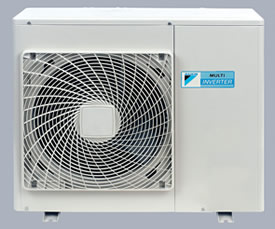
Mine's something like this, also from Daikin.

2. Car's air con

For my car's air con, the compressor is making a hell lot of noise when it's stationary. I was told that the symptoms will become worse as time progresses until eventually it'll not blow out cold air at all. I thought I'll get it fix the next time I go for my bi-annual servicing, and it'll probably cost maybe 1k? Ouch.

Cost: currently none, but estimated to be 1k

The lemonade out of the lemon: I discovered the joy of winding down the windows and enjoying the breeze whenever I drive! It's so addictive that we do it all the time except when we're stuck in a jam (which isn't that often) and when we enter an basement car park. Doing this is not only good for improving one's mood when driving, but it also saves a lot of fuel. I guesstimate it saves another 20 - 30% on fuel consumption. Instead of pumping fuel every 7 days, now it can drag to 9 or 10 days before needing a refuel.


I should get a car like that. But then, I forgot we're in Singapore lol

3. Kitchen tap leaking

My kitchen tap keeps dripping water. Not only is the noise irritating, but it's a real waste of water. On average, it can fill a 600 ml water bottle overnight. I wanted to find a plumber to do it but didn't really have any good contacts, so I keep procrastinating the repair. Eventually I got so fed up that I looked up you tube to see if I can fix it myself. I wanted to be self reliance instead of asking someone to fix everything in modern life.

Cost: none

The lemonade out of the lemon: Again, I personify the leaking tap as a old cranky person who is having a flu. Instead of being angry at the problem, I see it as a person needing help. Oh, how re-framing the problem helps so much! I remembered that I was at the kitchen sink trying to figure out what's wrong with the cranky tap. Somehow I realised that by turning off the tap gently, the problem can be reduced drastically. Counting the time between drips, it can change from 1s (very very fast drips) to 8s (tolerably slow drips) just by turning the tap gently! I don't know the reason why but it works that way. Because of this episode of dripping taps, I started putting a water bottle to catch all the runaway water to reuse. This act also started off a series of actions that makes me water to conserve water. I started to become more conscious of how much water we use and see what ways we can recycle them. To update, this leaking tap problem solved itself one day. As sudden as it came, as sudden as it went. Today, it no longer drips at all. Perhaps the lesson from this episode had been learnt. Or perhaps the tap recovered from his flu.


LOL! Lemonade taps

4. Windows at balcony dripping water

Whenever there is a super heavy rain with the wind blowing from a certain direction, my balcony will have water gushing out from the gaps between the frame and the window. It is so bad that I can collect a medium sized pail of water when it happens. My neighbor directly below my unit also complains that his ceiling is bloated with water retention so the town council stepped in and tried to solve the problem. The problem is attributed to some external wall and they are sending contractors to rectify it (at no cost to me, thankfully). But I suspect the inspector made an observational error. I didn't tell him at that time because I wasn't sure...so I think even after the repairs had been done, we'll still be in the same situation. We'll take one step at a time.

Cost: Tens of dollars (see below)

The lemonade out of the lemon: I tried to make some repairs to bridge the gap between the window frame and the window itself by getting some silicon sealant from DIY shops. It worked, but it wasn't an elegant solution, so I redid it again. This time, I bought foam tapes from Daiso. It should work now because since I installed it like 2 months ago, there's no more water gushing out. Then again, this problem only comes when it rains a certain degree of intensity and the wind comes from a certain angle, so I wasn't sure if my newest solution is a success or it simply hadn't been tested. We'll see. But this desire to be as self reliant as possible makes me want to learn how to solve my leaking tap issues. In modern life, we forgot how to live and we always solve problems by outsourcing to specialist. We should try to capture that can-do spirit as much as possible again.


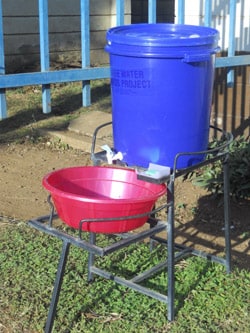
This is something like the contraption I use to catch those gushing water


In summary, I think I was pretty methodical in solving my those little problems that crop up in my household. Scientific even. Re-framing a problems helps to put it in a different light. Try it! Always look on the bright side of lie :)




Tuesday, December 03, 2013

3 Things to be grateful for

Since this month is December, a great holiday for students and a more laid back month for those working, I thought I should do a post to reflect upon the things that I'm grateful for in my life. I think in life, we focus a lot on the things that we do not have and not so much on the things that we had. It's a good time to put things in their right perspective. I don't know who said this, but I'm pretty sure it goes something like this: If you can't have what you love, then love what you have.


3 Things in life that I'm grateful for:

1. Good health

When we're healthy and everything is fine, we tend to take good health for granted. We do silly things that abuse our body, thinking that when we're older, good health is still a given. No it's not. When you're in your mid thirties, you feel your body slowly down and that's completely natural. You don't have as much energy as you would when you are in your twenties. You can't stay up all night and go to work the next day and not suffer the consequences. I'm thankful for my relatively good health so far.


2. Loving and supportive wife

I'm in a job where the pay is not fixed and certain months I'm basically eating grass. If not for the strong family support that I have, I might not last that long. During my winter months, she's been paying her share of her expenses and more, so that it's easier on me. For her support, I'm eternally grateful and thankful.


3. Cats

Ah, these godly beings who lie around in plain sight while minions like us work and slave around them. I believe that cats are here for a purpose - to teach us how simple a good life can be. While most are not as enthusiastic as how dogs show their love, they do so in their purrfectly tender and soft way. There's this cute little cat who lives at a carpark near my home and I always see her around. She recognises us and will scamper towards us when we call her out. I'm grateful for these little gestures shown by cats that teaches us how little we need to be happy. In the presence of cats, we're just sniveling, sycophantic minons. Happy, nevertheless.


I made a few posts like this in the past too. It's interesting to read about the things that I was grateful for at the time of writing, haha

Wednesday, November 27, 2013

New clothes for BullyTheBear

It's time to change a new template for bullythebear.


It had been 5 years since I've last changed a new template, so I guess the time is ripe for another change. This change will make the 3rd major change since I started since blog. As always, it'll be dark themed. So if you're waiting for Bullythebear to have a white based theme, haha, wait longer! I think darker themes is easier on the eyes when reading, at least to me. Since the current template had been with us for 5 years, I guess that there'll be more resistance. But as always, trust that the change is good, if you can be patient and grow to like the new changes, as you've always had done so in the past :)


These days, more people are reading off hand phones and tablets, rather than desktop and laptop. The on-the-go kind of mobility means that the template got to have less loading time and also be able to fit aesthetically into the palm size screen of tablet and hand phones. For the current template, I always have to scroll horizontally, if not the fonts are too small to read comfortably on the handphone. I'm not sure if I'm the only one to have this problem, but no one had complained to me about it before. The usual complaints are that the screen/fonts contrast are too weak, so it makes reading the words hard. Well, I'll try my best to make the contrast a little better, but it'll never have that strong in-your-face contrast of white background against black fonts for white themed templates - something I really hate reading on.


The usual elements of bullythebear will be there, like the cbox, some nuffnang ad elements (lesser and hopefully less intrusive) and some ads that I designed. I'm not so hard up about ads anymore. Financial bloggers earn peanuts from ads anyway, so let's not kid ourselves. Obviously, I'll have to change the colour themes of the cbox to make it more suitable for the new template, but I think a lot of regulars will complain too, haha! 5 yrs is a long time to grow attach to something that I check everyday :)


For records sake, I'll be putting screenshots of the current template here. It's good to see how far we've come to by looking at previous post.


Huat ah....be well and prosper :)

Monday, November 25, 2013

Tightening my belt in December

As December approaches, I'll be careful to monitor my mental health for signs of depression. Why? I think I'm sort of a workaholic. Work fulfills me, not just in terms of the obvious financial gains that I will get, but also it's therapeutic to me. I cannot recall the countless times that doing my work (tutoring) makes me feel better. As year end approaches, I get 'retrenched'. Whatever amount of salary that I accumulated from the start of the year by getting more assignments gets blown away. I start off the new year with much reduced pay and I work my way upwards, before the dreaded winter months wipe it off again.


December is also a period of time where people get informed of their year end bonuses. Generally it's a festive month for them as the hard earned bonuses makes them spend a little on themselves and their families. For me? It's a month of tightening my belt. My income probably become less than 1k during the winter months - not even sufficient to offset my fixed expenses of 3.5k. Usually it's not a problem but this year is bad due to a variety of reasons that I don't wish to explain, hence there's little excess from the good months to tide over the winter months.


"It's time to tank behind a shield and wait for the harsh months to pass"
Pic by zgul-osr1113 from deviant art


As I've less work and more time at hand, I usually take the quieter period to think about whether this is the kind of life that I want to be in, or is it time to do something different. Always it's the same few thoughts:

1. Have faith - Think positively and fulfilling work will come your way. So much so that I will have to reject some of them because I don't have time to take them up.

2. Have a break - I've been working hard for the months leading up to my winter months, so relax and give myself a hiatus before cheonging again for the coming new year. I rest now so that I can walk further later.

3. Have a life - Work, though it seems like play to me, is fulfilling but there are other aspects to life as well that can be equally fulfilling. I take this opportunity to experience life, spend more time with loved ones, exercise hard, sleep late, devour tonnes of books and play games that I wouldn't have the time/energy to do in my peak months.


I guess ten years being a full time tutor already allowed me to understand what it is like to be in this business. I voluntarily choose to have no paid leave, no paternity leave (if I have a kid), no bonus, no CPF employers contribution, no medical benefits, no chance to travel overseas, no colleagues, no career track, no company functions, no fanciful resumes and no corporate titles. Instead, what I do have is a lot more free time, a meaningful work that doesn't even feel like work, and a goddamnit will to survive years of seasonal retrenchment and pick myself up again and again.


Time to sit tight in the winter months and wait for the robins to appear.


Wednesday, November 20, 2013

Desktop productivity tools

I'm always very interested in improving my workflow. I don't own a laptop and most of my work is done on a desktop pc. For me, a non-cluttered pc desktop, a non-cluttered physical desktop, a clean and aesthetic software and stationery that boosts my productivity are paramount before I start something heavy (and possibly dreary). Take it as a planned procrastination, but that's how I gear up my momentum before I dive into something big.


I'll list down some of the programs that I use very often to improve my productivity. In no order of importance, here's my best 5:


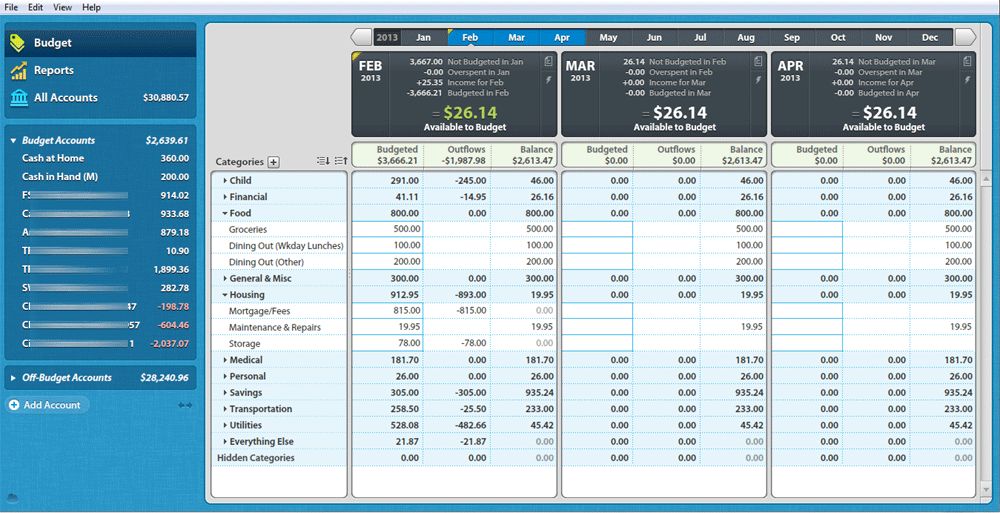
I've written extensively about this software that aids in managing and tracking my personal finance here. Having used for for 2 months now, I'm still very pleased with how it cut short so much of my time keying in my expenses. It comes with an android / iOS app that syncs with the desktop version. I foresee myself using this for a very long time.


This is those clean up program that everyone should have. It does a couple of functions like optimizing your memory usage, cleaning up temp files and clearing all those broken shortcuts and invalid registry - in other words, it boost your pc performance. You know, after a few years of using your laptop or pc, it starts to slow down as more junk are added. Without clearing them frequently, it slows down to a crawl and even opening a browser or a doc will take ages. This is what you need.


3. Fences

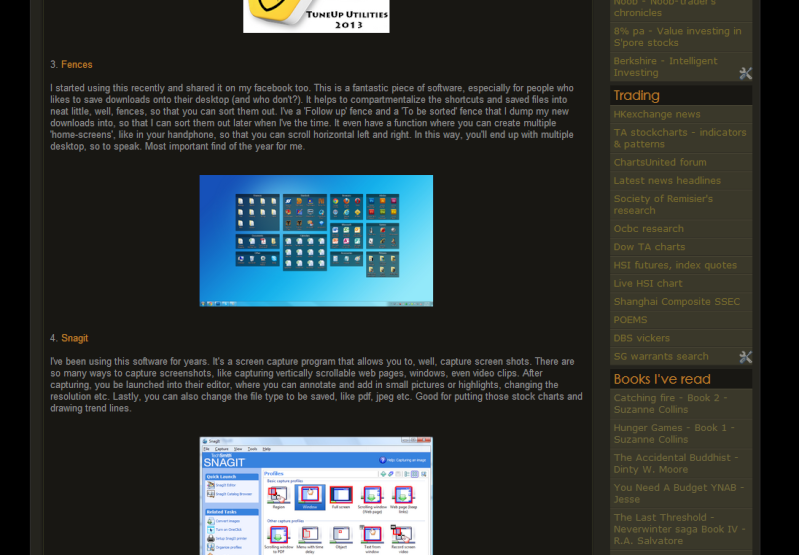
I started using this recently and shared it on my facebook too. This is a fantastic piece of software, especially for people who likes to save downloads onto their desktop (and who don't?). It helps to compartmentalize the shortcuts and saved files into neat little, well, fences, so that you can sort them out. I've a 'Follow up' fence and a 'To be sorted' fence that I dump my new downloads into, so that I can sort them out later when I've the time. It even have a function where you can create multiple 'home-screens', like in your handphone, so that you can scroll horizontal left and right. In this way, you'll end up with multiple desktop, so to speak. Most important find of the year for me.


4. Snagit

I've been using this software for years. It's a screen capture program that allows you to, well, capture screen shots. There are so many ways to capture screenshots, like capturing vertically scrollable web pages, windows, even video clips. After capturing, you be launched into their editor, where you can annotate and add in small pictures or highlights, changing the resolution etc. Lastly, you can also change the file type to be saved, like pdf, jpeg etc. Good for putting those stock charts and drawing trend lines.


Adobe reader is one of the worst pdf readers because it's so slow. After changing to this, pdf files open up so much faster. They also allow you to annotate and add comments (depends on the version), something that is not possible on the free version of adobe reader. To think that I've been stuck on adobe reader for so long! If you don't like this, there are other free and better software than adobe reader. Stop using that bloaty software for your own sake!


This is not an advertorial and I don't get paid for promoting these. These are some software that works for me, and by hopefully for you too. I hope you'll find some of these helpful. If you do, please let me know. Share some of your best productivity tools with me too!

Monday, November 18, 2013

The relative size of your problems

"To be successful in life is to continuously be defeated by bigger and bigger things".

I was just showering when I suddenly remembered that phrase I've read it from somewhere. I tried googling it but couldn't find anything remotely close to it. Doesn't matter. I think this phrase ties in with two blog posts that I've written many years ago here and here, about growing bigger than your problems so that the problems that you had seems like flies buzzing around you instead of dragons - a mere annoyance rather than a fiery death-threatening problem.


In other words, the bigger your problem is and the smaller your annoyance, it means that you've grown bigger and correspondingly, your problem smaller. Congrats! Challenges that seem like mountains years ago are now dwarfed by your growing size. But there's a Chinese saying that goes like this: There's always a taller mountain. So to be successful, you have to grow bigger, again! That's why if we're continuously defeated by bigger and bigger things, it's a sure sign that we've outgrown ourselves. On the flip side, if you find that the problems that are causing you severe stress seems to be getting smaller in nature, I think you're getting smaller in size. That's the road to a lifetime of misery and depression.


So how do we grow bigger than our problems?


1. Always push your limits. If you don't test your limits, you can never push beyond your comfort zone. In investing, there's always Buffett fans saying that we should not invest beyond our circle of competence. But have you asked how you even get that circle of competence in the first place? You certainly don't get born with one.


2. Don't be afraid to try new experiences. Black swans work both ways. You want low probability events with huge consequences to act in your favour. The best way to do this is to expose yourself to things that you're too afraid to try.


3. Be comfortable with failure. If I'm an employer, I'll look for someone with track records of failing and picking himself up again. Then I'll know for sure that the person had gone through the trials of fire and survived. If you're looking for someone with the best track record, you never know if he can handle failure and how he'll respond to it. Better look for a proven survivor than a unproven one.


Thursday, November 14, 2013

My plan for my wife when I pass away

While having lunch in a subway outlet, me and my wife started talking about something morbid. It's about our plans for each other when we pass away prematurely, like within the next few years. It wasn't a morbid topic for me though. I thought that we should talk about such issues so that we have a feel for each other's plan. In the eventuality that we pass away, we can do so in peace with the knowledge that the other party is well taken care off. That's the important part - to leave peacefully and to know that whoever we leave behind is well taken care off, at least financially.


When I pass away,

1. All the outstanding mortgage payments to HDB will be paid up for. That's like $450k we're talking about.


2. The death benefits from my insurance depends on how I pass away. If it's before 2023, it'll be $275k in total. If it's accidental death and I'm younger than 64 yrs old, it'll be $350k. If none of the above, it'll be $250k. Since we're talking about dying in the immediate future, let's just treat it as $275k.


I think my wife will have no problem taking care of the car loan which is about 10k. I haven't even included my bank accounts, stock portfolio and CPF money to the whole equation, but I'm pretty sure my parents and wife is well taken care financially. That's very good. But money isn't always the only problem that needs to be taken care of. Actually emotional and mental health is just as important.


With that in mind, I even thought out a plan for her:

1. With all the money left, she should just let it sit in the bank for a while and not touch it for at least 6 months to a year. This is the cooling off period to make sure that she don't use the money emotionally.


2. The 5 room HDB that we're currently staying is too big for her needs. She should not sell it but rent it out at maybe 2 to 3k if it's after 5 years of minimum occupation period. If it's before 5 years, ask her parents to stay over at my home and rent out her parent's home. This will free up cash to take care of her parents and also to generate positive cash flow for her own retirement.


3. Look for investment opportunities in the stock market or property investing. This will require the help and advice of my good bullythebear friends, whom she also keeps in constant contact. I'm sure she'll have the best advice from them. Get a small property if necessary, pay off enough as down payment to make sure that the rental from the HDB can cover a big percentage of the mortgage of the new property. This will ensure that in the event that the property market is not good after the purchase, she'll have enough to pay off the mortgage monthly without breaking a sweat.


4. Ask her immediate supervisor for a pay raise. If they refuse, just leave them and concentrate on those work that is satisfying for her. She probably don't have to work so hard for money anymore, so she should find something she likes to do to earn some income. Maybe like just work for 2 or 3 days in a week. No stress.


5. Use the time freed up to take care of her health by going to exercise more often, eat more healthily and bring herself and her parents/my parents overseas to enjoy life.


6. Find herself a good husband if she can, to take care of her.


Good plan? With all these 'morbid' thoughts in mind, I think I'll treasure my time here with her more.

Tuesday, November 12, 2013

The advice from an economist lecturer

This is an interesting story that I heard, the source of which I will not mention to protect the people involved.


There is an economics lecturer in a university, and we shall call him John. He is middle age, with adult kids. The kids had migrated over to Australia for reasons unknown to me, but he's still staying here in Singapore, earning a more than decent living working part time as a lecturer. The other part time work that he's doing is that of a land lord. He didn't say much, but it's reasonable to deduce that he is semi retired and had reached a certain degree of financial freedom so that he can quit his job and still maintain the same standard of living as before.


I'm not sure how many properties he had, but it should be more than 1 and that excludes the residential property that he's living in now. He had many advice for the young people he taught and some of the financial advice he mention are listed below:


1. You should buy a private property as soon as you can. Suppose an affordable property cost $1 million and you need a down payment of 20%, that is easily 200 k.


2. You should study lesser and go out to work early so that you can earn the first drop of capital to start investing. Investing, together with hard savings, will make it possible to get that down payment of 200k to begin your financial freedom journey.


Okay. Decent advice to young people (in fact, to all people) trying to make a decent living here in Singapore. But when asked whether the opportunities that enabled him to buy several properties, and reach financial independence way before the standard retirement age of 65, are still available to young people these days, not withstanding all the property cooling measures and the very recent measures by the G to clam down on the high household debts, he said a thoughtful no.


On the first point, 200k is quite impossible for a young person to amass in a short time at all. Say, that a person can save 25k a year, or slightly more than 2k a month, that would be possible after 8 yrs. But 2k a month savings on a salary of what - 3 to 3.5k? It's going to be a tough 8 years. Make it very lean and very tough 8 years. If you're a non-graduate, it's going to be like running in the Gobi desert for 8 years. Barefooted.


Oh yeah. Just like that. Running barefooted in the desert.


On the sheer difficulty of young people even getting that first bucket of money, John proposed that getting married is the key to young couples amassing enough capital to make the first down payment. 200k is difficult for 1 person? Maybe 100k is much more manageable for each unit of a couple. To save 100k, that's about saving 12k a year or 1k a month for about 8.5 years.


That's pure savings, with zero elements in investing. John mentioned that the money saved should be invested in safe, recession proof stocks (he mentioned a supermarket chain). Hmm, I would think STI might prove to be a better bet if you want to be invested in something robust. I worked it out a spreadsheet, injecting capital of 12k per year and investing all in a suitable STI fund that gives a returns of 3%. In about 8 years, you'll get your 100k. But of course there's a risk that you might end up with something lower than 100k because you have to sell it when it's not doing so well at the end of 8 years.


In other words, investing in the stock market when you need a property in 8 years might not be such a guaranteed thing that John mentioned. By investing in the stock market, based on my spreadsheet, 96k of the 100k is through pure savings (12k per year over 8 yrs = 96k), while the remaining 4k is your returns from investing. 4k! I might as well save 1k per month over 4 months - it's much more guaranteed and certainly less stressful!


In other words, it's not easy.


An interesting wrap up to this is that John regrets that his parents had sent him to school overseas. They might had better investment returns if they had used that tuition fees to buy a property. Again, totally agreed, but isn't that looking back on the rose tinted, fantasy laced view from the rear mirror? He even suggested that young people should study less and go to the workforce earlier so that they can amass that all important first bucket of gold.


Alas, things are not so simple. If you're not decently educated, chances are you'll not have a decent pay, which makes everything downstream much harder. To tell the next generation to follow the recipe of your success that happened in the past is too much of a prediction for me. In my parent's time, they see the highly educated doing office work and getting very good pay, so they advised us to study hard and get a good job in the future. A future that (most likely) our parent's generation do not possess because they are not highly educated. When it comes down to our generation, we teach our children not to study so hard because the rich are those towkays who are not highly educated but they have a strong entrepreneurial spirit. We tell them it's okay not to be good in studies and should go start a business if and when they can in order to secure a good future. A future that (most likely) we do not possess because we are too highly educated and had too much to lose if we start a business.


What's the next generation going to advice the future generations?


Date: 12-Nov-2013

Thursday, November 07, 2013

Paying down your debts or invest the cash?

If you have spare cash, would you dump it to make a partial payment of your mortgage loans or would you invest it so that you can generate more returns? Sooner or later, I think that's the question that you will have to face in your life. The philosophy and the baggage that you carry with you will determine which decision you'll make.


Let's put in the context. I used HDB's loans with interest of 2.6% pa, spanning over 30 yrs. My monthly mortgage, all paid in cash since I have no or little CPF, is about 2k. Each year, based on the monthly mortgage payment of 2k, I would have paid a sum of $24k (2k per month x 12 months). Me and my wife had saved up $24k and I was wondering if it's good to make a partial repayment of our loans. Since the loan is by HDB, there isn't any penalty for early repayments for loans, so this is quite unlike most private bank loans. I guess even bank loans have their own terms and conditions, so penalty for early repayment is not a given; it depends on the contract you've signed on.


Pay down your debts or invest it?


Effectively, if I were to make a partial repayment, that means I'm paying a total of $48k this year - twice as much as I'm obligated to. What's good and bad about this? The good thing is that if I maintain this yearly, I can shorten my remaining 27.5 yrs loan to just 11 yrs. There is going to be huge interest savings in this. The bad thing is that I'll have less cash available for investments. This is especially true for me because I pay off in cash, not using CPF. In other words, I have a higher opportunity cost than if someone pays off in CPF (yes, I know CPF earns 2.5% interest pa and cash inherently has near 0%). What kinds of investments are we talking about? Not just restricted to stocks, but also property.


I've blogged before that I would take the middle path. I would pay off a big portion in the form of partial repayment in my early years of the loan period, until the monthly mortgage becomes 'manageable', before conserving the cash and reserve it for investments/property etc. I've changed the plan a little though. Initially I wanted to make partial repayments and choose the option that allows me to reduce the monthly mortgage instead of the option that reduces the mortgage loan duration. I didn't take into account the fact that the paper work involved for both of them differ. There's a whole lot of paper work that needs to be done to reduce the monthly payment, like changing the GIRO amount, writing in to HDB etc etc. Nah, too much trouble. I'll just tweak my plan to reduce the loan duration initially. When it makes a substantial difference then I'll switch to reducing my monthly mortgage amount.


Anyway, it's not as if all these is going to end in 2-3 yrs. It's more likely going to be an arduous 10 to 15 yrs. Long journey to go, so no point being caught up in paper work every year. Maybe after the 5th year of such repayments, I'll review and see if it makes sense to reduce the monthly amount.


Interest that you owe to others is guaranteed. Investment returns are not. I guess we have to make a compromise between these two.


* After putting in the extra cash of 24k, I noted that I've shaved off 2.5 years off my 30 yrs loan period. A future payment of 1 yr equates to 2.5 yrs of savings from future payments. Hmm, depending on inflation, it might or might not be worth it.


Date: 7-Nov-2013

Monday, September 30, 2013

Thoughts after 1 month of YNAB

I've finally reached the 1 month mark of using the personal finance software, You Need A Budget (YNAB). It's the first time that my expenses are measured to the cents, inclusive of all the accounts that I had. In the past, I didn't include the cash in my wallet and neither did I group all the spending I had using my credit card and cash together. For example, if I've spent $100 on food using cash and another $50 on food using credit card, I didn't take into account that I spent $150 on food. It's a simpler inclusion in my spreadsheet to do it, but I just didn't do it. I guess there's no real reason for me to do it.

Well, using YNAB didn't give me a choice.

Hence, I uncovered a few things about my spending:


1. I spend about $540 on food. These includes groceries trip, hawker/food court and also restaurants. Since me and my wife take turns to pay for restaurants, my restaurant bills also includes her share. But I think it averages out, since my wife also help to offset my bills by paying for me. 30% of the food bills come from restaurants trip, another 68% from hawker/food court and the rest are groceries. I think if I need to cut anything, it'll be restaurant bills.


Another interesting thing is that I grossly underestimated my food expenses. As a rule of thumb, I count it as $10 per day ($5 per meal) for 30 days per month, amounting to $300. Then I include another $100 for restaurant bills, chalking about $400. I didn't include groceries at all in the past. So now, the new metric should be $20 for food per day, everything in.


2. I used to be very concerned about spending a lot on gadgets. I mean when I don't spend, I really don't spend. But if I do, it'll be $xxx to $xxxx in one shot. This is something quite different from my wife, as she is used to spending $xx but very reluctantly to do $xxxx. I set up an account called 'play fund' to purchase all these computer gadgets/games/peripheral computer stuff. Busted it this month when I spent a few hundreds for my handphone. At least I don't feel so guilty now, since I already put in a budget for it. That's one of the main reason why I wanted to do a budget - so that I can spend without feeling guilty, otherwise I could save too much. A happy problem, but a problem nevertheless.


3. I have missing cash here and there in my 'wallet' account and occasionally, extra cash. It's not a lot of money. $1 here, 50 cts there, 20 cts there. It's funny because I recorded in every single transaction. The only way that I could lose or gain these small sums of money is because I seldom count in detail the change that I get from others. It's just a quick visual look and I'll put the change aside. Either that, or my wallet has a small hole that I'm unaware of. This unaccountable sums of money that I can get from time to time is classified under 'reconciliation balance', and it happens when my actual amount of money in my wallet is different from the amount of money I should have in my 'wallet' account in the software.


Things are much much cleaner and clearer. I thought it's good enough using spreadsheet but now I probably couldn't go back to using just spreadsheet. The integration between mobile phone and desktop is perfectly suitable for my needs and it saves me a lot of time double checking.


Certainly one of the best things that happened in this aspect of my life. I'm a big fan of anything that improves my productivity.

Wednesday, September 25, 2013

I don't know

It's so easy to say the three words, "I don't know". By saying that, you don't have to put more effort anymore. You don't have to try anymore and you certainly don't have to blame yourself for not knowing. Just by saying I don't know, you absolve yourself of all responsibilities. Suddenly, it's other people's problem - those who 'know' - and you just have to wait for them to help you solve it.


The difference between a good student and a bad one can be seen by how easily they say those three words. Good students face as much difficulties as bad students when they encounter something new, but their attitude makes all the difference. They seldom say I don't know. In fact, they seldom give up. They'll work on a problem until the problem gives way. If they can't do it, they'll try it again and again. If they can't solve it without some guidance, they'll seek the necessary guidance and find the necessary skill set and knowledge to solve it. They own the problem. They want to solve it. It's their focus and never say die attitude that makes them winners, eventually. Good students work on a problem longer than others, outlasting those who say "I don't know" the instance they encountered difficulties.


Bad students are just like tissue prata on a rainy day. The moment the first raindrop hits the prata, it crumbles and soften, losing all shape and structure. They lack the tenacity to fight and they certainly don't own the problem. If you don't own the problem, it's not your problem, so you don't have the motivation and determination to finish it till the end.


Like a prata hitting the first drop of rain. Can you imagine it?


This kind of attitude will last long into your adult life and beyond your student days. If someone ask me what's the point of learning 'cheam' trigonometry and differential equations and integration, this is what I would tell them. In learning a particular subject, there is a set of syllabus laid out by MOE and a hidden set of syllabus of LIFE. The syllabus by MOE are the learning objectives for that particular subjects. These outcomes will be tested in the exams but will be soon forgotten once the student leaves school. However, the hidden curriculum - the syllabus of LIFE - these are much much more precious and have long lasting effect in your life, well beyond the context of the subject. To succeed well in maths, besides knowing how to do the content well, you also need to have a set of characteristics. In maths, it could be logical thinking, carefulness, tenacity and creativity. For example, no matter how good you are, if you're not determined, as soon as you hit an obstacle, you'll give up. In that way, you'll never be able to do well in the subject. Those little habits you do while doing maths - like forcing yourself to try again and again, or checking, or asking around for help but working through the sums yourself - reinforces good character over and over again throughout your study life. These things last, long after you forgot the solution to the integration of ln x and differentiation of cot 2x.


I must have learn tenacity by playing computer games. In those days, SEGA games seldom comes with autosaves or save-any-time-you-like. You only save at a certain point, or mostly, none at all. I remember playing contra or sonic, carefully working through levels and levels and not having a save point anywhere in sight. You die often. You try again. You die again. You try again. UNTIL THE GAME GIVES UP OR YOU GIVE UP! The reward for not giving up and winning the game is often just that you can see a lousy pixellated victory at the end game and perhaps some sob story to convince you that the hero won against all odds.


So, do yourself a favour. Don't say "I don't know" so easily. Fight hard and fight harder.

Friday, September 20, 2013

5 reasons why you need YNAB (and 3 reasons why you don't)

This is an unpaid review of You Need A Budget, also known as YNAB. I bought it last month from steam at a discount, but had long heard of it by others who gave rave reviews about this personal finance software. Since it's at a great discount of 75%, I decided to plunge into it and try it for myself. Prior to this leap in using the software, I already had a working excel spreadsheet that works for me for the past 5 or so years. The spreadsheet is meant to keep tabs on my expenses and also keep records of all my transactions in the form of a cash flow statement, balance sheet and an income statement. I record all my expenses and the income flowing from my handphone using just a simple note taker, afterwhich I'll transfer the information to my spreadsheet in my computer after forthnightly or weekly.


As you can see, I'm not so hot about changing a system that works for me and that I'm so comfortable in using. But there's a few things about my system that I don't like. Firstly, it's hard to reconcile bank statements. Secondly, it's lacking a graphical interface. Call me shallow, but between a system that works 100% but is ugly and a system that works 90% but is pretty, I'll go for the second one. The nice interface makes me want to do this forever, not that I'm lacking in motivation.


 YNAB is basically a budgeting software. You decide, at the start of the month, how much each dollar you would give to different envelopes, like food, entertainment, handphone bills etc. They also have a free android app (I checked, they have an app for iOS as well) that ties in very nicely with the software that is installed on your main computer. The information between the app and the one in your computer can be synced using dropbox. All the backup and data are placed in the dropbox, so you can start your YNAB budget from one of these autosaved points, which can be very handy in case something horrible happened that wiped out all your hard work in keeping tabs on your personal finance.


Nice clean interface makes you want to key in something!


I realized that I'm using this software less like a budgeting software, but more like an accounting software, where all my transactions between accounts and cashflow in and out of accounts are recorded and kept track of. I guess this would take some time to adjust because as mentioned, I've never done budgeting before and I already knew roughly what my expenses are for different categories. But I always say we can do better, that's why I did a system overhaul by adopting this new software.


One of the good things I like about YNAB is that because it's all programmed nicely, it's exceedingly easier to change things and make sure that everything is still tallied. During the past one month of using the software, I had to do some major changes to my account. In the past, using spreadsheet, I've to comb though the worksheets of the previous months carefully. But for now, I just have to key in the new changes, and everything else is taken care of. Needless to say, I'm suitably impressed. Though I'm not expecting much major changes going forward, it's still a nice feature to have knowing that any new way to partitioning your personal wealth is easily down with a click of a few buttons. Effortless.


The YNAB app on mobile phones makes it very easy to key in transactions and it auto syncs.


I keyed in all my accounts in YNAB, including all the marked to market value of my various investment portfolio, insurance cash value, and all the shitloads of debts that I owed HDB. Straightway, I can see my networth displayed with superbly clean charts and nicely tabulated figures. If I need to see my income vs expenses, there's another tab to click to see it too. I can compare data across the years, the past 3 months, this month and the year to date. This is something that I can't do easily since I divided my expenses spreadsheet physically year by year. I can, of course, combine them, but again, it's the ease of use in YNAB that blows me off.


Nice pie chart showing you the different categories of expenses according to timeline that you set


In summary, here's what I like about YNAB:


1. Extremely easy to check and reconcile accounts. 

If your actual statements and the one you had in YNAB differs even by a cent, it'll alert you and you can do the necessary checking. Saves me a hell lot of time for this little function.


2. Very clean and nice graphical user interface

Clean and nice. The reports generated are also very good, if you're into this sort of thing. Makes you want to keep checking it.


3. Ability to change things easily and keeps backup on dropbox

If you make a fatal mistake, you can return to the last autosaved place. Changing something automatically changes everything from the past to this moment. You won't appreciate this until you got something major to change, so trust me on this one.


4. It has an well integrated free app on android.

I used to key my expenses into a simple note taker in my phone, then transfer the records over to my spreadsheet over at my computer. This doesn't take much time but it still takes some time. With this app, whatever I keyed into my hp automatically gets synced to the software at my main computer. That makes my life soooo much easier. Just this alone makes this software worth adopting.


5. Very nicely integrated philosophy behind the programming

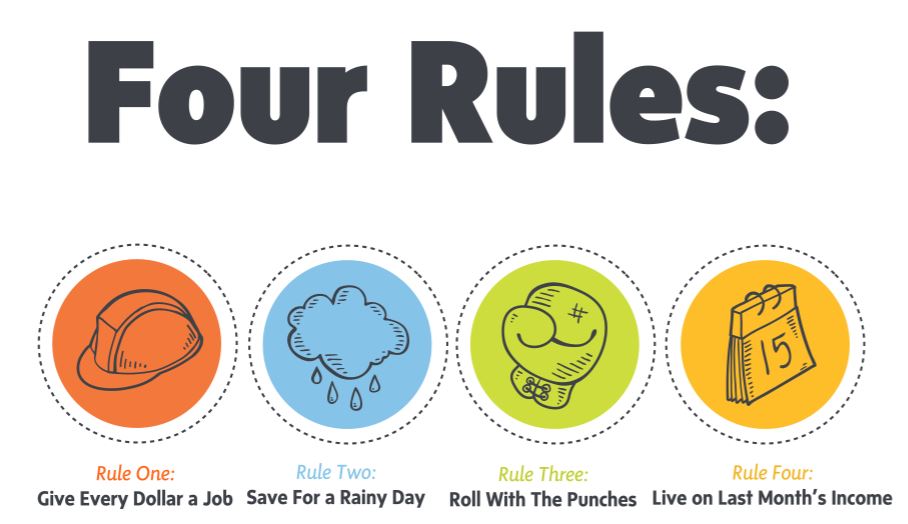
Once you start downloading the software, you'll be in a short but useful online lecture program on how to jumpstart your failing financial management knowledge. You'll be exposed to very good advice to save up, to do proper budgeting and basically good personal finance habits. Even I find it useful. I particularly like a phrase which they used very often - "Give every dollar a job!". If want to learn more, there's even free live classes that you can sign up and learn about various topics. It seems like the people behind YNAB is really interested in making you financial healthy. They are really serious in making you change your mindset to have real change in your life.


Rule number 1: Give every frakking dollar a job!


Here's what not to like about YNAB:


1. Poor integration of financial aspects

If you're looking for something that can keep track of your investments, this is not for you. It works very well in what it aims to do, and this is just not one of its function. I still using my trusty old spreadsheet for that purpose.


2. No auto download of credit card statements or bank statements

Actually maybe it does have but I don't like the idea of it at all. If you want to keep tabs on your expenses, then do so. The act of doing it will bring a lot of benefits rather than downloading the statements automatically from the bank. However, if you really want to, you can download credit or bank statements, then upload it to YNAB. It can accept .OFX , .QFX, .QIF and .CSV format. I wouldn't recommend it, neither do the people behind YNAB.


3. Tracks the amount of money right to the cent

What's not to like about this? Well, usually when I'm keeping tabs on expenses manually, I disregard anything less than $1. I also don't count the money that I've in my wallet. This program forces me to count each and every cent. There are many times that I noticed that the amount of money that I had and the amount of money that I'm supposed to have in my wallet do not tally. I need to reconcile the differences. This means I must have missed out some stuff...Not a big sum (<$15), but can be irritating when the software highlights to me that I missed something out and I'm the sort of person who then have to correct the mistakes. It's making me anal fussing over 10 cts here and 20 cts there. Granted, this is the point, afterall.


I really think this software is worth putting the time and effort to learn. For newbies who are starting out to earn their first drop of cash, it'll make you learn a few good habits that can last you for life. That alone is worth the price of this software. For those who had been tracking your expenses fastidiously all along using excel spreadsheet, perhaps a little more graphics, a little more automation can make an easy job even easier. Do try it as they have a full featured demo for 34 days - more than enough time for you to try it out to see if it can fit in to your life. No harm trying right?

Monday, September 16, 2013

Redefining your 'self' is the key to anger management

Most people love themselves more than others. It is entirely understandable, though it is self centred and egoistic. Human nature perhaps. Is it possible then, that if the concept of self is widen to include others, then the self centreness will be morphed into compassion and empathy for others? By changing the paradigm of "me against others", to "us against others", onward to "we against you", and finally just "everyone against no one", is it possible to change selfishness to selflessness?


I was very angry with someone recently. For the sake of this conversation, let's just call him Ajit. I felt that Ajit is the one at fault here because he is being selfish and irresponsible. I've been doing my share of work but he didn't and the fact that he's constantly sick, and therefore can't be healthy enough to do his fair share of work is just ridiculous to me. I always think that if you don't mind, it doesn't matter. For me, duty and responsibility is paramount, but apparently Ajit didn't share my philosophy here. Nevertheless, the underlying point is that I'm angry with him. Very angry.


I went to shower fuming. Ten thousand evil thoughts flickered through my mind. You know, when you're angry with someone, you'll replay 'the' conversation again and again, with each subsequent iterations punctured by remarks more poisonous and hurtful than the last. It certainly makes my heart pound faster and faster as I replayed those fantastical conversation with Ajit again and again in my mind, complete with all the mean things I'll say and all the counter points I'll make. Soap opera at its best, except that I'm the lead and the director and the script writer.


I remembered something that I read, essentially that's the first paragraph of this article. If I can extend my definition of self to include Ajit, then his failure is my failure and suddenly all became clear to me. There's no me against Ajit; simply put, there's just me thinking about Ajit making me angry. Since Ajit is an extension of myself (actually it's all in my mind because I'm just imagining how he reacted. I 'conversed' with him through whatsapp), I'm angry with myself. This notion is ridiculous, hence I stopped the anger and become (more) at peace.


From http://advaitatoons.blogspot.sg/


Thus, instead of following the poisonous script in my mind when I was showering, I changed my tack to something more inclusive and ultimately more useful in solving the problem at hand.

Friday, September 13, 2013

Budgeting your time and energy

I bought a personal finance software not too long ago, ironically on a website that sells computer games - the infamous "Steam". As usual, my day begins by checking out on the latest offer on the gaming website. Sometimes, they sell games at 50% or even 75% discount. Even though I play games much less frequently now (I prefer to read, if anything), I still want to be in the know in that industry. It's out of interest, and also because it gives me some talking point to create rapport with my students. More of the former than the latter. Anyway, steam gave an offer I simply could not refuse. Instead of the recommended retail price of 60 USD, it's selling at 15 USD - a whopping 75% discount. Hoot lah, I say.


I knew of this software, aptly named You Need A Budget or affectionately called YNAB by users, from Drizzt. If you subscribe to his facebook and twitter, he'll have this automated post every now and then coming up saying that you'll get more confidence from savings. Yes, but no need to make that an automatic post right?! (haha, 50% joking, 50% poking to Drizzt)


Budget your time - taken from lifehacker.com

But this is not a review of that software. It's a little premature to give a review when it's less than a month since I bought and used the software. Perhaps by the end of this month I'll give my thoughts on YNAB and how it can benefit people who haven't got a clue as to where their money flows to, and to others who had been tracking their expenses fastidiously (like me) on excel spreadsheet.


I've never put myself in a budget before, so using the software makes me think of a few things related to budgeting. To budget is to realise that you have a resource that is scarce and precious, hence you have to proportion it to different places in the manner most beneficial. It's a subjective exercise and nobody can say that his or her budget is better than yours. Even though I say that, there's clearly a line between a good budget and a foolish one. If you budget until your spending far exceeds your income, that's obviously a foolish one (You have to wonder why certain governments can make such foolish mistakes when they budget their country's wealth). On the other hand, if your budget makes you save and save without spending proportionally, that's also a foolish one, though it takes a little more insight and wisdom to see why and that's out of the scope of this post (but it also makes you wonder if our govt is following such a roadmap).


Question: Have you ever thought about budgeting your time and energy?


For a large part of my life, from my student days to the first few years of my working life, it's like this:

Career & Money : 80%
Body & Health: 5%
Spiritual: 0%
Family and friends: 15%


Career, when I'm a student, is simply about being a good student. I seldom do sports unless I have to and you can't really say that I'm taking good care of my health. It's hard to define spiritual aspects of my life, perhaps you can say it's religion, perhaps it's also a bit more than religion. The best definition I can give is this: that which gives you peace and happiness. Needless to say, for most part of my life, it's quite tumultuous. Almost never spent a single dime of energy and time towards the betterment of my spiritual self. Family and friends are not a big part of my life. I'm quite a loner.


Let's look at now:

Career & Money : 60%
Body & Health: 20%
Spiritual: 0%
Family and friends: 20%


There's a greater shift of my energy/time towards body and health. I try going to the gym at least once a week. I haven't passed my IPPT since like 5 or 6 yrs ago (used to be silver, alas..) and now I'm working towards passing. Never felt fitter in my life than at this point in time, and I realised that the benefits of having a better body/health spills over to other aspects of my life too. Still not a party person, but the increase from 15% to 20% in "Family and friends" means that I spent quite a bit of time with my wife. As I get older, I realise that you have less and less friends, but you have more and more intense friendship. Good trade-off if you ask me.


How true! - taken from www.babble.com


Ideally, my time/energy should be allocated like this:

Career & Money : 25%
Body & Health: 30%
Spiritual: 25%
Family and friends: 20%


Remember, there's no right or wrong budget. Your budget best reflects your life and only you can clearly define them. I'll try to work towards this budget of my time and energy and this should be the workplan for the "middle age" of my working life. You can see that I really wanted to spend more time and energy on developing my spiritual self - something that I've been neglecting. Health should take a bigger priority of my life and career/money, well, let's just say that something has to pay the bills while you're still alive. More time and effort should be spent doing the things that you like. Hopefully, that's work, lol!

Wednesday, September 11, 2013

Is your financial goal your Procrustean bed?

It's interesting that these days, there are more and more young bloggers who are financially enlightened. They started having the idea that retiring early is a worthy goal of their life, hence the way to achieve it is to increase savings, tighten expenses and work on their investment skills to increase their passive income. The funny thing is that I've been there (but can't say that "I've done that!" though) and I no longer am actively seeking to be there. Strangely, I don't think I've ever said that I wanted to retire early in my blog post (someone prove me wrong pls?), but I did mention a few times that I wanted to achieve a level of passive income to offset my expenses. And I'm a strong advocate of having a strong savings discipline as soon as you start getting money.


A few people (notably a blogger I affectionately called PG) also blogged about the same issues. Started off wanting to retire early and before long, life caught up and he's no longer so actively seeking that goal. I believe he has the same thinking as me. It's not that it's no longer importantly, it's just that it's no longer the sole purpose of living. These days, I dare to say that if I can't achieve financial independence before the self defined retirement age (usually 35?), I'm going to be okay. I'm not a failure and I hope I can sincerely say that I'm not jealous of others who can do so too.


So what happened to diminish this worthy goal? I'm not so sure I can say it's this reason or that. I've a feeling that it's more like a straw of this and a straw of that and soon, the straws become a substantive enough mass to proverbially break the camel's back. Let's see if I can identify a few straws:


1. The realisation that I can lead my life in different ways

2. The realisation that retiring early at an early age has a cost that I do not want to burden myself with

3. The confidence that I'll be okay even if I can't retire early and have xyz passive income flowing in monthly


I reserve the right to change my opinion at a later point in life, once information changes, as I had done in the past. Haha, life is complicated and I'm certainly not simple too.


I want to point out that not having a goal of wanting to retire early and having xyz passive income does not mean that I act irresponsibly towards my own financial situation. After tracking my expenses and understanding how I treat money, I have the confidence to say that even if I were to turn my financial tap looser and let the cash flow out, I still wouldn't be a spendthrift. It just isn't me. Neither am I saying that people should follow my ways.


You're free to lead the life you want, and ultimately you're the person responsible for it. I'm just saying you shouldn't take a goal that seems so fashionable nowadays and try to mould yourself towards it. Don't be like Procrustes, the Greek who cuts off people's hands and legs so as to fit into a iron bed that he had. Ask yourself if this is really what you want.


You know, in my line, not everyone wants an A for exam.

Thursday, August 01, 2013

Multiple prices for Multiple income streams at Multiple avenues

The world is a strange place.

For Robert G. Allen's upcoming seminar on 19th August, which is supposed to talk about how you can be a millionaire by having multiple income streams, the price differs from place to place. I'm not sure whether it's done purposely by the organiser of the seminar to create price differential in the different platforms that they advertise. But look at all these different price for the same course on the same day:


1. From AK's blog - $64 original price

Upon entering promotional code, you can get a 10% discount for limited stocks only, thus it'll cost $57.6. This is especially worrying when I learnt about the email exchange between AK and the organizer. It would seem that the organizer had misrepresented the pricing and spirit of the 'special' offer for his loyal readers. It turned out that the price of the offer is not specially cheaper (in fact, it's the most expensive). But one cannot argue that it's not a special meant only for AK's readers. None of the other people get to purchase their tickets at so high a price! LOL!

**New updates**
Apparently the fishy business runs deeper. For a full account, please read AK's post on I will not attend multiple streams of income seminar.


2. From greatsage's blog - $57

There's no mention of any promotional code, nor limited time or limited stocks. Turns out AK's special deal is a non-event. Even without entering any codes, the price bought from greatsage's link is cheaper. Bummer.


3. From kiasuparents forum - $30 for 1 ticket (early bird) and $57 for 3 tickets (early bird)

This one beats all the rest. What is the qualifying period for the early bird discount? I've no idea at all. But $57 for 3 tickets definitely beats $57.60 for 1!


God knows how much cheaper it can get when you really run a more thorough search in other places where they advertised for the seminar. Wow, what's up with their techniques of marketing? I think the organizer is trying to do some guerilla marketing technique. Maybe by advertising at different places with different ticket price for the same seminar, they are really creating multiple streams of income, lol! Or maybe there's really no such thing as bad publicity, so the more controversial it gets, the hotter it'll be?


Maybe the organizer would like to leave a comment here to let people understand why there's such a huge price differentiation on different marketing avenues.


In the meatime, I'll continue to say that this is a strange world.

Tuesday, July 30, 2013

The social cost of reits

Reits are hot hot hot. With the low interest rate environment, where investors are looking for a place to park their money to beat inflation, the yield of reits is indeed alluring. I've invested in them and they had made a fair share of profit for me. But because I've also went to the other side of the equation, I realized that there's a huge social cost in reits being so hot.


As reits are public company, they owe it to the shareholders to increase DPU year after year. That way, the managers of the reits can also get more performance fees. But who are the ones really paying for the increase in DPU? It's those people renting to do business! I've heard stories of rents increasing from 5k to 8k in those malls that are in the heartland managed by one of the listed reits. How are people going to make a living when the next time their rental are renewed, there's a jump of 30 to 60% increase? It's just not sustainable.


Even when a building is not managed by a reit, as the price of the rental in a reit manged building increases, it causes a trickle down effect to all the neighboring areas. The landlord in a non-reit managed building must be thinking that, hey, just across the road, those guys can charge so high, so why can't we do the same? So up and up the rental rates spiral, and down and down the margins of the business goes. It's just crazy when maybe 30-40% of your profits are all given to the landlord and passed on to the reits.


This will eventually end up very badly. The party will end when the rents are revised so high that few would dare to take up the space. Honest hardworking entrepreneurs who are out to make a decent living would be hard pressed to set up business. Everyone suffers. Including, eventually, the shareholders.


I know there are many ways that the reits can increase DPU without raising rental rates. I'm just ranting the pervasive idea of a reit always working to increase the rental at all cost, without regards to the human cost behind those numbers. How would you feel if your boss, in the pretext of accounting to the shareholders, decided to reduce your salary so that the company's share price can increase?

A new journey begins

While having a shower, I was mentally calculating the kind of money that I can save, given my 'new' circumstances now. 'New' because it had actually been a while - 2 yrs to be exact - that I had my own cosy hdb flat, I'm married and I've a pre-owned car. Realistically, these two things would add up to the expenses that I spend on a monthly basis, so it also goes to say that I would find it more difficult to save the magic 4.2k per month. Why 4.2k per month? Because 4.2k x 12 will add up nearly to 50k - that challenge that I set myself seemingly so many years ago.


It had also been a while since I tabulated my monthly expenses. I had always been keeping track on all the items that I spend on, noting them down fastidiously in my handphone before keying it into my spreadsheet. This habit started so long ago, after I wanted to find out exactly where my money flows to each month. I initially wanted to stop after 1 month, but got so used to it that I had done it for 6 years (I had to look at my excel file to realise that 6 yrs had passed!). A quick calculation on excel shows that that, indeed, my expenses had increased. Nothing surprising there.


Here's the breakdown per month:

Mortgage payment for hdb (including insurance for property) - 33%
Personal expenses (includes petrol, entertainment, food) - 25%
Personal insurance (whole life, term, disability etc) - 13%
Parents -16%
Tax- 4%
Utilities -3%

Total : 100%


I'm sharing half the expenses with my working wife for those shared expenses like housing and car. Most of the items I can't and don't want to cut. If there's any expenses that I can cut down, it'll be on personal expenses. Maybe if I reduce some more discretionary spending, I can push the expenses down a bit more. Bah, but what's life without all these perks...I'm happy with these figures.


As for savings, maybe I can start with 30k per year. This should be a comfortable figure to begin with. I don't want to begin with any number lesser than that.

25 k per yerar - 2.1 k savings per month
30 k per year - 2.5 k savings per month
35 k per year - 2.9 k per month
40 k per year - 3.3 k per month
45 k per year - 3.75 k per month
50 k per year - 4.2 k per month


With 30k per year, I would need to save 2.5k per month. I've been keeping track of my expenses since 2008. Since I know what my monthly expenses are, I'll just add the amount that I need to save and I'll get my target income. It happened to me many times in the past...once you put your mind to a figure and let the universe know about it, things will happen in your life to make it happen. Of course you must come with a prepared mind and seize the opportunity as they come along.


But unlike in the past, I'll take it easy this time. This shall be my game that I can play comfortably, not a competition to hoard as much as I can. I think I can do a fine balance this time round.

Friday, July 12, 2013

Antifragile

I've not done a book review in ages, believing that one should read a book in order to derive a personal experience that the book can only impart to he who reads it. Every reader will get something different. So, this is not a book review. This is my personal experience with this book by Nicholas Nassim Taleb, one of my favourite philosopher-finance writer. It's called Antifragile: Things that gain from disorder.


It's not the easiest book to read, but if you plough through it all, you'll recognise the kind of person that he is. I've read through all four books of his: Fooled by randomness, The Black swan and The Bed of Procrustes , and lastly Antifragile, with the last being his book of all books, his magnum opus, his unified string theory. The concept of antifragile springs from the fact that there is no suitable word for something that benefits from volatility. If you disturb something, there's only 3 ways that it can behave - it can stay more or less the same (robust), it can become worse (fragile) and it can benefit from it (antifragile). It ties in all the ideas from the other books and integrate it into this one. If Fooled by randomness is Star wars episode IV, Black swan is episode V (some say it's the best of the Star Wars episodes) and Bed of Procrustes is episode VI, then Antifragile is the Episode I. It's the book that brings you back to the beginning, so that you can see all the other episodes in its respective glory. Note: It does NOT have the suckiness of Episode I though, lol


A few key points that I take away from the book:

1. It's easy to tell whether something is antifragile, robust or fragile, but rather impossible to know when or even what kind of black swan event can stress it. As such, focus on the detection of the state of its antifragileness (or fragileness) rather than predicting the rare event or worse, the probability of it happening, that will rock it.

E.g. Antifragile is characterised by low downside risk, high upside rewards. If it looks like a sunny day and I'm about to leave the home in 10 minutes, do I hang my clothes out to dry till I come back? If it rains (black swan event), it's very bad. If it didn't, my clothes will benefit slightly only. So I don't hang it out, if not it'll fragilize the system.


2. For antifragile systems, the more volatility (read: shocks) it experiences, the more it will benefit, up to a certain point. Vice versa for fragile systems.

E.g. The human body is a great antifragile system (so are most things in nature). Small shocks to the system is ultimately good for the body. Short periods of fasting, short acute exercises, short acute stresses, short period of illness...all these will build the body up and it will benefit from these shocks, again, up to a certain point.


3. The antifragility of a system depends on the fragility of the components that make up the system. We need individuals to fail so that the whole system can benefit and become progressively more antifragile.

E.g. If individual shops don't fail, the next batch of shopkeepers won't learn from the mistakes, and the eventual failure will be worse and magnified beyond repair. We must learn not to intervene all the time, and trust in the antifragility of things to take care of itself. Small failures, if they are prevented from occurring, will lead to ultimately bigger failures.


4. If things had been around for a long time, you can bet that it'll be around in the future for a long time too. Only the antifragile survives the stress of time.

E.g. The author wrote that he only drinks beverage that had been around for many many years, like wine, coffee and water. No soft drinks, no aspartame diet drinks, no isotonic electrolytes drinks. Probably a good idea to look at the way you cook things. No microwave food for me, as far as I can help it. I'll rather eat it cold than have it blasted with electromagnetic waves.


There's a lot more, of course, but I leave it to the reader to find out. His books always sets me thinking. It should do to you too. Alvin from BFP blog did a book review on this. Probably writing it way more comprehensive than I can ever do. Do read his reviews.


You might be interested in what I've to say about the ideas postulated by Nichoals Nassim Taleb:

1. Black Swan book reflection
2. Black swan revisited
3. Fooled
4. Living life in an uncertain world


Tuesday, July 02, 2013

Being comfortable with who you are

As I get older in age, hopefully more mature in thinking, I realized that I'm more and more comfortable with being myself. When I was younger, there's a lot of insecurities because there's a lot of people that you feel that you ought to model after and ought to follow, maybe sometimes also to lead. I think I was young and likely impressionable, so whoever is successful in whatever ways, I would like to model after him or her. As a result of such imprinting in my earlier years, I've a mish-mash of characteristics that I think is good for me in my development as a human being. It's not always easy to change your own characteristics, because it takes a lot of effort to do so and requires a lot of change. And change always require much much more than just passively following, isn't it? It requires you to really want to do it.


But I'm getting more and more comfortable being who I am. I see less and less need to mimic others. This also comes about because I realized who I am and who I am not. What makes people happy might not truly make me happy. Now that is an important realization because the key to happiness is to know what makes you happy. Blindly following what makes other people just wouldn't cut it. This is, after all, a journey that you take yourself.


I don't have to keep on comparing whose balls are bigger and whose pecker is longer. I'm glad that my job don't put in a situation where I constantly have to prove to others that I've arrived. I sympathize but I can never truly empathize with people who are in the cobra-corporate world who always have to feign happiness and fake success. Is work all about getting progressively higher and higher pay, bigger and bigger bonuses? It might be if that's what makes you happy, but I suspect that for many others, it's not. Which is why we see so many people, in the midst of a successful track career groomed for all the greatness to come in the cobra-corporate world, suddenly come to a halt and switch to a totally different career. Mid-life crisis, they say. If that's the term for 'suddenly' realizing that what makes you happy is a total change in career, then so be it. I will welcome it with open arms.


I realized, surprisingly not too long ago, that I don't really talk much about retirement and having a passive income and all those fun stuff. It dawned on me that it's not really what I wanted in life. Is it sacrilegious, for a financial blogger like me, that it's not my goal to achieve this numerical value before certain age? Maybe I shouldn't call myself a financial blogger anymore. Just because I occasionally blog about personal finance and very occasionally about stocks (nowadays) doesn't qualify me as a financial blogger, just like you wouldn't call a cashier a financial guru because he handles money. Let me qualify it further - while it's not my goal to achieve financial independence, it's still something that's on my mind, specifically at the back of my mind. It's just that I no longer obsess over it.


Define obsession. Here's what I did in the past:

1. Read a book about stocks / personal finance / money for 1-3 yrs, about one book a week. I cleared shelves of books in my local library until it comes to a point where there's really very few books that I haven't read.

2. Keep on trying to squeeze more time out to do more work to earn more money to hit my savings target, broken up into annual, monthly, weekly and madly enough, daily targets.

3. Keep on trying to reduce my expenses by cutting on food, drinks, transport and what have you.


It's not making me any happier, I came to realize. I must have carried it to the extremes of my limitations, hence the fatigue and therefore the unhappiness. But obsession is important because there lies the motivation to go on fighting when others have long given up. However, like a horse, if you don't control the unbridled power of obsession, it'll consume you.


So what am I now that I'm so comfortable being? I'm not a perfectionist - It's okay if I fail to achieve my goals and lack the discipline to follow my convictions. I'm not always consistent - I'm bashing others over lack of discipline in some areas and I'm advocating others to be less disciplined. I'm idiosyncratic - I don't buy drinks when I eat alone to save money but I spend big bucks on gadgets to save time. I'm not a rational person but I'm a rationalizing person - I act on my right brain but use my left brain to explain to others what I did. I'm an idiot in life but I do pretty well in school. I can be jealous - I'm envious of other's success and sometimes explain the success by luck or more satisfyingly, by inheritance. I can be vengeful - in my mind's eye, people who crosses me had died by horrific contraptions to extort the most pain in the most vivid manner.


If you still like me, or worse, are like me, then good. We can drink, eat and be merry and occasionally talk about how we survive this crazy world at this moment and how we're planning to survive in the future. If not, farewell and be glad that our paths, though different, had a chance to mingle and criss-cross, at least for a while.


Life is just like this, isn't it? Beautifully repulsive, sickeningly attractive.

Thursday, June 06, 2013

How pride gets in the way of having fun

I've the fortune of teaching very young children in a group setting. From there, you'll learn a few things by observing how they interact with each other. There was an incident where two best friends are arguing over something. It could be trivial to us, but for the children involved, it must have meant the world. This is because one of them said in anger, and perhaps with a bit of tears in his eyes, that he'll never talk to the other one ever again. Such harsh words. Never is a long time.

Perhaps not too long. In less than 2 minutes, they are talking again. In less than 5 minutes, they are laughing and playing like nothing had happened before.

It makes you wonder how come small children can swallow their pride and concentrate on what really mattered to them - having fun - but adults couldn't. If pride gets in the way of having fun, screw pride.