Monday, November 30, 2015

Free lance tutoring as a business - Part 3

Cash flow. This business is all about cash flow. In fact, shall I say all business is about cash flow? You can boost about how high your revenue growth is, but without actual cash flowing into your coffers, the revenue you noted down might not be translated to actual money. And we have to pay our bills with money, not with revenue.


Here's a few key issues to think about:

1. Variability of cash flow
2. Recognition of income
3. Cash flow management


Unlike employed people, my salary as a tutor is not fixed. Nobody will magically give you a sum of money at the end of the month, every month for a year. You will have to secure your own students, carry out your services, and then receive money. Hence, there's a certain variability in the income that flows in. How much I earn really depends on the month in which you are asking. Generally, there is a seasonality to your income which is based on the exam cycles, and hence there is also seasonality to the cash flow you receive. It can really vary a lot from month to month.


Below is a picture of my income over 7 yrs, written in this blog article here.


On a quick glance, you can see that the off peak season income can be quite negligible. The debt you owe is to be paid monthly, but if your income (and hence cash flow) is seasonable, that might pose a serious issue, especially if you do not have savings. I'll talk more about it under cash flow management later.


But I do get paid weekly, in various sums. It's just that during the off peak periods, the cash flow tap runs a little dry. That could get some people jittery, especially when your family sees you sitting at home, watching tv or reading a book and not working. I realised this can be quite stressful for people used to getting a fixed pay at the end/start of each month.


The only way to mitigate this is to have different levels of students. You cannot do this if you have all sec school students or all JC students.  A mix of different levels will ensure that the exam cycles of each level overlap. It's important to set a predetermined level of graduating and non graduating students, something like 7:3 ratio or 6:4 will ensure good continuous flow of cash throughout all months.


Here's a question: Do you recognise your income the moment you carry out the service or do you recognise your income only when you receive your fees? In my personal accounting, I do the latter. Fees are paid either in advance (usually 1 month ahead) or paid on the last lesson of each month, or on a per lesson basis. I do all three, depending on the preference of the parent. But for new students (defined as those who are not recommended by my usual network and are 'cold'), I usually collect the fees ahead. I've a few bad debt cases in the first few years of my job, so I do not want to repeat that again. It's emotionally draining and it eats up your soul. These days, there's strict cut loss practice when collecting the fees, rather than to carry on the service and hope that the payment will come through eventually. So far, I do not have to bring anyone to the small court tribunal to claim my fees, but I'll not hesitate to do so should the circumstances arise. If I do my fees management properly, I won't even have to be anywhere near the small court tribunal.


I believe in fair practices too. There's risk to parents if they pay their fees in advance. There's also risk to tutors who can't claim back their rightful fees. So if I'm going over to the student's place (tutor-moving model), I'm okay to collect my fees at the end of a set of 4 lessons. The credit given to the parents is to assure them that I'll not run away with the prepayment of fees. On the other hand, if the student is coming over to my place (student-moving model), then my usual practice is to collect fees in advance since I'm the party holding the higher risk. I'm afraid the student will run away before the fees can be collected. Most people are forgetful and not malicious, but again, I've my own bad cases so I'll rather be safe than sorry.


Regarding the management of the cash received, I think it's important to have a buffer of savings against the drier months. I know that my work will dry up in around end Oct until Feb (nothing serious gets done until after Chinese new year). Hence I'll have to save up during the peak period to offset the lack of income in the off peak period. Savings to me is not a luxury, it's the way to survive. I guess the same can be said for farmers who have a harvest period too. You can't spend all the money you have during the good months, only to starve in the drier months. For this year, I've saved up enough money to last from Nov to Dec without doing any work, so I know I'm covered. The next thing to do is to do some work during the drier months. I mean I'm prepared not to work for the next 2 months, but it doesn't mean I'll just sit at home and use up that reserve.


So there you go, hopefully people will open their eyes wide before jumping into this line!

Saturday, November 28, 2015

The Lesson from the Death of an Ant

Recently, I made acquaintance with a long time student of mine that I taught way back in 2006. He had since become a private tutor like me. Back then he was a chubby kid who is bright and always very inquisitive. I met him up this year for lunch and we kept in contact ever since. He’ll sometimes text me to ask for my feedback and advice on stuff related to students and work in general. All in all, a nice feeling to this because I see that I did help him in some meaningful ways or another.


Just yesterday, he texted me and told me an incident with a student that left him very distraught. The student killed an ant and he told me that he was so upset with the whole incident that he didn’t talk for 5 mins. I guess it’s his way of mourning over the passing of a life so carelessly and needlessly taken away.


And then he told me it was me who taught him to value the life of an ant back way when I taught him as a student.


Frankly, I couldn’t remember that incident. I have a habit of asking students not to kill ants when I see them crawling over their textbooks or notebooks. For my student, he reminded me that he was going to kill it with liquid paper but I told him not to do it. I vaguely recalled that he was toying with the life of a sentient being and I was disgusted with that attitude, so I had this huge  argument with him over it.  However, he told me recently that it took him nearly 10 years to learn the lesson.


I’m both proud and humbled by this incident. As teachers or tutors, we have to be careful of what we say and how we treat others. Eventually the integration and trigonometry that we teach the students will be long forgotten, but the values and the life lessons will remain. Well, at least some of it,  and to some people. Ultimately, we need to show more love at the end of the day.


I’ll continue doing what I do – changing the world one student at a time.

-------------------------------------
This post is first published from my tuition website Kungfu Cats Academy link located here.

Friday, November 20, 2015

Free lance tutoring as a business - Part 2

Revenue is not the main thing we should be looking at. Afterall, not all the revenue you earned is going all into your pockets because there is cost involved. Revenue, after all the costs had been deducted, becomes the profit. And that's what we're looking at in this post.


I like to see myself as a company. What I earned for a living is my revenue, while all that I spend are the cost of earning that revenue. So what's left after all the costs are subtracted will be my profits. Some people operate like a heavy capex company, with huge capital expenditures that keeps increasing so as to generate more revenue and high profits. Imagine someone who earns 10k a month and spends 8k a month in order to continue earning 10k a month. This is an example of a high capex individual. Quite tough, I'll say, because you have to keep on running on the treadmill just to stay at the same place. There are others who are like the service industry, light on costs and generally have much higher profit margins. I think I'm more of this type of company.


When we look at profits, we have to look at the cost. Here's a few things worth mentioning with regards to free lance tutoring:


1. Cost of rental + utilities
2. Cost of transport
3, Cost of raw materials


I've analysed quite a few companies listed in sgx. The three main cost are typically rental of premise, wages of labour, and cost of raw materials. For a free lancer tutor, the cost consists of rental + utilities, cost of transportation and cost of raw materials. There are different models of doing this and it depends on who is moving - the student or the tutor. In the student-moving model, the tutor stays put and the student travels over to a place where the tutor rented. The rental premise can also be at the residential property of the tutor, though some of my tutor friends die die refuse to do that. Invasion of privacy they say. The other tutor-moving model means that the student stays put in their own home, while the tutor moves around. I used to operate under this model for nearly 6 to 7 years until I have my own property. Now, I'm mainly adopting the student-moving model, although I still have to travel to some students place for work. 


That's my actual classroom, by the way


Now if you're the tutor who is moving around, then you'll incur transportation cost. If you don't take cabs all the time, the cost will be about $100 to $120 per month if you work 7 days a week. This will of course increase substantially if you take cabs every now and then. This model will have transportation cost incurred but there's no rental or utilities cost. But trust me, if you have to take 3 students a day, you'll end up about 2 hours on the road waiting and travelling. It's low cost but it comes at a heavy price of taxing your time and energy. Hence, I'll typically charge a higher rate to off set this cost, but it's still not fully recoverable. Some tutors might also buy a non-weekend car for the purpose of work too. I'll say it's a great investment, especially if you buy 2nd hand ones with about 3-5 yrs left. Some of the hardest places to go are also the ones that pays the greatest in tuition fees, but you have to work out the sum yourself.


On the other hand, adopting the student-moving model, you'll incur rental cost plus the cost of air-conditioning etc. Those who are using a room in their property will have to put in some renovation costs, and have to add in some teaching aids and a printer, but that's just one off. I always switch on the aircon in my classroom, though I can't be sure if that's a common practice for other tutors. I've been to student's place drenched in sweat from the walking and with no fan for 2 hours. It's not a nice feeling and it affects your concentration level as it's not conducive enough for learning. The good advantage is that you don't have to move about, and can typically save tremendous amount of time that can be better spent on other things, including adding one more extra class per day, if you're so inclined. 


Cost of raw materials is near minimal. There's printing cost of in-house worksheets and past year papers, but that's not usually a lot. Sometimes there's cost incurred in buying books for self reference or for the student, but again, this are far and few. Perhaps with the exception of the first few years when you are still learning your craft, the cost of raw materials for teaching is not especially high.


These 3 are the cost of doing the business but we should look at the non accounting cost of the business too. As an individual, we have to spend on food, entertainment, material goods etc. I count this as the cost of doing business too, though I'm fully aware the standard accounting practice do not count that. Generally, if you're in a high stress job, you will need to spend more to de-stress. A low stress job will require less retail therapy. Some bankers, typically a high stress job with quotas to meet, have to spend tremendous amount of their 'revenue' (i.e. salary) in order to continue working to earn that salary. The end result is that the profit of such people might not necessary be higher than someone earning an average pay in a low-stress job with little or no retail therapy needed. 


If I may be so bold to change the lyrics of that popular song, it's all about the profit, 'bout the profit, not revenue, it's all about the profit, 'bout the profit, not revenue...


Hence, profit is actually the savings you have at the end of your month. Profit margins of a company is your savings rate. If you save 30% of your salary, you're like a company with 30% profit margins. The truly great people-company are the ones with 70 to 90% profit margin, spending only 10 to 30 cts to every dollar they earned. They will have so much cash flow that the happy problem is what to do with it. Pay an interim dividend to themselves or their shareholders? Invest in another stream of revenue? Acquire and merge with another company? Spin off another subsidiary or two with the merger company? LOL


Going to talk about cash flow in the next part. Stay tuned.


Thursday, November 19, 2015

Free lance tutoring as a business - Part 1

The more I understand how to valuate a business as an investor, the more clearly I can see what makes a good company from a bad. I think some of these skills can be applied to myself since you can say I'm also doing a business as a self employed, being a full time tutor for about 10 years. I'm not a business owner in the sense that there is a system where I can hire people without me having to teach, but more like a sole proprietorship. Think of it as a one man business where you're both the boss and the employee. Think of me as a sweat soaked hawker in a wet market stall, holding a wok with a dirty towel slung over my neck, selling education in a paper plate. Want chilli or not?


The top line of a business, or revenue, is the first thing that people will have to look at when they peruse the income statement. In my case, it's the fees that I get paid for doing a service, which is to tutor the students. The things that are worth taking note are listed below:


1. Percentage revenue growth
2. Seasonality effect
3. Concentration risk
4. Multiple streams of revenue


Percentage revenue growth is obvious - it measures how much revenue is increasing as a percentage of the revenue earned last year. Higher is not necessary better, as I realised from experience. The main contributor of earnings comes from the graduating students (JC2, IB yr 6, Sec 4, N lvl) because as the national exams spreads way after school ended, there'll be more lessons needed for extra revision and preparation of exams. If I want to increase the revenue earned this year by multiple times, I will take in more of such graduating students, so I will see a huge increase in percentage revenue. But I know the following year will be worse off, because when the graduating students leave, I'll have to build up my student base again to match my income for the year. It might not always be that smooth sailing. Hence, it's better to smoothen out the difficulty of finding new students by having a mix of graduating and non-graduating students. More is not necessary better.


You can increase your revenue by either increasing your students, increasing the fees charged, or teaching more students together over the same time slot. That's in order of ascending preference. Why? Each day you only have 24 hours. Each student you take will take 2 hours (usually), which means your income is capped, hence you can't keep increasing the number of students you can take. It just couldn't scale up. Increasing fees is okay, but as all economist knows, it'll possibly result in lowering the demand. If you price yourself too far out of the market, you might end up with much lesser students than is worth it. It also depends on your area of operation too, because you just can't sell atas organic chocolate mille crepes priced at $9 per piece in a neighborhood wet market stall. That's more for Bukit Timah, Orchard Road-ish type of area of operations. Mine is in humble Bedok where the world's most delicious carrot cake can be had at $2.50 per plate.

Black or white? I say black, from Song Zhou Lou Bo Gao near Bedok interchange hawker centre (pic taken from ieatandeat)
What's the third option of increasing revenue? It's to have lessons in a group. Charge a cheaper rate but group them together, effectively increasing your income per hour multi-fold. I limit my class size to 4 because there's diminishing returns in students learning from huge class size, and all the students in the group comes from the same class/school. It's not always easy to find such groups, but it's always more fun because of the group dynamics.


Seasonality effect of the revenue comes from the nature of the business itself. Some people think that as a tutor, I'll be very free during June and December period because there's where the school holiday lies. That's not true. Usually these period is the busiest. Think of me as a bus captain. When you're going home from work, I'll be working. During public holidays, I'll be working. During weekends, I'll be working. The general rule of thumb is this: The more free you are, the more busy I am. Vice versa. Understanding the seasonality of my revenue stream allows me to act in a manner that will smoothen my income. The way to do this is to take have multiple streams of income. I'll discuss about this in detail later.


Concentration risk refers to whether you have a huge percentage of your revenue coming from a single subject, or a single student, or a single group of students, or from one tuition centre. For example, if I'm only teaching chemistry as the sole subject and one very unfortunate day, MOE decided to adopt a campaign "Teach nothing and learn something", so they scrapped off chemistry as a subject. If that unlikely event is to happen, my revenue stream will go to straight to zero. Don't say it won't happen. I know of a tuition centre that specialises only in Chinese. In the past 10 yrs, MOE had major changes in the structure and content for Chinese. I can't remember exactly what the announcement was about, but I remembered within a fortnight, the student intake of the student dropped to single digit and they had to close down by the end of the year. That's subject concentration risk.


There's also concentration risk arising from having a single big group of students. It's really good revenue since you spend the same amount of time but earn a lot more per hour, even though each student pays less. Think of it as a leverage on time. If this group of student forms 80% of your income stream and they graduate this year, the following year you'll have to find students to replace them. It's just something that you have to think about. Always the next year and the next year. Nobody will hand you a salary for free, but hey, that's what you signed up for as a free lance tutor.


Multiple streams of revenue is always better than a single stream. I'm not even talking about passive streams like dividends or from book sales, blog advertising etc. Different levels of student have their own unique peculiarity and seasonality. For example, for lower sec 1 students, they will usually not have lessons during the holidays because they had just finished a major exam (PSLE). Parents will be more lax while they concentrated on their primary school siblings, or they just want their kid to have a break before the more 'important' years. Sec 2 you'll see a lot more help during June and Sept holidays because that's the streaming year where students bid for their subjects combination for upper sec. Sec 3 you'll see a lot of activities even during the end of year holidays as they try to gear up for the all important O'lvl years. The different seasonality will help to even out drier non-peak months so that your revenue stream will have lower volatility. This will make sure you don't have to pluck grass from the roadside to eat during the winter months and freeze to death like a ill-prepared grasshopper.


I'll talk more about the profit part in future posts. Look out for it.

Monday, November 16, 2015

The bite into the forbidden fruit

Today marks a significant milestone in my life. It marks the first week since my transition from digital wasteland, to digital wonderland. It’s been 7 years since I last bought a brand new mobile phone, and my last phone attest to the suspension of time. The Nokia E71 was the vanguard during its times, but is now a vagabond that is relegated to a relic. It witnesses the rise of the smartphones, and the fall of the very company that birthed it. Its strength lies in its tenacity, but now even tenacity is tenuous. In the era where endearing is more important than endurance and where form and function triumph over durability, I have decided to take the leap of faith and foray into the foreign land. Nestled precariously in the palm is the portable device that opens the portal to the virtual universe, and welcomes the wanted and the unwanted.


What are the wanted? Ah – the wanted are aplenty. Firstly, I was granted both anonymity and acknowledgement at the same breathe. Anonymity because my device is merely one among the countless ones carried and cradled by strangers on the trains. For once, I failed to feel the momentarily sense of awkwardness that comes with the realisation that there is none other phone like mine. However, that sense of awkwardness was replaced by an equally uncomfortable sense of acute awareness – when I realised that people recognised my phone as the one plastered on walls.


Iphone 6s Plus. Rose Gold.


It blends in, yet it stood out.


Another wanted feature was its ability to anticipate me. It could read my thoughts before I formed them. The screen was filled with tiny boxes that showcase more ideas than I could even think of – the camera app jostle with the communication app for my attention, while others wait patiently in line to be noticed. Yes – I do notice all and try them out – eventually.


The last wanted feature is how it change the way I communicate and experience the world. In the old paradigm where there were emoticons instead of emojis, and emotions are expressed through a limited permutations of : ; ) ( p in only single shade of black – one cannot possibly capture the spectrum of feelings and convey them to others. In the world where symbols, words, pictures and sounds are weaved together for a holistic experience, Whatsapping becomes an intensely engaging exchange. Moreover, this device had the ability to expand and encourage positive habits. I was embarking on the journey to track my expenditure, and magically there were apps appropriate for that activity.


Such wondrous experiences! Is there anything that one possibly not want? Yes. The ambivalence of whether you possess the possession or the possession possesses you. I never had to be so keenly aware of my phone – till the day I got the new one. The past week was a harrowing game of hide and seeks. Where is it? Is it there? Check. Check. Check. The material constraints were immaterial when compared to the nagging issue of materialism. Did I make a wise decision in purchasing it? Were it meant to fill genuine needs, or to fulfil the crass desire of having materialism materialised? Although it allows the proliferation of positive habits, I can envision how it exacerbates the evils of negative habits – to use it excessively, compulsively, addictively. The dilemma is, do I control the device, or is the device conditioning my responses? The numerous functions forced my mind to adapt to its high expectations. Gone were the days when I could safely single-task – protected and secured from the surge of activity due to the limited functions of my old phone. Now the entire universe is laid out before my eyes, and when I try to see all, I see none.


Perhaps that’s what Alice saw in Wonderland. Illusion and disillusion. Enchantment and disenchantment.


----------------------------------


That was what my wife wrote when she recently got into the iphone craze. Asked her why she wanted to get an iphone when she isn't even interested in IT and gadgets, she said she wanted to experience it. It's interesting that while I am trying to unwind myself from being too attached to expensive phones (I'm using mi 4i, btw), she's upgrading to high end phones. It's about $800+ with the plan. Much how is $800? Well, she'll experience it now. I also told her to write about her experiences in switching from a  '2G' phone to a '4G' phone.

There's an interesting thing which I had observed. When one uses an iphone, it's not just the cost of the plan and the initial cost of the phone that we had to pay. The cost of all those paraphernalia are usually not counted in. As an example, a tempered glass screen protector can cost up to $50. A hard 'armor' hand phone casing can cost another $50. You can buy an insurance plan for the phone as well, for another $8/mth. All these are the hidden cost of owning one of the most coveted phones in the world.

I guess you don't just buy a phone. You buy a lifestyle of paranoia in owning a piece of expensive gadget too.

It's not all that bad. She bought a personal finance app to track her expenses daily now, and she's more up to date with opinion articles from news agency, which in turn generated lots of interesting focal points when we discussed what went on in our day. So the bite into the apple isn't all that sinful, since it also brings with it a byteful of knowledge. Life's full of irony, LOL

Thursday, November 12, 2015

What will you grab before your house burns down?

What will you grab from your home if you have 2 minutes before your whole house gets burned down? I watched this interesting clip on Youtube, called Tiny House Nation. It's a sneak preview of this particular episode 5 in season 1, where a couple had their house burned down to ashes. The husband was away but the wife was at home when it happened.


When she realised that the fire cannot be put out, she had to rush within minutes to grab literally a handful of personal items while she still can. As she was in a panic, she realised that she was grabbing her computer screen in her arms without thinking. When she realised how silly that was, she stopped and let it go so that she can quickly get those items that are really important to her.


Let's pause for a while and think about what items you will grab should this unfortunate event happen to you. As we go through life, we accumulate more and more stuff into our lives, without really reflecting on whether they are important or useful to us. An involuntary event that forces us to prioritize what is important might not be such an unfortunate event afterall.


So, what's the 'grab-in-emergency' items you will take from your home? Take a moment and reflect on this question.


For her, she brought along these items:

1. Her husband's down slippers (those feathery stuff you used to put inside hotel pillows)

2. Her husbands's jacket, which he had since high school that is of great comfort and nostalgia for him

3. Her own pillow, which is bought around 1960s from her grandparent's house. She had to sleep with it everyday

4. Her leopard soft toy which she had to have in order to sleep. A dear friend of theirs who got cancer bought it for her and she had that for the longest time.


Like someone who survives a life threatening illness, this sort of involuntary event will jolt you out of the daily grind of life and force you to prioritize what's truly important to you. If you see it positively, it's a lesson that the universe is trying to get you to wake up from your slumber. Let's not wait for such an event to sort out our lives because if we're aware of it, we can actually do it right now.

Tuesday, November 10, 2015

Not YOLO, it's YOLLO.

I was reading 15HWW post on Hedging against a Short life. It's a great article and a good defence against those YOLO people who argued that because WOLO (we live only once), we should spend our money without care and worry. I think philosophically, it's a good idea, but it fails on the execution part. I think the key point is that we should spend on things that matters to us, not necessarily things that are the most expensive or the most extravagant, and certainly not all the time. The law of diminishing happiness ensures that the more we upgrade on the choices that makes us happy, the more level our happiness will be. Until the next record breaking happy activity that we choose to indulge in, that is.


From TechGadgeteer. This is damn good.


His article cleverly pushes the theme further away from materialism and more towards the idea of happiness, which I think is a stroke of genius. Basically, if you can only live once, then you should make it as happy and fulfilling as possible. If spending money makes you happy and fulfilled, then by all means go ahead! But if you can believe the words of the truly rich, you'll know that while having money solves a lot of life's struggles and daily grinding, ultimately whether you're happy or not is still a big question mark. For those who are cursed by the Gods to win a lottery, the common regret is that they wished that they didn't win it because they are a whole lot worser than before.


This is all very subjective, since the pathway to your happiness could be the pathway to my depression. Hence, in a pursuit of happiness, we can do things that can be considered 'unhappy' by everyone else except yourself.


This got me thinking also. So what makes me happy?


1. Spending a whole day at home, reading books on my bed until I feel sleepy, then take a nap, and wake up and read again. I'm an introvert, and I get a huge energy boost from having lots of me time at home away from people.

2. Cafe hopping with my wife on a weekday while others are busy doing their work, leaving the cafe relatively quiet and serene.

3. Working. I know this sounds crazy, but I love doing what I do for a living. At a point in my life where I have depression, I think it's my work that brings my happiness level back to normality. So yes, it's that important for me.


And since WOLO, we should really examine our lives and put a happiness tag on the things we do, and ask if doing this or that thing will elevate our overall happiness index. It's not as selfish as it sounds and it's not about I, myself and me, because I think for most of us, making the people around us happy will also make us happy. We live both for ourselves and for the bigger social circle that we are all part of.


So for me, forget all the YOLO and WOLO, and try YOLLO instead. Yes On Living Less Ostentatiously

Sunday, November 08, 2015

Compound effect of our choices

Compound interest doesn't only work on money. It works on everything that we choose to do, which includes all the good choices and the bad choices.


Compounding works on this equation:

Taken from WikiHow link here.

Not all the decisions that we make have the same interest rate. Some decisions are trivial and these compound at a lower interest rate. Yet other decisions are heavier, incurring a much heftier interest rate. If you have to make a decision on whether to drink coke or pepsi, these are unlikely to incur a heavy interest rate. If your peers egg you on to smoke, and you are at the crossroad where you are choosing between smoking or not smoking, these are - surprise surprise - also unlikely to incur a high interest rate. Smoking one cigarette for one day probably wouldn't affect your health significantly. But if you are to decide whether to commit to a serious crime, or to murder someone, I think these are the decisions that may make or break you.


If you think about it, there's not a lot of decisions that incur such a heavy interest rate. Not even if you decide to play and not study for your exams. Well, though they are moderately high in interest rates (your views might be different from mine, of course), they are not likely to be such a great decision that will make or break you. In fact, the older I get, the more I realised that most things are life can be reversed and remedied, but you might not know it when you go through them. On the benefit of hindsight (and age and wisdom), you might be able to pierce through the fog of war and see an event that happened to you in its proper light.


But we haven't talked about the time factor. We know that in investments, even if the investment returns are low, given enough time on our side, it'll snowball and increase exponentially. I think the same can be said for our decisions. If you smoke 10 cigarettes a day for 1 week, it'll not likely to result in any serious harm to your body. But if you are to smoke 10 cigarettes a day for the next 10 years, I think the compounding effect of a low interest rate decision can snowball to seriously harm your body. The same can be said for good decisions too. Doing just 10 pull ups a day for 1 week isn't going to improve your health much, but if you persevere and consistently do 10 pull ups a day for the next 10 months, you're likely going to see see real health and physical improvements.


The last factor is actually the frequency of compounding. When applied to real life, it refers to how often you repeat your decisions. Smoking 10 cigarettes a week for 10 yrs is likely to be vastly different from smoking 10 cigarettes a month for 10 yrs, because the period of compounding is different, even if we are talking about the same decision and hence the same interest rate and the same time period. If you read 1 book a week over 5 years, it's also likely to be different from reading 1 book a month over 5 yrs. The benefits of a good decision compounds its interest rate over the frequency of compounding over the time period. The same goes for bad decisions.


Do not underestimate the power of small positive steps taken over a long period of time compounded over a high frequency of compounding. It's like how we can underestimating the amount we get if we just invest $100 per month over 30 years at 2.5% pa compounded yearly. You'll get an incredible $54,000 at the end of 30 yrs!


While we do not know the numerical values of the interest rate, frequency of compounding and the time period of our decisions, it's still possible to guesstimate and control the variables. If you're having a good habit, make it more frequent and sustain it over a long period of time no matter how minuscule that gain is initially. One day, when a certain critical mass of good decision accumulated is reached, you'll find that you'll end up miles ahead from where you began. On the other hand, if you know you have a bad habit, reduce the frequency of the habit compounding, then shorten the time period until eventually you kick it off. If not, when you accumulate a critical mass of past bad decisions, you might really be too late to reverse the situation.


I think one of the most important decision I've made to improve myself is to read. I started the habit in 2007 and the target is always to read one book a week. Over the course of 9 yrs, trying to read a book a week, I read and re-read 353 books to date. These are not all unique titles, and a percentage of them are re-reads. Some books I try to read again every few years because those are just like meeting an old friend over kaya toast and kopi. My language improved a lot, I blog better, I think clearer, I synthesize and play around more creatively. These are improvements that are not made in one year or two years or three years. It's about doing the same thing over and over again, over a long time and gaining that minuscule advantage each time until it compounds to a sizable return.


What good habits have you compounded over the long term? Are you a long term compounder of your choices?

Thursday, November 05, 2015

The slum master's achievement

I was furiously typing on my desktop when my wife pops in. Actually, her head pops in first with a jubilant smile on her face. She's beckoning me to follow her to the living room, specifically the dining table where the 'slum' is situated. The slum is what I called the part of the home where I have no jurisdiction and you have no order. Work stuff lay at odd angles to each other, with files and books stacked like a cheap and quick imitation of the Mayan pyramid. There you can hear the silent screams of misplaced nail clippers and pens and all the other knick knacks that are dying to go back to the little drawers where they belong.


That's a favela


I follow her out. When the slum master beckons, you follow.


I was lead to a computer screen with a spreadsheet program being worked on, presumably by the slum master. The computer screen is an odd thing that rises out of the slums, like how a single bright neon billboard that advertises the best of what capitalism offers will look like in the hill favela in Brazil. Like a moth drawn to a flame, I stared at the screen and was curious what she is doing on an excel spreadsheet. The slum master working on an excel spreadsheet is like putting nutella on rice. Or steamed oranges. Two ordinary things combined in a weird and unconventional manner.


She beamed brightly while pointing out the rows and columns of the spreadsheet. She's showing me the expenses she had for the day, for the past few days this week. She proudly exclaimed that she had not been spending a lot of money this day, except for the lunch that she had. Rows of itemized spending is keyed in neatly, with the right end of the row accompanied by the dollar equivalent of the spending. Daily recording of expenses, hmm...


I gave her the thumbs up. If I am a tree of happiness, a few fruits ripened that very moment. If my life is a movie, this is where the camera pans in slowly in a anticlockwise manner, with me in the center rising vertically upwards, until the camera zooms in on my face. As the heroic music plays on, the beginnings of a smile dawns on my face.


And yet no camera can capture the beams of pride that emanates out of me.

Tuesday, November 03, 2015

Croesus rights allocation is out

A quick update before I start work.


The rights allocation for Croesus is out. I haven't got the refund of money yet in my bank account and to check how many rights you're allocated, just go to CDP site here, log in (hopefully you've got all the password and token access) and check how many rights you have.


I have 10,000 shares of Croesus and I have 13,100, so I know my entitled amount is 2,200 and excess is 900 shares. Since I have full rounding, I'm pleasantly surprised to see that I have excess. Not too bad at all. My strategy for the rights is to subscribed for all the entitlement and double it to apply for the excess. From experience of rights exercise from reits, the excess never exceeded the amount of entitled rights, so this is a sound strategy. You also don't want too many when others don't want it haha!


Have you checked?

Monday, November 02, 2015

Saizen reit - the strange beast

This is a strange beast. You would have expected that because there's a stated acquisition price of $1.172, the price of Saizen reit would have traded closer to that price as arbitrators close in to profit from it. But the price jumped to 1.09 from 0.925/0.930 expectedly, then went to a high of 1.14, before lingering around the 1.10/1.12 range and closing at 1.10 for Monday.


If you buy in at 1.12 for example, you would easily have made 0.05 cts, about 4.5% off this arbitrade. This doesn't even include the dividend (from July to Dec 2015) that is going to be declared, which amounts to about 0.03, bringing the total reward to 0.08 cts, or 7.1%. And quite possibly, there should be another partial dividends from Jan 2016 to whatever date that Saizen assets are scheduled to be sold. So the important question is, if we choose to arbritrade, are we the smart ones or are we the suckers? Is there something they know that we don't?


I didn't know Saizen also represent the best, or forefront, in Japanese


Let's see what's the risk involved here. I think the primary risk is that the deal will not go through, and it's really not a done deal yet, though it's a fairly confirmed one since the management of Saizen had accepted an offer already. As such, the longer this drags, the higher the risk of the deal not going through. The deal is conditional upon a few things, but I think the most important ones are (1) approval by SGX and MAS and (2) the approval of unit holders. I don't think both are serious issues, especially the second point. The offer is ridiculously generous, considering that the stock is lingering about 0.8+, which is way below NAV. The unit holders should be jumping for joy at having such so many years of income all squeezed into one.


The secondary risk is how this is going to benefit unit holders. Technically, after Saizen sells off their assets, they will be loaded with cash and with no real business. It's stated that the manager will distribute the net proceeds from the deal to unit holders as soon as practicable through a special distribution. They will cease to be a reit and should likely choose to delist. Could it be possible that they will change their mind and choose to invest or acquire other business, change its name and still operate as a company? If that's the case, the unit holders of Saizen reit will not get the full 1.17 per share. Perhaps a fraction of it or none at all. There's a lot of uncertainties here, but this will be set out in a circular that will be mailed out to unit holders soon.


Let's see who are the possible sellers of Saizen?

1. Insiders who had gotten wind of the information and bought in way before it's announced, bringing up the price from 0.8+ to 0.9+ last week. They might want to sell out to seal their profits.

2. Investors who wanted income and wanted to take the money to invest in other reit before others come crowding in. A bird in the hand is better than two in the bushes. Something like that ;)

3. People who had borrowed money to get into reits might want to sell off. If you borrow at say 5% and get into this reit at 6%, you'll get a kind of leveraged yield or a dangerous kind of passive income stream. It's like picking pennies in front of steamrollers. They would want to sell off upon such news since they are using money they don't have.

4. Blur sotongs who don't know why the price went up so high and sold off to take profit.


Are there any more reasons? Wish me luck. I'm vested as of today.

Real investor (in pref shares), real returns!

Real investors, real returns!


I had the honour of handling my parent's retirement portfolio, otherwise known as LP bond fund 1, 2 and 3, starting from around 2013 to the most recent early 2015. In it, I bought several lots of preference shares by OCBC. It's the perp that I blogged about earlier here, paying a coupon yield of 4.2% pa and they are going to be redeemed soon in 2nd December 2015.


One good thing about investing in bonds is that you know the returns and the price before you plonk in your money. In the case of preference shares or perps, it's a little trickier because you don't know when they are going to redeem it back. In other words, unlike bonds with a stated and clear maturity date, perps technically only have an optional first callable date. It happens that for this OCBC pref shares, the first callable date is on 14th July 2013, and thereafter on every dividend payment date, they can choose to redeem it back at a par value of $1.00 per share.


With that, I can calculate exactly how much returns I extracted from the preference shares while holding it. So here's the result:


A few key points:

1. The earliest first batch, invested since 27 Dec 2013 gets the most returns. I got in at a price above par of 1.025, and averaged out over the entire holding period, it gives me an average of 2.80% per year. Very similar to the singapore savings bond, except that the instrument is not out yet in 2013. Back then, it was pretty hard to find a decent retail bond!


2. The second batch, about 1 month later, gets 2.73% pa on average over the holding period. Still okay. I got in at a slightly higher price of 1.029 though. That probably accounted for all the difference in the final total returns.


3. The third batch is the one that I just broke even excluding commissions, and slightly negative after comms. Who would have thought that the issuer will redeem back the preference shares less than 1 yr after I got in? It would minimally need 1.5 yrs before I can make a positive return, and I bet that it wouldn't redeem back within that time. And I lost that bet. The good thing is that it's only a small part of my parent's portfolio, consisting between 17% to 27% in each tranche of the portfolio (I've LP bond 1, 2 and 3). In absolute amount, the loss is $20.30, thankfully. I think the relevant lesson learnt here is that if you want to have a portfolio of preference shares or bonds, it's wise not to put the entire sum into the one with the highest yield, even after accounting for the safety of the issuer company. The reason is that even the safest company may fail. History shows a lot of such blue chips quality company turning blue black. The other reason is that if they redeem it back, then you might have to reinvest again at a point at a point where it's not conducive to do so. That might eat into your returns as well.


So, when they redeemed back the preference shares, I can only hope they will reissue another preference shares. A good quality preference shares by a bank is something that would be suitable for my parents, since their holding period is really just forever.


Now I've to crack my brains to think of where to put in the capital to generate cashflow again. Or maybe I can return back to my parents, haha


Saturday, October 31, 2015

Enjoying the present - Good buy or goodbye?

Not talking about bonds or ipo or stocks today. I'm not just an engineer, I'm also a poet and an artist and a philosopher. Let's talk about life.


Everyday, I wake up, have breakfast then go to work. While working, I think of lunch and what to eat. After lunch, I go back to work again. In the meantime, I look forward to the end of the work day, where I go home and have dinner. After that, I watch some youtube videos (nobody watch tv nowadays) and read some books before going to bed. The same thing happens again and again for the next 40 years or so. Then I retire and then I die.


Isn't that depressing? Isn't life meaningless? Much ado about nothing!


Humor me. How about we look at life through rose tinted lens? Let's try:


When I woke up, the sky looks bright and brilliant with just a hint of dark clouds looming on the horizon. The sun light pierces through the cloud, much like Gandalf dispelling the darkness of the sky scene in lords of the ring. What a beautiful juxtaposition! My day looks good ahead already!


This one lah - that LOTR scene where the old man shoots lights to the skies


This is what I mean - Sun light piercing the clouds. Taken from my humble home.


Then I went to work. On the way there, I passed by a coffeshop on the way to the mrt, and I saw two birds chirping noisily over a scrap of food on the grass. Mynahs. Have you ever wondered why pigeons and sparrows don't fight over food scraps? It's always the mynahs and *gasp* the crows that do all the shouting and bullying. Pigeons and sparrow just share.


And the grass are blooming like crazy! Goodness me! The little white parachutes carrying packets of seeds act entirely opposite to our notion of parachutes. They start off from the  earthly stalk of the grass, then when the wind blows, they start flying up to the skies and spread their little packets everywhere. My wife is the one who first introduced me to this wishing plants, as she called it. She will bring a stalk, make me close my eyes and make a wish. Then blow it to send these tiny messengers on parachutes off, where they will send my wishes up to the universe.


Looks something like this

I can go on and on but I think you get my point. There's beauty in everything we do, if only we can afford to stand and stare. Even if the day is a lousy day, I think by focusing on the minute but beautiful details, it'll be better. Delusional? Maybe, but if I keep thinking about all the bad and negative stuff, that's also delusional. And psychotic and sadomasochistic.


I prefer mindfulness. Why are we in such a hurry? Even when we reach our destination that we're so anxious to be in, we're hurrying off to leave again. Life then becomes a series of destination, moving from one place to another place. We can enjoy the here and the now by focusing on the present. The future might be bright and utopia but let's enjoy the pretty and pleasant journey now.

Thursday, October 29, 2015

Jumbo Group IPO - Good buy or Goodbye?

Out of curiosity, I wanted to find out more about Jumbo Group Limited IPO. This is the group that is famous for their Jumbo Seafood and their signature Jumbo chilli crab, black pepper crab, salted egg golden prawns and crispy baby squids. They have restaurants under the Jumbo seafood brand in Singapore and PRC too. Besides this, they also have JPOT, Ng Ah Sio Bak Kut Teh, Chui Huay Lim Teochew Cruisine, J cafe, Yoshimaru Ramen Bar, as well as Singapore Seafood republic. Singapore Seafood republic is found in Japan, specifically Tokyo and Osaka.


To be honest, I seldom visit any of their restaurant brand. Even the famous Jumbo seafood restaurant at east coast (I live in the east), I've been there only less than 5 times in my entire life. It's always a touristy kind of place, and I don't feel like spending a lot of money to eat okok food. But that's just me. Neither did I visit Jpot, or Jcafe or any of their outlets, sad to say, haha!


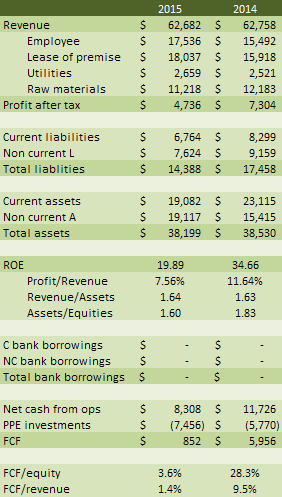
But what's impressive is their results. Since the finalised version of the prospectus is not up yet, I've to work on the preliminary one. Facts might change, but anyway, here's a summary of the key financials:


Here's a few key points:


1. Revenue had been rising, together with earnings after tax. This rise in earnings is not likely fueled by debts, as you can see from their Assets/Equities from 2012 to 2014. It seems to be driven by the greater profit margin of their business, which is always a good thing.


2. ROE at 23% to 26% is fantastic, especially so when they are not crazily leveraged. As a comparison, ROE of Oxley, the company that I recently covered while trying to decide whether their bond is a good buy or good bye here, shows an ROE of about 18% in 2015, but their assets/equities (a sort of financial leverage) is 6.81 times! Okay, granted, that's not fair since they are of different industries. Let's compare with other f&b establishments listed locally - Japan Food holdings and Soup restaurants.


Here's Japan Food holdings (figures in '000):


And here's Soup restaurant:


If we compare these 3 f&b places, we can see that the ROE of Jumbo is in a very good and envious situation. Jumbo's ROE is about 25% compared to Jap Food of about 20% and Soup restaurant of about 7%.


3. Great net profit margins. Their net profit margin varies from 8% to the more recent 12% in 2014. I think f&b business is kind of hard to have high profit margins, and Jumbo is doing a great job as a company (but ripping us off as consumers!). Their top 3 things in 2014 that reduces their net profit, besides tax, are raw materials and ingredients (43.3% of total cost), wages and salary (27.1%) and lease of premise (9%).

It's interesting when we compare with Jap Food holdings in 2015, because the top 3 cost are lease of premise (31,1% of total cost), wages and salary (28%) and raw materials (19.4%). So are Japanese food materials less expensive, seafood ingredient more expensive or somebody is serving us lousy ingredients? lol

Just for curiosity, the top 3 cost in 2014 for Soup restaurant are wages and salary (36.2% of total cost), raw materials and ingredients (23.9%) and lease (17.5%).


4. ROA or Revenue/Assets - this gives us how much profit they can generate from investing in their assets. It's not shown in the table, but Jumbo has consistent ROA throughout 2012 to 2014 ranging from 16% to 19.4% (in 2014). Very good, when compared with that of Jap Food, which is about 12 to 18% and Soup Restaurant of about 2 to 5%.


5. Jumbo do not have a lot of long term debts. Their total bank borrowings is about 4 to 7% of their total liabilities. One year of their net profit can cover their total bank borrowings 7 to 17 times over, so it's really not a concern. If you use their free cash flow (FCF), each year of operations can cover their total bank borrowings by 4 to 12 times. It's a very robust balance sheet that they have. Comparing with Jap Food holdings and soup restaurants, I'm quite surprised that F&B business do not have a lot of debts. Perhaps it's such a good cash business that they don't need debts to tide over their cash flow problems, if any.


6. Jumbo is generating free cash flow like crazy. I'm lazy, so I'm using FCF = Net operating cash flow - cash needed for PPE as a proxy. It's stable and consistent, can't ask for more.


It's hard to say if this is a good buy or good bye without knowing the ipo price. Since it's IPO - It's Probably Overpriced, but it'll be good to look at this again. What I like about Jumbo is that it's a cash business, not highly leveraged, great ROE, good net margins for a f&b business and best of all, fantastic free cash flow. What's not to like about it?


Perhaps the IPO price, lol

----------------------------------------
Latest update:

Many thanks to musicwhiz who told me that the IPO prospectus is now in Catalodge under SGX. Strange, I always thought that Opera is the place to find such prospectus. Anyway, with that finalised prospectus, things are a lot clearer.


They are listing it at an IPO price of $0.25


Here's some pro forma per share data:
NAV: $0.068
EPS: $0.027
PER: 9.3x
Dividend policy: No fixed policy. Intention to distribute not less than 30% of net profits in FY2016 and FY2017. 30% of EPS of 0.027 will be 0.81 cts, representing at least a 3% pa dividend if FY2015 earnings remain the same.


With an IPO price of 25cts, Jumbo is priced at 3.7 times of NAV. Let's compare the other two f&b enterprise listed here:


Jumbo NAV: 6.8 cts, IPO price: 25 cts (3.7x)
Japan Food holding: 2.5 to 2.8x NAV
Soup restaurant: 4.8x NAV

What about the PE ratio of Jumbo?

Jumbo EPS: 2.7 cts, IPO price: 25 cts (9.3x)
Japan Food holding: 15 to 22x
Soup restaurant: 4 to 6x


Looking at the ratios, the business of Jumbo seems more like Japan Food holdings than of Soup restaurant. If we go by that standard, then the PE ratio of Jumbo might ultimately trade around 15 to 22x, which means a price range of about 40.5 cts to 60 cts. I'm not looking at NAV because it's not really relevant in such a business.


They are putting out 2 million shares for public offer (for us) and 86.233 million shares for private placement. There's also 72.1 million shares (separate from private placement) taken by cornerstone investors (namely Orchid 1 Investments Pte Ltd by Heliconia capital management- 40 million shares, and Mr Ron Sim, CEO of Osim - 32.1 million shares). With only 2 million shares out for retail investors, this is going to be as hot and spicy as their signature chilly crab.


Verdict: Good buy, if you can get any. More likely you'll get insufficient number of shares to make it worth a stag after commission, haha!


Wednesday, October 28, 2015

Another pref shares bites the dust..

Just received word that the OCBC Bk 4.2% NCPS preference share is going to be fully redeemed. That is very bad news. As it is now, there's not a lot of preference shares by the banks listed in at SGX, and yet one by one those good ones are redeemed. There used to be UOB's preference shares too, but that is gone by the wind too. Now, there's just the preference shares by CityDev, Hyflux, another OCBC 5.1%, DBS 4.7%, Fibrechem and lastly United engineers.


OCBC is going to pay the last preferential dividend of $1.00 x 4.2% x 183/365 = $0.02106 per share and redeem back the preference shares at $1 par value. The trading price now is 1.020/1.025, so it's about right. If ever the price drops below 1.020, you should just buy it because you get net returns after getting paid your last dividends and losing out due to the capital loss from buying above par (excluding commission).


The redemption date is on 2nd Dec 2015 and the counter will go XD after 27 Nov, and will cease trading on 30th Nov and will be delisted on 22nd Dec 2015. Proceeds from the redemption of the preference shares at par value will be paid on 21st Dec 2015.


Personally I don't have any of this, but my parent's portfolio which I managed had a substantial chunk of this. Need to find a place to park their money after I get the proceeds from the redemption. So many low yield but high quality retail bonds out there, so I'm not afraid, haha

Tuesday, October 27, 2015

Oxley 5% bond - Good buy or Goodbye?

I realised that my bond articles are quite widely read. It was quite shocking to see that all my highest read post are bonds - Aspial, Perennial, Frasers, hyflux pref shares (kind of a bond) etc - all of them are up there in the highest number of pageviews throughout the entire history of nearly 10 yrs,  So let me say this in the clearest way possible. You don't just read what others write about bonds and then you decide whether you want to follow. Even if I decide to buy a certain bond, it doesn't mean that it's suitable for you. Even if it's suitable for you, it doesn't mean that you bought the right amount according to your portfolio allocation. Even if you bought the right amount to diversify in your allocation, it doesn't mean you have the holding power. So many unknowns. I'm writing for myself and for my own situation, so please do your own due diligence. At best, this is just a platform for discussing the virtues (or sins) of any particular investment and at worse, I'm just a idiot not knowing what I'm talking about. You should assume and learn towards the latter. I hold no more special knowledge than any of you.


Okay, that should be clear enough.


Oxley, mentioned that they are going to issue bonds of 5% pa for a duration of 4 yrs. The details are as follows:

Issuer and guarantor: Oxley MTN Pte. Ltd is the issuer and Oxley Holding Limited is the Guarantor.
Issue price and board lot: $1 par value, board lot size of 1000
Maturity date: 5th Nov 2019 (4 yrs from now)
Payment: Twice a year, 5th May and 5th Nov every year, from 5th May 2016 onwards until 5th Nov 2019
Credit rating: Unrated
Amount of bonds issued: $125 mil in total with $100 mil for public retail tranche and $25 for institutional investors. Option to increase up to $300 mil in total.

Application: Opens from 27th Oct 2015 9am to 3rd Nov 2015 12 noon. Min $2k and incremental of $1k thereafter

Expected timetable of key events:


The surety of a bond depends on the solvency of the underlying company, so let's take a look at Oxley.

Here's a few pointers:


1. This company has many many bonds, issued at various year and matured at different years ranging from 2015 to 2018. They have a total of $725 million fixed rates notes (i.e. bonds), all listed in the table below:


If you look at bond number 3 and 4 which expiring in 23rd Sept and 6th Nov 2015 respectively, the total amount is $135 + $90 = $225 million. Both are at a rate of 4.75% maturing for 2 yrs. Based on the overwhelming response from the most recent Aspial and Perennial bonds, it seems they are likely to increase the size of the offering. Perhaps the bond is to replace these 2 that are expiring at the end of this year.

Considering that they had been issuing bonds every year since 2013, I think they are also going to issue bonds next year, possibly at a higher rate than 5%, though not necessarily to retail investors. I think they are using a series of bonds/notes to fund their business.


2. The total liabilities to total asset had been dropping steadily since 2011. They are listed in 2010. The TL/TA ratio is shown below.

2012 - 0.90
2013 - 0.89
2014 - 0.86
2015 - 0.85


3. Having debts is okay if they can pay off the debts with their earnings. (The) Boring Investor posted an excellent article that inspired me to pick up my dusty copy of Security analysis again to review the fixed income investing section. Will do that during the holiday season to sharpen my skills. Till then, I'm referring to his clear and concise method of calculating earnings coverage ratio. Any error in calculating it is solely due to my sucky skills at reading financial statements.

Here goes the earnings coverage:

2012 - 8.21
2013 - 15.46
2014 - 12.17
2015 - 3.98

The aim is to be more than 3 times, and Oxley passed in all the years since listing. I would wish for a longer period of listing to see how they performed during the crisis years, but that's the data I have.


4. ROE


I'm not so concerned about ROE, more about the Asset/Equity ratio. You can see that this is really a business that is funded by debts. Dupont analysis of ROE shows us what drives the business forward. Assets/Equity is also known as a kind of financial leverage. As we can see from the total liabilities to assets in point 3, it is dropping, but it's still freaking high.


Conclusion: This is probably more risky (to the bookmakers) than Perennial, based on the yield and duration of the bond. Oxley offers 5% pa for 4 yrs, while Perennial is 4.75% pa for 3 yrs. Perennial don't have a long history to see their results, while Oxley has a history mired in debts and bonds. What's the chances of Oxley defaulting? I don't know, but I think they should be able to repay off their bond debts since it's not floating, so nothing really to do with interest rates. The only problem is whether their business can still do well if we're expecting higher interest rate environment, with the cost of borrowing money to buy property going to be higher, which invariably affects their bottom line.

Man, this is a hard one for me to decide. I'm sitting on the fence for the decision - I really don't know.

Monday, October 26, 2015

Sneak preview: Oxley 5% bond, 4 yrs maturity

The local retail bonds scene is bursting with action this year with so many choices for people to invest in. I think it must have something to do with the ssb savings bond or the impending rate hike. Suddenly everyone is rushing to build up their cash reserves before something happened. There's Frasers 7 years @ 3.65% in May this year, Aspial 5 years @ 5.25% around August, and Perennial 3 yrs @ 4.65% which haven't even finish completing their ipo bond exercise.


And now we have a new kid on the block, and that's Oxley holdings.


There's scant details of the bond, where news of it is just fresh out of the oven here. $100 million will be issued to the general public and $25 million will be for institutional investors, with DBS as the book runner for the bond. I'll blog more about it when details of the bond comes out. As it is, Oxley holdings holds several residential/industrial/commercial properties in Singapore (about 80% of which are freehold) and some in London, Cambodia and China.


Didn't look through the annual report much, but at the very least they are making money in 2013 and 2014. And they had been giving dividends since 2011 without fail - so that's always a good sign. Will have to do a more thorough check up later when they have more details of the bond.


This looks good for me because it fulfills the requirement of being at least 5% in order for my 1k per month passive income (again based on 240k capital) to work. It's good to have an instrument that you don't have to care about prices for the next 4 yrs. A small holding in this shouldn't go wrong.

Update as of 27th-Oct-2015: The new post on Oxley bond is here.

Tuesday, October 13, 2015

Perennial Real Estate 4.65% bond - Good buy or Goodbye?

Perennial Real Estate Holdings is launching their first retail bond. It's a 3 year bond paying 4.65% pa, payable semi-annually and with a min amount of $2k. Is it good buy or good bye?


Beautiful name, this perennial word. Perennial means lasting or existing for a long or apparently infinite time; enduring or continually recurring. Unfortunately, the word perennial for this company refers to the hope that it'll last forever and not a fact of its actual existence. How so?


I went to SGX website to take a look at the issuing company's financial statements, and realised that there's only 2 yrs worth of it. It's essentially one year if you exclude FY2014, because the figures between the FY2014 and FY2015 doesn't make sense. From their circulars, I read that last year in 2014, they went through sooo many corporate changes that I was not even sure I'm reading it correctly. Perennial Real Estate Holdings originally came from St. James Holdings Limited, and they are going to dispose all their existing business to Citybar Holding Pte Ltd, consolidate their shares to the tune of every 50 to 1, offer of Perennial China Retail Trust by exchanging their shares (don't ask me the details), transfer their catalist listing to main board and many other proposals, and thereafter change their name to the present Perennial Real Estate Holdings Limited.

Yeah, this St. James powerstation

It is this Perennial Real estate holdings that is issuing the 3 yr bond of 4.65% pa. So this company is one of the many shape shifter company that changed name and business until nobody really knows who they came from and where. As such, they really only have 1 year of financial statements to look at. Nothing really to see, so this is going to be short.


A few key points:

1. Their total assets consists mainly of China (70%) and Singapore (27%). Their Singapore assets consists of CHIJMES, TripleOne Sommerset, Capitol Singapore, House of Tan Yeck Nee, AXA Tower, Chinatown point and 112 Katong. I don't know how well their business is in China, but I don't really like their properties in Singapore. They are really no where near the quality of Capitaland and Frasers.

2. How well a bond does depends on how well the issuer company do, especially over the duration of the bond. I have no idea how they are doing, given the short history of their 'new' company and hence have no idea how well the bond will be doing. I don't even know how well their management is going to be like.

3. Sponsors come from Mr Kuok (CEO of Wilmar), Mr Ron Sim (CEO of OSIM), Wilmar International Ltd and Mr Pua (CEO of this group). Not exactly comforting or reassuring to me.


That's it.


The good thing about this bond is that it has a short duration, hence it won't be so affected by the impending interest rate hike. Anyway, if the company lasts that long and you hold the bond for the full duration, it'll be capital guaranteed. The recent Aspial, 5.25% pa, 5 yr bond is trading at $1.017 now, up from $1.000 par value and I'm quite sure this will be something like that too. Frankly, looking for a high yield bond coupled with the inherent risk that comes with it by sacrificing safety seems silly to me. Don't forget, there's always the 'risk-free' SSB with possibly 3% pa (it's now 2.78% pa on average) if you hold for 10 yrs. So is it a good buy or good bye for me?


It's a good bye for me. Thanks but no thanks.


Wednesday, October 07, 2015

Frugality isn't just about saving money

Frugality isn't just about saving money.


This article here says exactly what I'm thinking. To me, frugality is about being efficient, which means you spend the right amount of energy, time and money without wastage. And efficiency varies according to the different life stage that you're in.


For example, when I was a student with very little pocket money to spare, I'll go all the way to some cheap bargain sales at Peninsula Plaza to buy a pair of track shoes. There are many shops there that are in close proximity to each other, and you can bargain there, so it'll be easier to find something good and really affordable. But the downside is that to save that $20-$30 bucks, you might have to spend 1 to 3 hrs there. While I would certainly do that in the past, I wouldn't care to do it now. What had changed? My time became more precious, so spending 1 to 3 hrs to save $20 to $30 bucks is not what I would do now but is something I would gladly do in the past.


Efficiency can be seen as a percentage also. If I have $200 in my bank account, saving $20 is a big deal to me because that's easily 10% of my networth. If I have $200,000 in my bank account, saving $20 is just a drop of my networth - a mere 0.01%. No way am I going great length to save 0.01% of my networth, especially if it takes up a lot of my time. This can be easily applied to our free time too. During my student phase, there's school holidays, so I'm practically free for 15 hours per day, every day, for 1 month (not much homework in the past). That's a freaking 450 hours of free time. If I have to queue for 5 hours for a freebie, why not? It's just about 1% of my free time. However, when I'm working, and I only have 24 hours of weekend time free, spending 5 hours will take up a proportionally bigger 20% of my time. As a full time tutor, especially now during the exam season, I really only have about 8 hours of free time per week. Spending 5 hours to queue up? No freaking way. I'll rather spend the money and use the time to sleep.


So, time is money. When we're young, our time is cheap and we don't have a lot of money. Hence, we spend time to save money. When we're older, (hopefully) our time becomes more costly, and we have a lot of money. Therefore, we spend money to save time.


But habits can be hard to correct. Imagine a big part of your life you've been trying to spend time to save money. The cost of your time might have increased tremendously but you're still stuck to the habit of using time to save money. That would not be wise and efficient, because while you're a good saver of money, you're not a good saver of time.

Monday, October 05, 2015

For the Advanced Croesus Rights players

Alright, now that you've read the basics here, you can progress to more advanced stuff.


Nicholas Nasim Taleb (NNT) is my favourite modern philosopher and it's a good thing that he dabbles in the market too. His concept about antifragility - to make it out better when crisis strikes and not merely to survive it - is enlightening. So with regards to the rights exercise of Croesus Retail trust, how do we best capitalise on this?


First, you need to know the Theoretical Ex-Rights Price (TERP), which is the theoretical price of the stock after all the rights exercise. Since the price of the Croesus is about 80 cts (plus minus 1 ct), let's just say it's 0.80. The rights exericse states that you'll get 22 rights shares for every 100 mother shares @ 61 cts each. Hence the TERP = (0.80*100 + 0.61*22) / (100 + 22) = $0.766. Bear in mind that this is all theoretical and the TERP will vary according to which starting price (I picked 80 cts) you choose. I like to choose the price when the counter goes XR, but there's really no reason why you couldn't choose others.


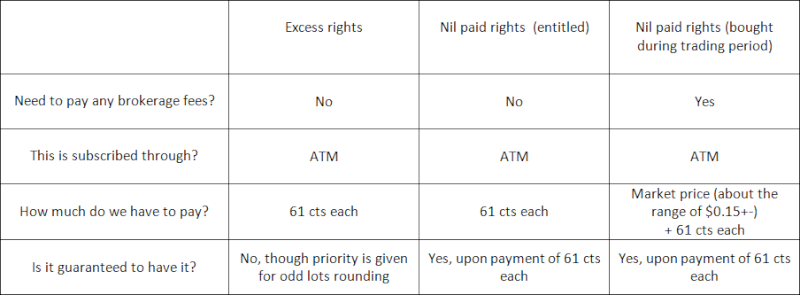
Why is it important to know the TERP? To maximise your benefits from the rights exercise, you need to get as low a price for the shares as possible. This usually means you want to get as many rights shares at 61 cts as you can possibly get in order to get an average price per share below the TERP if possible. And there are 3 ways to do so:


1. Get as many mother shares before XR as you get. The more mother shares you have, the more entitled rights shares you will get, based on the ratio of 22:100. This is a lousy way to do so because it will give you proportionally the number of right shares, not more and not less. Anyway, Croesus went XR last Fri, so this option is not available anymore.


Scenario 1: I have 1000 shares which I bought at 87 cts, so I'm entitled to 220 rights @ 61 cts each. I'm a casual rights participant, and I just want to get it over and done with. Before 23rd Oct, I go to the ATM and pay $134.20. I will now have 1000 + 220 = 1,220 shares. 

My average price is : (1000 * 0.87 + 220 * 0.61)/1220 = $0.823 per share


2. Buy more nil paid rights during the nil-paid rights trading period. During the nil paid rights from 9th Oct to 19th Oct 2015, you can buy or sell the rights that you are entitled to. If you have 100 mother shares, you will have 22 entitled rights that have not been subscribed or paid for yet. Some investors, for whatever reasons, might choose to subscribe partially or not at all. So this period is important for these people to sell. Otherwise, if you don't subscribe by the closing date (23rd Oct 930pm by ATM), the nil paid rights will be rendered worthless.


This is so important, so let me repeat. If you do not wish to subscribe for your entitled rights (in our example, the 22 nil paid rights), you need to sell it between 9th Oct to 19th Oct. If you don't sell it, you'll just lose money that you're entitled to. You also need to pay brokerage like the trading of normal shares.


Now here comes the interesting part. You can choose to buy more nil-paid rights during the trading period also. If the TERP we calculate initially is $0.766 and the rights shares are priced at $0.61, then the nil paid rights should also trade at $0.156 (0.766 - 0.61 = 0.156). The equation is this:


Price of nil-paid rights + 0.61 = TERP


Now, the theoretical price of nil paid rights is $0.156, but the market price varies according to sentiments. If the price of the nil paid rights on the market is trading at less than 0.156, then it represents a good buy. If the price of the nil paid rights is trading at more than 0.156, then it represents a good chance to sell off any that you don't wish to subscribe. But remember, in total, your total nil paid rights = (entitled nil paid rights + nil paid rights bought during trading period). You need to subscribe by paying for both before 23rd Oct.


Scenario 2: I have 1000 shares which I bought at 87 cts, so I'm entitled to 220 rights @ 61 cts each. During the nil paid trading rights period, I saw that the nil paid rights are trading at $0.150, which represent a good value. I proceed to buy 200 shares at $0.150. Before 23rd Oct, I subscribe by ATM for all the entitled rights (220 shares) and nil-paid rights that I bought (200 shares), paying a total of $195.2 (420 x 0.61 = 195.2).

My average price is : (1000 * 0.87 + 200 * 0.150 + 420 * 0.61)/1420 = $0.814 per share (does not include cost of brokerage incurred when buying 200 shares @ $0.15)


3. Apply for excess rights shares. There will be people who do not want to subscribe to it and people who wants more of the rights units because it's cheaper than the mother shares. You can apply for more than the amount of shares allocated to you. For example, if you have 1000 shares and you are entitled to 220 rights, you can go ahead and apply for 500 rights shares. During the subscription period before 23rd Oct, you need to pay 500 x $0.61 = $305 first. The 380 shares that you are not entitled for but nevertheless applied for is called the excess rights.


But subscribing more doesn't mean that you will get all. Priority is given to those who wants to round off their odd lots. Since the board lot size is reduced from 1000 shares to 100 shares, there is less rounding to do. Those excess rights shares that you applied and paid for without success will be refunded to you automatically to the bank account that your ATM is tied to.


For hot counters (possibly this one), there's really no point subscribing for more than the amount of lots that you have. If you have 10 lots initially, you will likely not get more than 10 lots of excess. My rule of thumb is just to put in twice the amount of money that you are entitled to. If you have 1000 shares, you're entitled to 220 shares and you have to pay $134.20. Just apply 440 shares (220 allocated and 220 excess), paying $268.40 will be more than sufficient to 'tikam'.


Scenario 3: I have 1000 shares which I bought at 87 cts, so I'm entitled to 220 rights @ 61 cts each. I want to apply for excess rights and I hate odd lots, so I applied for 80 more excess rights through the ATM @ 61 cts each and paid $134.20 (for the entitled 220 shares) + $48.80 (for the excess 80 shares to round up a lot of 100 shares), giving a total of $183. Assuming I got all the excess 80 shares that I applied for, I effectively have 300 shares @ 61 cts each (220 + 80 = 300).

My average price is : (1000 * 0.87 + 300 * 0.61)/1300 = $0.810 per share


4. If you don't have any mother shares of Croesus, rights exercise present an excellent opportunity to enter before XR. Since the counter went XR last Fri, this option is no longer available, but for educational sake, let's just run it through.


You generally want to buy enough mother shares before XR so that you have the number of excess rights furthest away from one round lot of 100 shares. The table below shows some of the 'correct' number of mother shares you need in order to maximise the number of excess rights needed for rounding. Since priority is given to people who need to round off their odd lots, it's wise to maximise the number of excess rights needed for rounding, so that you will have the greatest probability to get them at a cheap price of 61 cts each.


As a counter example, If I have 4500 mother shares before XR, I'll be entitled to 990 rights. To round it to one full lot, I just need 10 shares, so that's not really good. 98 is the highest ever you are going to get based on the 22:100 ratio. For those mathematically inclined, the number of mother shares to own before XR to maximise shares for rounding is (5000n - 900), where n are the positive integers beginning with 1.


Again, this option is no longer available since Croesus went XR last Fri, so don't do it. With the board lot size changed from 1000 shares to 100 shares, this is getting less significant too.


Scenario 4: I've heard of Croesus but have zero shares now. I'm excited because Wong Fei Hong also have it. I want to maximise the number of excess rights that I have. Since greater priority is given to people who applies for excess rights to round their odd shares, I want to buy mother share now before XR so that I can have the maximum number of excess rights. Hence, I want to buy 4,100 mother shares so that my entitled rights is 902 shares. This will ensure that the chances of me getting 98 excess rights @ 61 cts is given the highest priority.

Before XR, I bought 4,100 shares at $0.81. I'll then be entitled to 902 nil paid rights. Before 23rd Oct, I go and pay up $550.22 for my 902 entitled rights and also subscribe for another 98 excess rights for $59.78, paying a total of $610.

My average price is: (4100 * 0.81 + 1000 * 0.61)/5100 = $0.770 per share (does not include cost of brokerage incurred when buying 4,100 shares @ $0.81)


In summary, regardless of which options or combinations, it's important to remember the following basic rights information:


1. Nil paid rights entitled to you need to be subscribed by paying 61 cts before 23rd Oct. As for the nil paid rights bought during the nil paid right trading period between 9th and 19th Oct, you will need to pay brokerage fees AND also to pay 61 cts before 23rd Oct. Failing which, it will be worthless after 23rd Oct. In fact, any nil paid rights not subscribed will be worthless.


2. If you don't want to subscribe or choose to subscribe partially, you need to sell off your entitled rights during the trading period from 9th to 19th Oct. Failing which, it will be worthless after 23rd Oct.


3. Any transactions using brokerage platform need to pay brokerage fees. Any transactions using ATM need only to pay a service fee of $2, if I recall correctly. Hence, there's brokerage fees to be paid for nil paid rights bought or sold during the trading period and there's no brokerage fees needed to be paid for application of excess rights because it's done over the ATM.


4. The difference between excess rights, nil paid rights entitled to you and nil paid rights bought during trading period is this: